Quantifying wind & solar intermittency

Averaging wind and solar output volumes reveals some structural patterns.  Wind output tends to be higher during the day time than at night and has a seasonal profile. Solar output is also seasonal with a strong linkage to daylight hours.

But analysing power markets based on average conditions, understates the true impact of system intermittency on market prices. Around these averages sits a wide and growing distribution of wind & solar output uncertainty.

This uncertainty needs to be captured in order to understand power asset value & quantify value capture. In this article we look at:

  1. The impact of wind & solar intermittency on power market supply stacks and
  2. How to quantify volume distributions of wind & solar output swings.

How intermittency impacts the supply stack & prices

Power price uncertainty has traditionally been driven by swings in demand and fuel prices.  While these factors remain an important influence, they are set to be overtaken by swings in wind & solar output.

Chart 1 illustrates how these forces combine to drive price:

  1. For a given time of the day (e.g. 20:00)…
  2. System demand is determined by factors such as weather…
  3. The positioning of the supply stack to meet that demand depends on prevailing wind & solar output…
  4. The marginal unit required to meet demand drives system price.

Chart 1: Power price formation in 4 boxes

Source: Timera Energy

As wind and solar capacity grows, so to do the swings in the supply stack (right & left) as output continuously expands and contracts.  These swings in the supply stack (in combination with load swings), act to drive power price volatility.

Quantifying wind & solar swing: UK case study

While Chart 1 helps conceptualise the impact of wind & solar swings, it does not help quantify how large these swings may be. We address this in Charts 2 & 3, using the UK power market as a case study.

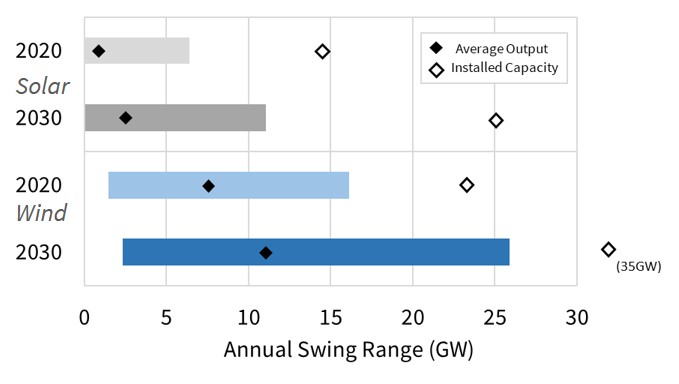
Chart 2 illustrates the estimated annual swing range distribution for solar & wind across all half hours of the year in 2020 versus 2030:

  • The shaded bars show the 5th – 95th percentile annual output ranges (across all half hours)
  • The black diamonds show average annual output (across all half hours)
  • The white diamonds show assumed total installed capacity

Chart 2: Estimated annual swing ranges for UK wind & solar

Source: Timera Energy

For example, Chart 2 shows that by 2030, wind output may range across the year from as low as 2GW (5th percentile) to 26GW (95th percentile). These ranges are useful in understanding how intermittent supply can vary across a medium term horizon.  But it is the intraday swings of wind & solar that are key drivers of short term price dynamics (e.g. volatility) and the value of flexible power assets (e.g. gas-fired plants, storage and DSR).

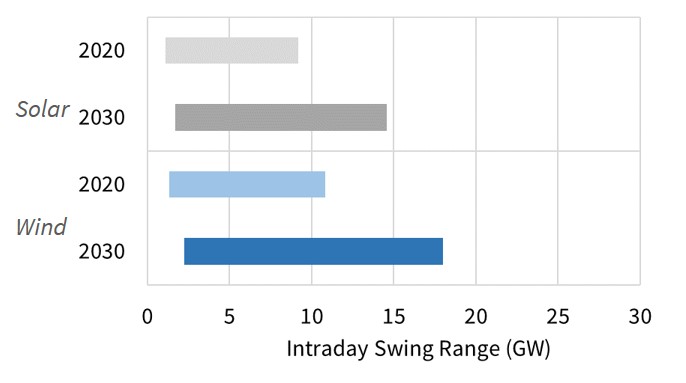
Chart 3 illustrates the 5th – 95th percentile intraday swing ranges for wind and solar output. Stepping down the time window from a year to a day (i.e. Chart 2 to Chart 3), does not actually reduce the swing ranges by that much. For example the estimated 2030 intraday wind output range is 2GW (5th percentile) to 18GW (95th percentile).

Chart 3: Estimated intraday swing ranges for UK wind & solar

Source: Timera Energy

These large and growing gyrations in power market supply stacks are underpinning the formation of market prices.  Capturing the associated uncertainty should be ‘front and center’ in any analysis of asset value and how that value can realistically be captured.


Russian capacity to get gas into Europe

As winter approaches the European gas market is looking east.  A tight market increases the importance of Russian flows to maintain orderly hub prices and security of supply.

Gazprom has ample production capacity to ramp up exports to Europe, supported by 80+ bcma of ‘shut in’ gas in Western Siberia.  But there are some key pipeline capacity constraints that impact the flow of Russian gas into the interconnected European hub network.

There are two key types of potential capacity constraints:

  1. Daily deliverability: the ability to flow gas into Europe on a given day
  2. Annual flow: the ability to flow a higher volume of Russian gas into Europe across a year

Daily deliverability will be a key factor impacting the gas market across the next two winters. From 2020, the commissioning of new pipelines should ease deliverability issues shifting the focus to growth in annual Russian import volumes.

In this article we put some numbers around how much capacity headroom exists against both daily and annual constraints. We also look at the impact of new pipelines in alleviating these constraints.

Short term flow constraints

There are 3 ‘trunk’ routes for Russian gas into the European hub network:

  1. Nordstream: Gazprom’s newest and favoured export route via the Baltic
  2. Yamal: an alternative ‘northern’ route via Belarus
  3. Ukraine: the politically sensitive flow route via Ukraine & Slovakia

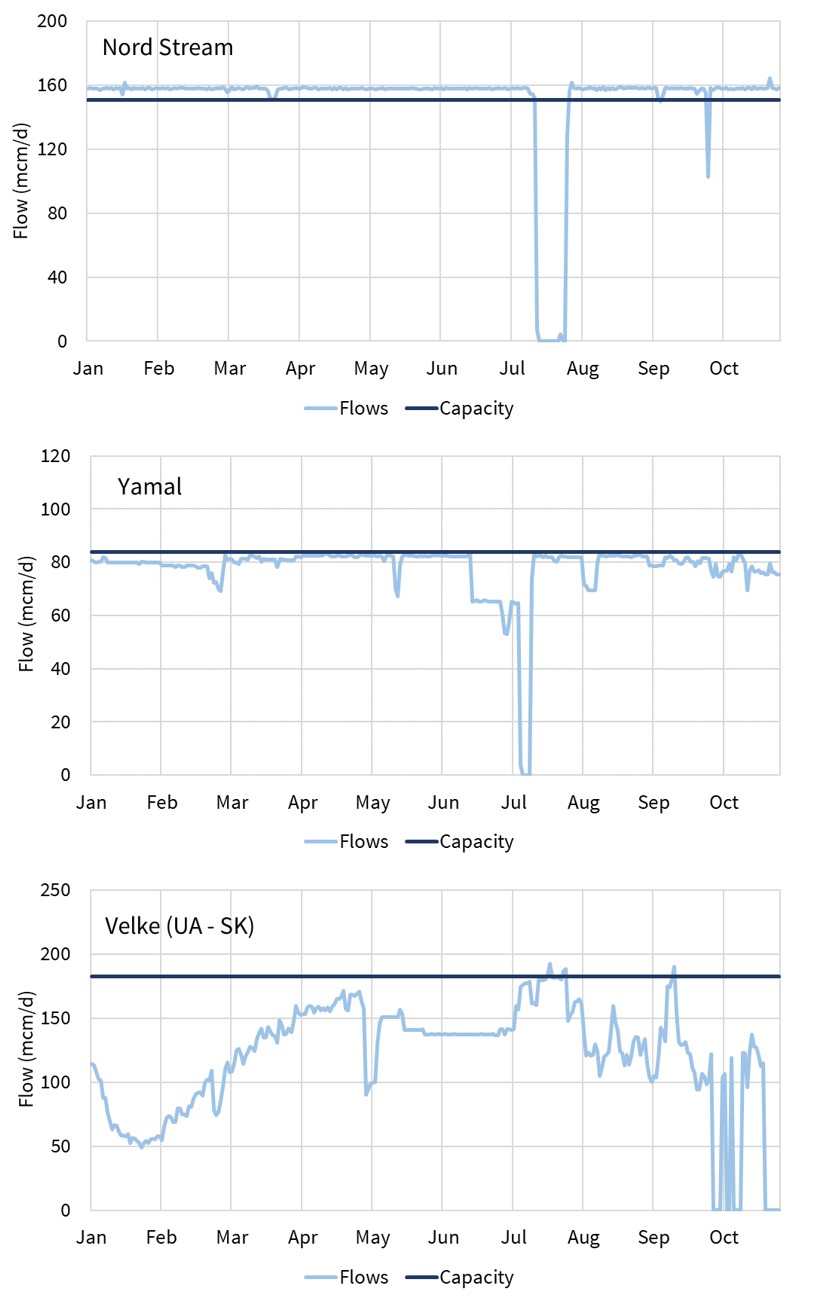
Chart 1 shows the evolution of daily flows across 2018, for the key European border entry points associated with these routes.

Chart 1 daily deliverability at key border points into Europe

Source: Timera Energy, ENTSOG (note Nordstream has been achieving flow rates above nominal capacity).

The simple conclusion here is that Nordstream and Yamal have been flowing at or very near to maximum capacity across 2018.  That means there is very little incremental capacity to provide either daily deliverability or annual flow volume upside.

As a result, import flexibility is now focused on Gazprom’s less favoured Ukrainian flow route.  This route has also hit daily flow constraints a few times across summer 2018. However there is at least 10 bcma of annual flow upside.

Daily deliverability is the key issue this winter.  It is not hard to construct a set of circumstances where deliverability of Russian gas into European hubs is constrained across a number of days (or potentially weeks) e.g. due to a cold weather pattern or supply outage.

At the point that Russian capacity becomes constrained, Europe would likely require a TTF price response that induced:

  1. Switching in the power sector to reduce CCGT load factors and hence gas demand, and/or
  2. Diversion of LNG supply from Asia (i.e. competing for marginal cargoes)

Both these mechanisms are relatively unresponsive to price (i.e. supply is inelastic in the short term). And if this situation arises it may result in major hub price shocks and volatility (reference the ‘beast from the east’ shock in Mar/Apr).

Medium term flow upside

Capacity is likely to remain tight for the next two winters.  But work is underway to alleviate the flow constraints for Russian gas into Europe.

The TAP pipeline from Greece to Italy, the final link of the new Southern Corridor route into Europe, is due be commissioned in early 2020.  TAP in theory opens up another 10 bcma of flows that could displace gas flowing south into Italy via TAG (from Baumgarten) and Transitgas (from TTF/NCG/PEG). But contractual positioning is likely to mean only some of this will actually occur.

The real game changer is Nordstream 2.  And it is precisely this reason that this project will almost certainly go ahead.  Europe may not like increasing its dependence on Russian gas, but Nordstream 2 is effectively a free option on security of supply.  String 1 (27.5 bcma) is likely to come online in early 2021, with String 2 (same volume) online in early 2022.

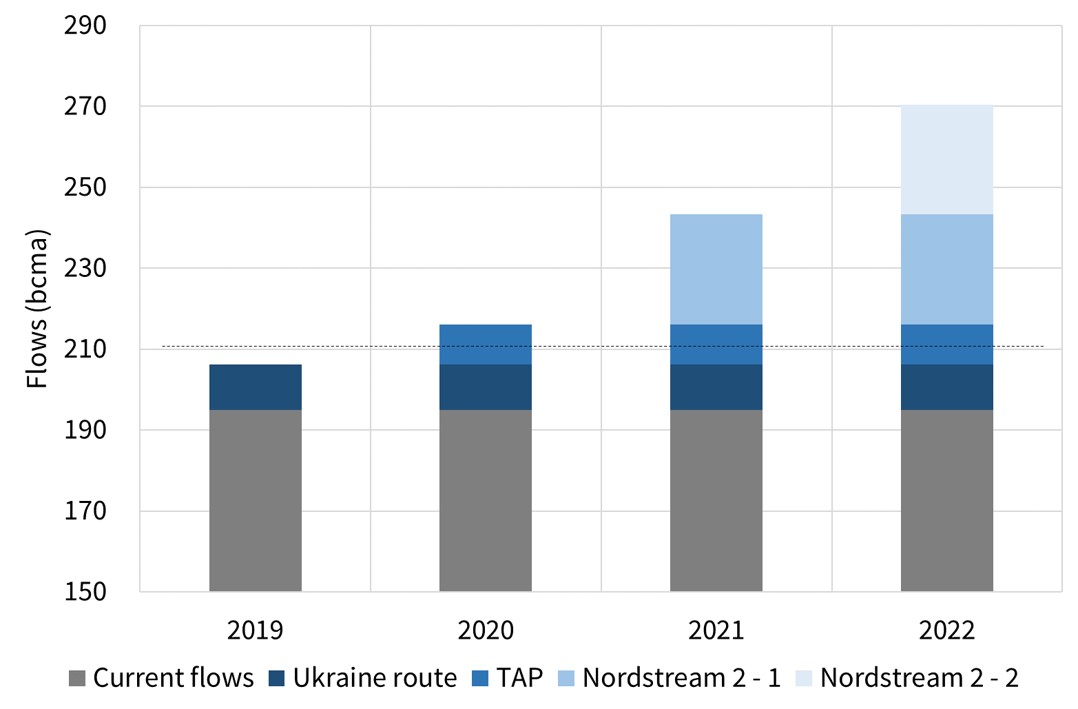
Chart 2 shows current annual capacity headroom based on a comparison of projected 2018 flows versus available capacity across the 3 existing routes. The chart also illustrates the potential impact of the TAP and Nordstream 2 pipelines in raising capacity headroom.

Chart 2 Existing and projected annual capacity headroom for key Russian routes

Source: Timera Energy

It is important to note that not all of the annual capacity headroom in the chart is necessarily accessible. Flows on certain pipes may vary across seasons (e.g. be constrained in winter but not in summer) which can reduce annual flow potential.  There are also contractual & logistical constraints that can impact full utilisation of available capacity (e.g. as described for TAP above).

Tight capacity headroom on marginal sources of supply is a catalyst for price volatility.  So watch out for potential fireworks across the next two winters (18/19 in particular).

From 2021 capacity constraints are likely to ease rapidly with Nordstream 2.  That potentially opens the door for significant growth in Russian imports up towards 250 bcma.

Power plant optionality & dispatch cost hurdles

The transition taking place in European power markets is reshaping supply stacks. Retiring coal, CCGT & nuclear plants are being replaced with a combination of:

  • Renewables: zero/low variable cost capacity, dominated by wind and solar
  • Peaking flex: higher variable cost capacity, dominated by gas engines, batteries and DSR.

This structural shift in capacity mix is taking place across all of Europe’s power markets, albeit at varying speeds.  It has two key impacts on supply stack dynamics that can be summarised as follows:

  1. Steepening: supply stacks are pivoting steeper as a result of removing coal/CCGTs (middle of the stack) and replacing with low variable cost renewables (bottom of the stack) & high variable cost peaking flex (top of the stack).
  2. Shifting: growth in intermittency is causing growing fluctuations in supply stacks (shifting left and right) as wind & sun conditions constantly change.

Both these factors support a structural increase in intraday price shape and in price volatility. Steepening causes a greater price impact for a given change in demand.  Shifting causes greater fluctuations in the marginal capacity units setting price.

Rising price shape and volatility increases the flexibility value or optionality of power plants.  In this article we consider how power plant optionality behaves in relation to variable dispatch costs across different capacity types (renewables, conventional thermal and peaking capacity).

The ‘in the moneyness’ of options drives value capture

The optionality of power plants is derived from their flexibility to ramp output up and down.  They are essentially granular strips of call options on the spread between market power prices and plant variable costs.

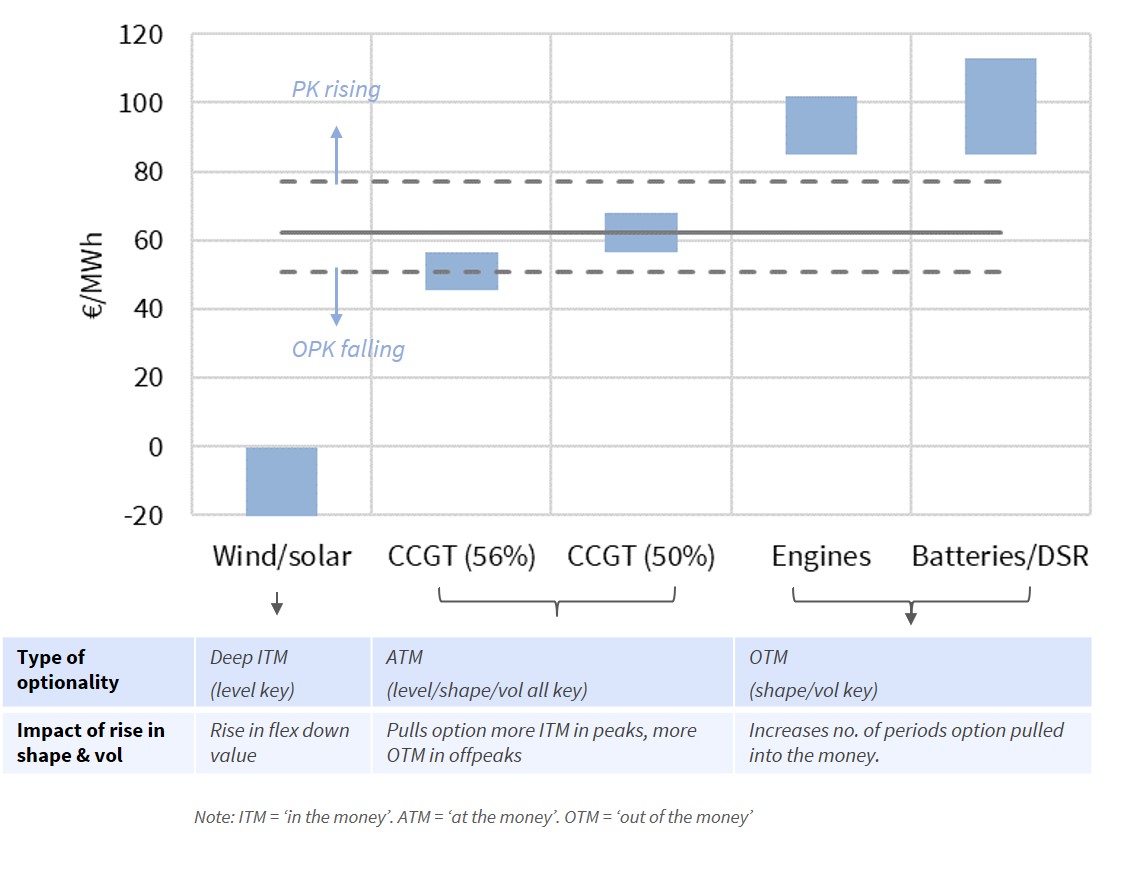
We illustrate this relationship in Chart 1 which illustrates the variable cost dispatch hurdles (effectively the varying option strikes) for different capacity types.

Chart 1: Variable cost dispatch hurdles vs market prices


Source: Timera Energy. Note battery dispatch hurdle is more complex than for thermal assets as described below.

Renewables

The optionality of renewable capacity (such as wind and solar) is deep ‘in the money’ (ITM) given near zero (or even negative) variable dispatch costs.  In wholesale market terms, the deep ITM nature of renewables means their value is focused on the level of power prices, with a low value attributed to flexibility to respond to price shape and volatility.

The ‘price cannibalisation’ problem is particularly important for wind and solar capacity.  There is a strong correlation of high renewable output with weaker prices e.g. when the wind blows the price received by wind capacity falls.

Renewable flexibility is being used to provide balancing services in some markets, typically from ramping down when networks can’t cope with high wind load.  But revenues form a relatively small portion of overall margin.

Conventional thermal

The variable dispatch cost hurdles of CCGTs and coal units vary with plant efficiency and location.  But the optionality of these assets is typically closer to ‘at the money’ (ATM).  In other words, variable dispatch costs are close to the level of market power prices. This is reflected in the relatively tight nature of clean spark and dark spreads relative to power prices, particularly with rising renewable output pulling down power prices and thermal load factors.

Flexible ramping to capture price shape is becoming increasingly important for these units, as renewable output pulls down average price, spark/dark spread levels and load factors.  A similar logic applies for capture of price volatility e.g. caused by short term fluctuations in wind speed, solar patterns and demand.  In option terms, the extrinsic value of conventional thermal assets is rising as average prices and load factors decline.

Peaking flex

This group consists of a number of different capacity types across gas engines (of various efficiencies), GTs, batteries and demand side response (DSR).  On a variable cost basis these units are typically ‘out of the money’ (OTM) versus hedgeable market prices.  In other words unit variable dispatch costs are above even peak prices, as illustrated in Chart 1.

Batteries are a unique and more complex case that we have set out in more detail in a recent article. Battery dispatch is based on relative not absolute price signals (e.g. the time spread between individual hours). The dispatch cost hurdle depends on degradation costs & assumed offpeak charging levels. Dispatch may also reflect ‘shadow pricing’ of battery discharge against other peaking asset variable costs.

The characteristic that all different types of peaking flex have in common is their exposure to spot price volatility. The OTM nature of optionality means that value is realised by ramping to capture price jumps (and price dips in the case of batteries).

Why optionality is increasingly important

The portion of power plant value generated by ramping flexibility is rising, as renewable penetration pulls down average prices. The importance of plant optionality is set to continue to rise as stack steepening and shifting dynamics support price shape and volatility.

Investors and owners are confronting a key challenge in being able to quantify and capture the value of optionality of different types of capacity.  The starting point is to properly deconstruct asset optionality and analyse the interaction between variable dispatch cost hurdles and market prices.

3 key factors driving European hub prices

European hub prices have roughly doubled since Summer 2017 from 5 to 10 $/mmbtu (15 to 30 €/MWh).  Half of this price move has happened in a surge between Jul and Sep 2018.  Hub prices are sending a clear signal that the European gas market is tightening fast.

Three key factors are driving current hub price behaviour:

  1. LNG flows: Asia is pulling LNG supply away from Europe, given continuing strong demand.
  2. Power switching: Rising coal and carbon prices are dragging up gas for coal switching levels in European power markets.
  3. Russian flows: There are currently constraints impacting the incremental flow of Russian gas into European hubs. We address these in more detail today.

These 3 drivers have been behind the surge in hub prices across the summer.  Next comes winter, with an increased risk of demand shocks (e.g. cold weather) and supply shocks (e.g. infrastructure outages).  The European gas market looks to be heading into its tightest winter this decade.

In this article we set out how these drivers are interacting to set hub prices at the margin.  We also provide a framework with which to understand what could happen this winter, and the drivers of hub prices beyond.

How supply & demand are interacting to clear European hubs

The European gas market evolves around a network of interconnected hubs.  The Dutch TTF sits at the centre of this hub network and is the key pricing benchmark.  Prices across hubs are structurally converged on a forward basis.  Price differentials between TTF and other hubs reflect variable transport costs, except during times of temporary constraints.

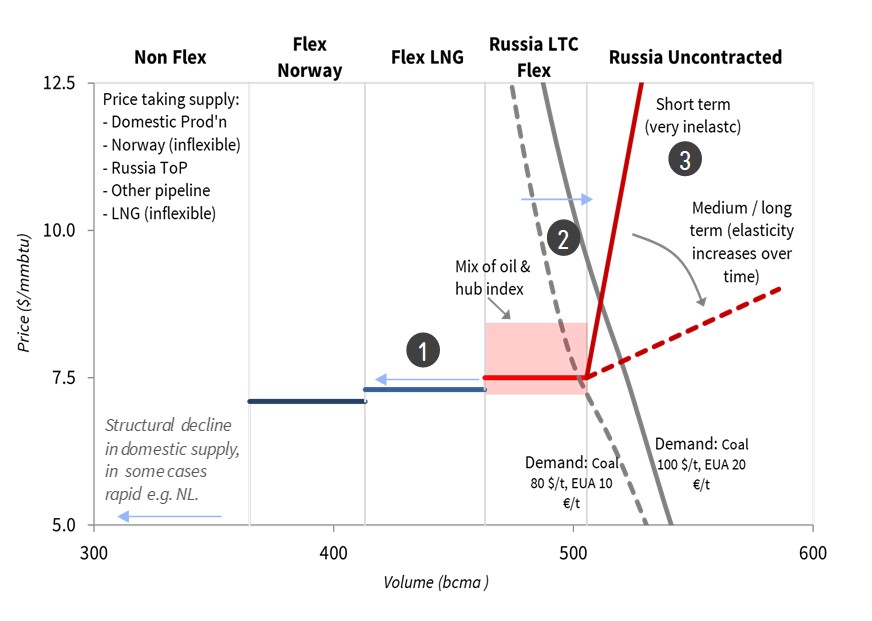
The interconnected nature of European hubs means that it is useful to take a step back when analysing price dynamics and consider the European gas market at an aggregate level.  Chart 1 shows a simplified view of the pan-European supply & demand balance for 2019.

Chart 1: European gas market supply & demand balance


Source: Timera Energy

We have purposefully simplified the annual supply & demand balance view in Chart 1.  Behind this lies a detailed country level build up of supply & demand in our European gas market model (which is linked to our global LNG market model & pan-European power market model).  There are also a number of more complex considerations at the sub-annual level e.g. storage balances and seasonal production flows.  But the advantage of this simplified aggregate annual view is that it allows a cleaner illustration of the ‘macro’ forces driving hub pricing.

Supply

The chart shows sources of European gas supply grouped into several key tranches:

  1. Non flexible price taking supply: consisting of (i) domestic production e.g. UK, NL, NO (very low variable cost) (ii) pipeline contract ‘take or pay’ volumes (ii) inflexible LNG contract volumes. These ‘price taker’ volumes flow regardless of hub price levels.
  2. Flexible Norwegian volumes: consisting of Norwegian production flexibility and flexible hub indexed contract volumes. These volumes are also effectively ‘price taking’ given Norway produces to an annual production target, but they are shown at a slight discount to current hub prices to reflect the fact that flows are seasonally profiled & optimised against hub prices.
  3. Flexible LNG volumes: made up of divertible European LNG supply contract volumes and LNG spot cargoes surplus to the requirement of other regions. Volume and flow depends on netback LNG spot price differentials relative to European hub prices.
  4. Flexible LTCs: Long term contract swing volumes above ‘take or pay’ levels, predominantly sourced from Russia (historically oil indexed but with rapid shift to TTF indexation), but also smaller volumes from other sources (e.g. North Africa).
  5. Uncontracted Russian flex: gas volumes that Gazprom can choose to flow into European hubs, or sell on shorter term basis (e.g. Q4 2018 auctions), given 80+ bcma of ‘shut in’ low variable cost production in Western Siberia.

A sharp reduction in Dutch production (Groningen earthquakes) and the impact of Asia pulling LNG away from Europe has shifted the European supply curve to the left in 2018, tightening the market.  This has been exacerbated by a shift of the demand curve to the right as coal & carbon prices have risen.

Demand

Gas demand from the industrial, commercial and residential sectors is relatively unresponsive to price in the shorter term.  In contrast, liquid power markets across Western Europe mean that gas demand from the power sector responds directly to gas market price signals.

The downward slope of the demand curve in Chart 1 reflects the potential for coal plant generation to ‘switch’ to gas plant generation across Europe as gas prices fall. Increases in coal & carbon prices shift the demand curve to the right (as shown in the chart). This is because for a given level of TTF, there is higher aggregate gas burn across Europe as the variable cost of coal plants increases.

The European gas demand curve has seen a major shift to the right since 2016.  In 2016 & 2017 this was driven by an increase in coal prices (from 40 – 100 $/t), in addition to reduced French nuclear output & low Spanish hydro availability.  The shift in 2018 has predominantly related to carbon (with a more than 250% increase in carbon prices across the summer to above 20 €/t).

The surge in hub prices since Jul 2018 is at the simplest level a function of the European gas demand curve being driven up a steep short term supply curve.  What happens to hub prices across this winter and beyond, strongly depends on the responsiveness of Russian supply.

The importance of Russia

The current tightness of the European gas market focuses attention on Gazprom as supplier of the ‘marginal molecule’ into European hubs. It is Russian gas flow dynamics that determine the slope of the key last tranche of the supply curve intersecting with demand in Chart 1.

Gazprom has been ramping up its sale of incremental short term volumes in response to the Q3 hub price surge. At least 1.5 bcm of additional supply has been flagged for sale via auction in Q4. Gazprom has not indicated a cap on these auction volumes, so this number is likely to grow, particularly if TTF prices remain strong.

The Russian flow response to higher hub prices is impacted by a mix of strategic, commercial and logistical factors.

In the medium to long term (i.e. beyond 2019), it is not in Gazprom’s strategic interest to have TTF price levels at current levels around 10 $/mmbtu.  Price levels above the Long Run Marginal Cost of new LNG supply (~ 8 $/mmbtu) are likely to encourage FID of new liquefaction capacity.  Once new LNG projects are committed, they compete with Russia for market share.

However, in the short term (i.e. next few months) Gazprom has other commercial & logistical considerations in play. Two of the three main routes for Russian gas into Europe have hit maximum flow constraints across 2018 (Nordstream and Yamal). The third route via Ukraine is the focus of the Q4 Gazprom auction volumes and has some spare capacity (although it temporarily experienced daily flow constraints over the summer). But flows via this route are impacted by complex geopolitics between Russia, Ukraine and the EU.

Then there is Nordstream 2. The next 3 months are critical for EU approval of this 55 bcma new pipeline that can help grow Russian market share in the 2020s. In that context, capacity constraints and high hub prices are a convenient backdrop for Russia in trying to secure approval (& resolve Ukraine route issues).

What to watch this winter?

There are 5 factors worth keeping an eye on this winter, that are likely to drive the European supply and demand balance and hub prices:

  1. Coal & carbon prices: Further price rises will continue to shift the European demand curve to right, tightening the gas market and driving up TTF. Price falls will have the opposite effect.
  2. LNG flows: Market consensus expects Asia to continue to pull LNG away from Europe across this winter. But Asian buyers are likely to have higher levels of contract cover after the spot price pain of last winter. So it is not a forgone conclusion that all available LNG flows to Asia (e.g. Asian spot prices have fallen back towards TTF in October).
  3. Shocks: Weather is key to demand shocks, with the impact of prolonged cold snaps fresh in everyone’s minds after the ‘beast from the east’. Infrastructure outages tend to drive supply shocks (which are correlated to cold weather, particularly in the North Sea).
  4. Storage: European storage balances are lower than usual coming into winter (partly due to rising hub prices in 2018). The decline rate of storage inventories across the winter will determine the Q1 2019 buffer against shocks.
  5. Russian flow dynamics: Last and perhaps most important are the Russian dynamics we set out in the section above. The level of incremental Russian gas that flows into hubs will be a key driver of hub prices across this winter (& beyond).

The tightness of the European gas market across the current winter can be summed up by the balance shown in Chart 1.  A steep demand curve is riding up a steep supply curve. Those are not conditions for price stability.  If there is one thing to expect this winter it is higher hub price volatility.

Briefing pack: European gas market in transition
Timera Energy has just published a briefing pack on European gas market drivers & commercial implications. This covers:

  1. Analysis of tightening European & global gas market balances
  2. Dynamics of 3 key current drivers of European hub prices (LNG flows, switching, Russian flows)
  3. Potential paths for hub prices, seasonal spreads & volatility
  4. Commercial challenges facing gas players given market transition (capturing asset value, portfolio construction, asset investment)

This pack can be downloaded here: European gas market in transition


UK battery investment 3: building an investment case

The current interest in UK merchant battery investment is supported by some powerful fundamental drivers. The most important of these is a strong case for increasing UK power price volatility as renewable intermittency rises and the supply stack steepens.

Policy changes are also creating tailwinds. Adjustments are being implemented in the Balancing Mechanism (BM) that should increase incentives for flexible response e.g. the PAR1 changes that sharpen cashout price signals. System charges are also likely to be reformed in favour of batteries (e.g. tackling the double cost of charge & discharge).

But an exciting fundamental backdrop is a different thing to a robust investment case.  In this article, our 3rd and final in a series on battery investment, we consider some of the key challenges facing investors in building a robust investment case.

Balancing 5 considerations

In order to build a merchant battery investment case, it is useful to start with a broader consideration of the challenges a battery developer is trying to navigate in developing a viable project.  These are set out in Table 1.

Table 1: Battery project success factors

Challenge Description Considerations
1. Capex How much do I need to invest over the project life? Low capex key to economics. Unit costs falling fast but with an uncertain rate of future cost declines. Short duration L-ion batteries currently winning the race.
2. Duration What is my cycling time? Focus currently on L-ion 1-2 hour duration. This skews investment case towards volatility chasing & extrinsic value. Economics of longer duration batteries more difficult.
3. Variable cycle cost How much does it cost me to cycle? Variable cycling cost determines the hurdle that must be overcome to capture price spreads. It is driven by efficiency, system charges, transactions costs & degradation allowances.
4. Degradation How does cycling impact my battery life? Cycling reduces battery life, accelerating replacement capex. Degradation depends on technology and cycling patterns. It needs to be explicitly integrated into the variable cycling cost hurdle.
5. Margin stacking How can I stack interdependent margin streams to make a viable return? The ability of a battery to generate margin depends on 1. to 4. Margin focus can vary by project. But wholesale/BM value capture is the foundation of merchant battery returns.

Battery developers are trying to optimise these 5 considerations to structure an investable project.  But how do you quantify margins for a merchant battery project to underpin an investment case?

Quantifying battery risk/return

Quantifying battery value is a different challenge to other types of conventional capacity.  Building a battery investment case using a traditional Base/High/Low margin forecast approach is a bit like trying to fly a fighter jet without radar. Unless you’re Top Gun there is a fair chance you will get cooked.

Robust battery storage valuation depends on understanding and quantifying project risk/return distributions, recognising the inherent uncertainty of battery value capture.

The first step in doing this is to properly deconstruct battery optionality. This is a costs and constraints problem:

  • Cost hurdle: The option ‘strike price’ of a battery is represented by the variable cycling cost hurdle, driven by efficiency, system charges, transaction costs & variable degradation costs.
  • Physical constraints: Battery constraints are defined by the physical cycling characteristics of storable energy volume and charge/discharge rates.

The second step in projecting robust battery margins involves probabilistic modelling of the exercise of battery optionality against uncertain market prices. Exercising this optionality involves a complex set of decisions on value capture at different points in time as market prices cascade towards delivery.

Battery optionality can be exercised against various price points, each of which have different liquidity, volatility and risk characteristics. For example:

  • Day-ahead – relatively liquid, lower risk (as prices can be secured in the auction), but lower volatility
  • Within-day – less liquid, higher risk but increasing volatility
  • BM bids/offers – potential for very volatile b/o levels, but with substantial forecast risk i.e. risk of not being dispatched
  • Cashout prices – high volatility, but with substantial forecast risk i.e. risk of losses as well as profits.

In addition the battery owner needs to optimise wholesale market & BM value with other interdependent value streams (e.g. ancillary services & embedded benefits).

We set out the practical challenges of monetising battery value in our last article in this series. The main difference between a ‘theoretical’ and a ‘tangible’ investment case is the extent to which these value capture challenges are reflected in battery margin analysis.

The most important challenge in creating ‘tangible’ numbers is incorporating the impact of price uncertainty on battery margin distributions. This involves analysis that captures both:

  1. Price dynamics: modelling the evolution of the relationship between different prices against which battery optionality can be exercised e.g. the dynamics of day-ahead vs within-day vs BM price distributions.
  2. Forecast error: accounting for the fact that merchant batteries are optimised and dispatched based on forecast prices, with inherent price forecasting error resulting in losses as well as profits.

A battery investment case should be underpinned by probabilistic analysis of how price uncertainty drives margin distributions and therefore project risk/return dynamics.

Raising capital & route to market

Batteries share some of the challenges that gas engines face when raising capital.  This stems from a focus on value capture from price volatility for both types of capacity.

Gas engines have benefited from the relatively secure nature of 15 year capacity agreements to support capital raising (at least until this year’s T-4 auction cleared at 8 £/kW). Shorter duration merchant battery projects do not enjoy that capacity margin buffer (given low derating factors).  This means that merchant battery investment cases to date are focusing on equity capital to absorb the market risk around revenues.

It is possible to firm up revenues over the front years of a battery project via signing a contract with a market facing counterparty (e.g. a supplier).  But the value haircut from doing so typically outweighs the benefits of reducing project cost of capital.

This leads to the route to market challenge. A battery project needs market access i.e. the ability to execute the trades required to capture value in the market.  But more importantly it needs a commercial function to optimise battery optionality.  This means hiring traders, developing analytical capability, building systems and implementing risk management processes.

The route to market challenge gives players with an established commercial function a competitive advantage in the battery space (e.g. suppliers & aggregators). There are also clear overlaps with the commercial optimisation of batteries and engines, that result in economies of scale for larger flexible portfolios.

So merchant battery projects may be born from a range of developers and business models. But battery projects (like engines) are ripe for consolidation. Step forward a couple of years and dominance of the battery space is likely to gravitate towards a narrower group of players who have the sharpest commercial functions to optimise the value of flexibility… and manage associated risk.

Briefing pack: Price dynamics driving asset value
Timera Energy has just published a briefing pack on UK power market dynamics & asset value. This summarises our views on the evolution of price shape & volatility, and its effect on UK power asset risk/return dynamics. This pack can be downloaded here: Price dynamics driving asset value


Global gas market risk shifting to the upside

Price behaviour is the most objective barometer of market balance.  And gas prices in 2018 are signalling a tightening market. Two price moves this year have sent up a flare that risk is shifting to the upside.

Firstly, Asian LNG prices maintained a significant premium (1.0-2.5 $/mmbtu) above European hub prices across summer 2018.  Asian prices temporarily diverged from TTF across the last three winters to meet seasonal demand (especially in the case of China). But the fact that the price premium to Europe has remained elevated through a period of traditionally weaker seasonal demand has flagged a tighter LNG market.

Secondly, there has been a summer surge in European hub prices, which have risen by more than 30% from Jul – Sep 2018. This price rise has been the result of higher carbon prices pushing up power sector switching levels and tighter competition for available LNG.  The TTF spot price surge & steep forward curve backwardation is symptomatic of a scarcity of near-term gas supply.

In today’s article we take a step back and look at the global gas market balance and potential price evolution between now and 2025.

Downsize risk diminishing… but not gone

Wind back the clock to 2015 and there were broadly two paths the LNG market could take in absorbing more than 100 mtpa of committed new supply coming to market across 2015-20:

  1. High Asian growth: A high Asian LNG demand growth trajectory could just about keep pace with new supply. In this case, the impact of surplus LNG volumes ‘spilling’ into Europe was likely to be limited.
  2. Low Asian growth: A low Asian growth trajectory meant substantial volumes of surplus LNG would need to flow to Europe, potentially pushing TTF prices down towards Henry Hub levels.

Step forward to 2018 and Asian LNG demand has grown at a blistering pace across the last three years. Growth has been led by China, which has undertaken a strong policy driven transition from coal to gas to address urban pollution issues.  At the same time some LNG projects in Australia and the US have suffered schedule slippage reducing supply projections.

Chart 1 shows Chinese LNG demand over the last 5 years. After standing still in 2015 (-4%), Chinese demand has grown at 31% and 47% across 2016 & 2017 respectively.  In 2018 Chinese LNG imports are running almost 50% above 2017 levels to the end of August.

Chart 1: Chinese LNG demand 2014-18


Source: Timera Energy

The pace of Asian demand growth has been so rapid this year, that Asia has been pulling LNG away from Europe across summer 2018 as opposed to spilling surplus LNG. This has been reflected in the Asian price premium over TTF.

From where we stand now in 2018, two factors have reduced downside price risk compared to 2015:

  1. Capacity delivery: More than 50% of the current wave of new LNG liquefaction capacity is now online. The time window of potential oversupply has narrowed accordingly.
  2. Growth trajectory: The current growth trajectory for Asian demand is keeping pace with new supply. This reduces the risk of a ballooning surplus.

However, downside price risk is not dead and buried. The Chinese demand growth halt in 2015 is a reminder that Asian demand growth can surprise to the downside as well as the upside, particularly given the 2018 surge in prices.  The most obvious threat to demand is a global recession (given we are ten years into an economic expansion).

There is still more than 50 mtpa of committed supply coming online across 2019-21. If this outstrips demand, then a spill scenario pushing European hub prices down is still a credible risk.

Upside risk in 2020s is rising

Beyond the 2019-21 horizon, the global gas balance has tightened given an expectation of a continuation of the strong Asian demand growth experienced across 2016-18. This means the risk of a gas market squeeze in 2022-25 has increased substantially.

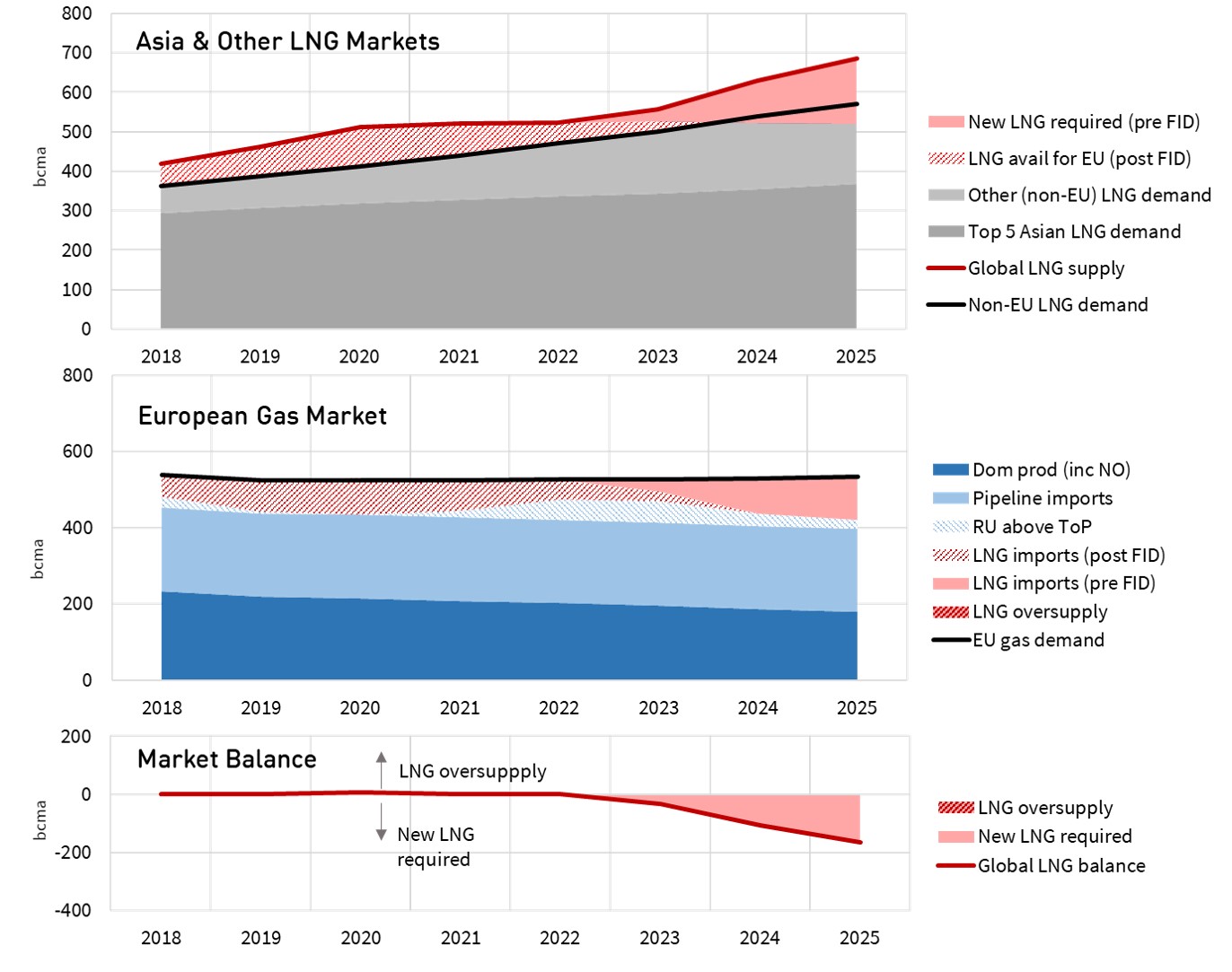
Chart 2 illustrates the balance of the LNG market if Asia continues on its current high demand growth trajectory.  The chart shows the supply and demand balance in the LNG market (top panel), and European gas market (middle panel). It also shows LNG market balance based on current committed supply (bottom panel).

Chart 2: LNG market supply & demand balance under a High Asian Growth scenario

Source: Timera Energy

The bottom ‘market balance’ panel highlights two important implications of the current rate of Asian demand growth:

  1. There is little to no surplus LNG spilling into Europe over the 2019-21 horizon
  2. The LNG market needs new supply from 2022.

FIDs for new liquefaction projects have been thin on the ground since 2016.  The only projects of scale that have committed to proceed are the Qatari expansion & the Shell led Canada LNG project announced last week.

These projects are not enough to meet the supply gap given the current pace of demand growth.  Projects take 4 to 5 years to come online post FID.  This means the timing and scale of new FIDs over the next 12 months will likely be critical to determining how tight the LNG market will be across the 2022-25 horizon.  The risk of a sharp squeeze is increasing.

3 potential paths for price evolution

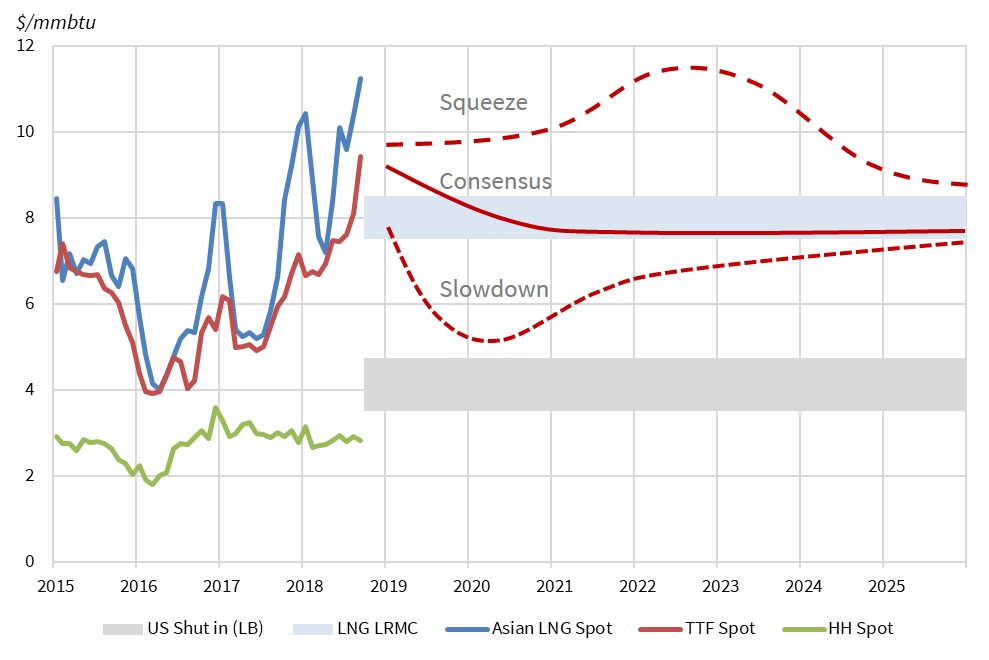
Chart 3 shows three illustrative price paths for European hub prices to 2025. We have not shown Asian spot LNG prices.  But these are likely to remain structurally linked to TTF, given large volumes of flexible LNG supply that can arbitrage price differentials (albeit with a continuation of significant short term Asia vs TTF price spread volatility given supply chain response constraints).

Chart 3: 3 illustrative TTF price paths to 2025

Source: Timera Energy

  1. Consensus

The central path follows forward prices for the first 3 years and then assumes prices remain flat in real terms at 7.5 $/mmbtu, at the lower end of consensus estimates of the Long Run Marginal Cost (LRMC) of the next wave of LNG supply.

This is consistent with Russia increasing gas flows into Europe across 2019-21, in order to ease prices back to levels that make LNG project FIDs more challenging.

Gazprom has a strong incentive to prevent a competitive surge in the FID of new LNG projects across the next two years. New LNG projects are a clear threat to Russia because once committed, they represent price taking gas that can flow into Europe if a surplus arises.

  1. Squeeze

The higher price path is consistent with a continuation of strong Asian demand growth. This could be coupled with delays/issues with new LNG supply (as has been the case across 2015-18).

In this scenario, Asia continues to pull LNG supply away from Europe at the same time domestic production is declining.  Price evolution is also consistent with Russia failing to dampen price rises, due to capacity constraints or political issues (e.g. Nordstream 2 delay, Ukraine route issues).  Under these conditions, European hubs are pulled higher as they compete with Asia for LNG.

A perceived higher price path is likely to incentivise more LNG project FIDs during 2019 and 2020.  This would likely set up a price decline in the mid-2020s as new capacity comes online, the extent of which depends on the pace of global demand growth.

  1. Slowdown

The lower price path is consistent with some form of interruption to the current rate of Asian (and/or European) demand growth. A global recession is the most obvious example, but this could also come from slowing Asian demand in response to recent price rises.

Within Europe, falling hub prices would also be consistent with an increase in Russian flows (2019-20) to pull prices back down below levels supporting new LNG FIDs.

The influence of any of these factors is only likely to be temporary across the 2019-21 window.  Beyond that it is hard to build a scenario where prices do not move back towards levels consistent with investment in new supply.

These 3 price paths illustrate the range of uncertainty over the next 5 years confronting portfolios with gas price exposure.  But behind this uncertainty, two key structural drivers remain: demand growth in Asia and declining domestic production in Europe. It is those drivers that are shifting gas market risk to the upside.

Battery investment 2: Monetising battery value

2019 may be the breakthrough year for merchant battery investment in the UK.  Battery developers have re-focused investment cases on wholesale market returns, given declining ancillary revenues, cuts to embedded benefits and the slashing of battery capacity derating factors.

As other sources of margin recede, the UK battery investment case has shifted to focus on merchant value capture from price volatility. Batteries have unparalleled stealth in responding to price fluctuations. But there are some important practical constraints around value capture.

It is one thing to forecast lofty battery returns in a spreadsheet.  It is quite another thing to turn those forecasts into cold hard cash.

We published our 1st article in a series on UK battery investment in early September looking at the transition in UK battery business models.  In today’s 2nd article in the series, we look at how merchant batteries capture value in the wholesale market and Balancing Mechanism (BM).  Then in a 3rd article to follow we consider the challenges that investors face in quantifying battery returns and building a robust investment case.

No need to reinvent the wheel

The challenge battery owners face in capturing merchant value may appear to be unique at first glance.

But there are two other energy assets that have very similar value capture dynamics:

  1. Fast cycle gas storage: A salt cavern gas storage facility is essentially a gas battery. Value is focused on short term (day-ahead & within-day) cycling to capture price volatility.
  2. Pump hydro: Pump storage is a water battery. It typically has longer duration than lithium-ion batteries. But the cycling constraint dynamics driving value are very similar.

A short duration battery has the same valuation characteristics as these other storage assets.  It is just faster cycling and can store a relatively small volume of energy.

The storage value of a battery is driven by relative differences in short term prices. The battery essentially gives the owner a very granular strip of ‘time spread’ options (the option to capture price spreads between different time periods).

As with all storage assets the variable cost of cycling is key to capturing value.  As long as a price spread exceeds this variable cycling cost hurdle, positive margin can be generated by charging & discharging.

In the case of a battery, the variable cycling cost hurdle is a function of:

  1. Full cycle efficiency costs (i.e. energy loss from cycle)
  2. Variable supplier/grid charges
  3. Market transaction costs (there can be significant bid-offer spread & liquidity costs in securing illiquid prompt prices)
  4. Variable degradation cost of cycling (i.e. an explicit charge to reflect impact of cycling on reducing battery life).

Some of the techniques currently being applied to value & optimise merchant batteries are ignoring a huge depth of expertise that already exists on valuing and monetising other types of energy storage assets.

Merchant battery value capture

Wholesale market & BM value capture can account for 50-80% of required returns for a merchant battery project (depending on business model adopted). To access this value, it is hard to side step significant exposure to market price risk. This is because there are no liquid products that allow an owner to hedge battery optionality on a forward basis.

A small portion of ‘arbitrage value’ can be hedged at the day-ahead stage. For example a 1 hour duration battery can buy the lowest price hour and sell the highest price hour in the day-ahead auction.  But this arbitrage value for a short duration battery only represents a very small portion of required returns.

The lion’s share of battery returns is generated by optimising cycling to capture value from responding to volatility across cascading day-ahead, within-day and BM prices.

Chart 1 provides a simple illustration of battery value capture across a 24 hour period. It shows Day-Ahead (DA) wholesale price and BM cashout price evolution and two cycling examples.

The 1st cycle shows dynamic response to capture a cashout price spread. In reality a battery may be cycled multiple times within a day to capture cashout price differentials that exceed the battery variable cost hurdle.

The 2nd cycle shows value that can be hedged at the day-ahead stage (e.g. via N2EX prices).

Chart 1: Illustration of day-ahead and BM battery value capture


Source: Timera Energy

Merchant battery margin is primarily generated by extracting value from price volatility in the BM (as illustrated by the 1st cycle in Chart 1). BM value capture is currently focused on responding to forecast cashout price differentials – also know as NIV (Net Imbalance Volume) chasing.  The advantage of this strategy is it avoids the set up and ongoing operational cost & complexity of submitting bids and offers into the BM (currently the realm of larger utility/IPP trading desks).

However, the volumes of flexible battery and gas engine capacity adopting this strategy are likely to quite quickly dwarf UK market imbalance volumes. This is set to increase risk and erode returns from NIV chasing. It will likely force battery (and gas engine) owners to fully participate in the BM to capture value (via bid / offer submission). Some of the larger UK flex operators are already doing this.

The forecasting problem

Battery owners face an inherent risk in capturing value from the volatility of uncertain market prices.  Battery cycling decisions rely primarily on forecasting differentials in prices as they cascade near to delivery (day-ahead to within-day to BM).

Forecasting techniques are improving but no-one has a crystal ball. Forecast errors mean losses as well as profits, a factor which is not always properly reflected in projections of battery value capture.

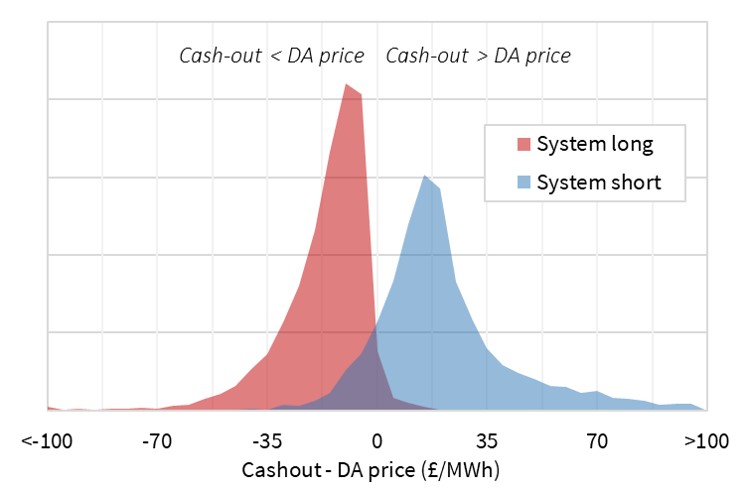
This problem of forecasting prices is illustrated in Chart 2 which shows how dramatically prices can deviate between the Day-Ahead (DA) stage and cashout (delivery).

Chart 2: Distribution of price deviations from Day-Ahead to cashout


Source: Timera Energy

To develop the chart we have split price data into two buckets based on whether the system was long (red) or short (blue). This is easier to view than a combined distribution.

Take the blue distribution as an example. The expected differential between Day-Ahead and cashout prices was ~15 £/MWh (across periods when the system was long).  But individual observed differentials fluctuated from -35 to +100 £/MWh. No matter how good your forecasting is, price swings that large cause forecasting errors that results in losses.

The sophistication of short term price forecasting techniques is improving rapidly (e.g. via applying machine learning). But as increasing volumes of battery (& engine) capacity are rolled out there are two factors making value capture more challenging:

  1. Value erosion: large volumes of flexible capacity responding to price signals in parallel may ‘cannibalise’ each other’s returns (a similar issue to that facing merchant wind & solar).
  2. Forecast error: price forecasting (particularly for cashout prices) is likely to become more challenging as volume swings from flexible capacity trying to capture prompt price moves increases.

These value capture challenges are not always robustly reflected in the quantification of battery economics.  We return in our next article to look at the challenges investors face in quantifying battery value and building a robust investment case for merchant batteries.

Building an energy trading capability

To trade or not to trade. This has been a philosophical question confronting energy company boards since the liberalization of energy markets.

Trading is the core focus of some company business models e.g. Vitol and Mercuria.  But other companies have historically had a strong cultural aversion to trading. Perhaps the most prominent of these is Exxon, where for many years trading has been a dirty word.

But markets are changing and business models with them.  Asset value is increasingly being monetised via traded markets closer to delivery.  This is true for example in:

  • Power markets – renewables driving increase in value from capturing prompt price shape & volatility
  • Gas & LNG markets – increase in traded market liquidity and decline of long term contracts
  • Oil & products markets – impact of shale in shortening investment cycles and facilitating new entrant players

These trends are changing the attitudes of company boards to energy trading.

New entrant players are building trading functions to allow portfolio value & risk management (e.g. in the UK, new entrant retailers such as Smartest Energy and flex providers such as UKPR & Limejump).

Large producers are looking to acquire trading businesses as a way to expand their footprint and enter new markets (e.g. Equinor’s acquisition of power & gas trader Danske Commodities).

But perhaps the biggest strategic shift of all is that of Exxon which has announced plans to develop a trading business. In today’s article we look at the Exxon case study as well as setting out 5 key challenges that energy companies face in building a robust and profitable trading business.

Case study: Exxon’s shift to embrace trading

Exxon has for decades had a deep-rooted cultural aversion to trading as a source of enhancing margin.

It has been a company that has focused on excellence in engineering: delivering complex upstream projects on time and on budget. This has been underpinned by a very strong ‘controls culture’ which has become part of the psyche of the company.  Trading has been at odds with this culture i.e. ‘if you give the toys to the boys, the boys will play with the toys’.

That is why, when it signaled its change of heart by hiring several industry leading traders to build up a trading function, Exxon made global headlines this year.

Exxon has historically left its production virtually unhedged, selling at spot (or 1 month forward). This has been a coherent alternative business model to the more common trading-hedging model of many of Exxon’s competitors (e.g. BP & Shell).  As evidence of the effectiveness of this model, Exxon has maintained a AAA credit rating from 1949-2016 (when S&P dropped it a notch to AA+).

The ‘no hedging strategy’ approach has been sold to Wall Street as a ‘pure oil-price play’.  As long as Exxon’s balance sheet has been strong enough to ride out the bad times, the company saves on the ‘insurance premiums’ associated with hedging.

So why the change of heart – as a ‘non-trader’, what might Exxon have been missing? Profit growth is the obvious angle e.g. in the increasingly liquid LNG market where Exxon has a strong position.  The long term growth outlook for plain vanilla hydrocarbon production is increasingly uncertain in a world of decarbonisation (even if Exxon is notoriously averse to admitting this in public).

A trading function can also bring entrepreneurial benefits, driving innovation and commercial evolution within a company. These are likely to be valuable for a company that has suffered from introversion and commercial blind spots.

Exxon also has an abundance of capital and lines of credit. These are valuable attributes to support a trading function and can be a big differentiator when dealing in derivatives and structured products.

But perhaps the biggest factor in Exxon’s favour is the intangible value arising from the market information available on the substantial physical commodity flow associated with its business.  Leveraging physical portfolio flexibility has been the clearest route to trading function success in other energy companies.

Practical challenges in getting it right

Whether it is a giant corporation like Exxon or a small new entrant retailer, there are some key success factors that underpin the development of an effective energy trading business. We summarise five of these in Table 1.

Table 1: Key success factors in developing an energy trading capability

Success factor Considerations
Culture shift Traders are different people, by temperament and working practices, than engineers and traditional commercial staff.  Neither are easily able to manage the other for best results.  Successful trading businesses need adequate representation at a senior management & Board level, particularly if core company focus is elsewhere.
Investment & capital allocation A ‘trading lite’ approach is not a viable option for energy desks. Setting up a trading function requires sufficient investment in people, systems, data, analytical capability. Most importantly it requires the allocation of risk capital (whether implicit or explicit) to support P&L swings.
Risk appetite, limits & measurement Traders require genuine commercial freedom/flexibility to operate within the clearly defined constraints of a well drafted statement of Board risk appetite. A robust risk limits structure underpins the delegation of risk-taking capacity. Limits in turn rely on an adequate risk measurement capability.
Incentivisation & performance measurement Incentive structure is key for trading staff.  Well framed bonus schemes drive results.  Poor incentives schemes can engender dysfunctional trader behaviours and be divisive within the organisation.  A classic flaw is allowing traders to ‘skim’ profits from other divisions, either inadvertently or deliberately, to bolster trading results.
 Governance A trading desk is typically the only function within an energy business that can harm the company overnight (safety incidents aside). Trading must be within a top-to-bottom governance framework, including oversight by sufficiently knowledgeable, commercially independent senior management.


There have been a number of success stories where a physically focused business has successfully applied these principles to develop a strong trading capability (e.g. EDF Trading, Gazprom Marketing & Trading).

There have also been some spectacular company downfalls, led by trading related problems (e.g. Noble’s recent problems and the Enron related collapse of energy traders such as Dynegy, Williams and TXU in 2000-01).

Most energy companies sit somewhere in between success and failure. This often reflects the challenges of evolving a trading function within a company that has its cultural and commercial roots elsewhere. But it also sets up tangible opportunities to bolster profits and improve the integration of trading functions by tackling the 5 success factors above.

Carbon surge driving up TTF & spot LNG prices

A carbon price surge in Europe pulling up LNG prices in China? This may sound like a case of the butterfly effect. But the current tandem rise in carbon and gas prices reflects an important linkage through the European power sector.

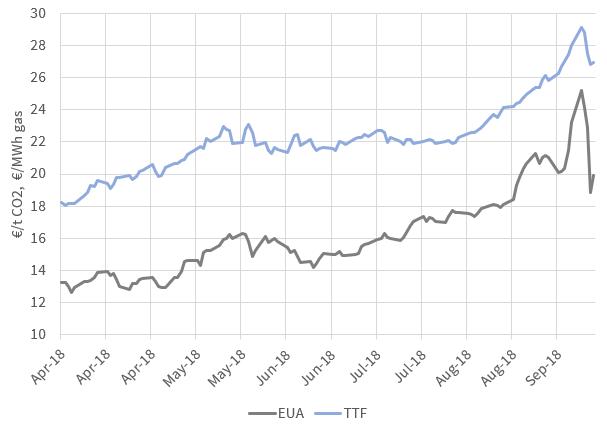
The carbon vs gas price relationship has come into focus this year as the result of surging carbon EUA prices. Carbon prices topped 25 €/t last Monday, a 142% move higher from the start of Q2 2018 (when prices were 13 €/t).

As carbon prices have increased, so has price volatility. After peaking on Monday last week, EUA prices fell 20% by Friday to close the week just under 20 €/t.

The TTF gas curve and Asian spot LNG prices have risen in parallel with carbon since Q1. They also fell in sympathy with the steep decline in EUA prices across last week.

The mechanics of this linkage between gas and carbon prices is underpinned by gas vs coal plant switching in European power markets, as we set out in this week’s article.

What is driving carbon higher

Carbon prices have rallied this year in response to finalisation of the Market Stability Reserve (MSR) measures.  The MSR has been a long time coming, but represents a clear mechanism to reduce the surplus of carbon credits that has built since the financial crisis.

Under the MSR, surplus carbon inventory will be removed at the rate of 24% a year across 2019-23. Culling of EUAs will then continue beyond this at a 12% rate.

The net impact of the MSR has been to reignite the requirement for market driven emissions abatement from the power sector.  In other words, the EUA market anticipates a shortage of emissions allowances, which needs to be cleared via higher prices.

The key mechanism driving carbon abatement at the margin, is the switching of coal units for CCGTs. Germany is particularly important given its large switching potential, with 28GW of installed hard coal capacity and more than 20GW of gas-fired capacity (currently running at relatively low load factors).

Switching linkage between gas & carbon

Rising carbon prices hurts coal plant competitiveness versus gas.  The carbon intensity of coal-fired units is more than double that of CCGTs (e.g. 0.85 vs 0.35 t/MWh of power produced). This means the variable cost of coal plants rises faster than CCGTs in response to a carbon price increase.

Everything else being equal, this carbon induced shift in competitiveness in favour of gas plants results in higher CCGT load factors. This in turn causes higher gas demand which acts to pull up European gas hub prices.

Movements in forward prices anticipate this relationship. In other words, a move higher in carbon prices is typically accompanied by a move higher in gas prices to maintain similar gas vs coal switching levels.  This dynamic can be observed in Chart 1.

Chart 1: Relationship between front month EUA and TTF prices

Source: Timera Energy

Front month carbon & EUA prices have been 94% correlated since the start of Q2 (with daily price returns 41% correlated).  The ratio of carbon vs gas price moves is not a ‘1 for 1’ relationship as it depends on the relative impact on gas vs coal plant variable cost.

The detailed mechanics of this carbon vs gas price linkage are quite complex.  They depend on the relative variable costs of coal vs CCGT units taking into account gas price seasonality, different unit efficiencies and supply stack variances across markets.

This complexity means there is not a simple formula that defines the relationship between carbon and gas prices. It requires detailed modelling of pan-European power markets as we set out here.

But there is a clearly observable correlation between carbon and gas forward prices that is driven by European power market switching boundaries.

The connection to LNG spot prices

The carbon vs TTF price relationship also extends to impact spot LNG pricing. We recently set out the price relationship between the European gas market and Asian LNG spot prices. Spot LNG cargoes in Asia are priced at a spread to TTF.  In other words, the volume of LNG flowing into Asia is primarily driven by the relative level of Asian spot prices above TTF, not the absolute level of Asian spot prices.

Strong Asian LNG demand this year has opened up an Asia/TTF spread that has been ranging above the 1.50 $/mmbtu level required to divert significant volumes of LNG from Europe to Asia. Asian spot prices must rise with TTF to support this spread level, in order to maintain cargo diversions to meet Asian demand.

The fact that Asia is pulling LNG away from Europe strengthens the importance of switching levels in driving TTF pricing. When Asian and European gas prices are converged, LNG imports tend to dampen rising European hub prices.

But in 2018, cargo diversion to service inelastic Asian demand has created somewhat of a vacuum above European hub prices. That has seen the carbon price rise translate more directly into higher TTF prices.

How fuel & carbon prices are driving switching

Switching dynamics of gas for coal plant has been a key theme of this blog.  Power sector switching is one of three key mechanisms currently setting marginal prices at European gas hubs. The relative variable cost of gas & coal plants is also a key driver of European power price levels and price shape.

In this week’s article we use three simple charts to explore the evolution of the fuel & carbon components of German coal & CCGT plant variable costs.  We then look at the evolution of the competitiveness of coal vs gas plants.

Rising coal plant costs

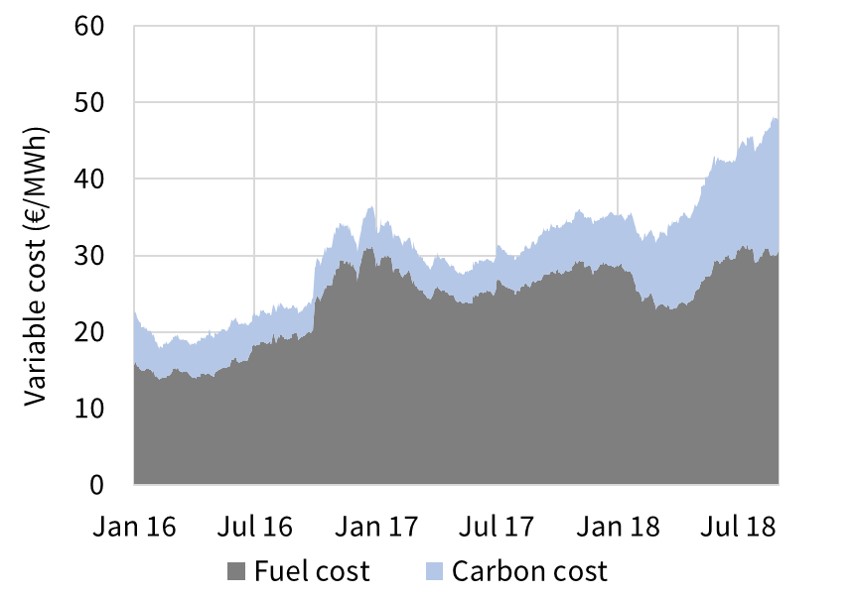
Chart 1 shows the evolution of the variable cost of an older German coal plant, split into carbon and fuel cost components. For simplicity variable O&M costs are not shown as they are relatively low (~ 1 €/MWh) and stable over time.

Chart 1: German coal unit fuel & carbon variable cost (40% efficiency)

Source: Timera Energy

European coal prices have doubled since the start of 2016 (52 – 103 $/t).  Most of this move higher happened in 2016 as can be seen in Chart 1.

The big increase in coal plant variable costs this year has been driven by carbon.  EUA prices have risen 250% this year (8 – 20 €/t).

The combined impact of these price moves has been a more than doubling of coal plant variable costs since commodity prices bottomed in 2016. More than half that increase has happened in 2018.  That is why power prices across Continental Europe have also soared this year.

Gas plant costs & switching levels

Chart 2 shows the evolution of fuel & carbon variable cost components for a newer CCGT plant in Germany. The black line overlaid on the chart is the total variable cost of the 40% coal unit from Chart 1.

Chart 2: German CCGT unit fuel & carbon variable cost (52% HHV efficiency)

Source: Timera Energy

There is a stronger seasonal shape to gas plant variable cost, driven by hub price seasonality. This means that CCGTs tend to be more competitive than coal units across the summer months.

As Chart 2 illustrates, there have been periods across the summers in 2016 & 2017 when there has been structural switching of newer CCGT units for older coal plants (shown with arrows). That has not been the case over the current summer.

In 2018, the impact of a sharp move higher in gas hub prices on CCGT variable costs, has outweighed the impact of higher carbon prices on coal plant costs.  We explored the factors driving this move higher in gas prices in a recent article.

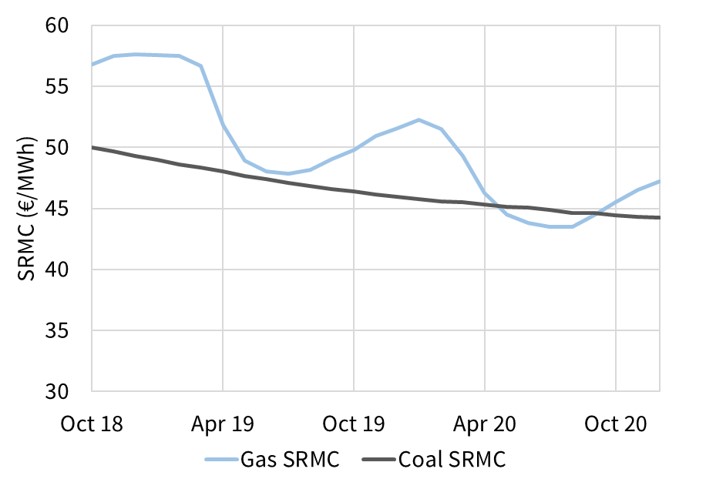
In Chart 3 we shift our focus to the future. The chart shows the gas vs coal plant competitive balance implied by current forward prices.

Chart 3: Forward implied variable costs of CCGT (52%) vs coal unit (40%)

Source: Timera Energy

The move higher in gas prices this year has shifted the whole gas curve higher, although pronounced backwardation remains.  Rising gas prices are increasing the relative competitiveness of coal vs gas plants (and causing a move higher in dark spreads).

But it remains to be seen whether this trend will continue. Switching is a naturally reverting process where as CCGTs are pushed out of merit, the associated fall in gas demand tends to weigh on hub prices.  At the same time higher coal burn also feeds through into higher carbon emissions and EUA prices.

That is why, despite periods of temporary divergence, there is a strong relationship between the variable costs of coal and gas units.