
How flex price signals differ across TTF vs NBP

The European gas market is formed around a well interconnected network of traded hubs. Liquidity at most of these hubs is limited to a short-term horizon close to delivery.  When it comes to forward market liquidity, there are only two hubs that count.

The Dutch TTF hub sits at the commercial centre of the European gas market. Price signals at other hubs are strongly linked to the variable transport cost differentials to TTF, although can at times be impacted by physical of commercial constraints.

But despite the primary status of TTF, just across the English Channel, the UK’s NBP has retained its status as a key secondary source of forward liquidity.  There are two important reasons behind the resilience of NBP:

  1. Separation: The relative isolation of the UK market at the Western edge of the European gas network means that constraints flowing gas between the UK and the Continent can drive structural differences in pricing dynamics.
  2. Regas access: The UK has relatively large volumes of under-utilised regas capacity that allow LNG market players access to a liquid hub price signal in order to manage portfolio exposures.

Basis differentials between TTF and NBP have ben fairly stable, with basis risk accordingly low.  But as the European gas supply flexibility balance slowly tightens across Europe, some interesting divergences are opening up between price behaviour at TTF vs NBP.  In today’s article we set out a comparative analysis of the key flex market price signals across the two hubs.

Flex signal 1: Seasonal price spreads 

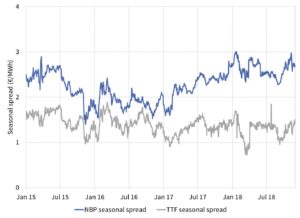
The key benchmark for the value of flexibility to shift gas between seasons is the summer/winter price spread. Chart 1 shows the evolution of the front year forward contract spread at NBP compared to TTF.

Chart 1: NBP vs TTF front year forward market seasonal price spread

Source: Timera Energy

NBP seasonal spreads have historically maintained a small premium to TTF. This is consistent with NBP tending to trade above TTF in winter to attract imports to meet higher demand and at a discount across summer as UKCS flows (in excess of UK demand) are exported to the Continent.

However, the closure announcement of the Rough storage facility in 2016 opened up a more structural divergence of NBP and TTF spreads.  Rough (at full strength) represented almost 4 bcm of working gas volume.  Given the relatively slow cycling speed of Rough, this working volume was focused on providing seasonal flexibility.

The loss of Rough has meant that this flex needs to be backfilled, primarily via Norwegian supply flex but also by drawing on flows via the IUK & BBL interconnectors.  The seasonal spread price signal to incentivise these alternative sources of flexibility is significantly higher than that required to cover the variable cycling costs of Rough.  This has driven the more structural divergence of NBP spreads above TTF.

TTF seasonal price spreads remain stubbornly stuck in a 1-2 €/MWh range, close to a soft lower bound driven by the variable cycling costs of seasonal storage. A more structural recovery of spreads at TTF is likely to depend on:

  1. Storage closures: a number of European seasonal storage assets remain cashflow negative at current spread levels. Ongoing spread weakness and expiry of long term contracts (at more favourable terms) is pushing owners towards closure.
  2. LNG import seasonality: LNG import flows into Europe have typically been higher in summer than winter, given Asian LNG demand patterns. As LNG import volumes grow, seasonality may increase.
  3. Russian flows: Russian supply contracts have traditionally been a key source of seasonal flexibility. But seasonality of Russian flows has decreased as volumes have ramped up since 2015.

The evolution of storage closures and seasonal import flow patterns into next decade will be important in driving TTF seasonal price spread levels.

Flex signal 2: Spot volatility

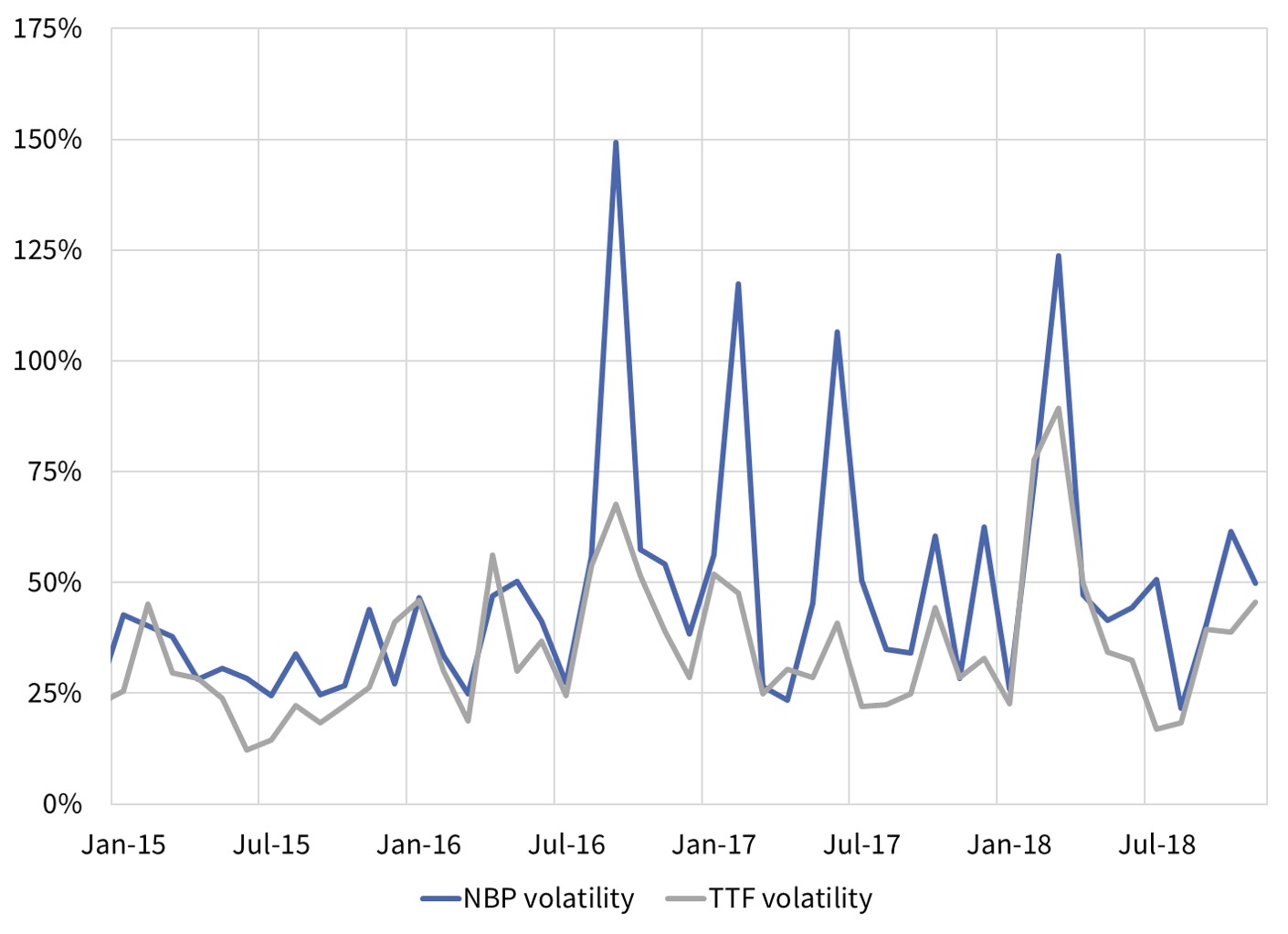
The second key signal for gas supply flexibility is spot price volatility. This drives the value of daily (or short term) deliverability of gas.  An analysis of day-ahead NBP vs TTF spot price volatility is shown in Chart 2.

Chart 2: Historical day-ahead spot price volatility at NBP vs TTF

Source: Timera Energy

A divergence between NBP and TTF spot price volatility can also be seen after the 2016 Rough closure announcement. This is consistent with the fact that Rough represented about 25% of UK daily storage deliverability.

In the Chart 2 analysis we have excluded short term price jumps (measured as daily price returns greater than 3 standard deviations from the mean).  If price jumps are added back in, then the divergence between NBP and TTF volatility is even greater.

The higher level of spot volatility at NBP (vs TTF) is driven to a large extent by larger and more frequent market stress events. It is interesting to note two types of volatility events in Chart 2:

  • Competitive stress events: Some stress events are European market wide and see the UK and NW European markets competing for available gas. Examples here are the ‘beast from the east’ shock in Q1 2018 and the French nuclear outage related stress in Win 16/17.
  • Isolated stress events: But since the closure of Rough, NBP has been more susceptible to volatility caused by UK specific constraints (e.g. see UK price jumps across 2017). These may act to transmit some volatility to TTF, but are primarily reflected in more volatile NBP prices.

Spot volatility across both NBP and TTF has risen since 2016 as the European supply flexibility balance starts to tighten.  But this increase in volatility is focused on market stress events, with NBP more susceptible than TTF and TTF-NBP basis risk set to become more of an issue than for many years. The growing influence of stress events on flexibility value is likely to continue as the European gas market becomes more import dependent in the 2020s.

Boosting midstream asset value capture

This decade has been a tough one for owners of flexible midstream gas assets such as storage, pipelines & regas terminals. Asset returns have been hit by a post financial crisis overhang of supply flexibility in the European gas market.  At the same time, market drivers are structurally altering the risk/return profile of midstream assets.

But as is often the case, commercial strength is born from adversity. Midstream asset owners are improving returns by evolving commercial models and optimising margin & costs.

A combination of sharper commercial strategies and recovering market fundamentals is set to underpin midstream value recovery into next decade.

In this article we set out:

  1. 3 structural market trends supporting European midstream asset value
  2. 3 resulting commercial trends impacting midstream asset value capture
  3. 5 ways asset owners are responding to boost value capture.

While 1. applies generally across all midstream assets, our coverage of 2. and 3. focus on flexible TPA exempt assets.

3 structural market drivers supporting midstream value

Energy markets are cyclical in nature. Several years of tough conditions and low investment tends to set up a market recovery. But in addition to cyclical factors there are three structural drivers of a recovery in the value of European gas supply flexibility across the next 5 years:

  1. Import dependency: European domestic production is in structural decline. This means the European gas market is becoming more dependent on longer import supply chains e.g. LNG imports and Russian pipeline flows from Western Siberia. Longer response times increase market price volatility and the frequency and magnitude of price shocks.
  2. Power sector swing: Gas fired power plants are set to play an increasingly important flexibility provision role over the next 5 years. Regulatory driven closures of nuclear, coal and lignite plants will increase gas plant load factors. In parallel, the requirement for flexibility is set to rise with a substantial increase in intermittent wind & solar output.  The increased ramping of gas-fired power plants depends on supply flexibility from the gas market.
  3. Ageing infrastructure: European midstream gas infrastructure is ageing. Yet investment in both maintenance and renewal capex for midstream assets has been relatively low this decade given weak market price signals.  Infrastructure outages and retirements are likely to increase as a result into next decade.

These drivers are underpinning a gradual recovery in flexibility price signals since 2016.  This recovery has been more pronounced in the UK market with the closure of Rough.  But TTF volatility has also been rising in 2018.

These structural market drivers are supporting several key commercial trends impacting midstream value capture.

3 commercial trends impacting value capture

The market drivers described above are resulting in important trends in the way TPA exempt midstream asset owners are capturing value.  These are summarised in Table 1 below.

Table 1: Commercial trends impacting midstream value capture

Trend Description
1. Value shifting to prompt
  • A rising portion of asset value is being monetised closer to delivery (e.g. within-year, within-month).
  • Structural market trends above support continuation of this trend (e.g. LNG import swings, power sector intermittency).
2. ‘Shock’ value rising
  • Increased import dependency means the European market is relying on longer supply chains (e.g. LNG, Russian pipes), with longer response times to dampen market stress.
  • Ageing infrastructure is resulting in more frequent outages.
3. LT contracts rolling off
  • Legacy long term contracts used to support midstream asset development are rolling off & can’t be replaced at the same terms.
  • There is a structural trend towards shorter term contracting in the European gas market as hub liquidity improves.


As contracts roll off, value shifts to the prompt and volatility increases, more market risk is being pushed onto midstream asset owners and investors. With that higher risk comes the potential for enhanced returns.

In other words, there is a structural transition in asset risk/return profiles that favours companies with the ability to absorb market risk and the commercial capability to manage that risk and commercially optimise asset returns.

5 ways asset owners are responding to boost value capture

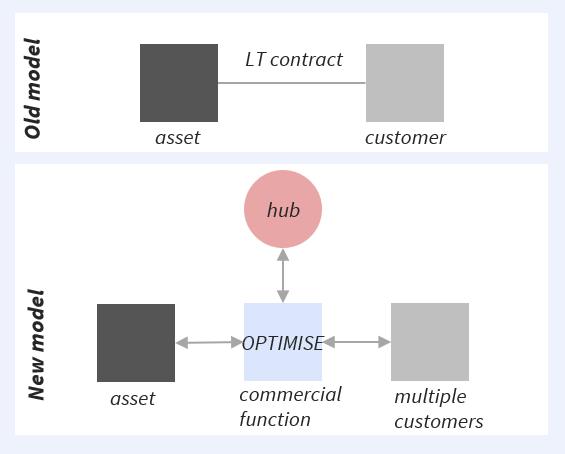
Midstream asset owners have not been idle in responding to these evolving market and commercial trends. Midstream business models are adapting to reflect the increasing importance of optimising physical asset flexibility against hub prices to provide a more targeted range of customer products and services. This business model transition is summarised in a simple schematic in Diagram 1 below.

Diagram 1: Evolution of midstream business models

Source: Timera Energy

An enhanced commercial function sits at the centre of the new midstream business model.  This often consists of only 2-4 capable commercial staff.  And it does not necessarily involve a trading function and associated overheads. There are examples of both pipeline and storage operators in Europe that retain asset flexibility into the day-ahead horizon to enhance value capture, before selling capacity to trading counterparties with direct market access.

In Table 2 we list five ways midstream asset owners are enhancing value.

Table 1: Commercial trends impacting midstream value capture

Trend Description
1. Optimise asset variable costs
  • Reducing variable cost hurdle for utilizing asset flex
  • For example: cycling costs for storage, flow costs for pipelines, throughput costs for regas
2. Optimise asset supply chain
  • Managing & bundling entry/exit capacity costs/exposure
  • Optimising asset maintenance timing & fuel gas purchases
  • Extracting additional flex e.g. linepack optimisation
3. Retain asset flex into prompt
  • Retaining asset flexibility within-year (e.g. up to day-ahead stage) to capture more value versus selling out in annual contracts
  • Indexing price of longer term contracts to retain exposure to within-year price movements
4. Use hubs to enhance asset flex & services
  • De-link financial structure of products & services from physical constraints of the underlying asset
  • For example: customer netting, low risk overselling
5. Broaden & refine product offering
  • Combine 1. to 4. to refine offering of products & services to a broader range of customers
  • For example: virtual products, graded priority, enhanced/premium products, incremental components


The actions in Table 2 can significantly enhance midstream asset margin, even in the absence of any flexibility market recovery.  But these are also powerful tool to enable asset owners to maximise their benefit of market recovery, rather than that benefit only flowing to customers.

Timera team expanding
Jessica Gervais has joined Timera as a Senior Analyst. She has 10 years commercial and analytical experience in European energy markets.  She joined Timera from Platts Analytics (formerly Eclipse) where she was Head of Modelling for European Gas & Power. Prior to this, she led the development of ArcelorMittal’s European gas trading capability, with responsibility for optimising energy sourcing across multiple hubs in Europe.  More details here.


European gas price rally hits reverse

European hub prices doubled between July 2017 and September 2018.  50% of that move happened in Q3 2018. Through the objective barometer of market price, the European gas market has tightened significantly across 2017-18.

The big rally in gas prices between the current and previous summers was fuelled by:

  1. LNG volumes being diverted to Asia to meet strong demand
  2. Big rallies in coal and carbon prices, raising gas plant switching levels in the power sector
  3. Near term constraints on ramp up of Russian import volumes.

We described these 3 key drivers of hub prices in a recent article published in October.

In Q4 there has been another interesting shift in gas market dynamics.  Gas prices have fallen back sharply from September levels and LNG is flowing back into Europe in a very different pattern to the onset of the last two winters.

In today’s article we provide a brief summary of why gas prices are falling and the current state of play heading into winter.

What is behind the Q4 price plunge?

Energy markets are rarely dull as illustrated by the evolution of global price benchmarks in Chart 1. TTF prices rose more than 25% across this summer (from around 8 to 10 $/mmbtu), only to reverse and give up those gains across October. As of late November prices look to be trying to stabilise around 8 $/mmbtu.

Chart 1: Evolution of global gas price benchmarks

Source: Timera Energy

So why this sudden price reversal? To a large extent this comes down to the same drivers behind the Q3 price rise, only acting in reverse. The following is a summary of 5 factors behind the Q4 price decline:

  1. Economy: Forward expectations of gas demand are sensitive to economic conditions. Global stock markets have fallen sharply across Oct-Nov as trade war tensions grow, interest rates continue to rise and central bank stimulus starts to roll off.
  2. Commodity prices: Consistent with 1., European gas prices have fallen in sympathy with a broad based decline in commodity prices in Q4 e.g. oil -25%, coal -15%, carbon -20%.
  3. Switching levels: Power sector switching levels have fallen with coal and carbon prices, reducing gas demand as the relative competitiveness of coal plants increases accordingly.
  4. LNG flows: LNG is flowing back into Europe after being diverted to Asia across the summer. The positive arbitrage to Asia in Q3 has reversed in Q4. Asian demand for spot cargoes has weakened as buyers look well hedged into the coming winter. And a huge jump in shipping costs (200k $/day charter rates) has increased the cost of delivering LNG to Asia.
  5. Russian flows: Gazprom has auctioned just over 1bcm of incremental gas across Q4 via the Ukraine/Slovakia import route. This has helped to increase supply into European hubs and Gazprom has now announced a halt to further auctions in Q4.

The first two of these drivers illustrate the impact of global macro drivers on the European gas market.

The last three represent the practical mechanisms via which these macro drivers act on supply and demand balance and hub prices.  Q4 price dynamics are a great case study of the 3 key hub price drivers we set out in our October article.

Shock suspension of UK Capacity Market

Last Thursday the UK government abruptly halted the Capacity Market to comply with a European Court of Justice (ECJ) ruling.  The implications of this are an immediate stop to capacity payments under existing agreements and the cancelling of auctions in 2019.

The government’s announcement was the equivalent of an immediate and indefinite zero capacity price outcome for all CM participants. It is an understatement to say it was a surprise of the first order.

You can read elsewhere about the details of the ECJ ruling, but in today’s article we set out some initial thoughts on the potential market implications of CM suspension.

Impact of suspending payments on existing capacity providers

Halting capacity payments has an immediate margin & cashflow impact on all holders of 2018-19 capacity agreements. This includes owners of coal plants, CCGTs, engines, nuclear plants & DSR capacity.

Most of the capacity across the current delivery period is under T-4 agreements (from the first auction in 2014). A 20.8 £/kW price applies for these agreements (the 19.4 £/kW clearing price adjusted for inflation).

While a single T-4 clearing price applies, the impact of suspension of payments varies significantly by asset.  There are four main factors that drive this:

  • Derating factor
  • Portion of asset margin driven by CM
  • Extent of leverage (i.e. project/owner debt structure)
  • Length of contract (i.e. 1 year vs 15 year)

The asset owners that are most exposed are those that rely on CM payments to:

  1. Cover fixed costs in order to remain cashflow positive
  2. Meet debt repayments.

Older & less efficient CCGTs and coal plants are most vulnerable in the first category. Leveraged engine & DSR projects are vulnerable in the second category.

This is where uncertainty around the extent of CM payment suspension is very important.  A temporary halt of a couple of months before payments are reinstated may be painful but is unlikely to precipitate major closures or defaults.  The costs of operating capacity are largely sunk over this time horizon.

However, a prolonged or indefinite suspension of payments will have real implications for more vulnerable capacity owners relatively quickly. This may mean mothballing, accelerated closures and defaults.

For that reason, expect a sharp and strong lobbying response from affected owners.  The interests of utilities, IPPs, flex developers and aggregators in pressuring the government to reinstate payments appear to be strongly aligned.  The main hurdle to achieving this seems to be one of legal process rather than overcoming structural conflicts within the industry.

Impact on security of supply & policy

The government has tried to allay fears that CM suspension threatens security of supply this winter.  That may be right in the sense that existing capacity is likely to remain operational between now and next March.

But beyond this narrow interpretation there can be little doubt that CM suspension represents a major threat to security of supply.  The Capacity Market has been the cornerstone of the government’s policy platform to ensure enough flexible capacity is operational to keep the lights on.

Again, the interests of the government, consumers and a significant majority of market participants appear to be aligned in ensuring the CM does not suddenly disappear.  The alternative stop gap solution is for the government to get Grid (as system operator) to ‘do all it takes to ensure security of supply’.  The flawed SBR mechanism is reminder of why that is likely to be a bad outcome.

What the ECJ ruling may precipitate is an acceleration of the government’s review of the CM.  For example, a significant broadening of the CM to include other types of generation (e.g. renewables) was already under discussion. But complex reforms of this nature are not well suited to ‘gun to the head’ haste.  An interim solution is required to stem the bleeding and buy some time for well-considered reform.

Impact on investors

The key immediate impact of CM suspension on investors, is the cancellation of the 2019 T-4 and T-1 auctions.  The government has indicated it may hold a T-3 auction for the 2022-23 capacity year instead.

This imposes a direct cost on investors relating to the carrying cost of capacity projects intended for the 2019 auctions.  But perhaps more importantly, the uncertainty associated with CM suspension is likely to have a greater intangible impact on investor confidence.  The cost of that uncertainty is passed on to UK consumers via higher cost of capital to deliver required capacity.

Investor patience has already been tested by Brexit, the price cap, embedded benefit reforms and the charging review. The CM has been a source of relative stability over the last 4 years… until last week.

Uncertainty may result in more marginal investment projects being delayed, shelved or canned. It may also speed up the process of consolidation & aggregation of development projects that is already underway.  And that may extend to the fire sale or closure of vulnerable existing assets, particularly those that become cashflow negative or cannot meet debt payments.

Uncertainty is likely to remain, at least for the next few weeks given the parallel issues with Brexit negotiations. But the path through that uncertainty is likely to favour a level-headed approach to the structured assessment of risks, including stress testing asset cashflows to quantify the impact of potential outcomes.

Quantifying wind & solar intermittency

Averaging wind and solar output volumes reveals some structural patterns.  Wind output tends to be higher during the day time than at night and has a seasonal profile. Solar output is also seasonal with a strong linkage to daylight hours.

But analysing power markets based on average conditions, understates the true impact of system intermittency on market prices. Around these averages sits a wide and growing distribution of wind & solar output uncertainty.

This uncertainty needs to be captured in order to understand power asset value & quantify value capture. In this article we look at:

  1. The impact of wind & solar intermittency on power market supply stacks and
  2. How to quantify volume distributions of wind & solar output swings.

How intermittency impacts the supply stack & prices

Power price uncertainty has traditionally been driven by swings in demand and fuel prices.  While these factors remain an important influence, they are set to be overtaken by swings in wind & solar output.

Chart 1 illustrates how these forces combine to drive price:

  1. For a given time of the day (e.g. 20:00)…
  2. System demand is determined by factors such as weather…
  3. The positioning of the supply stack to meet that demand depends on prevailing wind & solar output…
  4. The marginal unit required to meet demand drives system price.

Chart 1: Power price formation in 4 boxes

Source: Timera Energy

As wind and solar capacity grows, so to do the swings in the supply stack (right & left) as output continuously expands and contracts.  These swings in the supply stack (in combination with load swings), act to drive power price volatility.

Quantifying wind & solar swing: UK case study

While Chart 1 helps conceptualise the impact of wind & solar swings, it does not help quantify how large these swings may be. We address this in Charts 2 & 3, using the UK power market as a case study.

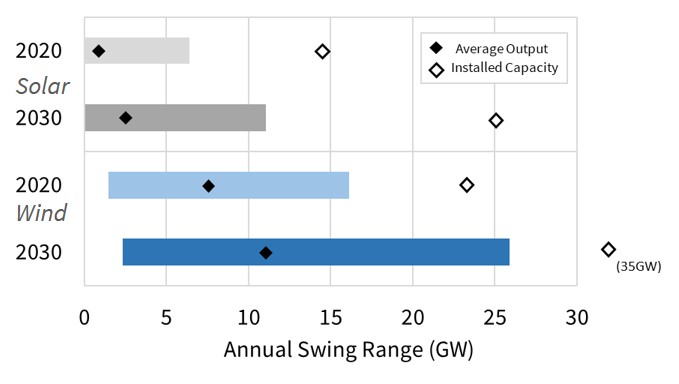
Chart 2 illustrates the estimated annual swing range distribution for solar & wind across all half hours of the year in 2020 versus 2030:

  • The shaded bars show the 5th – 95th percentile annual output ranges (across all half hours)
  • The black diamonds show average annual output (across all half hours)
  • The white diamonds show assumed total installed capacity

Chart 2: Estimated annual swing ranges for UK wind & solar

Source: Timera Energy

For example, Chart 2 shows that by 2030, wind output may range across the year from as low as 2GW (5th percentile) to 26GW (95th percentile). These ranges are useful in understanding how intermittent supply can vary across a medium term horizon.  But it is the intraday swings of wind & solar that are key drivers of short term price dynamics (e.g. volatility) and the value of flexible power assets (e.g. gas-fired plants, storage and DSR).

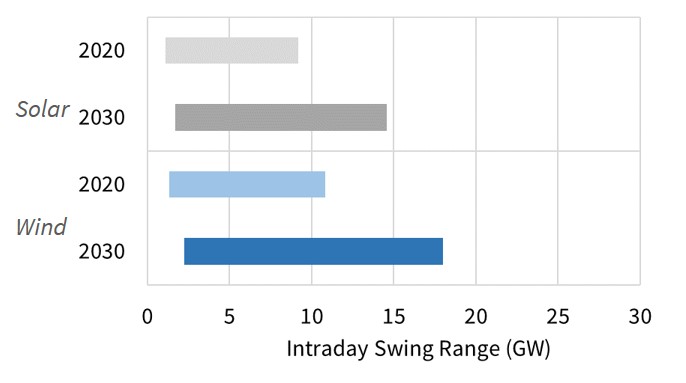
Chart 3 illustrates the 5th – 95th percentile intraday swing ranges for wind and solar output. Stepping down the time window from a year to a day (i.e. Chart 2 to Chart 3), does not actually reduce the swing ranges by that much. For example the estimated 2030 intraday wind output range is 2GW (5th percentile) to 18GW (95th percentile).

Chart 3: Estimated intraday swing ranges for UK wind & solar

Source: Timera Energy

These large and growing gyrations in power market supply stacks are underpinning the formation of market prices.  Capturing the associated uncertainty should be ‘front and center’ in any analysis of asset value and how that value can realistically be captured.


Russian capacity to get gas into Europe

As winter approaches the European gas market is looking east.  A tight market increases the importance of Russian flows to maintain orderly hub prices and security of supply.

Gazprom has ample production capacity to ramp up exports to Europe, supported by 80+ bcma of ‘shut in’ gas in Western Siberia.  But there are some key pipeline capacity constraints that impact the flow of Russian gas into the interconnected European hub network.

There are two key types of potential capacity constraints:

  1. Daily deliverability: the ability to flow gas into Europe on a given day
  2. Annual flow: the ability to flow a higher volume of Russian gas into Europe across a year

Daily deliverability will be a key factor impacting the gas market across the next two winters. From 2020, the commissioning of new pipelines should ease deliverability issues shifting the focus to growth in annual Russian import volumes.

In this article we put some numbers around how much capacity headroom exists against both daily and annual constraints. We also look at the impact of new pipelines in alleviating these constraints.

Short term flow constraints

There are 3 ‘trunk’ routes for Russian gas into the European hub network:

  1. Nordstream: Gazprom’s newest and favoured export route via the Baltic
  2. Yamal: an alternative ‘northern’ route via Belarus
  3. Ukraine: the politically sensitive flow route via Ukraine & Slovakia

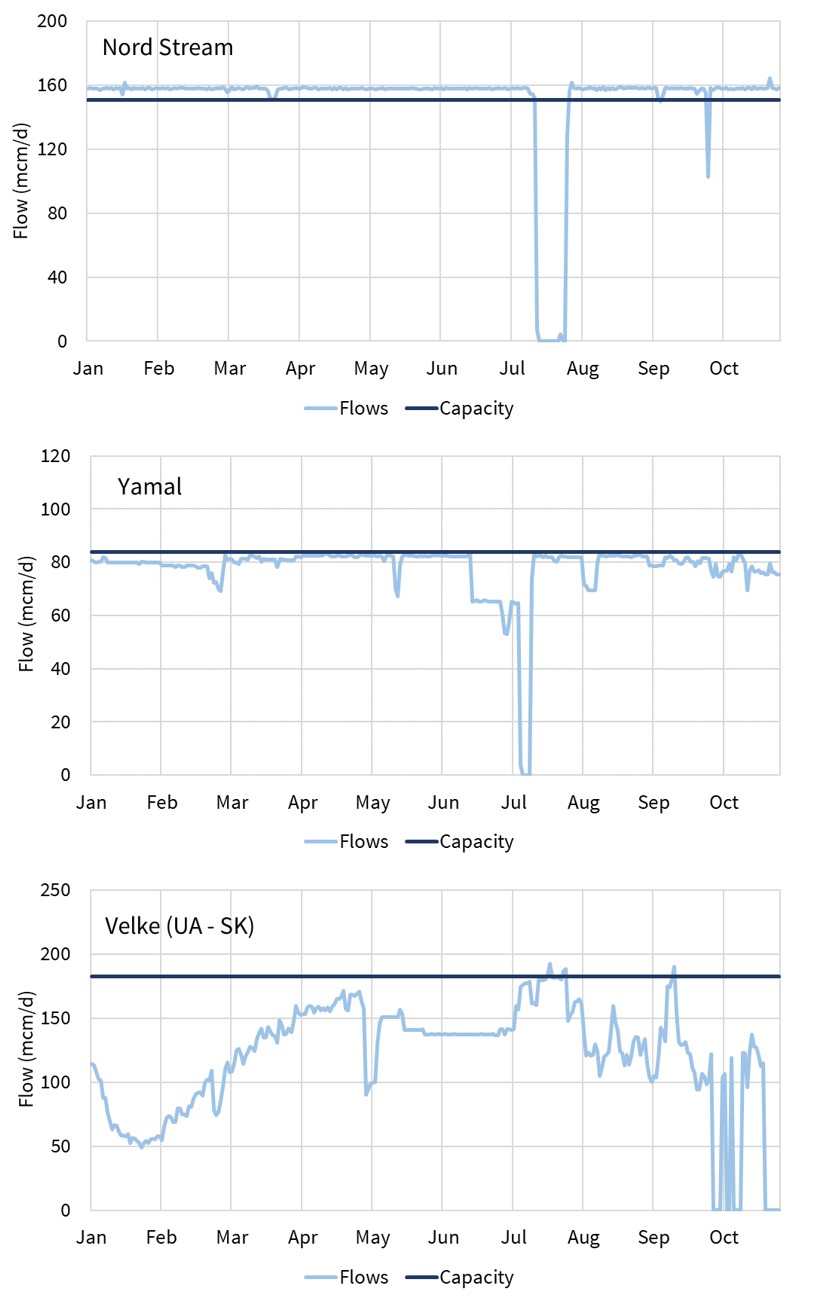
Chart 1 shows the evolution of daily flows across 2018, for the key European border entry points associated with these routes.

Chart 1 daily deliverability at key border points into Europe

Source: Timera Energy, ENTSOG (note Nordstream has been achieving flow rates above nominal capacity).

The simple conclusion here is that Nordstream and Yamal have been flowing at or very near to maximum capacity across 2018.  That means there is very little incremental capacity to provide either daily deliverability or annual flow volume upside.

As a result, import flexibility is now focused on Gazprom’s less favoured Ukrainian flow route.  This route has also hit daily flow constraints a few times across summer 2018. However there is at least 10 bcma of annual flow upside.

Daily deliverability is the key issue this winter.  It is not hard to construct a set of circumstances where deliverability of Russian gas into European hubs is constrained across a number of days (or potentially weeks) e.g. due to a cold weather pattern or supply outage.

At the point that Russian capacity becomes constrained, Europe would likely require a TTF price response that induced:

  1. Switching in the power sector to reduce CCGT load factors and hence gas demand, and/or
  2. Diversion of LNG supply from Asia (i.e. competing for marginal cargoes)

Both these mechanisms are relatively unresponsive to price (i.e. supply is inelastic in the short term). And if this situation arises it may result in major hub price shocks and volatility (reference the ‘beast from the east’ shock in Mar/Apr).

Medium term flow upside

Capacity is likely to remain tight for the next two winters.  But work is underway to alleviate the flow constraints for Russian gas into Europe.

The TAP pipeline from Greece to Italy, the final link of the new Southern Corridor route into Europe, is due be commissioned in early 2020.  TAP in theory opens up another 10 bcma of flows that could displace gas flowing south into Italy via TAG (from Baumgarten) and Transitgas (from TTF/NCG/PEG). But contractual positioning is likely to mean only some of this will actually occur.

The real game changer is Nordstream 2.  And it is precisely this reason that this project will almost certainly go ahead.  Europe may not like increasing its dependence on Russian gas, but Nordstream 2 is effectively a free option on security of supply.  String 1 (27.5 bcma) is likely to come online in early 2021, with String 2 (same volume) online in early 2022.

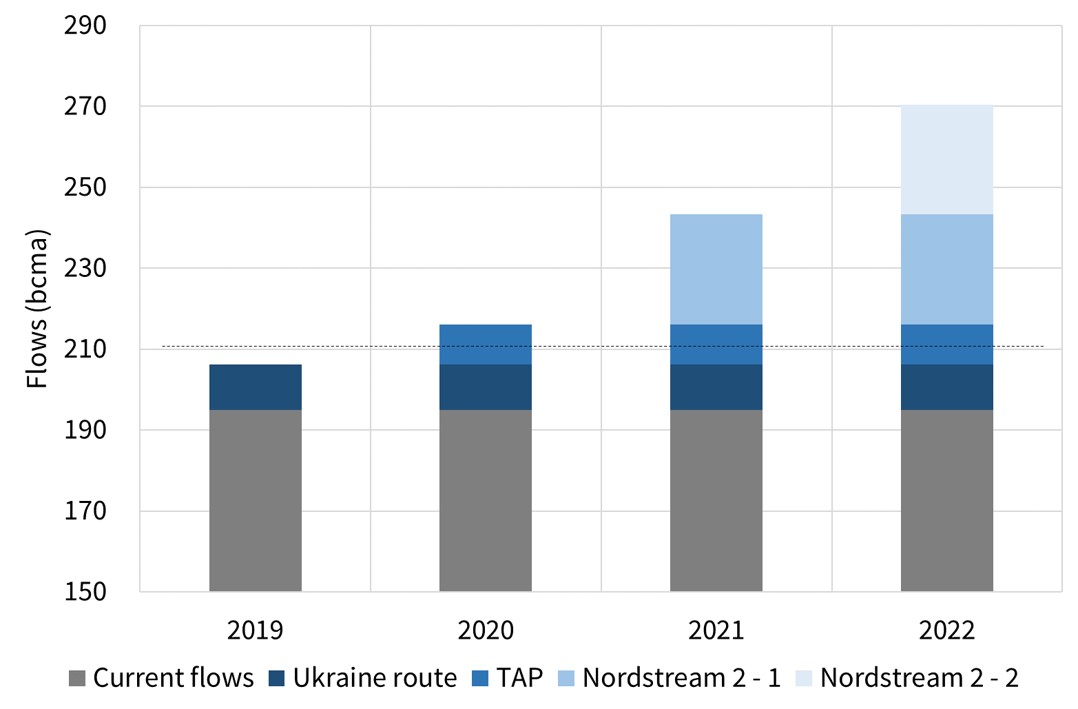
Chart 2 shows current annual capacity headroom based on a comparison of projected 2018 flows versus available capacity across the 3 existing routes. The chart also illustrates the potential impact of the TAP and Nordstream 2 pipelines in raising capacity headroom.

Chart 2 Existing and projected annual capacity headroom for key Russian routes

Source: Timera Energy

It is important to note that not all of the annual capacity headroom in the chart is necessarily accessible. Flows on certain pipes may vary across seasons (e.g. be constrained in winter but not in summer) which can reduce annual flow potential.  There are also contractual & logistical constraints that can impact full utilisation of available capacity (e.g. as described for TAP above).

Tight capacity headroom on marginal sources of supply is a catalyst for price volatility.  So watch out for potential fireworks across the next two winters (18/19 in particular).

From 2021 capacity constraints are likely to ease rapidly with Nordstream 2.  That potentially opens the door for significant growth in Russian imports up towards 250 bcma.

Power plant optionality & dispatch cost hurdles

The transition taking place in European power markets is reshaping supply stacks. Retiring coal, CCGT & nuclear plants are being replaced with a combination of:

  • Renewables: zero/low variable cost capacity, dominated by wind and solar
  • Peaking flex: higher variable cost capacity, dominated by gas engines, batteries and DSR.

This structural shift in capacity mix is taking place across all of Europe’s power markets, albeit at varying speeds.  It has two key impacts on supply stack dynamics that can be summarised as follows:

  1. Steepening: supply stacks are pivoting steeper as a result of removing coal/CCGTs (middle of the stack) and replacing with low variable cost renewables (bottom of the stack) & high variable cost peaking flex (top of the stack).
  2. Shifting: growth in intermittency is causing growing fluctuations in supply stacks (shifting left and right) as wind & sun conditions constantly change.

Both these factors support a structural increase in intraday price shape and in price volatility. Steepening causes a greater price impact for a given change in demand.  Shifting causes greater fluctuations in the marginal capacity units setting price.

Rising price shape and volatility increases the flexibility value or optionality of power plants.  In this article we consider how power plant optionality behaves in relation to variable dispatch costs across different capacity types (renewables, conventional thermal and peaking capacity).

The ‘in the moneyness’ of options drives value capture

The optionality of power plants is derived from their flexibility to ramp output up and down.  They are essentially granular strips of call options on the spread between market power prices and plant variable costs.

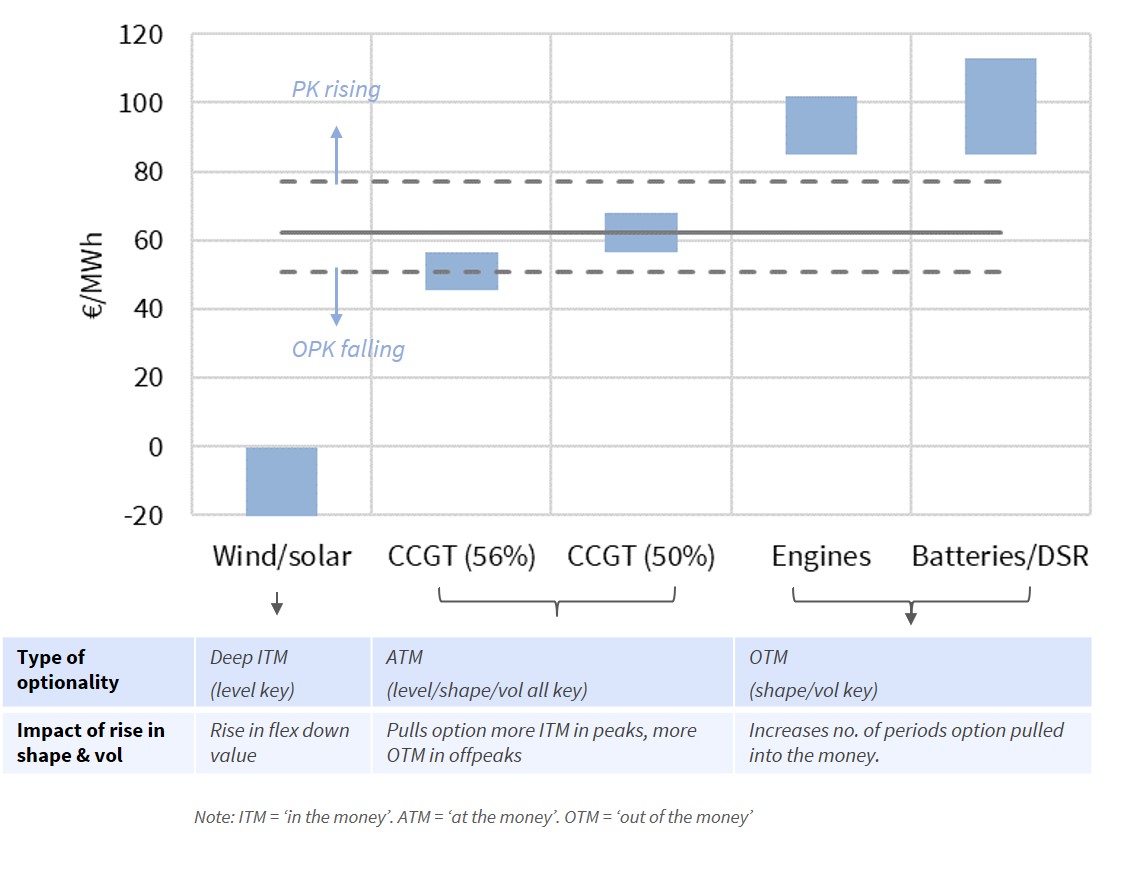
We illustrate this relationship in Chart 1 which illustrates the variable cost dispatch hurdles (effectively the varying option strikes) for different capacity types.

Chart 1: Variable cost dispatch hurdles vs market prices


Source: Timera Energy. Note battery dispatch hurdle is more complex than for thermal assets as described below.

Renewables

The optionality of renewable capacity (such as wind and solar) is deep ‘in the money’ (ITM) given near zero (or even negative) variable dispatch costs.  In wholesale market terms, the deep ITM nature of renewables means their value is focused on the level of power prices, with a low value attributed to flexibility to respond to price shape and volatility.

The ‘price cannibalisation’ problem is particularly important for wind and solar capacity.  There is a strong correlation of high renewable output with weaker prices e.g. when the wind blows the price received by wind capacity falls.

Renewable flexibility is being used to provide balancing services in some markets, typically from ramping down when networks can’t cope with high wind load.  But revenues form a relatively small portion of overall margin.

Conventional thermal

The variable dispatch cost hurdles of CCGTs and coal units vary with plant efficiency and location.  But the optionality of these assets is typically closer to ‘at the money’ (ATM).  In other words, variable dispatch costs are close to the level of market power prices. This is reflected in the relatively tight nature of clean spark and dark spreads relative to power prices, particularly with rising renewable output pulling down power prices and thermal load factors.

Flexible ramping to capture price shape is becoming increasingly important for these units, as renewable output pulls down average price, spark/dark spread levels and load factors.  A similar logic applies for capture of price volatility e.g. caused by short term fluctuations in wind speed, solar patterns and demand.  In option terms, the extrinsic value of conventional thermal assets is rising as average prices and load factors decline.

Peaking flex

This group consists of a number of different capacity types across gas engines (of various efficiencies), GTs, batteries and demand side response (DSR).  On a variable cost basis these units are typically ‘out of the money’ (OTM) versus hedgeable market prices.  In other words unit variable dispatch costs are above even peak prices, as illustrated in Chart 1.

Batteries are a unique and more complex case that we have set out in more detail in a recent article. Battery dispatch is based on relative not absolute price signals (e.g. the time spread between individual hours). The dispatch cost hurdle depends on degradation costs & assumed offpeak charging levels. Dispatch may also reflect ‘shadow pricing’ of battery discharge against other peaking asset variable costs.

The characteristic that all different types of peaking flex have in common is their exposure to spot price volatility. The OTM nature of optionality means that value is realised by ramping to capture price jumps (and price dips in the case of batteries).

Why optionality is increasingly important

The portion of power plant value generated by ramping flexibility is rising, as renewable penetration pulls down average prices. The importance of plant optionality is set to continue to rise as stack steepening and shifting dynamics support price shape and volatility.

Investors and owners are confronting a key challenge in being able to quantify and capture the value of optionality of different types of capacity.  The starting point is to properly deconstruct asset optionality and analyse the interaction between variable dispatch cost hurdles and market prices.

3 key factors driving European hub prices

European hub prices have roughly doubled since Summer 2017 from 5 to 10 $/mmbtu (15 to 30 €/MWh).  Half of this price move has happened in a surge between Jul and Sep 2018.  Hub prices are sending a clear signal that the European gas market is tightening fast.

Three key factors are driving current hub price behaviour:

  1. LNG flows: Asia is pulling LNG supply away from Europe, given continuing strong demand.
  2. Power switching: Rising coal and carbon prices are dragging up gas for coal switching levels in European power markets.
  3. Russian flows: There are currently constraints impacting the incremental flow of Russian gas into European hubs. We address these in more detail today.

These 3 drivers have been behind the surge in hub prices across the summer.  Next comes winter, with an increased risk of demand shocks (e.g. cold weather) and supply shocks (e.g. infrastructure outages).  The European gas market looks to be heading into its tightest winter this decade.

In this article we set out how these drivers are interacting to set hub prices at the margin.  We also provide a framework with which to understand what could happen this winter, and the drivers of hub prices beyond.

How supply & demand are interacting to clear European hubs

The European gas market evolves around a network of interconnected hubs.  The Dutch TTF sits at the centre of this hub network and is the key pricing benchmark.  Prices across hubs are structurally converged on a forward basis.  Price differentials between TTF and other hubs reflect variable transport costs, except during times of temporary constraints.

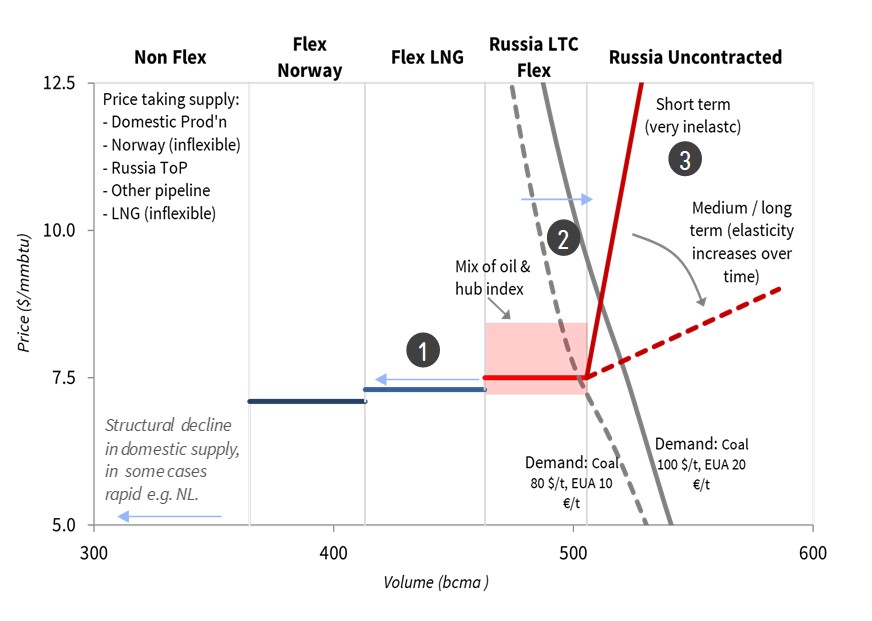
The interconnected nature of European hubs means that it is useful to take a step back when analysing price dynamics and consider the European gas market at an aggregate level.  Chart 1 shows a simplified view of the pan-European supply & demand balance for 2019.

Chart 1: European gas market supply & demand balance


Source: Timera Energy

We have purposefully simplified the annual supply & demand balance view in Chart 1.  Behind this lies a detailed country level build up of supply & demand in our European gas market model (which is linked to our global LNG market model & pan-European power market model).  There are also a number of more complex considerations at the sub-annual level e.g. storage balances and seasonal production flows.  But the advantage of this simplified aggregate annual view is that it allows a cleaner illustration of the ‘macro’ forces driving hub pricing.

Supply

The chart shows sources of European gas supply grouped into several key tranches:

  1. Non flexible price taking supply: consisting of (i) domestic production e.g. UK, NL, NO (very low variable cost) (ii) pipeline contract ‘take or pay’ volumes (ii) inflexible LNG contract volumes. These ‘price taker’ volumes flow regardless of hub price levels.
  2. Flexible Norwegian volumes: consisting of Norwegian production flexibility and flexible hub indexed contract volumes. These volumes are also effectively ‘price taking’ given Norway produces to an annual production target, but they are shown at a slight discount to current hub prices to reflect the fact that flows are seasonally profiled & optimised against hub prices.
  3. Flexible LNG volumes: made up of divertible European LNG supply contract volumes and LNG spot cargoes surplus to the requirement of other regions. Volume and flow depends on netback LNG spot price differentials relative to European hub prices.
  4. Flexible LTCs: Long term contract swing volumes above ‘take or pay’ levels, predominantly sourced from Russia (historically oil indexed but with rapid shift to TTF indexation), but also smaller volumes from other sources (e.g. North Africa).
  5. Uncontracted Russian flex: gas volumes that Gazprom can choose to flow into European hubs, or sell on shorter term basis (e.g. Q4 2018 auctions), given 80+ bcma of ‘shut in’ low variable cost production in Western Siberia.

A sharp reduction in Dutch production (Groningen earthquakes) and the impact of Asia pulling LNG away from Europe has shifted the European supply curve to the left in 2018, tightening the market.  This has been exacerbated by a shift of the demand curve to the right as coal & carbon prices have risen.

Demand

Gas demand from the industrial, commercial and residential sectors is relatively unresponsive to price in the shorter term.  In contrast, liquid power markets across Western Europe mean that gas demand from the power sector responds directly to gas market price signals.

The downward slope of the demand curve in Chart 1 reflects the potential for coal plant generation to ‘switch’ to gas plant generation across Europe as gas prices fall. Increases in coal & carbon prices shift the demand curve to the right (as shown in the chart). This is because for a given level of TTF, there is higher aggregate gas burn across Europe as the variable cost of coal plants increases.

The European gas demand curve has seen a major shift to the right since 2016.  In 2016 & 2017 this was driven by an increase in coal prices (from 40 – 100 $/t), in addition to reduced French nuclear output & low Spanish hydro availability.  The shift in 2018 has predominantly related to carbon (with a more than 250% increase in carbon prices across the summer to above 20 €/t).

The surge in hub prices since Jul 2018 is at the simplest level a function of the European gas demand curve being driven up a steep short term supply curve.  What happens to hub prices across this winter and beyond, strongly depends on the responsiveness of Russian supply.

The importance of Russia

The current tightness of the European gas market focuses attention on Gazprom as supplier of the ‘marginal molecule’ into European hubs. It is Russian gas flow dynamics that determine the slope of the key last tranche of the supply curve intersecting with demand in Chart 1.

Gazprom has been ramping up its sale of incremental short term volumes in response to the Q3 hub price surge. At least 1.5 bcm of additional supply has been flagged for sale via auction in Q4. Gazprom has not indicated a cap on these auction volumes, so this number is likely to grow, particularly if TTF prices remain strong.

The Russian flow response to higher hub prices is impacted by a mix of strategic, commercial and logistical factors.

In the medium to long term (i.e. beyond 2019), it is not in Gazprom’s strategic interest to have TTF price levels at current levels around 10 $/mmbtu.  Price levels above the Long Run Marginal Cost of new LNG supply (~ 8 $/mmbtu) are likely to encourage FID of new liquefaction capacity.  Once new LNG projects are committed, they compete with Russia for market share.

However, in the short term (i.e. next few months) Gazprom has other commercial & logistical considerations in play. Two of the three main routes for Russian gas into Europe have hit maximum flow constraints across 2018 (Nordstream and Yamal). The third route via Ukraine is the focus of the Q4 Gazprom auction volumes and has some spare capacity (although it temporarily experienced daily flow constraints over the summer). But flows via this route are impacted by complex geopolitics between Russia, Ukraine and the EU.

Then there is Nordstream 2. The next 3 months are critical for EU approval of this 55 bcma new pipeline that can help grow Russian market share in the 2020s. In that context, capacity constraints and high hub prices are a convenient backdrop for Russia in trying to secure approval (& resolve Ukraine route issues).

What to watch this winter?

There are 5 factors worth keeping an eye on this winter, that are likely to drive the European supply and demand balance and hub prices:

  1. Coal & carbon prices: Further price rises will continue to shift the European demand curve to right, tightening the gas market and driving up TTF. Price falls will have the opposite effect.
  2. LNG flows: Market consensus expects Asia to continue to pull LNG away from Europe across this winter. But Asian buyers are likely to have higher levels of contract cover after the spot price pain of last winter. So it is not a forgone conclusion that all available LNG flows to Asia (e.g. Asian spot prices have fallen back towards TTF in October).
  3. Shocks: Weather is key to demand shocks, with the impact of prolonged cold snaps fresh in everyone’s minds after the ‘beast from the east’. Infrastructure outages tend to drive supply shocks (which are correlated to cold weather, particularly in the North Sea).
  4. Storage: European storage balances are lower than usual coming into winter (partly due to rising hub prices in 2018). The decline rate of storage inventories across the winter will determine the Q1 2019 buffer against shocks.
  5. Russian flow dynamics: Last and perhaps most important are the Russian dynamics we set out in the section above. The level of incremental Russian gas that flows into hubs will be a key driver of hub prices across this winter (& beyond).

The tightness of the European gas market across the current winter can be summed up by the balance shown in Chart 1.  A steep demand curve is riding up a steep supply curve. Those are not conditions for price stability.  If there is one thing to expect this winter it is higher hub price volatility.

Briefing pack: European gas market in transition
Timera Energy has just published a briefing pack on European gas market drivers & commercial implications. This covers:

  1. Analysis of tightening European & global gas market balances
  2. Dynamics of 3 key current drivers of European hub prices (LNG flows, switching, Russian flows)
  3. Potential paths for hub prices, seasonal spreads & volatility
  4. Commercial challenges facing gas players given market transition (capturing asset value, portfolio construction, asset investment)

This pack can be downloaded here: European gas market in transition


UK battery investment 3: building an investment case

The current interest in UK merchant battery investment is supported by some powerful fundamental drivers. The most important of these is a strong case for increasing UK power price volatility as renewable intermittency rises and the supply stack steepens.

Policy changes are also creating tailwinds. Adjustments are being implemented in the Balancing Mechanism (BM) that should increase incentives for flexible response e.g. the PAR1 changes that sharpen cashout price signals. System charges are also likely to be reformed in favour of batteries (e.g. tackling the double cost of charge & discharge).

But an exciting fundamental backdrop is a different thing to a robust investment case.  In this article, our 3rd and final in a series on battery investment, we consider some of the key challenges facing investors in building a robust investment case.

Balancing 5 considerations

In order to build a merchant battery investment case, it is useful to start with a broader consideration of the challenges a battery developer is trying to navigate in developing a viable project.  These are set out in Table 1.

Table 1: Battery project success factors

Challenge Description Considerations
1. Capex How much do I need to invest over the project life? Low capex key to economics. Unit costs falling fast but with an uncertain rate of future cost declines. Short duration L-ion batteries currently winning the race.
2. Duration What is my cycling time? Focus currently on L-ion 1-2 hour duration. This skews investment case towards volatility chasing & extrinsic value. Economics of longer duration batteries more difficult.
3. Variable cycle cost How much does it cost me to cycle? Variable cycling cost determines the hurdle that must be overcome to capture price spreads. It is driven by efficiency, system charges, transactions costs & degradation allowances.
4. Degradation How does cycling impact my battery life? Cycling reduces battery life, accelerating replacement capex. Degradation depends on technology and cycling patterns. It needs to be explicitly integrated into the variable cycling cost hurdle.
5. Margin stacking How can I stack interdependent margin streams to make a viable return? The ability of a battery to generate margin depends on 1. to 4. Margin focus can vary by project. But wholesale/BM value capture is the foundation of merchant battery returns.

Battery developers are trying to optimise these 5 considerations to structure an investable project.  But how do you quantify margins for a merchant battery project to underpin an investment case?

Quantifying battery risk/return

Quantifying battery value is a different challenge to other types of conventional capacity.  Building a battery investment case using a traditional Base/High/Low margin forecast approach is a bit like trying to fly a fighter jet without radar. Unless you’re Top Gun there is a fair chance you will get cooked.

Robust battery storage valuation depends on understanding and quantifying project risk/return distributions, recognising the inherent uncertainty of battery value capture.

The first step in doing this is to properly deconstruct battery optionality. This is a costs and constraints problem:

  • Cost hurdle: The option ‘strike price’ of a battery is represented by the variable cycling cost hurdle, driven by efficiency, system charges, transaction costs & variable degradation costs.
  • Physical constraints: Battery constraints are defined by the physical cycling characteristics of storable energy volume and charge/discharge rates.

The second step in projecting robust battery margins involves probabilistic modelling of the exercise of battery optionality against uncertain market prices. Exercising this optionality involves a complex set of decisions on value capture at different points in time as market prices cascade towards delivery.

Battery optionality can be exercised against various price points, each of which have different liquidity, volatility and risk characteristics. For example:

  • Day-ahead – relatively liquid, lower risk (as prices can be secured in the auction), but lower volatility
  • Within-day – less liquid, higher risk but increasing volatility
  • BM bids/offers – potential for very volatile b/o levels, but with substantial forecast risk i.e. risk of not being dispatched
  • Cashout prices – high volatility, but with substantial forecast risk i.e. risk of losses as well as profits.

In addition the battery owner needs to optimise wholesale market & BM value with other interdependent value streams (e.g. ancillary services & embedded benefits).

We set out the practical challenges of monetising battery value in our last article in this series. The main difference between a ‘theoretical’ and a ‘tangible’ investment case is the extent to which these value capture challenges are reflected in battery margin analysis.

The most important challenge in creating ‘tangible’ numbers is incorporating the impact of price uncertainty on battery margin distributions. This involves analysis that captures both:

  1. Price dynamics: modelling the evolution of the relationship between different prices against which battery optionality can be exercised e.g. the dynamics of day-ahead vs within-day vs BM price distributions.
  2. Forecast error: accounting for the fact that merchant batteries are optimised and dispatched based on forecast prices, with inherent price forecasting error resulting in losses as well as profits.

A battery investment case should be underpinned by probabilistic analysis of how price uncertainty drives margin distributions and therefore project risk/return dynamics.

Raising capital & route to market

Batteries share some of the challenges that gas engines face when raising capital.  This stems from a focus on value capture from price volatility for both types of capacity.

Gas engines have benefited from the relatively secure nature of 15 year capacity agreements to support capital raising (at least until this year’s T-4 auction cleared at 8 £/kW). Shorter duration merchant battery projects do not enjoy that capacity margin buffer (given low derating factors).  This means that merchant battery investment cases to date are focusing on equity capital to absorb the market risk around revenues.

It is possible to firm up revenues over the front years of a battery project via signing a contract with a market facing counterparty (e.g. a supplier).  But the value haircut from doing so typically outweighs the benefits of reducing project cost of capital.

This leads to the route to market challenge. A battery project needs market access i.e. the ability to execute the trades required to capture value in the market.  But more importantly it needs a commercial function to optimise battery optionality.  This means hiring traders, developing analytical capability, building systems and implementing risk management processes.

The route to market challenge gives players with an established commercial function a competitive advantage in the battery space (e.g. suppliers & aggregators). There are also clear overlaps with the commercial optimisation of batteries and engines, that result in economies of scale for larger flexible portfolios.

So merchant battery projects may be born from a range of developers and business models. But battery projects (like engines) are ripe for consolidation. Step forward a couple of years and dominance of the battery space is likely to gravitate towards a narrower group of players who have the sharpest commercial functions to optimise the value of flexibility… and manage associated risk.

Briefing pack: Price dynamics driving asset value
Timera Energy has just published a briefing pack on UK power market dynamics & asset value. This summarises our views on the evolution of price shape & volatility, and its effect on UK power asset risk/return dynamics. This pack can be downloaded here: Price dynamics driving asset value


Global gas market risk shifting to the upside

Price behaviour is the most objective barometer of market balance.  And gas prices in 2018 are signalling a tightening market. Two price moves this year have sent up a flare that risk is shifting to the upside.

Firstly, Asian LNG prices maintained a significant premium (1.0-2.5 $/mmbtu) above European hub prices across summer 2018.  Asian prices temporarily diverged from TTF across the last three winters to meet seasonal demand (especially in the case of China). But the fact that the price premium to Europe has remained elevated through a period of traditionally weaker seasonal demand has flagged a tighter LNG market.

Secondly, there has been a summer surge in European hub prices, which have risen by more than 30% from Jul – Sep 2018. This price rise has been the result of higher carbon prices pushing up power sector switching levels and tighter competition for available LNG.  The TTF spot price surge & steep forward curve backwardation is symptomatic of a scarcity of near-term gas supply.

In today’s article we take a step back and look at the global gas market balance and potential price evolution between now and 2025.

Downsize risk diminishing… but not gone

Wind back the clock to 2015 and there were broadly two paths the LNG market could take in absorbing more than 100 mtpa of committed new supply coming to market across 2015-20:

  1. High Asian growth: A high Asian LNG demand growth trajectory could just about keep pace with new supply. In this case, the impact of surplus LNG volumes ‘spilling’ into Europe was likely to be limited.
  2. Low Asian growth: A low Asian growth trajectory meant substantial volumes of surplus LNG would need to flow to Europe, potentially pushing TTF prices down towards Henry Hub levels.

Step forward to 2018 and Asian LNG demand has grown at a blistering pace across the last three years. Growth has been led by China, which has undertaken a strong policy driven transition from coal to gas to address urban pollution issues.  At the same time some LNG projects in Australia and the US have suffered schedule slippage reducing supply projections.

Chart 1 shows Chinese LNG demand over the last 5 years. After standing still in 2015 (-4%), Chinese demand has grown at 31% and 47% across 2016 & 2017 respectively.  In 2018 Chinese LNG imports are running almost 50% above 2017 levels to the end of August.

Chart 1: Chinese LNG demand 2014-18


Source: Timera Energy

The pace of Asian demand growth has been so rapid this year, that Asia has been pulling LNG away from Europe across summer 2018 as opposed to spilling surplus LNG. This has been reflected in the Asian price premium over TTF.

From where we stand now in 2018, two factors have reduced downside price risk compared to 2015:

  1. Capacity delivery: More than 50% of the current wave of new LNG liquefaction capacity is now online. The time window of potential oversupply has narrowed accordingly.
  2. Growth trajectory: The current growth trajectory for Asian demand is keeping pace with new supply. This reduces the risk of a ballooning surplus.

However, downside price risk is not dead and buried. The Chinese demand growth halt in 2015 is a reminder that Asian demand growth can surprise to the downside as well as the upside, particularly given the 2018 surge in prices.  The most obvious threat to demand is a global recession (given we are ten years into an economic expansion).

There is still more than 50 mtpa of committed supply coming online across 2019-21. If this outstrips demand, then a spill scenario pushing European hub prices down is still a credible risk.

Upside risk in 2020s is rising

Beyond the 2019-21 horizon, the global gas balance has tightened given an expectation of a continuation of the strong Asian demand growth experienced across 2016-18. This means the risk of a gas market squeeze in 2022-25 has increased substantially.

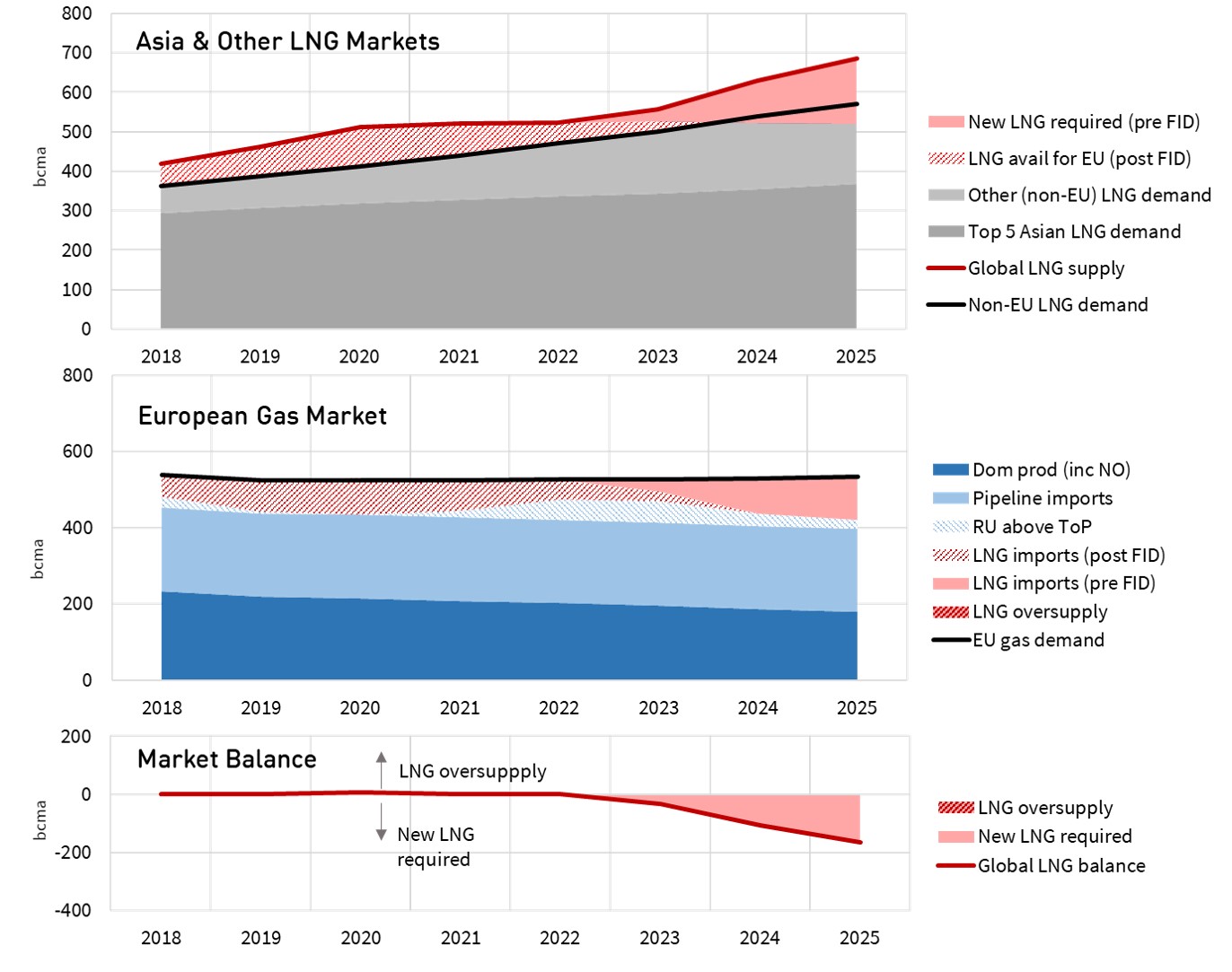
Chart 2 illustrates the balance of the LNG market if Asia continues on its current high demand growth trajectory.  The chart shows the supply and demand balance in the LNG market (top panel), and European gas market (middle panel). It also shows LNG market balance based on current committed supply (bottom panel).

Chart 2: LNG market supply & demand balance under a High Asian Growth scenario


Source: Timera Energy

The bottom ‘market balance’ panel highlights two important implications of the current rate of Asian demand growth:

  1. There is little to no surplus LNG spilling into Europe over the 2019-21 horizon
  2. The LNG market needs new supply from 2022.

FIDs for new liquefaction projects have been thin on the ground since 2016.  The only projects of scale that have committed to proceed are the Qatari expansion & the Shell led Canada LNG project announced last week.

These projects are not enough to meet the supply gap given the current pace of demand growth.  Projects take 4 to 5 years to come online post FID.  This means the timing and scale of new FIDs over the next 12 months will likely be critical to determining how tight the LNG market will be across the 2022-25 horizon.  The risk of a sharp squeeze is increasing.

3 potential paths for price evolution

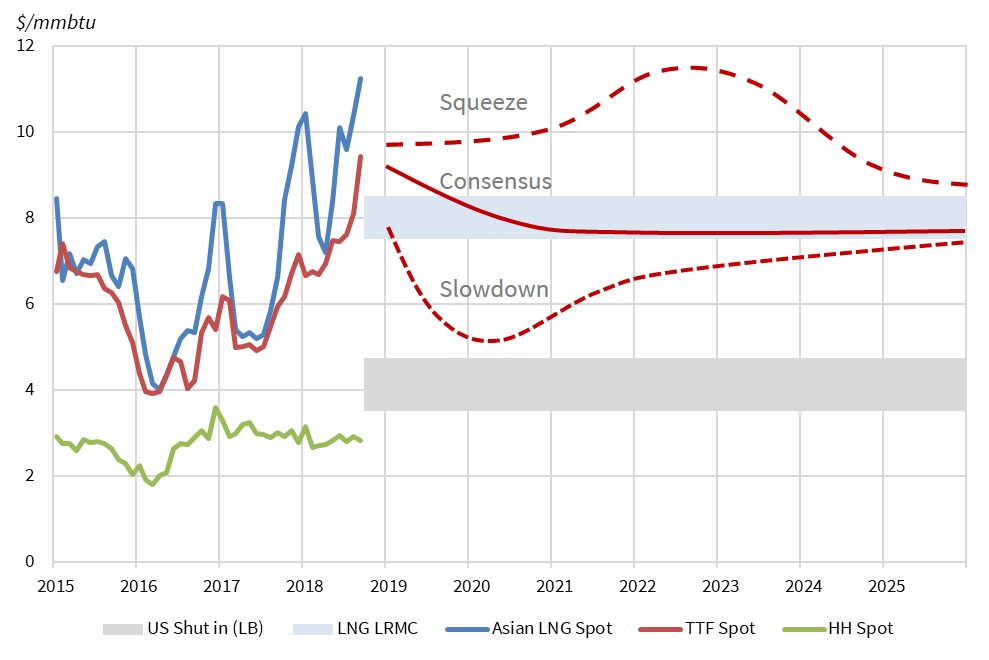
Chart 3 shows three illustrative price paths for European hub prices to 2025. We have not shown Asian spot LNG prices.  But these are likely to remain structurally linked to TTF, given large volumes of flexible LNG supply that can arbitrage price differentials (albeit with a continuation of significant short term Asia vs TTF price spread volatility given supply chain response constraints).

Chart 3: 3 illustrative TTF price paths to 2025


Source: Timera Energy

  1. Consensus

The central path follows forward prices for the first 3 years and then assumes prices remain flat in real terms at 7.5 $/mmbtu, at the lower end of consensus estimates of the Long Run Marginal Cost (LRMC) of the next wave of LNG supply.

This is consistent with Russia increasing gas flows into Europe across 2019-21, in order to ease prices back to levels that make LNG project FIDs more challenging.

Gazprom has a strong incentive to prevent a competitive surge in the FID of new LNG projects across the next two years. New LNG projects are a clear threat to Russia because once committed, they represent price taking gas that can flow into Europe if a surplus arises.

  1. Squeeze

The higher price path is consistent with a continuation of strong Asian demand growth. This could be coupled with delays/issues with new LNG supply (as has been the case across 2015-18).

In this scenario, Asia continues to pull LNG supply away from Europe at the same time domestic production is declining.  Price evolution is also consistent with Russia failing to dampen price rises, due to capacity constraints or political issues (e.g. Nordstream 2 delay, Ukraine route issues).  Under these conditions, European hubs are pulled higher as they compete with Asia for LNG.

A perceived higher price path is likely to incentivise more LNG project FIDs during 2019 and 2020.  This would likely set up a price decline in the mid-2020s as new capacity comes online, the extent of which depends on the pace of global demand growth.

  1. Slowdown

The lower price path is consistent with some form of interruption to the current rate of Asian (and/or European) demand growth. A global recession is the most obvious example, but this could also come from slowing Asian demand in response to recent price rises.

Within Europe, falling hub prices would also be consistent with an increase in Russian flows (2019-20) to pull prices back down below levels supporting new LNG FIDs.

The influence of any of these factors is only likely to be temporary across the 2019-21 window.  Beyond that it is hard to build a scenario where prices do not move back towards levels consistent with investment in new supply.

These 3 price paths illustrate the range of uncertainty over the next 5 years confronting portfolios with gas price exposure.  But behind this uncertainty, two key structural drivers remain: demand growth in Asia and declining domestic production in Europe. It is those drivers that are shifting gas market risk to the upside.