Early warning signs of an emerging markets problem?

In our last article of 2013 we posed a question around the vulnerability of energy markets to an economic shock.  We specifically considered the case of fallout from the current unprecedented global experiment in monetary expansion.  By the end of January 2014 it looks like there could be a potential candidate to test our hypothesis in the form of a shock to emerging market economies.  There is certainly not yet any conclusive evidence of a crisis.  But some warning signals have been flashing amber as January has progressed.  We illustrate these in this article with the use of several charts.

Emerging economy linkage to energy markets

We have been keeping a close eye on China as a key theme of this blog.  This is primarily because the state of Chinese economic growth is a useful barometer for the strength of commodity markets, given the key role China plays in driving global commodity demand growth.  While we are fully bought into the long run story around the emergence of China, it seems to us there is a growing risk of a shorter term hiccup.  There are currently a lot of somewhat unimaginative projections of Chinese growth that extrapolate recent history for ever.

But China is not the only developing economy that has an important influence on commodity markets.  India is the world’s second largest importer of coal and could potentially surpass China in the next 5 years.  India has also just overtaken Japan as the world’s 3rd largest importer of crude oil.

Closer to Europe, Turkey’s growing demand for energy has an important influence on coal and LNG markets.  Turkish demand for spot LNG over the current winter has been a factor behind soaring global spot prices.  In fact energy costs are the principle driver behind the eye-opening $60bn Turkish current account deficit that has been making headlines as the Turkish Lira has fallen over the last month.

Some warning signals flashing amber

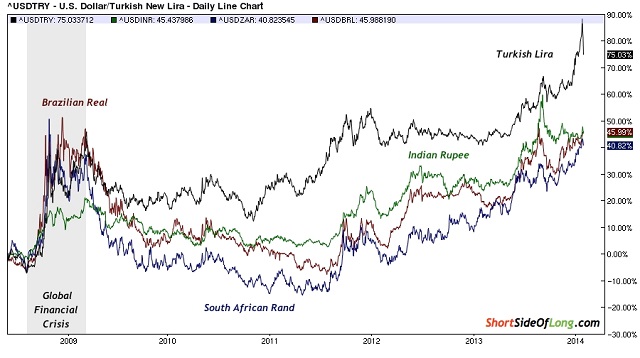
In order to examine the impact of events in emerging economies it is useful to look at several charts.  Chart 1 shows the evolution of the USD against several key emerging market currencies (i.e. a rising line on the chart means a falling currency against the USD).

Chart 1: Emerging economy currencies in downtrend

EM currencies

While it has been the Turkish lira that has dominated recent headlines, there has been a pronounced downward trend in a range of emerging market currencies over the last 6 to 12 months.  The US Federal Reserve announcement of its plans to ‘taper’ monetary expansion (or Quantitative Easing) in mid 2013 has been a key driver.  As QE is unwound, foreign capital that has been chasing higher returns in emerging economies is returning to the relative safety of the developed world.

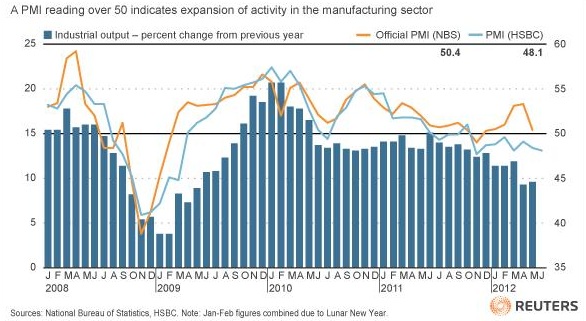
Chart 2 shows China’s manufacturing sector, measured by the Purchasing Managers Index (PMI), returning to contraction in January.  This appears to be signalling an end to the brief recovery in the second half of 2013 and may indicate weakening Chinese commodity demand in 2014.

Chart 2: Chinese manufacturing contracting again

China PMI

(source HSBC, Zero Hedge)

The Baltic Dry Shipping Index is a also useful indicator of global economic activity and trade flows.  Its sharp decline in January, shown in Chart 3 below, is another warning signal to watch.

Chart 3: Baltic Dry shipping index

BDI chart

 (source Stockcharts.com)

One of the key implications of a shock to emerging economies is its potential impact on the level of coal prices.  Chart 4, courtesy of the Reuters power and gas team, shows the API2 (European benchmark) year-ahead futures contract languishing around the key 80 $/t support level.  Continued weakness in coal prices is an important factor supporting the competitiveness of coal vs gas plant in European power market supply stacks.  It is also offsetting the effects of the recent uptick in EUA carbon prices.

Chart 4: European coal futures in decline

coal API2

 (source Reuters)

Beyond the nearer term horizon, weakness in emerging economies could also have an important impact on the LNG market.  Projected LNG demand growth is heavily skewed towards emerging economies (e.g. China, India, Argentina, Turkey) and a shock to growth would flow through to energy demand.  A more prolonged set back for emerging markets could leave a material dent in global gas demand projections over the remainder of the decade.

The charts set out above, illustrate some useful indicators to keep an eye on.  The current warning signals may of course recede again.  The global economy has managed to navigate past a number of icebergs over the past 5 years, assisted by further bursts of monetary expansion.   But if the current warning signals were to evolve into a more serious set back for emerging markets (e.g. similar to the crisis of the late 90s), then this would likely have an important impact on energy pricing and demand.

UK Capacity Market to become a reality in 2014

2014 will mark the end of the energy only power market that has served the UK over the past two decades.  By the end of this year the energy market will co-exist with a Capacity Market.  The UK government has announced that it will stick to its aggressive implementation timetable.  So barring any embarrassing delay, the first capacity auction will take place in November.

This auction will target the delivery of capacity in the winter of 2018/19.  But the impact of the Capacity Market will be felt long before the end of the decade.  The outcome of the 2014 auction will be a key driver of decisions to build, mothball or close gas & coal fired capacity over the interim period.  This will have important implications for the system capacity margin and pricing in the wholesale energy market.

Implementation of the Capacity Market will fundamentally transform UK pricing dynamics and generation returns.  It is also likely to be the blueprint for similar capacity markets across Europe.   This is the first article in a series where we will address the structure, pricing dynamics and value/risk impact of the new Capacity Market.


UK Capacity Market 101

If you had recently returned to the UK power market after having been lucky enough to take a 5 year holiday, you would probably be in need of a stiff drink.  Unfortunately whisky would do little to help you understand the government’s Electricity Market Reform (EMR) package.  In fact anyone claiming to be able to enlighten you as to the workings and implications of EMR is likely to be dangerously removed from reality.

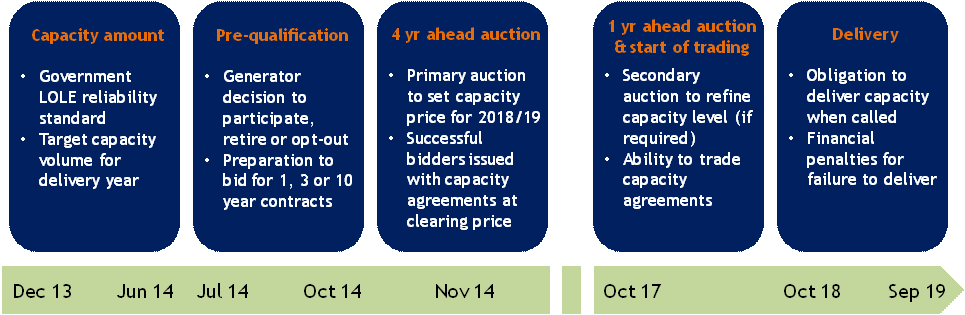
Even for those of us who have endured 5 years of Electricity Market Reform, the Capacity Market is a special challenge.  It is essentially a correctional policy mechanism, attempting to compensate for the market distortions introduced by the other EMR policies.  As a result the design is complex and it is still evolving.  But we start by setting out a brief outline of the key elements announced to date, illustrated in diagram 1.

Diagram 1: Capacity Market elements & timeline into first delivery
Cap Market Timeline

Amount of capacity

A reliability standard will be used to determine the target system capacity level.  This standard will be based on what the government deems to be an acceptable loss of load expectation (or LOLE).   The government has said it intends to set this at 3 hours per year (i.e. a system security level of 99.966%).

Guided by the reliability standard, National Grid as the System Operator will then undertake analysis to determine the volume (GW) of capacity required to meet this standard in each year.  This volume will then set the target level for capacity auctions.

Participation

Capacity covered under other policy support mechanisms (e.g. FiT/CfD, RO, RHI) will not be eligible to participate in the Capacity Market.  In practice this means the exclusion of most low carbon generation capacity, although Grid will of course still include this capacity in calculating the target system capacity level.  Interconnection capacity will also initially be excluded, although with a view to later inclusion.

So Capacity Market participation will primarily be focused on new & existing gas plant, and existing coal plant.  While in principle it is a voluntary market, generators will be strongly incentivised to participate.  But existing assets have the option to retire rather than participate (e.g. at asset end of life).  Demand side response and power storage assets will also be able to participate.

Auctions

The primary capacity auction will be held 4 years ahead of each delivery year.  This is intended to allow the necessary lead time to develop new plant if successful in the auction.  The government has said it also intends to hold a secondary auction at the year ahead stage with a view to ‘refining’ the capacity balance if required.  The auction process will follow a descending clock format.  Auctions will be ‘pay as clear’, i.e. all participants will receive the clearing price of the marginal bidder.

The government has said the Capacity Market will consist of 3 key forms of capacity agreement:

  1. 10 year contracts to support new generation assets
  2. Up to 3 year contracts to support major refurbishment of existing assets
  3. 1 year contracts for existing generators

Importantly, only capacity providers that incur costs above a certain threshold (primarily 1 and 2 above) will have ‘price maker’ status, i.e. be allowed to bid freely to set the capacity price.  Bidding will however be constrained based on a government measure of the cost of new entry, with a view to protecting the consumer.  Existing plant will participate as ‘price takers’ unless they can demonstrate costs incurred above a predetermined threshold (e.g. there may be a case for CCGT which are currently making a loss to recover costs that would otherwise have caused the plant to close by 2018).

We will consider capacity pricing drivers and benchmarks in more detail in our next article.

Trading

In principle the government intends to facilitate the secondary trading of capacity rights between auction and delivery.  However this is likely to be restricted until the year-ahead of delivery.  This element of the market design looks to be dosed with a healthy measure of academic fantasy.  From the current CM design, it looks unlikely that capacity rights will be ‘commoditised’ to the point required to support significant volumes of secondary trading.

Delivery & payment

In the delivery year, Grid will manage periods of system stress via Capacity Market warnings.  These will be issued 4 hours in advance of the requirement to deliver electricity.  Holders of capacity agreements will be obliged to be available and ready to deliver a specified quantity of electricity when called upon in order to avoid financial penalties.  The penalty structure is still under development but will likely be quite punitive, although with a mechanism to cap generator exposures.  Grid will also have the ability to carry out spot checks on capacity delivery capability outside periods of system stress.

And the cost burden of this complex exercise?  That of course sits with the end consumer and is likely to be smeared across suppliers based on contribution to peak demand.


Some key considerations for market participants

It is easy to get bogged down in the complexity of the market design.  But with a basic understanding of the concepts it is possible to start to draw some conclusions on the commercial impact of the Capacity Market.  We address a few of the more obvious considerations at a summary level below, before returning to explore these in more detail in our subsequent articles.

What will determine the capacity price?

The key factors driving capacity price in any delivery year will be (i) the projected requirement for incremental capacity and (ii) the cost of providing that incremental capacity.  During periods where a capacity shortage is anticipated against the system target, participants will compete to provide incremental capacity.  So the costs of CCGT refurbishment and of CCGT/OCGT new build will be key pricing benchmarks.  During periods of adequate capacity margin, the capacity price is likely to be driven more by fixed cost recovery on existing assets.

While cost benchmarks will be important, the limited number of participants and complexity of market design will ensure that market power will also play a key role.  We come back to capacity pricing as the key focus of our next article.

What are the implications for generation returns?

Historically, returns on conventional UK generation assets have been firmly focused on the wholesale energy market, with top-ups from participation in the balancing market and provision of balancing services.  That is set to change significantly.  Going forward this focus will expand to cover 3 buckets of generation margin: energy market, capacity market and balancing/ancillary services (which are likely to become an increasingly important source of gross margin).

Generation margin will shift between these buckets depending on factors such as system capacity, relative fuel pricing and plant type & location.  While in principle capacity payments represent a more stable source of income than wholesale energy margin, the Capacity Market will carry an unwelcome exposure to regulatory risk and the potential for market manipulation.  So a key challenge for generators will be to anticipate and manage the value & risk that accrues across these 3 margin buckets.

What are the implications for wholesale energy prices?

The commercial decisions of asset owners and investors will increasingly be driven by the return across all 3 buckets of generation margin.  So there will be a key dependency between capacity pricing and wholesale energy pricing.  A higher generation recovery from the Capacity Market will under normal circumstances adversely impact wholesale power prices (and vice versa).

Variable generation cost (i.e. fuel, carbon, VOM) will remain the key driver of power prices.  But the extent to which wholesale prices rise above variable cost will depend on capacity pricing and generator ability to exercise market power during periods of system tightness.  The volume of capacity targeted by Grid via the capacity auctions will also be a key factor determining the extent to which power prices rise above variable cost.

What happens between now and 2018?

Despite trying to ram through the Capacity Market implementation by November this year, the government still faces several nervous years before it delivers any capacity.  Any recovery in demand or further closure of existing CCGTs may bring on major system stress prior to 2018.  As a result, the government is in the process of implementing Supplemental Balancing Service payments which give Grid the freedom to contract capacity in advance of 2018.

This means the ancillary/balancing services generation margin bucket may play an increasingly important role.  Existing gas and coal plant (particularly older assets close to retirement) may have significant leverage in negotiating reserve contracts with Grid as the system capacity margin tightens. 

The way forward to the first auction

It would appear to be ten minutes to midnight on an implementation timeline for such a complex policy mechanism.  But there are still a number of key areas of contention that are emerging from the industry consultation process.  As a result there has to be a meaningful risk of delayed implementation or a disorderly first auction.

Perhaps the greatest focus is on the structure of capacity contracts and the constraints around capacity pricing.  For example, generators are lobbying strongly for longer contracts to support both new build and life extensions.  The supporting arguments revolve around increasing bankability and reducing the cost of capital.  There is also contention around use of an OCGT asset as the basis for new entry cost to set bidding thresholds.  While there is a theoretical link between OCGTs and capacity cost, it is the cost structure of CCGT assets that dominates the UK capacity options.

Many of these unresolved issues are quite fundamental to the structure of the market.  But it is still possible to draw some sensible conclusions on Capacity Market implications.  For example on the pricing of capacity, impact on generation returns and implications for asset investment.  As the clock ticks down to the first auction, we will explore these issues in more detail over several subsequent articles.

We offer bespoke workshops on the commercial implications of the Capacity Market. These can be tailored to address issues such as business impact, asset strategy and market pricing dynamics. If you are interested please contact us.

Conventional power plant value analysis has evolved

The value of European gas and coal fired power plants is a very different proposition to what it was 5 years ago.  Growth in renewable output has eroded plant load factors and increased margin variability. Correspondingly, there has been a significant increase in the proportion of value driven by plant flexibility to respond to changes in market conditions.

Historically, conventional power plants have been built or bought based on relatively simple scenario analysis.  Plant value has been assessed against Base, High and Low price forecasts to give an indication of the potential range of value outcomes.  But changing conventional plant value dynamics have meant this approach has become largely obsolete.

Instead plant value analysis is evolving to better address market uncertainty, margin variability and the value of plant flexibility.  Defining the key drivers of plant value and risk over different time horizons is key to this evolution. This means applying more sophisticated analytical methodologies, in contrast to the more one dimensional scenario focus that has traditionally been applied.  But an increase in sophistication does not need to come at the cost of transparency.

Breaking the problem into bite sized pieces

It is useful to think of plant value over three key time horizons:

  1. Prompt dispatch: the short term horizon (e.g. < 1 week) over which the plant is optimised in the prompt forward and balancing markets, as price certainty and granularity increases (e.g. with clearer information on weather, load and availability).
  2. Forward curve: the medium term horizon (e.g. 1-2 years) over which forward curve liquidity is available to facilitate hedging of plant generation margin.
  3. Lifetime value: the plant lifetime horizon (e.g. 10-20 years) which drives asset investment decisions (e.g. asset development, sale/purchase, major capex spend).   

The boundaries between these horizons are a bit arbitrary, but what is important is the shift in focus on drivers of plant value and risk.  For simplicity, value and risk drivers can be grouped into 3 categories:

  1. Plant technical constraints: These are the physical characteristics of the plant that impact its ability to capture market value, e.g. ramp rates, efficiency curves, minimum down times and start costs.
  2. Spread levels: The structural market price conditions that drive ‘intrinsic’ plant margin as measured against projected future spark or dark spreads (i.e. the generation margin implied by the premium of power prices over the cost of fuel and carbon).
  3. Spread dynamics: The volatility and correlation of power, fuel & carbon prices that drive generation margin risk and the value of plant flexibility.

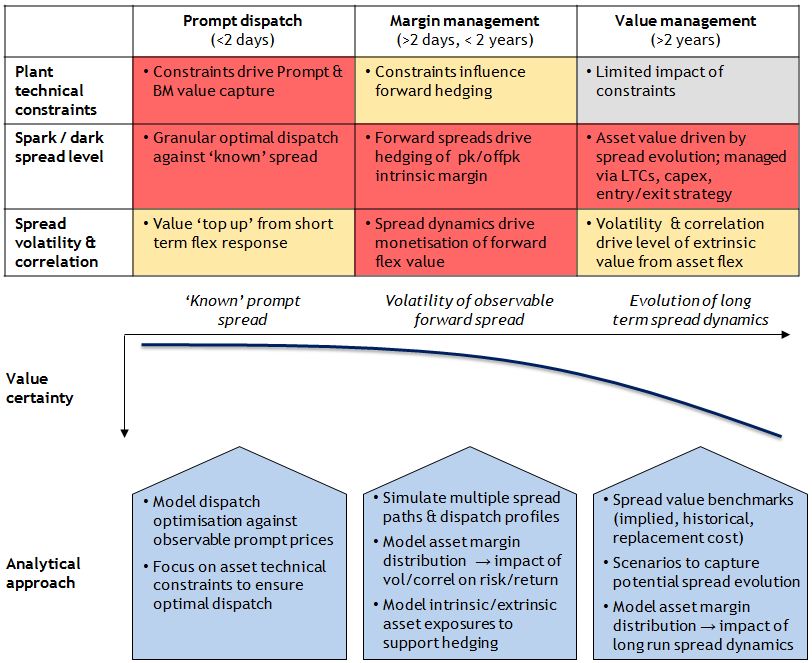
Breaking the problem down by time horizons and value/risk drivers, allows a more targeted approach to plant analysis as illustrated in Diagram 1 below.  The top table shows a ‘heat map’ of the drivers of value/risk over different time horizons.  Analysis can be targeted accordingly as shown in the blue boxes below the table, which we explain in more detail in the following paragraph.

Diagram 1: Analysing conventional power plant value

Thermal Plant Analytics

Source: Timera Energy          

Targetted value analysis

Generation asset owners often split responsibility for managing power plant value based on time horizon.  An asset portfolio or investment management team are typically responsible for managing plant value over the asset lifetime horizon.  While responsibility for value management over the prompt/hedging horizon is usually handed to a trading function (either internally or via contract).

This division of responsibilities is logical from an organisational perspective, but it is important that value is consistently measured and analysed across time horizons.  It may be difficult to hedge plant value in 5 years time, given an absence of liquid forward contracts.  But value over the lifetime horizon will eventually be monetised via hedging and dispatch optimisation decisions as the dispatch period approaches.  A common flaw in the analysis of asset value over a lifetime horizon is to ignore the practical implications of how value will be monetised via hedging and optimisation decisions.

While a consistent analytical approach is important across all value horizons, it makes sense to target the focus of analysis by time horizon as described below.

Dispatch horizon

Over the intra day to week ahead period ahead of dispatch, the focus of analysis is on plant optimisation to manage near term value and balancing risk. Plant technical constraints such as ramp rates are key.  Value analysis is about understanding the interaction of these constraints with transparent and granular prompt forward and balancing prices.  Understanding value uncertainty is less important than accurately capturing optimal dispatch decisions.  It is typically plant scheduling and operational trading teams that are most interested in value over this short term horizon.

Forward curve horizon

Beyond the dispatch horizon, value uncertainty becomes a much more important focus.  The focus of analysis is on hedging to capture value against a set of volatile forward power, gas and carbon prices.  Plant intrinsic value can be measured against forward prices relatively easily. But in an environment of weaker spreads some form of simulation based (or stochastic) modelling methodology is required to understand:

  • The value of plant flexibility to respond to changes in market price
  • The risk impact of price uncertainty on plant margin variability

A simulated distribution of plant margin can be used to inform value management decisions, e.g. understanding the value/risk impact of incremental hedging decisions.  Analysis of value over this horizon is typically of interest to trading desks as they hedge asset exposures.  But it is also important for asset managers in understanding how hedging decisions impact plant value and risk.

Lifetime value horizon

Asset managers and investors are typically most focused on quantifying and managing power plant value over a lifetime horizon.  Value uncertainty is significantly higher beyond the forward curve horizon.  Asset values are subject to major shifts in factors such as gas vs coal pricing, capacity margin evolution and regulatory landscape. Anyone tempted to rely on price forecasts to analyse plant value should compare forecasts from 5 years ago with the reality of today.  Targeting value analysis to recognise market uncertainty should be the key focus over an asset lifetime horizon.

The best way to achieve this is to use as many benchmarks as possible to bound potential plant value. For example:

  • Forward curve simulation: understanding what an extension of current forward market pricing would mean for plant value.
  • Scenario definition and simulation: projecting credible downside or recovery spread scenarios driven off required levels of asset remuneration (e.g. fixed cost recovery or life extension of marginal generation asset class), and then simulating potential margin distributions around these.
  • Implied value: using price data from (i) recent power plant transactions or (ii) indicative tolling contract pricing quotes to ‘back out’ market implied generation asset value.
  • Historical value: Analysing plant value capture over an historical horizon that captures different market conditions (this is an important way to benchmark the actual plant value that can be monetised versus theoretical modelled value).
  • Replacement value: Understanding the level of spreads that are consistent with the market delivering incremental generation capacity.  This is not just a simple analysis of new build cost (LRMC).   Given policy supported growth in renewable capacity, replacement cost is now more focused on cheaper sources of incremental flexible capacity (e.g. plant life extensions or flexibility enhancements).

All of these benchmarks can be translated into a view on the long run evolution of market spreads and generation margins.  But it is important to overlay simulation based analysis to capture plant extrinsic value, particularly as renewable output continues to erode conventional plant load factors.  In our view, a simulation based plant dispatch optimisation modelling approach is key to the consistent analysis of value across all three time horizons.

Using analysis to manage plant value

The analytical approaches described above are about gaining a better understanding of the behaviour of plant value and risk given market uncertainty.  Targeting analysis to the drivers of value & risk over different time horizons maximises the benefit of analysis to inform commercial decision making.

This may be decisions to invest in (or divest) assets.  Or it may be decisions on enhancing the value of an existing asset, e.g. investing to increase plant flexibility or understanding the maintenance/cost impact of changing operational patterns.  Simple scenario analysis no longer does justice to understanding the value of conventional power assets.  But by using targeted simulation based analysis and multiple value benchmarks, plant owners and investors are able to confront the impact of market uncertainty.

Steam coming out of the LNG shipping market

With rapid growth in the trading of spot and short term LNG cargoes, fluctuations in spot shipping charter rates are having an increasingly important impact on the pricing and flow of LNG.  The LNG shipping market has evolved rapidly over the last decade, driven by growth in global liquefaction capacity.  But the order and delivery of LNG vessels has been quite cyclical in nature.

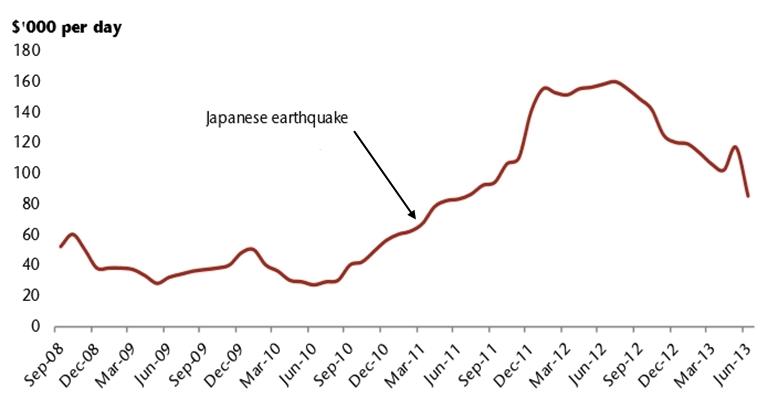
Shipping charter rates are the largest component of the cost of moving LNG around the globe.  Break even charter rates are estimated to be around 60,000 $/day.  But recent years have seen some wild swings in spot charter rates above and below this level.

Charter rates fell as low as 25,000 $/day at the depth of the financial crisis before recovering to 160,000 $/day post-Fukushima.  Spot charter rates are currently around 90,000 $/day, but a surge in delivery of new vessels in 2013 and 2014 could again tip the LNG shipping market into a period of oversupply.

LNG shipping – the basics

The fleet

The global LNG fleet consists of around 380 vessels.  The standard size for an LNG carrier has traditionally been 155,000 mcm.  However over the last 3 to 4 years the size of many delivered carriers has increased to 170,000 mcm as infrastructure has evolved to deal with larger vessels.

For the Qataris, size is everything.  They have developed their own fleet of Q-Max carriers with a capacity of 267,000 mcm.  Liquefaction terminals in Qatar are specifically designed to cater for these large carriers, with the benefit of size being lower energy requirements (~40%) given economies of scale with engine efficiency.

The fundamental drivers

Historically, source to destination LNG contracts backed by dedicated shipping capacity made the forecasting of shipping capacity requirements relatively straight forward.  However over the last decade, the evolution of LNG portfolio optimisation and growth in trading of spot cargoes has resulted in shipping market dynamics becoming much more complex.

Despite this complexity, demand for LNG shipping capacity can be broken down into two main drivers:

  1. The volume of LNG to be shipped.  Higher LNG demand means higher demand for shipping capacity.
  2. Average journey time and the proportion of ballasted (un-laden) voyages.  These factors are a function of the pattern of LNG trade flows, with longer average voyages and a higher proportion of ballasted voyages requiring more shipping capacity to move a given volume of LNG.

In other words, understanding LNG trade flows as well as global LNG demand growth is important in understanding tightness in LNG shipping capacity.

LNG shipping flows

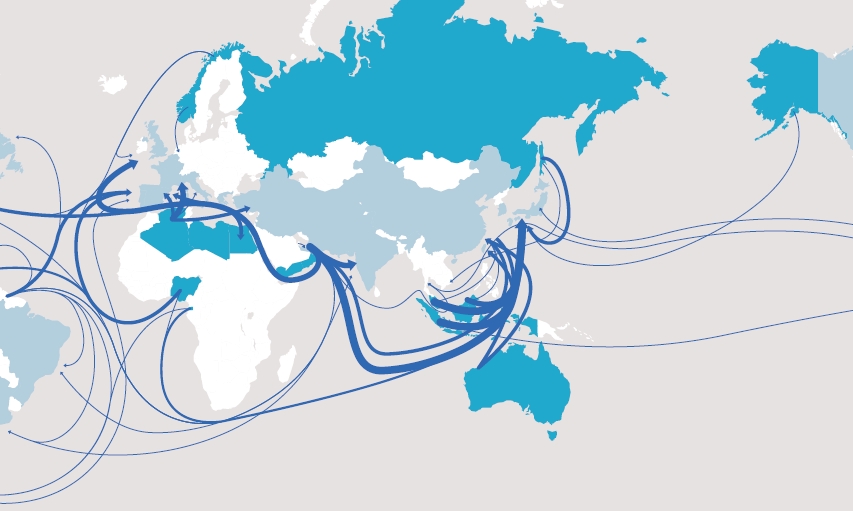
The shipping of LNG is focused on moving gas from producing nations to Asia. Key shipping routes include the Middle East to Asia, Australasia and South East Asia to Northern Asia and Africa to Southern Europe as illustrated in the schematic in Diagram 1.

Diagram 1: Global LNG trade flows 2012 (GIIGNL)

LNG flow                         

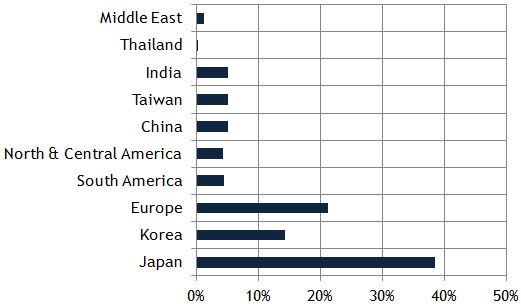
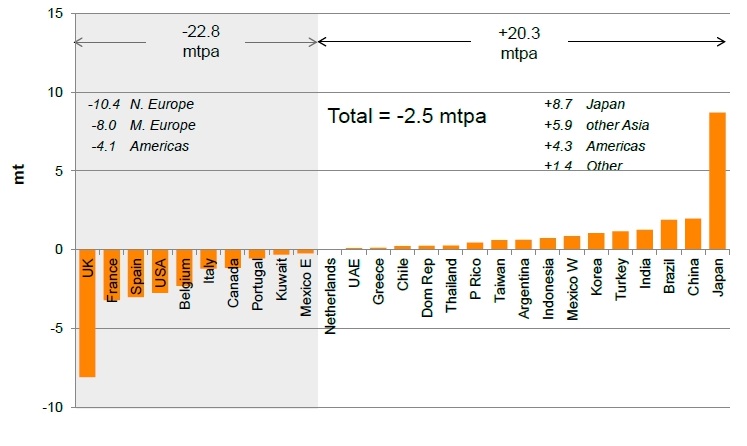
Since the Fukushima crisis, shipments to Asia have been bolstered by the diversion of gas originally intended for Europe.  This has had the effect of increasing both average voyage times and ballasted voyages, supporting the demand for LNG shipping capacity.  Diagram 2 shows 2012 LNG shipping flows by destination, with Diagram 3 illustrating how incremental flows have shifted with the diversion of European gas to Asia.

Diagram 2: Global LNG flow by destination in 2012

flow by destination

Source: GIIGNL, Timera Energy

Diagram 3: Incremental changes in LNG demand in 2012

2012 inc demand

Source: BG Group

The shipping outlook

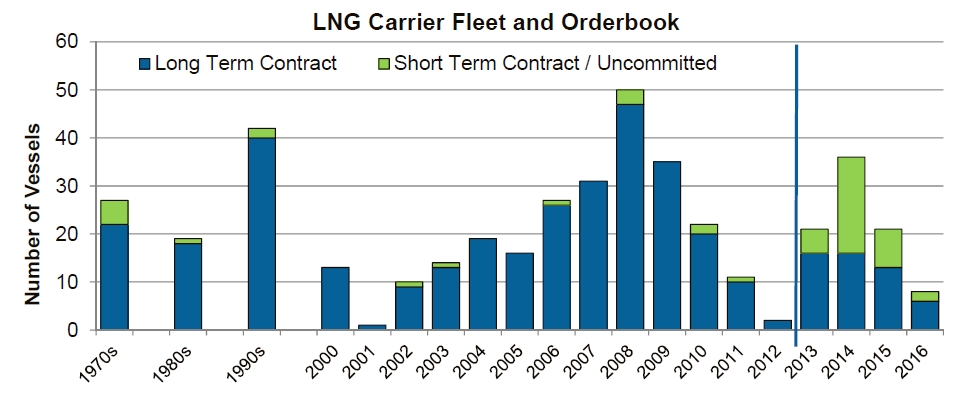
Historically, the delivery of new LNG carriers has been somewhat out of sync with LNG market demand for shipping capacity.  The primary issue is that there is typically a 2 to 3 year lead time for ship delivery.  The cyclical nature of ship delivery is illustrated in Diagram 4.

Diagram 4: LNG carrier fleet & order book

LNG fleet order book

Source: Clarksons, Teekay

This cyclicality has resulted in some pronounced fluctuations in shipping market balance, with the impact on spot charter rates illustrated in Diagram 5.

Diagram 5: LNG spot charter rates

charter rates 2

Source: Fearnleys Research, Jefferies

  • 2009-10 glut: A large volume of new carriers were delivered between 2007-09.  This in part matched rapid growth in liquefaction capacity but it also coincided with the onset of the financial crisis and a rise in US gas self sufficiency.  A shipping glut ensued with spot charter rates ranging from $25,000-$60,000 a day.  The glut also negatively impacted orders for new vessels.
  • 2011-12 boom: Post-Fukushima Asian demand caused a sharp reversal in shipping returns.  Not only was there a rapid increase in spot demand from Japanese buyers, but average voyage mileage increased as gas was diverted from all over the world to meet the Asian shortfall.  A lack of new shipping capacity also contributed to market tightness.  Between Q2 2011 and Q2 2012, spot charter rates almost tripled from around $60,000 to upwards of $160,000.
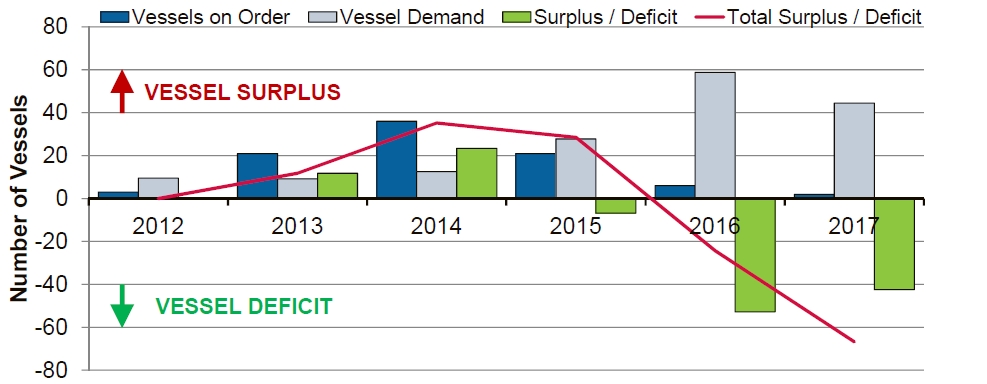
  • 2014-15 glut?: Spot charter rates in 2013 settled around 90,000 $/day.  However 2014 may mark the start of the next glut in LNG shipping capacity.  Diagram 4 illustrates the substantial order book of LNG carriers to be delivered over the 2013-15 horizon.  These ships will be entering the market during a period when there is little growth in new liquefaction capacity to absorb new shipping capacity.  The capacity surplus is likely to continue until at least 2016, as shown in Diagram 6, when volume ramps up from new Australian liquefaction and US export projects.

Diagram 6: Projected LNG carrier supply/demand balance

supply demand balance

Source: Clarksons, Teekay

The extent to which this period of shipping oversupply extends into the second half of the decade will largely come down to:

  • The rate of emerging market LNG import demand growth – a factor to which the whole LNG market is hostage
  • The timing and extent of delays in liquefaction capacity projects in Australia and the US
  • The impact of this new liquefaction capacity on global LNG shipping flows, e.g. by shortening average journey times

The development of new LNG shipping capacity has the potential to send spot charter rates back towards the 2009-10 glut levels.  LNG diversion to Asia is an important factor which is currently helping to support shipping charter rates.  But beyond this it will take new liquefaction capacity to soak up the new vessels being built.  So as sparks fly in the shipyards, ship owners are likely to be praying for a continuation of robust Asian spot prices and the timely development of Australian and US export projects to contain the damage.

Price spikes and the value of gas flexibility

European gas hub price volatility has been in steady decline over the last 3 years.  We explored the factors behind subdued volatility in an article last year on the death of gas volatility in Europe.   But despite this trend, there have been several periods of aggressive price spikes.  As winter matures and gas storage levels decline, we are again moving into a higher risk period for price spikes.

Falling levels of price volatility have contributed to a sharp drop in the market value of flexible gas assets (e.g. swing & storage).  But the periodic price spikes have been important drivers of the value of fast response flexibility (e.g. fast cycle storage).  In this article we look at how to treat price spikes when valuing gas flexibility.

Prompt gas prices periodically awake from their slumber

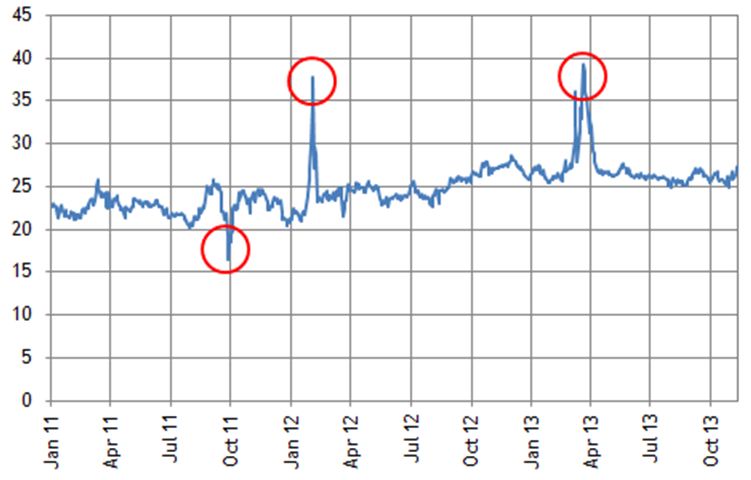
The main cause of price spikes is unforeseen shocks to short term fundamentals, often involving some form of major supply side incident.  The impact of supply shocks close to delivery are magnified by the inherent inflexibility (or inelasticity) of short term gas supply.  Three recent examples of European gas price spikes are shown in Chart 1.

Chart 1: TTF Day-Ahead prices 2011-2013

TTF Day Ahead Prices

Source: LEBA

There are 3 clear price spikes (1 down, 2 up) in the chart above:

  1. Oct-11: An unseasonal autumn heat wave caused a fall in gas demand with surplus gas trapped in a temporarily oversupplied market.
  2. Feb-12: An unexpected cold snap across Europe caused a temporary shortage of short term deliverability into North West European hubs.
  3. Mar/Apr-13: Prolonged periods of cold weather, low storage levels and major Norwegian supply disruptions caused a more prolonged period of tightness in the UK gas market, with price volatility exported to the Continental European hubs.

Each of these price spikes exhibits different characteristics (e.g. direction, magnitude, duration).  But in order to better understand the impact of spikes on flexibility value, it is useful to explore the analysis of gas price behaviour in some more detail. 

Price changes not absolute prices drive flexibility value

The value of flexible gas assets (e.g. swing contracts and storage capacity) is driven by differences in the value of gas across time periods (inter-temporal optionality).  Valuing these assets is a complex problem because the decision to utilise flexibility in any given period impacts the availability of flexibility in other periods (path dependency).

But ultimately flexibility value is driven by the behaviour of price changes (or price returns) between periods rather than the absolute price level in any particular period.  As a result, the pricing models behind gas flexibility valuation methodologies are concerned with capturing the period on period change in prices (price returns).  This includes  consideration of price spikes which consist of more extreme examples of price changes.

In most basic spot price models, the natural log of price returns (loge(pt/pt-1)) is assumed to follow a normal distribution with the width of the distribution governed by the level of volatility.  However, a common criticism of these models is that the distribution of observed gas price returns exhibits ‘fat tails’ when compared against a normal distribution.   Price spikes are typically the culprit.

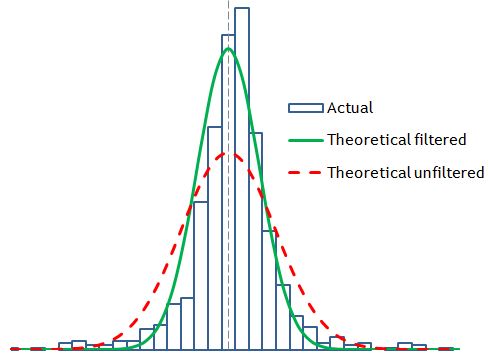
Chart 2 shows three distribution of Day-Ahead TTF price returns:

  1. An actual distribution of price returns from the start of 2009 to end 2013 (blue bars)
  2. A theoretical modelled distribution of price returns, based on measured historical volatility over the actual dataset, including price spikes (red dashed line).
  3. A theoretical modelled distribution of price returns, based on measured historical volatility over the actual dataset, filtering out price spikes (green line).

The definition of a price spike is somewhat subjective.  But in the filtered calculation we have filtered out every price return that is greater than 3 standard deviations from the mean.

Chart 2: Actual vs theoretical distributions of TTF Day-Ahead price returns

Gas Price Return Distibutions

Source: Timera Energy

The actual price returns reassuringly follow the classic bell shaped curve.  However the theoretical distribution based on an unfiltered volatility calculation (red dash line) implies a much wider distribution than what was actually observed (blue bars).  In many cases, a valuation based on the unfiltered data will over value flexibility.

The theoretical distribution based on the filtered data (green line), gives a distribution that is a much closer width than the actual distribution.   But this distribution underestimates the possibility of extreme price movements, which are an important driver of flexibility value (especially fast response flexibility).  So given current market conditions where price spikes are a major source of value, it is important that they are in some way accounted for in flexibility value analysis.

Capturing the impact of price spikes on value

There are three main approaches for dealing with price spikes in gas flexibility valuation models:

  1. Combining higher levels of volatility with stronger assumptions on mean reversion of prices
  2. Inclusion of a factor in the pricing model to explicitly account for the existence of price spikes
  3. Using a filtered volatility assumption in the primary valuation model and then explicitly estimating the incremental  value generated by spikes with a separate ‘back of the envelope’ calculation

In many cases option 1 is chosen by default without explicit consideration, by using an unfiltered price series to calibrate a pricing model.  But this can be a bit like trying to hammer a square peg into a round hole.  It creates price paths with a dog tooth pattern (many sharp price movements around the mean), generating theoretical price return distributions similar to the red-dashed line in the chart.  This will generally result in flexibility being over valued (especially fast response).

Option 2 would at face value seem to be the most sophisticated.  Incorporating spikes via a factor in the pricing model can generate price paths that look very similar to actual spot price history. However, estimating the parameters for these models is not straightforward or intuitive.  In addition, it precludes the use of some flexibility valuation techniques (e.g. trinomial trees) as it becomes difficult to analytically generate conditional probabilities for more complex price models.

Option 3 appears to be the crudest approach.  But isolating spikes and separately estimating the incremental value they create is typically the most simple and transparent means of tackling the problem.  Isolating the value contribution of spikes also allows a more robust analysis using several different benchmarks.  A useful starting benchmark is the flexibility value that could have been realised from different historical periods of price spikes.  As is often the case, simplicity and transparency is likely to increase confidence in using analysis to inform commercial decisions.


2013: Study the past if you would define the future

With Christmas rapidly approaching this is the last blog article for 2013.  We will be back next year on the 6th January.  But to finish off this year we take a step back and review 2013 energy pricing dynamics with a view to trying to better understand what may lie ahead. We also explore how a macroeconomic shock might upset current energy market trends.

Global energy pricing dynamics

Last decade was characterised by correlated movements in global energy prices.  There were some substantial price swings, focused around the boom and bust of the commodity ‘supercycle’.   But the pricing of oil, coal and gas largely reflected changing market views on the impact of emerging economy demand for energy, particularly with respect to China.

Oil, coal and gas prices have regained some of their independence this decade.  2013 has seen coal prices decline a further 20% as Chinese import demand has continued to slow.  Brent crude prices on the other hand have bucked the 2013 trend of falling commodity prices, remaining remarkably resilient against a backdrop of elevated unconventional production costs and continuing tensions in the Middle East.  For all the swings in spot crude prices, the back end of the Brent curve has remained firmly anchored around 85-90 $/bbl.

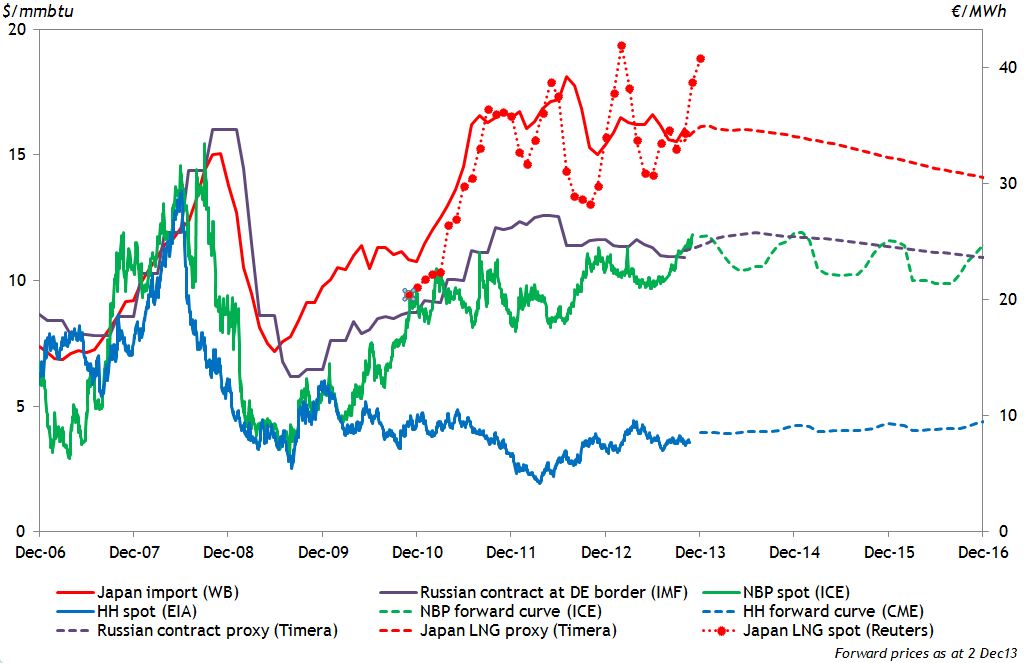
While the oil and coal markets are truly global in nature, significant regional price differentials have remained across the global gas market in 2013, as shown in Chart 1.  These price differentials largely reflect constraints in the ability to move gas from the Atlantic Basin (particularly North America) to Asia. But 2013 has seen the firming prospect of substantial volumes of US exports in the second half of this decade.  In our view these US exports are set to have a major impact on the global gas market.

Chart 1: Evolution of global gas price benchmarks

Global Gas Prices Dec13

Source: Timera Energy

With an absence of new liquefaction capacity and feed gas issues, the post-Fukushima global gas market remains tight.  Flexible European LNG supply has continued to be diverted to higher priced markets in 2013. But this has done little to temper the price premium of Asian and South American LNG over Europe. Spot LNG prices have remained volatile across 2013, although they have broadly reflected seasonal Asian demand, with prices currently strengthening again into the Asian winter.

Within Europe, hub prices have evolved in a manner consistent with oil-indexed contract pricing.  This oil-linkage has been supported by the diversion of flexible LNG supply and negotiated discounting (~10%) of a number of Russian oil-indexed swing contracts.

With European gas hub prices supported by oil, the 2013 fall in coal prices has seen a continued erosion of gas generation margins and load factors.  As a result of this and the continued expansion in renewable capacity, the relationship between coal and power prices has strengthened, particularly in Germany.

The last decade has seen dramatic shifts in price behaviour across oil, coal and gas markets.  In the context of this period the last two years have been relatively stable.  The trends of 2012 have broadly remained in place for 2013. Market consensus suggests these trends will continue into 2014.  But how useful is this as a guide?

Market consensus as a guide to the future

Looking forward into 2014 and beyond we are struck by a number of strong consensus market views.  For example:

  • The global gas market will remain tight for the rest of this decade, supporting a structural Asian LNG price premium.
  • European LNG supply will continue to be diverted, with gas hub prices remaining broadly linked to oil.
  • Gas-fired generation will remain expensive relative to coal in Europe for a number of years.
  • Gas generation margins will remain at current depressed levels for the rest of this decade (given renewable build and gas vs coal pricing).

Strong cases can be made for each of these views and they may turn out to be right.  But looking at the deviation of outcomes from consensus views across recent history (e.g. ‘supercycle here to stay’ – 2007, ‘global gas glut to last years’ – 2009), there is certainly the risk of some major surprises. One strong potential candidate to shock the status quo is an unhappy ending to the current burst of global monetary expansion.


Market shock case study: Monetary expansion fallout

2013 has seen yet another remarkable central bank sponsored increase in the availability of money.  The impact of this unprecedented global experiment in monetary expansion has not been specific to energy markets.  But it is sure to be a key factor shaping the evolution of energy markets going forward.

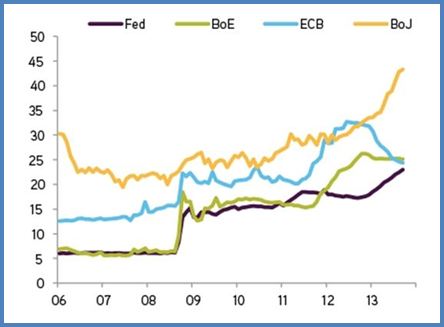
The competitive nature of monetary expansion has become clearer as 2013 has progressed, as shown in Chart 2.  Japan threw down the gauntlet in April with a promise to double its monetary base across the next two years.  Europe has paid the price with a sharply appreciating currency, although the ECB is in the process of trying to respond by further easing the cost of money.  And despite a rapidly declining budget deficit in the US, the Federal Reserve appears as enthusiastic as ever to provide liquidity by purchasing debt (taper or otherwise).

Chart 2: Central Bank balance sheets as a % of GDP

Central Bank Bal Sheets v2

Source: KKR, Haver Analytics

The result of the open liquidity taps has been a remarkable rise in financial asset prices in 2013.  The US benchmark S&P 500 stock market index has increased by about 25% to new all time highs.  Perhaps more importantly for energy markets, credit spreads in the developed world have compressed dramatically, reducing the cost of capital.  But these moves have been in stark contrast to a fall in commodity prices across 2013, with the benchmark CRB commodity index declining by about 10%.

Monetary expansion on this scale is a force to be reckoned with.  It may well ensure these market price trends continue through 2014.  But we suspect that it is the prices of commodities rather than financial assets that reflect the true state of the global economy.  Behind the purple haze of liquidity, there has been little in the way of structural economic reform to address the causes of the last financial crisis.  And with its 5 year anniversary approaching in March 2014, history suggests the current economic cycle is getting long in the tooth.

Perhaps the most important impact of the current liquidity boom is its distortion of the true cost of credit.  As 2013 has progressed, global markets appear to have increasingly priced in the continuation of cheap credit conditions over a long term horizon.  Low borrowing costs and low returns are again encouraging a boom in investor risk appetite.  Deja vu 1998/99, 2006/07.

As a result, the global economy looks increasingly vulnerable to a shock that causes the market pricing of credit to reassert.  But the monetary and fiscal response over the last 5 years has left central banks and governments ill-equipped to fight the next downturn.  Whether that downturn arrives in 2014 or later, the effects of global monetary expansion are likely to be a key driver of energy market evolution and perhaps the source of a major shock to market consensus.


An economic shock and energy markets

Exploring potential shocks to current market conditions is not an attempt to predict the future.  Rather it is a prudent exercise in risk management.  One powerful lesson from the last decade is that consensus views on energy market evolution are easily shattered.  So there is a clear benefit from challenging (or stress testing) commercial decisions and portfolio construction with an open mind as to future outcomes.

Defining relevant scenarios is of course company and portfolio specific.  But for example, what would the impact of one or more of the following outcomes be:

  • A period of surplus in the spot LNG market causing Asian spot prices to fall to a level where flexible supply flows back into European hubs.
  • Another period of significant disconnect between European gas hub prices and oil-indexed contract prices (similar to 2009-10).
  • A major slowdown in Chinese economic and industrial growth, e.g. reducing gas import demand and inhibiting a policy shift from coal to gas-fired generation.
  • A significant fall in gas prices relative to coal, shifting the competitive balance back towards gas-fired generation.
  • A prolonged period where oil prices fall back below 80 $/bbl.
  • A pronounced policy shift away from support for low carbon generation capacity.

Sound arguments can be made against each of these outcomes.  But before you discard them as impossible, think back to some of the shocks over the last decade; the commodity supercycle, fracking, the global financial crisis and Fukushima.  We subscribe to the old adage; it is dangerous to rely on forecasts, particularly about the future.

Happy Christmas

2013 has been another great year of readership growth for the Blog and we have again been widely published in the industry press (e.g. Energy Risk, Commodities Now, LNG Industry, Reuters).   We look forward to continuing in January.  In the meantime, thanks for your support and all the best for a Happy Christmas and relaxing break.

Carbon price floor impact on the UK power market

The UK carbon price floor is driving a wedge between the UK and European cost of carbon.  This will have an important impact on the competitiveness of gas vs coal generation in the UK.  Indicative forward market pricing suggests that gas plant may start to displace coal plant by the summer of 2016.   This has interesting implications for UK power price dynamics and generation returns.

Intervention to support the UK carbon price is one of the four pillars of the UK government’s EMR policy.  This is to be achieved via a tax funded top up premium that will increase the price of UK carbon above that of the EU ETS market price.  With the government publishing its intended carbon support levels out to 2016 in this year’s budget, we can start to get a clearer idea of the implications for the UK power market.

Gas vs coal plant competitiveness

The carbon intensity of electricity generation from a coal plant (around 0.9 t/MWh) is more than double that of a gas-fired CCGT plant (around 0.4 t/MWh).  So the carbon price floor acts to increase the variable cost of coal generation relative to gas.  This impact is currently relatively small given the current carbon support premium of around 5 £/t on top of the EUA price (currently around 4 £/t).

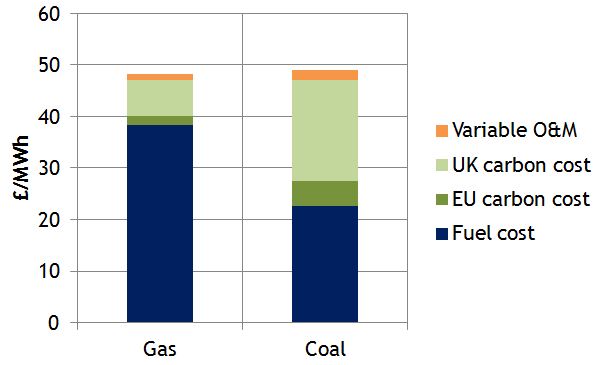
But by 2016, the UK government intends to add a 21 £/t premium to the carbon EUA price.  A premium of this size will have a significant impact on gas vs coal plant competitiveness as illustrated in Chart 1.

Chart 1: Summer 2016 Short Run Marginal Cost of UK CCGT vs coal plant (54% vs 36% efficiency)

CPF gas vs coal

The chart shows the short run marginal cost (SRMC) of a new CCGT (54% HHV efficiency) versus an average UK coal plant (36% efficiency).  Fuel and carbon costs are based on indicative forward pricing for gas, coal and carbon for summer 2016.  On a variable fuel cost basis, coal generation is still much cheaper than gas.  But the government’s carbon price support means the cost of carbon starts to tip the competitive balance in favour of gas plant.

Another factor behind the forward market anticipated change in gas vs coal SRMC, is the shape of fuel forward curves.  The coal price curve is in relatively steep contango (prices rising over time).  The NBP gas forward curve on the other hand is in backwardation, consistent with falling forward prices in the Brent curve.  So although liquidity is poor out along the curve, forward markets suggest a narrowing in the fuel cost premium of gas over coal. 

Power market impact

Closing the gap between gas and coal plant competitiveness has an important impact on UK power market returns and pricing dynamics.  Two important implications of the government’s carbon price support are:

  1. Increasing the cost of carbon is acting to flatten the UK supply curve over time.  As gas and coal plant competitiveness reconnects, there is around 40GW of CCGT and coal capacity with a similar variable cost.
  2. Relatively small shifts in commodity prices may cause significant changes in gas and coal plant load factors.

Chart 2 illustrates our net supply curve view of the UK power market based on Summer 2016 indicative forward prices and the government’s published carbon support premium.  The flattening of the supply curve is clear.  It can also be seen that at these price levels, the newest CCGT plants start to displace older coal plant.

Chart 2: UK net supply stack chart Summer 2016

CPF supply stack

The importance of the dynamics illustrated in the chart is their impact rather than their timing.  Alternative pricing outcomes and coal plant efficiency upgrades may delay the switching of gas for coal beyond 2016.  There is also a risk that the government revises down its carbon price support levels, particularly given the design of the mechanism has a number of flaws.

But as long as the government’s carbon price support remains in place, it will act to flatten the supply curve and increase the competitiveness of gas plant relative to coal.  This will tend to dampen UK power price volatility and increase CCGT load factors.  It may also impact the correlation between gas (vs coal) and power prices, as marginal price setting shifts between fuel types.

But higher CCGT load factors will not necessarily translate into a recovery in generation margins.  The flat supply curve also reduces the rents that conventional generation assets earn when higher cost plants are setting the market price.  The key to higher gas plant generation margins is a tightening in the market capacity margin.  As plant closures and mothballing continue over the next 2 to 3 years this will act to increase marginal pricing in periods of high net system demand (high load, low wind).  It is the increase in power prices and volatility over these periods that will be a critical driver of a recovery in generation margins.

Panama Canal upgrade impact on the LNG Market

The Panama Canal is synonymous with the global shipping industry, facilitating over 14000 transits per year.  But currently it is not a significant feature of the global LNG market.  This is because only 21 of the 370 LNG vessels currently in service can pass through the canal.  However the Panama Canal expansion project will allow over 80% of LNG vessels to pass through from late 2015 when it is due to be completed.

When the $5.25b project was approved in 2006, the consensus view was for a limited impact on global LNG trade.  The key beneficiary of the expansion was expected to be the owners of Trinidad and Tobago cargoes, given canal transit significantly shortens the trip to Asia.

But the rapid development of plans to build large volumes of LNG export capacity on the US Gulf Coast means that the canal expansion project is set to have a far greater impact on the LNG market than previously envisaged.  In addition, it may increase the competitiveness of lower volume existing trade routes (e.g. Trinidad to Chile) or open up new ones (Peru to Europe).  Panama is also looking to start importing LNG in 2013.

Impact of shipping economics

The impact of the canal expansion on LNG trade is fairly obvious: shorter distances and voyages, lower shipping costs.  The differences in shipping times are summarized in Table 1.

Table 1.  Comparison of shipping distances and voyage times for cargoes delivered to Japan (Sakai)

Trinidad

US Gulf Coast (Sabine Pass)

NM

Days

NM

Days

Via Suez

13,000

29.5

14,300

32.4

Via Panama

9,150

21.1

9,500

21.8

Reduction

-30%


-34%

Source: Timera Energy (assumes average speed of 19 knots, includes 1 day for canal transit and excludes loading and discharging times).

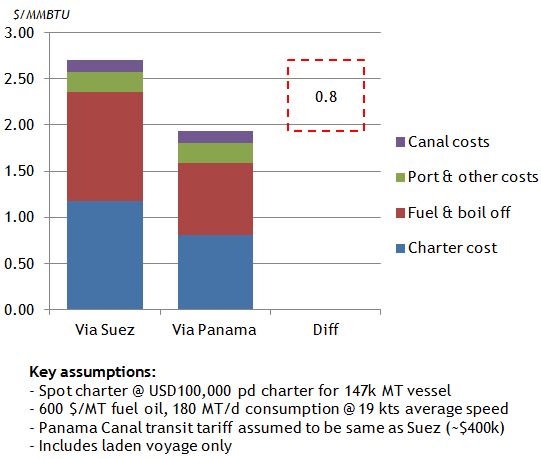
Shorter distances reduce fuel consumption and LNG boil-off.  Shorter voyages reduce the charter period for spot voyages and increase vessel utilisation. The scale of the difference in shipping cost of a Panama vs Suez canal transit for Gulf Coast exports is illustrated in Chart 1.

Chart 1: Estimated shipping cost differential Gulf Coast (Sabine Pass) to Asia (Sakai – Japan)

Panama Canal

Source: Timera Energy

There are two important assumptions applied in estimating the shipping cost differential:

  1. For ease of comparison, the new Panama transit cost (not yet published) is assumed to be the same as the Suez transit cost.  In reality it could be significantly higher.
  2. Shipping costs are based on a ‘one-way’ spot charter rate covering only the laden voyage.

On this basis the estimated cost saving of transit from the US Gulf Coast to Japan is in the region of 0.8 $/mmbtu.  A more precise cost savings estimate will be possible once the new Panama transit tariffs are published.  The Panama Canal Authority is currently consulting with customers and expects to publish tariffs in mid 2014.  There has been concern the tariff may be significantly higher than the Suez equivalent (approx ~$400k), with estimates ranging up to $2m per round trip.

However, the direct canal transit costs are only a relatively small portion of the actual shipping costs.  As a rule of thumb, each $100k of canal transit cost will increase the cost of shipping Gulf Coast exports to Asia by around 0.03 $/MMBTU.  So while a high transit fee would reduce the Panama versus Suez cost differential, it would not erode it altogether.

The other important factor in the shipping cost estimate is accounting for the cost for the unladen (or ballast voyage), see here for further background on this.

Impact on global gas market price dynamics

The importance of the Panama expansion from an LNG market perspective is its influence on global gas price differentials.  Lower shipping costs improve the relative economics of shipping US gas to Asia.  Over time this should act to reduce inter-regional price spreads.  The Panama expansion is also likely to bring down the price of spot deliveries to the Latin America pacific cost (Altamira in Mexico and Quintero Bay in Chile).

Reduced journey times to Asia will also have a second order impact marginally increasing supply chain flexibility.   This will allow US exporters to respond more quickly to short term fundamental shocks which may act to dampen volatility of prices for short term delivery.

But perhaps most importantly, reduced shipping costs will increase the competitiveness of two very flexible sources of LNG supply, exports from the US and Trinidad & Tobago.  The flow of gas from these exporters will be strongly influenced by the spread between the Henry Hub price and Asian spot price signals.  The Panama expansion will therefore likely play its part in increasing the influence of the Henry Hub price on Asian LNG price signals.

Beware of a shift to central planning

The UK’s 2001 implementation of the NETA wholesale power trading arrangements marked the ideological peak of a push towards liberalised wholesale power markets in Europe.  Power market liberalisation followed across Europe with varying degrees of enthusiasm.  But by the end of last decade, the UK had already signalled a return to a more interventionist policy stance with its vision for an Electricity Market Reform (EMR) package.

Growing concerns over security of supply and decarbonisation targets, have led the UK government to develop an EMR policy toolkit that allows it to target specific generation technologies.  As EMR has evolved, it has become increasingly clear that the government intends to use this toolkit to drive the UK capacity mix.  There is a growing risk that this path will end with the funeral of the wholesale power market, with a government directed ‘central buyer’ of capacity emerging from the ashes.  This outcome may currently seem to have a low probability, but it warrants careful consideration over a strategic planning horizon.

UK market redesign signals the way forward for Europe

The UK is Europe’s ‘canary in the coal mine’ when it comes to dealing with the side-effects of government intervention to support renewable capacity.   The UK power market needs to deliver new conventional capacity this decade to avoid a capacity crunch. 

Most other European power markets can fall back on a current capacity oversupply situation, the result of a post-crisis slump in demand and support for renewable build.  This reduces the urgency of having to tackle some of the difficult market design issues the UK faces.  But these issues will eventually need to be dealt with across Europe.

Just as the UK led the push towards liberalisation in the 1990s, it looks to be leading the retreat back towards central planning this decade.  It remains to be seen whether this retreat will be structured and orderly, or a more panicked response to the looming security of supply threat.  Either way the path of UK energy policy is likely to be an important signal as to the future policy direction across European power markets. 

The UK plan for a ‘third way’

There are broadly two models for electricity market design:

  1. A competitive wholesale market with transparent rules, strong independent regulation and a ‘sharp’ (cost reflective) market price signal to induce investment.
  2. A centrally administered solution where an independent body with a clear mandate uses a transparent approach to determine and deliver against capacity targets (e.g. via capacity auctions).

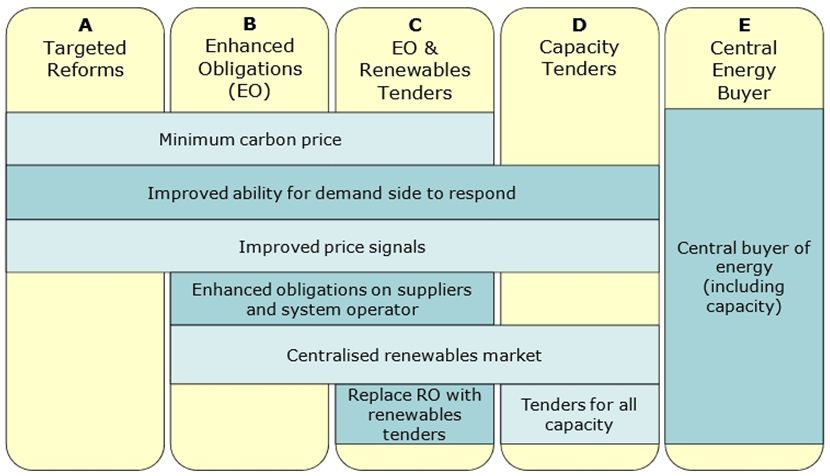
But the UK government has tried to steer towards a dangerous middle ground (as we set out previously).  The origins of that middle ground came from Ofgem’s Project Discovery conducted over 2009-10, with a consultation process run around a set of potential policy intervention packages set out in the chart below.

Chart 1: Ofgem’s Project Discovery policy intervention packages

Project Discovery

Project Discovery was intended to offer the government a menu of potential market intervention mechanisms.  But rather than choosing to:

  1. make targeted reforms to the existing wholesale market (box A) or
  2. opt for a radical shift to a ‘central buyer’ solution (box E)

DECC instead chose to layer everything on the menu into a poorly designed and unnecessarily complex mix of inconsistent market interventions.  It was this process that has evolved into DECCs EMR policy package that is currently being implemented via the Energy Bill.

Progressing towards central planning

The EMR policy measures have not had a happy history to date.  Piecemeal intervention to support low carbon generation technology has distorted wholesale market price signals and incentives.  Driven by concerns around security of supply and renewable targets, the government has increasingly targeted policy measures to influence the build of specific generation technologies as summarised in Table 1:

Table 1: EMR policy intervention measures by generation technology type

Technology

Policy intervention

Renewables

Currently supported by Renewable Obligation Certificates which are ‘banded’ by technology.

Move to FiT/CfDs under EMR, with strike prices set by technology.

Nuclear

Although supposed to be covered under FiT/CfDs, nuclear support has essentially become an in-transparent bilateral negotiation between EDF and the government.

Gas

Gas plant is to be supported by a Capacity Market to be introduced in 2014 for delivery of a government determined capacity target in 2018.

In the meantime Ofgem is consulting on a Supplementary Balancing Reserve mechanism that Grid can use to support existing gas plant from closing.

Coal

Coal has effectively been removed as a new build capacity option by the EMR Emission Performance Standard and lack of meaningful progress on support for CCS.


The government’s vision for EMR is to create a new and improved wholesale market for a low carbon world.  But EMR is undermining investment based on wholesale market price signals.  Regulatory inconsistency and uncertainty is also substantially increasing the cost of investment capital.  As policy intervention measures are layered on, investors are losing confidence in returns driven by an increasingly distorted wholesale market.

In reaction, investors have turned to lobbying the government to ‘underwrite’ investment returns via the EMR mechanisms being developed.  The support package recently served up to deliver EDF’s Hinkley Point nuclear plant should be enough to make every British consumer’s stomach churn.

Policy design by lobbying and intervention is creating a circular feedback loop that is slowly but surely moving the UK power market towards a centrally planned solution.  This is a path that poses large and unnecessary costs onto the UK public, particularly because of the higher cost of capital required to deliver new capacity.  If a centrally planned solution is to be the end game then it would be much more efficient to move there with purpose and intent.

The risk of a central buyer end game?

The problem with EMR is that it has created a set of circumstances that are vulnerable to a political change of tack.  If for example a serious capacity crunch materialises later in the decade, the government of the day could well make a concerted grab for control of the power market.  Not by re-nationalisation of power companies & network assets but via a move to a central buyer approach.

Under this outcome the liberalised wholesale market would likely be assigned to the scrapheap and replaced by capacity auctions to meet government mandated targets.  Ironically, the increased transparency of this outcome may result in a better deal for the UK consumer than the complex uncertainty of EMR.

It is also possible that there is a more gradual transition away from the current wholesale market design.  The recent Labor Party energy policy statement proposed a move back to a gross pool market, accompanied by measures to break up the ‘Big Six’ incumbent utilities.  But such a move assumes that the government of the day has the time to work with the private sector to implement such a transition.  If the catalyst for change is an imminent threat to security of supply, a central buyer solution may give the government a greater degree of control more quickly.

A move to a ‘central buyer’ driven market would have serious implications for the business model and asset values of most energy companies & investors with a UK market presence.  Investment would no longer be driven by wholesale market price signals but by some form of government driven signal (e.g. via long term capacity auctions or offtake contracts).  While this could ultimately mean returns on new asset investments are more secure, the transition from wholesale market to central buyer is unlikely to be a smooth one for existing asset values.

In our view the probability adjusted impact of a central buyer outcome is high enough to consider as a serious business risk over a 5-10 year strategic planning horizon.  The Labor Party’s recent policy announcement, while poorly conceived, is an indication of the mood for more radical change.  The probability of a policy shift is only likely to increase as the capacity margin tightens and the EMR policy mechanisms come under pressure.  It may be prudent to spend a few minutes considering the portfolio impact, mitigation steps and business model implications of a major shift in power market design.

Gas hub price evolution: applying the framework

There can be little doubt as to the ascendancy of hub pricing as the key driver of commercial decision making in the European gas market. Hub prices have become the benchmark for customer supply contracts and gas portfolio optimisation across North West Europe. The influence of hub prices is also rapidly penetrating to the South (e.g. Italy and Spain) and into Eastern Europe. But what are the key factors that will drive hub price evolution? And what are the boundaries that are set to contain price levels?

Last week we set out a framework for understanding the drivers of European gas hub pricing dynamics. This approach was built on grouping similar supply sources and focusing in on the flexible supply tranches that drive marginal pricing. In this week’s article we apply this framework to take a more practical look at how commercial decisions drive hub pricing.

A European supply stack view

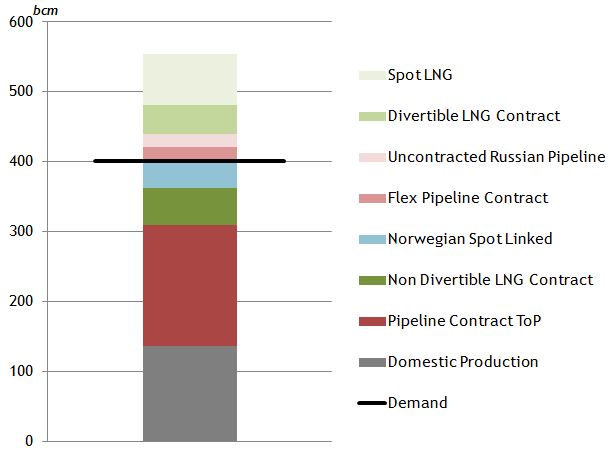
At the simplest level, gas supply is about price and volume. A supply stack illustrates supply volumes ranked by price. So a simple pan-European supply stack can be developed by adding price and volume assumptions to each of the tranches of supply we set out last week. A simple supply stack is shown in Chart 1 along with an indicative annual demand level for the European hub zone.

Chart 1: 2014 pan-European supply stack

2014 Supply

Note 1: Diagram and gas flows based on a European hub zone boundary that covers UK, BE, NL, FR, DE, CZ, AU, CH, IT & ES.  Russian gas contract volumes are based on delivery into this zone (i.e. do not include broader sales into Eastern Europe).

Note 2: The uncontracted Russian pipeline tranche includes 2014 estimates of uncontracted production. Volumes are much larger than this in the medium term.

Inflexible supply tranches:

The supply tranches in the stack chart are broadly ranked from lowest to highest marginal cost. The inflexible supply sources include:

  1. Pipeline contract take or pay volumes – primarily from Russia, Norway and North Africa
  2. Non-divertible LNG contracts – primarily into Southern Europe (and defined broadly to exclude cargo reloads)
  3. Most domestic production – focused on the UK and Netherlands (domestic being defined as within the hub zone boundary as opposed to imports outside of this).

These tranches can effectively be assumed to be priced at zero cost, because the gas will flow regardless of market pricing. In practice these tranches may contain some flexibility (e.g. the ability to bank gas across contract years) but this tends to have only a secondary impact on hub pricing.

Flexible supply tranches:

Much more important are the flexible tranches of supply that can respond to incremental changes in hub price levels. The key tranches of flexible supply are broken out in the table below along with indicative current price ranges and pricing characteristics. The first three tranches are the key drivers of marginal pricing across the hubs. The next three tranches are supply sources that are ‘out of the money’ at current hub price levels, but can provide incremental volume if required.

Flexible tranche

Current price range

Pricing characteristics

Pipeline contract swing volumes

11-13 $/mmbtu

Swing volumes (above take or pay) are optimised by contract owners based on contract vs hub price relationships (see last week’s article). Russian contracts are a key provider of swing, with the recently renegotiated discounted tranches (11-12 $/mmbtu) an important driver of marginal pricing.

Discretionary spot linked LNG

Spot linked

This is essentially a managed volume of LNG that Qatar chooses to place into Europe rather than selling at higher Asian spot prices (shown as non-divertible LNG in the chart). It is a secondary outlet for Qatari production that could otherwise adversely impact Asian spot prices.

Norwegian spot linked sales

Spot linked

In addition to oil-indexed contract sales, Statoil sells spot linked gas up to its annual production targets. This is both via sale of spot-indexed contracts and sales directly at the hub.  There is a pronounced seasonal shape to this gas flow and it is actively optimised based on hub price signals.

Russian uncontracted production volumes

13 $/mmbtu +

Spare Russian production capacity that can flow to market if prices rise above oil-indexed contract levels. This tranche is only small in the 2014 stack chart, but is set to grow substantially in volume by the end of this decade (an estimated 60-100 bcma).

Flexible/divertible LNG supply contracts

13-18 $/mmbtu

Destination flexible European LNG supply contracts that are typically priced based on netback LNG spot market opportunity cost (e.g. to Asia, Sth America) adjusted for any portfolio sunk costs.

Spot LNG supply

13-18 $/mmbtu

Spot LNG cargoes that are also priced against netback LNG spot prices

Gas storage capacity

Opportunity cost of flex

Storage capacity is priced off the opportunity cost of alternative flexibility (typically pipeline swing). Storage is not shown in the supply stack as it has a limited net impact at an annual level (i.e. it is primarily used to move gas between different periods across the year).

How does flexible supply set hub prices?

The first three supply tranches interact to dominate current hub pricing dynamics. Price levels are anchored by the oil-indexed cost of pipeline swing. The discounted Russian supply contracts that have recently been re-negotiated by major European suppliers are particularly important. These sit at the lower end of the pipeline swing tranche (with contract prices around 11 $/mmbtu) and have a strong influence over marginal pricing.

But the extent to which swing contracts influence hub prices depends on the flow decisions of the Qatari’s and Norwegians. Qatar continues to place a portion of its LNG production into Europe so as not to depress Asian spot prices. Norway flows uncontracted production on top of spot-indexed contract sales to broadly match its annual production targets, optimising this flow across different hubs and time periods.

But both these sources of supply effectively displace pipeline swing contract volumes, causing annual hub price levels to remain at a ‘loosely managed’ level below oil-indexed contract prices. The future evolution of hub prices comes down to whether the balance of power currently exercised by key producers can be maintained.

Commercial dynamics impacting price evolution

The evolution of hub price levels over a medium to longer term horizon will be strongly influenced by the strategic commercial decisions of key producers. There are three gas producers with the production flexibility to materially impact the pricing of incremental gas volumes into Europe:

  1. Russia: Estimates of uncontracted Russian production that could flow into Europe range from 60 – 100 bcma over a medium term horizon. The key uncertainty associated with this gas is the price at which the Russians will sell. But to date they have staunchly defended oil-indexation and it is reasonable to assume that Russia will not place large new volumes of gas into Europe if hub prices are below existing oil-indexed contract levels. This is an important factor from a European pricing perspective. The sheer size of potential export volumes will tend to provide stiff resistance against a structural increase in hub prices above oil-indexed contract levels (e.g. towards Asian LNG netback equivalent levels).
  2. Qatar: The European market is viewed as a secondary export outlet by the Qataris. Their primary target is sale of long term oil-indexed contracts into Asia at a price premium to European hubs. However this means the Qataris are cautious as to how much spot LNG they sell into Asia. By depressing Asian spot prices, Qatar may adversely impact its long term contracting opportunities. So they have maintained a volume of spot and shorter term hub linked contract sales into Europe (e.g. the 3mtpa NBP linked contract to 2018 signed with Centrica this week). This gas is effectively displacing pipeline contract imports and helping to keep hub prices below oil-indexed levels. But in the medium term Qatar will likely act to dampen any major price shifts, e.g. if hub prices recover they can increase their spot flow of cargoes into Europe, if prices fall they may further pull back on spot supply.
  3. Norway: There is less production upside from Norwegian upstream given the maturity of field development. Norway also sets reasonably transparent annual production targets. But it still has some strategic flexibility to reduce or increase production in response to major price shifts. The option to pullback on volume is particularly important from a European pricing perspective. For example if LNG started to flow back into Europe in significant volume again (e.g. as it did in 2009-10), the Norwegian flexibility to reduce production could play an important role in supporting hub prices, at least on a temporary basis.

Incremental supply into Europe is of course not limited to these three players. But other sources of supply are typically too small to have significant strategic pricing power. And it is the pricing power of these 3 key players that is the force acting to keep hub prices within a band of oil-indexed pipeline contract supply. All three have a vested interest in trying to ensure that this situation remains. The Russians are the champions of the cause and retain the greatest influence. The Qataris and Norwegians may be more progressive, but they are ultimately sympathetic supporters.

Gas hub pricing boundaries

Despite the trend towards the spot indexation of gas in Europe, it is oil-indexed price levels that will likely remain the anchor for the evolution of European hub pricing. Two reasons work together to support this logic:

  1. Oil-indexed pipeline contracts represent the dominant tranche of flexible supply driving marginal pricing at hubs (and declining domestic production levels should reinforce this).
  2. The key producers have a shared strategic interest in controlling physical flow into Europe to support hub prices at a level broadly in line with oil-indexed pipeline supply.

This outcome relies on the continuing influence of key producers. And with Europe’s growing gas import requirements the balance of power looks skewed in their favour.

A European ‘gas squeeze’ up to Asian price levels is unlikely, despite Europe’s import appetite. There is not a structural requirement for Europe to sign contracts for large new volumes of LNG supply this decade. LNG will play a role in the supply mix, particularly for European gas portfolios with a global presence. But Europe does not need to compete head to head with Asia for long term contracted LNG at the current Asian price premium. Instead the 60 – 100 bcma volume of uncontracted Russian production is likely to be the dominant influence on long term European pricing.

The threat to this dominance is the emergence of large volumes of flexible LNG beyond 2015, causing an overflow of gas into Europe and a battle for market share (i.e. a gas glut along the lines of 2009-10). Europe is a natural home for substantial volumes of flexible LNG if the current Asian price premium were to disappear. This is particularly the case if US export capacity currently being developed to flow to Asia, instead flows towards Europe. A surplus of gas flowing out of Henry Hub at the variable cost of liquefaction and transport (e.g. 7-8 $/mmbtu) could place substantial downward pressure on European hub prices.

An understanding of European hub pricing dynamics comes down to an appreciation of the key pricing boundaries between different tranches of supply. In last week’s article we set out a framework to approach this problem. In this article we have used a pan-European supply stack to illustrate some of the practical pricing implications. The factor that underpins both these views is an understanding of the behaviour, interaction and pricing of Europe’s key tranches of flexible supply. In our view that is the place to focus if you want to get on top of the European gas market.