Collapse in LNG charter rates continues

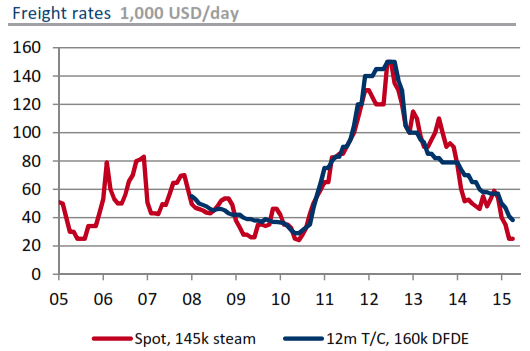
Oversupply in the LNG market is having a knock on impact on the LNG carrier market. LNG vessel charter rates have suffered another down leg in 2015, with spot charter rates falling to USD 25,000 per day. Rates have halved in the last six months, falling back to levels seen in the depths of the global financial crisis.

The breakeven cost for delivering new vessels is estimated to be around USD 60-70,000 per day. Term charter rates (12mths+) have now fallen below USD 40,000 per day, opening up a sizeable gap versus new build recovery. But despite these numbers, there is still a substantial volume of LNG vessel capacity under construction. New capacity and changing route dynamics are likely to ensure downward pressure on charter rates remains over the next two or three years.

The drivers behind charter rate decline

Chart 1 illustrates the interesting journey of LNG vessel charter rates over the last five years. A post financial crisis shortage of vessel capacity combined with longer post-Fukushima vessel journeys (Asian diversion), caused a sharp squeeze in charter rates from 2010-12. A reverse in these factors has driven the fall in charter rates from their peak above USD 140,000 in mid-2012.

Chart 1: LNG sport and term time charter rates

charter rates

Source: RS Platou Monthly (April 15)

We have previously set out why we believed LNG charter rates would decline, e.g.:

  • Jan 14: Steam coming out of shipping market here
  • Oct 14: LNG charter rates heading south here

The decline in charter rates over the last 12 months has been particularly impacted by changing LNG flow dynamics. Convergence in Asian & European prices since summer 2014 has undermined demand for vessels to facilitate high volume diversion of LNG from Europe to Asia. As a result the number of longer distance voyages and therefore vessel utilisation has fallen substantially.

In addition the smaller returns from LNG spot trading and portfolio optimisation have created a greater focus on the costs of diversion economics. Squeezing out an extra 0.05 $/mmbtu in shipping cost reductions is more important in a world of 0.5 $/mmbtu diversion margin than in one where 5 $/mmbtu is possible.

Fleet overcapacity set to continue

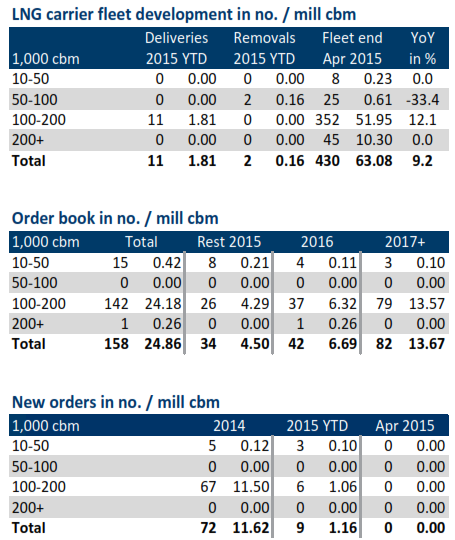
The number of new LNG vessel orders has almost dried up this year, an understandable reaction to plunging charter rates. However there are currently 150+ vessels on order (constituting a ~35% increase in the current global fleet of 430) as illustrated in Table 1.

Table 1: LNG fleet snapshot

carrier table

Source: RS Platou Monthly (April 15)

The vessels currently on order reflect long delivery lead times. These orders were committed on the basis of the wave of new liquefaction capacity currently under construction (as we set out here). Orders were also supported by the assumption that the majority of flexible and spot LNG supply would continue to be diverted to Asia, supporting vessel utilisation. The rapid convergence in global spot prices is a key factor weighing on charter rates in 2015.

Looking forward for signs of a recovery

The LNG carrier market is set to undergo a rapid phase of evolution with more than 150+ bcma of new liquefaction capacity to be commissioned by the end of this decade. New liquefaction capacity creates a requirement for shipping capacity. But much of the new liquefaction capacity is located in Oceania, under long term contracts to Asian buyers. Vessel orders to support these contracts were made on the basis of a tighter carrier market and substantially higher charter rates.

New vessels and anaemic charter rates present a threat to older vessels in the existing fleet. Scrapping or mothballing vessels has not been a strong feature of the LNG market to date, although two vessels have been removed from the fleet in 2015. A continuation of lower charter rates may start to take its toll on older vessels that are more expensive to operate.

Perhaps the most important uncertainty going forward is the evolution of LNG flow dynamics. A recovery in the Asian LNG price premium (over Europe and the US) will support higher vessel utilisation and in turn support charter rates. But if, as we suspect, the current period of global LNG price convergence continues towards the end of this decade, downward pressure on charter rates is likely to remain.

Article written by David Stokes & Olly Spinks


Look to the USD for oil price direction

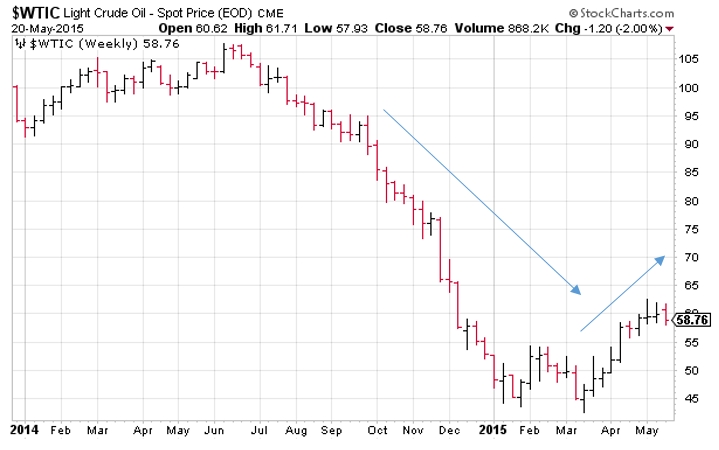
The decline in crude prices that started last summer has been one of the sharpest selloffs in the history of the oil market. After stabilising towards the end of Q1 2015, crude prices have recovered in Q2. There are two schools of thought as to the meaning of this price rally:

    1. Correction: After a sharp move lower in crude prices, the recent rally is a temporary correction before prices fall again.
    2. New trend: The Q2 rally is the start of a more structural recovery in oil prices as supply has been curtailed by lower prices.

We subscribe to the former view. But whatever your view is on the oil market, it is worth considering the relationship between crude and the US dollar (USD). There is currently an important set of fundamental drivers, focused around US shale oil production, which is unique to the oil market. But the strength of the inverse relationship between the USD and crude prices provides a useful directional barometer.

Important price relationships

Global commodities are traded in US dollar terms. This supports a strong inverse relationship between commodities (priced in USD) and the strength of the USD itself (e.g. against a basket of other currencies).

This relationship does not just reflect basic arithmetic (i.e. a rising denominator). The oil price has fallen substantially in EUR terms, even though the EUR has also fallen against the USD. A rising US dollar tends to reflect a fundamental environment that is less favourable for commodity prices. For example, increasing US interest rates, a tightening of credit conditions and a general rise in market risk aversion.

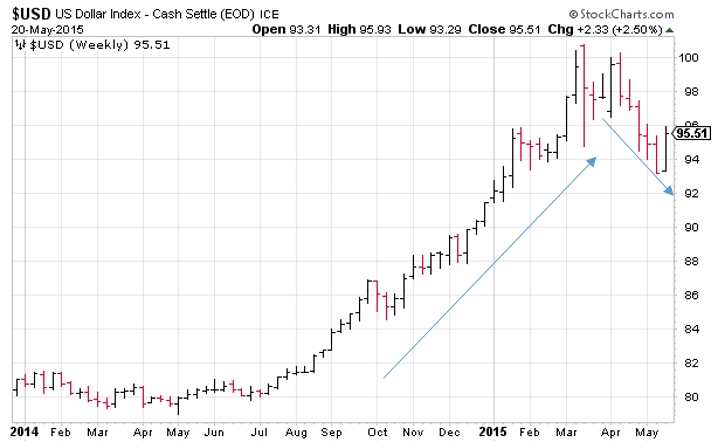
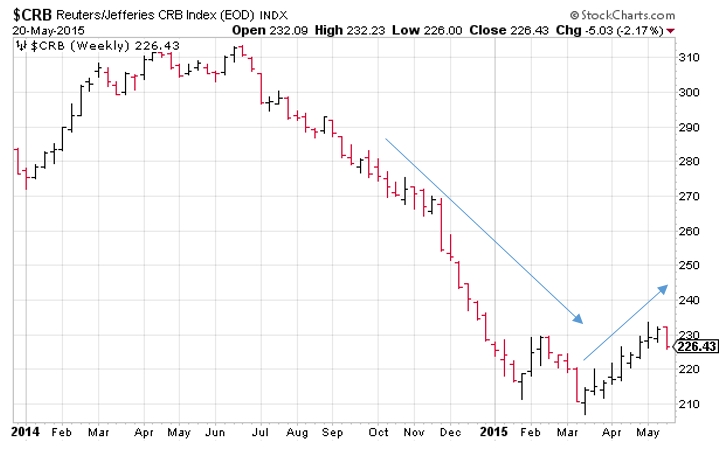
The extent of the relationship between the USD, crude and a basket of all commodities (the CRB index) is illustrated in Charts 1, 2 and 3 respectively.

Chart 1: US dollar index

USD

Chart 2: WTI crude front month contract price

WTI

Chart 3: CRB commodity price index

CRB

Q3 2014 – Q1 2015: The sharpest rally in the USD in 30 years commenced in the summer of 2014. This was the same point in time at which crude began to fall. And crude prices were accompanied lower by other commodities (e.g. metals, agriculture).

Q2 2015: The peak of the USD rally towards the end of Q1 coincided with the bottoming of crude prices and those of other commodities. Through Q2, prices of oil (& other commodities) have recovered as the USD has weakened in a sharp counter trend move.

Q3 2015+: History shows that major currency trends tend to last significantly longer than 9 months. These trends tend to reflect structural macro drivers (e.g. a strengthening of US interest rates vs Europe and Asia) that can often last several years. This suggests that the Q2 weakness in the USD, and in turn the recovery in crude, is a temporary correction.

Back to the fundamentals

From the lowest price this year (around 42 $/bbl), front month WTI crude prices have recovered 50% to above 60 $/bbl. Over this period, the tail of the WTI crude curve has moved back up towards 70 $/bbl. This is an important level because it represents the lower bound of long run marginal cost (LRMC) benchmarks for investment in new US shale production.

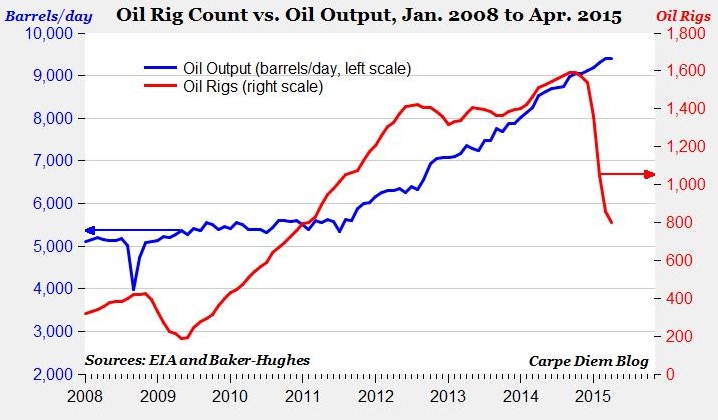
The relatively short well life cycle of US shale means that the LRMC of new production is very important in driving US production volumes, as we set out here. The impact of the recent crude curve fall on investment in new US oil wells can be seen via the declining US rig count shown in Chart 4 (the red line).

But throughout the price decline of the last 9 months, crude prices have remained above the short run marginal cost (SRMC) of production for existing wells. This has led to a steady increase in US oil production, despite lower prices (the blue line in Chart 4).

Chart 4: US oil production vs rig count

US prod vs rig count

Source: Carpe Diem Blog, EIA, Baker Hughes

The recent rig count declines will start to impact US crude production going forward, although the fall in rig numbers is to some extent being offset by an increase in rig productivity. But this rig count decline will likely stabilise or even reverse if forward crude prices reach levels that again cover the LRMC of drilling new wells.

The way forward

The ongoing increase in US production and the fact that WTI prices are approaching LRMC benchmarks for new investment, suggests to us that the recent rally in oil prices may not have much further to run. If this is correct then the USD is likely to provide a useful indicator as to the next move lower in crude prices. If the USD resumes its climb then oil prices will likely face strong headwinds.

Production cost drivers point towards higher oil prices in the long term (e.g. 2020+). For example the LRMC of new deepwater and oil sands production investments is significantly higher than current crude price levels. But the evolution of oil prices in the short to medium term is likely to remain focused on US shale production. In our view, a longer period of lower prices is required to interrupt the US shale production investment cycle.

Gas vs coal switching in Continental power markets

Five years of coal price weakness has decimated the value of European gas-fired power plants. Spark spreads in Continental power markets have fallen into deeply negative territory as coal plants have dominated the setting of marginal power prices. Gas plant load factors and margins have plummeted as CCGTs have been relegated to a peaking role.

Against this backdrop, market sentiment on the value of gas plants in Europe is understandably very poor. Substantial volumes of existing gas-fired capacity is being closed or mothballed. Investment in new CCGTs has all but disappeared. Forward market pricing and the actions of asset owners point towards a consensus view of ongoing weakness in gas-fired generation margins.

However a more structural weakening in gas hub prices is quietly starting to undermine the competitive advantage of coal plants. This has not yet had much impact on realised gas plant margins on the Continent. But as gas prices fall, gas plant optionality is becoming less ‘out of the money’. This has a positive impact on expected margin capture and risk adjusted asset values.

Continental switching dynamics

In a recent article we showed newer CCGTs starting to displace coal plant in the UK merit order as gas prices fall. Gas vs coal switching happens in the UK before it does on the Continent as a result of the carbon price floor and dominance of gas plant in the UK generation mix. The picture in Germany is a different story, as shown in Chart 1.

Chart 1: Current German gas vs coal (36%) switching dynamics

DE coal gas switching

Source: Timera Energy

Chart 1 shows that gas hub prices need to fall from current levels around 7 $/mmbtu to below 5 $/mmbtu in order to bring CCGTs back into merit in the German power market (assuming a constant coal price level). As gas prices fall, the competitiveness gap between coal and gas plants is closing. But another significant hub price down leg is required before market pricing induces structural (baseload) displacement of coal plants by CCGTs.

We have chosen Germany to illustrate switching dynamics because it is the core of the NW European power market. But also because it is one of the most difficult European markets for gas-fired plants.  Black coal and lignite plants currently enjoy a significant variable cost advantage over CCGTs.  At the same time, increasing renewable output is eroding gas plant load factors, although the development of renewable capacity is starting to face some headwinds in Germany given concerns over rising customer bills.

The German market is important for its neighbours because it dominates the setting of marginal power prices in NW Europe across much of the year (particularly in summer and off-peak periods). However, the situation for gas plants in some other Continental markets is somewhat better. For example, in peak winter periods in Belgium and France, power prices separate from Germany as gas plants set marginal prices. In other words, gas plant load factors and margins in NW Europe start to increase at hub price levels well above the German baseload switching point.

Why switching on the Continent may have to increase

Russian oil-indexed gas supply contract prices (~ 7 $/mmbtu) are currently driving marginal pricing dynamics across Europe’s hubs (NBP, TTF, NCG) as shown in Chart 2. But European LNG import volumes (green supply tranche in the chart), may be close to the ‘tipping point’ where oil-index contracts are pushed off the margin, as we set out here.

At the point that the European gas market can no longer absorb more LNG imports by ramping down pipeline supply contract volumes, gas vs coal plant switching becomes a key source of incremental gas demand and hub price support. This is a key factor behind the downward slope of the European gas market demand curve, shown in Chart 2.

Chart 2: Projected European gas market supply and demand balance (2016)

EU Gas Supply Curve

The UK provides initial switching support for hub prices given the carbon price floor and dominance of CCGTs, approximately 20 bcma in a 5.50-7.00 $/mmbtu gas price range. But if the European gas market moves into a period of more significant oversupply (e.g. 2008-09), gas displacement of coal plant on the Continent may also be required to induce demand support. We estimate 60-80bcma of incremental demand in a 4.00 to $6.00 $/mmbtu price range. If LNG imports into the European gas market continue to rise, gas plant load factors may need to increase substantially in order to absorb surplus gas volumes.

Implications for gas plant value on the Continent

Chart 1 shows a significant gas price fall required to induce gas vs coal switching in Continental markets. While that is true for baseload displacement of coal by CCGTs, switching starts to take place at much higher gas prices when hourly price shape and price volatility is taken into account.

As gas prices fall, CCGT competitiveness is improving, albeit from a very weak starting point. In other words the ‘out of the moneyness’ of CCGT optionality is falling and peak margin capture opportunities are increasing. This is particularly the case in markets where gas plants play an important role in winter peak periods (e.g. Belgium & France).

There are two ways that the values of gas-fired assets can increase as a result of falling hub prices:

  1. Higher peak margins, increasing the right tail of asset value distributions & supporting the value suppliers place on ‘peak insurance’.
  2. Structural recovery in gas plant competitiveness, where falling gas prices cause displacement of coal plants and higher CCGT margins and load factors (e.g. if hub prices reach the tipping point as LNG imports rise).

The analytical challenge for asset owners and investors is to properly quantify the impact of 1. and 2. on risk adjusted asset value and asset risk/return dynamics. The traditional Base, High & Low scenario view of analysing asset values is of limited benefit in doing this. Instead it is important to use a probabilistic plant valuation model that generates asset margin distributions and allows a robust calculation of risk adjusted asset value.

The commercial challenge for owners and investors in CCGTs on the Continent is covering fixed costs over the period until asset margins recover. This is reflected in low (or zero) current asset values. Deep value discounts remain for Continental gas plants given more challenging risk/return dynamics and bearish CSS sentiment. These conditions are supported by the fact that most markets in NW Europe currently have healthy capacity margins.

However over the next five years, as less flexible and higher emission thermal plants close, capacity constraints are going to start to bind across European markets. Regulators and system operators are aware of this problem and capacity payment mechanisms are being progressed to support adequate volumes of flexible capacity.

Against a backdrop of increasing renewable intermittency, there will be a requirement across European power markets to maintain relatively high volumes of flexible lower load factor mid-merit and peaking capacity. Retaining existing gas-fired assets is the cheapest source of this flexible capacity, as the UK capacity market experience is showing.

The current ‘graveyard’ consensus on Continental gas plant value is consistent with asset margins today. But value dynamics look very different in a world where capacity payments cover fixed costs and there is asymmetric value upside from recovering wholesale energy margins (e.g. as gas prices fall & power volatility rise). The challenge is to successfully bridge this gap with the right asset in the right market. This relies on the ability to generate a robust view of risk adjusted asset values.

Article written by David Stokes, Olly Spinks & Emilio Viudez Ruido


Acquisitions and monetising asset value

European energy asset transaction activity is on the rise. After ambitious but largely unsuccessful growth and acquisition sprees last decade, utilities are selling off flexible assets & downsizing trading functions. In a world of unpredictable asset margins and lower price volatility, utilities are reverting to the perceived safety of core business and subsidised renewable asset development. E.ON’s intention to spin-off its thermal generation and commodity trading business is perhaps the most prominent example of this change in tack.

Infrastructure and private equity funds are showing an increasing appetite for energy assets. This is being fuelled by favourable lending conditions and growing pools of capital chasing yield. But funds are also facing competition from commodity trading companies, such as Glencore, Vitol & Mercuria. Commodity traders are acquiring assets and bolstering their energy trading capability, encouraged by the regulatory driven exit of investment bank competitors.

Asset buyers are being confronted with the challenge of determining how to monetise asset value in the traded energy markets. For example:

  • Determining a route to market
  • Defining a trading and risk management strategy
  • Developing a commercial and operational capability to support the assets

The approach to these challenges varies widely across asset buyers. But risk appetite and existing commercial capabilities are two important factors determining how companies approach monetisation of newly acquired assets. We explore those drivers in more detail today.

Risk appetite

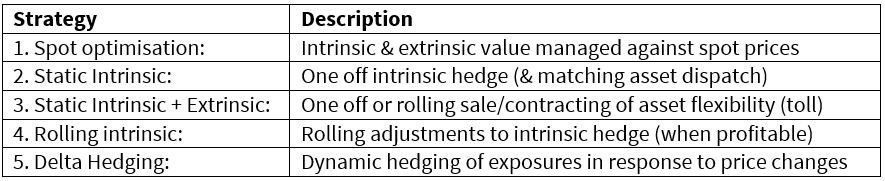
In March we published an article providing an overview of the five most common monetisation strategies for flexible assets. These are summarised in Table 1 below:

Table 1: Five most common asset monetisation strategies

Strategy Table

Source: Timera Energy

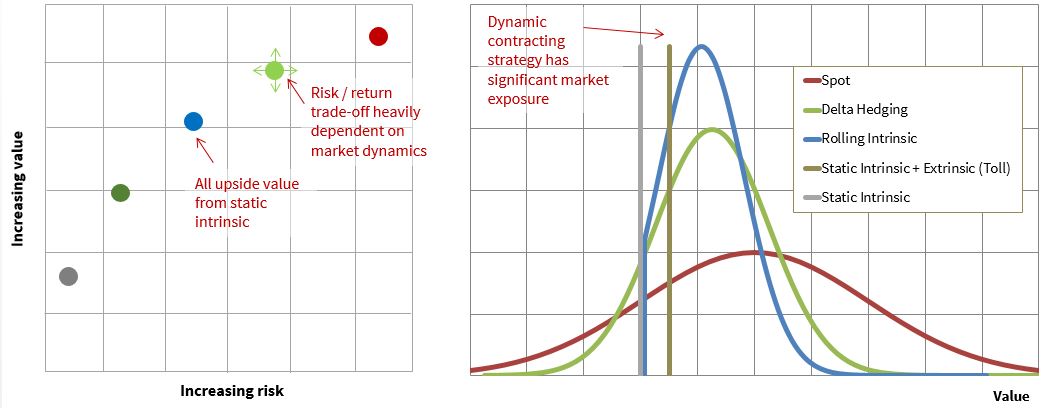
Each of these strategies ultimately involves a trade-off between expected return and risk. So a company’s risk appetite is typically the primary driver of which strategy is adopted. Chart 1 provides a simple illustration of the risk/return trade-off for each of the different asset monetisation strategies.

Chart 1: Monetisation strategy risk / return dynamics rerun dynamics

Monetisation Diag

Source: Timera Energy

Strategy considerations can be summarised as follows:

  1. Spot: The decision to operate assets on a purely merchant basis is typically driven by necessity (e.g. peaking assets with little intrinsic value) or as a high level strategic choice (e.g. Exxon’s approach decision to undertake limited hedging of its spot oil exposures).
  2. Static intrinsic: This ‘hedge and forget’ approach is typically unnecessarily conservative, unless an asset is deep ‘in the money’ or operating in a very illiquid market.
  3. Static intrinsic + extrinsic: Selling the full flexibility of an asset via a structured long term contract (e.g. a tolling agreement), is attractive for more conservative investors (e.g. infrastructure funds). It allows the monetisation of asset extrinsic value (albeit at a discount to expected value), while avoiding the complexity and costs of developing a trading capability.
  4. Rolling intrinsic: This ‘risk free’ hedge improvement strategy is perhaps the most common strategy for realising asset value, given the relative attractiveness of its transparency and risk return trade-off.
  5. Delta hedging: Hedging forward exposures on a probabilistic basis is a strategy typically favoured by companies with sophisticated existing trading capabilities. It targets the capture of maximum expected value whilst directly reducing risks, but requires greater analytical and trading overheads.

As in our previous article on these strategies, we note again that in reality many companies adopt hybrid approaches that combine more than one strategy.

Business capability

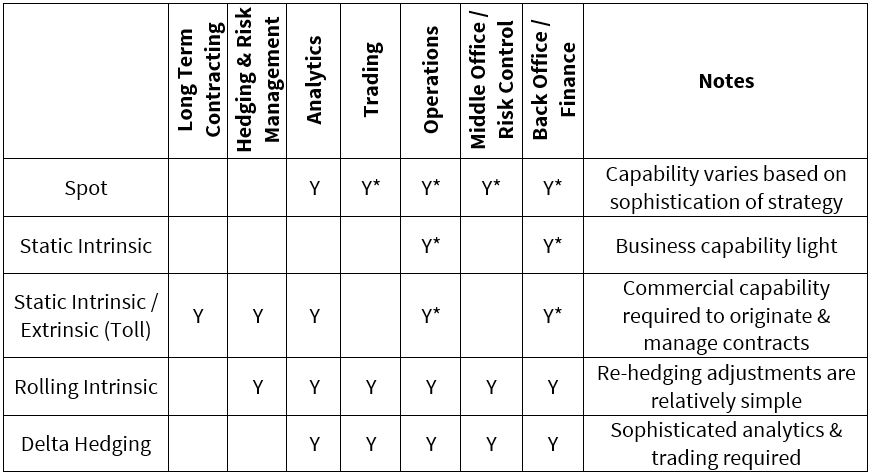
The commercial and operation capability required to support asset monetisation is also an important driver of monetisation strategy choice. Business capability requirements vary widely across the different strategies. The cost of developing and maintaining an appropriate capability in-house is an important consideration and needs to be offset against expected asset return.

Table 2: Basic organisational capability requirements

Biz Capability Table

Source: Timera Energy

An increasingly common way for infrastructure funds to avoid substantial business capability development costs is to outsource their ‘route to market’ to a third party. This can be done for example via an energy management services contract (and applies to all the boxes marked in the table with an asterisk). Whether or not it is outsourced, a basic operations, scheduling, risk control and finance/invoicing function is required for all strategies.

All five of the monetisation strategies require a mandate from senior management (e.g. the Board) setting out the boundaries within which value capture takes place. Typically this involves clear delegation of authority for:

  1. Structural asset hedging and risk management decisions (where these are relevant), often managed by a hedging or risk management committee.
  2. Day to day trading and optimisation decisions, usually managed in real time by a trading desk.

A full trading capability and supporting functions are required to implement more sophisticated spot, rolling intrinsic and delta hedging strategies. Whereas a static intrinsic and a more passive static intrinsic/extrinsic strategy require less regular contracting & hedging decisions and only a basic operations and back office function.

As an example, decisions around implementing a rolling intrinsic or delta hedging strategy will typically be made at the trading book level. Whereas contracting and hedging decisions for a more active static intrinsic/extrinsic strategy are likely to be developed by the asset owner’s commercial strategy function. But in both cases these decisions are guided by overall a company’s risk appetite and commercial strategy.

Asset monetisation driving new partnerships

The transfer of energy assets from utilities and producers to investment funds looks set to continue. But these funds are showing little interest in developing their own energy trading capabilities, due to a combination of business model considerations, overhead costs and risk appetite. This is supporting strong growth in ‘route to market’ and ‘energy management’ services.

The logic of these service partnerships is simple. It makes sense for funds to outsource ‘market facing’ capabilities to companies that already have an established market presence. This includes commodity traders, banks and (somewhat ironically) the trading functions of utilities and producers.

However the challenges of structuring a robust ‘route to market’ or ‘energy services’ contract are far from simple. These contracts need to capture the:

  1. Clean ongoing transfer of asset exposures from owner to trading counterparty
  2. Holistic coverage of the evolution of different margin streams over the contract lifetime
  3. Appropriate alignment of incentivisation between owner and trader (e.g. margin/risk sharing)
  4. Definition of a robust trading performance measurement framework

Capturing an effective balance of these factors in a long term contract is a big hurdle. But contractual structures are starting to become more standardised as fund transactions increase. We will return to set out some of the key principles behind a successful contractual partnership in an article to follow.

Gas plant competiveness is increasing

Over the last five years, European coal plants have developed a substantial variable cost advantage over gas plants. This has been driven by relative weakness in coal and carbon prices over a period where gas hub prices have been supported by oil-linkage.

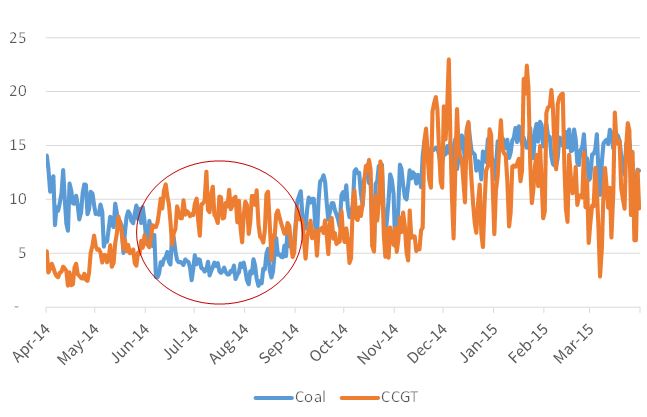
But coal’s competitive advantage has suffered a pronounced decline since summer 2014. A growing global oversupply of LNG and falling oil prices have driven down European gas hub prices. This is reducing the variable cost gap between gas and coal plant.

Looking ahead, this trend of increasing gas plant competitiveness may continue. Europe is set to absorb higher volumes of LNG as a market of last resort for surplus cargoes. This may tip the European gas market into pronounced oversupply. In this environment CCGTs play a key role in soaking up surplus hub gas, meaning higher plant load factors and margins.

An increase in gas plant competitiveness feeds through into higher risk adjusted asset values. CCGT assets are becoming less ‘out of the money’, increasing their ability to capture margin from power price shape and volatility. This supports an increase in asset values, even before CCGTs come back into merit on a more structural basis. In our view these are important dynamics to understand in a world where asset owners are heavily discounting the value of their CCGT portfolios.

Gas vs coal plant marginal cost

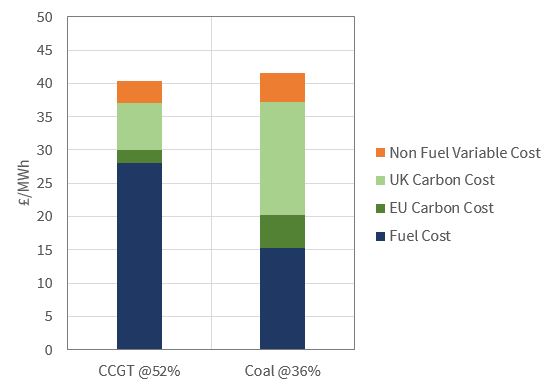
Competition between CCGTs and coal plants is driven by short run variable cost. CCGTs are more efficient and less carbon intensive, but need to burn gas (which is relatively expensive per energy unit). Coal plants are disadvantaged on an efficiency and carbon intensity basis, but benefit from cheaper per unit fuel costs. Chart 1 shows the relative composition of gas vs coal plant SRMC for the UK across the coming summer, where newer CCGTs (52% efficient) are starting to displace older coal plants (36% efficient).

Chart 1: UK CCGT vs Coal SRMC (Summer 2015)

UK Power SRMC

Source: Timera Energy

We focus initially on the UK because it is the European ‘canary in the coal mine’ when it comes to gas/coal switching. This is a function of the UK’s carbon price support (now 18 £/t) and the dominance of gas in the generation mix.

Gas vs coal switching is already a reality in the UK. Chart 2 illustrates the significant displacement of older coal plants by newer CCGTs last summer, when hub prices fell as the flow of LNG imports increased. The 2015 step up in carbon price support from 9 to 18 £/t has furthered closed the gas vs coal competitiveness gap.

Chart 2: UK Coal vs CCGT output over the last 12 months (GW)

UK coal gas output

Source: Timera Energy

Gas vs coal switching dynamics

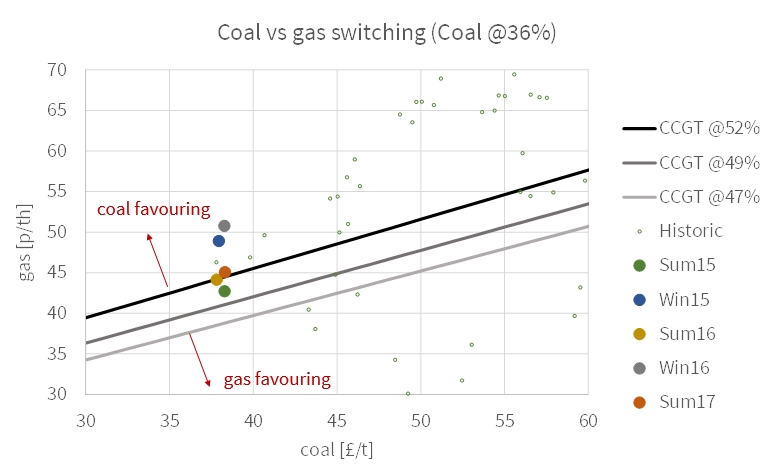
Structural switching of coal plants for CCGTs is not yet reflected in forward market pricing, even in the UK. By structural switching we mean the return of more efficient CCGTs to baseload running as they displace coal plants. But Chart 3 illustrates that this switching point is not far away.

Chart 3: Current UK forward market view of gas vs coal switching

coal gas switching

Source: Timera Energy

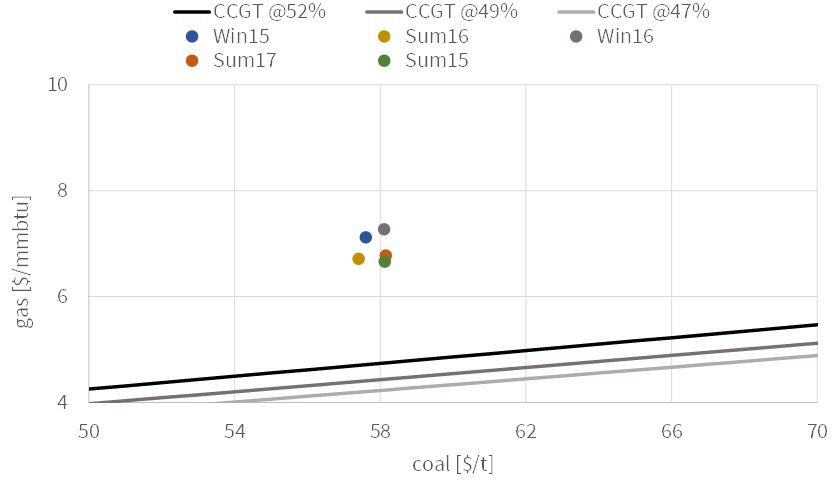
The chart axes show the cost of gas and coal (in traded units). The upward sloping lines show the gas & coal price boundaries for CCGT displacement of coal plants at different CCGT efficiencies:

  • 52% efficiency: A benchmark for the newest plants built since 2005
  • 49% efficiency: A benchmark for average system CCGT efficiency (equating to assets built around 2000)
  • 47% efficiency: A benchmark for older CCGT assets (e.g. pre 1998)

Gas and coal price combinations below the upward sloping lines, favour CCGT operation over coal. Price combinations above the lines favour coal over gas.

The two clusters of coloured dots on the chart show current forward market pricing points for gas and coal over the next few seasons. CCGTs are relatively more competitive in the summer given lower seasonal gas hub prices.

While CCGTs are not yet structurally displacing coal, forward pricing over the next three summers show newer CCGTs starting to displace older coal plants. Gas plant competiveness is a lot higher than it has been over most of the last five years.

Importantly market price trends in 2015 may be moving in favour of gas plants. Hub prices remain under pressure from LNG imports, while coal prices in European currency terms have been supported by a strengthening US dollar. Europe looks particularly vulnerable to a further decline in gas hub prices this summer which may cause a significant increase in UK CCGT load factors. This may also start to increase CCGT run hours in Continental power markets.

What does this mean for gas-plant values?

The roll of CCGTs in European power markets is structurally changing as intermittent renewable capacity increases. CCGTs have become mid-merit and peaking assets. This means that CCGT asset optionality in capturing margin needs to be properly valued. The traditional Base, High & Low scenario approach to asset valuation does not do this justice, as we summarised here.

It is easy to write off CCGT asset values based on weakness in forward spark spreads. But this oversimplifies asset value dynamics. Realised asset margin capture from prompt price shape and volatility tend to increase before forward spreads react (as has been witnessed recently in the UK). And margin capture from shape and volatility is sensitive to changes in gas vs coal switching dynamics.

As the SRMC of gas plants becomes closer to that of coal plants, the number of hours of positive margin capture increases. At the same time, the costs of capturing margin tend to decrease (e.g. via a reduction in start costs and sub full load efficiency degradation). This means that plant margin increases in a non-linear relationship to gas plant competitiveness. In other words there is typically a big value difference between a gas plant running at sub 5% load factor versus one running at 30%.

Chart 4: CCGT gross margin distribution chart (€m)

thermal plant margin

Source: Timera Energy power plant valuation model

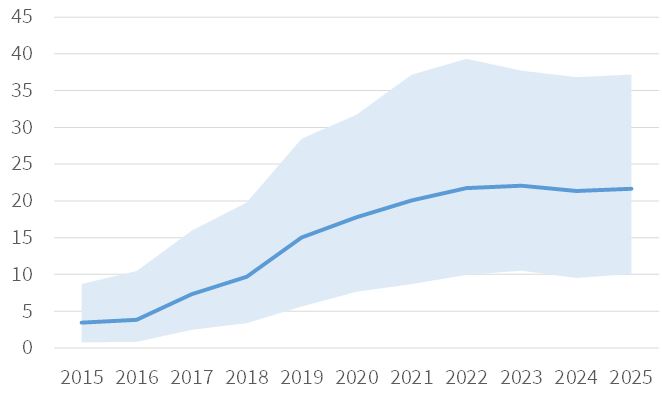
The characteristics described above contribute to the asymmetric upside exhibited by CCGT asset margin distributions. This can be seen in the example CCGT margin distribution shown in Chart 4. The blue line shows expected asset margin, in this case increasing as gas competiveness rises over time. The shaded envelope around the expected (50th percentile) margin line reflects the 5th and 95th percentiles of the margin distribution. This margin distribution can be used to quantify the risk/return dynamics of the plant and to properly value asset optionality.

The nature of gas/coal switching and asset value

Gas vs coal switching is often perceived to be a binary affair: at the point when the SRMC of gas plants falls below that of coal plants, CCGT load factors and margins rise at the expense of coal plants. But the reality is that switching has a more gradual impact across different assets, time periods and markets.

UK CCGTs are already starting to realise the benefits of increased gas plant competitiveness. Gas plants on the Continent remain ‘out of the money’ on a forward price basis, but as hub prices fall their ability to capture margin from price shape and volatility in peak periods is increasing. These dynamics should translate into higher risk adjusted asset values. As a result, analysing how asset values can increase with gas plant competiveness is an important area of focus for gas plant owners and investors.

We will come back shortly with an expanded analysis of gas vs coal switching dynamics on the Continent.

Article written by David Stokes, Olly Spinks & Emilio Viudez Ruido

Watch out for Chinese & European gas demand

The European gas market’s ability to absorb surplus global LNG flows may be tested over the next five years. More than 150 bcma of new LNG supply is under construction for completion by the end of this decade. Surplus LNG supply above Asian and emerging market requirements will primarily flow to Europe.

European hubs should be able to absorb additional LNG flows in an orderly fashion as long as European suppliers retain the flexibility to reduce pipeline contract volumes. But once swing flexibility above contract ‘take or pay’ levels is exhausted, European hubs may reach a tipping point, as we set out in a recent article.

Beyond this tipping point, hub prices may fall sharply and disconnect from oil-indexed contract prices, as was the case in 2008-09. The interaction between Chinese and European demand growth will play a key role in determining whether this tipping point is reached.

China: the world’s marginal LNG buyer

Anticipated growth in Chinese gas demand has underpinned much of the 150+ bcma of new LNG liquefaction capacity under construction. The fundamental logic behind this is robust. China has made clear its intentions to orchestrate a centrally planned shift away from coal towards gas for power generation, in order to address local pollution issues.

But Chinese gas demand and Chinese LNG demand are two different things. China signed 68 bcma of framework agreements for oil-indexed pipeline imports from Russia in 2014. Although the terms of these agreements are far from concluded, they reflect China’s intent to ensure gas supply diversification. This is in addition to anticipated growth in existing pipeline imports from Turkmenistan and Central Asia via the West – East Pipeline. China has also made clear it wants to develop its own unconventional gas production as a third pillar of supply (although this is unlikely to start to have a significant impact until next decade).

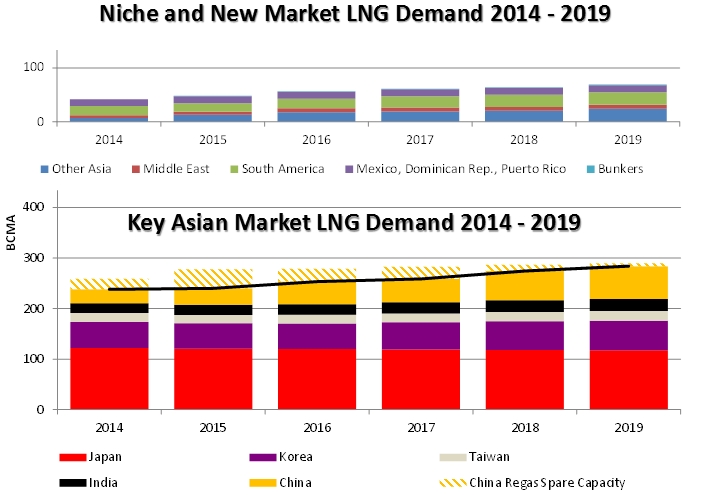
Chart 1 shows the relative importance of Chinese LNG demand in a global market context. It assumes an 18% compound annual growth rate for Chinese LNG demand which means current Chinese regas capacity is broadly fully utilised by the end of the decade. This would be broadly in line with presentations from CNPC of November 2014.

Chart 1: Breakdown of global LNG demand (source Howard Rogers)

Sc 1 LNG

The chart also illustrates the importance of Chinese LNG demand growth in relation to:

  1. Other Asian markets (bottom chart)
  2. Niche and new LNG markets (outside the big 5 Asian buyers)

The volume of Chinese LNG demand will be price sensitive. If the current conditions of lower LNG prices continue, China may provide key LNG spot price support as an opportunistic buyer of surplus LNG.  We looked at factors driving Chinese LNG demand here.

But why is Chinese LNG demand so important for Europe? In an oversupplied global gas market, the majority of surplus LNG that is not bought by China (and to a lesser extent other opportunistic buyers) will flow into European hubs.

Europe: the world’s LNG sink

Europe plays a key price support role in an oversupplied global LNG market as we explained here. The volume of European gas demand growth over the remainder of this decade will be a key determinant of Europe’s ability to absorb LNG flows in an orderly fashion.

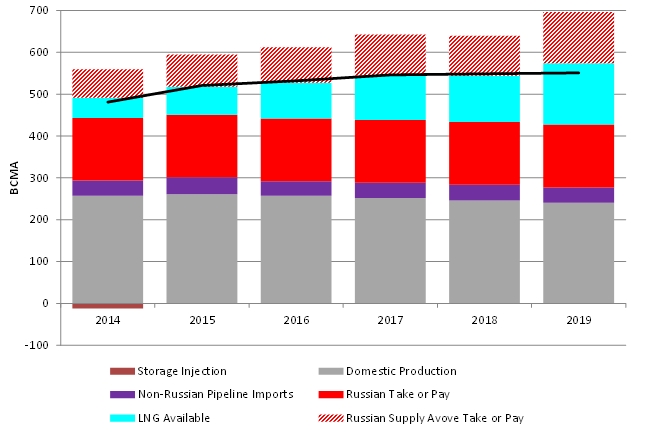
Chart 2 shows the European gas market balance assuming recovery from 2014’s weather related demand levels and a 1.5% pa growth thereafter, based on a combination of economic recovery and nuclear and coal retirement substitution. . The chart has been developed based on the global LNG demand projections shown in Chart 1. In other words LNG supply over and above aggregate LNG demand shown in Chart 1 is assumed to flow into Europe (the turquoise shaded area in Chart 2). The chart illustrates LNG flows displacing flexible Russian pipeline contract volumes.

Chart 2: European gas market balance (source Howard Rogers)

Sc 1 EU

Chart 2 shows a finely balanced European gas market. Virtually all of the flexibility to ramp down pipeline contract volumes to the traditional 85% take or pay levels is utilised to allow the European market to absorb LNG flows. It is important to note that there is likely to be some additional flexibility to ramp pipeline volume take below 85% ToP levels as we set out here.

But Chart 2 suggests that a slower pace of European demand growth, for example induced by continued economic stagnation or a new recession, may be enough to upset the European gas market balance. If instead of the recovery described above (and shown in Chart 2), European demand in 2019 was only 8% above that of 2014, this would be enough to push the European market beyond the tipping point.

If China doesn’t absorb surplus LNG, Europe will have to

Questioning the robustness of Chinese LNG demand was a somewhat controversial view in early 2014. But the industry consensus on Chinese LNG demand growth volumes has been shaken by over the last twelve months. This in conjunction with 150 bcma of new supply (predominantly from Australia and the US), has focussed attention on the ability of China doing the ‘heavy lifting’ to absorb new supply, via its growing fleet of regas terminals. Even at the lower spot LNG prices of the last year, this is not a foregone conclusion given the reduction in China’s industrial growth rate.

Europe has in the past been the receiving market for LNG supplies surplus to Asia’s requirements. This was demonstrated in 2010 when weather induced high demand allowed volumes to be absorbed with albeit minor difficulty in meeting Russian pipeline contract take or pay commitments. Between 2015 and 2019 the path of European demand will be key in determining this market’s ability to absorb large new LNG volumes while meeting Russian contract take or pay levels. Events will of course be subject to uncertainties of economic performance and power sector fuel mix in addition to weather.   But if Europe cannot absorb surplus LNG, the tipping point phenomenon we have described will become evident in hub price falls and a significant pick up in prompt price volatility.

Article by David Stokes, Olly Spinks & Howard Rogers

Evolving roles and risks in the European gas market

Much industry analysis and discussion has been directed at European gas price formation, specifically the transition from oil indexation to hub pricing. But there has been less focus on the changing roles and risks of the key players. In this article we examine the drivers of European hub prices and attendant uncertainties and also the risks of key players compared to the pre-liberalisation era.

Revisiting the hub price framework

With hub prices eclipsing those of oil (product) indexation as the key wholesale reference price it is natural to ask the question ‘What are the determinants of European hub pricing?’ We have addressed this question previously in articles that set out and then applied a framework for the analysis of hub price behaviour. Two important conclusions from this framework approach are:

  • If demand in Europe, which is linked by infrastructure to liquid hubs, is met at the margin by Russian pipeline gas above take-or-pay levels, then hub prices will gravitate towards the Russian oil-indexed contract price.
  • If, however, demand is depressed and/or supplies of flexible LNG represent the marginal supply tranche for ‘liquid’ Europe, then prices fall below Russian oil-indexed contract prices. The exact hub price level depends on supply and demand dynamics and market sentiment, but important price support exists at levels where gas displaces coal in the power generation sector.

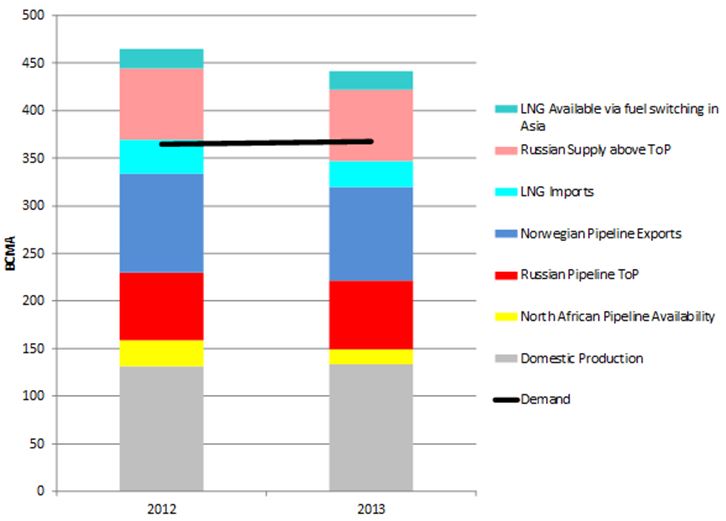
Historical analysis shows the framework approach to have worked reasonably well to the beginning of 2014, as shown in Figure 1. For 2012 and 2013, the annual average NBP price was $9.36 and $10.63/mmbtu respectively.

Figure 1. A Supply Stack for North and Central Europe, 2012 and 2013

Supply Stack Rogers-Stern

Source: Rogers & Stern, OIES

Two areas that are more challenging with the framework approach from a practical viewpoint are:

  • In order to project the volume of LNG available for Europe, it is necessary to evaluate the global balance of LNG supply and demand which is subject to a significant degree of uncertainty.
  • With the introduction of ad-hoc concessions on price formulae, take or pay levels and rebates relative to hub prices on an individual contract basis, it is extremely difficult to define what the ‘Russian contract oil-indexed price’ is.

In early 2014, continuing to the present time, hub prices have fallen and remained below estimates of Russian contract price based on historic relationships to lagged oil product pricing. In mid 2014, NBP fell to levels where it demonstrably displaced coal in the UK power market. The forward curve for NBP and TTF appears to broadly re-converge with the consensus view of Russian contract prices in the 2nd half of 2015. But if substantial volumes of LNG keep flowing into European hubs, realised spot prices may again fall below contract price levels (a risk which we explored last week). We will return to the price exposure risks for midstream companies presently.

Evolution of European gas players

At the birth of the continental European gas industry the challenges in introducing natural gas as a new fuel were essentially to establish:

  • a pricing mechanism which would price gas into the energy mix at an advantageous level relative to oil products (without undue market disruption); and,
  • national (or sub-national regional) champions (monopolies) to contract supplies from domestic and increasingly foreign producer/suppliers on a long term basis such that the financing of pipelines and distribution systems could be undertaken.

With the continuing strong growth in European gas demand up to the mid to late 2000s, this model proved highly successful for upstream and midstream participants. Demand growth effectively passed on the residual price risk to end consumers (power generators and industrials), who until relatively late in the day were unaware of this.

In the 2000s however, the First and Second Gas Directives, the Energy Sector Enquiry and the subsequent Third Package and Gas Target Model resulted in radical changes to the status quo. Network unbundling, entry/exit tariffs for transportation and the end goal of delivery of gas to hubs represented significant changes to the regulatory landscape. At the same time and partly in response to such changes, a wave of mergers created pan-European players. Significantly these were primarily power and gas utilities, dominated by power generation and management teams with more of a ‘trading mentality’.

In this new landscape the following changes can be observed in the roles of the key players in the gas supply chain:

  • Producers and Exporters: Their primary role is largely unchanged; however they now have the option to sell directly to large end-users – either via medium term contracts or as trading counterparties on the hubs. They may wish to continue with existing long term contracts and to sign new contracts if undertaking large new upstream projects.
  • Network Companies: Transmission System Operators (TSOs) and Distribution System Operators (DSOs): These are new players, the product of unbundling pipeline assets from the Midstream Gas Companies. They enjoy low (regulated) rates of return but bear arguably little risk.
  • Local Distribution Companies: Although they have lost their physical networks, LDC’s have not yet been subject to serious competition for their ‘captive’ customers due to low levels of customer switching.
  • Mid-Stream Gas Companies: These became the gas departments of energy utilities. They retained their long-term supply and transmission contracts. The supply contracts are subject to continual arbitration/renegotiation with upstream producers (unless they have been changed from oil- to hub indexation). The customer base is under attack from upstream producers and downstream LDC’s. Depressed demand also serves to increase the risks of not achieving take or pay commitments as well as creating potential financial exposures on send or pay in long term transmission capacity contracts.

The market landscape evolution described above has served to migrate risks into what were formerly Mid-Stream Gas Companies. The challenge they face is to continue to generate a margin on sales volumes given:

  • A flat or at best low demand growth environment and competition for market share from LDC’s and new entrants.
  • The exposure to price on their contracts with upstream producers (and the continual management distraction of renegotiations and arbitrations), if these have not been moved to hub indexation.
  • The need to meet take or pay and send or pay commitments in supply and transmission contracts.
  • The costs incurrent, not just in terms of sales management overhead but also the cost of transporting gas from the delivery point to the customer or hub.

Exposures can be mitigated (but not always eliminated) by trading portfolio optimisation for the liquid portion of the forward curve. But the midstream players effectively need to pay a ‘hub minus’ price to the producers on the basis that they supply an aggregation function which has inherent value. At present it is not clear:

  • Whether an upstream producer with an in-house trading capability recognises the value of aggregation versus direct hub sales; and,
  • Whether exposure to midstream risks through intense mitigation activity is sustainable for the remaining life of long-term supply and transmission contracts, some of which run into the late 2020s.

European gas players looking forward

Looking to the future, there are three scenarios that can be envisaged:

Scenario 1: The ‘hub-minus model’ is successful and accepted by producers. Midstream players continue with a smaller but profitable merchant business and with some difficulty are able to continue with their long term contracts to expiry.

Scenario 2: The ‘hub-minus model’ is not accepted by producers. Midstream players are unable to establish a profitable business and cannot continue to the end of their long term contracts. Intense competition results in a consolidation, with companies leaving the sector leaving 6 or fewer serious players (‘the British model’).

Scenario 3: The existential threat to midstream gas players raises governmental concerns in some countries where the collapse of long term supply and transmission contracts is viewed as unacceptable. Financial support in some form is made available to enable existing contracts to be managed until expiry.

The current level of hub prices in Europe (around $7/mmbtu) may help midstream companies in terms of demand stimulation and meeting take or pay (or send or pay) commitments. However some of the problems described above primarily relate to the spread between oil indexed contract prices and hub prices. Although such spreads may reduce in the second half of 2015 it is difficult to predict whether this will be reflected in the spot market at that time or whether such a convergence will endure. The inability of players to hedge exposures beyond the liquid portion of the forward curve will unfortunately ensure that such problems are likely to recur throughout the remaining life of these contracts.

This article was drafted by Howard Rogers and is based on the findings and conclusions of the following paper:

The Dynamics of a Liberalised European Gas Market: key determinants of hub prices, and roles and risks of major players (Jonathan Stern and Howard V Rogers, OIES, December 2014).

The tipping point in the gas market

The global gas market balance has swung from Asia back towards Europe as oversupply in the LNG market has taken hold. European hubs are providing key global price support as a market of last resort for surplus LNG flows. But how much surplus LNG can Europe absorb without driving hub prices sharply lower?

The ability of European hubs to absorb LNG is driven primarily by supplier flexibility to ramp down pipeline contract volume to take or pay levels. But at the point that contract swing flexibility is exhausted, hub prices may disconnect from oil-indexed contract prices and fall substantially, firstly to levels that induce gas vs coal switching in European power markets and then ultimately towards price support from Henry Hub (as was the case in 2008-09). This is what we refer to as the tipping point.

Current global balance

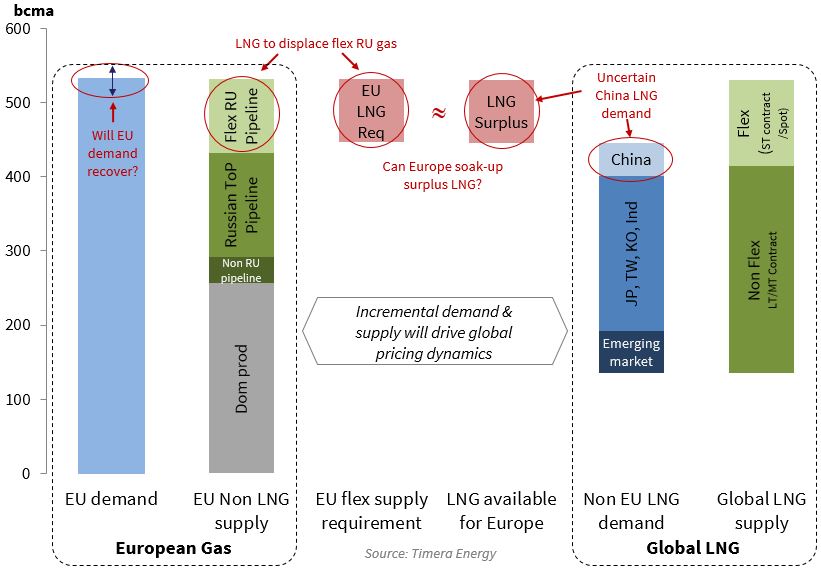
Forward market prices do not yet anticipate this ‘tipping point’ being reached. Forward hub prices remain broadly in line with oil-indexed contract price proxies. But the global market currently looks to be finely balanced. In Chart 1 we show our summary view of the supply and demand balance in the European vs global LNG market for 2016.

Chart 1: European vs LNG market balance (2016)
EU Volume Chart

The left hand side of the chart shows the supply and demand balance at European hubs. The right hand side of the chart shows the global LNG market balance. LNG supply in excess of Asian demand (and the relatively small non-Asian emerging market demand), will need to be absorbed by Europe.

Some of this European volume is via non-divertible LNG supply contracts, primarily into Southern Europe. But as new volumes of LNG liquefaction capacity are commissioned in 2015 and 2016 they look to be exacerbating the oversupply situation in Asia. Under conditions of oversupply, divertible European LNG contracts and surplus spot LNG cargoes will flow into European hubs.

The ability for European hubs to absorb surplus LNG volumes is driven primarily by the displacement of flexible pipeline contract volumes, most of which come from Russia. As surplus LNG flows act to push hub prices below oil-indexed strike prices, suppliers are incentivised to minimise pipeline contract volumes to the annual contract ‘take or pay’ (ToP) levels.

Chart 1 illustrates the volume of pipeline swing contract flexibility above ToP. Swing flexibility has traditionally been about 85% of annual contract volume. However suppliers have negotiated additional ToP flexibility through contract reopener processes over the last 5 years, although it is difficult to know exactly how much given confidentiality of negotiations.

The important thing to note is that with swing flexibility around this level, European hubs do not appear to be far from the tipping point we describe above. This tipping point could be tested over the next two years if European and Asian gas demand remains soft in the face of the rapid ramp up in new LNG supply.

A simple European supply stack view

There has been a rapid transition in European hub pricing over the last six months as crude prices have fallen and European LNG imports have increased. These conditions warrant revisiting our framework for analysing European hub prices, to gain some perspective on how prices may evolve going forward.

The purpose of our hub pricing framework is to simplify the complex interaction between sources of supply and demand that drive European hub pricing dynamics. As summarised in our previous article:

There are two important considerations that can be used to greatly simplify the problem:

  • Grouping sources of supply with similar pricing and flow dynamics
  • Focusing on the flexible volumes of gas that drive hub pricing at the margin (i.e. around the intersection of supply and demand)

The first of these tasks is helped by the fact that most sources of European supply are under long term contracts that use a similar structure. The second task is assisted by the fact that only a relatively small volume of total European supply actually has the flexibility to respond to changes in market price.

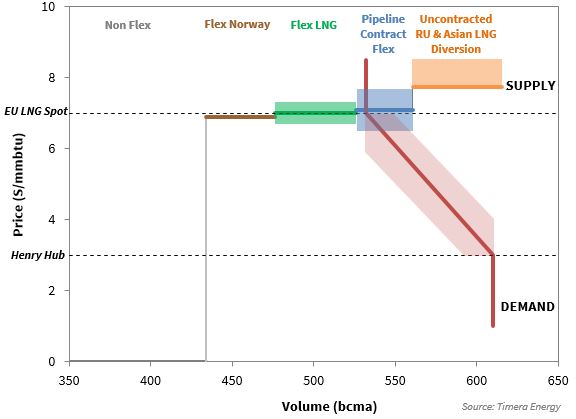
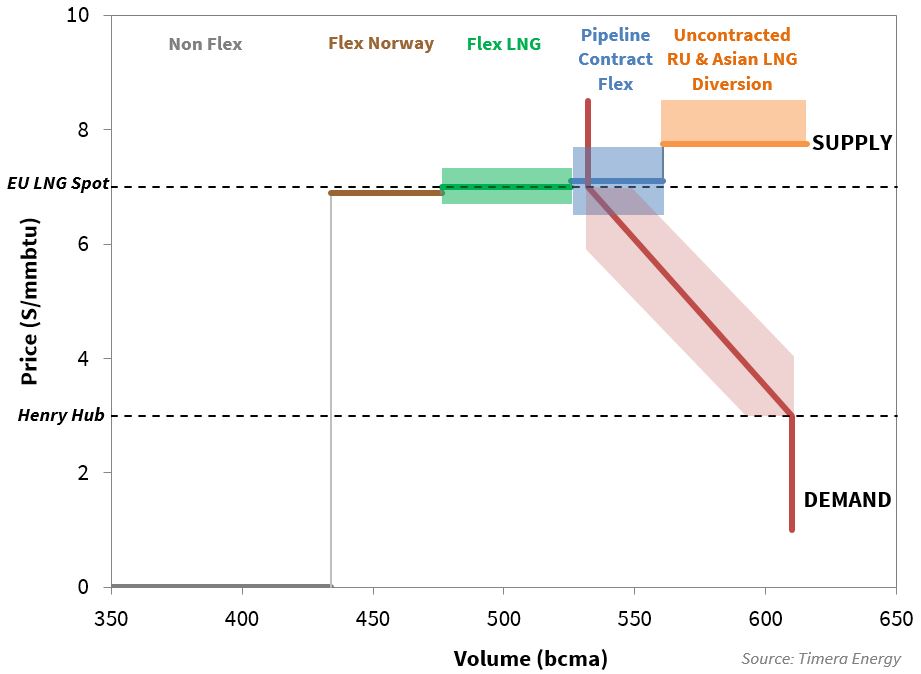
Chart 2 illustrates the key tranches of supply that are currently interacting to set hub prices at the margin. It is important to note that the chart contains a simplified view of both supply and demand, in order to get across the key concepts. It should also be noted that inflexible ‘must flow’ volumes of gas (e.g. domestic production and contracted ToP volumes) are assumed to sit to the left of the supply stack at zero price.

Chart 2: Summary European gas market supply stack (2016)
EU Gas Supply Curve

The demand curve (in red) shows a simplified representation of pan-European gas demand in 2016. Projected demand at current price levels is around 530 bcm. The demand curve is downward sloping at lower price levels. This is driven primarily by an increase in gas demand as coal plant output switches to gas plant output as gas prices fall. The shaded red range around the demand curve reflects uncertainty around factors that influence demand such as coal price levels. The Henry Hub price level represents a floor price for European hubs given the US gas market can ultimately assume the role of LNG market ‘sink’ for surplus cargoes (as it did in 2008-09), although this situation may act to push US gas prices lower.

We have simplified pan-European supply by grouping flexible sources of gas into four main tranches as set out in the table below (again more logic here in our previous article). This provides a basic view of supply source interaction which is enough to describe key hub pricing dynamics. This can then be enhanced relatively easily by adding more detail on volume and pricing as required (e.g. sub-tranches of supply).

Tranche

Description

Pipeline swing contract volumes (BLUE)

  • This volume consists predominantly of Russian swing contract flexibility (and matches the top bar in the EU supply column in Chart 1). The pricing and flow dynamics of this gas are heavily dependent on oil-prices given contract indexation.
  • We show an estimate of price ranges on the contracts that make up this swing supply (6.50 – 7.75 $/mmbtu) using a current proxy based on oil prices.
  • Current volume dynamics in 2016 suggest that most annual swing volumes above ToP will be displaced by flexible LNG flows into Europe (as described in Chart 1). The price level of just above 7 $/mmbtu is consistent with current NBP forward prices for 2016.
Flexible LNG (GREEN)
  • This volume consists of both divertible European LNG supply contracts and surplus spot LNG cargoes not required by Asia. These Flexible LNG volumes are currently displacing Russian pipeline swing contract volumes (as described above).
  • The volume of this Flexible LNG that flows into Europe will depend on Asian spot LNG prices in 2016, which we have approximated based on forward Asian LNG price proxies (note this is not a ‘transactable’ forward price benchmark). The important dynamic around this tranche of gas is that it will flow into European hubs as a market of last resort if not required in Asia.

Norwegian spot linked supply (BROWN)

  • In this tranche we have grouped (i) uncontracted Norwegian production (optimised against hub prices) and (ii) spot indexed Norwegian contract sales. We assume this gas is priced at (or marginally below) spot hub prices.
  • In other words while the pricing/flow of this gas is optimised within-year against spot prices, annual volumes are sold to ensure Norway’s annual production targets are met and contract volume requirements are fulfilled. Hence this tranche is assumed to sit ahead of the other flexible tranches of supply.

Uncontracted Russian production and Asian LNG diversion (ORANGE)

  • We have grouped the remaining higher priced supply sources on the far right of the supply curve. The two most important sources here are (i) uncontracted Russian production and (ii) flexible LNG volumes that could be diverted from Asia given an adequate premium of European hub prices over Asian spot LNG prices.
  • We do not give detailed consideration to the pricing of this gas for the simple view presented in this article. But as a guide on pricing, Russia is unlikely to sell additional volumes of uncontracted gas unless all of its contracted volumes have been lifted (i.e. pricing ranges above the swing contract tranche at $7.75+). Similarly a significant European price premium would be required to induce LNG demand reduction in Asia.


This simplified annual supply stack view provides a useful summary of some of the key drivers of hub price evolution given current market balance. While it is easier to observe these dynamics at an annual level, there are more complex dynamics at work behind this at a sub-annual level (e.g. seasonal price & flow behaviour). A particularly important dynamic here is the fact that there is additional within year flexibility in swing contracts (over and above the annual flex above ToP levels shown in the chart). These sub-annual dynamics do not invalidate conclusions at an annual level, but are important to bear in mind.

Conclusions on price dynamics

The price declines at European gas hubs over the last six months have been consistent with the fall in oil prices. In other words gas hub prices have remained broadly linked to long term oil-indexed contract prices. But this linkage is threatened by a limited volume of swing contract flexibility which can be displaced in order for hubs to absorb higher LNG inflows. At the point that contract swing flexibility is exhausted, hub price levels can disconnect from oil-indexed contract prices. At this tipping point, prices may fall sharply lower to levels that support the increase in demand required to absorb higher LNG inflows.

The supply stack in Chart 2 highlights the two key tranches of gas supply that will determine whether the European gas market reaches its tipping point. At current hub price levels (~7 $/mmbtu), European hubs cannot absorb both flexible LNG imports (the green tranche) and significant volumes of swing contract volumes above ‘take or pay’ levels (the blue tranche). This leads to the conclusion that increasing LNG inflows are likely to ensure that hub prices remain below oil-indexed contract price levels (i.e. flexible LNG will sit below swing gas in the supply stack).

Once European swing contract flex has been fully displaced by higher LNG imports, tipping point dynamics are driven by price inelastic volumes of demand and supply. Surplus LNG supply sold into Europe as a market of last resort is relatively insensitive to hub price levels. LNG will flow into Europe as long as NBP/TTF prices are more attractive than LNG spot price alternatives (e.g. in Asia). Similarly it may take significant gas price falls to induce higher European hub demand from gas vs coal plant switching. The inelasticity of these supply and demand volumes is an important factor that can drive sharp moves lower in hub prices.

The evolution of overall European gas demand levels will also be a key determinant of whether hubs reach the tipping point. If medium term demand is lower than the levels we have assumed, due to weather, continued economic stagnation, further general erosion of power sector gas burn by coal and renewables, this reduces the scope for European hubs to absorb LNG imports while meeting Russian take-or-pay volumes. This underlines the importance of keeping the assumptions within this framework refreshed as views of European demand change.

If Asian LNG demand remains weak over the next two years, the tipping point dynamics we describe in this article may take center stage. Global liquefaction capacity is set to increase by 55 bcma by the end of 2016. If a significant volume of that increase in LNG supply flows into Europe, it will test the ability of European hubs to ramp down swing contract take in order to absorb increasing LNG inflows. Under these conditions, the switching of coal for gas plant in the power sector will become a key driver of marginal hub pricing dynamics. We will come back shortly to focus on a more detailed analysis of coal vs gas switching dynamics.

Global LNG and European gas workshop

Timera Energy offers tailored workshops exploring the evolution of the global LNG and European gas market fundamentals and pricing dynamics.  These workshops involve Howard Rogers who, as the Director of the Gas Programme at the Oxford Institute for Energy Studies, is acknowledged as a leading industry expert in the global gas market.

If you are interested in more details please email olly.spinks@timera-dev.positive-dedicated.net

This article was written by David Stokes, Olly Spinks and Howard Rogers

 

UK gas storage capacity restrictions

It is almost a decade since a fire at Centrica’s Rough storage site sent shock waves through the UK gas market.  Market infrastructure has evolved since the fire, with significant increases in gas import capacity reducing the UK’s dependence on Rough flexibility.  But Centrica’s recent announcement of the temporary withdrawal of more than 25% of Rough capacity caused a notable market reaction.

The Rough news was followed by an announcement by SSE that it would mothball 33% of withdrawal capacity at its Hornsea storage site.  SSE, one of the largest investors in UK storage capacity over the last decade, cited ongoing weakness in UK storage market returns.  SSE’s unwillingness to invest in maintaining Hornsea’s capacity illustrates the challenge the UK is facing in ensuring new fast cycle storage capacity is developed to shore up security of supply as import dependency increases.

Nature of capacity reductions

Centrica has announced it needs to reduce pressure at the Rough facility to 3000 psi for up to six months while it resolves a ‘well integrity issue’.  The practical impact of this will be to restrict gas stored to between 29 and 32 TWh.  This represents a ~25-30% reduction in capacity versus a maximum historical volume of 41 TWh in 2014.

Centrica has stopped the sale of further capacity (SBUs) for the 2015/16 storage year to ensure it remains within this capacity constraint.  This does not preclude Centrica from selling additional capacity into next winter if the issues are resolved within six months (e.g. in October).  But the late sale of this capacity would restrict the length of the injection/withdrawal cycle.  And there is also presumably a risk of capacity restrictions being extended beyond six months if the well issues are more serious than anticipated.

SSE’s announcement on Hornsea impacts deliverability rather than space.  Withdrawal capacity at the site will fall by 6 mcm/day.  While this is relatively small in an overall market context, deliverability is the real constraint the UK gas market faces in winter periods.  SSE’s decision is also an important signal as to the appetite for storage owners & developers to commit to further investment spend in an environment of weak market price signals (i.e. low seasonal price spreads and volatility).

Scale of potential market impact

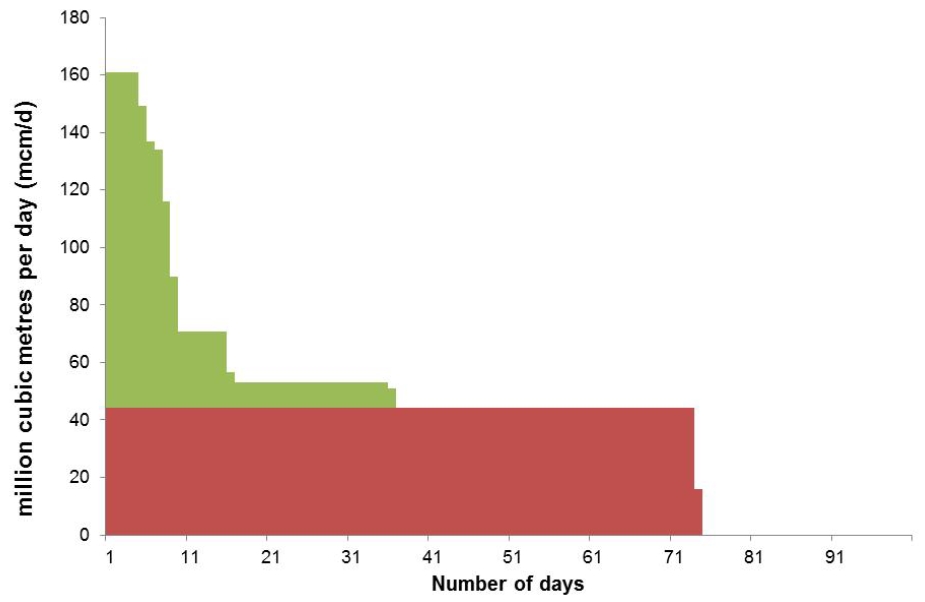
Rough is the UK’s slow giant.  It makes up about 70% of total UK storage space, but given relatively slow cycling, only about 25% of the UK’s daily deliverability.  So the 25-30% capacity reduction at Rough equates to a roughly 18-20% reduction in UK storage space.  But importantly, the capacity restrictions at Rough will not impact deliverability (Rough SBU withdrawal rates are not dependent on inventory levels).

The impact of the Rough restrictions can be visualised in Chart 1 which summarises UK storage capacity.   The vertical axis shows deliverability across all of the UK’s operational storage sites.  The horizontal access shows how many days that deliverability can be maintained assuming maximum withdrawal.

Chart 1: UK storage capacity deliverability

UK deliverability

Source: National Grid

The capacity restrictions on Rough, to the extent they reduce gas stored for next winter, will proportionately reduce the length of the brown area at the bottom of the chart.  In principle this acts to support seasonal price spreads at NBP.  But in practice the impact is likely to be relatively subdued given the UK’s access to ample seasonal flexibility on the Continent.  That said, the UK gas market would be more exposed to a prolonged cold spell next winter.

Rough deliverability, the height of the brown area in the chart, will not be impacted.  Storage deliverability is an important factor that acts to dampen prompt NBP price volatility.  So the volatility impact of the reduction in Rough pressure is likely to be negligible.

The impact of SSE’s Hornsea announcement on the other hand is all about deliverability.  The 6 mcm/day reduction of deliverability at Hornsea means a 4% reduction in UK storage deliverability.  This is relatively small in an overall market context, but not trivial.  For example it is equivalent to about one third of the deliverability from SSE’s latest fast cycle storage facility development at Aldbrough.

Storage announcements in context

As UK import dependency increases, the primary concern from a security of supply perspective is storage deliverability.  This plays an important bridging role over the two to three week period that it can take for the LNG import supply chain to respond to a major infrastructure outage or prolonged cold spell.

The Rough and Hornsea issues are likely to have a relatively small impact on UK seasonal price spreads and prompt volatility.  The potential for a pronounced pickup in the seasonal flow of LNG imports, for example, is a much higher impact factor currently looming on the horizon.  But Centrica and SSE’s recent announcements do highlight that the UK is more sensitive to interruptions in storage asset operation and investment than its Continental neighbours.

The Rough and Hornsea assets are the oldest in the UK fleet.  The current issues at each highlight a broader problem facing owners of older facilities in the UK and across the continent.  It is not a straightforward decision to commit to spend significant maintenance / renewal capex to extend the lives of older facilities in an environment of low volatility and spreads.  This unwillingness to invest in existing facilities may ultimately contribute to the market price signal recovery required to support investment in new storage infrastructure.

The dangers of mixing forecasts and forward curves

Forward market liquidity has steadily developed with the evolution of traded gas and power markets in Europe. This has supported traders and asset managers to hedge forward asset exposures, reducing portfolio earnings volatility.

Energy price forecasting on the other hand has not undergone the same evolution. The track record of industry price forecasters today is no better than it was a decade ago. Perhaps in recognition of this fact, price forecasts have become cheaper to obtain. But we are still not aware of any forecasters who are prepared to publish a ‘mark to market’ back test of their historical accuracy.

The US Energy Information Administration (EIA) does deserve an honourable mention in this regard, given it allows access to its past forecasts. The EIA price forecasts have been as consistently and strikingly erroneous as any other, as they freely acknowledge. But the EIA also regularly compares its price predictions to those of other forecasters, showing that they rarely fall much outside of a reasonably tight ‘consensus’ band. This neatly demonstrates the poor track-record of the price-forecasting community. It is understandable given these circumstances that the energy industry looks elsewhere for a view on future pricing outcomes.

At first glance, forward curves offer an attractive alternative, given they provide a transparent and objective view of market price. As a result many companies (and price forecasters) have adopted the forward curve as a spot price forecast, on the basis that it represents the market’s consensus view of future spot price outturn.

In our view this logic is a capital error, and in a short series of articles we set out to explain why. We also address the question – if the forward curve is not to be seen as a forecast of spot prices, how are we to interpret it? In this article we use the animation of Brent crude pricing history that we published recently to illustrate some of the dangers of using the forward curve as a spot forecast.

The differences between forward curves and forecasts

The two terms ‘forward curve’ and ‘forecast’ certainly both start with the letters F-O-R, but that is just about where the similarity ends. One might also remark that the axes on which forward curves (FC) and forecasts are plotted look the same. Certainly, the y-axis in both cases is price: but closer examination of the x-axes reveals a critical difference.

While both are denominated in units of future time, the x-axis of a forecast is a time-series continuum, generally of daily granularity across the chosen forecast period; while the x-axis of a FC is contiguous ‘time-buckets’, often starting with months, then becoming perhaps quarters, or seasons (winter / summer), and eventually years. It may be common practice to interpolate a baseline FC into common, more granular time divisions to give a smooth curve, but it should always be borne in mind that such a transformation signals a modelling-based step away from the raw input of forward prices coming from the market.

These time-buckets match the currently-traded forward instruments available in the market being reported upon: and the corresponding prices recorded on the FC are a snapshot of the various prices currently reflecting that traded market, as of the date on the curve. To be even more precise, they are prices from a series of related but individual markets: the forward market for month n, the forward market for month n+1 etc. With several months till delivery, ‘August gas’ (for example) is a different commodity to ‘September gas’.

To make the point even more strongly: in April the ‘August gas market’ is a market for pieces of paper on which appear obligations relating to deliveries of gas in August. ‘August gas’ only becomes the same commodity as ‘September gas’ if and when both have been delivered and are sitting in the same gas storage facility. Some August gas contracts will be liquidated before August arrives, and thus never go to delivery – they were never gas, and they were never cashed in for gas. Some August contracts were always to be financially, rather than physically settled, and were never destined to turn into gas at all – just a difference-payment, i.e. cash.

And there could be many more August gas contracts by volume than there will ever be physical gas either produced or consumed in August. August gas contracts have laws of supply and demand of their own – the supply and demand for pieces of paper with obligations written on them – which we discuss in terms of the liquidity of the forward market. For the most part these are quite independent of the physical realities of what will happen in the spot market in August which will be driven by physical supply-and-demand characteristics.

The spot versus forward price relationship

Of course there are connections between spot and forward markets, but some are fairly trivial. For example:

  • Spot prices are generally used to settle forward contracts. This follows directly from the original purpose of forwards as hedges against uncertain future spot prices.
  • The price of the nearest forward contract converges with spot price. This is generally true, but not a remarkable phenomenon because over short periods the spot and near-forward markets are readily arbitraged via storage and other means of temporal exchange.

Other connections are more interesting. For example:

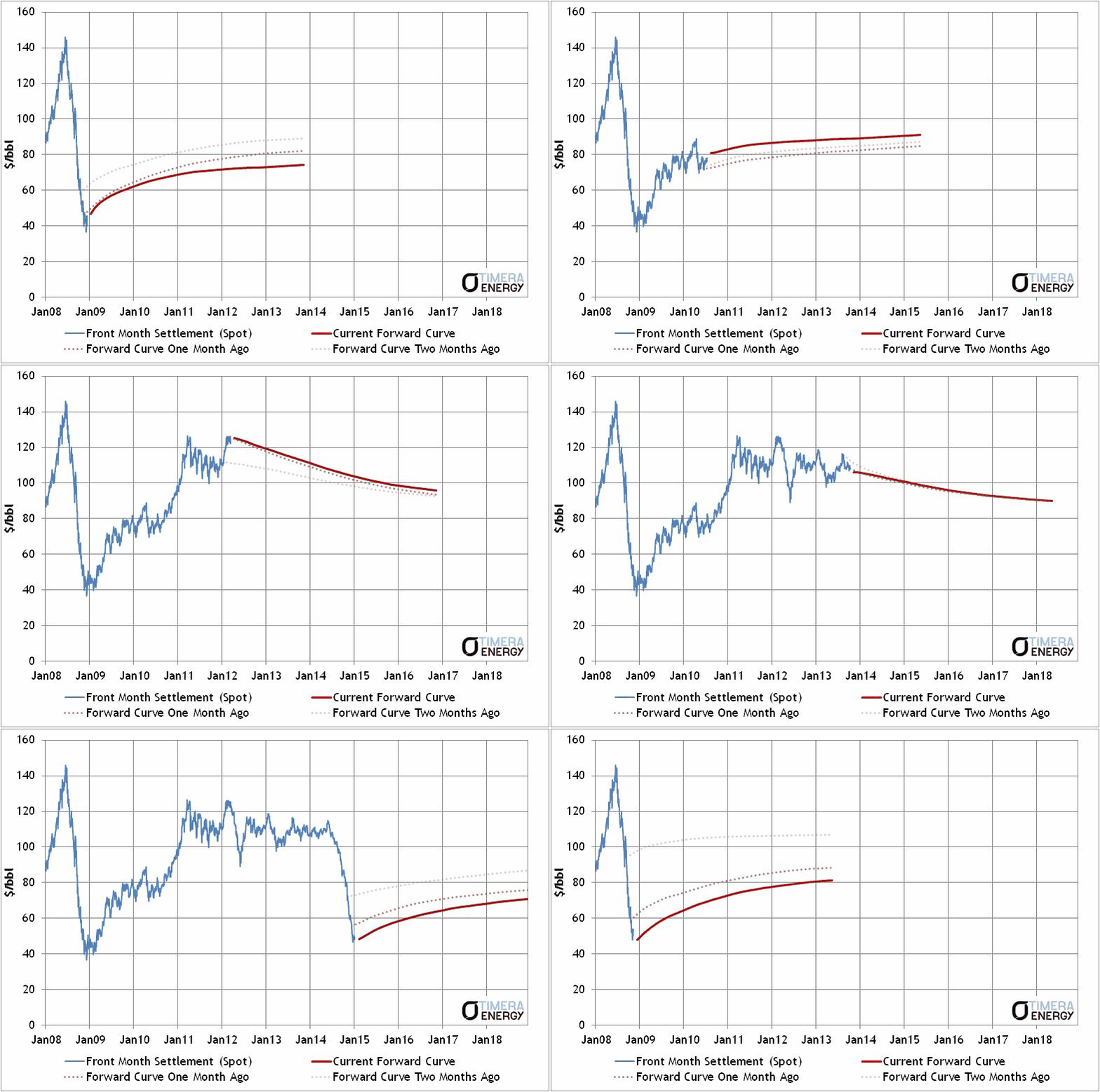
  • As neatly illustrated by the Brent animation (shown again in Chart 1), from day to day the biggest influence on the forward curve along its entire length is the spot price.
  • Indeed, the most common phenomenon in forward curve dynamics is the ‘parallel shift’, with the entire curve moving up or down almost in parallel, even if over the medium-term the gradient of the FC itself gradually changes, sometimes significantly.

Chart 1: Evolution of Brent crude spot and forward prices

oil animated v3

Source: Timera Energy (based on ICE Brent Futures settlement prices)

These phenomena clearly undermine the logic that ‘the forward curve is a forecast of spot prices’. Why would a three-year forecast change every day, and by the same amount across the whole forward period, and by the same amount as today’s spot price change? Who changes their long-term forecasts every day? Who thinks that an increase in today’s spot price, perhaps caused by the weather or a well-understood physical event in the supply chain, has any bearing whatsoever on prices three years from now? What kind of implicit fundamental modelling would give rise to such a result?

The Brent price animation illustrates a very simple test: has the FC been a good predictor of Brent spot prices? The answer is that it has clearly been a very poor predictor indeed.

In the articles to follow in this series we will consider a number of econometric theories as to how the FC relates to physical markets. We will see that they often bear very little relationship to reality: and that the dynamics of FCs is a subject best studied empirically.

This article was written by Nick Perry (Senior Advisor).