Structural transition in gas prices

A sharp slump in spot gas prices last summer marked the start of a new phase of global gas pricing.  This summer the gas market has been relatively quiet. Instead price action has been focused on the oil market. After recovering back towards 70 $/bbl in Q2, Brent plunged back under 50 $/bbl in August, pointing to a more prolonged period of oil price weakness.

An emerging oversupply of LNG and weak oil prices have seen the re-convergence of global gas prices. But so far European spot gas prices have remained broadly in line with oil-indexed contract prices. We have not yet seen a repeat of the global gas glut conditions of 2009-10, where a gap opened up between the cost of oil-indexed supply and hub prices. But this may change over the next to years.


The state of play

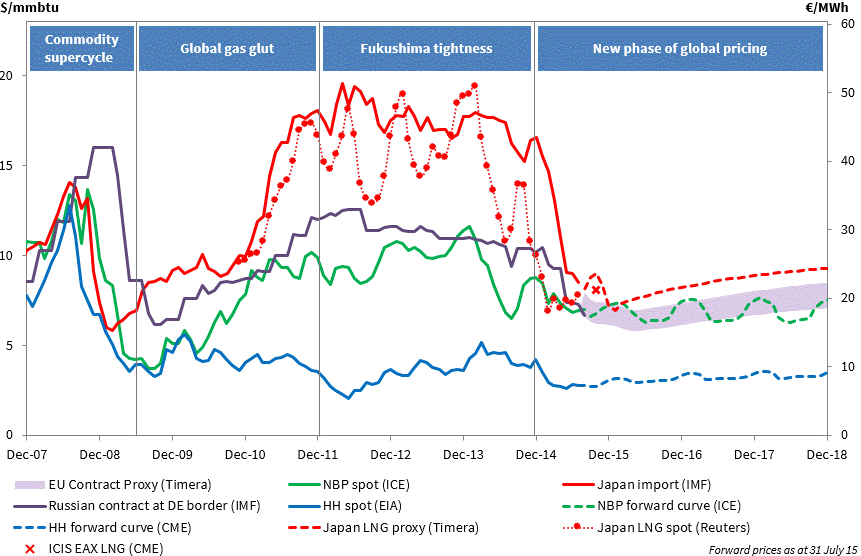
Chart 1 shows the rapid re-convergence of European & Asian gas prices over the last 12 months. The precipitous decline in Asian prices has been driven by the combined effect of (i) LNG oversupply and (ii) falling oil prices dragging down oil indexed contract prices.

In fact the last 12 months resembles 2011 in reverse. It so far remains to be seen if the gas glut dynamics of 2009-10 are to follow.

Chart 1: Global gas price evolution
Global Gas Prices Sept15

Source: Timera Energy

As summer winds to an end, European hub prices are hovering around the 6.00 $/mmbtu level. Asian spot LNG is changing hands at around 7.30 $/mmbtu (Japanese marker). So the acute pressure on European hubs from weak Asian LNG prices has temporarily subsided from earlier this year when the Asian vs European spot price spread briefly inverted.

But Europe’s status as the LNG market of last resort (or global gas sink) remains. European hubs are currently providing key support for global gas prices. Even if LNG is not flowing to Europe, it is being priced off a basis to European hubs.

There is no doubt as to the predominant exposure of large suppliers and portfolio players. The LNG market is long gas against a backdrop of relatively weak demand from Asian utility buyers. Rather than much anticipated demand from China driving price recovery, Chinese buyers are looking to unload portfolio length.

The main buying interest in the LNG market is currently focused on Middle Eastern buyers. But the competitive nature of the current Egyptian and Jordanian supply tenders and the likelihood of small premiums over NBP prices illustrates the LNG supply overhang.

After a brief recovery in Q2, oil prices are declining again, pointing to further downwards pressure on long term gas contract prices into 2016. The lagged impact of the oil price recovery on Asian contract prices can be seen via the red-dashed Asian LNG price proxy in Chart 1.

Higher slope coefficients on Asian LNG contracts mean contract prices fall faster in response to weakening oil than European pipeline contract prices. This also means that the Asian LNG market may transition to a role of dragging European hub prices lower, rather than pulling them higher.

Asian LNG contract prices are likely to end 2015 below 7.50 $/mmbtu (given the lagged impact of crude prices). Prices are set to fall further next year if oil price weakness continues. Lower Asian LNG prices are likely to drive the increasing diversion of flexible supply from Asia to Europe. This is the reverse effect of the post Fukushima period and means more LNG flowing into European hubs.


Looking forward into 2016

No crystal ball is required to predict the trend of supply in 2016. There is more than 50 bcma of new liquefaction capacity entering the LNG market across 2015-16. A number of large liquefaction projects will be commissioned from late 2015 into 2016 e.g. the two remaining Australian export projects on Curtis Island, the first US export trains at Sabine Pass and the expansion of the giant Gorgon field off Western Australia.

This new supply needs to find a home in a market that is already long LNG. To date there has been a notable absence of opportunistic buying in response to lower prices. China is the most important candidate, but weak manufacturing and export data and central authority devaluation of the yuan  do not bode well for a significant pick up in Chinese import demand in the near term. That points to large volumes of new supply flowing into European hubs, either directly (e.g. from Sabine Pass) or indirectly (e.g. via Australian gas displacing other Asian imports).

We have written previously about the risk of breaching the ‘tipping point’ in the European gas market. This is the point where the contractual flexibility to ramp down oil-indexed pipeline swing contract volumes to make way for LNG imports is exhausted. Once past the tipping point, oil-indexed prices are pushed out of their current role as the dominant setter of marginal hub prices. In turn, spot prices may need to fall significantly to induce demand response from gas-fired power plants e.g. in a 4-6 $/mmbtu price range. Conditions in 2016 look like they could well test this theory.


Gearing up for battle

From a European supplier perspective, it is not the absolute level of gas prices that are the key driver of portfolio value. It is rather the differential between the cost base of long term oil-indexed contract supply and hub prices which drive sales revenue. The divergence between oil-indexed and hub prices in 2009-10 precipitated big supplier losses and a round of supply contract re-negotiations & concessions that continued until 2012-13.

Suppliers have so far been shielded from the pain of 2009-10 given hub prices have remained broadly in line with contract prices. But if hub prices diverge from oil-indexed prices again in 2016, similar pressure on portfolio margins can be expected. A particularly dangerous scenario for suppliers would be a recovery in oil prices at the same time global gas market oversupply intensifies.

After 5 years of pain from power generation portfolio write downs, the balance sheets of European utilities are ill prepared for another shock. This would likely precipitate an intense phase of supply contract renegotiations, portfolio restructuring and asset divestments. It could also be the catalyst for the significant restructuring of portfolio supply to more closely reflect hub prices, with LNG offering a competitive alternative to pipeline supply.

Current market conditions and asset margins point towards a growing likelihood that utilities will need to raise capital to sure up balance sheets.  New capital with an appetite for energy assets is waiting in the wings in the form of infrastructure and private equity funds.  But fund appetite for merchant risk is limited by conservative risk/return mandates.  So transaction structures are likely to involve utilities retaining the lion’s share of asset market risk exposures.

Article written by David Stokes and Olly Spinks

UK spark and dark spreads in animation

The evolution of generation margins for gas and coal fired power plants are having wide reaching implications across European gas and power markets this decade. A collapse in spark spreads (gas plant margins) over the last five years has seen CCGT load factors crushed and units closed or mothballed. This has in turn driven a pronounced decline in European gas demand, contributing to weakness in gas prices, seasonal spreads and volatility.

Dark spreads (coal plant margins) remained somewhat stronger until 2014, supported by falling coal prices. But the onset of price weakness at European gas hubs last summer has steadily eroded dark spreads.

Weak gas and coal plant margins are a key issue in the UK power market, with the threat of closure of 8-10 GW of thermal generation capacity over the next two years.  The 2GW Eggborough coal plant last week became the latest station to announce it may close next year.

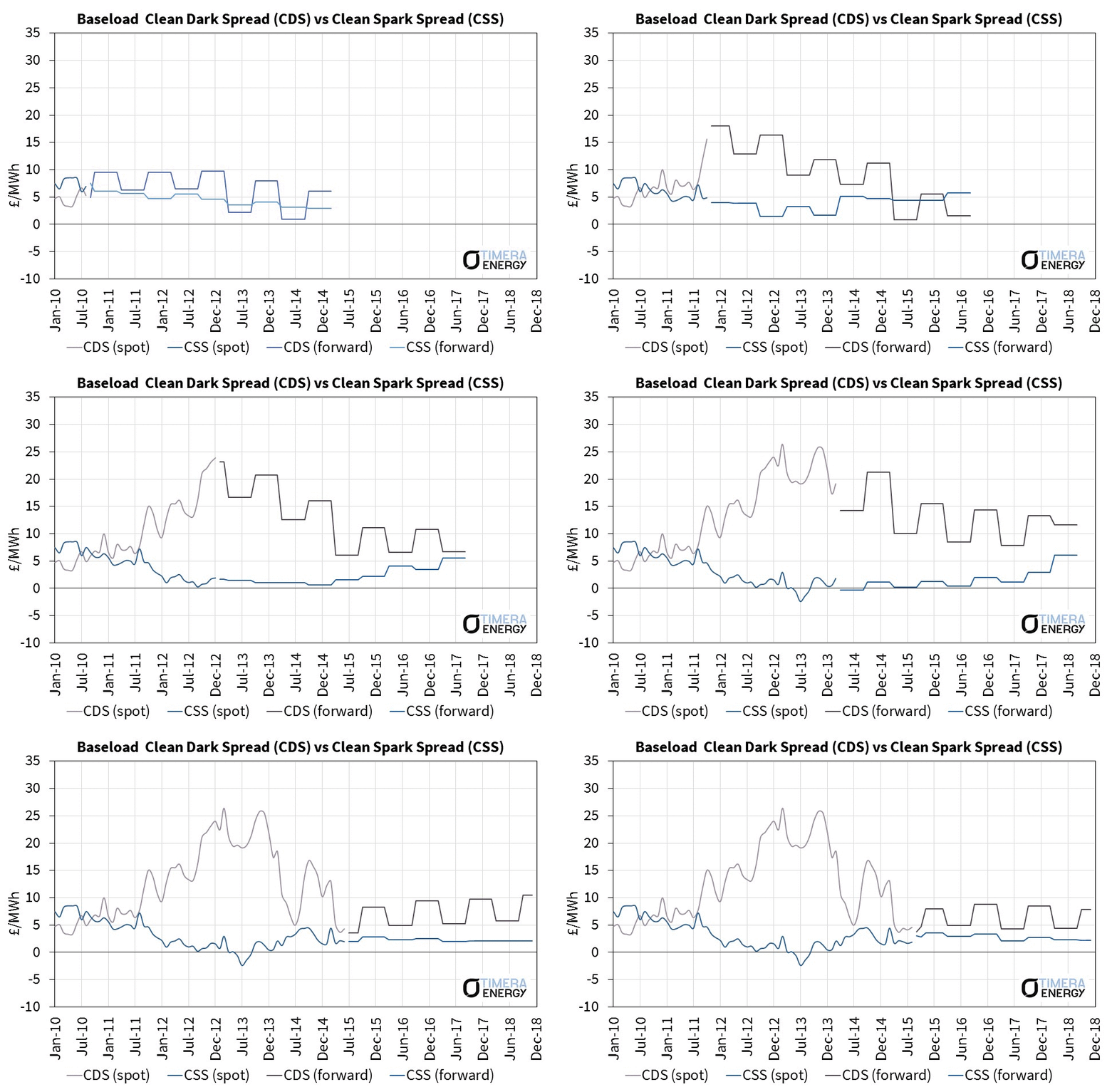
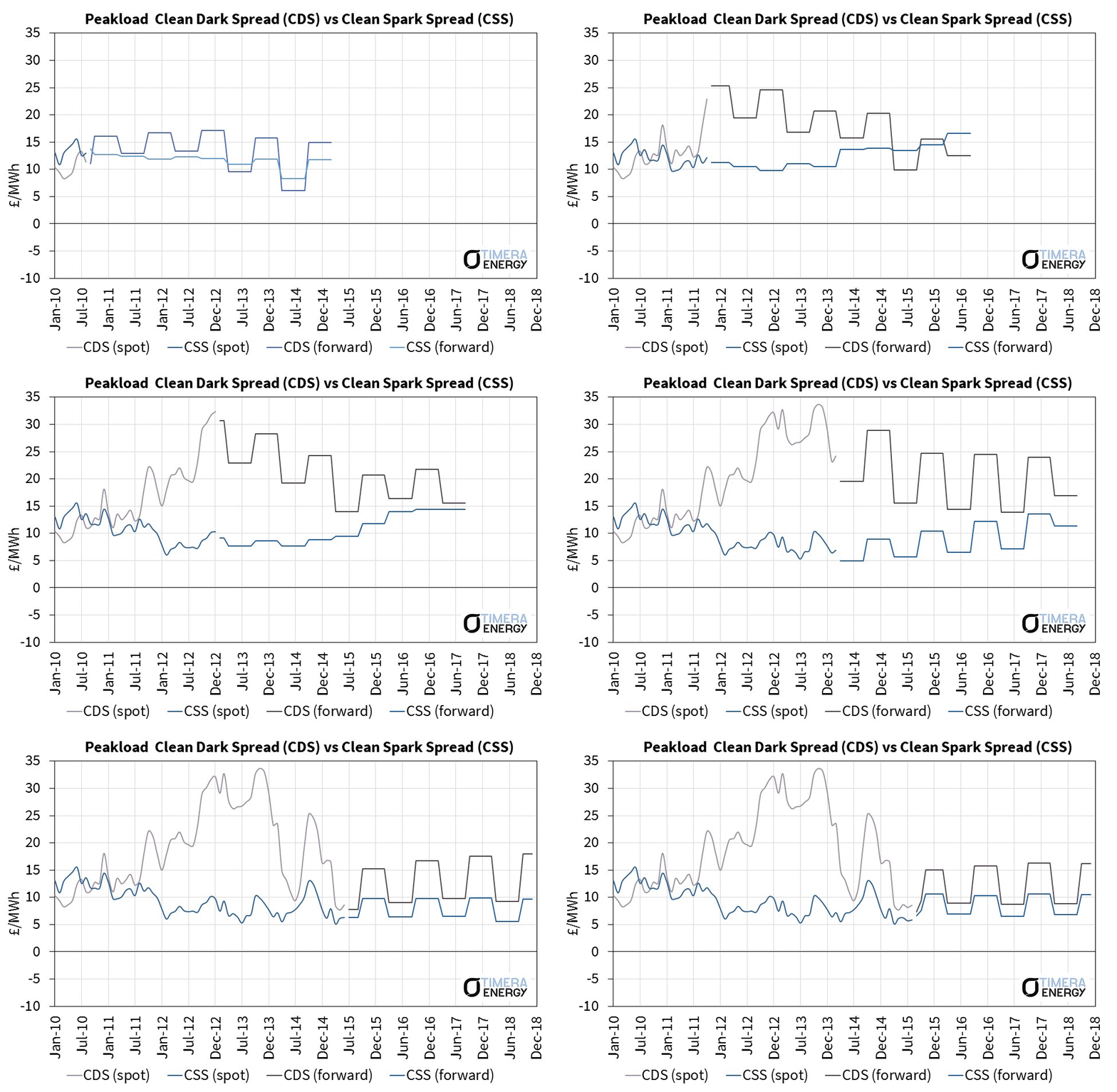
In order to investigate the dynamics of the evolution of clean spark and dark spreads (CSS & CDS), we have animated the evolution of spot vs forward spread curves. The approach we have used is similar to the previous animations we have done for the Brent crude curve and the NBP gas curve.

The reason why we like these curve animations is because they add a new dimension to the analysis of market price dynamics. Industry analysis is often very focused on spot prices. This is understandable given that spot prices drive asset dispatch decisions. But the majority of asset value is typically hedged against forward curve prices. An animation sheds light on:

  • The relationship between spot vs forward price behaviour
  • Forward price dynamics along different parts of the curve
  • And in the case of generation margins, how spark spreads evolve relative to dark spreads

UK Baseload and Peakload spreads are shown in Charts 1 and 2 below. We will come back in a subsequent article to show CSS & CDS animations on the Continent.

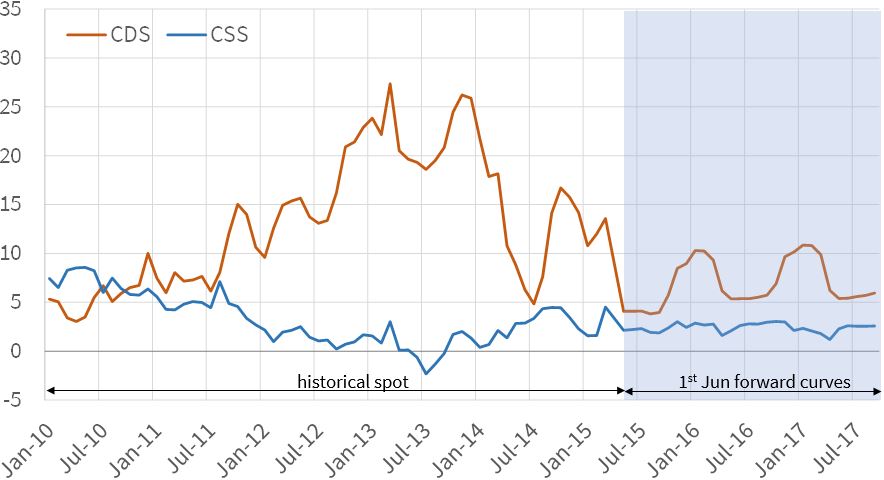
Chart 1: UK Baseload CSS & CDS

CDS vs CSS base  

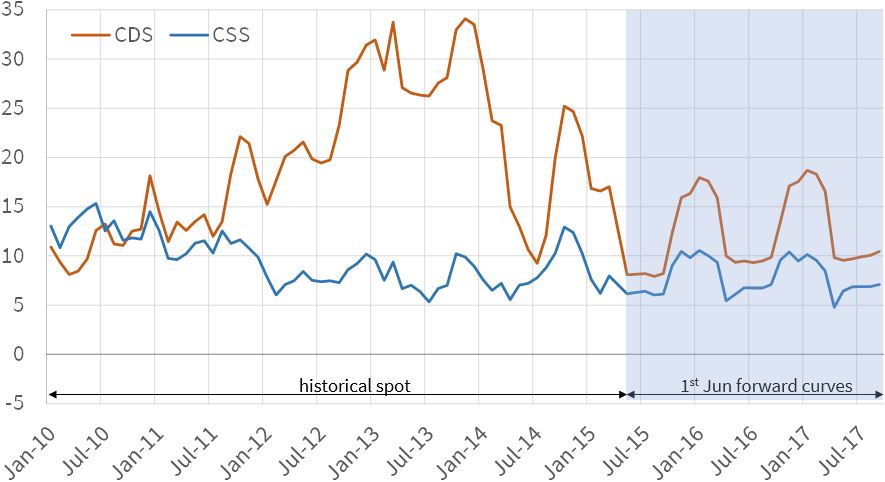
Chart 2: UK Peakload CSS & CDS

CDS vs CSS peak


Overview of spread dynamics

It is worth starting with a few observations about UK forward spread dynamics. The dominance of gas fired capacity in the UK power market (which has ~ 25GW of installed CCGT capacity) plays an important role in driving price evolution. Marginal power prices are predominantly set by gas fired plants, meaning there is a strong correlation between gas and power prices.

This provides strong support for Baseload CSS around the 0 £/MWh level and prevents pronounced negative spreads from occurring as seen in Continental power markets this decade (where coal plants set marginal prices). This logic has historically been used by trading desks to support spot vs curve strategies e.g. buying negative forward spreads to deliver into spot on the basis that gas plants on the margin should ensure spreads will be positive on delivery.

The dominance of gas plants in setting marginal prices also means the CSS curve has a less pronounced seasonal shape than the CDS curve. Both gas and power price curves have seasonal shape (which smoothes the CSS curve) whereas the CDS curve has a more pronounced shape given the absence of shape in coal forward prices.

Spread curves are also influenced by the contango (upward sloping) and backwardation (downward sloping) dynamics of the underlying fuel, carbon and power price forward curves. For example, the steep backwardation that can be seen in the UK CDS curve in 2013 is a function of strong coal and carbon curve contango.

But perhaps the most important observation about price behaviour from the animation is that spot spreads have a very strong influence on CSS and CDS forward curves. This is often referred to as ‘the prompt wagging the curve’. We have explored this dynamic in previous articles, but in the UK power market it is also a function of relatively weak liquidity. With the market dominated by vertically integrated utilities, liquidity is normally restricted to the front three seasons (and is often limited within this time horizon).


Coal vs gas plant margin behaviour

From 2011 to 2013, a gap opened up between coal and gas plant margins. This was driven by relative fuel price movements. Across this period, gas prices remained broadly linked to oil (above 100 $/bbl). Whereas the onset of oversupply in the global coal market saw coal prices decline more than 50%.

Coal-fired plants opened up a large competitive advantage over gas-fired plants. This pushed older less efficient CCGTs out of merit, causing the weakening of spark spreads that can also be seen from 2011-13.

Two factors have rapidly changed the fortunes of UK coal fired-plants since 2013:

  1. The carbon price floor has been increased to 18 £/t, adding a substantial carbon cost on top of EUA certificates
  2. NBP gas prices have declined as oil prices have fallen and an oversupplied LNG market has set in

The current forward CDS curve sits barely above the CSS curve. Yet the fixed costs of coal-fired plants (~ 50 £/kW) are roughly double those of CCGTs (~ 25 £/kW). In other words less efficient coal plants are running at negative margins. This is the primary driver of the announced closures of around 5GW of coal capacity in the UK (Longannet, Eggborough, Ferrybridge). While these closures are consistent with the previous UK government’s carbon price floor policy intentions, they are pushing the UK power market into a period of unprecedented capacity tightness.


Spread curves are not pricing in a capacity crunch

If the threatened plant closures materialise, National Grid’s measure of UK system reserve margin is likely to swing into negative territory over the next two winters. The forward market appears remarkably complacent about this.

There was a pronounced contango (upward slope) that developed in the peak and baseload CSS curves through 2012-13. This was in part a function of backwardation in the gas forward curve, but also reflected power prices increasing along the curve in anticipation of the system capacity margin tightening. The animation illustrates how this CSS contango (particularly peak CSS) has been flattened since summer 2014. Again this relates in part to the reversal of NBP gas curve contango, but the current UK forward spread curves are not pricing in any recovery in generation margins despite a looming capacity crunch.

So why is there no market price signal emerging to encourage thermal plants to remain open? If you take a cynical view of UK power market regulation, you can argue that the market anticipate ssome form of regulatory intervention will prevent a capacity crunch come what may. But in our view that is not the whole story.

The number of more speculative trading desks taking an active view on forward UK power price evolution is declining, given capital constraints and the winding down of energy trading functions at banks. This means weaker liquidity along the curve with the forward market dominated by utilities and generators.

These conditions suggest that there is ‘prompt wagging the curve’ logic in play. In practice this is likely to be caused by weaker prompt spreads causing generators to maintain or even increase their forward hedge cover to protect downside exposure, rather than lifting hedges in anticipation of higher margins in the future. As a result the market price signal from the onset of a capacity crunch is likely to be seen first in spot prices and it may happen very rapidly.

Article written by David Stokes, Olly Spinks & Emilio Viudez Ruido.

The next leg down in commodity prices

It has not been a peaceful summer in global commodity markets. After a six month period of consolidation, July saw a renewed broad based decline in commodity prices. This has continued through August as concerns over China’s growth prospects have intensified.

Crude oil prices have plunged back through January levels and look set to test the lows set at the height of the global financial crisis below 40 $/bbl. This will in turn put downward pressure on global LNG prices and European gas hub prices as the year progresses.


All eyes on China

All is not well in China, the global engine room of commodity consumption. The country that used more cement in three years than the US did across the entire the 20th century, looks to be suffering a pronounced economic slowdown.

China devalued the yuan in early August in an attempt to sure up its ailing export sector. This has triggered a new bout of global risk aversion and sharp selloffs in the currencies of other developing markets. It has also been the catalyst for a renewed selloff in commodity prices as fears grow that Chinese demand will weaken going forward.

The surprise yuan devaluation intensified selling pressure in commodities markets. A weaker currency means that raw commodities will be more expensive for Chinese buyers. But perhaps more importantly the devaluation may be a signal of heightened concerns within the Chinese administration as to the state of the export driven economy.   The August Chinese Purchasing Managers Index reading (47.8) showed a third consecutive month of contraction. Export data was particularly weak.

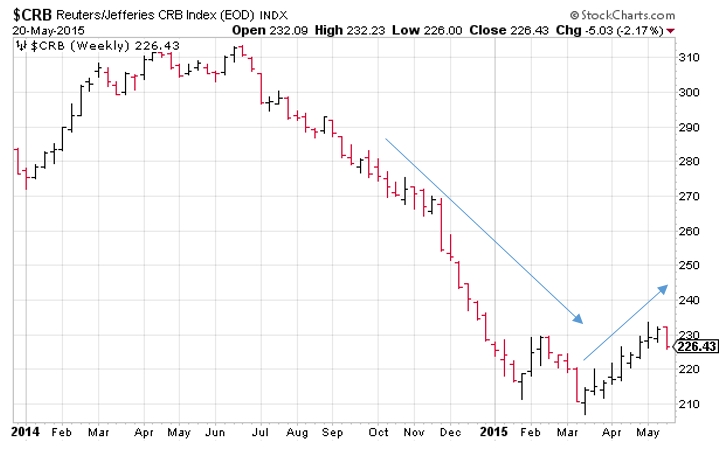
The summer commodity price fall can be seen in Chart 1 which shows the benchmark global commodities index (CRB) breaking down through levels reached at the peak of the financial crisis rout in 2009.

Chart 1: CRB Index

CRB

Global commodity markets are sliding down the backside of the commodity supercycle price mountain. Chart 1 is an interesting illustration of the short term elasticity of commodity supply. Given the lead time on investment cycles, the supply of resources is typically slow to respond to increases in demand. This is evident in the dramatic price rises that preceded the supercycle peak in 2008 (driven primarily by rapid Chinese economic expansion).

But production response has a habit over overshooting, as well as being slow to respond to market price declines. As Chinese demand projections have been revised down over the last year, producers in most commodity markets have refocused on battling for market share in the face of precipitous price declines.


The oil rout continues

The oil market is a case study in market share warfare. Since OPEC’s aggressive production stance triggered the price decline below 80 $/bbl last year, global production has increased not decreased. US and Gulf state producers have fought to sure up output in the face of lower prices, driving an increase in crude production of 2 million barrels per day. The lifting of Iranian sanctions (expected early next year) is likely to add at least another half a million barrels per day.

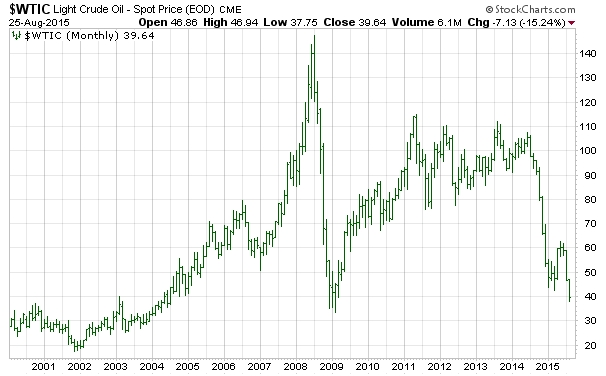
It is this increase in production set against a backdrop of weakening demand projections that has fuelled the latest leg down in crude oil prices. Chart 2 shows the US WTI crude oil price benchmark breaking below 40 $/bbl last week to levels not seen since the peak of the financial crisis in 2009.  A big short covering rally at the end of the week saw WTI crude close the week above 44 $/bbl, hinting that the sell off may be over done in the short term.  But a structural recovery is difficult to see until the current supply overhang dissipates.

Chart 2: WTI crude oil price

WTIC

When crude was above 60 $/bbl in May, we set out why we thought oil would head back to 40 $/bbl and remain weak for a more prolonged period than the market was pricing in. That logic still holds and we think the US shale oil investment cycle needs to be materially disrupted to cause a stabilisation in prices back towards crude long run marginal cost benchmarks above 70 $/bbl. Look out for some major distress and consolidation amongst US shale producers over the next twelve months.


The implications for global gas pricing

The latest leg down in oil prices is in the process of feeding through into global gas prices. The role that oil-indexed European pipeline contracts play in setting marginal hub prices, ensures a strong relationship to oil, albeit on an approximately six-month time lag. The bulk of the latest decline in oil-prices will not feed through into European gas contract prices until early next year. But suppliers are likely to utilise any available flexibility to delay contract take until these lower prices take effect (as was seen in Q1 2015).

The majority of long term Asian and European LNG contracts are also oil-indexed. But the slope co-efficient of LNG contracts to oil is typically higher than that in European pipeline contracts. The time lag for contract oil-indexation are also typically shorter. This means that there is likely to be a sharper impact of the crude decline on LNG prices, reinforcing the factors driving Asian & European gas price convergence and acting to increase the flows of LNG into European hubs. Lower oil-indexed hub prices and cheaper LNG imports are set to work in tandem to drive down European hub prices.

In the post Fukushima years (2011 to mid-2014) the global gas market was focused on high oil prices and Asian demand driving regional price divergence, supply concerns and a premium to ship gas to Asia. That thesis has undergone a sharp reversal in the space of just 12 months. Now lower oil prices and an oversupply of new LNG production are driving regional price convergence and a downtrend in prices back towards those at the US Henry Hub.

Gas volatility & investment in deliverability

The article below is our last before the summer break.  We will be back with more in late August.

There are two key structural trends in play that will place increasing demands on the flexibility of European gas supply infrastructure over the next decade:

  1. European import dependency will increase substantially as domestic production declines, increasing the likelihood and impact of supply shocks (e.g. infrastructure outages, supply disruptions)
  2. Gas demand swings in the power sector are set to increase as intermittent renewable output expands

These trends primarily drive a requirement for greater gas deliverability (as opposed to greater seasonal flexibility). Yet the market price signal for deliverability, spot hub price volatility, has remained subdued over the last five years.

In this article we look at the evolution of historical volatility. We investigate the recovery in volatility that started last summer and has since fizzled out. And we explore some of the factors driving ongoing weakness in hub price volatility & the implications for investment in deliverability.


2014: a volatility review

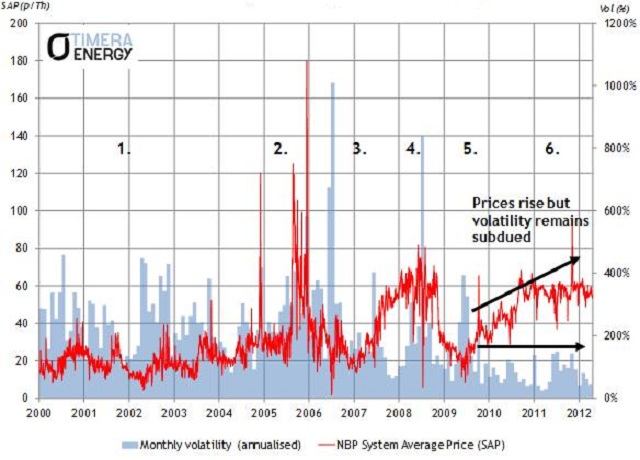
There were several sharp spikes in day-ahead price volatility across 2011-13 relating to specific supply shocks (e.g. the Norwegian field and IUK outages in 2013). But the effects of these were short lived and had little impact on underlying volatility weakness, as illustrated in Chart 1.

Chart 1: The evolution of TTF prompt prices and historical volatility (2010-25)
vol chart
Source: Timera Energy (using LEBA data)

2014 ushered in the start of what looked to be a shift in the underlying level of volatility. Higher volatility is typically associated with higher prices in energy markets. But the first half of 2014 saw hub prices fall (weak demand, higher LNG imports) and volatility rise, particularly over the summer which is typically a relatively weak time for volatility. As hub prices fell they disconnected from oil-indexed contract prices, reducing contract take and the use of swing flexibility.

Towards the end of 2014 and into 2015, volatility levels sank back towards the depressed levels of the last few years (sub 40% on an annualised basis). Over this period hub prices re-converged with oil-indexed contract prices, due in part to a hub price recovery and in part to falling oil prices. The volatility recovery of summer 2014 proved to be a short lived phenomenon.


What does 2014 tell us about the future?

The factors that drove this rise in volatility are interesting as they may apply again in periods going forward. Warm weather at the start of 2014 caused a slump in demand as we explored in detail last week. As the summer approached gas hubs were swamped with heavy storage withdrawals and an increase in LNG imports due to weak Asian spot prices. This knocked the market out of equilibrium and drove hub prices well below oil-indexed contract prices. Prompt volatility rose as a result.

2014 gas demand was 52bcm down on 2013, given some of the warmest weather in recorded history. In other words it represented a low demand outlier event. But the other factor contributing to oversupply, an increase in LNG imports, is something that is set to happen in much higher volume over the next 3 years as new liquefaction capacity comes online.

We have outlined in a number of previous articles the risk of higher LNG import volumes driving the European gas market past the tipping point of available pipeline contract flexibility to absorb them. In an oversupplied market such as this, flexible LNG flows will play an important role in setting marginal hub prices. They will typically do so at price levels below oil-indexed contract prices under similar (or more severe) conditions as those seen in the summer of 2014. It is also likely that lower gas prices will see greater swing demand from CCGT power plants as they come back into merit. In addition LNG imports are likely to ebb and flow in response to short term regional price signals in the LNG spot market.

So while conditions of oversupply have been associated with depressed volatility over the last few years, this will not necessarily be the case going forward. A transition to a more serious state of oversupply may see both LNG imports and the power sector influencing marginal hub prices (as they disconnect from oil-indexed contract prices). And this may drive an increase in prompt price volatility.


Investment in deliverability

Europe also faces the question of how new flexible gas supply infrastructure will be commissioned given the current absence of a market price signal in a weak volatility environment. The same logic applies to the approval of renewal capex spend on ageing existing infrastructure (e.g. Centrica’s Rough facility in the UK), which may have a higher cost structure than deliverability sourced from investment in new flexible assets. Virtually no new deliverability is being added across Europe in the current market environment. In fact the market is losing flexibility from existing infrastructure, e.g. Groningen field cut & the reduction of UK storage flexibility (Rough & Hornsea).

That is not to say there is anything wrong with the European gas market. Just that there is a disconnect between current price signals and the investment in deliverability required into next decade. In that context, if you can buy or invest in high deliverability flexible assets that are priced based on current volatility conditions, you may stand to make healthy returns into next decade.

European gas demand, LNG flow & hub prices

Last week we explored the impact of weaker Chinese LNG demand on European hub prices. We set out a scenario that illustrated the impact of European hubs having to absorb higher volumes of flexible LNG as the global balancing market.

This week we shift our focus to European gas demand. We aim to set out why European demand growth will be even more important than Asian LNG demand in driving the evolution of both European hub prices and spot LNG prices over the remainder of this decade.


European gas demand is a big deal

In the last 5 years gas demand across Europe has fallen by a staggering 19%. This equates to a 109 bcm reduction in annual demand from 585 bcm in 2010 to 476 bcm in 2014 (based on the IEA’s definition of Europe’s 32 gas consuming countries).

Putting this 5 year reduction in European demand in the context of the LNG market, 109 bcm represents more than 40% of total current annual Asian LNG demand. Approximately half of the fall in demand over the last 5 years occurred in 2014 alone (52 bcm), the result of exceptionally warm weather, e.g. Germany’s weather was the warmest in recorded history.

From these high level numbers, it is clear that the evolution of European gas demand over the remainder of this decade is a going to be a key driver of the global gas market balance. We will come back to look at the drivers of European gas demand in more detail in a separate article. But it is worth noting a few of the factors behind the decline:

  1. Fall in power sector gas demand as gas plant load factors have declined
  2. Relatively weak European economic growth
  3. Some structural reductions in demand e.g. energy efficiency improvements in residential gas demand (although these are small in size relative to the attention they have attracted)

Of these 3 factors, the power sector (1.) has been by far the largest contributor to the overall reduction in gas demand (once weather influences are accounted for). The fall in demand has been induced both by gas vs coal plant switching (given relatively weak coal prices) and by an increase in renewable output across Europe.

Looking forward, it is important to note the impact of extreme weather in 2014. Industry forecasters have been consistently overly optimistic in predicting a recovery in European gas demand. But it is reasonable to expect a significant demand recovery in 2015 regardless, given normalisation of the weather effects of 2014. This may also be supported by somewhat higher gas plant load factors as the result of weaker gas hub prices.


Demand growth and Europe’s ability to absorb LNG

In order to explore the impact of weaker European demand on hub prices, we use the same scenario framework we set out last week. We have defined what we see as a reasonable weaker gas demand growth scenario over the next 5 years as follows:

  • European demand recovers by 27 bcm in 2015 as weather normalises, approximately half of the fall in demand from 2013 to 2014
  • European demand then grows at an average of 0.75% from 2015-2020, primarily reflecting a recovery in power sector demand as the result of weaker gas hub prices
  • That results in an annual demand of 522 bcma by 2020 (slightly less than the 2013 demand level) & can be contrasted with the more robust demand scenario we set out in April where demand recovered to 562 bcma by 2020

We combine this European demand scenario with an assumption that Asian LNG demand growth continues at a reasonably robust rate (18% CAGR), again as we assumed in the original LNG market scenario we set out in April.

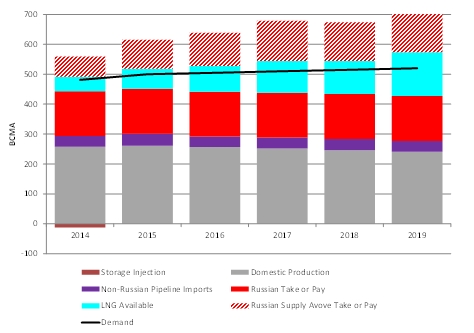
The resulting impact on the European gas supply & demand balance is shown in Chart 1

Chart 1: European gas market balance with 0.75% average demand growth (2015-2020)
Sc 3 EU
Source: Howard Rogers

It is useful to contrast this chart with the one we showed last week. In the weak Chinese LNG demand growth scenario from last week, Europe only really started to struggle to absorb surplus flexible LNG from 2019.

The tipping point (where pipeline contract flex is exhausted), is reached much earlier in a weak European gas demand scenario. This comes down to the scale of European gas demand relative to Asian LNG imports. Asian demand growth is impressive, but it is coming off a much lower base.

The point of the scenario analysis above is not try and forecast a weak demand outcome. Instead we are trying to illustrate that weak demand adds to the challenges Europe is already facing in absorbing growing surplus global volumes of LNG over the remainder of this decade.

Over the last two weeks we have looked at the impact of (i) weaker Asian LNG demand and (ii) weaker European demand on the European gas market balance. Of these two, European demand is the bigger driver. But a combination of the two in parallel would cause a larger and more rapid development of surplus gas at European hubs. The risk of this happening and the resulting impact on hub price dynamics means we are keeping a close eye on the tipping point framework we set out recently as new liquefaction capacity comes to market.

Article written by David Stokes, Olly Spinks & Howard Rogers

European hub prices and Chinese gas demand

One of our themes in 2015 has been the increasing importance of the LNG market as a driver of European hub prices. To date we have focused more on the evolution of gas supply. But we turn now to focus on the other side of the equation: gas demand growth.

The global gas price convergence that has prevailed since summer 2014 means there is a strengthening relationship between global LNG demand and European hub prices. This is because Europe is acting as the swing importer of surplus LNG in an oversupplied market. We set out the logic of this relationship in a recent article here.

The weaker global LNG demand growth is, the more LNG that will need to flow into Europe in order to balance the global LNG market. The more LNG that flows into Europe, the greater the downwards price pressure at European hubs.

Growth in global LNG demand over the next decade will be driven by two main factors:

  1. Developing Asian LNG importers (particularly China)
  2. Growth in European LNG imports as domestic production declines

Both these factors will in turn be important drivers of European hub price dynamics. So over the next two weeks we will look at scenarios that explore the impact of:

  1. Weaker Chinese LNG demand growth (this week’s article)
  2. Weaker European gas demand growth (next week’s article)

We do this with the same framework we used for the global LNG supply and demand balance scenario we presented in late April.


China LNG demand dynamics

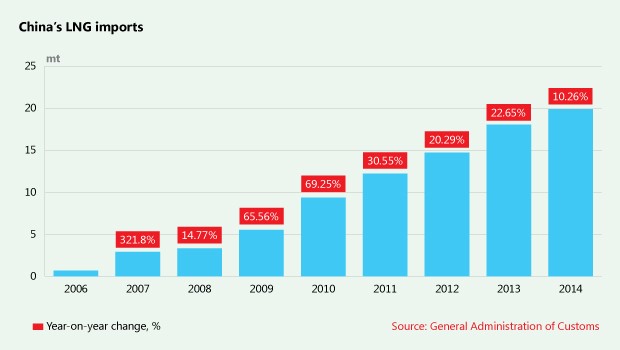
Chinese LNG demand made headlines in Q1 2015 after suffering its first ever quarterly decline (y-o-y) since China started importing LNG in 2006. This followed LNG import growth data for 2014 (10% CAGR) which was also significantly down compared to previous years, as shown in Chart 1.

Chart 1: Annual growth in Chinese LNG imports

Historic CH LNG Demand

Source: Interfax

This slowdown in LNG demand was consistent with a sharp slowdown in Chinese gas demand growth to 5.6% in 2014. The primary cause has been weakening Chinese economic growth and industrial gas demand.  Looking forward, there is also considerable uncertainty over the evolution of Chinese gas demand.  Demand growth will be heavily influenced not only by economic growth, but by the pace of a centrally planned push to reduce pollution from coal-fired power production.  The level of regulated gas prices will also have an important influence on demand.

Weakening demand growth in the face of this uncertainty is causing Chinese gas importers to question their future LNG requirements. 2015 has seen Chinese buyers trying to re-negotiate existing supply deals or sell contracted volumes. Importers are particularly concerned about being over-contracted in periods of lower seasonal demand. Lower LNG spot prices have added to the incentives to curtail contracted supply.  Despite aggressive future growth predictions, LNG imports although substantial, essentially remain a balancing item after domestic production and pipeline imports.

But what are the implications of weaker Chinese LNG demand growth for global LNG demand and in turn the European gas market balance?


A weaker Chinese LNG demand growth scenario

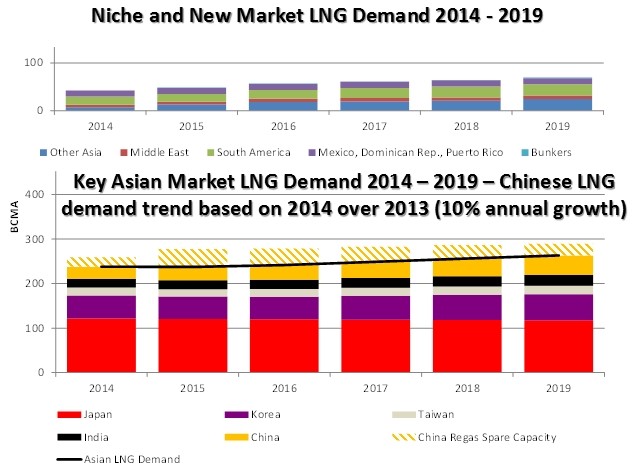
In the previous global LNG demand scenario we showed in April we assumed an 18% compound annualised growth rate (CAGR) in Chinese LNG demand through until 2020. This assumption was in line with recent presentations from CNPC and consistent with current Chinese regas capacity being broadly fully utilised by the end of the decade.

In order to explore the impact of weaker Chinese LNG import demand growth, we now assume only 10% growth (CAGR) in Chinese LNG demand until the end of the decade. In other words we extend the observed growth rate from 2014 out over the next 5 years. The impact of this assumption on global LNG demand is shown in Chart 2.

Chart 2: Global LNG demand with 10% CAGR Chinese import growth

LNG demand HR Scenario

Source: Howard Rogers

Given China is the key market driving Asian demand growth, this scenario results in materially weaker Asian LNG demand. This is set against a backdrop of a large ramp up in committed global liquefaction capacity. Unlike the relative uncertainty associated with global LNG demand, supply volume growth out to 2020 is anchored by delivery lead times on projects already under construction (see our assumptions on LNG supply ramp up here).


Impact on the European gas market balance

Weaker Chinese LNG demand growth has an important knock-on effect for European hubs given Europe’s role as the market of last resort for surplus LNG. This global balancing role is supported by several factors.

The UK NBP and Dutch TTF hubs offer good spot and forward liquidity to facilitate the sale of gas, ultimately backed up by the ability for hubs to absorb very large volumes of additional supply as gas vs coal switching occurs at lower prices. This liquidity is supported by the ample availability of regas capacity and a relatively friendly TPA environment. In addition European LNG supply contracts (& player portfolios) have inherently high levels of flexibility to support volume swings.

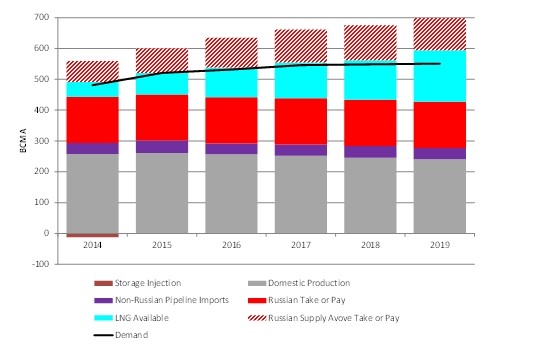
The scenario impact of higher LNG import volumes on the European gas market supply and demand balance is illustrated in Chart 3.

Chart 3: European gas market balance (10% CAGR Chinese LNG demand growth)
EU Gas Demand HR Scenario
Source: Howard Rogers

The important point to notice in this scenario is that by 2017, LNG import volumes have more than displaced annual pipeline contract flexibility (ACQ), assuming 85% annual ‘take of pay’ levels in European pipeline contracts (although as we noted here actual flexibility may be somewhat greater). The displacement of pipeline contract flexibility becomes significantly more pronounced by 2019.

Once the flexibility to ramp down pipeline contract volumes is exhausted, hub prices may need to fall sharply lower in order to induce additional gas burn from Europe’s fleet of CCGT power plants. In other words under this scenario, weaker Chinese LNG demand causes the European gas market to breech the tipping point that we have described previously. We return next week to see how vulnerable this tipping point is to a weakening in European gas demand.

Electricity storage investment: path to commercialisation

Battery storage technology costs have been declining at an impressive rate over the last 2 to 3 years. Interest in the investment growth potential for electricity storage has increased sharply as a result. Much of this is being driven by enthusiastic projections for the mass market role out of batteries. There has been a particular hype around electric vehicle batteries, led by the pin up boy of battery evolution, Tesla CEO Elon Musk.

But it is utility scale electricity storage solutions that have the potential to make a larger and quicker impact on wholesale power markets. The major hurdle for broader commercialisation of storage technology is cost reduction. But the full force of US technology innovation is working on addressing this problem. Intense competition between technology providers is the driving factor behind rapidly falling unit costs. This has led to bold claims by some bank analysts that there may be significant rollout of utility scale battery storage by 2020.

Against this backdrop, we are publishing a series of articles on investment in electricity storage. In this first article, we provide a brief overview of different technologies as well as defining a set of key storage parameters that are common across all technologies. We then summarise the drivers of storage value and cost. Finally we set out the main challenges that need to be overcome to achieve broader commercialisation. We will then come back in subsequent articles to look in more detail at the economics and potential market impact of storage investment.


Electricity storage technology

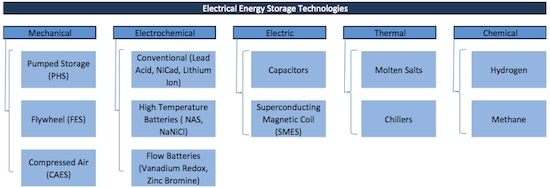
Utility scale electricity storage is not a new concept. Storage solutions have been commercially applied for decades, most commonly in the form of pump storage hydro assets. But the recent pickup in investor interest is focused on a number of emerging electricity storage technologies. These utilise a range of different methods for storing electrical energy as summarised in Chart 1.

Chart 1: Summary of electricity storage technologies

tech categories

Source: Deutsche Bank, State Utility Forecasting Group

Developers are competing against each other and the clock to develop a commercially viable utility scale storage solution. The most promising signs of technology evolution are focused on the electrochemical category in the chart given rapid recent declines in the unit costs of battery storage.

We do not address the pros and cons of different technologies in this article. Instead we focus on defining a common set of parameters which can be used to characterise the performance of any storage system. Ultimately it is these parameters that will interact with wholesale market dynamics and cost structure to define the investment case for any particular storage project.


Storage physical characteristics

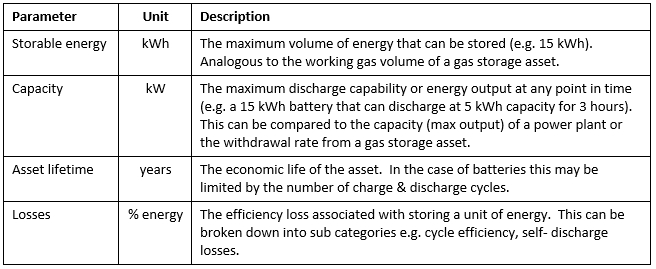
There are four key parameters that can be used to characterise any electricity storage technology (regardless of whether it is e.g. mechanical, electrochemical or thermal). These parameters are summarised in Table 1.

Table 1: Key electricity storage asset parameters
phys table 2

It is important to recognise the differences between a controllable generation asset (e.g. a thermal power plant) and a storage asset. Conventional generation assets are typically capacity constrained not energy constrained i.e. they have access to ample fuel supply (to convert into electricity) but are constrained by maximum capacity (or output). In contrast, the primary constraint for storage assets is the volume of stored energy rather than capacity to discharge energy. This is a commonly understood characteristic of hydro reservoir assets, but it applies equally to other forms of electricity storage e.g. batteries.


Storage value dynamics

The investment case for an electricity storage asset is driven by the interaction between the physical parameters described above and the dynamics of the market in which the asset is deployed. As with gas storage assets, the primary value driver of electricity storage assets is typically the ‘merchant value’ associated with the charging/storing of electricity in low priced periods and discharge/release of electricity in higher price periods.

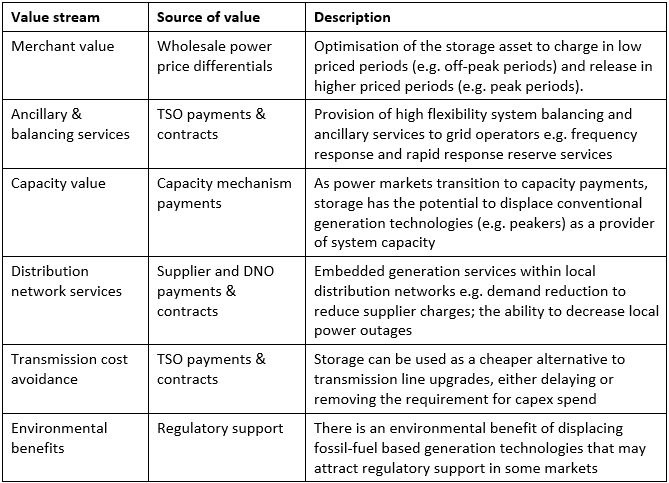
But in contrast to gas storage, there are a number of other drivers of electricity storage value that combined have the potential to be as important as the merchant value. The different electricity storage value streams are summarised in Table 2.

Table 2: Electricity storage value streams

ElecStor Table2

Storage has well defined access to the first two value streams (merchant & ancillaries) via existing revenue streams in wholesale power markets. Storage should also have good access to capacity payments as these evolve.

However access to value becomes more complicated for the other value streams. This is particularly true of some of the more unique benefits that storage can provide to transmission and distribution networks (e.g. capex cost avoidance and increased reliability). It is these areas where policy evolution will be required to facilitate a clearer price signal if storage is to access potential value (e.g. through evolution of regulated cost recovery mechanisms for TSOs and DNOs).

It is also possible that some market regulators will implement regulatory support to remunerate the environmental benefits of storage technology (e.g. in displacing thermal power generation).

While in theory storage appears to benefit from a diverse range of value streams, these may not be independent and additive. In other words benefiting from one value stream (e.g. merchant revenue) may inhibit access to other streams (e.g. transmission & distribution benefits).

However what is encouraging about storage from an investment perspective is that, unlike renewable technologies, the first five storage value streams in the table above are not driven by consumer subsidies. In other words, storage commercialisation should be possible on a standalone basis if value can be practically monetised and projected cost reductions can be achieved. But there are a couple of key ‘ifs’ in the previous sentence.


Storage cost dynamics

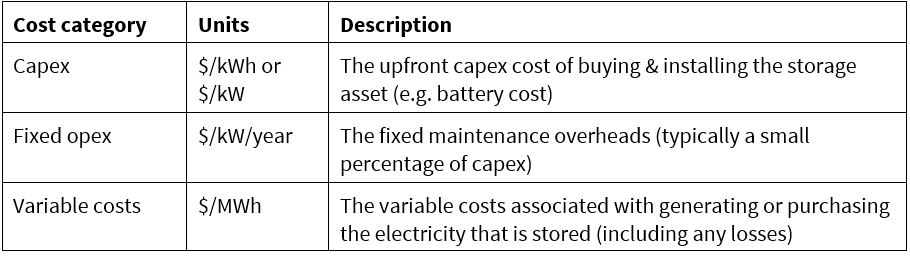
The costs of storage investment can be split into three broad categories shown in Table 3.

Table 3: Electricity storage cost categories

ElecStor Table3

It is important to note that for battery storage, the operational pattern of battery usage is important in defining its cost structure e.g. whether usage is focused on fast cycling to capture price differentials or providing network support services. There can also be significant non-battery capex costs associated with developing the storage system.

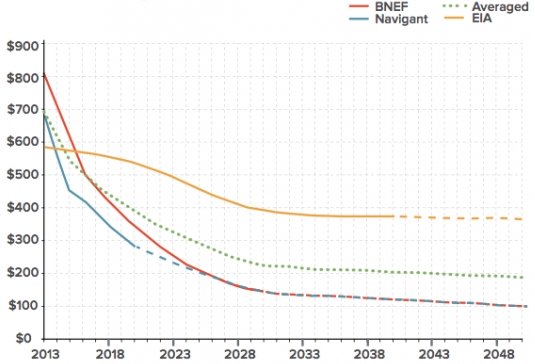
Capex costs are typically measured on a $/kWh stored energy basis, with current costs ranging upwards of 500 $/kWh. But investor focus is particularly on the potential for battery storage costs to fall rapidly over the remainder of this decade. A viable investment clearly depends on number of other factors as well as capex. But a commercialisation hurdle for storage costs of around 200 $/kWh is commonly cited as a reasonable benchmark.

Chart 2 illustrates shows some examples of published cost reduction curves for battery storage. We do not show this chart as an accurate representation of future storage costs, but rather to illustrate the aggressive cost reduction curves currently in circulation. The differences in forward projections illustrate the inherent uncertainty around technology cost reduction. What is clear however, is that battery storage is currently driving down the steep section of the cost reduction curve.

Chart 2: Example of projected battery storage cost reductions

 cost reduction


Path to commercialisation

Unlike renewable technologies, the major hurdle for storage investors is not gaining access to consumer funded regulatory support. Commercialisation of storage is likely to require cleaner regulatory definition of price signals. But broader commercialisation will need to happen on a standalone basis.

The key challenge in building an investment case is to access a set of revenue streams that will support investment costs and financing, within a palatable risk/return boundary. This relies on more than just a cost competitive source of storage capacity. It also needs to be built on a realistic view of the interaction between the physical parameters of the storage asset and the monetisation of different revenue streams in the market in which the system is employed. Given the challenges described above, we suspect early deployment of storage will be focused on particularly compelling localised opportunities e.g. ancillary services or embedded benefit payment streams that can be clearly monetised without adversely inhibiting the capture of merchant revenue.

In order to define and analyse electricity storage investment opportunities, it is useful to develop a framework that overlays the physical, value and cost parameters set out in Tables 1 to 3 above. This supports the consistent assessment of storage investment opportunities across different technology types and different wholesale power markets. We will come back to look at the investment economics of electricity storage in more detail in our next article in this series.


Article written by David Stokes and Emilio Viudez-Ruido

Shipping cost impact on LNG price spreads

The LNG market is adjusting to the new reality of regional price convergence.  Soft Asian demand, new liquefaction capacity and lower oil-indexed contract prices are all contributing to compress regional price differentials.  Under these conditions, LNG shipping costs are playing an increasingly important role in determining LNG flows and spot pricing dynamics.


Quantifying the fall in shipping costs

We recently published an article on the rapid decline in LNG vessel charter rates over the last three years.  This fall in charter rates has significantly reduced relative incremental shipping costs between delivering gas to Asia versus Europe.  In other words, the ‘strike price’ for diverting LNG from Europe to Asia has fallen. This effect has been reinforced by a fall in bunker fuel prices as the oil market has weakened.

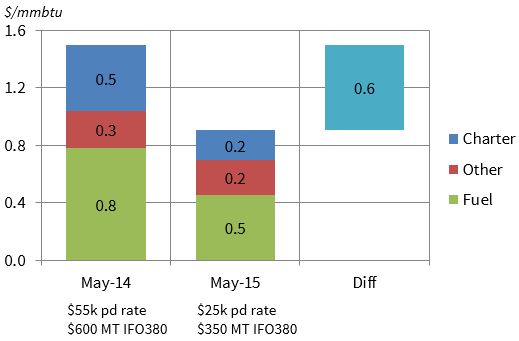
Chart 1 illustrates an example of the reduction in LNG shipping costs over the last 12 months (from May 2014 to May 2015).  It focuses on the cost of diversion of a cargo located at a Spanish terminal (Huelva) to Japan (Sakai).

Chart 1: Cargo diversion costs for shipping from Spain to Asia
Shipping Cost Fall
Source: Timera Energy.

Assumptions 147k MT vessel.  19 knots average speed. 10014 NM journey via Suez.  Laden leg only.  USD 400k canal transit charge (one way) + other costs including port fees, brokerage and insurance.

The chart illustrates how the different components of shipping cost have contributed to the overall reduction in laden voyage direct costs.  The key factors driving the 0.6 $/mmbtu decline in shipping cost over the last year have been:

  1. A ~55% reduction in spot charter rates from $55k to $25k per day
  2. A ~40% reduction in fuel oil costs from 600 to 300 $/mt (IFO380 benchmark)

The days of the structural diversion of LNG from Europe to Asia are gone.  Cost reduction of cargo diversion to Asia, combined with much tighter regional spot price differentials, means LNG spot market flows and pricing are becoming much more dynamic.


The importance of shipping costs in driving LNG price spreads

LNG shipping costs are an important driver of the way LNG trading desks optimise cargoes.  But they also have a broader impact in determining how LNG volumes flow between regions and how regional LNG spot prices are determined.

Since summer 2014, Asian spot LNG prices have remained within a tight range of European hub prices.  The practical mechanism which is driving this convergence is the optimisation of flexible cargoes between the two regions.  And shipping costs play a key role in driving this as we set out above.

In order to understand how regional spot price differentials are driven, it useful to think of different tranches of flexible supply with diversion decisions influenced by relative shipping costs, for example:

  1. Reload and diversion of a European cargo to Asia
  2. Diversion of an Atlantic basin sourced cargo to Asia versus Europe
  3. Qatari decision to sell spot cargo into Asia or Europe

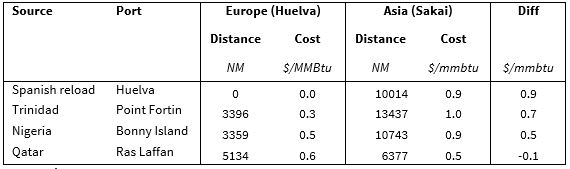
The spot price premium required to attract cargoes to Asia (from Europe) falls across these three tranches.  This is illustrated in Table 1 which shows shipping cost differential examples for Tranches 1 to 3 (with two examples shown for Atlantic Basin diversion Tranche 2: Trinidad and Nigeria).

Table 1: Asian / European Shipping Cost Differentials (@ 25kpd and laden voyage only)

Shipping Cost Table

Source: Timera Energy

When interpreting the numbers in the table, it is important to note that they reflect direct costs for a laden only voyage (i.e. do not allocate a cost for the return voyage).  In our view this is the most transparent and objective way to assess differentials.  But in practice there can be significant cost and risk premiums over and above the direct costs of cargo diversion.  This can add upwards of 0.5 $/mmbtu to the spread required for companies to exercise a diversion option.  An overview of the calculation of shipping costs and premiums can be found here.

The table illustrates how different sources of flexible LNG supply to Asia are ‘choked off’ as regional price spreads decline.  European reloads are the most expensive source of diverted LNG and are therefore the first to go.  There has been clear evidence of this over the last 12 months as European reload volumes have virtually dried up as the Asian price premium has collapsed.

Diversion costs then decline based on the incremental distance to ship cargoes to Asia (e.g. Trinidad higher than Nigeria).  Qatar plays a key role at the centre of the LNG market, with its location meaning that producers are largely indifferent on a shipping cost basis as to whether cargoes are sent to Europe or Asia.  At the point where Asian spot prices fall below NBP (as was the case earlier this year), the incentives to flow flexible LNG to Asia disappear altogether.


Current LNG spot price dynamics

Asian spot LNG prices are currently around 7.30 $/mmbtu.  This compares to UK NBP prices at around 6.70 $/mmbtu.  Asian spot prices have settled at a small premium above NBP over the last couple of months, although the current spot market is characterised by a lack of liquidity.  With Japanese and Korean importers well contracted and carrying high inventories, spot trade has been dominated by opportunistic buying of cargoes in a 7.00-7.50 $/mmbtu price range (e.g. from China and India).

Spot market liquidity is set to increase over the next two years as new liquefaction capacity comes online.  This is particularly true of destination flexible supply (e.g. US export capacity) that will flow to the highest netback spot price.  But the spot price dynamics that have evolved in 2015 are representative of what can be expected going forward in a world of price convergence.

The LNG spot market will remain anchored by European hub prices.  Asian spot prices will typically trade within a reasonably tight range of European hubs, although there may be volatility in regional spot prices at any point in time, reflecting shorter term fluctuations in supply and demand.  Under these conditions, shipping costs are set to play an increasingly important role in driving flexible LNG cargo flows and spot pricing dynamics.

This article was written by David Stokes & Olly Spinks.

Oil market illustrates risks of relying on price forecasts

Commodity price forecasts are widely used across energy markets. Forecasts are used as an input for a range of commercial activities including business plans, budgets and investment cases. In fact some view of the future evolution of commodity prices is a pre-requisite for many of these activities. But the principle danger associated with price forecasts is not recognising their limitations.

For want of a better source of information, price forecasts are often based on current forward market price information. This may be associated with the common misconception that forward curves represent a market consensus forecast of future spot prices. In today’s article we use a practical case study based on Brent crude oil price forecasting to illustrate the dangers of relying on price forecasts.

We published an article on Mar 30th setting out the importance of distinguishing between forward curves and forecasts of future spot prices. In this first article in a series on ‘forecasts vs. forward curves’, we described the superficial visual similarity between graphs of both, and the common but erroneous belief that the forward curve is somehow a ‘market consensus spot-price forecast’.

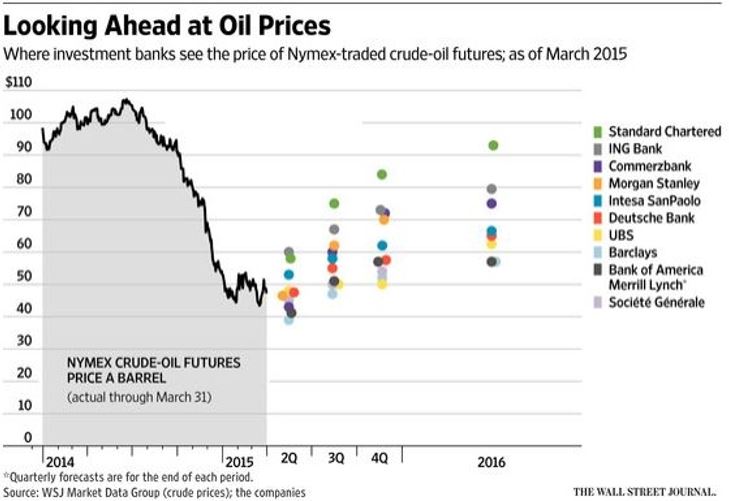
Spring 2015 marks a phase in the evolution of Brent prices, both spot and forward, when professional price forecasters have diverged dramatically in their views of what will happen over the next two years. Chart 1 shows the Mar 2015 spot-price predictions of ten leading oil market analysts for the remainder of 2015 and 2016.

Chart 1: Brent price history and forecast range

WSJ Chart

Source: Wall Street Journal

The remarkable spread in forecaster views is immediately obvious. Even for the current quarter of this year (Q2), the highest pick is 54% greater than the lowest, a disparity rising to 68% for the fourth quarter. The scatter is almost uniform for the third quarter, and bunching only emerges at the end of the year when the group splits into a cluster of four higher-than-average tipsters and a second cluster of six who go lower-than-average in their outlooks. Only one consistent theme emerges across all: the price of oil is seen as rising steadily from the levels of second-quarter 2015. It is probably no coincidence that this reflects the current Brent curve contago.

Many oil producers may be disappointed, if not surprised, to see no-one forecasting above $100. Although it may be fairly observed that an average for 2016 of $93 (the highest prediction) would suggest that the Brent price is seen going back into 3 figures for at least some of that year by that forecaster, if by no-one else amongst the ten.


A consensus view?

Chart 1 is hardly a picture of consensus. To the contrary, it is difficult to recall a time of more divergent views since the post financial crisis market turmoil of 2008-09. However, it should immediately be registered that throughout the oil market price turmoil of those years, and of 2014-2015, the Brent market has remained very liquid along the forward curve. In other words, the forward curve is entirely meaningful on its own terms. That is it represents an array of prices at which actual forward business is being conducted in large volume today, irrespective of what anyone might think about where spot prices will be in the future.

So the failure of analysts to agree on the future does not in any way undermine the forward market’s willingness to make prices. This is yet another challenge to the perception that ‘forwards are forecasts’: for if the forward curve is to be seen as a market consensus how can it exist at all when, as at present, essentially there is none?


Putting Your Money Where Your Mouth Is

It is interesting to consider conceptually the uses to which price forecasts might be put. In principle, if a forecast carries any weight with the recipient – who may have paid good money for it – he or she should be willing to act as though future prices may reliably be expected to settle at approximately the levels projected. This may inform (for example) budget provisions, investment decisions or whether it is necessary to hedge a given exposure. If a company is long oil, and believes a forecast that predicts prices will rise, why would they hedge?   The answer, amply illustrated over the years, is that whatever is ‘believed’ about the future, there can be surprises in store for anyone.

In circumstances such as now, when forecasters diverge so significantly in their views, few players with significant money at stake are likely to consider it safe to leave their exposed oil positions unhedged. The fact remains that at all times, even when there seems to be a consensus amongst professional pundits, if a position is technically open and the holder does not wish to carry the risk, then only a hedge will do. A chart with some numbers on it, whoever generated the numbers using whatever methodology and irrespective of their track record, can never substitute for a watertight forward hedge with a creditworthy counterpart.


What is ‘a good forecast’?

The writer is reminded of an incident of some twenty five years ago. Working for an oil company at the time, he was called in by his boss and told: “we need a good forecast” – a phrase often heard from many different people on many occasions since.   But what could this possibly mean? Is a “good forecast” the one that costs the most? The one that makes our projects look most attractive? How could we tell in advance which one is going to be the most accurate? At best, it might translate as: we need a forecast from a source or methodology which has a consistently good track-record over a long period of time.

Sadly, there is no such source or methodology. There is, however, a range of academic theories on the dynamics of forward prices, which we will consider in the next piece in this series.

This article was written by Nick Perry.

Capacity fallout in the UK power market

The system capacity margin for the UK power market fell to 4% heading into last winter. Across the winter generation margins have remained weak and the inaugural UK capacity auction cleared at a price level under 20 £/kW. This has left owners of less efficient coal and CCGT plants in a difficult position.

So far in 2015, 5 GW of coal and CCGT capacity has been closed or earmarked for closure over the next twelve months. An additional 5 GW of older capacity has failed to qualify for capacity payments in last December’s auction. These plant remain operational, but with forward market margins well below fixed costs, further asset mothballing or closure decisions are imminent.

The UK power market cannot afford to lose 10 GW of flexible thermal capacity. So the stage is set for a game of political and commercial brinksmanship to determine which plants will survive. As this plays out the UK system capacity margin is likely to remain very tight for the next three winters.


Market spreads hurting coal and doing little to help gas

The absolute level of power prices in the UK is determined predominantly by the cost of gas, given the dominance of CCGTs in setting marginal prices. So it is more important to focus on spark and dark spreads, or gas and coal plant generation margins, when assessing plant economics. However UK forward market spreads have so far shown a muted reaction to the tightening system capacity margin.

The evolution of baseload and peakload clean spark (CSS) and dark (CDS) spreads and current forward curves are shown in Charts 1 and 2.

Chart 1: Baseload spark and dark spreads (£/MWh)

Baseload UK Spreads

Chart 2: Peak spark and dark spreads (£/MWh)

Peak UK Spreads

Source: Timera Energy using ICE data (CCGT efficiency 49% HHV, coal plant efficiency 36%)

The most obvious observation from these charts is how much coal plant margins (CDS) have declined since the start of 2014. There are two important factors which have contributed to this:

  1. Weakening European gas hub prices (see here and here for drivers)
  2. An almost doubling of the UK governments carbon price floor (to 18 £/t) in April 2015

These factors combine to create a very tough margin environment for less efficient coal plants without a capacity agreement. Although CDS remain marginally higher than CSS, coal plant fixed costs (typically 40+ £/kW) are much higher than for CCGTs.

CCGT margins (CSS) have recovered somewhat from their weakest levels in 2013, but remain relatively weak on a forward basis over the next 2-3 years. Around 10 GW of CCGT capacity is out of merit (i.e. running at zero or very low load factors).

With a CCGT fixed cost base of 20-25 £/kW, the future does not look bright for older assets with no capacity agreement. Supplemental Balancing Reserve (SBR) contracts are about the only source of hope, but pricing of these contracts is likely to be competitive given the overhang of distressed gas and coal capacity.


More closures, tighter system margins

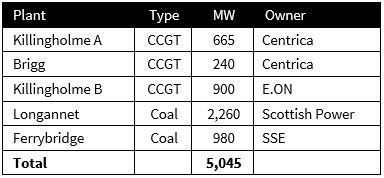
Somewhat counterintuitively, the first capacity auction has precipitated a number of asset closures (as we foreshadowed here). The auction has clarified expectations around capacity price returns going forward, which combined with the weak energy market conditions described above, has been too much to stomach for owners suffering ongoing fixed cost burn. In the case of Longannet, high transmission costs in Scotland have   also contributed to poor plant economics. 5 GW of capacity available last winter has either been closed or ear marked for closure as shown in Table 1.

Table 1: UK plants closed in 2015, or earmarked for closure in the next 12 months

Plant closure table

Source: Timera Energy

Another 5.7 GW of other older plants (4 GW coal, 1.7 GW CCGTs) remain open but under imminent threat after failing to secure capacity agreements. Expect further announcements of mothballing and closures as the year progresses.

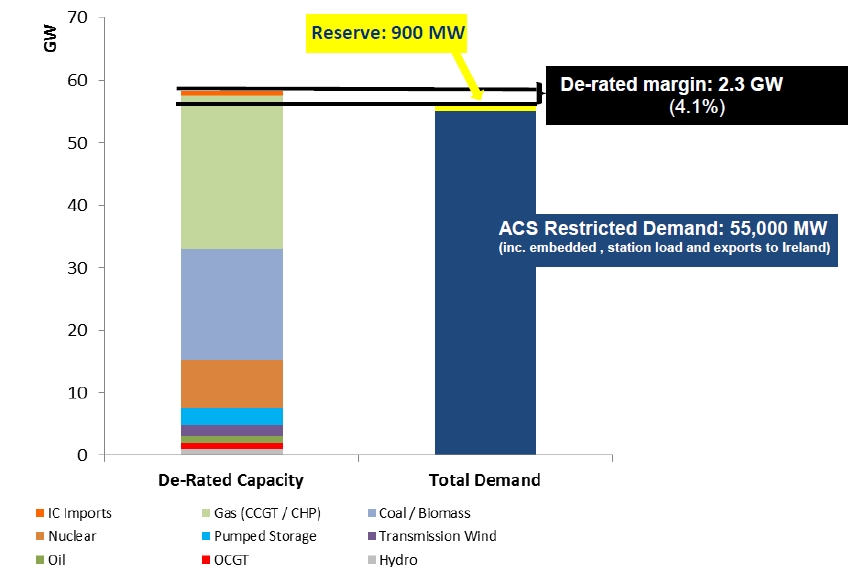
Despite the system capacity balance being very tight, National Grid’s analysis of system margins last summer predicted 3-4 GW of additional thermal asset closures by 2017. This analysis showed tightness in the system capacity margin peaking in the coming winter (2015/16), before new capacity build (predominantly renewables) and declining system demand starts to improve security of supply. Grid’s assessment of de-rated system reserve margin for last winter is shown in Chart 3.


Chart 3: National Grid Winter 2014/15 de-rated system capacity margin

system margin

Source: National Grid

The chart illustrates the 2.3 GW reserve margin last winter in the context of the 5 GW of closures announced so far this year (note a ~85% derating factor needs to be applied to the 5 GW to make it comparable). Grid’s assumptions in calculating reserve margin (e.g. on peak winter demand and interconnector availability) are intentionally conservative. But nevertheless more closures and a cold winter would appear to leave the UK power market in a precarious position.

The last two winters have been relatively mild and windy causing little in the way of challenge to security of supply. Our suspicion is that the UK government and Grid will not be keen to ‘roll the dice’ on a third mild winter. The focus for alleviating system capacity issues is on Grid’s SBR contract auctions. SBR has become a somewhat opaque temporary mechanism to bridge the period until new capacity comes online from the first capacity market auction (by 2018). Plants that successfully secure SBR contracts may live to fight another day. But the remainder of the 10.7 GW of plants that failed to secure capacity agreements remain on the endangered list.

Article written by David Stokes, Olly Spinks & Emilio Viudez Ruido