Europe providing global gas supply flexibility

Asia dominates global LNG demand. The US and Australia are challenging the Middle East for domination of global LNG supply. But it is Europe that has become the LNG market ‘swing provider’.

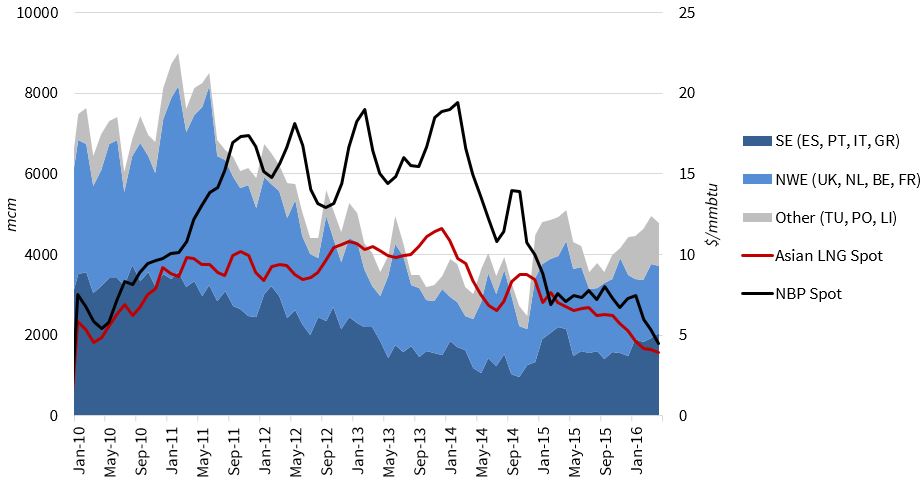
Chart 1 shows a view of the evolution of European LNG imports this decade. This illustrates Europe’s role as swing provider under different prevailing market conditions:

  1. Tight LNG market: Under conditions of global tightness, the European gas market diverts flexible LNG supply to meet shortfalls in Asia and other regions (e.g. post-Fukushima 2011-14)
  2. Oversupplied LNG market: Under conditions of oversupply, European hubs absorb surplus LNG (e.g. 2015-2017).

Chart 1: European LNG imports

Source: Timera Energy

In today’s article we explore 5 drivers of Europe’s role as a provider of global supply flexibility:

1.  Price responsive demand 

Unlike Asia, European gas demand is directly responsive to changes in market prices. The mechanism driving this demand elasticity is switching of CCGTs for coal plants in the power sector, driven by spot fuel prices. As gas prices fall the competitiveness and hence load factors of CCGT plants increases (and vice versa). This key demand side flexibility mechanism allows Europe to efficiently absorb LNG in periods of surplus and divert LNG supply in periods of tightness, e.g. the 20 bcma of additional gas absorbed by the European power sector in 2016.

2.  Price responsive supply 

The European gas market also exhibits supply elasticity. Flexibility is supported by swing volumes above take or pay levels on long term pipeline contracts (particularly for Russian gas). In addition Norway has significant upstream production flexibility that is profiled on a seasonal basis, with daily flows managed by Statoil against spot price signals. In contrast to Asia, Europe also has substantial volumes of underground gas storage capacity that is also optimised against hub prices. These supply flexibility mechanisms combine to facilitate substantial ebbs and flows of European LNG import volumes.

3.  Liquid hub price signals 

The price responsiveness of European gas supply and demand is underpinned by trading hub liquidity. This provides robust spot price signals against which LNG cargoes can be monetised. Hubs also support the forward hedging of LNG exposures facilitating portfolio and supply chain management. This is why the North West European hubs (NBP and TTF) currently form the key global benchmark against which LNG cargoes, contracts and tenders are priced.

4.  Regas capacity headroom 

European flexibility to absorb large swings in LNG volumes is also a function of adequate import infrastructure. European regas capacity is rarely constrained, although this situation may change with LNG’s growing role in the supply mix. Access to regas capacity connected to liquid hubs via UK, Dutch, Belgian and French terminals is particularly important in servicing shorter term flexibility requirements. But there is further headroom beyond this given the key security of supply role played by regas infrastructure, for example on the Iberian Peninsula.

5. Flexible portfolios

Last but not least is the impact of the portfolio construction of European gas companies. There are a number of large European gas players whose portfolios span both the global LNG and European gas market supply chains, e.g. Shell, BP, ENI, Total, Engie, Statoil, Uniper and RWE. The internal optimisation of gas within these portfolios provides a substantial additional source of supply flexibility. The exercise of this internal portfolio flexibility, such as the re-routing of flows and swapping of cargoes, is highly responsive to spot price signals even though it often does not involve direct transactions visible in the market.

European LNG imports are set to grow significantly into next decade as domestic production declines. But there is inherent price responsive flexibility in the European gas market to service large swings in import volumes. As LNG imports grow, so too will Europe’s ability to export LNG supply flexibility to the global market. This will underpin the role of European hub prices as the reference for Asian spot LNG prices in a world where growing, flexible LNG flows intensify inter-regional arbitrage opportunities.

Article written by David Stokes, Olly Spinks & Howard Rogers


Options confronting gas storage owners

Seasonal storage operators across Europe are confronting a harsh reality. Many slower cycling seasonal storage facilities are not economically viable at current seasonal price spread levels.

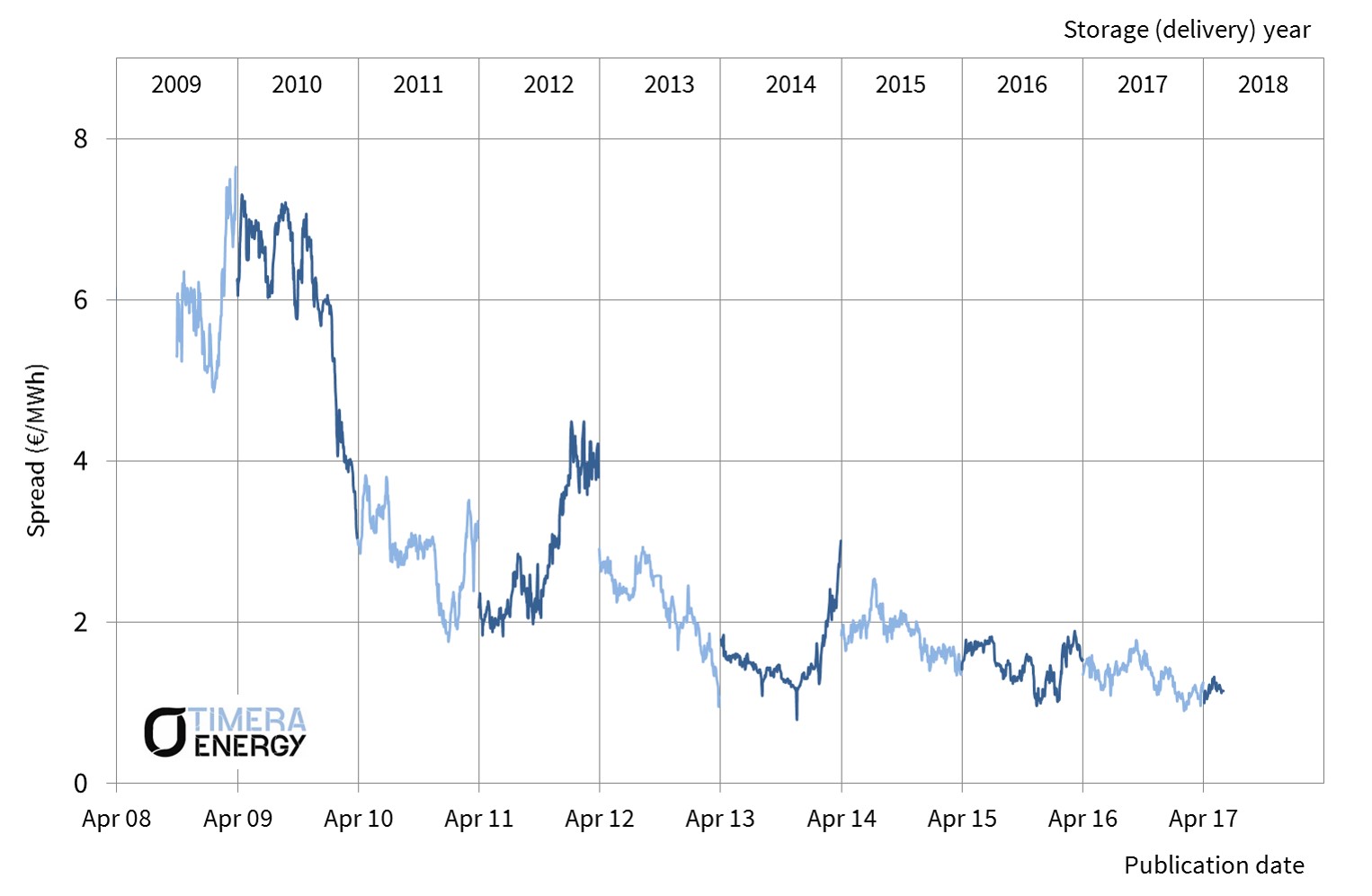
The seasonal price spread at the key Dutch TTF hub has fallen from levels above 10 €/MWh a decade ago to below 2 €/MWh over the last 5 years. This has left storage operators struggling to cover fixed costs, let alone to earn any return on capital.

2016 saw some recovery in spot price volatility, the other key market price signal for gas storage assets. A recovery in spot volatility is good news for faster cycling storage assets designed to respond to shorter term price fluctuations.

But seasonal price spreads remain in the doldrums, suggesting a continuing surplus of seasonal supply flexibility, despite the loss of Rough flexibility and reductions in Groningen production. This can be seen in Chart 1 showing the evolution of the front year TTF seasonal price spread.

Chart 1: TTF seasonal price spread (2008-17)

Source: Timera Energy

Ongoing weakness in seasonal spreads has caused operators, including Uniper, RWE, OMV & Engie, to suffer impairment charges relating to seasonal storage assets. Many European operators are now in the process of strategic reviews to decide on the future of storage assets. We consider the strategic options that they face in today’s article.

Summary of strategic options

The level of seasonal price spreads is only one of a number of factors driving storage asset economics. The level of fixed and variable cycling costs are a key determinant of asset returns and competitiveness versus other facilities . Long term contract positions  can insulate owners from the pain of lower price spreads, but can on the other hand result in long term obligations to service customers. Ability to access cushion gas value is also a key consideration.

We summarise the main strategic options confronting owners of seasonal storage assets in Table 1.

Table 1: Strategic options

  Option description Cashflow implications
1.    Remain open
  • Minimise fixed costs to try and preserve margin
  • Wait for recovery in market price signals for flexibility
  • Negative or weak cashflow until market recovery
  • Retain option to access to future asset cashflow upside
2.    Close
  • Close asset & blowdown
  • Withdraw cushion gas and sell at current hub prices
  • Stem negative cashflow & losses
  • Move forward cashflow from CG sale (time value of money)
3.    Mothball
  • Avoid fixed costs by mothballing
  • Retain option to re-open if market price signals recover
  • Stem negative cashflow & losses
  • Inability to access cushion gas value, but retain potential upside
4.    Sell asset
  • Aim to sell asset at a premium to value of cushion gas withdrawal
  • Stem negative cashflow & losses.
  • Monetise cushion gas value & aim to realise a value premium

Source: Timera Energy

Many owners (and their shareholders) are losing patience with Option 1. This in our view is going to precipitate a growing shift towards Options 2, 3 and 4.

Transmission charges, which vary from country to country, form a significant portion of fixed opex of gas storage assets.  Moves to harmonise gas transmission charging methodologies and potential discounts for storage assets may help reduce fixed costs faced by storage operators.

Relative economics of closing vs hanging on

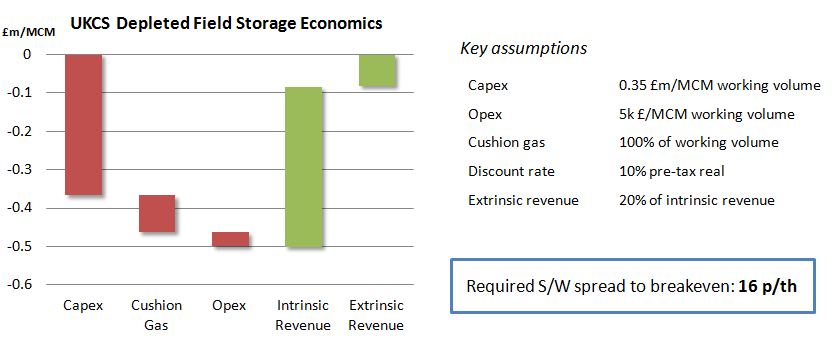
It is useful to look at some high level numbers on seasonal storage asset economics to appreciate the challenges facing owners. In order to do this we focus on the key option to remain open (1) or to close and withdraw cushion gas (2). The other options to mothball or sell (3 or 4) are variations on these.

Chart 1 shows a breakdown of NPV economics of a generic seasonal storage facility under three scenarios:

  1. Remain open assuming no market recovery, with seasonal price spreads and volatility staying at current levels (1.35 €/MWh TTF spreads; 50% TTF spot price volatility)
  2. Close and withdraw cushion gas, with cushion gas assumed to be sold at current forward curve prices over a 5 year extraction horizon (this will in practice vary by asset)
  3. Remain open assuming some market recovery, with seasonal spreads recovering to a long run average of 3.00 €/MWh

Chart 1: Scenario lifetime economics of a generic seasonal storage asset

Source: Timera Energy

Key assumptions:

  • Cycling time: 180 days (90 in/out)
  • Cushion gas: 100% of WGV, 3 year drawdown (sold at long run price of 20 €/MWh)
  • Fixed opex (including transport capacity): 1.5 €/MWh of WGV
  • Extrinsic value premium: 25% above extrinsic (50% for market recovery scenario)
  • Remaining economic life: 15 years for remain open cases

Scenario 1 illustrates how the economics of a generic seasonal storage asset are marginal at current spread levels (NPV of only 5 € per MWh of working volume). Less advantaged assets may actually be NPV negative, assuming no market recovery.

Scenario 2 (NPV of 16 € per MWh of working volume) illustrates the incremental value of closing and monetising cushion gas value vs Scenario 1.

Scenario 3 (NPV of only 22 € per MWh of working volume) illustrates the potential value upside from a recovery in seasonal spreads, back to a long run average of 3.00 €/MWh by 2020.

This recovery upside represents a relative small incremental gain compared to closing and selling cushion gas, bar any regulatory relief via fixed transmission cost reductions. It is this dynamic that is likely in our view to lead to a number of seasonal storage assets closing over the next year or two.

Storage asset sales

Aside from closing or waiting, the other option open to storage facility owners is to sell assets, an option that is currently on the table for a number of operators. Sale could either be to an investor with a more optimistic view on market recovery or with a more aggressive risk appetite.

Selling a storage asset has the attraction of allowing owner fast access to cushion gas value, without having to incur market risk across the gas withdrawal period. But asset price is clearly key to determining whether there is value for prospective buyers. The aborted sale of the RWE DEA German storage assets in 2016 illustrates the challenges of selling storage facilities in the current market environment.

The attractiveness of storage assets to potential buyers comes down to:

  • Flexibility & cycling speed: The European gas market has a greater need for the short term deliverability provided by faster cycle storage, than for seasonal flex (which can be provided by e.g. Norway, LNG imports).
  • Asset cost structure: Low variable costs mean storage is more competitive in providing flexibility. Low fixed costs reduce required revenues to hit return targets.
  • Location: Some markets/locations have strategic/insurance premiums or regulatory volume mandates associated with storage capacity that support asset value.
  • Contracts: Legacy long term contracts signed at higher price levels can help protect asset margin while buyers wait for market recovery.

There is a genuine interest in gas storage as an asset class from more adventurous infrastructure investors. But this has not been well tested in recent years due to a limited number of storage asset transactions.

Implications for the value of supply flexibility

Whether via direct closure of sale and consolidation, Europe is likely to lose a significant volume of slower cycling storage capacity over the remainder of this decade. Decisions to close less flexible and higher cost seasonal assets should help underpin the recovery in the value of faster cycling assets with a lower variable and fixed cost base.

The closure of seasonal storage assets may also help to accelerate the recovery in hub price volatility. In an environment where there is a weak seasonal spread price signal, slower cycling storage assets focus more on responding to short term price fluctuations. So closure of seasonal storage capacity reduces the volume of working gas volume competing to dampen spot price volatility. That is good news for faster cycle storage assets.

Article written by Olly Spinks & David Stokes


European gas for coal switching boundaries in 2017

The switching of gas for coal fired power plants was one of the key themes in European energy markets in 2016.  Switching drove a 20 bcma recovery in power sector gas demand last year.  This reversed the downtrend in European gas demand across the previous five years.

A year ago we looked at the relative fuel price dynamics driving switching in the UK and on the Continent, foreshadowing significant switching potential as the year progressed.  In today’s article we look at the current forward market switching boundaries, to provide an insight into how switching may evolve in 2017 and 2018.

The UK power market has switched

Switching happens first in the UK power market because of the UK carbon price floor.  This additional 18 £/t variable cost imposed on coal plant supports switching from coal to CCGT plants at higher gas price levels than in Continental European power markets.  This is illustrated by the fact that the UK accounted for almost half of additional power sector gas burn in 2016.

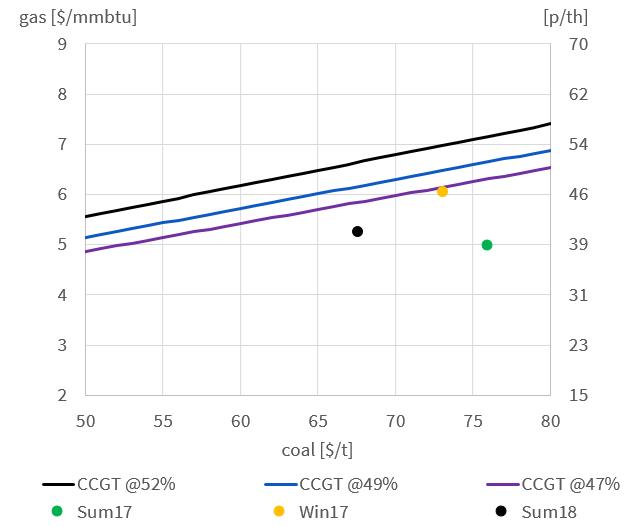
Chart 1 shows switching boundaries in the UK power market at current forward price levels for gas, coal and carbon.

Chart 1: UK switching boundaries

Source: Timera Energy (coal plant 36% HHV efficiency)

The chart shows whether current forward market fuel prices favour gas or coal burn.  The coloured dots represent different combinations of gas and coal prices for seasonal forward contracts over the next three seasons (Sum 17 to Sum 18).  The diagonal lines show the baseload switching boundaries for CCGT plants of different efficiencies (a 52% new plant through to a 47% 1990s plant).  In simple terms, if the dots sit below the diagonal switching lines then market prices favour gas burn.  If the dots sit above the switching boundaries they favour coal burn.

It can be seen from Chart 1 that CCGTs now have a structural variable cost advantage over coal in the UK.  This advantage is more pronounced in summer, given seasonally lower gas prices.  But it is also sustained across the winter.  With the carbon price floor in place, UK coal plant are effectively providing peaking capacity, with the influence of coal units on peak prices driving an increase in CCGT margin rents.

Summer switching potential in the German power market

Germany has the lowest power prices of the major European power markets (excluding the hydro dominated Nordpool markets). This is due to a combination of relatively low variable cost coal/lignite capacity and high renewable penetration. In this environment, CCGTs have been structurally out of merit for most of the last five years.

Germany is Europe’s toughest major market for switching.  There is no carbon price support like in the UK.  Germany is also well interconnected to allow imports of hydro flexibility from Nordpool and the Alpine markets. But most importantly, the German fleet of coal plants has relatively high efficiency levels.

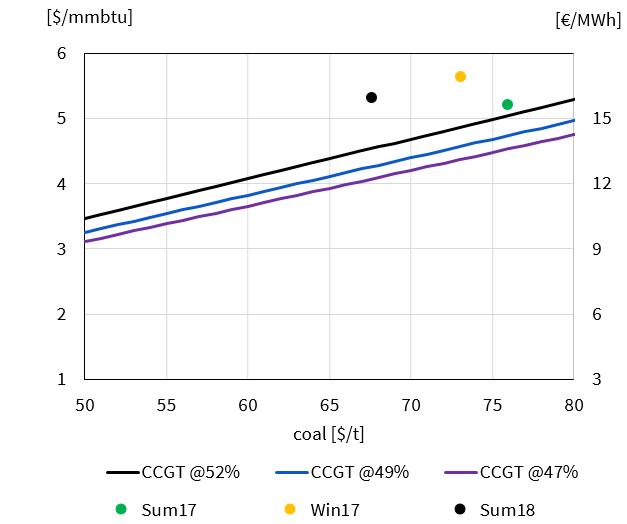
Despite this, significant switching occurred in the German market in summer 2016 given seasonal weakness in hub prices.  Chart 2 shows that the German switching boundary is not too far away for current Summer 2017 fuel prices (the green dot).

Chart 2: German switching boundaries

Source: Timera Energy (coal plant 36% HHV efficiency)

It is important to note that the switching boundaries shown in Chart 2 are for older 36% efficient coal plants, the first to be displaced by CCGTs as gas prices fall relative to coal.  The efficiency of German power plants range from the 36% level up to around 45% for the newest stations built this decade.  These new coal stations require a more significant decline in gas prices (~3 €/MWh) to be displaced by newer CCGTs.

That said, the 36% German switching boundary is a useful benchmark to signal switching potential across other Continental European power markets.  If switching is taking place in Germany, it will also be happening in other key markets e.g. Italy, France and the Netherlands.

Switching over the next two years

European spot coal prices have remained stubbornly above 70 $/t this year (currently around 75 $/t), despite strong backwardation in the coal forward curve.  Gas hub prices on the other hand have been weakening into the summer as a result of unseasonably warm weather and robust LNG import volumes.

The behaviour of European gas prices across this summer will be an important barometer for 2017 power sector switching dynamics.  If gas prices continue to decline, e.g. another 1 to 2 €/MWh relative to current levels, this will likely trigger significant switching across European power markets.

The path of gas hub prices across the remainder of 2017 will be strongly driven by European LNG import volumes.  Cargo flows into Europe have been steadily rising this year as global supply grows and Asian LNG demand weakens into the summer. If LNG imports continue to rise, power sector switching will be the primary mechanism that allows European hubs to absorb more gas.

Article written by David Stokes & Olly Spinks

UK peaker investment: here comes consolidation

Competition to provide new capacity across the UK’s first three capacity auctions has been dominated by thousands of small peaking units. In contrast, only one relatively small CCGT has bid successfully (Centrica’s 0.4GW Kings Lynn plant).

3.5GW of distribution connected diesel and gas fired peakers have received 15 year capacity agreements across the 2014-16 auctions. An additional 2GW of new Demand Side Response (DSR) has been successful, mostly supported by peaking units behind the meter.

The capacity market has been designed to deliver competitively priced capacity. And the relatively low capital and fixed costs of distribution connected peaking units has seen developers substantially undercut competition from larger scale, grid connected CCGT and OCGT plants.

Peaker investment to date has been driven by a range of smaller developers. But larger players are eyeing the peaker sector which appears ripe for aggregation and consolidation. And portfolios of small scale peakers fit the risk/return profile of large infrastructure investors, unlike larger scale thermal assets which have a higher dependence on more volatile wholesale margins.

State of play in the peaker sector

There are several established medium sized players focusing on peaker investment in the UK market. At least two of these, Green Frog Power and UK Power Reserve are flagged for sale. But these initial sales processes may just be the tip of the iceberg.

There is strong infrastructure investor interest in peaker portfolios given margin protection from 15 year capacity agreements. Market entry options include acquiring an established player, aggregating smaller projects and/or growing organically via development of new capacity. All of these options are being actively pursued in a flexing of investor muscles that is yet to determine who will dominate the peaker sector going forward.

The other factor that suggests consolidation is a shift in the regulatory environment. The investment case for distribution connected peakers was dealt a blow by Ofgem earlier this year, when it indicated its intention to slash the ‘triad benefit’ that peakers earn by generating in peak periods to reduce supplier transmission charges.

In addition the UK government has indicated it intends to remove ‘double payment’ for the Capacity Market Supplier Charge (on top of the capacity price) and to constrain investment in higher emission diesel peakers.

While the more established players have been preparing for these regulatory blows, reduction of the triad benefit has hit some smaller, less experienced developers hard. A number of projects may be scrapped or consolidated within other peaker portfolios.

But despite these regulatory changes, distribution connected peakers are still a competitive source of highly flexible and low capex capacity, to support low load factor backup of intermittent renewable generation. But there are a number of challenges  investors face in getting comfortable with the peaker investment case summarised in Table 1.

Table 1: Peaker investment case considerations

Factor Consideration Getting comfortable
1. Investment model Building a scalable peaker portfolio: Acquire, aggregate or develop? Benchmark business & financing models & capability development costs.
2. Competitive dynamics Quantifying threat from alternative flex providers (CCGTs, OCGTs, DSR, batteries)? Excess Analyse competitor economics and co-dependence of margin streams
3. Capacity margin How will UK capacity pricing and the role of peakers in the capacity mix evolve? Model evolution of capacity market & supply stack (drivers of capacity price)
4. Other margin streams Projecting co-dependent margins streams (e.g. energy, balancing, STOR)? Model peaker flex value capture from energy, BM & STOR market evolution
5. Route to market Acquire/develop internal trading capability or use incentivised 3rd party market access? Benchmark market access service options vs internal trading development.

Source: Timera Energy

Quantifying peaker portfolio risk and return

A key challenge for investors looking at peaking units is getting comfortable with the evolution of the multiple margin streams that drive asset economics. These can be broadly split into four streams:

  1. Capacity margin: driven by capacity market pricing
  2. Energy margin: driven by the wholesale energy market and Balancing Mechanism evolution
  3. Balancing services margin: driven by e.g. STOR market and ancillary services pricing
  4. Embedded benefits: driven by the evolution of regulatory policy and supplier grid charges

Peaker margin streams are not simply additive e.g. a decision to provide STOR services directly impacts energy and BM margin capture. This means it is key to overlay a realistic view of how peaking units will practically generate value.

The regulatory changes described above are shifting the relative risk/return profiles of peaker margin streams. Gas reciprocating engines are now the principal technology (given diesel unit emissions). These units have higher capital costs than diesel generator sets. But they are also more efficient, meaning significantly lower variable costs.

Lower variable costs increases the opportunities for gas engines to capture value from power price volatility in the wholesale energy market and Balancing Mechanism (BM). Peaking units are extremely flexible (e.g. fast ramp times, low start costs), but quantifying this flex value requires a robust probabilistic plant modelling approach. This means using a stochastic pricing simulation engine and associated plant dispatch optimisation model. The two key advantages of this approach are:

  1. It is consistent with the way trading desks actually optimise and dispatch portfolios of peaking units
  2. It generates margin distributions (as opposed to scenario forecasts), providing a robust view of asset risk/return dynamics

The peaker investment case is still built around 15 year capacity agreements and access to balancing services revenue. But understanding wholesale energy market and BM margin are becoming a key element of gas peaker economics.

A traditional Base, High and Low scenario approach for peaker margin may have been adequate when the investment case was driven by the triad benefit and diesel engines. But gas engine investment requires a more sophisticated analytical approach.

Article written by David Stokes and Olly Spinks


Timera take on the Flame gas conference

Each May the European energy industry convenes in Amsterdam for the annual Flame gas conference. The 2016 conference was somewhat overshadowed by a focus on plunging commodity prices. In contrast, this year’s conference had a more constructive and forward looking perspective. This was driven by a focus on structural themes emerging from the early stages of a major transformation in the European energy industry.

In today’s article we set out 5 key themes that we took away from this month’s conference:

The three Ds

Decarbonisation, decentralisation and digitalisation. These three trends formed the backbone of conference discussions, reflecting their role in the energy industry transformation, being driven by both regulatory and commercial forces. Importantly, it appears that consensus is shifting towards this being an opportunity rather than a threat to the gas industry.

The nature of the ‘three D’ trends also emphasises how the evolution of the European power and gas sectors is converging. To a large extent decarbonisation, decentralisation and digitalisation has ‘first impact’ on the power sector, driving a shifting focus towards payment for capacity rather than energy. But there are profound knock on implications for gas, as a provider of flexibility to the power sector, as a source of heat, as a substitute for oil in the petrochemical industry and possibly transport.

Business models

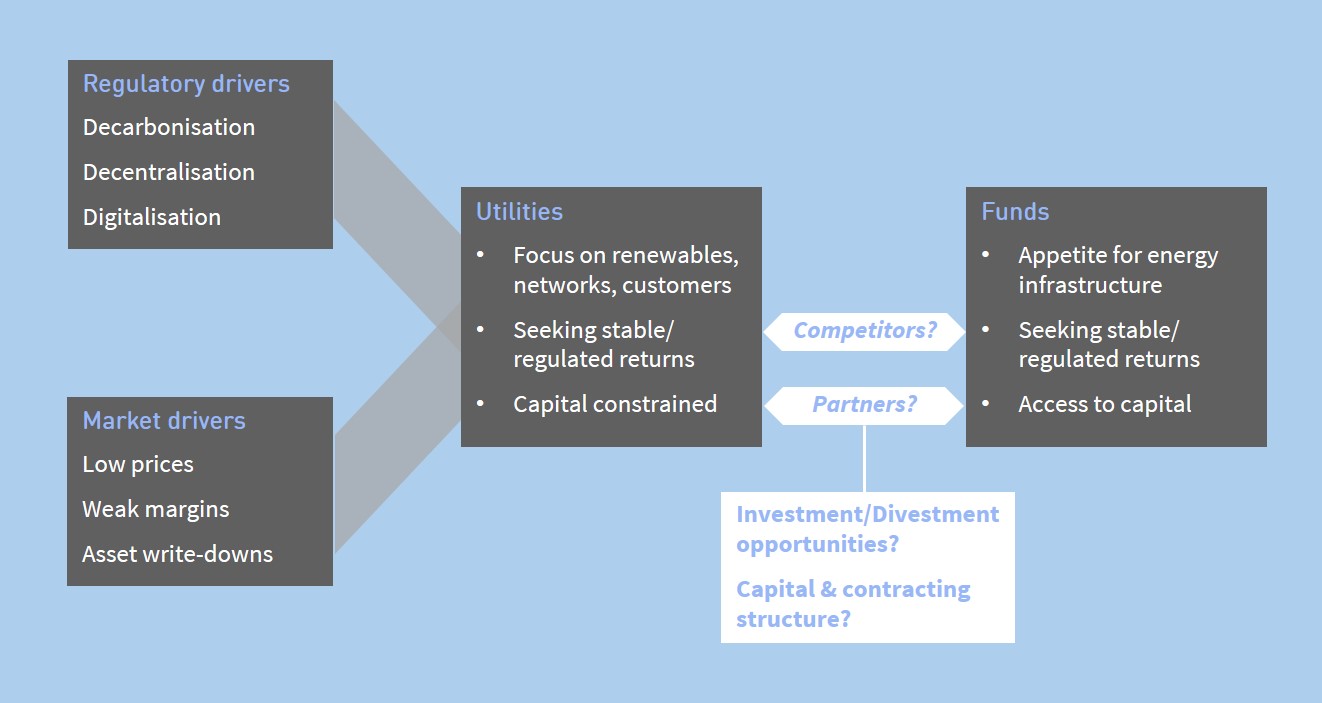
The evolution of European utility business models is playing an integral role in the industry transformation described above. This evolution is focused on:

  1. Balance sheet repair
  2. An appetite for stable and regulated cashflows
  3. A strategic shift towards renewables, networks and customer services (driven to a significant extent by 1. & 2.)

These business model trends are consistent with the shift in regulatory policy towards the ‘three Ds’. But they also reflect a period of recovery from industry wide asset write-downs as market conditions have squeezed margins on conventional assets (e.g. thermal power and upstream & midstream gas assets).

The dominance of vertically integrated utility business models is also being eroded. This is illustrated for example by the spin-off of Uniper from E.ON, utility divestment of E&P and generation assets and the transformation of Centrica towards a customer services company. The traditional role of utilities is also being challenged by new entrants e.g. car & battery manufacturers and retail services companies such as Google and Amazon.

Diagram 1: Evolving trends with utility business models and asset investment

Source: Timera Energy

Investment

Another key theme at Flame was the growing role of funds as investors in European energy infrastructure. This reflects opportunities to both:

  • Acquire assets being divested by energy companies repairing balance sheets
  • Invest alongside energy companies to develop new assets

Timera chaired a plenary panel on Investment and Divestment that focused on the evolving roles of utilities and funds. Discussion here highlighted how different pools of fund capital were driving asset investment.

A greater willingness to take on market risk has seen private equity and sovereign wealth funds dominating investment in non-regulated assets (e.g. KKR’s acquisition of French CCGTs and ADIA backed TAQA’s investment in Bergermeer gas storage). Infrastructure funds on the other hand are being driven by a mandate to protect capital, underpinning an investment focus on regulated assets such as renewables and networks.

The panel also discussed the interesting competitive tension between infrastructure funds and utilities, given a shared appetite for stable and regulated cashflows. This is being reflected in increasingly lean returns as highlighted by Dong and EnBW’s recent ‘zero subsidy’ wind project bids.

Gas market share

In an environment of surplus gas supply, market share strategy was a dominant theme. Discussion revolved around three key players in the global gas market:

  • US LNG – the dominant source of committed new supply over the next two years and a competitive and potentially huge source of new supply in the 2020s
  • Russia – presenting an increasingly assertive stance on European market share in response to the growing threat of LNG imports, backed by large volumes of shut in production in West Siberia
  • Qatar – which in April fired a shot across the bows of LNG competitors as it lifted its production moratorium on the giant North field (we will shortly publish a specific article on the implications of this).

There are interesting strategic dynamics around market share in the nearer term. If European hub prices continue to converge more closely with US Henry Hub, Russia may be able to temporarily displace some US exports by placing more gas at European hubs. But the more important question is how these players will interact to provide the new supply required in the 2020s and how this supply will be priced. There is a lack of clear industry consensus here and it highlights a key strategic issue for further attention.

Gas market pricing

The emerging role of Europe as a key provider of LNG flexibility to the global LNG market was another important theme. This is a function of Europe’s hub price response mechanisms that allow efficient adjustments to both gas demand and supply (e.g. gas vs coal switching and flexible gas supply contract structures).

Europe’s swing provider role also underpins its influence in setting global gas prices. Timera gave a Flame presentation on this topic setting out evidence on how European hubs drive marginal LNG price signals (summarised here by ICIS Heren).

The increasing importance of US Henry Hub was also a key topic. As US export contracts ramp up, the influence of Henry Hub on LNG flow decisions will increase in significance. Convergence of European hubs with Henry Hub over the peak of the current supply glut could also see the US gas market temporarily driving global spot price signals. But for the moment that role sits with European hubs, which are also likely to dominate LNG price signals well into the 2020s.

Article written by Olly Spinks & David Stokes

Germany’s replacement of baseload capacity with wind

There was much excitement last month when EnBW and Dong bid to deliver 1.4GW of ‘zero subsidy’ offshore wind projects in the 2017 German offshore wind auction. Grid connection costs for these projects will be borne by German consumers. But the developers will need to recover the remainder of costs from wholesale power price revenue alone.

A case of return free risk? Maybe. But the auction results point to two interesting dynamics:

  1. Continuing reductions in offshore wind technology and implementation costs.
  2. Germany’s focus on wind as the main source of replacement capacity for closing nuclear and thermal power plants.

These dynamics have important implications for the German power market balance, given large volumes of scheduled thermal and nuclear capacity closures over the next 5 years. They are also important for the broader pan-European market balance, given the size of the German market and tightening reserve margins in neighbouring markets.

Looming German capacity closures

To date the German power market has absorbed new wind capacity in a relatively orderly fashion, although system stress points are starting to show. The transition to higher volumes of wind output has been helped by a large buffer of flexible gas, coal and nuclear capacity and high volumes of interconnection with neighbouring markets.

But the German power market faces a new challenge over the next five years. Not only will Germany continue to add large volumes of intermittent renewable capacity, it will also lose large volumes of flexible coal and gas and baseload nuclear capacity. And market price signals do not currently support adequate returns on existing thermal plants, let alone investment in new flexible capacity.

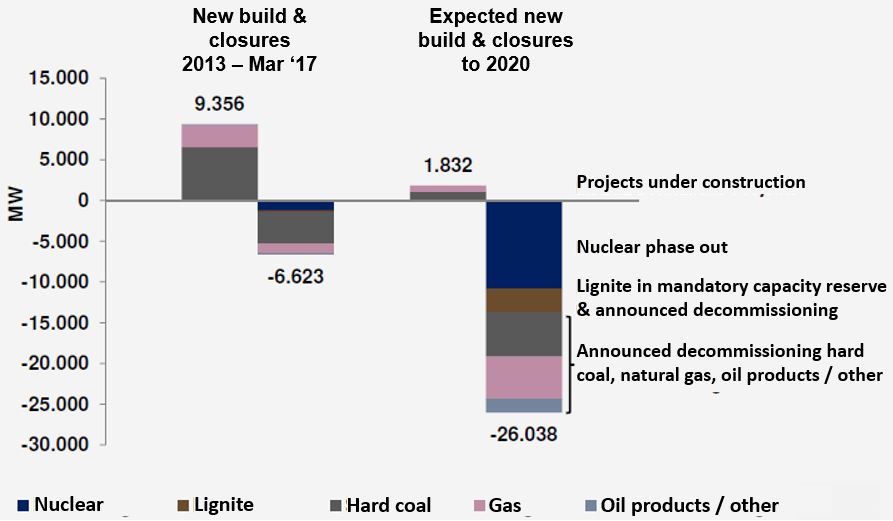
The plant closure issue Germany faces was highlighted recently by BDEW (the German Association of Energy and Water Industries), who are projecting 26GW of German capacity closures by 2022 as shown in Chart 1.

Chart 1: Recent and projected German conventional capacity new build and closures

Source: BDEW (translated)

While the BDEW projection may somewhat over estimate closures, the chart illustrates an important point. The German market saw a net addition of 3.3GW of flexible capacity over the last 5 years (2013-17). But it is confronting a very substantial net deficit of flexible capacity over the next 5 years (BDEW estimates 24GW of net closures), given a lean development pipeline of non-renewable capacity (1.8GW).

Capacity closures are being driven by two main factors:

  1. 11GW of regulatory driven closures of German nuclear plants by 2022.
  2. Ongoing closures of coal and gas fired plants as a result of more stringent emissions requirements and weak generation margins.

We recently showed the very low levels of prevailing spark and dark spreads in the German market. Spark spreads have been negative for more than 5 years, with dark spreads hovering near zero for the last 18 months. This has crushed returns on coal and gas fired generators, resulting in an ongoing flow of announcements by plant owners of their intention to close capacity.

So far the German electricity regulator (BNetzA) has been notified of a total of 13.3GW of thermal capacity closures. Of this volume 5.7GW has already closed. Another 7.6GW is awaiting closure, although 3.3GW of this is required to remain open for security of supply reasons (e.g. relating to constraints in the South of Germany).

The implications of swapping baseload capacity for wind

Germany has close to 55GW of installed wind capacity. Average wind farm load factors range from 20% for onshore projects to more than 40% for advantaged offshore projects. As Germany continues to rollout wind capacity, this contributes significant additional generation output on an annual average basis.

But it is periods of low wind & solar output that are important for German security of supply. System continuity depends on a buffer of adequate flexible capacity to meet peak demand in periods of low wind generation. And this is where capacity closures leave the German market exposed, a fact that is being disguised by complacency driven by a number of years of over-capacity.

Germany’s gradually increasing security of supply exposure was illustrated over the past winter when renewable contribution to the German market stagnated. For a two week period renewables contributed little more than 3GW of capacity through a period of higher winter demand. In these circumstances Germany relies heavily on imported flexibility, for example from hydro capacity in Scandinavia and the Alpine regions. This cross-border dependence means that swings in German renewable output are also forcing unwelcome stress on neighbouring transmission systems.

Investment in replacement flexible capacity?

Germany has not implemented any form of market wide capacity payment mechanism. So as renewable output grows, margins on coal and gas fired power plants will continue to be eroded by lower variable cost units setting marginal prices. In this environment it is hard to see how significant volumes of new CCGT capacity will be developed without capacity payment support.

Germany has so far instead been pursuing a capacity reserve policy The proposed approach involves network operators initially procuring and holding 2GW of reserve capacity outside the wholesale market from Winter 2018.

But last month the EU raised a number of state aid concerns relating to the German reserve scheme (e.g. it is not open to foreign capacity or DSR). The German approach is not helped by the fact that grid operators are playing an increasingly interventionist role after the day-ahead auction has cleared, causing growing divergences in real time pricing and dispatch.

In our view, pressure on thermal generation margins may precipitate a capacity crunch sooner than expected in Germany. If the regulator does not provide a clean answer, the market will. This could have a significant knock-on impact across North-West Europe as reserve margins also tighten in neighbouring markets (e.g. France and Belgium).

The UK’s experience with its Supplementary Balance Reserve (SBR) policy suggests that piecemeal capacity reserve schemes are a mistake. Germany would be better anticipating the requirement for a competitive, technology neutral, system wide capacity market, well in advance of a system capacity crunch.

Authors: David Stokes & Olly Spinks

Impact of the approaching LNG supply wave

Supply growth from new LNG projects has to date been on something of a ‘rolling delay’. Project execution slippage and start-up/commissioning problems have delayed the attainment of designed capacity output levels, particularly in the case of the Australian Gorgon project.

This delay phenomenon was also observed in the last supply wave of the mid to late 2000s. Liquefaction projects represent complex investments with capital costs in the tens of billions of dollars. Oncehttps://timera-dev.positive-dedicated.net/asian-demand-response-to-lower-lng-prices/ started they proceed to completion, so achieving the ramp up of new supply is a matter of time not probability.

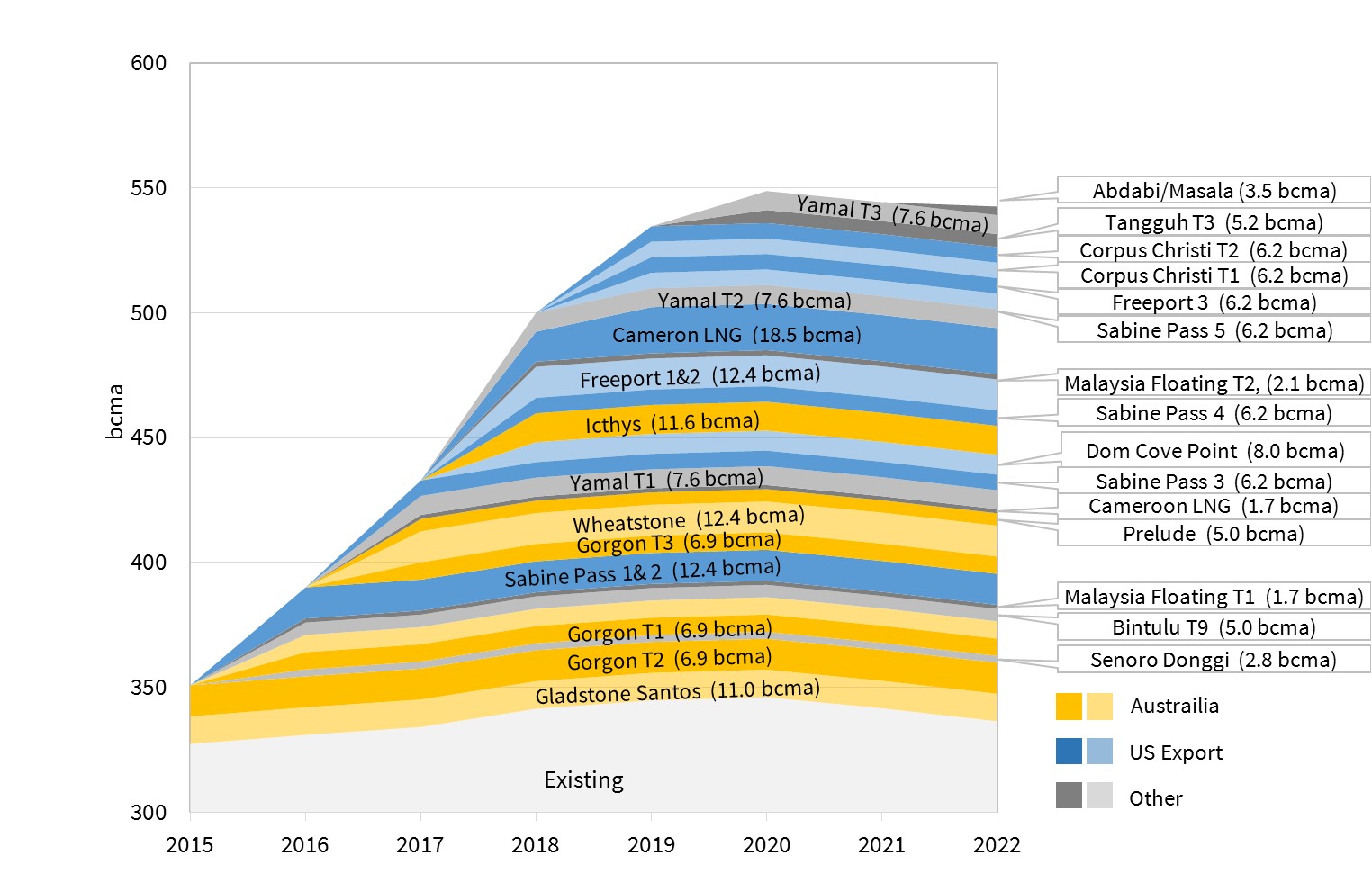
Despite delays there was a 6% increase in global LNG supply in 2016. This was consumed by markets in Asia (up 17 bcma) and the Middle East (up 10 bcma), with South American demand down 5 bcma. This left only 50 bcma of LNG available for Europe in 2016, little changed on 2015 LNG import levels. Chart 1 shows our current estimate of global LNG supply to 2021.

Chart 1 Annual global LNG supply outlook to 2021 (projects post FID)

Source: Timera Energy

The impact this supply surge will have on regional markets will be primarily determined by how much LNG Asia is able to absorb.

All eyes on Asian demand growth

The key uncertainties driving future Asian LNG demand growth include the:

  1. pace and extent of Japan’s nuclear re-start programme
  2. scale of coal to gas switching in China achieved in line with policy
  3. affordability of LNG in India (subsidy regime and infrastructure build being key factors)
  4. aggregate scale of imports in markets such as Pakistan, Bangladesh, Thailand and others where domestic gas production is in decline.

Analysis and judgment can be used to define High and Low future Asian LNG demand scenarios. But it may take a year or two of further evidence before the range of uncertainty can be narrowed. One factor which clouds the picture is the degree of seasonality in Asian LNG demand, in large part driven by the lack of significant gas storage capacity in these markets.

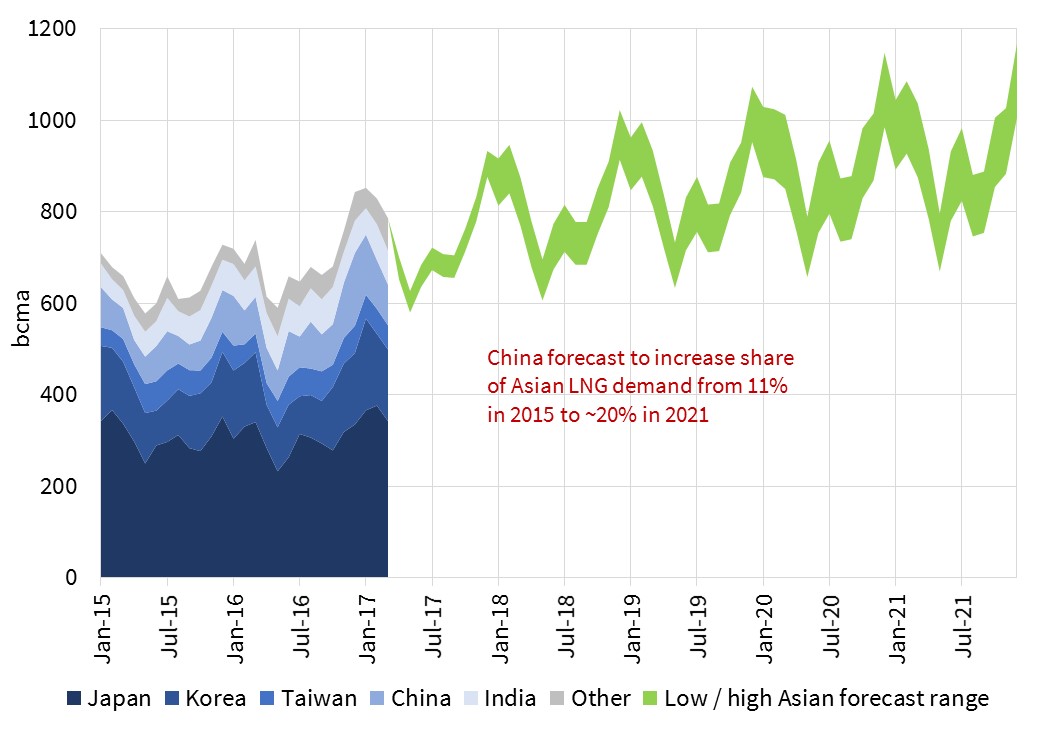
Chart 2 shows monthly Asian LNG import historical data and future trends for both the High and Low scenarios we have defined. Winter 2016/17 saw the impact of an (anticipated) cold Chinese winter and the impact of nuclear capacity offline.

Chart 2 Asian LNG demand (2015 – 2021)

Source: Timera Energy

This resulted in a spike in Asian LNG prices which subsided and re-converged on European hub prices by Spring 2017. Late 2017 Asian import levels should provide a better guide to annual trends (particularly if winter 2017/18 has ‘average’ seasonal temperatures).

Scenario analysis of LNG market balance

Asian demand growth is the most important variable determining the global market gas balance.   So we now look at the implications for the wider market of LNG supply growth under the two Asian LNG demand scenarios shown in Chart 2.

Low Demand scenario

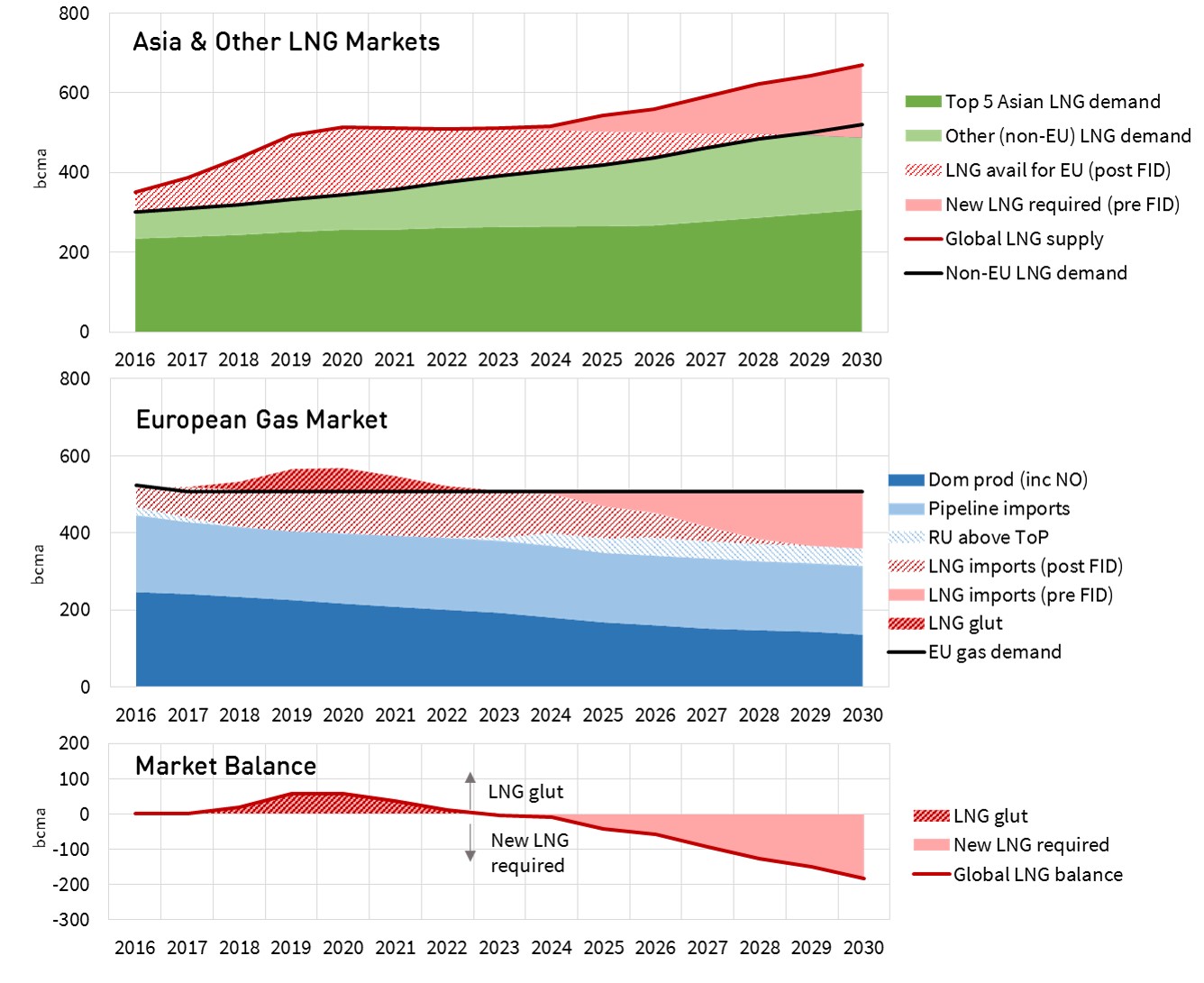
Chart 3 shows, for the Low Asian Demand case, global LNG supply compared with non-European LNG demand. In the upper panel, total non-European LNG demand rises to some 520 bcma by 2030. LNG from post FID projects above this demand line is available for Europe. The graph also shows a notional volume of ‘New LNG’ from future (pre-FID) projects from 2025 onwards.

The middle pane shows the European gas market balance, assuming a flat demand level of some 510 bcma. This is met by:

  1. a) Domestic gas production (including Norway)
  2. b) pipeline imports comprising North Africa, Azerbaijan and Russia (at take or pay levels)
  3. c) Russian pipeline gas volumes above take or pay levels (dashed blue)
  4. d) LNG imports from post-FID projects and
  5. e) LNG imports from future (pre-FID) projects (assumed to be notionally 180 bcma).

The bulge above the demand line is the ‘LNG glut’ in this scenario. This represents surplus LNG that in not absorbed by ‘business as usual’ demand in Europe. The surplus in this scenario reaches levels of around 60 bcma in 2019 and 2020.

Chart 3 – Low Asia Demand Case LNG Balances

Source: Timera Energy

The lower pane of Chart 3 isolates the glut and the new LNG required from new pre-FID projects. Three points arise from this analysis:

  • Although represented as a ‘glut’ – the apparent oversupply of LNG would be cleared by the market through one or more of the following mechanisms: (i) coal to gas switching in the European power sector, (ii) induced additional demand due to lower spot LNG prices in Asia, (iii) potentially a reduction of LNG send-out for coal seam gas – supplied Australian LNG projects and (iv) the curtailment of some US LNG export volumes as the compressed spread between Henry Hub and European hubs (and Asian spot prices) becomes less than the variable costs of the most expensive off-takers.
  • As the glut recedes, Europe requires higher volumes of pipeline gas from Russia, who (in this period) are providing the marginal supply tranche into the system and are therefore in a position of ‘pricing power’.
  • In anticipation of this re-balancing and consequent higher pricing, new LNG projects gain FID around the turn of the decade and begin producing from 2025 onwards. In Chart 3, the (assumed) mid 2020s wave of new supply is such that it still requires Russian volumes above take or pay levels out to 2030. Consequently Russia retains significant pricing power over European hubs, and through LNG arbitrage, Asian LNG spot prices. It is possible that optimism over future LNG demand trends could lead the industry to ‘overinvest’ in the mid-2020s LNG supply wave, in which case we may see a repeat of the ‘glut’ phenomenon ten years from now.

High Demand scenario

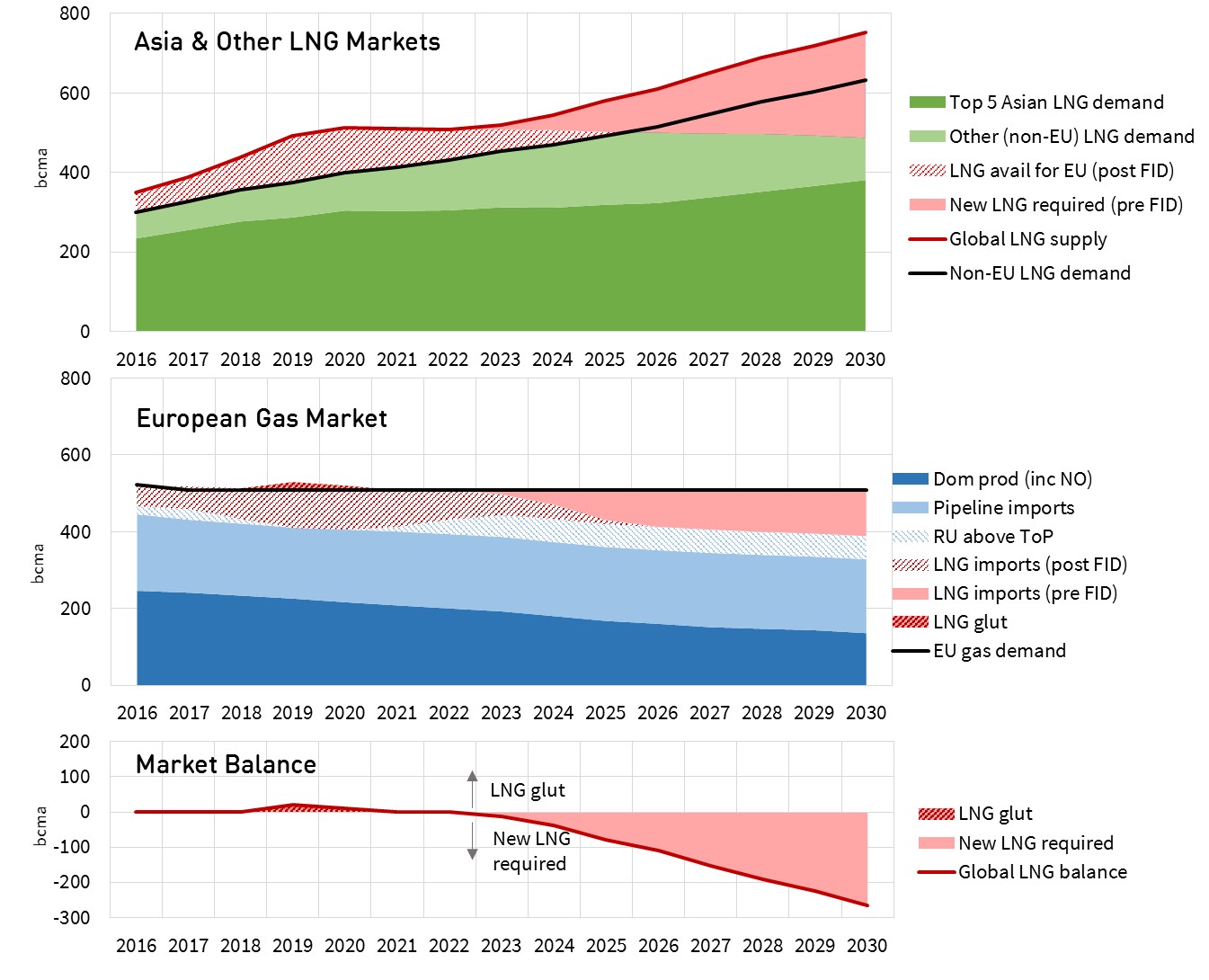
Chart 4 shows the same representations of the global LNG supply and European balance for the High Asian Demand case. In the upper panel, total non-European LNG demand rises to some 635 bcma by 2030. LNG from post FID projects above this demand line is available for Europe. The graph also shows a notional volume of LNG from future (pre-FID) projects from 2024 onwards.

Chart 4 – High Asia Demand Case LNG Balances

Source: Timera Energy

The middle panel shows the European gas market balance, again assuming a flat demand level of some 510 bcma. As the market in this scenario rebalances earlier and more rapidly, the build-up of Russian volumes above take-or-pay is more emphatic. The ‘LNG glut’ in this scenario is muted: 20 bcma in 2019 and 10 bcma in 2020. The assumed mid 2020’s wave of new LNG supply in this scenario is more significant (270 bcma by 2030), while still leaving Russia with a total of some 210 bcma of pipeline exports to the European regional market.

Implications of scenario analysis

This scenario based analysis of the LNG market balance, forcing attention on the global implication of the LNG cycle, throws up some interesting insights.

Currently industry attention is rightly focused on the period of potential ‘glut’ between 2018 and 2021. But the growth of Asian LNG demand, even in the Low Case, requires near term upstream investment in new LNG project FIDs, by the end of this decade at the latest.

The pace and scale of the next LNG supply wave of the mid 2020s could be comparable to that of the 2010s and even exceed it in the High Case. This again underlines the importance of understanding Asian LNG demand trajectories going forward.

The rise of Russian pricing power in the 2020s is also a feature of both scenarios. This may either be directly or implicitly via an oil-products price linkage. Or it may be via a more strategic targeting of hub pricing through physical volume management.

Time is well invested in better understanding Asian demand growth and Russian price/volume strategy as two critical drivers of LNG market evolution into next decade.

Authors: Howard Rogers, David Stokes & Olly Spinks

Further detail on the themes in article can be found in Howard Rogers’ article: The Forthcoming LNG Supply Wave: A Case of ‘Crying Wolf?’.

A wild winter in European power markets

The Winter of 2016/17 will be etched in the annals of European power market history. A string of safety related outages highlighted Europe’s dependence on the 63GW fleet of French nuclear plants as a cornerstone of its capacity mix. The resulting generation shortfall drove extreme price volatility in France and sent shockwaves through interconnected neighbouring markets.

We have already written about the price shocks over the current winter in the UK power market. Today we look at last winter’s events as an interesting case study in the differences between pricing dynamics in the French and German power markets.

Winter dynamics in France

French power prices are structurally higher than in Germany, with a baseload price premium of around 6 €/MWh in 2018. This premium is driven by winter peak prices where France utilises gas-fired generation, both from within its borders and imported from neighbouring markets, to satisfy demand. In contrast summer prices are typically set at the German border, with the variable costs of coal and lignite plants being the predominant driver.

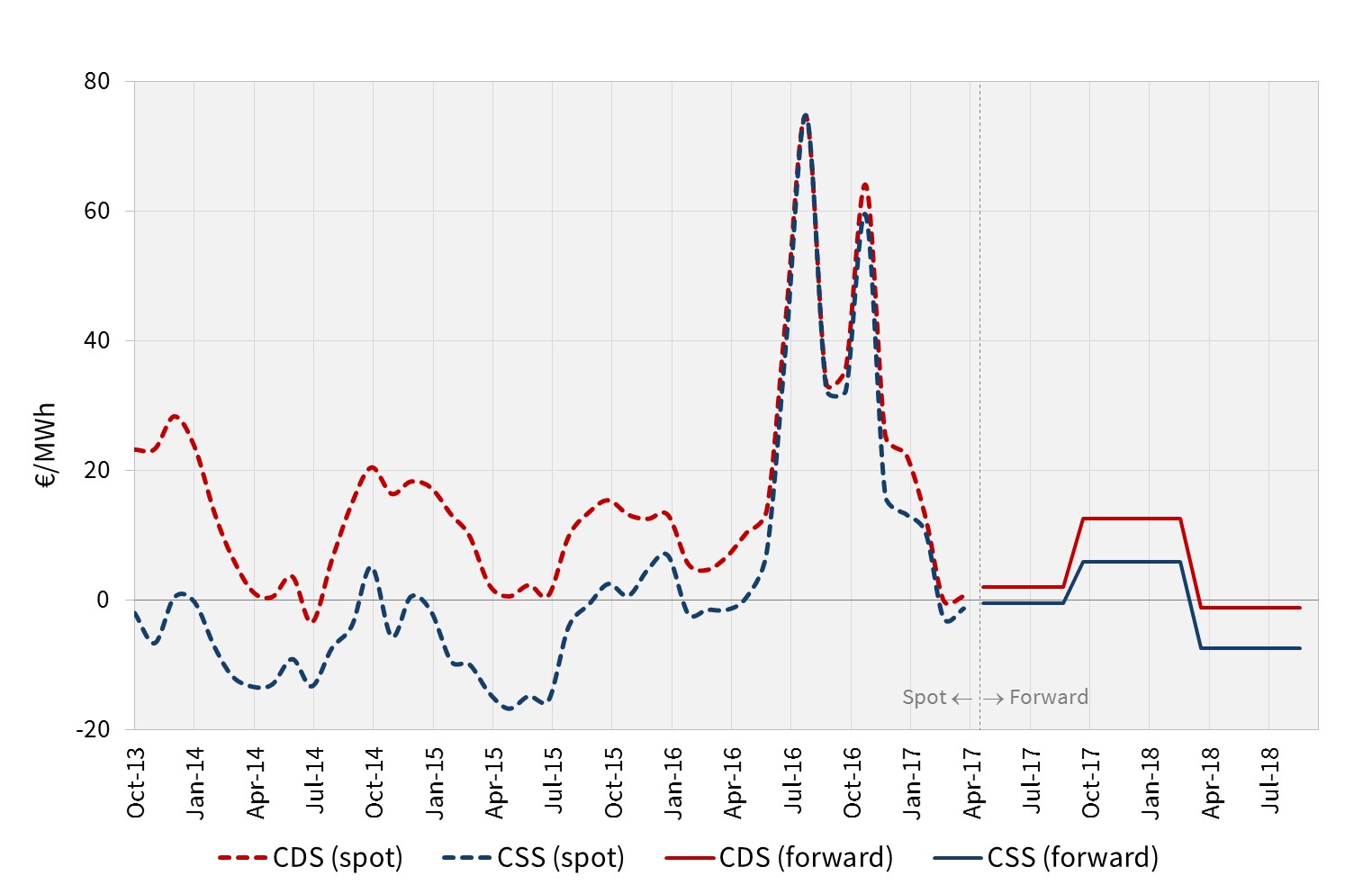
Chart 1 shows the evolution of generation margins for coal and CCGT plants in France since 2013. This puts the price shock of the current winter in perspective.

Chart 1: Evolution of French clean dark and spark spreads

Source: Timera Energy

As the scale of the nuclear outage issue became apparent in Sep 2016, French spot power prices spiked higher. The concept of power prices rising above variable fuel and carbon costs is often referred to as a ‘scarcity premium’. This is a rather loosely used term that often reflects theory more than reality.

Let’s take a look at Q4 power prices in France as an illustration of the actual drivers of elevated prices. The price premiums that can be seen in Q4 reflect the marginal price signal required to:

  1. Incentivise dispatch of more expensive peaking generation within France
  2. Attract sufficient imports (or reduce exports) from neighbouring markets, particularly the UK market which was also very tight

In addition in some periods of more severe tightness, individual generators (or interconnectors) actually gain pricing power. This is a function of a reduced level of competition to provide the marginal MW, amongst the available sources of capacity.

These situations can lead to quite extreme price spikes with the market pricing up towards expensive balancing alternatives or ultimately towards the value of lost load. Periods of significant pricing power tend to be short lived until more normal levels of supply competition are restored.

As a result of surging Q4 power prices in France, both clean spark and clean dark spreads jumped and remained at elevated levels across Q4. But as 2016 drew to a close and nuclear capacity returned, spot prices & spreads reverted to more normal conditions. French power prices have continued to weaken this year, helped by unusually warm spring weather, with France experiencing the warmest March weather for more than one hundred years.

Forward French spark and dark spreads are hovering around zero across the summer. But baseload prices for next winter currently sit at around a 9 €/MWh premium over Summer 17. Behind this premium is the requirement for gas-fired plants to run across the winter peaks, reflected in forward peakload spark spreads which are currently around 17 €/MWh.

Winter dynamics in Germany

Price setting in the German power market is dominated by coal-fired generation capacity. Over the last 3 years German power prices have declined, helped by robust growth in low variable cost wind and solar output. Over the same period gas prices have declined relative to coal prices.

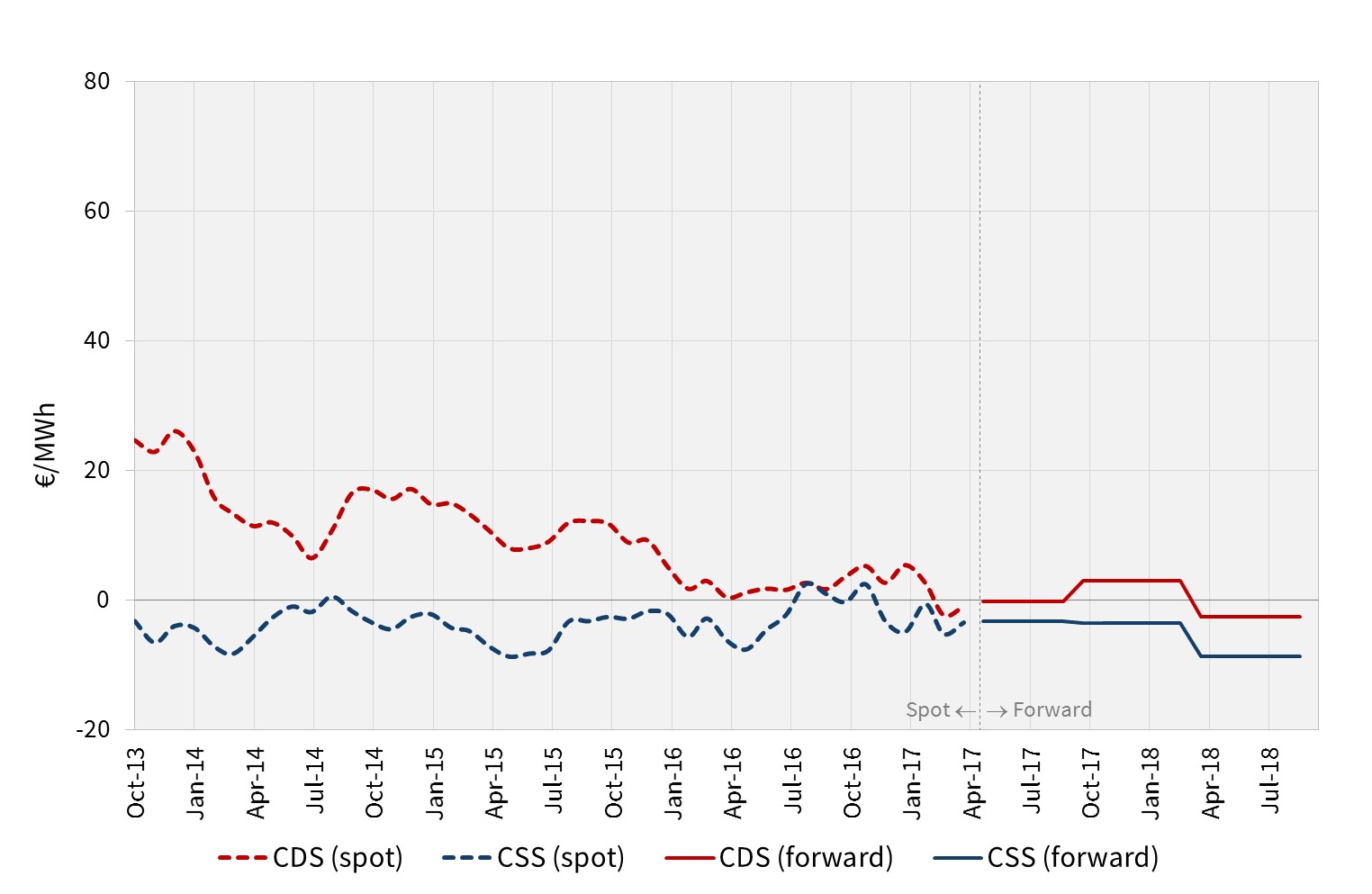
These factors have combined to drive a convergence in the generation margins of coal and gas fired plants in Germany. This can be seen in Chart 2.

Chart 2: Evolution of German clean dark and spark spreads

Source: Timera Energy

German CCGT margins have been in negative territory for most of the last 5 years as generation output is dominated by lower variable cost coal capacity. But as the French market tightened in Sep 2016, German CCGTs were required to help make up shortfall. Chart 2 shows German spot spark spreads temporarily recovering into positive territory in 2016.

However the price impact of French nuclear outages was much more subdued in Germany. German power prices rose as the French market imported more German power. But at the point that available interconnector capacity became constrained, pricing across the two markets separated, with German prices and generation margins remaining at a substantial discount to France.

Forward spark and dark spreads remain very lean. This is a function of the continuing role out of low variable cost renewables and a current overhang of thermal capacity. Higher spot price returns are likely to precede a structural recovery in forward spreads.

What does Winter 16/17 tell us about the future

Last winter’s events illustrate the dependence of European power markets on the French nuclear fleet. If nuclear safety issues resurface, higher prices and volatility will return. The winter price shock also seems to undermine current French election pledges for a major reduction in nuclear output by 2025. Political debate has conveniently sidestepped the resulting impact of higher prices on French industry and consumers.

The events of winter 2016 were also an indication of how conditions in North West European power markets may change into the 2020s as capacity retires. Germany alone is set to lose a huge volume of capacity by the early 2020s given regulatory and economic retirements. The German Association of Energy and Water Industries (BDEW) estimates 26GW of nuclear and thermal plant closures by 2022.

This highlights the challenge North West European power markets face over the next five years. The rollout of renewables continues at an impressive pace, but this intermittent capacity requires flexible backup. Market price signals currently do not support existing flexible capacity, let alone development of new capacity. This suggests higher prices and volatility are going to become a more regular feature of European power markets.

Article written by David Stokes & Olly Spinks


The UK gas market without Rough

Centrica Storage Limited announced on the 12th April that there will be no injections at the Rough storage facility until May 2018 at the earliest. This leaves Rough effectively crippled for at least a year.

Rough could return to operation in some constrained form in 2018, but there appears to be a growing threat of permanent closure. There are substantial technical challenges facing the ageing facility relating to well integrity. Even if these can be partially overcome, it is unlikely that current seasonal price spread levels would justify the capex investment required. Closure also allows Centrica to monetise the substantial volume of cushion gas in the reservoirs by flowing this into the grid .

In an article last year we looked at the threat of reduced flexibility from Rough. In today’s article we consider the impact on the UK gas market of the closure of Rough.

Space vs deliverability

The UK market is less dependent on Rough flexibility than it was a decade ago. This is because of major investments in connectivity with the Norwegian Continental Shelf (Langeled, Vesterled), interconnection with the Continent (BBL) and incremental regas capacity (at Dragon, South Hook & Grain).

This new supply infrastructure means that the UK has ample import capacity to meet annual demand and to support seasonal flexibility. The gas market’s vulnerability is to shorter term constraints in supply deliverability to meet gas demand on any given day.

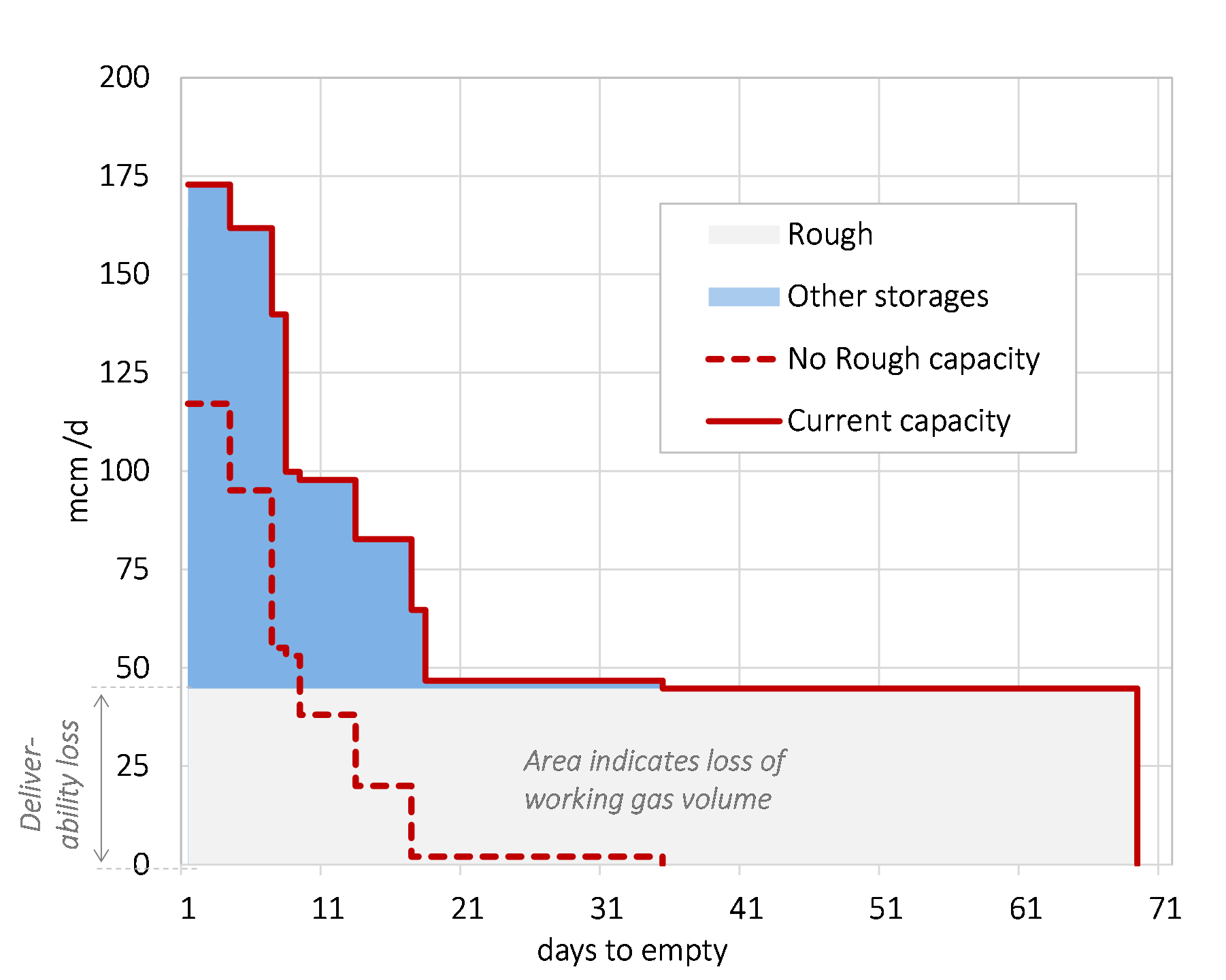
Rough makes up an impressive 70% of the UK’s storage working gas volume. This can be contrasted with Rough’s contribution to the UK’s daily deliverability, at around 25%. And it is the deliverability that the UK market will miss most. The impact of Rough closure on deliverability is illustrated in Chart 1.

Chart 1: UK gas storage deliverability profile (assuming all capacity starts full)

Source: Timera Energy

The solid red line in the daily deliverability profile of aggregate UK storage capacity including Rough, assuming continuous withdrawal from full inventory. Deliverability quickly falls past the first 1-2 weeks as fast cycle facilities exhaust their working gas volume, with Rough providing the only significant delivery capability beyond a two week horizon. The impact of losing Rough is illustrated by the dotted red line.

Impact on pricing

The chart illustrates the two main impacts of Rough closure:

  1. A 25% fall in deliverability reduces the ability of the UK market to respond to short term swings in the supply/demand balance (e.g. import infrastructure outages, cold snaps), over a 1 -2 week horizon.
  2. A 70% reduction in working gas volume reduces the ability of the UK to cope with a more prolonged supply shock over the 2-6 week horizon period it can take for the LNG supply chain to respond a, e.g. as the UK faced in Mar/Apr 2013.

The loss of deliverability should boost spot price volatility as it reduces the buffer of supply flexibility available to respond to swings in daily demand. There is already evidence of volatility recovery in 2016, supported by the partial Rough outage. The loss of working gas volume is likely to mean that supply shocks (e.g. major infrastructure outages) have a sharper and more prolonged price impact.

The other interesting pricing dynamic is the spread between UK and Continental hub prices. The Rough injection season has historically acted to soak up UKCS summer production, supporting NBP prices. The loss of Rough may see a reduction in NBP prices relative to TTF in summer months and a fall in net UK to Continental export flows. This logic applies in reverse in winter when the UK will need to attract more gas from the Continent (or Norway) to replace Rough withdrawals.

Impact on asset values

The loss of Rough should increase the role that imports play in servicing daily demand swings. This is good news for the value of interconnector and regas terminal capacity. Value is likely to be impacted in two ways:

  1. Greater capacity utilisation as flows increase in the absence of the ability to store gas within the UK market
  2. A higher ‘insurance value’ associated with import capacity, given the reduction in deliverability means imports will play a more important role in servicing daily demand swings or providing supply shock response.

Rough closure is undoubtedly good news for UK storage assets, particularly fast cycle assets which are focused on providing deliverability. It means a lower volume of flexibility to respond to short term price volatility, as remaining slower cycling storage assets become more focused in backfilling the loss of Rough seasonal flexibility.

There is already a knock on impact being seen with pricing and demand for storage & transport capacity prices. This reflects anticipation of increasing returns on flexible capacity as a result of the Rough issues, as well as greater competition to acquire flexible capacity from other sources.

We recently set out evidence of a 2016 rise in spot gas price volatility after many years of decline. This is consistent with increasing UK import dependency, ageing flexible supply infrastructure and increasing gas swing demand from the power sector. The loss of Rough next winter, and probably permanently, is a big factor pointing towards a continuation of the volatility recovery.

Article written by David Stokes & Olly Spinks


Market access contracts: 5 success factors

Owners of gas and power assets in Europe are increasingly contracting 3rd parties to provide market access services. This is a function of changing asset ownership structures. Utilities and producers are selling assets to investment funds which lack the in-house trading & commercial capabilities required to hedge and optimise assets.

Last month we wrote an article on the types of market access services being provided by 3rd parties. In today’s article we set out 5 key success factors in structuring and negotiating market access contracts, based on our experience from working with asset owners. We focus on ‘incentivised exposure management’ contracts, the most common and most complex deals to get right.

As covered in our previous article, incentivised exposure management contracts involve the transfer of asset exposures from owner to 3rd party provider, along with incentives to monetise asset value within a defined set of constraints. If a contract is structured well, it allows the asset owner to retain a degree of control over managing asset risk/return. But it also allows for the 3rd party provider to add value through its trading expertise.

In order to illustrate the practical challenges and pitfalls for each of the 5 success factors, we use a case study. This involves a CCGT owner with no in-house trading capability but that wants to be actively involved in determining the forward hedging profile of the asset. This means negotiating a services contract with a 3rd party trading desk that covers market access, plant nomination & dispatch and hedging & optimisation over the prompt horizon (e.g. from the day-ahead stage to delivery).

Table 1 summarises the 5 success factors that we explore in more detail below. These are not in any specific order of priority.

Success factor Summary description Pitfalls
1. Governance Defining and enforcing guidelines for the management of asset value and risk. Asset risk profile not aligned to owner risk appetite. Excessive rigidity constraining trader value creation.
2. Fee structure Fair capture of a fixed fee covering overheads and variable fees covering trade execution costs. Excess charging for incremental overheads. Excess variable fees incurred due to ‘volume churn’.
3. Incentivisation Defining a clean mechanism and value baseline from which trading desk ‘value added’ can be rewarded. Alignment of party interests across value, risk & asset performance. Transparency & oversight where this isn’t possible.
4. Exposure transfer Clean definition of which party has responsibility for managing asset exposures at any point in time. Prompt exposure handover. Information asymmetry in defining value base line. Transfer of ‘monkey value’.
5. Asset representation Capturing actual physical asset characteristics in a way that can practically be written in the contract. ‘Grey areas’ of exposure and value responsibility for each party from over-simplified asset representation.

Source: Timera Energy 

1. Governance:

The ability to define an appropriate risk/return boundary is a primary concern for asset owners, underpinned by the owner’s risk appetite, equity return targets and debt service cashflow requirements. This is achieved via ensuring an appropriate governance structure for a 3rd party agreement.

Defining a robust governance structure is about imposing an appropriate set of guidelines, within which the 3rd party can maximise asset value creation. This is typically implemented in the market access contract via a defined set of controls that provide the owner with appropriate transparency and oversight as to how asset value is being managed by the 3rd party. For example hedging profile guidelines, asset risk metrics and an associated reporting framework.

Challenges & pitfalls

Let’s consider challenges in the context of our CCGT case study. Governance of power plant risk/return is typically based around forward hedging profile guidelines (e.g. min/max levels of hedge cover by time horizon). Associated risk metrics can be used to manage the exposure of unhedged volumes. This structure can be reflected in the market access agreement, along with a means of regular engagement between the 3rd party and owner to determine hedging decisions within the defined guidelines (e.g. via a regular hedging meeting).

A good 3rd party trading desk will create value within the defined CCGT hedging guidelines, e.g. via timing of trading decisions and hedging of spark spread optionality. But providing the trading desk with too much freedom around hedging decisions may encourage excessive risk taking, compromising the owner’s risk appetite. Alternatively, constraints that are too rigid may inhibit the ability of the 3rd party to create value (e.g. specific hedge execution orders vs target hedge ranges).

2. Fee structure

Market access contracts typically consist of a fee structure with fixed and variable components. The fixed fee element aims to reflect the overheads of the 3rd party in providing the contracted services (e.g. trading systems, analytics). The variable fees are intended to reflect the ‘per transaction’ costs of executing trades in the market (e.g. bid/offer spread, credit).

Benchmarking these fixed and variable fee elements is an important part of market access contract due diligence. Fixed fees should reflect the incremental costs of supporting the services provided (reflecting the economies of scale of an established trading desk). Variable costs should be comparable to market bid/offer spreads and credit costs.

Challenges & pitfalls

Ensuring a fair level of fixed and variable fees is becoming easier as competition to provide market access services increases fee transparency. It is easy to focus on the headline fee numbers, but there are other more subtle challenges.

For example the volume of trades undertaken by the 3rd party can have a big impact on asset value accruing to the owner. Higher trading volumes can be associated with greater value creation e.g. from re-optimising forward hedges. But a ‘per transaction’ fee structure can also incentivise the 3rd party to ‘churn’ trades in order to generate variable fee income. This needs to be appropriately captured via incentivisation mechanisms (e.g. netting variable costs) and transparency/guidelines on trading value capture (e.g. ensuring minimum value capture when re-optimising hedges).

3. Incentivisation:

A fundamental challenge of market access agreements is that the interests of the owner and 3rd party provider are not always aligned. The owner is focused on maintaining asset performance and meeting asset risk/return targets, the 3rd party on maximising value generated from the market access agreement (and potentially the value of other assets in its own portfolio). It is important to confront and address this tension when structuring the contract, rather than glossing over it.

Incentivisation structures are a key mechanism that asset owners can use to better align the interests of the contract parties. This is usually focused on defining a clean benchmark for value added by the 3rd party, which is then shared between the two parties. We focus specifically in success factor 4. below on issues in defining this value benchmark.

Challenges & pitfalls

Our CCGT case study can be used to illustrate examples of incentive alignment issues:

  1. Asset performance: The 3rd party trading desk may increase value capture via more aggressive utilisation of CCGT flexibility. But the owner bears an associated cost in the form of higher outage rates and maintenance charges.
  2. Risk/return profile: Downside risk for the 3rd party is typically limited by a fixed contract fee, whereas upside from value incentivisation is often uncapped (e.g. via profit sharing). This typically means the 3rd party is incentivised to take greater risk than the owner who bears the true risk/return profile of the underlying asset.
  3. Value incentivisation: The ability of the 3rd party to add value via trading, hedging and optimisation decisions differs over different time horizons. This can be reflected via a ‘tiered’ incentivisation structure that e.g. reflects a greater potential for the 3rd party to add value in the within-day period close to delivery. But a tiered incentivisation structure can cause further issues if it allows the 3rd party to push asset value into time buckets where it receives a higher profit share.

It is also important to consider how incentivisation mechanisms may change with market conditions (e.g. an increasing portion of plant value being achieved in the within-day market). Careful structuring of market access contracts can either better align party incentives, or ensure appropriate transparency and oversight where this is not possible.

4. Exposure transfer & valuation

Market access contracts by nature mean that two parties have responsibility for the management of asset value. This creates a structural challenge: there must be a clean definition as to who has responsibility for asset exposures at any point in time. The contract should set this out in black and white. It is not an area that benefits from grey.

This challenge typically focuses on the handover of asset exposures from the plant owner to the trading desk in the prompt horizon ahead of delivery. The handover of an owner mandated forward hedging profile can be achieved relatively easily e.g. using traded contract buckets. But the owner typically hands over asset exposures in their entirety close to delivery to allow the 3rd party to fully optimise flexibility in the traded markets (e.g. at the day-ahead stage).

A clean mechanism for transfer of asset exposures between the parties also typically underpins the contract incentivisation structure. This is because the transferred exposures are ‘marked to market’ at the point of handover to form a value baseline against which 3rd party ‘value added’ performance is measured. This baseline is sometimes referred to as ‘monkey value’, the value a monkey or robot could generate before any trader value added.

Challenges & pitfalls

Two key areas often undermine the exposure transfer structure in market access contracts. Failure to ensure:

  1. Transfer and valuation of exposures against clean executable market price benchmarks
  2. Fair representation and valuation of asset flexibility (or extrinsic value).

With a CCGT this means choosing a point in time ahead of delivery (e.g. at the day-ahead stage) when there is a clean price benchmark against which plant optionality can be optimised and transferred. From this point the 3rd party then assumes full control for creating further value in the within-day, balancing and ancillary services markets.

It is also common for the incentivisation link to result in ‘value bleed’ from the asset owner to the 3rd party, due to the exposures being undervalued at point of transfer between parties. The CCGT owner is confronted here by an important information asymmetry. The 3rd party will typically have a strong commercial and analytical capability to allow it to fully value plant flexibility. Whereas the owner may fall back on a simpler valuation mechanism to determine the value baseline for incentivisation in the contract. Confronting this issue to define a fair value benchmark is key to avoiding structural value bleed via giving away ‘monkey value’.

5. Asset representation

The final success factor we cover is how to represent a complex physical asset in a contract. This means striking the right balance between accuracy and practicality.

Getting asset representation right is important because it forms the foundation from which each of the two parties responsibilities are defined. It also underpins the management and transfer of asset exposures and the incentivisation of 3rd party performance.

In the interests of contract simplicity it is tempting to represent the asset in the market access contract at a simplified level. But this can result in ‘grey areas’ of contract interpretation which typically favour the 3rd party by opening opportunities to optimise value in its favour.

Challenges & pitfalls

The CCGT case study provides examples of some factors to consider:

  • Considering the plant at an aggregate level rather than breaking it down into individual units (or even sub-units e.g. to cover excess output from duct-firing)
  • Fully representing market granularity as opposed to aggregating exposures into non-traded buckets
  • Adequate capture of plant physical characteristics (e.g. ramp rates, start cost structure)
  • Robust treatment of outage risk, defining owner responsibility for asset performance but 3rd party responsibility for unwind of hedges (within realistic liquidity costs)

A key principle that helps with the clean structuring of market access contracts is ensuring that asset representation allows exposures to be allocated and priced by the party best placed to manage them This can be assisted by a review clause in the contract, to recalibrate the asset representation periodically.

Getting contracts right

Traders are experts at optimising within a given set of constraints to create value. This expertise can be harnessed via a well-structured market access contract to significantly increase an asset owner’s returns. In areas where trading expertise can really add value it can often make sense to strongly incentivise this (e.g. 25-50% profit share).

But it is a double edged sword. Trading desks will also optimise any loopholes in market access contracts, usually to the detriment of the asset owner who is at a clear disadvantage in identifying issues. In many cases loopholes are the result of weaknesses in the way the contract is structured before it is signed. In other words the loopholes are baked into the contractual relationship, often with the explicit knowledge and intent of the trading desk.

In some areas there is nothing an owner can do. There is a balance between structural complexity and practicality. But recognising potential loopholes and structuring incentivisation mechanisms accordingly is an important way of preventing value bleed.

As market access contracts continue to evolve, standardisation of terms should work in an asset owner’s favour. But that may take several years. In the meantime considering the 5 success factors above should help with a number of potential challenges and pitfalls.

Article written by David Stokes, Olly Spinks and Nick Perry