LNG market balance in 5 charts

2018 was a year that confounded LNG market expectations of winter squeezes and summer lulls.

The market was tight over summer, with Asia pulling available cargoes away from Europe. At the same time, a carbon price induced rise in TTF helped drive Asian spot LNG prices to their highest levels of the year across the summer (~ 12 $/mmbtu).

Then as winter commenced, a surge of surplus cargoes flowed back into European hubs across Q4. Spot prices in Asia and Europe fell in sympathy, reconverging near 8 $/mmbtu by year end (see our 2018 surprises article for a chart and more details).

But behind the within year excitement of 2018, some key structural trends continue to define the evolution of the LNG market.  In today’s article we take a step back to look at these trends across 5 charts that tell the story of the market supply and demand balance.

The LNG demand story

It’s all about China… isn’t it?

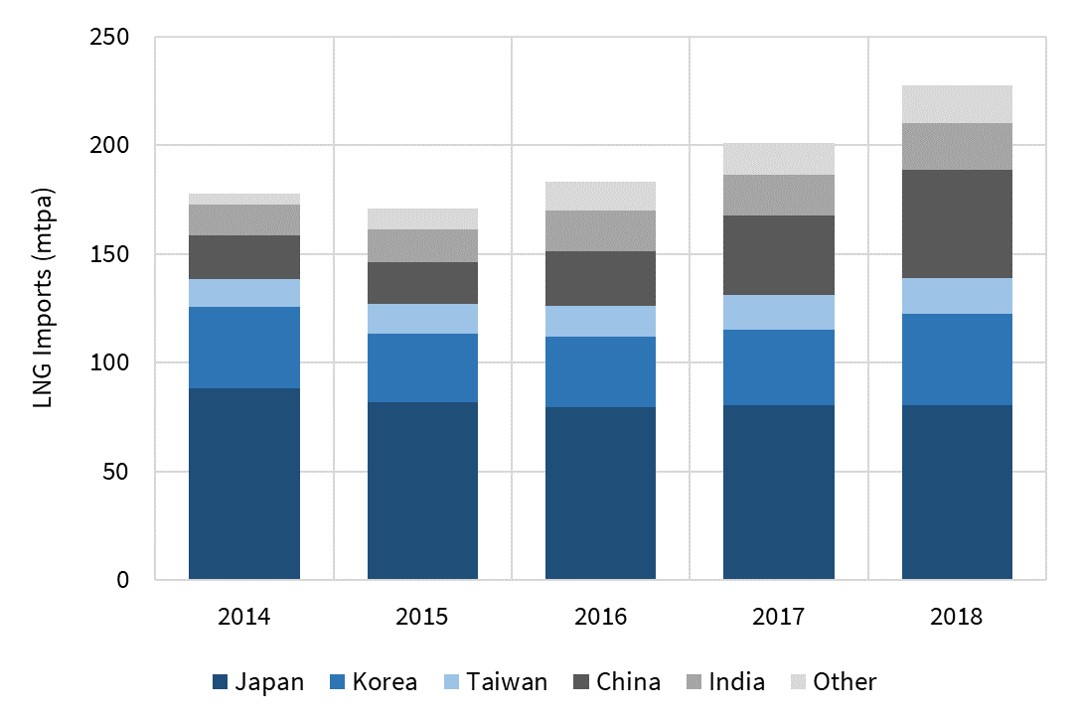
The most established structural trend in the LNG market is Chinese demand growth. China accounted for 61% of the 51 mtpa (69 bcma) of Asian demand growth from 2015-18, as shown in Chart 1.

Chart 1: China center stage in Asian demand growth story
Source: Timera Energy

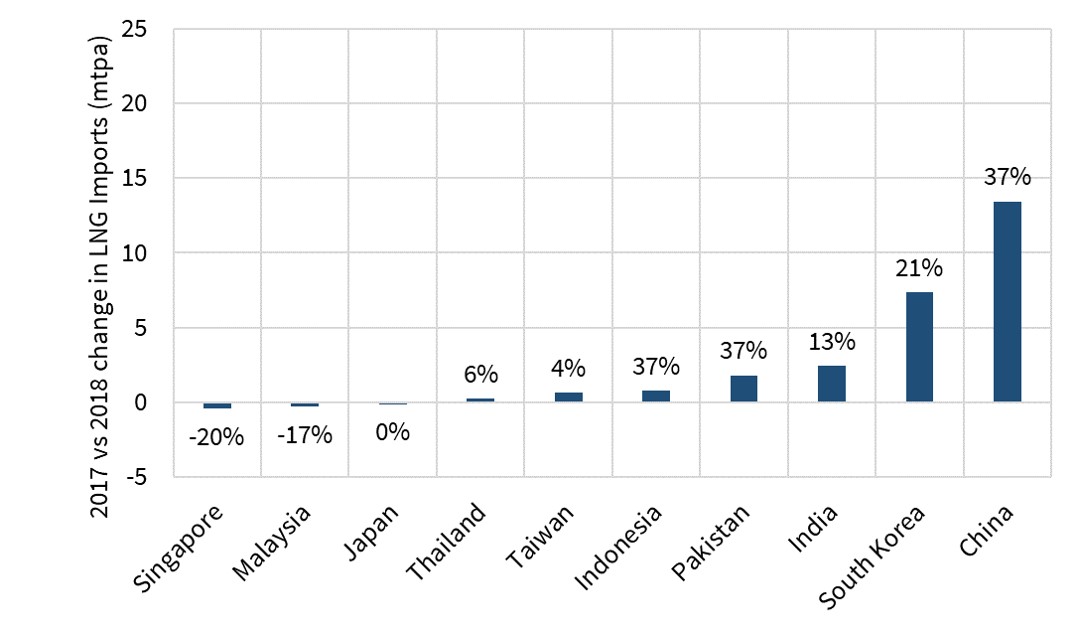
While Chinese demand growth continued at a blistering pace in 2018 (37% y-o-y), this actually represented a slowdown versus the two previous years.  The less acknowledged driver of Asian growth last year was South Korea as shown in Chart 2.

South Korea had a 7.5 mtpa (10.1 bcma) increase in demand (21% higher than 2017), driven by a surge in LNG demand for the power sector given a series of nuclear shutdowns (as we covered in our recent Snapshot piece).

Chart 2: But Sth Korea is also key in 2018
Source: Timera Energy

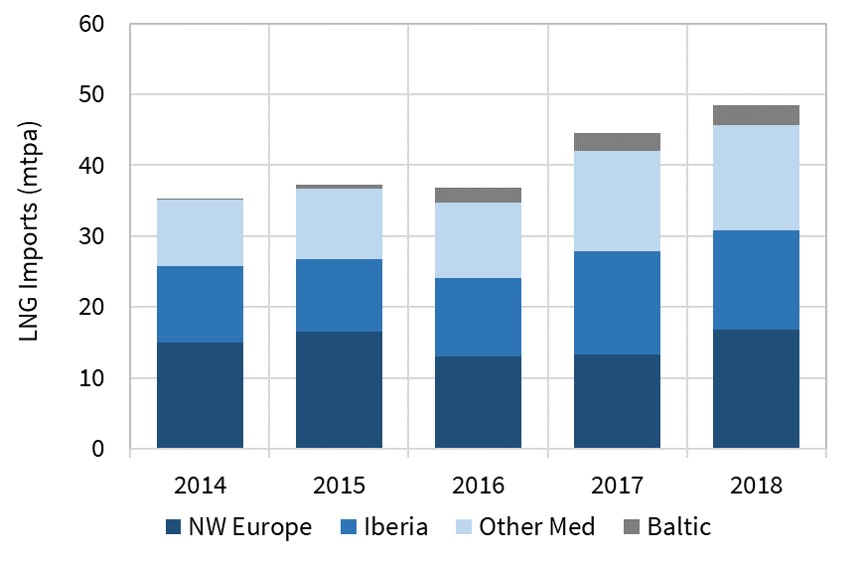
The other under-represented contributor to LNG demand growth is Europe. In the last 3 years, European LNG imports have risen by 30%  (11.4 mtpa, 15.5 bcma) as shown in Chart 3.

Chart 3: European demand growth is not trivial
Source: Timera Energy

The Q4 surge in surplus LNG flows into North West Europe supported European demand growth in 2018.  But this followed a European demand growth trend established in 2016-17 by:

  1. Iberian demand – helped by relatively low hydro balances lifting power sector gas demand
  2. Medditernean demand – with strong Turkish power sector demand and a pick up in Italian imports.

The LNG supply story

The supply side of the LNG market has less of a tendency to spring sudden surprises than the demand side. This is a function of the long lead times for delivery of new liquefaction projects (4 to 5 years).  Aside from project delays, start-up teething troubles, outages and the occasional geo-political issue, supply side visibility tends to be pretty good.

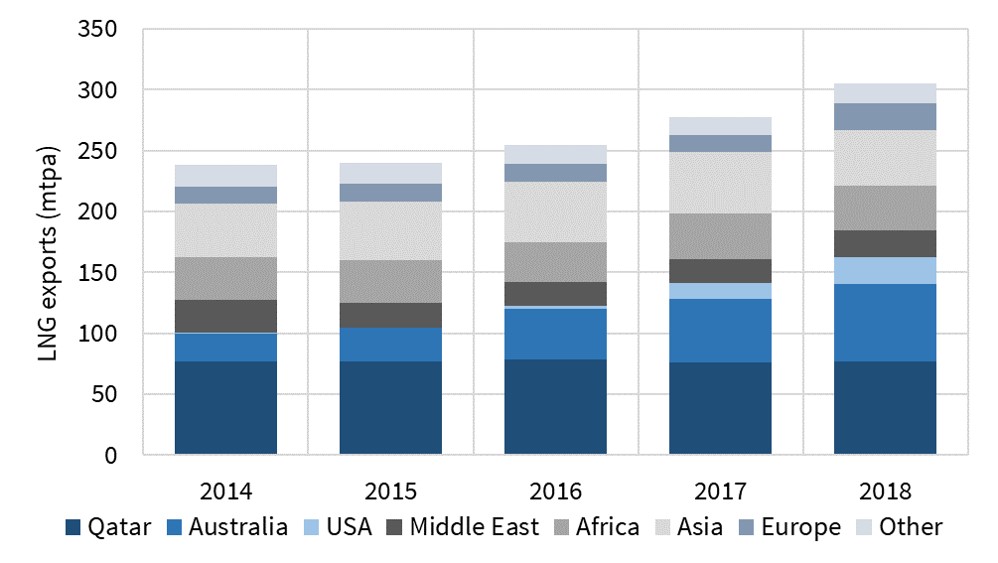
Chart 4 shows the ramp up in global supply from the current wave of new liquefaction capacity.  About half of this 2016-21 wave of new capacity is now online, with large volumes of new supply focused in the 2019-20 period.

Chart 4: Current wave of new supply continues
Source: Timera Energy

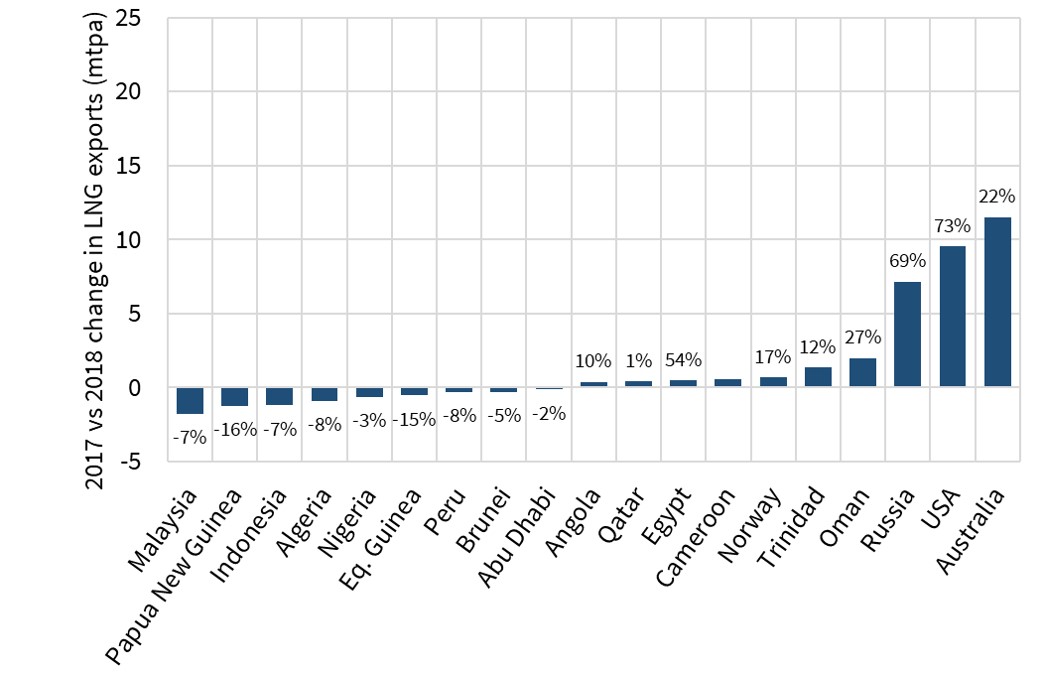
Three countries are dominating the current wave of new supply:

  1. Australia: doubling exports since 2015 to 64.6 mtpa (87.8 bcma) in 2018, with more to come this year
  2. US: exporting 22.9 mtpa (31.1 bcma) of LNG in 2018, with substantial additional volumes to follow in 2019-20
  3. Russia: with a healthy 17.8 mtpa (24.2 bcma) export growth in 2018

The importance of these three producing nations in contributing to 2018 supply growth can be seen in Chart 5.

Chart 5: Three large newcomers dominate 2018 supply growth
Source: Timera Energy

Combining the supply & demand pictures for 2019

2019 may be a critical year in determining the path of LNG market evolution.  A number of projects are queueing for Financial Investment Decisions (FID).  These could join the Qatari expansion and the Shell led LNG Canada project to form the next wave of new supply (2022-25).  Prospects looked good for a spate of 2019 FIDs until the cargo surplus and price slump of Q4 2018.

The combination of Asian and European demand growth comfortably kept pace with new supply over the last three years, until Oct 2018.  Softening conditions in the LNG market since Oct have also coincided with a broader selloff in global financial markets, as evidence mounted of a significant slowdown in economic growth, particularly in China.

So 2019 is important for two reasons. Firstly in 2019 we approach peak delivery levels for new supply from the current wave or projects under construction.  Any significant softening in demand this year may tip the market into a temporary (e.g. 1-3 year) period of surplus. Secondly the volume of new project FIDs taken in 2019 will be key to determining the LNG market balance in the 2023-25 period.

Somewhat counterintuitively, a temporary period of oversupply in 2019-20 which chokes off new FIDs, could well set up an uncomfortably tight market across 2023-25.
Variable cost a key differentiator for storage

Like cars, gas storage assets come in a range of sizes and speeds.  Any conversation comparing the relative merits of different storage assets tends to focus on:

  1. Working volume – how much gas you can store
  2. Cycling performance – relative rates of injection and withdrawal.

These headline attributes are definitely important in evaluating a storage asset.  But there is another characteristic that often gets less attention than it deserves: variable cycling costs.

Lower variable costs mean a lower hurdle to capture market price spreads. This translates directly into higher utilisation and higher expected returns on storage capacity.  It also offers downside protection in a low seasonal spread environment (such as the last five years).  For this reason, low cycling costs are a boon for traders and storage owners alike.

Illustrating variable costs dynamics via a case study

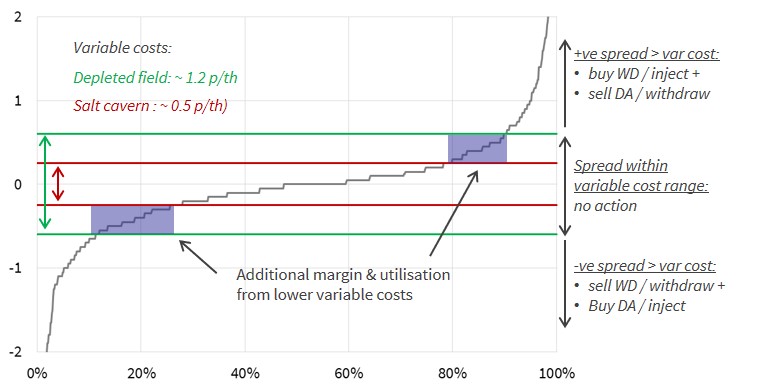
The most practical way to illustrate the impact of lower variable costs is via a simple case study. In Chart 1 below we compare value capture for two different UK storage assets:

  1. A salt cavern facility with lower variable cycling costs (0.5 p/th)
  2. A depleted field seasonal storage facility with higher cycling costs (1.2 p/th)

For simplicity of illustration we have assessed value capture against a ranking of Day-Ahead (D-A) versus Within-Day (W-D) price spreads. This assumes a basic D-A vs W-D trading strategy as follows:

  • When W-D price > D-A price plus variable cycling costs then capacity holder can buy D-A & inject and sell W-D & withdraw
  • When W-D price < D-A price minus variable cycling costs then capacity holder can sell D-A & withdraw and buy W-D & inject

Chart 1: Impact of variable cycling costs on value capture against DA/WD spread


Source: Timera Energy

The grey line shows the ranked NBP Day-Ahead to Within-Day price spread for across 2015-2018.  For both storage facilities there are a range of lower spreads where no action is profitable i.e. where variable cycling costs exceed price spreads.  But the ‘no action’ range for the fast cycle storage (red lines) is significantly smaller than for the depleted field (green lines).

Lower cycling costs mean greater utilisation & cycling opportunities for the salt cavern facility.  Lower costs also mean that the salt cavern captures a higher margin from spreads than the depleted field can capture.  Both these dynamics help protect margins for assets with low cycling costs when operating in a low price spread environment.

Factors influencing variable cost

The variable costs of storage can often be influenced by asset owners as a way of enhancing returns and optimising asset value.  Key factors influencing variable cost are:

  1. Asset design: For example, relative cavern pressure vs grid.
  2. Infrastructure: The age and configuration of facility infrastructure (e.g. compressors) can impact cycling efficiency/cost.
  3. Cavern type: For example, salt cavern variable costs are generally lower than for depleted fields.
  4. TSO charging structure: For example, German storage assets have historically had relatively high variable costs due to inclusion of D-A entry / exit capacity costs. These costs tend to be bundled into capacity products in UK/NL. There are currently EU wide and UK regulatory transmission charging reviews aiming to harmonise charging principles. 

There is ultimately a cost / benefit trade off for owners in optimising the variable costs of storage assets. Taking actions to reduce variable costs makes sense as long the incremental spend to achieve reductions is less than the risk adjusted market returns it yields.

Storage asset owners have suffered several tough years of lower market returns. In this environment, optimising asset variable costs can be a key source of value upside.

LNG shipping distances drive up costs

LNG shipping has grabbed an unusual amount of headline space across the last year. The primary reason has been a tripling in spot LNG vessel charter rates between Q1 and Q4 2018.  Charter rates rose from $70k to $220k per day, before falling back towards $150k towards the end of the year.

A shipping cost increase of this magnitude has a material impact on the LNG market.  For most sources of destination flexible LNG production, higher charter rates tend to support cargo flows into Europe given shorter delivery routes (vs longer routes to Asia). The 2018 increase in shipping costs has been an important factor behind the ramp up in European LNG imports since Q4 2018.

Voyage distances pulling up charter rates

The market for LNG vessels is increasingly commoditised and liquid.  Like any other competitive market, supply and demand drive pricing. One of the key factors tightening supply over the last two years has been an increase in average voyage distances.  Longer voyages mean that vessels are tied up for a greater period of time in delivering each cargo.

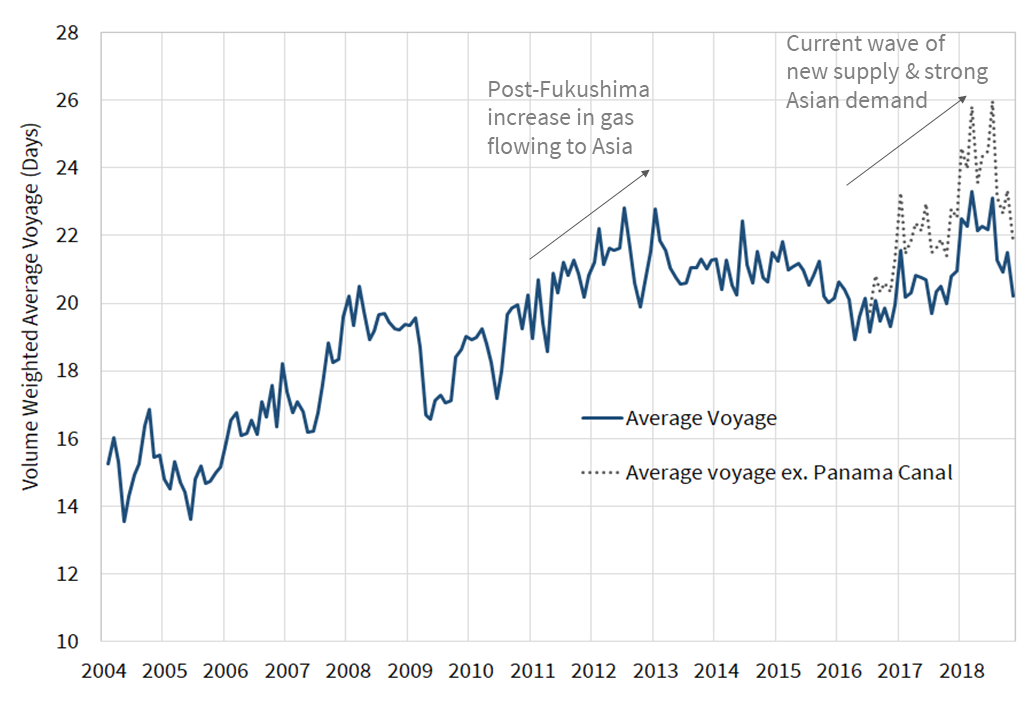
Chart 1 shows the evolution of average voyage distances in the LNG market across the last 15 years.

Chart 1: Global average LNG vessel voyage time

Source: Timera Energy. The commissioning of the Panama Canal expansion in 2016 has shortened voyage times from the US to Asia. To illustrate the impact of this structural change, the second dotted line shows an estimate of average voyage time if the Panama canal expansion had not taken place.

Over time, new supply (e.g. from the US) has been located further away from key demand centres (primarily in Asia). This dynamic has been the structural driver behind rising average voyage times across the chart horizon.

But beneath this key trend are some other interesting observations.  Firstly, voyage times increase in periods where strong Asian demand results in diversion of cargoes to Asia e.g. 2011-13 post Fukushima and 2016-18 strong Asian demand.

Secondly, voyage times tend to decline or stabilise during periods of LNG market weakness as a greater volume of cargoes flow into Europe (typically via shorter delivery routes vs Asia) e.g. during the 2009-10 post financial crisis slump and the 2014-16 period of oversupply.  This dynamic is also behind the steep decline in average voyage distance at the end of 2018 (as LNG flowed back into Europe in Q4).

In summary, voyage distances matter because they impact the tightness of the LNG vessel charter market.  And charter rates matter because they have an important influence on LNG flow patterns to Europe versus Asia.


Renewables in action: a German case study

The roll out of wind and solar capacity is transforming power markets across Europe.  If you want to understand the practical impacts of high renewable penetration, Germany is a great place to start.

Renewable generation output contributed about 38% of gross German electricity consumption in 2018.  The German market is particularly interesting because renewable production is dominated by intermittent sources:

  • Wind: 59GW of installed capacity (53GW onshore, 6GW offshore)
  • Solar: 45GW of installed capacity.

Wind and solar combined make up more than half of Germany’s 205GW of installed capacity, as well as dominating new capacity growth.

In today’s article we look at a Dec 2018 case study of swings in renewable output and their impact on German power prices.  This is an interesting ‘lab experiment’ for much bigger things to come next decade.

The behaviour of renewable intermittency

Perhaps the most important impact of rising intermittency is its effect in increasing market uncertainty.  Despite leaps forward in the ability to analyse weather data, it is difficult to predict wind & solar output tomorrow, let alone next month. The inherent uncertainty of renewable output is reshaping the risk/return profile of power assets.

Despite uncertainty, wind and solar output follow seasonal patterns that help define the range of output uncertainty.  For example, current German generation output distributions show that:

  • On sunny summer days solar output can reach nearly 30GW, but output rarely rises above 10GW in mid-winter.
  • Wind output can reach 45GW in winter but rarely breeches 30GW across the summer.

These numbers can be compared to annual peak demand around 84GW (gross).

Wind output is a much greater source of uncertainty than solar.  This is because wind speeds can ebb and flow substantially over the space of just several hours.  For more details see our article on analysis of quantifying wind and solar output distributions.

But fluctuations in wind and solar output are only half the story.  What is more important from a commercial perspective is the impact of these swings on market prices and plant load factors.  That is well illustrated via a recent German market case study.

A December 2018 case study

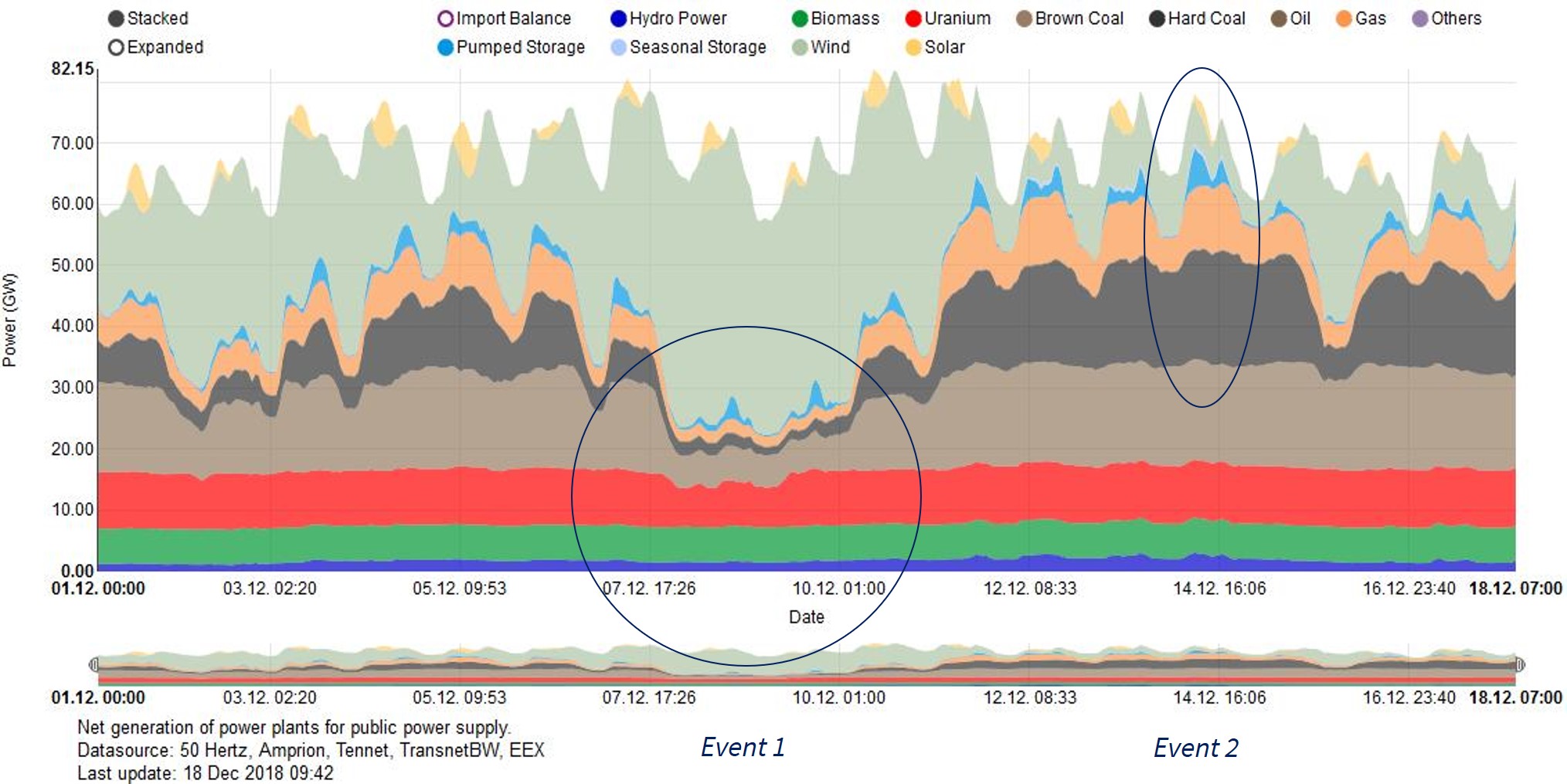
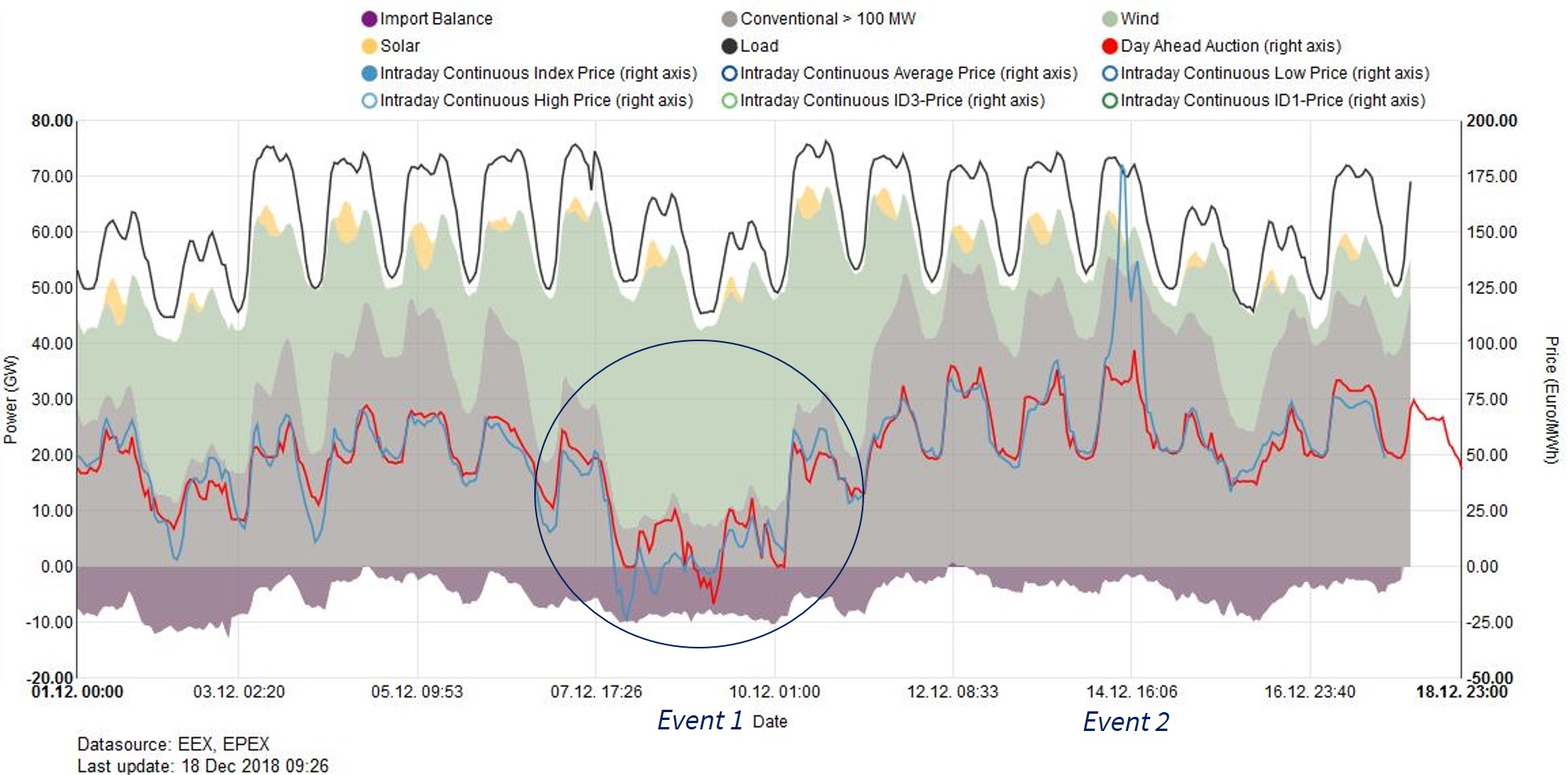
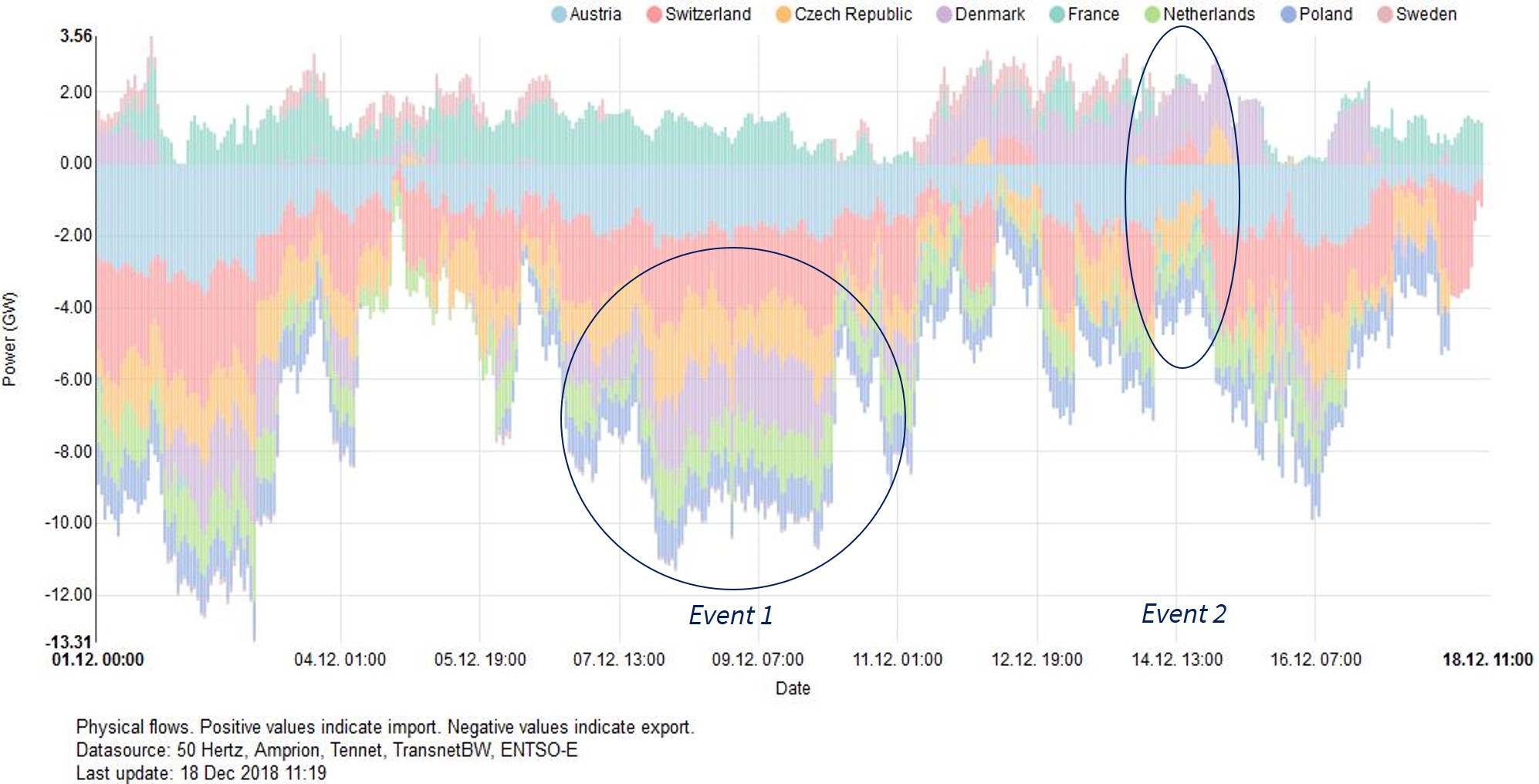
Chart 1 provides a summary of generation output (top panel), prices (middle panel) & cross border flows (bottom panel) in the German power market across the first half of Dec 2018.


Source: Fraunhofer ISE

Two events across this horizon illustrate some of the practical impacts of swings in renewable output.

Event 1: High wind output, low prices

The 8-9th of Dec was a relatively mild weekend. As a result, system demand was lower than average.  This set up an interesting combination of events:

  1. Wind output levels were very high across the weekend, above 44GW on 8th Dec (top panel)
  2. This drove both day-ahead and within-day prices below 10 €/MWh, with negative levels in some periods (middle panel)
  3. All flexible thermal generation units (gas, coal & lignite) were forced down to minimum output, with nuclear units providing marginal flexibility (top panel)
  4. Germany exported large volumes of low priced surplus power into neighbouring markets such as Austria, Switzerland, Denmark, Czech Republic & the Netherlands (bottom panel).

Event 2: Low wind output, higher prices

Several days later, on Fri 14th Dec the situation had flipped. Being a weekday, German demand was higher, but there was also a cold snap in Scandinavia that saw Sweden & Denmark pulling on German exports:

  1. Wind output levels were low (5-6GW)
  2. Imports from Scandinavia rose towards 2GW (vs 2GW exports on 8-9th Dec)
  3. Day-ahead prices topped 90 €/MWh, with intraday prices above 175 €/MWh
  4. German coal, lignite and CCGTs were running at high load factors with more expensive peaking flex (e.g. gas peakers & pump storage) setting prices.

A lens into the future

Germany has set a 65% renewable target by 2030 (vs current 38%).  Whether or not it achieves this target, there are concrete steps being taken to roll out substantial volumes of wind & solar capacity in the 2020s.  Many other markets in Europe are following suit.  Events like the two described in the case study above are set to become more frequent and larger as renewable penetration increases next decade.

Understanding the impact of renewable output uncertainty on power price dynamics is one of the key commercial challenges that the energy industry faces over the next 5 years. We will return in an article shortly that looks at how renewable uncertainty can be captured in power market modelling.

5 energy market surprises for 2019

Welcome back to our first feature article for 2019.  As has become tradition we start the year with five surprises to watch for on your radar screens.  Usual caveat: these are not forecasts or predictions but cover areas were we think it is worth challenging prevailing market consensus.

1.UK capacity payments reinstated

The sudden suspension of the UK capacity market was one of the major surprises of 2018. It has left many asset owners with gaping holes in their business plans, in some cases resulting in an inability to cover fixed costs.

The UK government was caught completely off guard by the European Court of Justice (ECJ) ruling. BEIS (the government department responsible) has been scrambling to reassure capacity owners that the situation is under control.  But industry confidence is understandably low given the scale of uncertainty set against a chaotic backdrop of Brexit politics.

Given these conditions, it is easy to build a ‘train wreck’ scenario.  BEIS is pushing plans for an extra T-1 auction to cover next winter, but the timelines & complexity of delivering that solution appear to be uncomfortably optimistic.  Adding to confusion is a lack of clarity as to (i) whether previous capacity payments may be recovered or (ii) what capacity owners and investors will face beyond next winter.

Wouldn’t it be surprise is some form of common sense prevails, even if initially via a messier ‘stop gap’ solution.  The capacity market has underpinned security of supply in the UK. The ECJ ruling may accelerate some market reforms that were already underway, but it is very unlikely that it will derail the capacity market.

BEIS appears to be aware of the urgency to reinstate some form of capacity payments before next winter in order to avoid accelerated asset closures.  They are also looking at solutions that could ‘backfill’ halted payments. Ultimately, some form of reserve mechanism payments via Grid (the TSO) could provide an initial emergency backstop.  Our first surprise for the year is that the issue of capacity payment reinstatement is substantively resolved in 2019.

2. Merchant battery investment takes off

Battery storage projects to date have been underpinned by ancillary services revenues, particularly for frequency response.  But this business model is being rapidly undermined by falling ancillary services revenues.  Over the last two years, frequency response prices have plunged in both the UK and Germany (Europe’s two leading markets for battery deployment). This is forcing battery developers to change tack and focus on merchant revenue models.

The merchant business model for batteries is a very different proposition. Most value is captured very close to delivery, by optimising battery flexibility from the day-ahead stage through to real time balancing.  This means that owners and investors need to bear substantial market risk, relying on projections of extrinsic revenue to support investment decisions.  We recently set out some of the challenges facing merchant battery investors.

Despite the headwinds described above, the pick up in investment momentum behind merchant battery projects may be a surprise in 2019.  Developers are focusing on short duration lithium batteries where cost declines are currently fastest.  There also appears to be strong investor interest in the scaling potential of merchant batteries despite the associated market risk.  What has been missing to date has been a clear track record of bankable projects.  That could change this year.

3. Gas demand shock

Global LNG demand has had a strong run since 2016, underpinned by Chinese annual demand growth of around 40%.  European gas demand has also recovered significantly over the last 3 years, helped by stronger economic growth and power sector demand.

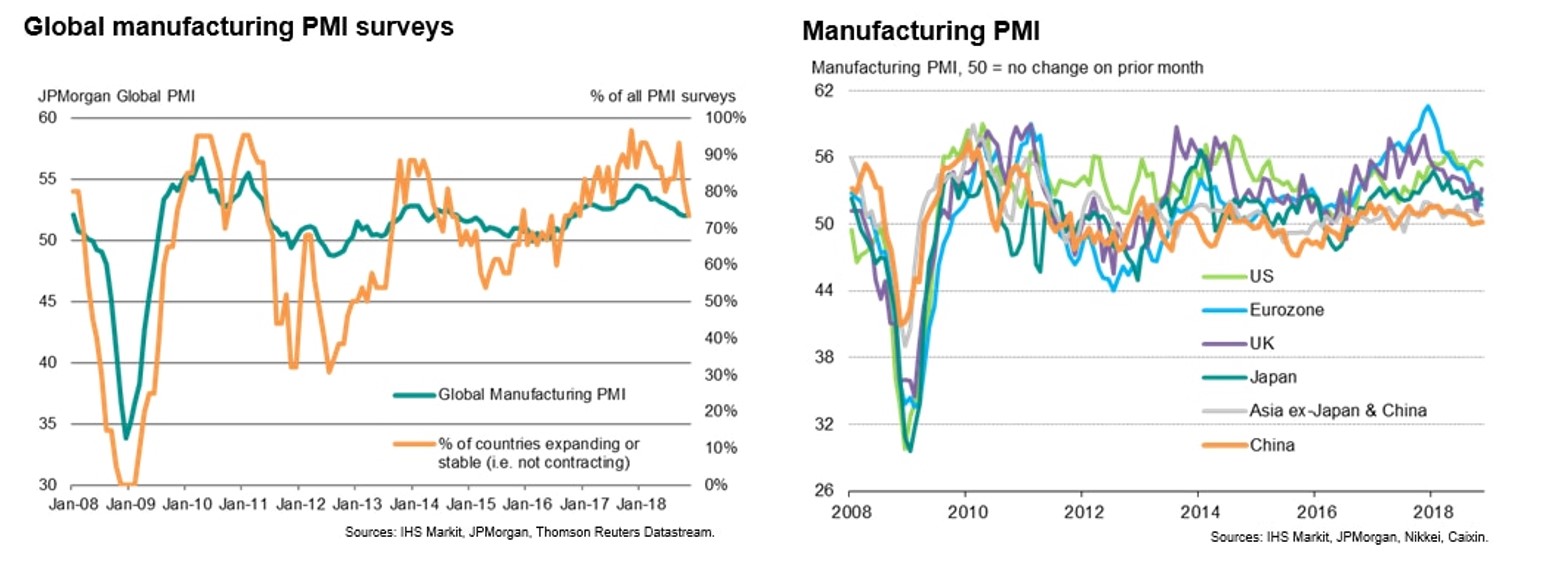
Global gas demand growth was driven by buoyant economic conditions across 2016-17, tagged by economists as ‘synchronised global growth’.  As 2018 drew to a close this had transitioned to ‘synchronised global slowdown’.  The 2018 slowing of growth in Chinese and European manufacturing data (as shown in Chart 1) is a particularly important warning sign for global gas demand.

The global economy is now entering its 11th year of consecutive economic expansion since the financial crisis.  An expansion of this length is unprecedented in modern times.  It raises the risk of a sharper slowdown or recession in 2019. Sharp declines in oil prices and global stockmarkets in Q4 2018 are flagging the risk of a weaker economic outlook.

Strong gas demand in Asia & Europe has seen large volumes of new LNG supply absorbed with relative comfort across 2016-18.  This has diminished the risk of a prolonged supply glut. But a gas demand shock in 2019 would come at a time when the largest volumes of the current wave of new LNG supply are coming onto the market.

Gas prices surprised to the upside in 2018.  But a major demand shock in 2019 could cause a temporary slump in TTF & Asian spot prices, particularly if accompanied by falling coal & carbon prices dragging down power sector switching levels.

Chart 1: 2018 slowdown in Purchasing Manufacturing Index (PMI) data

4. Gas storage closures

A number of higher cost, less flexible European storage assets are in trouble.  The funeral bells have been ringing for five years.  Owners have been holding on in the hope of a market recovery, deferring maintenance and investment decisions in an attempt to keep carrying costs to a minimum.  2019 may be the year that a significant volume of storage capacity is finally pulled off line.

TTF seasonal price spreads have remained stubbornly stuck between 1-2 €/MWh for most of the last five years, barely covering the variable costs of cycling seasonal storage.  Many asset owners have managed to hang on due to a combination of:

  1. Long term contracts at more favourable terms (many of which are now expiring)
  2. Hopes of a market recovery
  3. Hopes of regulatory reform to support storage (e.g. changes to system charges).

But owner patience may be running out, particularly those suffering negative cashflows. Storage assets with a higher fixed cost or variable cycling cost base are particularly vulnerable.  Any requirement for substantial capex spend may be terminal. The precipitation of closure decisions if it happens in 2019, will likely contribute to the start of a more sustainable recovery in value of European gas supply flexibility.

5. Rising cost of capital

Energy infrastructure developers have benefited from an historically low cost and easy availability of capital over the last five years.  Could that be about to change in 2019?

Easy access to capital has been underpinned by low borrowing costs. The cost of raising debt can be broken down into two components:

  1. Risk free rate: Massive central bank quantitative easing has driven down interest rates on ‘risk free’ government debt. This is most clearly reflected in 10 year German bond yields which are currently below 0.2%.
  2. Credit risk premium: The credit spread over risk free rates is also at low levels historically, reflecting e.g. low default rates and European Central Bank buying of corporate debt as part of its quantitative easing measures.

So what could change in 2019 to reverse 5 years of readily available capital targeting energy infrastructure? Firstly, global central banks are entering a phase of quantitative tightening in 2019 which could see borrowing rates rise.  Secondly, the potential for a deterioration in economic conditions could widen credit spreads.  Thirdly, investor risk appetite may decline as a result of the first two factors.

The impact of a higher costs of capital in European energy markets would be felt most by companies or projects with higher leverage.  Higher cost of capital erodes asset margins via increasing debt servicing costs. It also increases the cost hurdle for investment in new infrastructure.

We wish you all the best in navigating these (and no doubt many other) surprises across 2019.

Major energy surprises of 2018

 As the Christmas break rapidly approaches, it is time for our traditional year end review of energy market surprises.

We approach this in two parts in today’s article:

  1. A progress check on the 5 surprises we published at the start of the year
  2. A table of 5 things that have surprised us across 2018 given the benefit of hindsight.

Hope you enjoy the ride.

A review of our 2018 surprises

As usual we published a set of 5 potential surprises in Jan 2018.  We below do a quick review and progress check on each of them below.   A reminder that these surprises are not forecasts or predictions, but rather areas where we think it is worth challenging prevailing industry consensus.

1. A setback for LNG prices

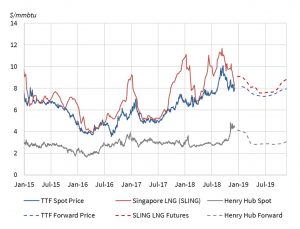
Chart 1 shows Asian spot LNG prices started the year at 11.0 $/mmbtu. To everyone’s surprise, prices again reached this level over the summer, with another year of blistering Chinese LNG demand growth.  But the North Asian spot markers look to be ending the year closer to $8.5/mmbtu.

The setback in prices came, but it was very much a Q4 story. Supply has ramped up into year end, both via new projects & from the seasonal increase in liquefaction plant output as temperatures cool. At the same time Asian demand for spot cargoes has been tepid in Q4.  Asian buyers appear well contracted into winter (after being caught short the last two years) and weather has so far been mild.  This has caused a substantial Q4 ramp up in cargoes ‘spilling’ into Europe.  So the setback came but not as most people imagined it.

Chart 1: Global spot gas price benchmarks

Source: Timera Energy

2. Blockchain transformation takes off

This surprise was rooted in a scepticism of bitcoin, but a constructive view of the peer to peer transaction mechanism underpinning it. Bitcoin crashed in 2018, while development of blockchain applications steadily progressed.

The Nov 2018 launch of VAKT, a blockchain based trading platform for crude oil (backed by e.g. BP, Shell, Gunvor, Mercuria), marked perhaps the highest profile energy progress.  But the more innovative use of blockchain to support the evolution of distribution connected energy evolution (e.g. roll out of renewables, flex, efficiency) remains in the early stages of evolution.  Will 2018 go down as the ‘take off’ point for blockchain in energy? No.

3. Reality check for UK engines & batteries

2018 has undoubtedly been a tougher year for UK distribution connected flexible assets. This is in part linked to a dual capacity market surprise: (i) a low 8 £/kW clearing price in Q1 and (ii) a sudden suspension of the capacity market in Q4. From a battery perspective falling frequency response prices have also hit margins.

2018 started with a ‘wall of capital’ looking to invest in distribution connected flex.  This was reflected in strong competition to purchase two of the UK’s leading flex portfolios (UKPR & Greenfrog), competition that somewhat fizzled out after the Q1 auction result. This tempering of investor enthusiasm is a setback not a roadblock. But it is forcing investors & developers to focus on evolving more robust merchant business models going forward.

4. Big step towards global hub based market

This surprise came in two parts: (i) rapid growth in liquidity of the traded LNG market and (ii) Gazprom fully conceding to hub price penetration in Europe. It was in essence a big step towards a global gas market underpinned by a TTF hub price signal.

LNG market liquidity has grown rapidly this year.  This has been helped by price volatility, continued expansion of flexible supply and trading intermediaries and significant growth in portfolio hedging against TTF (ICE TTF futures volumes up 70% in 2018).  But the extent to which Gazprom has embraced hub prices is a bigger surprise, via (i) contract concessions to reflect TTF (ii) directly auctioning supply and (iii) selling uncontracted production directly at hubs.

5. Fund acquisition momentum builds

Low interest rates and a search for yield appeared to be fuelling tailwinds for fund investment in European energy infrastructure at the start of 2018.  But as it turned out, this year’s biggest M&A activity in Europe was focused on utilities (e.g. E.ON / Innogy,  China Three Gorges / EDP and Total / Direct Energie deals).

In the gas & oil space, North Sea fund activity continued in both upstream & midstream assets (e.g. Wren House acquisition of NSMP UK gas processing assets). But if anything this was at a slower pace than 2017 and did not reflect a ramp up in fund acquisition activity.

A few 2018 surprises with the benefit of hindsight

So what else made headlines in 2018?  We summarise five things we think shook the consensus tree in Table 1 below.

Table 1: Hindsight vision – 5 major 2018 surprises

Surprise Description
1. UK Capacity Market halt The UK’s suspension of capacity payments has to be the biggest regulatory shock of the year. A Nov 18 ECJ court ruling saw an immediate halt to capacity payments that have underpinned the UK’s approach to security of supply.
2. CO2 price tripled; TTF surge to $10 Carbon prices tripled across Summer 2018 as implementation of the Market Stability Reserve brought marginal abatement in the power sector back into focus. This contributed to TTF prices surging to 10 $/mmbtu in Sep.
3. LNG shipping cost explosion Spot charter rates for LNG vessels started 2018 at around $70k per day. By early Q4, rates had tripled to $220k per day (although have since fallen back to around $150k). Higher costs have contributed to the ramp in LNG flow back into Europe.
4. Europe’s move against coal France & the Netherlands joined the UK & Italy in announcing permanent closure plans for coal fleets. But the move that attracted most attention was the establishment of a German coal commission to address phaseout (although initial findings have been delayed until 2019).
5. Russian gas import constraints Two of the three key Russian pipeline routes into Europe have been constrained across most of 2018 (Nordstream & Yamal). Even Gazprom’s less favoured Ukranian swing route faced constraints across Q3. These conditions were hard to imagine given European demand and Russian flow volumes back in 2015.


Timera year end news

Our client base has continued to expand in 2018 with new clients including JP Morgan, Cheniere, Axpo, Sumitomo, Ineos, Smartest Energy, Drax & Triton.

Our client work this year has included:

  • Development of an LNG portfolio flex optimisation model
  • Value capture optimisation of UK battery & engine portfolios
  • Valuation of large Continental thermal power portfolio
  • Commercial due diligence to support a bid for a large midstream gas portfolio
  • Valuation & investment case analysis for a range of European gas storage assets
  • Developing a portfolio risk management framework
  • Analysis of the evolution of price signals in the European gas market

To support this work we have again been actively growing the Timera team in 2018, with some exciting new additions also in the pipeline for 2019.

This is our last feature article for 2018.  But we’ll be back in early January with a set of new surprises for 2019.  In the meantime, we will be continuing to publish material via the Angle and Snapshot columns.

We wish you all the best for a relaxing festive season!

How flex price signals differ across TTF vs NBP

The European gas market is formed around a well interconnected network of traded hubs. Liquidity at most of these hubs is limited to a short-term horizon close to delivery.  When it comes to forward market liquidity, there are only two hubs that count.

The Dutch TTF hub sits at the commercial centre of the European gas market. Price signals at other hubs are strongly linked to the variable transport cost differentials to TTF, although can at times be impacted by physical of commercial constraints.

But despite the primary status of TTF, just across the English Channel, the UK’s NBP has retained its status as a key secondary source of forward liquidity.  There are two important reasons behind the resilience of NBP:

  1. Separation: The relative isolation of the UK market at the Western edge of the European gas network means that constraints flowing gas between the UK and the Continent can drive structural differences in pricing dynamics.
  2. Regas access: The UK has relatively large volumes of under-utilised regas capacity that allow LNG market players access to a liquid hub price signal in order to manage portfolio exposures.

Basis differentials between TTF and NBP have ben fairly stable, with basis risk accordingly low.  But as the European gas supply flexibility balance slowly tightens across Europe, some interesting divergences are opening up between price behaviour at TTF vs NBP.  In today’s article we set out a comparative analysis of the key flex market price signals across the two hubs.

Flex signal 1: Seasonal price spreads 

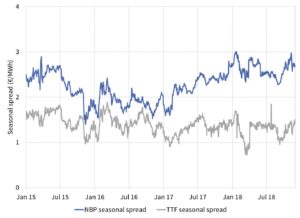
The key benchmark for the value of flexibility to shift gas between seasons is the summer/winter price spread. Chart 1 shows the evolution of the front year forward contract spread at NBP compared to TTF.

Chart 1: NBP vs TTF front year forward market seasonal price spread


Source: Timera Energy

NBP seasonal spreads have historically maintained a small premium to TTF. This is consistent with NBP tending to trade above TTF in winter to attract imports to meet higher demand and at a discount across summer as UKCS flows (in excess of UK demand) are exported to the Continent.

However, the closure announcement of the Rough storage facility in 2016 opened up a more structural divergence of NBP and TTF spreads.  Rough (at full strength) represented almost 4 bcm of working gas volume.  Given the relatively slow cycling speed of Rough, this working volume was focused on providing seasonal flexibility.

The loss of Rough has meant that this flex needs to be backfilled, primarily via Norwegian supply flex but also by drawing on flows via the IUK & BBL interconnectors.  The seasonal spread price signal to incentivise these alternative sources of flexibility is significantly higher than that required to cover the variable cycling costs of Rough.  This has driven the more structural divergence of NBP spreads above TTF.

TTF seasonal price spreads remain stubbornly stuck in a 1-2 €/MWh range, close to a soft lower bound driven by the variable cycling costs of seasonal storage. A more structural recovery of spreads at TTF is likely to depend on:

  1. Storage closures: a number of European seasonal storage assets remain cashflow negative at current spread levels. Ongoing spread weakness and expiry of long term contracts (at more favourable terms) is pushing owners towards closure.
  2. LNG import seasonality: LNG import flows into Europe have typically been higher in summer than winter, given Asian LNG demand patterns. As LNG import volumes grow, seasonality may increase.
  3. Russian flows: Russian supply contracts have traditionally been a key source of seasonal flexibility. But seasonality of Russian flows has decreased as volumes have ramped up since 2015.

The evolution of storage closures and seasonal import flow patterns into next decade will be important in driving TTF seasonal price spread levels.

Flex signal 2: Spot volatility

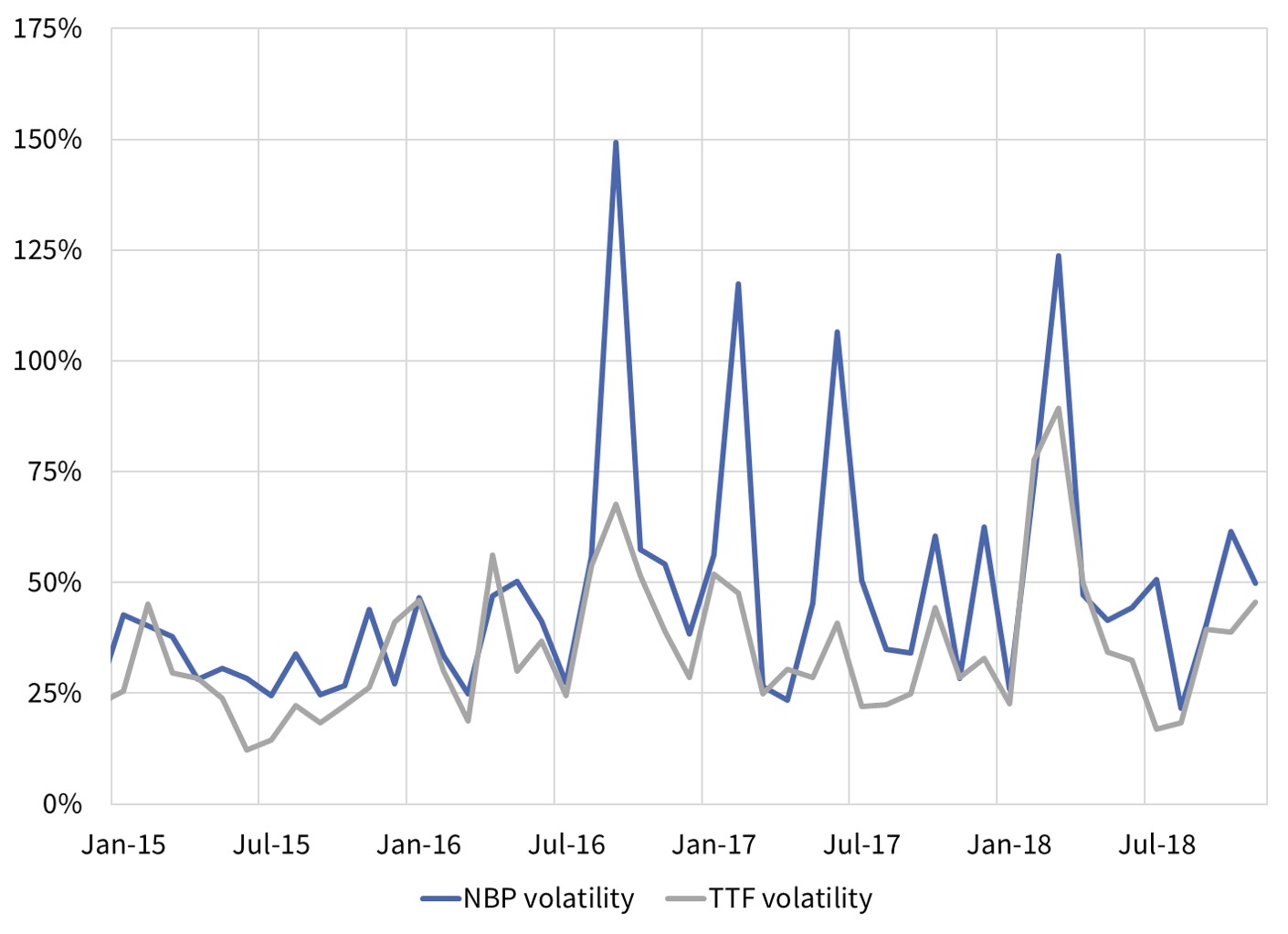
The second key signal for gas supply flexibility is spot price volatility. This drives the value of daily (or short term) deliverability of gas.  An analysis of day-ahead NBP vs TTF spot price volatility is shown in Chart 2.

Chart 2: Historical day-ahead spot price volatility at NBP vs TTF


Source: Timera Energy

A divergence between NBP and TTF spot price volatility can also be seen after the 2016 Rough closure announcement. This is consistent with the fact that Rough represented about 25% of UK daily storage deliverability.

In the Chart 2 analysis we have excluded short term price jumps (measured as daily price returns greater than 3 standard deviations from the mean).  If price jumps are added back in, then the divergence between NBP and TTF volatility is even greater.

The higher level of spot volatility at NBP (vs TTF) is driven to a large extent by larger and more frequent market stress events. It is interesting to note two types of volatility events in Chart 2:

  • Competitive stress events: Some stress events are European market wide and see the UK and NW European markets competing for available gas. Examples here are the ‘beast from the east’ shock in Q1 2018 and the French nuclear outage related stress in Win 16/17.
  • Isolated stress events: But since the closure of Rough, NBP has been more susceptible to volatility caused by UK specific constraints (e.g. see UK price jumps across 2017). These may act to transmit some volatility to TTF, but are primarily reflected in more volatile NBP prices.

Spot volatility across both NBP and TTF has risen since 2016 as the European supply flexibility balance starts to tighten.  But this increase in volatility is focused on market stress events, with NBP more susceptible than TTF and TTF-NBP basis risk set to become more of an issue than for many years. The growing influence of stress events on flexibility value is likely to continue as the European gas market becomes more import dependent in the 2020s.

Boosting midstream asset value capture

This decade has been a tough one for owners of flexible midstream gas assets such as storage, pipelines & regas terminals. Asset returns have been hit by a post financial crisis overhang of supply flexibility in the European gas market.  At the same time, market drivers are structurally altering the risk/return profile of midstream assets.

But as is often the case, commercial strength is born from adversity. Midstream asset owners are improving returns by evolving commercial models and optimising margin & costs.

A combination of sharper commercial strategies and recovering market fundamentals is set to underpin midstream value recovery into next decade.

In this article we set out:

  1. 3 structural market trends supporting European midstream asset value
  2. 3 resulting commercial trends impacting midstream asset value capture
  3. 5 ways asset owners are responding to boost value capture.

While 1. applies generally across all midstream assets, our coverage of 2. and 3. focus on flexible TPA exempt assets.

3 structural market drivers supporting midstream value

Energy markets are cyclical in nature. Several years of tough conditions and low investment tends to set up a market recovery. But in addition to cyclical factors there are three structural drivers of a recovery in the value of European gas supply flexibility across the next 5 years:

  1. Import dependency: European domestic production is in structural decline. This means the European gas market is becoming more dependent on longer import supply chains e.g. LNG imports and Russian pipeline flows from Western Siberia. Longer response times increase market price volatility and the frequency and magnitude of price shocks.
  2. Power sector swing: Gas fired power plants are set to play an increasingly important flexibility provision role over the next 5 years. Regulatory driven closures of nuclear, coal and lignite plants will increase gas plant load factors. In parallel, the requirement for flexibility is set to rise with a substantial increase in intermittent wind & solar output.  The increased ramping of gas-fired power plants depends on supply flexibility from the gas market.
  3. Ageing infrastructure: European midstream gas infrastructure is ageing. Yet investment in both maintenance and renewal capex for midstream assets has been relatively low this decade given weak market price signals.  Infrastructure outages and retirements are likely to increase as a result into next decade.

These drivers are underpinning a gradual recovery in flexibility price signals since 2016.  This recovery has been more pronounced in the UK market with the closure of Rough.  But TTF volatility has also been rising in 2018.

These structural market drivers are supporting several key commercial trends impacting midstream value capture.

3 commercial trends impacting value capture

The market drivers described above are resulting in important trends in the way TPA exempt midstream asset owners are capturing value.  These are summarised in Table 1 below.

Table 1: Commercial trends impacting midstream value capture

Trend Description
1. Value shifting to prompt
  • A rising portion of asset value is being monetised closer to delivery (e.g. within-year, within-month).
  • Structural market trends above support continuation of this trend (e.g. LNG import swings, power sector intermittency).
2. ‘Shock’ value rising
  • Increased import dependency means the European market is relying on longer supply chains (e.g. LNG, Russian pipes), with longer response times to dampen market stress.
  • Ageing infrastructure is resulting in more frequent outages.
3. LT contracts rolling off
  • Legacy long term contracts used to support midstream asset development are rolling off & can’t be replaced at the same terms.
  • There is a structural trend towards shorter term contracting in the European gas market as hub liquidity improves.


As contracts roll off, value shifts to the prompt and volatility increases, more market risk is being pushed onto midstream asset owners and investors. With that higher risk comes the potential for enhanced returns.

In other words, there is a structural transition in asset risk/return profiles that favours companies with the ability to absorb market risk and the commercial capability to manage that risk and commercially optimise asset returns.

5 ways asset owners are responding to boost value capture

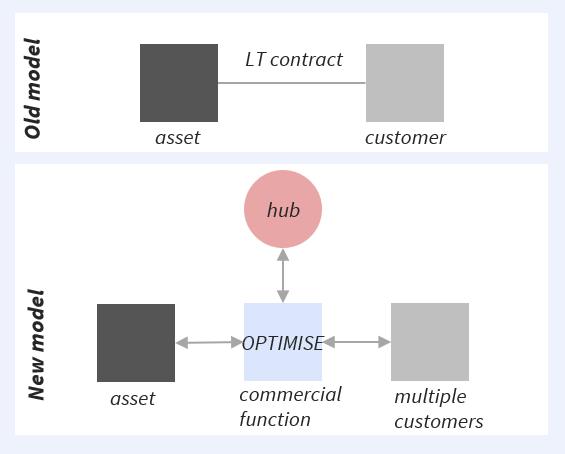
Midstream asset owners have not been idle in responding to these evolving market and commercial trends. Midstream business models are adapting to reflect the increasing importance of optimising physical asset flexibility against hub prices to provide a more targeted range of customer products and services. This business model transition is summarised in a simple schematic in Diagram 1 below.

Diagram 1: Evolution of midstream business models

Source: Timera Energy

An enhanced commercial function sits at the centre of the new midstream business model.  This often consists of only 2-4 capable commercial staff.  And it does not necessarily involve a trading function and associated overheads. There are examples of both pipeline and storage operators in Europe that retain asset flexibility into the day-ahead horizon to enhance value capture, before selling capacity to trading counterparties with direct market access.

In Table 2 we list five ways midstream asset owners are enhancing value.

Table 1: Commercial trends impacting midstream value capture

Trend Description
1. Optimise asset variable costs
  • Reducing variable cost hurdle for utilizing asset flex
  • For example: cycling costs for storage, flow costs for pipelines, throughput costs for regas
2. Optimise asset supply chain
  • Managing & bundling entry/exit capacity costs/exposure
  • Optimising asset maintenance timing & fuel gas purchases
  • Extracting additional flex e.g. linepack optimisation
3. Retain asset flex into prompt
  • Retaining asset flexibility within-year (e.g. up to day-ahead stage) to capture more value versus selling out in annual contracts
  • Indexing price of longer term contracts to retain exposure to within-year price movements
4. Use hubs to enhance asset flex & services
  • De-link financial structure of products & services from physical constraints of the underlying asset
  • For example: customer netting, low risk overselling
5. Broaden & refine product offering
  • Combine 1. to 4. to refine offering of products & services to a broader range of customers
  • For example: virtual products, graded priority, enhanced/premium products, incremental components


The actions in Table 2 can significantly enhance midstream asset margin, even in the absence of any flexibility market recovery.  But these are also powerful tool to enable asset owners to maximise their benefit of market recovery, rather than that benefit only flowing to customers.

Timera team expanding
Jessica Gervais has joined Timera as a Senior Analyst. She has 10 years commercial and analytical experience in European energy markets.  She joined Timera from Platts Analytics (formerly Eclipse) where she was Head of Modelling for European Gas & Power. Prior to this, she led the development of ArcelorMittal’s European gas trading capability, with responsibility for optimising energy sourcing across multiple hubs in Europe.  More details here.


European gas price rally hits reverse

European hub prices doubled between July 2017 and September 2018.  50% of that move happened in Q3 2018. Through the objective barometer of market price, the European gas market has tightened significantly across 2017-18.

The big rally in gas prices between the current and previous summers was fuelled by:

  1. LNG volumes being diverted to Asia to meet strong demand
  2. Big rallies in coal and carbon prices, raising gas plant switching levels in the power sector
  3. Near term constraints on ramp up of Russian import volumes.

We described these 3 key drivers of hub prices in a recent article published in October.

In Q4 there has been another interesting shift in gas market dynamics.  Gas prices have fallen back sharply from September levels and LNG is flowing back into Europe in a very different pattern to the onset of the last two winters.

In today’s article we provide a brief summary of why gas prices are falling and the current state of play heading into winter.

What is behind the Q4 price plunge?

Energy markets are rarely dull as illustrated by the evolution of global price benchmarks in Chart 1. TTF prices rose more than 25% across this summer (from around 8 to 10 $/mmbtu), only to reverse and give up those gains across October. As of late November prices look to be trying to stabilise around 8 $/mmbtu.

Chart 1: Evolution of global gas price benchmarks

Source: Timera Energy

So why this sudden price reversal? To a large extent this comes down to the same drivers behind the Q3 price rise, only acting in reverse. The following is a summary of 5 factors behind the Q4 price decline:

  1. Economy: Forward expectations of gas demand are sensitive to economic conditions. Global stock markets have fallen sharply across Oct-Nov as trade war tensions grow, interest rates continue to rise and central bank stimulus starts to roll off.
  2. Commodity prices: Consistent with 1., European gas prices have fallen in sympathy with a broad based decline in commodity prices in Q4 e.g. oil -25%, coal -15%, carbon -20%.
  3. Switching levels: Power sector switching levels have fallen with coal and carbon prices, reducing gas demand as the relative competitiveness of coal plants increases accordingly.
  4. LNG flows: LNG is flowing back into Europe after being diverted to Asia across the summer. The positive arbitrage to Asia in Q3 has reversed in Q4. Asian demand for spot cargoes has weakened as buyers look well hedged into the coming winter. And a huge jump in shipping costs (200k $/day charter rates) has increased the cost of delivering LNG to Asia.
  5. Russian flows: Gazprom has auctioned just over 1bcm of incremental gas across Q4 via the Ukraine/Slovakia import route. This has helped to increase supply into European hubs and Gazprom has now announced a halt to further auctions in Q4.

The first two of these drivers illustrate the impact of global macro drivers on the European gas market.

The last three represent the practical mechanisms via which these macro drivers act on supply and demand balance and hub prices.  Q4 price dynamics are a great case study of the 3 key hub price drivers we set out in our October article.

Shock suspension of UK Capacity Market

Last Thursday the UK government abruptly halted the Capacity Market to comply with a European Court of Justice (ECJ) ruling.  The implications of this are an immediate stop to capacity payments under existing agreements and the cancelling of auctions in 2019.

The government’s announcement was the equivalent of an immediate and indefinite zero capacity price outcome for all CM participants. It is an understatement to say it was a surprise of the first order.

You can read elsewhere about the details of the ECJ ruling, but in today’s article we set out some initial thoughts on the potential market implications of CM suspension.

Impact of suspending payments on existing capacity providers

Halting capacity payments has an immediate margin & cashflow impact on all holders of 2018-19 capacity agreements. This includes owners of coal plants, CCGTs, engines, nuclear plants & DSR capacity.

Most of the capacity across the current delivery period is under T-4 agreements (from the first auction in 2014). A 20.8 £/kW price applies for these agreements (the 19.4 £/kW clearing price adjusted for inflation).

While a single T-4 clearing price applies, the impact of suspension of payments varies significantly by asset.  There are four main factors that drive this:

  • Derating factor
  • Portion of asset margin driven by CM
  • Extent of leverage (i.e. project/owner debt structure)
  • Length of contract (i.e. 1 year vs 15 year)

The asset owners that are most exposed are those that rely on CM payments to:

  1. Cover fixed costs in order to remain cashflow positive
  2. Meet debt repayments.

Older & less efficient CCGTs and coal plants are most vulnerable in the first category. Leveraged engine & DSR projects are vulnerable in the second category.

This is where uncertainty around the extent of CM payment suspension is very important.  A temporary halt of a couple of months before payments are reinstated may be painful but is unlikely to precipitate major closures or defaults.  The costs of operating capacity are largely sunk over this time horizon.

However, a prolonged or indefinite suspension of payments will have real implications for more vulnerable capacity owners relatively quickly. This may mean mothballing, accelerated closures and defaults.

For that reason, expect a sharp and strong lobbying response from affected owners.  The interests of utilities, IPPs, flex developers and aggregators in pressuring the government to reinstate payments appear to be strongly aligned.  The main hurdle to achieving this seems to be one of legal process rather than overcoming structural conflicts within the industry.

Impact on security of supply & policy

The government has tried to allay fears that CM suspension threatens security of supply this winter.  That may be right in the sense that existing capacity is likely to remain operational between now and next March.

But beyond this narrow interpretation there can be little doubt that CM suspension represents a major threat to security of supply.  The Capacity Market has been the cornerstone of the government’s policy platform to ensure enough flexible capacity is operational to keep the lights on.

Again, the interests of the government, consumers and a significant majority of market participants appear to be aligned in ensuring the CM does not suddenly disappear.  The alternative stop gap solution is for the government to get Grid (as system operator) to ‘do all it takes to ensure security of supply’.  The flawed SBR mechanism is reminder of why that is likely to be a bad outcome.

What the ECJ ruling may precipitate is an acceleration of the government’s review of the CM.  For example, a significant broadening of the CM to include other types of generation (e.g. renewables) was already under discussion. But complex reforms of this nature are not well suited to ‘gun to the head’ haste.  An interim solution is required to stem the bleeding and buy some time for well-considered reform.

Impact on investors

The key immediate impact of CM suspension on investors, is the cancellation of the 2019 T-4 and T-1 auctions.  The government has indicated it may hold a T-3 auction for the 2022-23 capacity year instead.

This imposes a direct cost on investors relating to the carrying cost of capacity projects intended for the 2019 auctions.  But perhaps more importantly, the uncertainty associated with CM suspension is likely to have a greater intangible impact on investor confidence.  The cost of that uncertainty is passed on to UK consumers via higher cost of capital to deliver required capacity.

Investor patience has already been tested by Brexit, the price cap, embedded benefit reforms and the charging review. The CM has been a source of relative stability over the last 4 years… until last week.

Uncertainty may result in more marginal investment projects being delayed, shelved or canned. It may also speed up the process of consolidation & aggregation of development projects that is already underway.  And that may extend to the fire sale or closure of vulnerable existing assets, particularly those that become cashflow negative or cannot meet debt payments.

Uncertainty is likely to remain, at least for the next few weeks given the parallel issues with Brexit negotiations. But the path through that uncertainty is likely to favour a level-headed approach to the structured assessment of risks, including stress testing asset cashflows to quantify the impact of potential outcomes.