
Challenging three battery investment ‘myths’

‘Battery storage flexibility is a key building block of a decarbonised power sector.’

This statement is not a myth.  In fact it is almost a truism.

Intermittent renewables will dominate electricity supply in a decarbonised world. Wind and solar output require a low carbon source of flexible backup.  Rapidly declining battery costs will facilitate broad deployment. Sound familiar?

While there is a broad consensus around the vision for batteries, the practical details of the business model and investment case for individual battery projects is less clear.  In today’s article we challenge three ‘myths’ currently circulating in relation to battery investment.

‘Myth’ 1: Batteries shift load to smooth renewable output

While in theory batteries can be paired with renewables to smooth intermittent output, this does not represent a viable business model to support battery investment. There are three main reasons for this:

  • Duration: Investment is currently focused on 0.5-2.0 hour lithium-ion batteries, which are seeing the steepest & fastest cell cost declines. The short duration of these batteries significantly limits the volumes of energy that can be moved between time periods.
  • Degradation: A focus on shifting load requires deep cycling. This shortens the life of lithium-ion batteries and accelerates the costs of cell replacement, undermining project economics.
  • Returns: Cycling batteries to shift load is not commercially optimal. The returns from load shifting (e.g. full cycle to capture cheapest offpeak hour vs highest price peak hour) are well below those required to support investment.

Maximising battery returns involves the complex optimisation of battery optionality against multiple markets including wholesale (e.g. day-ahead and within-day prices), balancing markets and network services.

The logic above does not preclude successful co-location of batteries with solar or wind projects.  But the benefits of doing this are focused on cost reductions (e.g. shared infrastructure & connection) and portfolio risk diversification, not on load shifting.

Battery flexibility will also play a key role in dampening price fluctuations which are driven by intermittent renewable output.  But with shorter duration batteries this is via multiple shallow cycles to respond to short term price volatility rather than deep cycling in order to shift load.

A viable investment case for longer duration, deeper cycling storage solutions (e.g. flow batteries) looks to be at least five years away.

‘Myth’ 2: Battery investment is being underpinned by network services

The UK and Germany are leading European investment in batteries. Early projects in both markets have been supported by network services contracts (e.g. the UK EFR contracts tendered in 2016 for very rapid frequency response services).  But battery investment cases being developed today have turned to focus on merchant returns.

Revenue opportunities from network services remain. This includes both grid services for transmission connected projects (e.g. frequency response, reactive power) as well as local/site revenues for embedded batteries. But the value of these services has been declining and contract horizons shortening as competition to provide flexibility increases. For example, prices for frequency response services in both the UK and Germany have fallen significantly over the last three years.

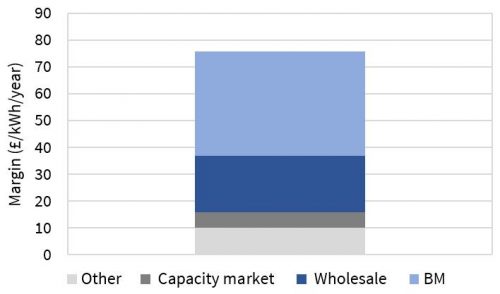
As a result, battery investment cases are being built on a ‘margin stacking’ model.  This includes a base of more stable returns e.g. capacity payments, ancillary services & local site revenue.  But merchant returns from wholesale and balancing markets are key to bridge the gap required to sign off a bankable project. An example of a margin stacking model in a UK battery project is shown in Chart 1.

Chart 1: Illustrative stacked margins required to support a transmission connected UK battery

Source: Timera Energy

The chart shows projected annual average required returns by margin category to support investment in a transmission connected battery (measured in £/kW of capacity installed for a generic 1hr duration battery).  The ‘Other’ category varies by project/site location but covers revenues from e.g. network services & positive transmission charges.

The highest returns on battery flexibility are achieved via ‘real time’ balancing markets e.g. in the UK the Balancing Mechanism and in Germany the primary reserve market.  This is for the simple reason that price volatility is highest in these markets. Wholesale market and balancing returns typically make up more than 70% of required grid connected battery margin.

This focus on merchant returns leaves battery developers and investors with the key challenge of how to monetise battery flexibility value.

‘Myth 3’: Battery projects are bankable already

If you take current battery returns (e.g. in the UK or Germany) and map them onto current capital costs, it is very difficult to build a viable investment case.  But investors are looking forward not down and there is a frenzy of activity in the battery space in 2019 in anticipation of an approaching tipping point.

This is supported by three strong tailwinds for battery economics:

  1. Declining capex costs: Battery cell costs are falling ~20% year on year and are projected to half again over the next 5 years. Cells typically represent about 50% of total project capex.
  2. Rising merchant returns: The last two years have seen weaker returns on flexibility (e.g. given capacity overhangs & warmer weather). But increasing intermittency and steepening supply stacks are key structural drivers supporting higher price shape & volatility into the 2020s, supporting rising battery margins.
  3. Policy changes: Policy makers, regulators and system operators are aware of the system benefits of batteries and are taking supportive action (e.g. via targeting removal of double charging for embedded batteries and sharpening balancing price signals).

There is no doubt that these tail winds will support the roll out of batteries at a substantial scale into the 2020s.  The transformative nature of battery flexibility is no myth.

The challenge today is anticipating how the three factors above will combine to underpin the battery investment case and developing a viable business model to support this.

Power sector setting gas prices in Europe

Two European gas market records were broken in March. Both LNG and Russian monthly import volumes surged to their highest levels in history. This has meant that gas is being pushed into the European market at an unprecedented rate.

Prices have responded accordingly.  As we set out last week, the US LNG shut in price range is now sitting just below current TTF price levels.  This should represent major price support.

In the meantime, the power sector is driving European gas prices. In today’s article we explore gas for coal switching dynamics and the key power markets that are providing incremental gas demand.

Record high supply volumes

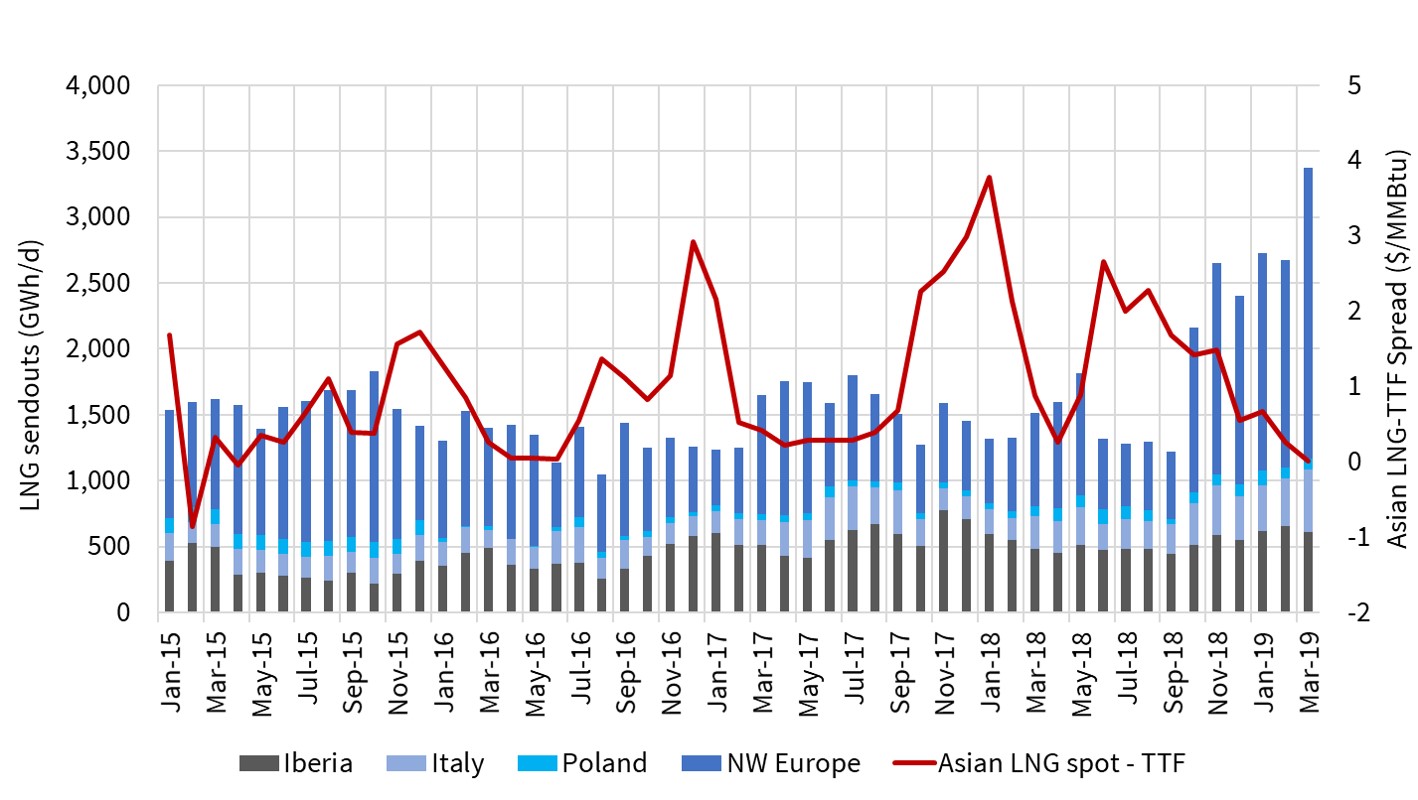
We start by looking at a pair of charts that provide some context for the record LNG & Russian import volumes in Mar-19.  Chart 1 shows average daily send out from European regas terminals. The last six months clearly illustrate the role of liquid NW European hubs as a sink for surplus LNG cargoes.

Chart 1: Monthly European LNG sendout vs Asian LNG-TTF spread


Source: Timera Energy

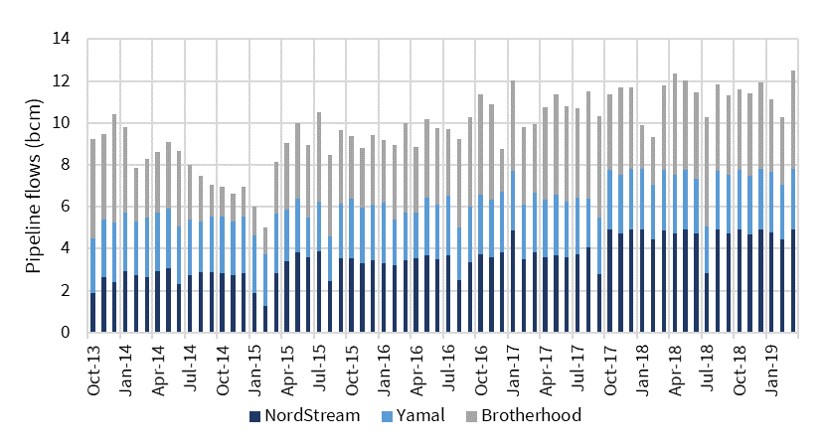
Gazprom has not flinched in the face of record LNG import volumes as shown in Chart 2.  Its favoured Nordstream (Baltic) and Yamal (Belarus) import routes have been flowing at max capacity across most of the last 18 months. But in Mar-19 flows via the Ukraine/Slovakian route also ramped up to near maximum capacity.

Chart 2: Russian gas deliveries via 3 main routes


Source: Timera Energy

It may be that Russia sees a strategic silver lining in temporarily lower gas prices, if this delays a growing queue of new LNG projects targeting FID in 2019-20.  Some temporary price pain now may reduce the competitive threat from new LNG supply in the early to mid 2020s.

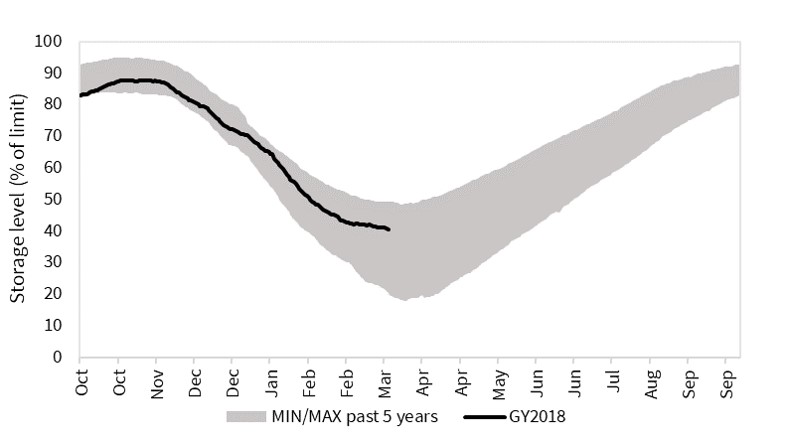
The other factor currently weighing on summer gas prices is unusually high European storage inventories (~20% higher than last year) shown in Chart 3.  This means storage injection will not play its usual role in supporting summer gas demand.

Chart 3: Pan-European storage inventory vs historical range.


Source: Timera Energy

The switching rubber band effect

It is clear from the three charts above that the supply side of the European gas market is not currently very responsive to price levels.  That shifts the focus to the power sector as the price responsive component of gas demand.

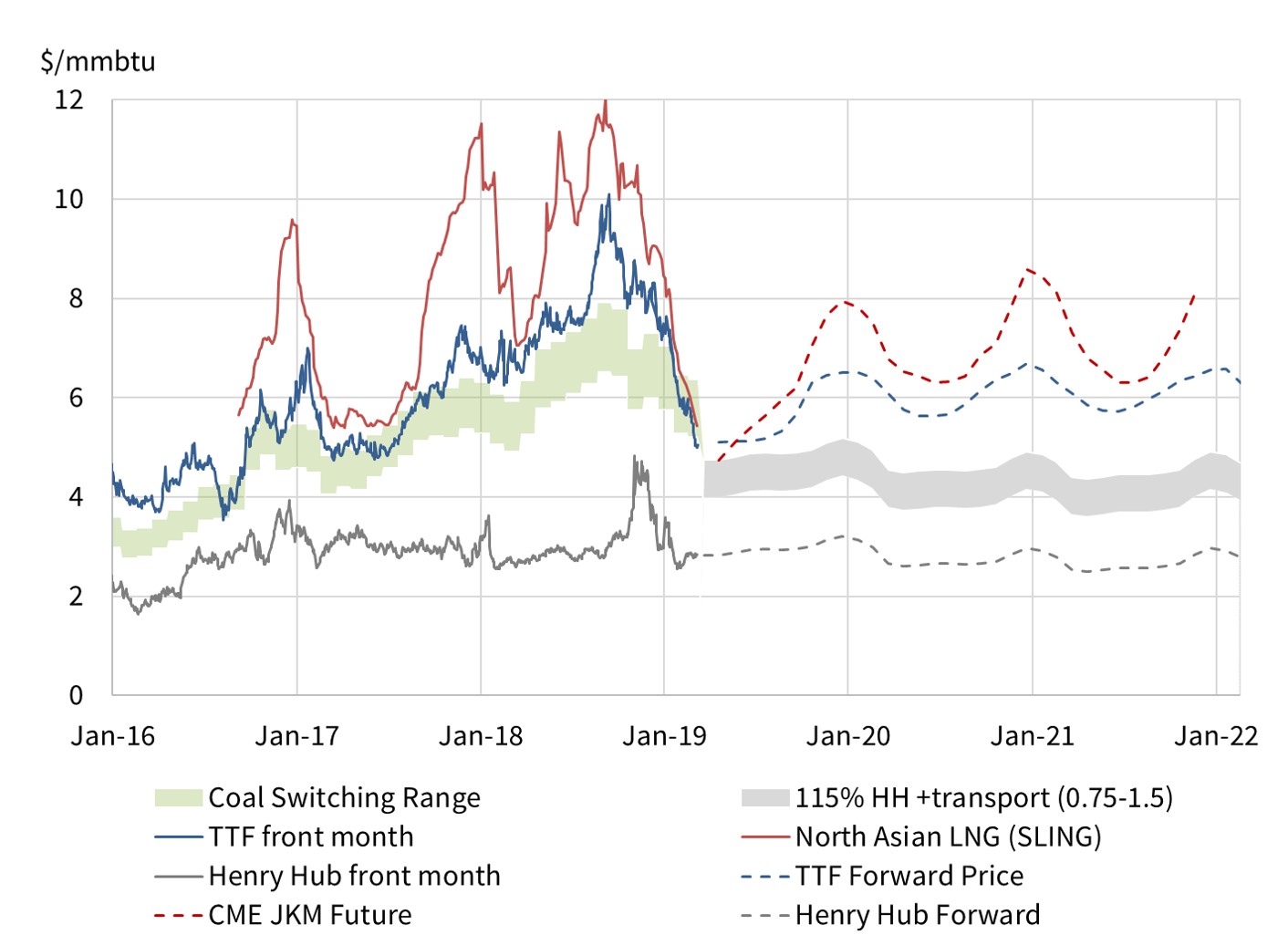
Liquid price signals for gas, coal and carbon mean that gas for coal plant switching in European power markets is a dynamic response mechanism to lower gas prices. This can be seen in Chart 4 which shows the strong relationship between TTF spot prices (blue line) and the gas for power switching price range (shaded in green).

Chart 4: TTF price evolution vs European switching range


Source: Timera Energy

Switching is often referred to as a dynamic that happens at a given price level.  But in reality the competitive dynamics of gas vs coal plant vary by market, with plant efficiencies and with other differences in variable costs (e.g. coal transportation costs).

The top end of the green range on Chart 4 represents the gas price level at which more efficient CCGTs (52% HHV efficiency) start to displace less efficient coal (40% efficiency).  The bottom end of the range is based on the TTF price at which less efficient CCGTs are displacing more efficient coal plants. The switching range moves dynamically with coal and carbon prices (the drivers of coal plant variable cost).

The chart shows that historically switching has provided strong support for TTF prices which tend to bounce off the top end of the range.  In times of temporary surplus, TTF prices can push down into the switching range, but this is a bit like pushing on a taught rubber band i.e. the resulting incremental gas demand tends to push prices back up again.

At the end of Mar-19, TTF prices broke through the bottom of the switching range.  This is a rare occurrence and it illustrates the extent of surplus gas at hubs last month.

This does not mean that switching potential in European power markets was exhausted.  The switching range is only a benchmark guide overlaid on a more complex interaction between hundreds of gas & coal plants across Europe.  To understand what is going on behind this benchmark we need to look at a breakdown of Europe’s key power markets.

Understanding Europe’s switching potential

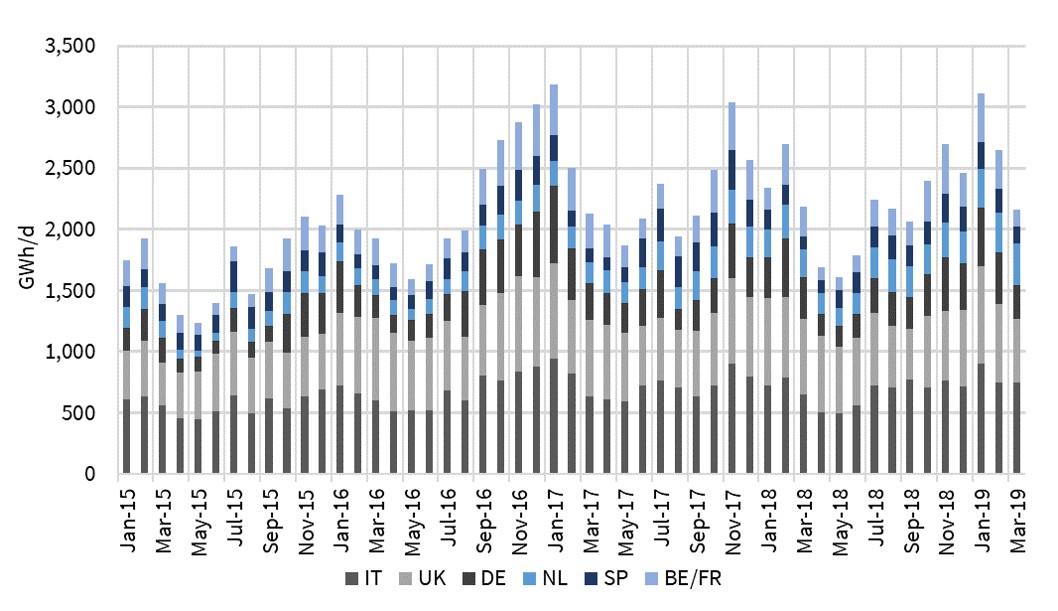
Chart 5 shows monthly gas demand across the key European switching markets (UK, Italy, Germany, Netherlands, Belgium, France and Spain).

Chart 5: Gas demand from power sector in NW Europe, Spain and Italy


Source: Timera Energy

Power sector gas demand was high across the first part of last winter, particularly in January where it reached levels not seen since the major French nuclear outages of two years ago. This high demand was partly the result of switching, but also reflected some cold weather in Q4.

March is however a different story.  Warmer weather and high wind output saw a significant reduction in output from gas-fired power plants.  This illustrates the seasonal pattern of power sector gas demand.  Demand falls as summer approaches, meaning that gas prices need to push further into the switching range to induce a similar volume of gas demand response versus mid winter.

The UK power market sits at the bottom of the switching merit order given an 18 £/t carbon price floor which disadvantages coal relative to gas. The largest block of switching potential sits across the NW European Continental markets.  This covers Germany / Netherlands (very well interconnected and with high volumes of coal & CCGTs) and to a lesser extent France & Belgium.  In southern Europe Italy is important given a high volume of CCGT capacity as is Spain (although gas burn can be strongly linked to hydro conditions).

Switching & US shut ins working against further declines

In an article last year we set out our estimate of 20-30 bcm of potential incremental European gas demand from power sector switching.  The exact volume is strongly dependent on the relative price levels of gas, coal and carbon. This power sector response mechanism represents a big ‘rubber band’ acting to support TTF prices around switching range price levels.

The two most likely sources of further downward pressure on TTF come from (i) a continuation of high LNG & Russian import volumes into summer and (ii) further declines in coal & carbon pulling down switching levels.

But there is a second and larger rubber band looming below in the form of US LNG export shut ins.  As we set out last week, 2019 US shut in volume potential is 55 bcm (40 mtpa).

Support for gas prices may have been thin across the 50% decline of the last 6 months.  But there is some major support between 4-5 $/mmbtu.  Don’t be surprised if European & Asian gas markets start to stabilise from here.

Gas prices plunge towards US LNG shut in levels

Off-piste descent for gas prices

TTF prices fell by more than 50% across Winter 2018-19.  No… that is not an April Fool’s joke.  The decline in European and Asian gas prices across the last six months has been steep and relentless.

The price decline gathered pace in Q1 2019 as shown in Chart 1.  As the quarter progressed, Asian spot LNG prices converged with European hub prices. Then in late March, the key North Asian LNG price marker JKM crashed through the TTF price level.

If the Q1 2019 price decline were a ski slope it would be marked with double black diamonds.

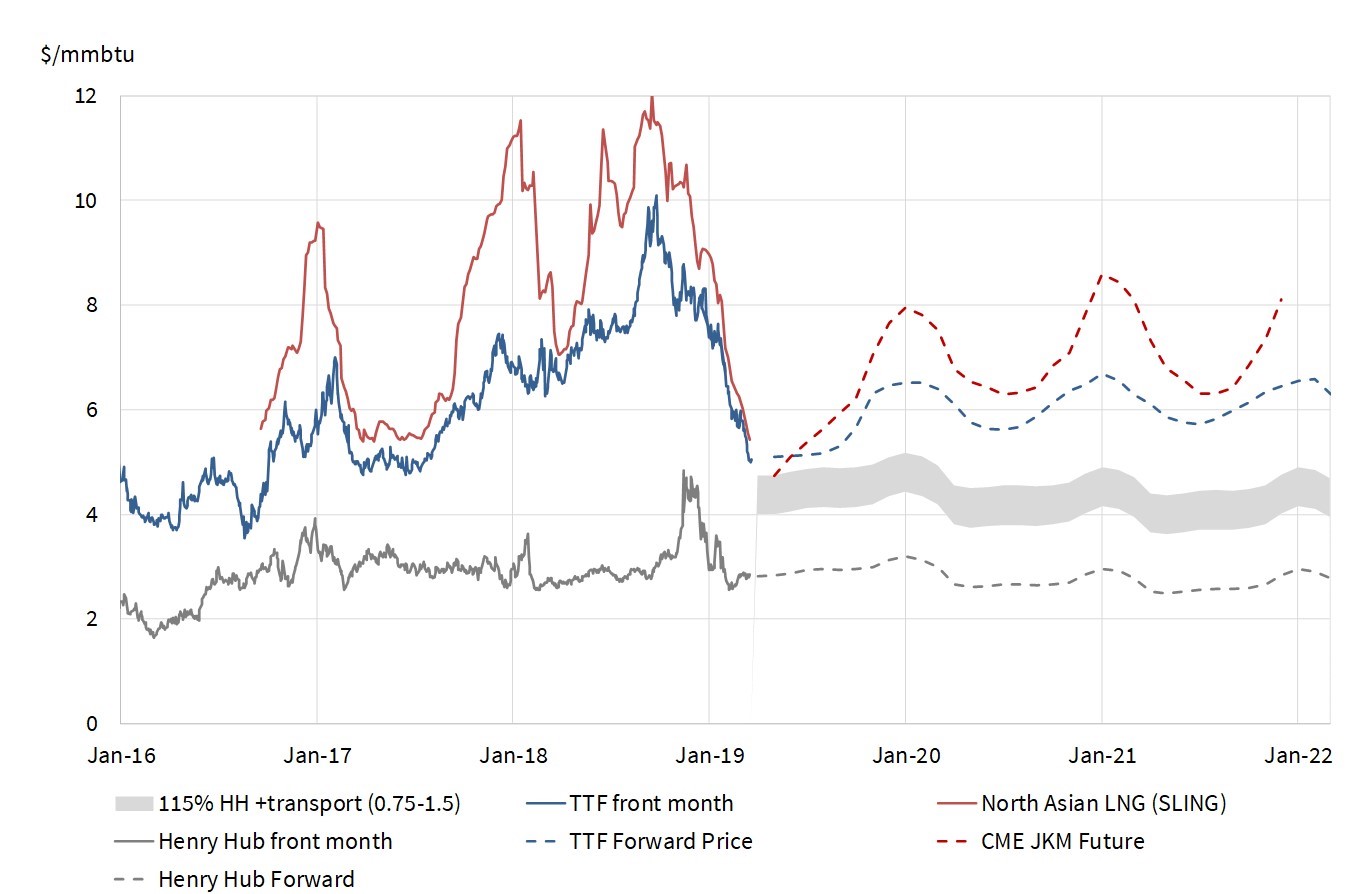
Chart 1: Global gas price regional benchmarks (historic spot & current forwards)

Source: Timera Energy

Price behaviour is consistent with an acute near term surplus of LNG into the start of summer. The growth in new LNG supply (e.g. from projects in Australia, Russia and the US) is at least temporarily outpacing demand growth.

The LNG market is clearing surplus cargoes via sending them to liquid north west European hubs. The discount of JKM to TTF reflects this dynamic, although liquidity in spot cargoes has been limited across recent weeks.  At current prices it makes no sense to send US LNG to Asia.As a result of these dynamics, LNG delivery volumes into Europe surged in Mar-19 to their highest level in history.

This coincided with a second European gas market record. Russian import volumes in Mar -19 were also the highest in history. Gazprom has shown no inclination to ease back on supply as prices have fallen.

As well as very strong import volumes, European gas demand has been relatively weak.  Q1-19 has been unseasonably warm.  Coal prices have also been falling, reducing the gas price switching levels at which incremental power sector gas demand kicks in.  And European industrial and manufacturing data across Q1-19 has been very weak (particularly in Germany & France).

At what price levels will US export supply be shut in?

The Q1-19 TTF price decline brings US LNG export ‘shut in’ levels sharply back into focus. Chart 1 shows our estimated TTF shut in price range for US export flows (the grey shaded band). This represents the range where TTF prices no longer cover variable liquefaction, shipping and regas costs for delivery into Europe (i.e. where Gulf Coast LNG netback prices become negative).

LNG vessel spot charter rates have fallen 80% since Q4 2018 and are currently around $40k/day (down from above $200k/day).  This has pulled down US LNG shut in price levels relative to 2018. We calculate the US export shut in price range based on:

  1. Feedgas & variable liquefaction costs – benchmarked at 115% of the Henry Hub price
  2. Shipping costs – ranging from 0.65 to 1.20 $/mmbtu depending on factors such as use of boiloff gas and treatment of single vs return voyage costs
  3. Regas costs – ranging from 0.1 to 0.3 $/mmbtu depending on sunk cost access dynamics.

These numbers gives a current US shut in range of 4.0 – 4.8 $/mmbtu.  TTF front month prices last week were touching the top of that range at 4.8 $/mmbtu.  By the bottom of the range we should start to see significant price support given the potential shut in of a portion of the 42 mtpa of expected US export volumes.

In the meantime, pricing dynamics at European hubs are firmly focused on gas for coal switching in the power sector.  It is this key mechanism that we return to explore in more detail next week.

The changing role of UK’s gas interconnectors


2019 is going to be an important year of transition for the two key interconnectors that link the UK with Continental gas markets.

The IUK pipe between UK and Belgium is entering its first year without long term contracts. The Q4 2018 introduction of shorter term capacity products is already structurally changing flow patterns and capacity booking.

2019 will also see important changes for IUK’s main competitor, the BBL pipe between UK and the Netherlands.  Following on from the merging of BBL with the TTF price zone last year, BBL will commission a reverse flow capability in 2019, increasing the UK’s gas export capacity.

In today’s article we look at the evolution of recent flow patterns and capacity bookings on these interconnectors.  We also consider the impact of these changes on market pricing.

A tale of two pipes

A brief summary of the two interconnectors that link the UK gas market with Continental Europe is provided below.

IUK (UK – Belgium)

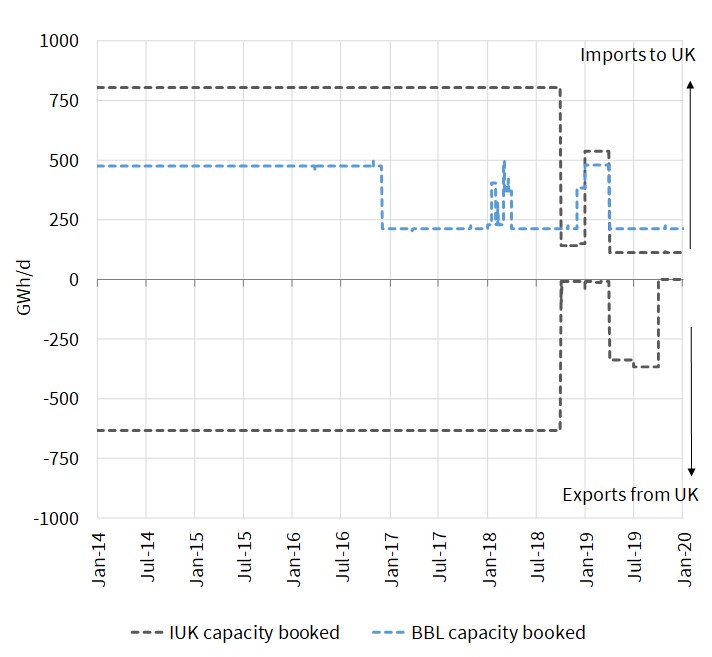
IUK has the capability for physical flow in both directions, linking the NBP and Zeebrugge hubs. IUK was commissioned in 1998, with financing supported by 20 year long term (LT) contracts.  These contracts expired at the beginning of Oct 2018.  A significant drop in booked capacity volumes has followed as can be seen in Chart 1.

BBL (UK – Netherlands)

BBL currently supports one way flow from (NL to UK), but with a reverse flow capability due to come online this summer.  BBL was commissioned in 2009, partially underpinned by a 7 year Centrica – Gas Terra contract which expired in Dec 2016.  Again, the impact of the expiry of this contract on capacity bookings can be seen in Chart 1.

Chart 1: IUK and BBL capacity bookings


Source: Timera Energy

Changing tariff structures & competition

The expiry of IUK’s LT contracts has significant implications for flows and capacity bookings on the pipe.  Up until Oct 2018, capacity was fully booked under LT contracts, with shippers treating capacity costs as sunk.  This meant relatively low variable costs to flow gas and in turn relatively high IUK utilisation.

But now the LT contracts have expired, IUK is selling capacity products on a more dynamic shorter term basis (e.g. via annual, quarterly, monthly & daily products). Before purchasing capacity, shippers are now weighing the cost of acquiring capacity (i.e. product tariffs) against the market price signals that drive capacity value.

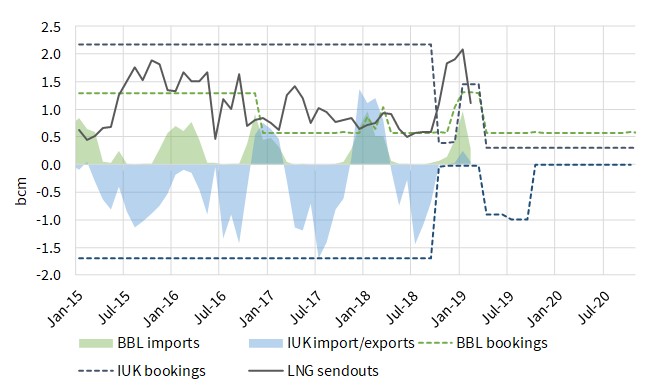
This expiry of LT contracts and new tariff structure has led to a significant decline in both capacity bookings and utilisation since Oct 2018 as shown in Chart 2.  Gas imports across IUK so far this winter are 12 times lower than for last winter (20 GWh/d average so far in Win 18-19 vs 242 GWh/d Win 17-18), as shown in Chart 2.

This winter’s decline in IUK import volumes has been impacted by the new cost structure of capacity.  But it is also the result of higher UK LNG delivery volumes and milder weather reducing the UK’s import requirements.

Chart 2: Daily IUK and BBL flows vs capacity bookings


Source: Timera Energy

In addition, IUK is facing competitive pressure from BBL.  The recent merging of BBL and TTF (via removal of the Julianadorp interconnection point between TTF and IUK) reduces flow costs from TTF to NBP.  Chart 2 shows BBL dominating import flows across the current winter.

From this summer, IUK will also face competition on export flows with the introduction of reverse flow on BBL.

Summer 2019 dynamics

Capacity bookings on IUK this summer are currently lower than peak utilisation levels across the last three summers.  But this is not all down to changes in the tariff structure.  There is a heavy summer maintenance schedule for Norwegian production fields and UK terminals in Q3 2019 which should reduce the UK’s requirement to export gas over the summer.

The giant Norwegian Troll and Ormen Lange fields will be shut down for longer than usual maintenance periods across the summer.  There is also significant UK gas terminal maintenance scheduled (e.g. Segal, Easington).  The resulting flow reduction to the UK should be felt mostly in Q3 2019 (Aug/Sep), while there may be flow upside in Q2 2019 with flow rediverted from the continent to the UK.

Lower anticipated export volumes this summer are also consistent with market price spreads. NBP is currently at a relatively small discount to TTF in Q2 2019 compared to recent summers (-1.1 p/th). The spread actually reverses in Q3 2019, with NBP currently at a small premium to TTF.

What impact will interconnector changes have on market prices going forward? 

The NBP – TTF price spread is the key benchmark for price differences between the UK and Continental Europe.  Price spread levels are driven by the marginal cost of flowing gas between markets.

The flexibility to flow gas between NBP and TTF is focused on three key sources.  The most dominant of these sources is the extensive pipeline & upstream network of the Norwegian Continental Shelf (NCS).  This allows Equinor the flexibility to flow gas to the UK or multiple entry points on the Continent (although in practice this flexibility is focused on Emden & Dornum).

The NCS is typically the lowest marginal cost source of flexibility to arbitrage price differences between NBP and TTF.  In other words, the NCS sits at the bottom of the ‘flexibility merit order’.

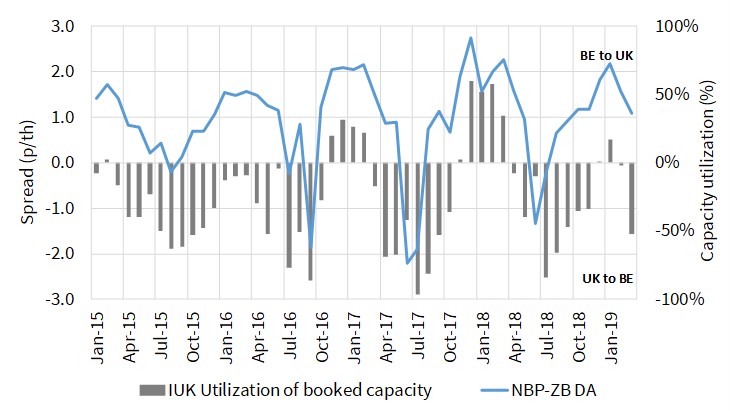
But additional flexibility is often required to flow gas across the Channel. This means NCS flexibility is often supplemented by IUK and BBL flows, with the marginal cost of flowing gas across these interconnectors being an important driver of UK vs Continental price spread levels. Chart 3 shows the strong relationship between IUK booked capacity utilisation and the NBP-ZB price spread.

Chart 3: Monthly average IUK utilisation vs NBP-ZB price spread


Source: Timera Energy

The level of price spreads has a strong relationship to shipper’s variable transit costs.  This is why the expiry of a large volume of LT contracts at IUK is important.

Historically IUK shippers have treated the cost of capacity as sunk (given LT contracts). But with the transition to short term booking of capacity, shippers are including the cost of capacity in their flow decisions. In other words, price spreads are rising to reflect the full costs of transit, both capacity tariff and variable transit charge.

The change in IUK tariff structure (from LT contracts to shorter term products) has pushed IUK towards the top of the flexibility merit order.  It remains a key piece of UK gas supply infrastructure, but has effectively become a ‘peaking’ provider of flexibility, given the associated increase in marginal flow costs.

The influence of IUK marginal costs on price spreads is set to be focused on periods of peak winter import demand, or periods of higher summer export surplus.  During these periods, the pass through of higher IUK marginal costs is likely to translate into higher price spread volatility.

An increase in NBP-TTF price spread volatility is good news for the owners of interconnector capacity (given it increases value).  But it is important to note that this value increase only accrues to the existing owners of capacity, not the marginal buyer whose pass through of costs is driving up the price spread.

2019 should be an interesting year to watch in order to better understand the changing role of interconnectors in driving price spreads between Europe’s two key hubs.

A new wave of LNG supply is building

European and Asian spot gas prices have halved across the last six months. European hub prices are currently testing the 5.0 $/mmbtu level, down from almost 10 $/mmbtu in late September 2018.  The key JKM Asian price marker has converged towards TTF price support and is currently around 5.5 $/mmbtu.  

This plunge in prices across the current winter, has the LNG market firmly focused on the near-term supply & demand balance. Debate is raging as to whether the current wave of new LNG supply (2016-21) is starting to outstrip demand growth.

In today’s article however, we are going to take a step back, look beyond the near term market balance and consider the potential timing and volume of a new wave of supply in the mid 2020s.

We have flagged several times that lower near term prices may increase the risk of a tightening LNG market in the early to mid 2020s. This is because there has been a relative hiatus of liquefaction project FIDs across the last three years. New projects take 4 to 5 years to deliver.  That leaves a potential supply gap in the 2022-25 horizon if global demand growth remains strong.

But from the middle of next decade a new wave of supply is starting to take shape.  34 mtpa of new projects have now been FID’d across the last 12 months. And there is a much larger volume of credible supply options queueing behind this.  We explore today what this next wave could look like.

Is this time ‘really different’?

The LNG sector is noted for its cyclicality of investment.  Past LNG supply waves have been built on buyer’s anticipation of demand 4 to 5 years into the future.  This has underpinned buyer willingness to sign long term contracts (mainly on an oil indexed or Henry Hub plus costs basis). Offtake contracts have then allowed project developers to secure non-recourse financing.

This time it is at least somewhat different:

  • Asian buyers such as Japan, South Korea and Taiwan are uncertain of their future LNG requirements given risks around changing energy mix policies and in the case of Japan nuclear re-starts.
  • India’s LNG requirements are difficult to gauge given the price sensitivity of its power generation and fertiliser sectors and the lack of a significant space-heating sector to underpin infrastructure extension.
  • For Thailand, Pakistan and Bangladesh the uncertainty of indigenous production decline rates makes future LNG requirements difficult to judge.

For these reasons, China remains the key market where long term contracts for end use consumption appear most likely. 

Enter the Portfolio Players

We have previously flagged that the next wave of new LNG supply will likely be dominated by gas majors (e.g. Shell, Exxon, Qatar & BP). Large trading functions and access to balance sheet financing give them a comparative advantage over independents who rely to a greater extent on non-recourse finance (and hence long term contracts).

This has been borne out across the last 6 months by the Shell Canada, BP Tortue and Exxon Golden Pass FID’s. Portfolio players have also facilitated the financing of LNG projects by signing up for the entire offtake of third party LNG projects (BP and the Mozambique Coral project and US Freeport train 2).  The portfolio player ‘direct upstream financing’ and ‘large offtake agreement’ model is supporting new LNG upstream FIDs in a period of uncertain Asian LNG demand growth.

There is still space for some ‘traditional model’ projects, where buyers underwrite supply with long term contracts. But the timing and volumes of supply in the next wave will be driven to a greater extent by the gas major’s assessment of supply and demand balance from the mid 2020s.  If the majors think the market will hold new supply then they will pull the FID trigger.

What could the next wave look like?

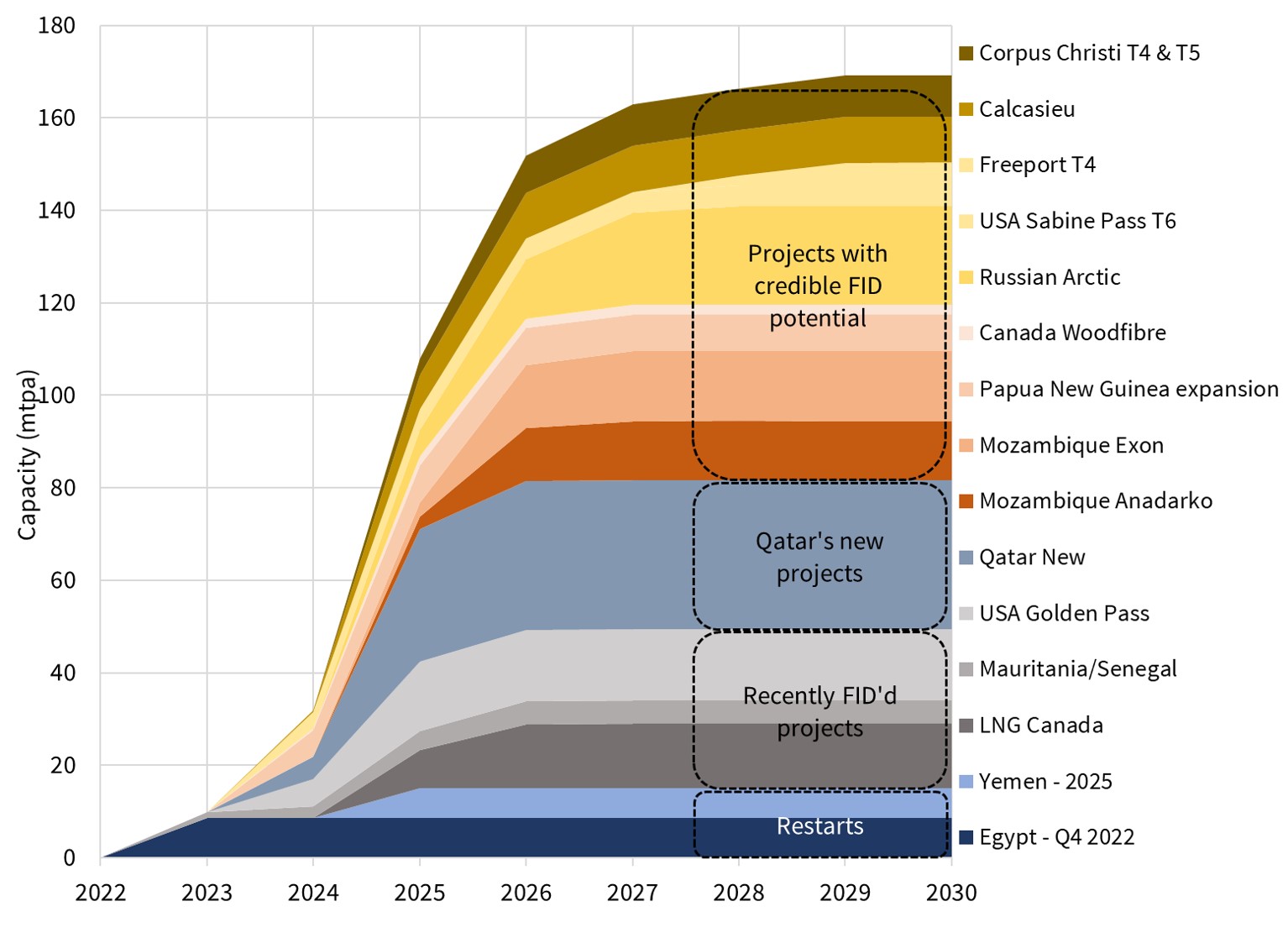
Chart 1 illustrates a build-up of credible sources of new supply that could contribute to the next wave.  These are split between:

  1. Restarts of existing liquefaction (Egypt, Yemen)
  2. Recently FID’d projects
  3. Qatar’s new trains – not yet formally FID’d but compelling economics
  4. Additional projects with credible FID potential

It is important to note that the chart does not represent a projection of anticipated volume ramp up timing.  This is something that will start to become clearer as FIDs are taken and construction commences.  The chart is instead illustrating when new project volumes could credibly come online given existing and potential FID dates.

Chart 1: Next wave of LNG supply taking shape


Source: Timera Energy

Restarts

Egypt currently has significant idle LNG export capacity. But its net export position could recover by up to 9mtpa in the early 2020s.  This is driven by new offshore gas fields coming onstream and the possibility of gas being piped in from gas discoveries and developments offshore Cyprus and Israel.

The re-start of supply from Yemen is dependent on the cessation of civil conflict, but 7 mtpa capacity could be back onstream by 2025.

Recent FID’s

New liquefaction project FIDs have been relatively scarce in recent years (e.g. in 2017 the Mozambique Coral Floating LNG scheme was the only FID).  May 2018 saw the FID on Corpus Christi Train3, but the last six months have seen a surge in activity with (i) BP’s Mauritania/Senegal Tortue (ii) Shell’s LNG Canada Project and (iii) the Exxon/Qatar US Golden Pass project reaching FID.  These three projects in aggregate represent 34 mtpa of capacity.

Qatar

Qatar suspended its rolling Moratorium on the North field development in 2017. The Qataris then announced four new LNG trains (total capacity 32 mtpa) which are widely expected to result in FIDs in 2019 and 2020. We have broken out Qatari gas into a separate category from other potential FIDs, given the economics, buoyed by significant co-production of condensate and NGLs,  are so compelling. In other words the development of new trains is a question of when not if.

Credible potential FIDs

There is also an additional 86 mtpa of credible liquefaction projects that could potentially reach FID over the next 1-2 years.

  • In Mozambique the Anadarko-led project (12.7 mtpa), having recently signed its 5th SPA (with Pertamina) brings its long term contract coverage to 74% of capacity.  An FID is anticipated in 1H2019.
  • The Exxon-led Rovuma project in Mozambique (15.1 mtpa) is also reported to be advanced in securing offtake agreements and is also expected to take FID in 2019.
  • Canada’s Woodfibre project FID (2.1 mtpa) may also FID in 2019.
  • In Papua New Guinea Exxon/Total’s expansion project (7.9 mtpa) is also at an advanced stage and should take FID in 2019.
  • Novatek’s success in executing the Yamal LNG project has given them the confidence and momentum to move to the Arctic LNG project for which pre-FID engineering is progressing.  This 19.7 mtpa project is expected to take FID in 2019.
  • In the USA, credible FID’s in 2019 or 2020 include Sabine Pass train 6, Calcasieu (2 trains), Corpus Christi trains 4 and 5 and perhaps a little later, Freeport train 4.

A new wave takes shape

In summary, restarts and committed projects are anticipated to increase supply by around 49 mtpa by the mid 2020s.  There is another 32 mtpa of Qatari gas that will almost certainly come to market mid next decade, but with some uncertainty around timing.  In addition a further 86 mtpa of capacity has credible FID potential across the next 2-3 years. That’s a total of 167 mtpa of committed and credible new capacity.

The recent surge in LNG project FIDs is being driven by the perception of major LNG portfolio players that a global supply-demand gap is emerging early to mid next decade. This is different to the current wave of supply, driven by ‘demand pull’ from end-user buyers willing to sign up to long term contracts.

The uncertainty created by this year’s ongoing slump in European & Asian spot prices will impact the pace of new FIDs. It is harder to sign off projects against a backdrop of plunging prices. If players get cold feet this year, FID timings may slip e.g. Qatar, Russian and US projects. But there is significant momentum building behind a new wave of LNG supply from the mid 2020s, similar to those experienced from 2015-20 and 2006-10.

But will this next wave arrive in time to prevent a tight LNG market in the 2022-25 horizon?  That will depend largely on the strength of Asian LNG demand growth and the volume of new FIDs taken over the next 12 months.

Shell, Limejump, Gridserve & business model evolution

Two deals were announced at the end of February that highlight two structural trends transforming European energy markets:

  1. Small players driving innovation &
  2. Large incumbent players looking to diversify business models.

Deal 1: Gridserve sets out a new model for unsubsidised solar + batteries

UK based developer Gridserve has agreed a deal with a local council (in Warrington) to build a large unsubsidised solar plus battery storage project.  The project consists of 60 MW of latest solar farm technology and 27MW of battery storage, with construction financed via private capital.  The council will own the assets once operational, but Gridserve will operate and maintain them.

Deal 2: Oil & gas major Shell acquires power aggregator Limejump

Shell announced its acquisition of Limejump, a digital platform based aggregator of decentralised flexibility (e.g. engines, batteries, DSR). This deal follows Shell’s acquisition of German residential battery producer Sonnen (earlier in Feb) and UK retailer First Utility (in 2017).

The first deal is one of many current examples of innovation being driven by smaller players. The second deal reflects a growing desire by large incumbents to diversify portfolio risk and look for new growth opportunities.

Small player innovation

European gas & power markets were dominated by large vertically integrated utilities in the 2000s.  Boardrooms were focused on acquisition and aggregation as a way to gain scale. But the financial crisis left the balance sheets of many companies overextended.

This decade has seen a steady erosion of utility dominance, coinciding with a rapid growth in the role of smaller players and new entrants, particularly in the power sector.

These companies tend to be innovative, nimble and unconstrained by the rigid structures of large utilities & producers.  They are particularly well suited to developing more effective customer relationships in increasingly decentralised markets, typically with lower cost overheads than incumbent players.

Examples of areas where smaller players are making inroads:

  1. Aggregators: smaller companies such as Limejump, UKPR and Flexitricity are leading the aggregation of flexible distribution connected resources such as engines, batteries and demand side response.
  2. Retailers: Growth in new entrant retailers (e.g. Smartest Energy, Ovo & Octopus) has been particularly prominent in the UK, although not all of these have survived the ‘risk management 101’ test.
  3. Developers: Gridserve is only one example of dozens of smaller innovative companies & funds developing power assets across solar, gas peakers, storage, DSR and onshore wind.

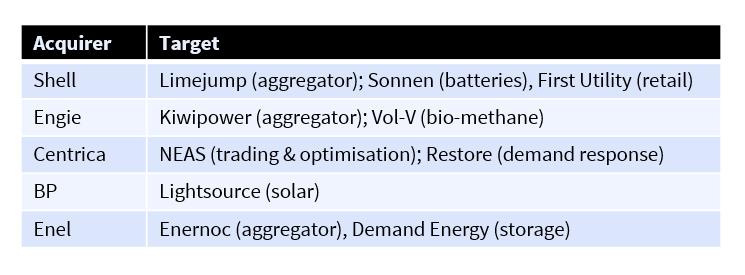
But as these smaller companies grow, they become prime targets for acquisition by incumbent utilities and producers looking to diversify portfolio exposures and access new growth opportunities. Some examples of this are set out in Table 1.

Table 1: Large incumbents swallowing smaller innovators

Large player diversification

Europe’s incumbent utilities and producers have large centralised asset bases, focused in most cases on production and consumption of hydrocarbons.

The hydrocarbon based businesses of these companies may remain profitable for decades, particularly gas & LNG portfolios as demand grows in developing markets. But boardrooms are increasingly focusing on three key risks to long term margin and growth potential:

  1. Decarbonisation
  2. Decentralisation
  3. Rapid technology innovation

These risks are driving large incumbent players to gradually transition their business models. This is happening via a shift in focus to new growth areas including renewables, distributed energy, trading, LNG, hydrogen and energy services. Four case studies of business model transition are shown in Diagram 1.

Diagram 1: Case studies in business model transition

The diagram also highlights the important role that the acquisition of small companies is playing in facilitating business model transitions. Innovative smaller companies represent relatively ‘cheap options’ for large incumbents looking to diversify and grow. Acquisition can also provide an accelerated ramp up in customer relationships, technology & software and specialist expertise.

But successful acquisition & integration can be challenging. The more rigid governance structures and bureaucracy of large utilities & producers can often undermine the innovative success of a standalone smaller player. It can also be difficult to integrate the management, culture and skill sets of new business areas with the much larger existing core businesses, as evidenced by the previous attempts of oil majors to break into renewable energy.

If these integration hurdles can be overcome, large incumbents can provide three key things that unlock value: (i) access to capital and corporate resources to facilitate scaling (ii) the commercial capability to manage market risk and (iii) the ability to influence policy makers. It is those drivers and a continued appetite for diversification that are likely to support a continuation of the current acquisition trend.

TTF animation shows wild gas curve swings

Given the complex nature of energy markets, a good chart can be worth a thousand words.  Animating a series of charts and turning them into a movie can be even more valuable. In our article today we apply this approach to illustrate the evolution of TTF prices over the last two years.

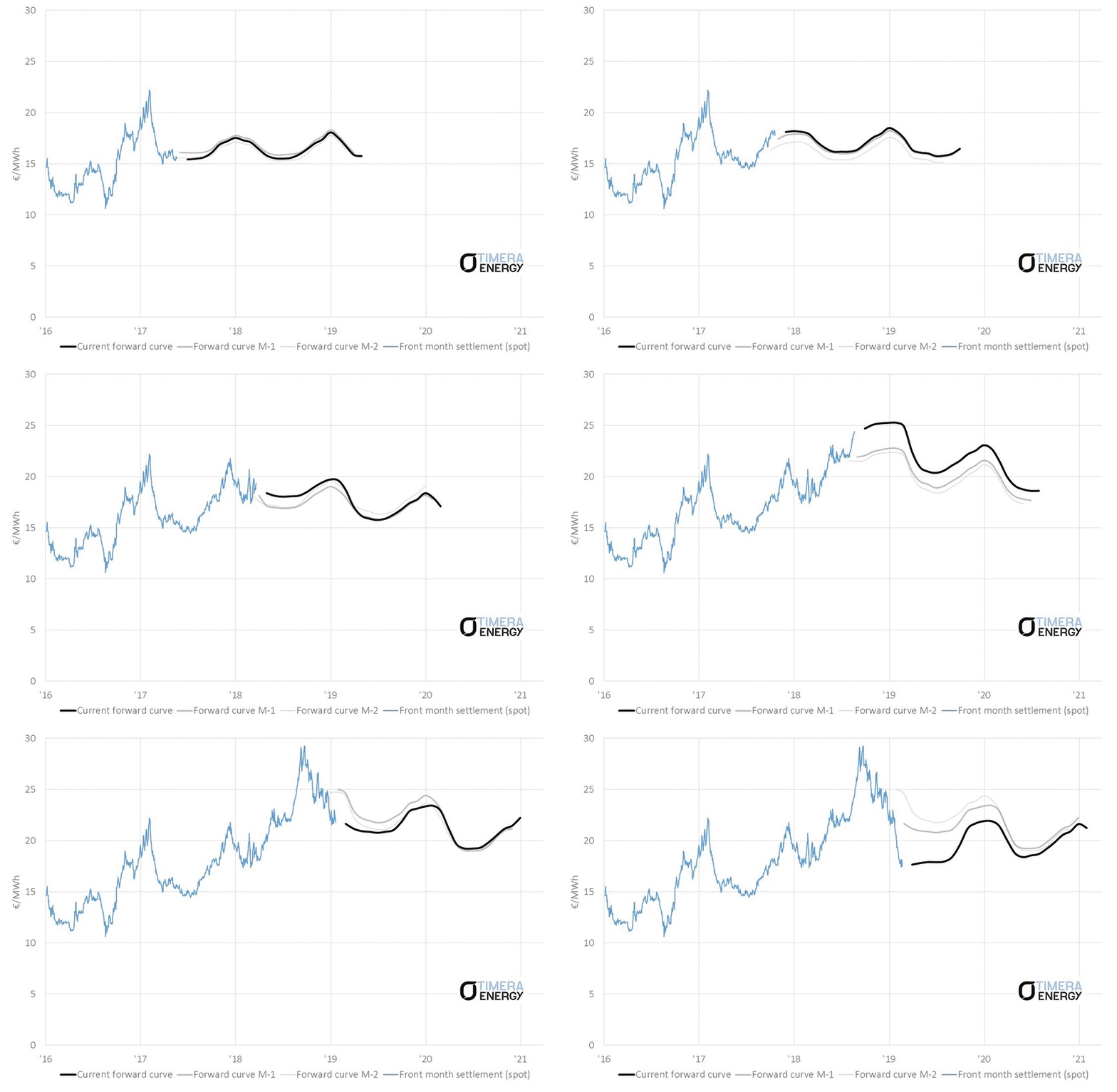
Chart 1 is an animated view of the evolution of front month TTF prices (the blue line) and the liquid front two years of the TTF forward curve (the black line).  To give a clearer view of shifts in the forward curve we also show the position of the forward curve for the two previous months (the grey lines).  As you can see TTF has been on quite a wild ride since 2016.

Chart 1: Animation of front month TTF vs forward curve


Source: Timera Energy

The spot price story

A brief recap of TTF spot price evolution across the 2016-19 horizon shown in the chart:

  • The bottom: TTF prices formed a major bottom in 2016 (along with other global commodity markets e.g. oil, coal & base metals), above 10 €/MWh.
  • Seasonal recovery: In 2016 and 2017, prices exhibited classic seasonal behaviour, rising across Winter 16-17 (strong gas demand given French nuclear outages) and falling into Summer 17 (inducing power sector switching).
  • The top: Prices rose again into Winter 17-18, but shirking the seasonal trend, remained elevated in 2018 around 20 €/MWh, before rising again across Summer 18 to almost 30 €/MWh (as European switching levels rose with carbon and LNG was diverted to satisfy strong Asian demand).
  • Big retracement: Price action across Winter 18-19 has been one way (as surplus LNG has flooded back into Europe and economic growth expectations have slowed). TTF again ignoring seasonal trends has plunged back below 18 €/MWh. More here on the drivers of this fall in TTF prices.

Across the 2016-19 period you can think of the European gas market having been through a mini-cycle which begun in Summer 2016 (~10 €/MWh) and peaked in Summer 2018 (~30 €/MWh), with prices retracing more than 60% of this rally in the last 6 months.

The forward price story

Within this mini-cycle there have also been some major shifts in the shape and behaviour of the forward curve:

  • Flat & rising: During the recovery stage of the move up in TTF prices across 2017, there was a virtually parallel shift up in forward prices (which retained a relatively flat curve shape across the front two years).
  • Surge to backwardation: In 2018, forward prices continued to move higher with spot, but this time with the front of the curve rising faster and opening up a pronounced backwardation by the end of Summer 2018 (an unusual condition in gas markets).
  • Slump to contango: Across Winter 18-19, not only have spot prices plunged, but the shape of the TTF curve has undergone a major shift from backwardation to contango. This reflects a huge shift across the last 6 months in the market’s expectations of the nearer term availability of gas (from drought to flood).

The change in curve price shape has been most pronounced over the first two months of 2019 as we set out in our Snapshot column chart last Friday, which shows 2019 summer/winter spreads blowing out to 3.6 €/MWh, their highest level since 2012.

Across the swings of 2018-19, particularly the recent steep decline, prices in the tail of the TTF curve (two years forward and beyond) have been more stable than the front of the curve. This differentiation in forward price movements is consistent with market players more actively managing positions across the curve. This is a good indication of a maturing forward market at TTF.

Power price uncertainty: a UK case study

Baseload power prices are becoming irrelevant.  This is down to the simple fact that a diminishing number of power assets run to a baseload profile.  Asset values are instead increasingly dependent on fluctuations in power prices close to delivery (‘prompt prices’).

The value of flexible assets, such as gas-fired power plants, hydro storage, batteries & demand response, is driven by prompt price shape and volatility. Value is created by dispatching asset flexibility to respond to fluctuations in prompt price signals, whether within wholesale or balancing markets.

The behaviour of prompt prices is also increasingly important for wind and solar assets.  As renewable capacity rollout increases, so too does price cannibalisation. In other words, in periods when wind & solar output is high it is driving down captured prices.

In today’s article we look at the dynamics driving the evolution of prompt power prices, recognising the uncertainty created by fluctuations in wind output, solar output and demand.  We do this by analysing the evolution of technologies setting marginal power prices across the day, using a UK power market case study.

Marginal price setting: a UK case study

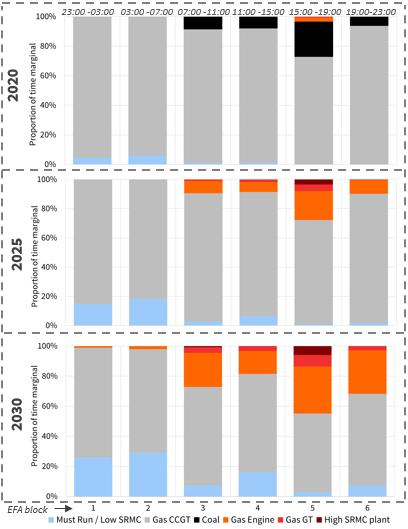
Chart 1 illustrates the evolution of the distribution of marginal price setting plant categories across different parts of the day as the UK market evolves from 2020 to 2030.

Analysis is built on a projected distribution of net system demand i.e. it captures the uncertainty associated with fluctuations in wind output, solar output and demand.  This draws on the logic we set out in an article two weeks ago on modelling power market uncertainty.

Chart 1: Evolution of UK marginal price setting technologies


Source: Timera Energy

The chart shows a projection of the percentage of time different technology types set power prices across the 24 hours of the day, aggregated into traded four hourly EFA blocks.

For example, the bottom panel shows that in 2030 in EFA block 4 (11:00-15:00):

  • CCGTs set prices 65% of the time
  • Low/zero variable cost plants (e.g. wind, nuclear) set prices 16% of the time (e.g. in periods of high wind & solar output)
  • Gas peakers, batteries & DSR set prices 19% of the time (e.g. in periods of low wind & solar output).

Several key dynamics can be observed in Chart 1:

  • Gas dominance: CCGTs continue to dominate UK marginal price setting through the 2020s, but with their influence being steadily eroded over time.
  • Low renewables: In periods of low wind & solar output and high demand, high variable cost peaking capacity (e.g. engines, batteries, DSR) sets prices.
  • High renewables: In periods of high wind & solar and low demand, low variable cost capacity (e.g. wind, solar, nuclear) sets prices at low or negative levels.

The analysis of evolution of marginal price setting plants allows us to draw some important conclusions on the evolution of price behavior over the next decade.

Conclusions on price behavior

  1. Support for peak prices

The retirement of coal & CCGT plants from the middle of the UK supply stack is set to increase the role of peaking flexibility (engines, GTs, batteries & DSR) in setting marginal prices. This peaking flex has higher variable costs than coal/CCGT plants, acting to support peak prices.

However, the evolution of peak price shape is also influenced by the pace and scale of shifting load shape. This depends on a combination of technology evolution (e.g. electric vehicle roll out, smart appliances & software) and the roll out of enabling infrastructure (e.g. across distribution networks).

  1. Downward pressure on offpeak prices

As wind & solar output volumes rise, so do the percentage of periods where low variable cost capacity (e.g. wind, solar, nuclear) set marginal prices at low or negative levels.  This acts to drag down prices in these periods, which are more prominent in the lower demand offpeak hours of the day.

Reports of the death of gas price linkage have been somewhat exaggerated.  CCGTs, gas engines and GTs will continue to dominate the price setting section of the UK supply stack well into the 2030s, even under high renewable rollout scenarios.  But there will be a gradual erosion of price linkage over time, particularly of capture prices for wind and solar assets.

  1. Support for price volatility

The rapid rise in wind & solar output across next decade increases supply stack fluctuations.  For example, we estimate 17GW wind and 14GW solar intraday swing ranges by 2030.  At the same time a steepening of supply stack increases the price impact of wind/solar fluctuations i.e. output swings can tip market from negative prices to 100+ £/MWh in hours.

The impact of shifting load shapes & rising battery flexibility is outweighed by intermittency.  For example National Grid estimates battery capacity in the UK to be 3-5GW by 2030.  The flexibility provided by this is much smaller than wind/solar swing volumes. As a result, power price volatility is set to increase.

Confronting uncertainty

Power asset values are becoming increasingly dependent on price dynamics close to delivery. The resulting problem that confronts asset owners and investors is prompt price uncertainty.

Being able to understand this uncertainty is key to quantifying and managing asset risk/return. This problem is tackled by analysing the evolution of prompt price distributions, rather than relying on forecasts of baseload (& peakload) price levels.


Europe & Asian gas prices slump

European hub prices have fallen 40% since Sep 2018. This is a substantial move over a five month period. It is even more impressive because the price decline has occurred across winter.

In today’s article we look at why gas prices are falling hard in Europe and Asia.  We also consider the important shift in European gas forward curves that has occurred at the same time.

A price jump followed by an even more rapid decline

Less than 6 months ago a carbon price surge pushed TTF prices to 10 $/mmbtu (almost 30 €/MWh).  This happened against the backdrop of an unusually tight LNG market across summer 2018. European and Asian markets were competing for available LNG cargoes, driving Asian LNG spot prices towards 12 $/mmbtu.

Chart 1 shows that the associated summer 2018 surge in European spot prices from 8 to 10 $/mmbtu was short lived, with prices falling back to 8 $/mmbtu by early Q4.  But the chart also shows an even more rapid decline in spot gas prices across December and January (from 8 to 6 $/mmbtu).  That is quite unusual behaviour across the coldest months of winter.

Chart 1: Global gas price benchmarks


Source: Timera Energy

It is no coincidence that the decline in gas prices since the end of Q3 2018 has been accompanied by a sudden rise in LNG flows to Europe.

Europe is soaking up surplus LNG

Europe’s liquid hubs (TTF & NBP) act as a sponge to mop up surplus cargos from the LNG market. With Asian LNG portfolios well contracted into Winter 18/19, Asian buyers have been net sellers of spot cargoes this winter. This is coinciding with the LNG market entering its most intense phase of volume ramp up from the current wave of new LNG supply projects.

These two factors combined to tip the LNG market into surplus in Q4 2018. As a result, the Asian spot price spread over TTF has fallen back under 1 $/mmbtu. This no longer covers the variable cost to transport LNG to Asia and there has been an associated surge in LNG imports into North-West European hubs as shown in Chart 2.

Chart 2: European LNG send out vs Asia/TTF front month price spread


Source: Timera Energy

Spot LNG charter rates have also declined towards $50k per day from above $200k in Q3 2018. This is consistent with reduced journey durations as LNG flows via shorter routes to Europe.

It is European power markets that are soaking up most of the incremental gas supply as LNG imports rise.  Falling gas prices are reducing the variable cost of CCGTs and tipping the competitive balance from coal towards gas plants.

Increased power sector gas burn so far this winter has been most pronounced in Germany and the Benelux region.  Gas for coal plant switching looks set to continue gathering pace as 2019 progresses.

While the impact of these large moves in spot gas prices is interesting, it is perhaps more important to understand what the impact has been on gas forward prices.  These have a stronger influence on asset hedging, investment and retirement decisions.

A major shift in European gas curves

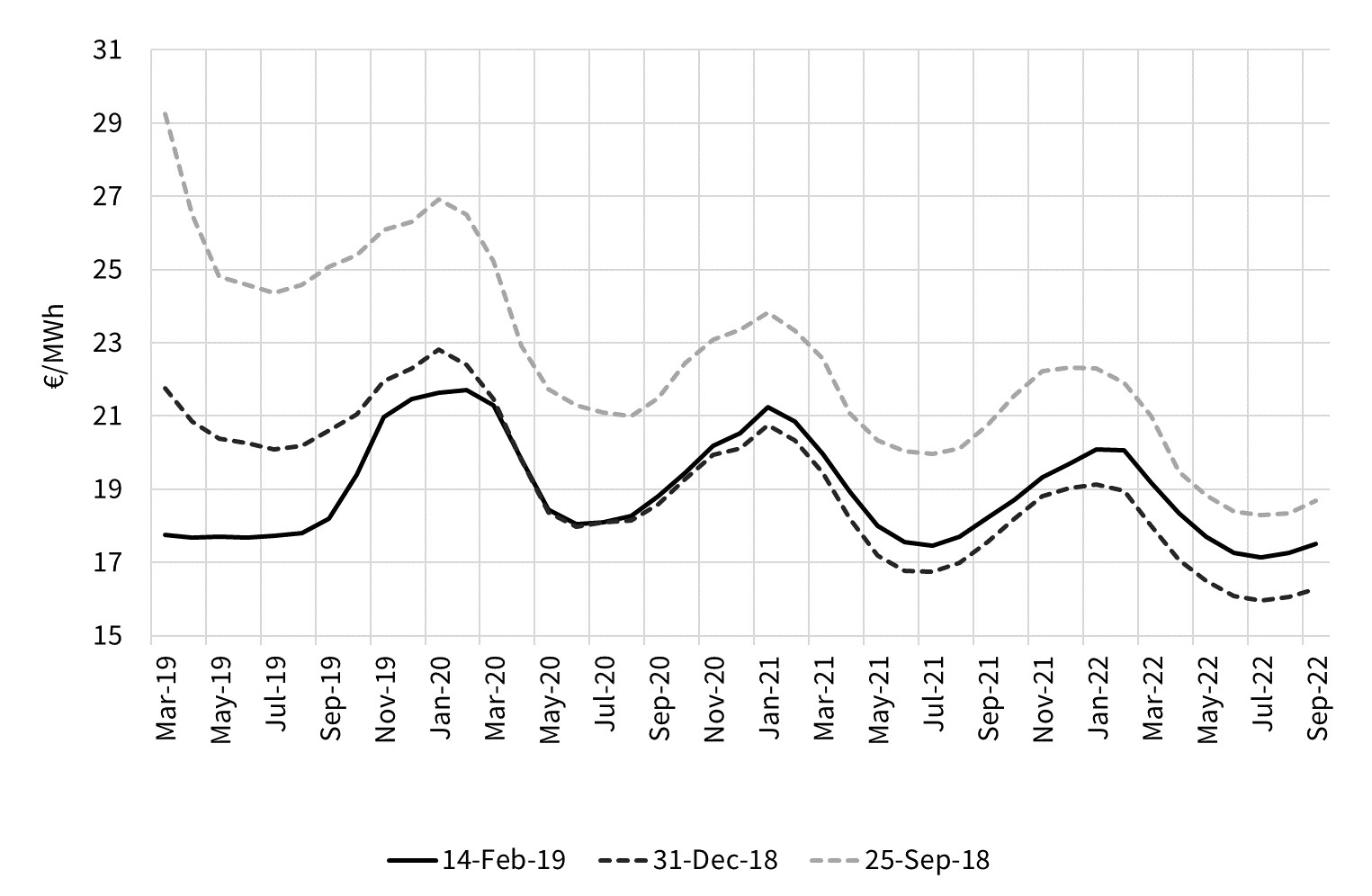
Chart 3 shows the current TTF forward curve compared to curves at the end of Q3 and Q4 2018.

The transformation of the TTF forward curve since Q3 2018 can be considered as the combination of two dynamics:

  1. Falling: Between Sep and Dec 2018, the whole TTF curve declined. This was driven by a revision of market expectations on (i) European economic growth & therefore gas demand and (ii) the volume of surplus LNG available to flow to Europe.
  2. Flattening: In 2019, the quite steep backwardation that existed in 2018 has been driven out of the TTF forward curve as it has flattened. The curve has tilted relative to its position in Dec 2018, falling at the front and rising at the back.

Chart 3: Evolution of the TTF forward curve since Q3 2018


Source: Timera Energy

There has been a particularly sharp move lower in the front months of the TTF curve this year.  Spring appears to be making an early appearance with warmer than usual weather.  This has contributed to European storage inventories sitting at unusually high levels.

A flat forward curve through summer offers little value from further storage withdrawals.  However this 2019 curve flattening has significantly increased the 2019 summer/winter spread at TTF (up from 1.5 around 3.0 €/MWh).

The factors pulling down the front of the gas curve are really 2019 ‘within-year’ effects.  The back of the TTF curve has actually risen since December as a broader recovery in commodity & financial markets has taken place since the Dec 2018 slump.

2019 is set to be a year to watch intermarket relationships closely. Interaction with the LNG market will be an important driver of the European supply picture.  The relationship between gas and coal plants in European power markets will be the key price responsive mechanism on the demand side.

Movements in the gas forward curve help shed some light on how market expectations of these intermarket relationships are evolving.

Confronting power market uncertainty

Everyone is familiar with the Base, High & Low scenario approach to power market analysis.  This is rooted in common sense. What is our best guess of what could happen (Base)? How could we be wrong (High & Low)?

However, the large scale roll out of intermittent renewable capacity in power markets has undermined this traditional scenario approach.  The inherent uncertainty of wind & solar output patterns and the substantial range of volume swings requires something new.

Probabilistic (e.g. simulation) based analysis of power markets is needed to properly understand:

  1. The distributions of potential market outcomes (both prices and volumes)
  2. The risk/return distributions of individual assets operating in those markets.

In today’s article we use a UK power market case study to illustrate how power market uncertainty can be deconstructed and analysed.  We look at some of the key market impacts of higher renewable penetration on market prices and asset values.

Why the traditional approach is broken

Traditional power market modelling involves creating detailed deterministic scenarios (e.g. Base, High, Low), that model a power system under a fixed set of conditions.

These deterministic scenarios are based on ‘average’ or ‘historical’ conditions for key sources of uncertainty in the market, for example:

  • Intermittent solar and wind output
  • Demand (e.g. short-term deviations due to weather).

This deterministic approach may have been adequate when these sources of market uncertainty were in aggregate not large enough to have a significant impact on price & volume outcomes.  But the large scale roll-out of renewables is changing that.

As a result, it is important to specifically capture uncertainty within the market modelling process, to understand market and value dynamics.  Important examples of issues that cannot be properly dealt with via the traditional scenario approach are summarised in Table 1.

Table 1: examples of where traditional modelling breaks down

Example Description Impact
1. Price cannibalisation The extent of renewable price erosion and its impact on achieved capture price Key value driver for wind and solar projects
2. Scarcity premiums The evolution of market scarcity premiums i.e. the premium of power prices over variable cost of price setting plants Key value driver for all flexible assets e.g. CCGTs, gas peakers, batteries
3. Price shape & volatility The evolution of intra-day price shape and spot wholesale & Balancing Mechanism price volatility Particularly important for value of peaking flex e.g. engines, batteries & DSR


It is in the interests of asset owners and investors to properly account for uncertainty.  Applying traditional scenario analysis to flexible assets such as gas peakers or batteries, typically undervalues optionality.  It can also significantly misrepresent the risks around price cannibalisation for renewable assets.

Deconstructing the impact of uncertainty

Commodity prices have historically been the largest source of power market uncertainty.  They remain a key driver, but for the purposes of today’s article we focus on the impact of uncertainty from wind output, solar output and demand.

Each of these three factors (wind, solar & demand) has its own unique behavioural characteristics.  But these can be aggregated to generate a combined distribution of net system demand (= demand – wind output – solar output).

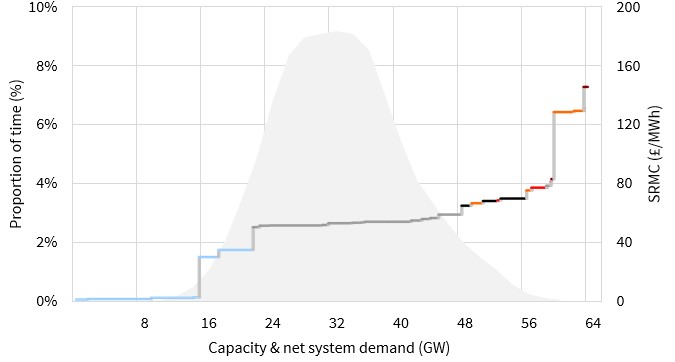
Net system demand is effectively what the dispatchable portion of the power market supply stack must cover in order to clear the market.  Chart 1 illustrates a distribution of UK net system demand overlaid on the dispatchable (or controllable) portion of the supply stack.

Chart 1: UK net system demand distribution vs dispatchable supply stack


Source: Timera Energy

The chart shows the portion of time that different sections of the supply stack are required to clear net demand. For example:

  • High load & low wind/solar periods in the right tail of the distribution result in peaking units setting prices
  • Low load & high wind/solar periods in the left tail result in renewable or must run capacity setting zero or even negative prices.

The chart illustrates the foundation of a probabilistic approach to supply stack modelling. Multiple simulations of net system demand can be run through the stack model to generate distributions of market price & volume outcomes.  These then allow analysis of the impact of net demand uncertainty on asset value (e.g. some of the drivers outlined in Table 1).

Analysing market evolution: UK case study

In Chart 1 we show the relationship between net demand and the supply stack at a given point in time.  But from an asset investment perspective it is important to understand how a power market will evolve over at least 15-20 years (i.e. a capital payback horizon).

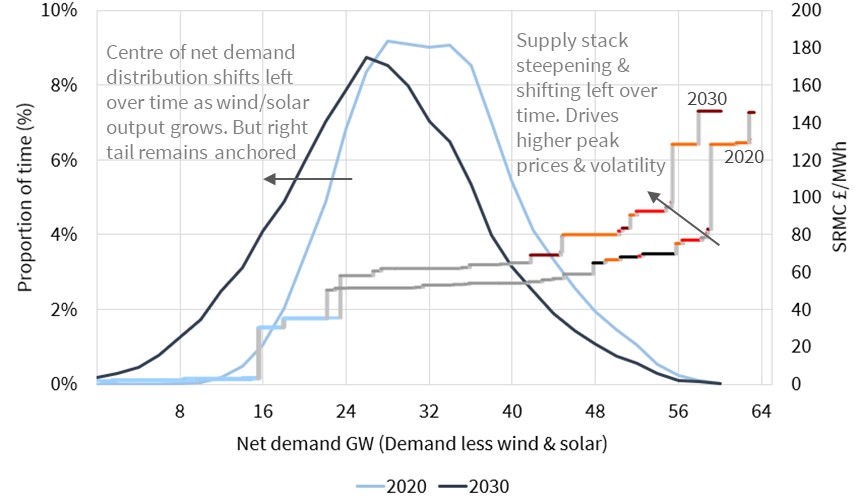
Chart 2 shows the evolution of both the dispatchable supply stack and net system demand distributions for the UK power market in 2020 versus 2030.

Chart 2: UK net system demand distribution vs dispatchable supply stack


Source: Timera Energy

Chart 2 illustrates two key themes summarised below.

  1. Increase in wind & solar output
  • Growth in wind & solar output shifts the center of the net demand distribution left over time
  • But the right tail remains anchored around the level of peak demand (i.e. there are still periods of very low wind & solar output that need to be covered by peaking flex)
  • The net demand distribution widens over time reflecting the increasing range of wind & solar fluctuations e.g. ~17GW wind & ~14GW solar intraday swing ranges by 2030.
  1. Stack steepens
  • The supply stack steepens over time as (1) coal & older CCGT plants retire from the middle of the stack and (2) they are replaced by higher variable cost peaking flex to the right of the stack (e.g. batteries, engines, GTs, DSR).
  • The steepening of the stack, increases the price impact of wind & solar fluctuations, i.e. output swings can tip the market from negative prices to 100+ £/MWh across several hours
  • The impacts of rising battery and demand side flexibility are substantially outweighed by swings in wind & solar output
  • In summary, ‘wind trumps batteries’ i.e. battery capacity (e.g. 4-6 GW by 2030) is much smaller than wind/solar swing volumes (30+ GW by 2030).

It is analysis of the interaction between changing supply and demand distributions that shines the light on how power markets will evolve.  Uncertainty may be an inconvenience for asset owners & investors, but capturing it underpins the meaningful analysis of asset value dynamics.  Applying the traditional Base, High and Low scenario view is a bit like trying to find a black cat in a dark room.