Carbon price floor impact on the UK power market

The UK carbon price floor is driving a wedge between the UK and European cost of carbon.  This will have an important impact on the competitiveness of gas vs coal generation in the UK.  Indicative forward market pricing suggests that gas plant may start to displace coal plant by the summer of 2016.   This has interesting implications for UK power price dynamics and generation returns.

Intervention to support the UK carbon price is one of the four pillars of the UK government’s EMR policy.  This is to be achieved via a tax funded top up premium that will increase the price of UK carbon above that of the EU ETS market price.  With the government publishing its intended carbon support levels out to 2016 in this year’s budget, we can start to get a clearer idea of the implications for the UK power market.

Gas vs coal plant competitiveness

The carbon intensity of electricity generation from a coal plant (around 0.9 t/MWh) is more than double that of a gas-fired CCGT plant (around 0.4 t/MWh).  So the carbon price floor acts to increase the variable cost of coal generation relative to gas.  This impact is currently relatively small given the current carbon support premium of around 5 £/t on top of the EUA price (currently around 4 £/t).

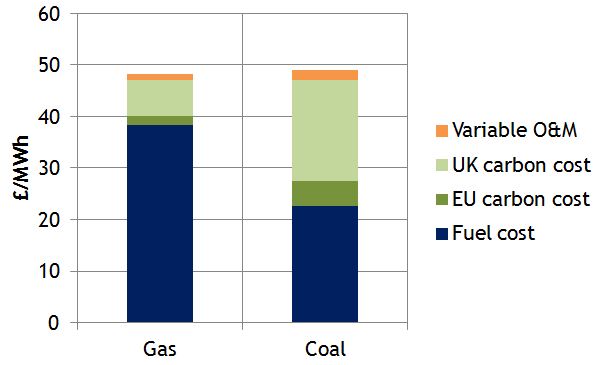
But by 2016, the UK government intends to add a 21 £/t premium to the carbon EUA price.  A premium of this size will have a significant impact on gas vs coal plant competitiveness as illustrated in Chart 1.

Chart 1: Summer 2016 Short Run Marginal Cost of UK CCGT vs coal plant (54% vs 36% efficiency)

CPF gas vs coal

The chart shows the short run marginal cost (SRMC) of a new CCGT (54% HHV efficiency) versus an average UK coal plant (36% efficiency).  Fuel and carbon costs are based on indicative forward pricing for gas, coal and carbon for summer 2016.  On a variable fuel cost basis, coal generation is still much cheaper than gas.  But the government’s carbon price support means the cost of carbon starts to tip the competitive balance in favour of gas plant.

Another factor behind the forward market anticipated change in gas vs coal SRMC, is the shape of fuel forward curves.  The coal price curve is in relatively steep contango (prices rising over time).  The NBP gas forward curve on the other hand is in backwardation, consistent with falling forward prices in the Brent curve.  So although liquidity is poor out along the curve, forward markets suggest a narrowing in the fuel cost premium of gas over coal. 

Power market impact

Closing the gap between gas and coal plant competitiveness has an important impact on UK power market returns and pricing dynamics.  Two important implications of the government’s carbon price support are:

  1. Increasing the cost of carbon is acting to flatten the UK supply curve over time.  As gas and coal plant competitiveness reconnects, there is around 40GW of CCGT and coal capacity with a similar variable cost.
  2. Relatively small shifts in commodity prices may cause significant changes in gas and coal plant load factors.

Chart 2 illustrates our net supply curve view of the UK power market based on Summer 2016 indicative forward prices and the government’s published carbon support premium.  The flattening of the supply curve is clear.  It can also be seen that at these price levels, the newest CCGT plants start to displace older coal plant.

Chart 2: UK net supply stack chart Summer 2016

CPF supply stack

The importance of the dynamics illustrated in the chart is their impact rather than their timing.  Alternative pricing outcomes and coal plant efficiency upgrades may delay the switching of gas for coal beyond 2016.  There is also a risk that the government revises down its carbon price support levels, particularly given the design of the mechanism has a number of flaws.

But as long as the government’s carbon price support remains in place, it will act to flatten the supply curve and increase the competitiveness of gas plant relative to coal.  This will tend to dampen UK power price volatility and increase CCGT load factors.  It may also impact the correlation between gas (vs coal) and power prices, as marginal price setting shifts between fuel types.

But higher CCGT load factors will not necessarily translate into a recovery in generation margins.  The flat supply curve also reduces the rents that conventional generation assets earn when higher cost plants are setting the market price.  The key to higher gas plant generation margins is a tightening in the market capacity margin.  As plant closures and mothballing continue over the next 2 to 3 years this will act to increase marginal pricing in periods of high net system demand (high load, low wind).  It is the increase in power prices and volatility over these periods that will be a critical driver of a recovery in generation margins.

Panama Canal upgrade impact on the LNG Market

The Panama Canal is synonymous with the global shipping industry, facilitating over 14000 transits per year.  But currently it is not a significant feature of the global LNG market.  This is because only 21 of the 370 LNG vessels currently in service can pass through the canal.  However the Panama Canal expansion project will allow over 80% of LNG vessels to pass through from late 2015 when it is due to be completed.

When the $5.25b project was approved in 2006, the consensus view was for a limited impact on global LNG trade.  The key beneficiary of the expansion was expected to be the owners of Trinidad and Tobago cargoes, given canal transit significantly shortens the trip to Asia.

But the rapid development of plans to build large volumes of LNG export capacity on the US Gulf Coast means that the canal expansion project is set to have a far greater impact on the LNG market than previously envisaged.  In addition, it may increase the competitiveness of lower volume existing trade routes (e.g. Trinidad to Chile) or open up new ones (Peru to Europe).  Panama is also looking to start importing LNG in 2013.

Impact of shipping economics

The impact of the canal expansion on LNG trade is fairly obvious: shorter distances and voyages, lower shipping costs.  The differences in shipping times are summarized in Table 1.

Table 1.  Comparison of shipping distances and voyage times for cargoes delivered to Japan (Sakai)

Trinidad

US Gulf Coast (Sabine Pass)

NM

Days

NM

Days

Via Suez

13,000

29.5

14,300

32.4

Via Panama

9,150

21.1

9,500

21.8

Reduction

-30%


-34%

Source: Timera Energy (assumes average speed of 19 knots, includes 1 day for canal transit and excludes loading and discharging times).

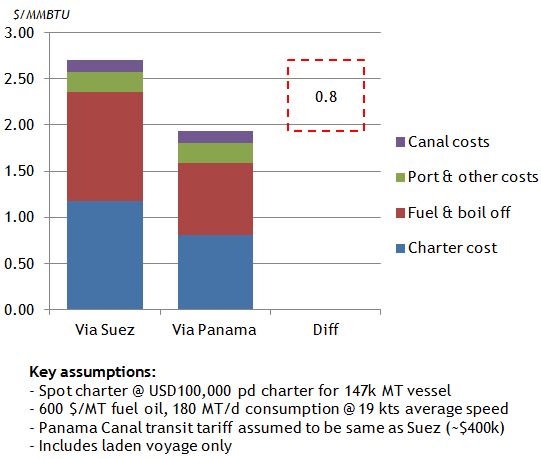
Shorter distances reduce fuel consumption and LNG boil-off.  Shorter voyages reduce the charter period for spot voyages and increase vessel utilisation. The scale of the difference in shipping cost of a Panama vs Suez canal transit for Gulf Coast exports is illustrated in Chart 1.

Chart 1: Estimated shipping cost differential Gulf Coast (Sabine Pass) to Asia (Sakai – Japan)

Panama Canal

Source: Timera Energy

There are two important assumptions applied in estimating the shipping cost differential:

  1. For ease of comparison, the new Panama transit cost (not yet published) is assumed to be the same as the Suez transit cost.  In reality it could be significantly higher.
  2. Shipping costs are based on a ‘one-way’ spot charter rate covering only the laden voyage.

On this basis the estimated cost saving of transit from the US Gulf Coast to Japan is in the region of 0.8 $/mmbtu.  A more precise cost savings estimate will be possible once the new Panama transit tariffs are published.  The Panama Canal Authority is currently consulting with customers and expects to publish tariffs in mid 2014.  There has been concern the tariff may be significantly higher than the Suez equivalent (approx ~$400k), with estimates ranging up to $2m per round trip.

However, the direct canal transit costs are only a relatively small portion of the actual shipping costs.  As a rule of thumb, each $100k of canal transit cost will increase the cost of shipping Gulf Coast exports to Asia by around 0.03 $/MMBTU.  So while a high transit fee would reduce the Panama versus Suez cost differential, it would not erode it altogether.

The other important factor in the shipping cost estimate is accounting for the cost for the unladen (or ballast voyage), see here for further background on this.

Impact on global gas market price dynamics

The importance of the Panama expansion from an LNG market perspective is its influence on global gas price differentials.  Lower shipping costs improve the relative economics of shipping US gas to Asia.  Over time this should act to reduce inter-regional price spreads.  The Panama expansion is also likely to bring down the price of spot deliveries to the Latin America pacific cost (Altamira in Mexico and Quintero Bay in Chile).

Reduced journey times to Asia will also have a second order impact marginally increasing supply chain flexibility.   This will allow US exporters to respond more quickly to short term fundamental shocks which may act to dampen volatility of prices for short term delivery.

But perhaps most importantly, reduced shipping costs will increase the competitiveness of two very flexible sources of LNG supply, exports from the US and Trinidad & Tobago.  The flow of gas from these exporters will be strongly influenced by the spread between the Henry Hub price and Asian spot price signals.  The Panama expansion will therefore likely play its part in increasing the influence of the Henry Hub price on Asian LNG price signals.

Beware of a shift to central planning

The UK’s 2001 implementation of the NETA wholesale power trading arrangements marked the ideological peak of a push towards liberalised wholesale power markets in Europe.  Power market liberalisation followed across Europe with varying degrees of enthusiasm.  But by the end of last decade, the UK had already signalled a return to a more interventionist policy stance with its vision for an Electricity Market Reform (EMR) package.

Growing concerns over security of supply and decarbonisation targets, have led the UK government to develop an EMR policy toolkit that allows it to target specific generation technologies.  As EMR has evolved, it has become increasingly clear that the government intends to use this toolkit to drive the UK capacity mix.  There is a growing risk that this path will end with the funeral of the wholesale power market, with a government directed ‘central buyer’ of capacity emerging from the ashes.  This outcome may currently seem to have a low probability, but it warrants careful consideration over a strategic planning horizon.

UK market redesign signals the way forward for Europe

The UK is Europe’s ‘canary in the coal mine’ when it comes to dealing with the side-effects of government intervention to support renewable capacity.   The UK power market needs to deliver new conventional capacity this decade to avoid a capacity crunch. 

Most other European power markets can fall back on a current capacity oversupply situation, the result of a post-crisis slump in demand and support for renewable build.  This reduces the urgency of having to tackle some of the difficult market design issues the UK faces.  But these issues will eventually need to be dealt with across Europe.

Just as the UK led the push towards liberalisation in the 1990s, it looks to be leading the retreat back towards central planning this decade.  It remains to be seen whether this retreat will be structured and orderly, or a more panicked response to the looming security of supply threat.  Either way the path of UK energy policy is likely to be an important signal as to the future policy direction across European power markets. 

The UK plan for a ‘third way’

There are broadly two models for electricity market design:

  1. A competitive wholesale market with transparent rules, strong independent regulation and a ‘sharp’ (cost reflective) market price signal to induce investment.
  2. A centrally administered solution where an independent body with a clear mandate uses a transparent approach to determine and deliver against capacity targets (e.g. via capacity auctions).

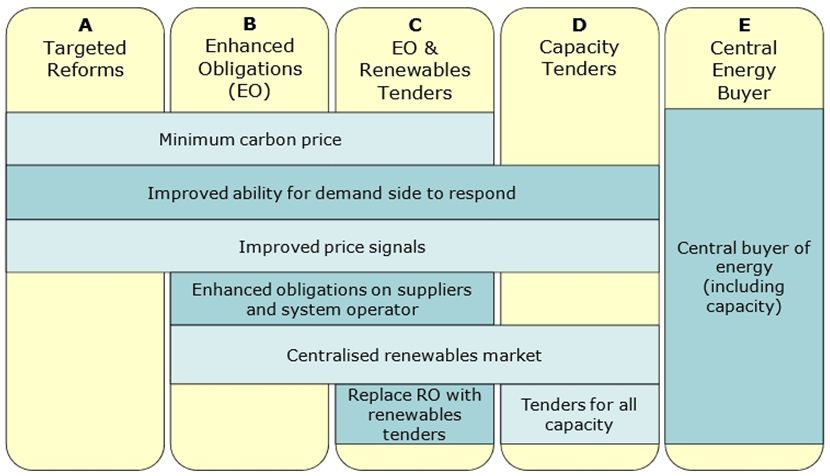
But the UK government has tried to steer towards a dangerous middle ground (as we set out previously).  The origins of that middle ground came from Ofgem’s Project Discovery conducted over 2009-10, with a consultation process run around a set of potential policy intervention packages set out in the chart below.

Chart 1: Ofgem’s Project Discovery policy intervention packages

Project Discovery

Project Discovery was intended to offer the government a menu of potential market intervention mechanisms.  But rather than choosing to:

  1. make targeted reforms to the existing wholesale market (box A) or
  2. opt for a radical shift to a ‘central buyer’ solution (box E)

DECC instead chose to layer everything on the menu into a poorly designed and unnecessarily complex mix of inconsistent market interventions.  It was this process that has evolved into DECCs EMR policy package that is currently being implemented via the Energy Bill.

Progressing towards central planning

The EMR policy measures have not had a happy history to date.  Piecemeal intervention to support low carbon generation technology has distorted wholesale market price signals and incentives.  Driven by concerns around security of supply and renewable targets, the government has increasingly targeted policy measures to influence the build of specific generation technologies as summarised in Table 1:

Table 1: EMR policy intervention measures by generation technology type

Technology

Policy intervention

Renewables

Currently supported by Renewable Obligation Certificates which are ‘banded’ by technology.

Move to FiT/CfDs under EMR, with strike prices set by technology.

Nuclear

Although supposed to be covered under FiT/CfDs, nuclear support has essentially become an in-transparent bilateral negotiation between EDF and the government.

Gas

Gas plant is to be supported by a Capacity Market to be introduced in 2014 for delivery of a government determined capacity target in 2018.

In the meantime Ofgem is consulting on a Supplementary Balancing Reserve mechanism that Grid can use to support existing gas plant from closing.

Coal

Coal has effectively been removed as a new build capacity option by the EMR Emission Performance Standard and lack of meaningful progress on support for CCS.


The government’s vision for EMR is to create a new and improved wholesale market for a low carbon world.  But EMR is undermining investment based on wholesale market price signals.  Regulatory inconsistency and uncertainty is also substantially increasing the cost of investment capital.  As policy intervention measures are layered on, investors are losing confidence in returns driven by an increasingly distorted wholesale market.

In reaction, investors have turned to lobbying the government to ‘underwrite’ investment returns via the EMR mechanisms being developed.  The support package recently served up to deliver EDF’s Hinkley Point nuclear plant should be enough to make every British consumer’s stomach churn.

Policy design by lobbying and intervention is creating a circular feedback loop that is slowly but surely moving the UK power market towards a centrally planned solution.  This is a path that poses large and unnecessary costs onto the UK public, particularly because of the higher cost of capital required to deliver new capacity.  If a centrally planned solution is to be the end game then it would be much more efficient to move there with purpose and intent.

The risk of a central buyer end game?

The problem with EMR is that it has created a set of circumstances that are vulnerable to a political change of tack.  If for example a serious capacity crunch materialises later in the decade, the government of the day could well make a concerted grab for control of the power market.  Not by re-nationalisation of power companies & network assets but via a move to a central buyer approach.

Under this outcome the liberalised wholesale market would likely be assigned to the scrapheap and replaced by capacity auctions to meet government mandated targets.  Ironically, the increased transparency of this outcome may result in a better deal for the UK consumer than the complex uncertainty of EMR.

It is also possible that there is a more gradual transition away from the current wholesale market design.  The recent Labor Party energy policy statement proposed a move back to a gross pool market, accompanied by measures to break up the ‘Big Six’ incumbent utilities.  But such a move assumes that the government of the day has the time to work with the private sector to implement such a transition.  If the catalyst for change is an imminent threat to security of supply, a central buyer solution may give the government a greater degree of control more quickly.

A move to a ‘central buyer’ driven market would have serious implications for the business model and asset values of most energy companies & investors with a UK market presence.  Investment would no longer be driven by wholesale market price signals but by some form of government driven signal (e.g. via long term capacity auctions or offtake contracts).  While this could ultimately mean returns on new asset investments are more secure, the transition from wholesale market to central buyer is unlikely to be a smooth one for existing asset values.

In our view the probability adjusted impact of a central buyer outcome is high enough to consider as a serious business risk over a 5-10 year strategic planning horizon.  The Labor Party’s recent policy announcement, while poorly conceived, is an indication of the mood for more radical change.  The probability of a policy shift is only likely to increase as the capacity margin tightens and the EMR policy mechanisms come under pressure.  It may be prudent to spend a few minutes considering the portfolio impact, mitigation steps and business model implications of a major shift in power market design.

Gas hub price evolution: applying the framework

There can be little doubt as to the ascendancy of hub pricing as the key driver of commercial decision making in the European gas market. Hub prices have become the benchmark for customer supply contracts and gas portfolio optimisation across North West Europe. The influence of hub prices is also rapidly penetrating to the South (e.g. Italy and Spain) and into Eastern Europe. But what are the key factors that will drive hub price evolution? And what are the boundaries that are set to contain price levels?

Last week we set out a framework for understanding the drivers of European gas hub pricing dynamics. This approach was built on grouping similar supply sources and focusing in on the flexible supply tranches that drive marginal pricing. In this week’s article we apply this framework to take a more practical look at how commercial decisions drive hub pricing.

A European supply stack view

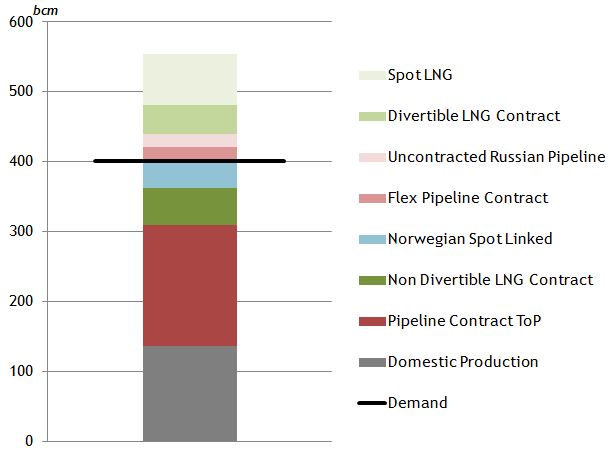
At the simplest level, gas supply is about price and volume. A supply stack illustrates supply volumes ranked by price. So a simple pan-European supply stack can be developed by adding price and volume assumptions to each of the tranches of supply we set out last week. A simple supply stack is shown in Chart 1 along with an indicative annual demand level for the European hub zone.

Chart 1: 2014 pan-European supply stack

2014 Supply

Note 1: Diagram and gas flows based on a European hub zone boundary that covers UK, BE, NL, FR, DE, CZ, AU, CH, IT & ES.  Russian gas contract volumes are based on delivery into this zone (i.e. do not include broader sales into Eastern Europe).

Note 2: The uncontracted Russian pipeline tranche includes 2014 estimates of uncontracted production. Volumes are much larger than this in the medium term.

Inflexible supply tranches:

The supply tranches in the stack chart are broadly ranked from lowest to highest marginal cost. The inflexible supply sources include:

  1. Pipeline contract take or pay volumes – primarily from Russia, Norway and North Africa
  2. Non-divertible LNG contracts – primarily into Southern Europe (and defined broadly to exclude cargo reloads)
  3. Most domestic production – focused on the UK and Netherlands (domestic being defined as within the hub zone boundary as opposed to imports outside of this).

These tranches can effectively be assumed to be priced at zero cost, because the gas will flow regardless of market pricing. In practice these tranches may contain some flexibility (e.g. the ability to bank gas across contract years) but this tends to have only a secondary impact on hub pricing.

Flexible supply tranches:

Much more important are the flexible tranches of supply that can respond to incremental changes in hub price levels. The key tranches of flexible supply are broken out in the table below along with indicative current price ranges and pricing characteristics. The first three tranches are the key drivers of marginal pricing across the hubs. The next three tranches are supply sources that are ‘out of the money’ at current hub price levels, but can provide incremental volume if required.

Flexible tranche

Current price range

Pricing characteristics

Pipeline contract swing volumes

11-13 $/mmbtu

Swing volumes (above take or pay) are optimised by contract owners based on contract vs hub price relationships (see last week’s article). Russian contracts are a key provider of swing, with the recently renegotiated discounted tranches (11-12 $/mmbtu) an important driver of marginal pricing.

Discretionary spot linked LNG

Spot linked

This is essentially a managed volume of LNG that Qatar chooses to place into Europe rather than selling at higher Asian spot prices (shown as non-divertible LNG in the chart). It is a secondary outlet for Qatari production that could otherwise adversely impact Asian spot prices.

Norwegian spot linked sales

Spot linked

In addition to oil-indexed contract sales, Statoil sells spot linked gas up to its annual production targets. This is both via sale of spot-indexed contracts and sales directly at the hub.  There is a pronounced seasonal shape to this gas flow and it is actively optimised based on hub price signals.

Russian uncontracted production volumes

13 $/mmbtu +

Spare Russian production capacity that can flow to market if prices rise above oil-indexed contract levels. This tranche is only small in the 2014 stack chart, but is set to grow substantially in volume by the end of this decade (an estimated 60-100 bcma).

Flexible/divertible LNG supply contracts

13-18 $/mmbtu

Destination flexible European LNG supply contracts that are typically priced based on netback LNG spot market opportunity cost (e.g. to Asia, Sth America) adjusted for any portfolio sunk costs.

Spot LNG supply

13-18 $/mmbtu

Spot LNG cargoes that are also priced against netback LNG spot prices

Gas storage capacity

Opportunity cost of flex

Storage capacity is priced off the opportunity cost of alternative flexibility (typically pipeline swing). Storage is not shown in the supply stack as it has a limited net impact at an annual level (i.e. it is primarily used to move gas between different periods across the year).

How does flexible supply set hub prices?

The first three supply tranches interact to dominate current hub pricing dynamics. Price levels are anchored by the oil-indexed cost of pipeline swing. The discounted Russian supply contracts that have recently been re-negotiated by major European suppliers are particularly important. These sit at the lower end of the pipeline swing tranche (with contract prices around 11 $/mmbtu) and have a strong influence over marginal pricing.

But the extent to which swing contracts influence hub prices depends on the flow decisions of the Qatari’s and Norwegians. Qatar continues to place a portion of its LNG production into Europe so as not to depress Asian spot prices. Norway flows uncontracted production on top of spot-indexed contract sales to broadly match its annual production targets, optimising this flow across different hubs and time periods.

But both these sources of supply effectively displace pipeline swing contract volumes, causing annual hub price levels to remain at a ‘loosely managed’ level below oil-indexed contract prices. The future evolution of hub prices comes down to whether the balance of power currently exercised by key producers can be maintained.

Commercial dynamics impacting price evolution

The evolution of hub price levels over a medium to longer term horizon will be strongly influenced by the strategic commercial decisions of key producers. There are three gas producers with the production flexibility to materially impact the pricing of incremental gas volumes into Europe:

  1. Russia: Estimates of uncontracted Russian production that could flow into Europe range from 60 – 100 bcma over a medium term horizon. The key uncertainty associated with this gas is the price at which the Russians will sell. But to date they have staunchly defended oil-indexation and it is reasonable to assume that Russia will not place large new volumes of gas into Europe if hub prices are below existing oil-indexed contract levels. This is an important factor from a European pricing perspective. The sheer size of potential export volumes will tend to provide stiff resistance against a structural increase in hub prices above oil-indexed contract levels (e.g. towards Asian LNG netback equivalent levels).
  2. Qatar: The European market is viewed as a secondary export outlet by the Qataris. Their primary target is sale of long term oil-indexed contracts into Asia at a price premium to European hubs. However this means the Qataris are cautious as to how much spot LNG they sell into Asia. By depressing Asian spot prices, Qatar may adversely impact its long term contracting opportunities. So they have maintained a volume of spot and shorter term hub linked contract sales into Europe (e.g. the 3mtpa NBP linked contract to 2018 signed with Centrica this week). This gas is effectively displacing pipeline contract imports and helping to keep hub prices below oil-indexed levels. But in the medium term Qatar will likely act to dampen any major price shifts, e.g. if hub prices recover they can increase their spot flow of cargoes into Europe, if prices fall they may further pull back on spot supply.
  3. Norway: There is less production upside from Norwegian upstream given the maturity of field development. Norway also sets reasonably transparent annual production targets. But it still has some strategic flexibility to reduce or increase production in response to major price shifts. The option to pullback on volume is particularly important from a European pricing perspective. For example if LNG started to flow back into Europe in significant volume again (e.g. as it did in 2009-10), the Norwegian flexibility to reduce production could play an important role in supporting hub prices, at least on a temporary basis.

Incremental supply into Europe is of course not limited to these three players. But other sources of supply are typically too small to have significant strategic pricing power. And it is the pricing power of these 3 key players that is the force acting to keep hub prices within a band of oil-indexed pipeline contract supply. All three have a vested interest in trying to ensure that this situation remains. The Russians are the champions of the cause and retain the greatest influence. The Qataris and Norwegians may be more progressive, but they are ultimately sympathetic supporters.

Gas hub pricing boundaries

Despite the trend towards the spot indexation of gas in Europe, it is oil-indexed price levels that will likely remain the anchor for the evolution of European hub pricing. Two reasons work together to support this logic:

  1. Oil-indexed pipeline contracts represent the dominant tranche of flexible supply driving marginal pricing at hubs (and declining domestic production levels should reinforce this).
  2. The key producers have a shared strategic interest in controlling physical flow into Europe to support hub prices at a level broadly in line with oil-indexed pipeline supply.

This outcome relies on the continuing influence of key producers. And with Europe’s growing gas import requirements the balance of power looks skewed in their favour.

A European ‘gas squeeze’ up to Asian price levels is unlikely, despite Europe’s import appetite. There is not a structural requirement for Europe to sign contracts for large new volumes of LNG supply this decade. LNG will play a role in the supply mix, particularly for European gas portfolios with a global presence. But Europe does not need to compete head to head with Asia for long term contracted LNG at the current Asian price premium. Instead the 60 – 100 bcma volume of uncontracted Russian production is likely to be the dominant influence on long term European pricing.

The threat to this dominance is the emergence of large volumes of flexible LNG beyond 2015, causing an overflow of gas into Europe and a battle for market share (i.e. a gas glut along the lines of 2009-10). Europe is a natural home for substantial volumes of flexible LNG if the current Asian price premium were to disappear. This is particularly the case if US export capacity currently being developed to flow to Asia, instead flows towards Europe. A surplus of gas flowing out of Henry Hub at the variable cost of liquefaction and transport (e.g. 7-8 $/mmbtu) could place substantial downward pressure on European hub prices.

An understanding of European hub pricing dynamics comes down to an appreciation of the key pricing boundaries between different tranches of supply. In last week’s article we set out a framework to approach this problem. In this article we have used a pan-European supply stack to illustrate some of the practical pricing implications. The factor that underpins both these views is an understanding of the behaviour, interaction and pricing of Europe’s key tranches of flexible supply. In our view that is the place to focus if you want to get on top of the European gas market.

A framework for understanding European gas hub pricing

What drives the pricing of gas at European hubs? Oil indexation, long term contracts, LNG flows, Russian supply, interconnection, swing, storage… or all of the above and more. This is a problem that asset owners, investors, traders and risk managers grapple with on a daily basis given its importance as a driver of asset and portfolio value. But understanding European hub pricing dynamics does not require terabytes of data and a super computer. At a basic level it is a problem that can be tackled in your head.

There are two important considerations that can greatly simplify hub price dynamics:

  1. Grouping sources of supply with similar pricing and flow dynamics
  2. Focusing on the flexible volumes of gas that drive hub pricing at the margin

The first of these tasks is helped by the fact that most sources of European supply are under long term contracts that use a similar structure. The second task is assisted by the fact that only a relatively small volume of total European supply actually has the flexibility to respond to changes in market price.

The traditional approach to analysing gas market pricing is to build a ‘bottom up’ view encompassing a detailed representation of fields, pipelines and contracts. In this article we challenge that approach. The growing complexity of interconnected gas markets is eroding its validity.

Instead we present an alternative framework for understand hub pricing. At its simplest level this can be used as a qualitative frame of reference – i.e. tackled in your head. Or it can be extended to numerical analysis with varying levels of complexity. But importantly there is no substantial time or cost hurdle in starting to apply the framework logic.

Where the traditional approach breaks down

The traditional view has been that complex modelling is required to do justice to an understanding of European gas pricing dynamics. A detailed view is required of the characteristics and costs of fields, contracts, import infrastructure, transmission, storage etc. This means lots of data and a large and complex model.

This bottom up supply and demand modelling approach works relatively well in power markets where price dynamics are primarily influenced by production costs. Transparent installed plant capacity and efficiency data combined with observable fuel costs mean developing a view of the power supply curve is relatively straightforward.

But the important difference with the European gas market is that most gas comes into Europe under long term contracts. So contractual pricing and flexibility are key drivers of physical flows and hub pricing dynamics. By contrast, contractual positions can largely be ignored in power market analysis where pricing dynamics are focused on variable production cost.

The traditional bottom up supply and demand analysis approach may have had its place when gas markets were relatively isolated (e.g. tackling the UK market on a standalone basis). But the European gas market is now a highly interconnected set of hubs across a complex range of physical infrastructure. Hubs are also increasingly influenced by global pricing dynamics. Trying to represent this complexity in a detailed bottom up model has two key flaws. The detail erodes transparency as to the real drivers of gas flows and pricing. And genuine insight is lost in the noise created by trying to capture the complexity of detail.

Grouping sources of European gas supply

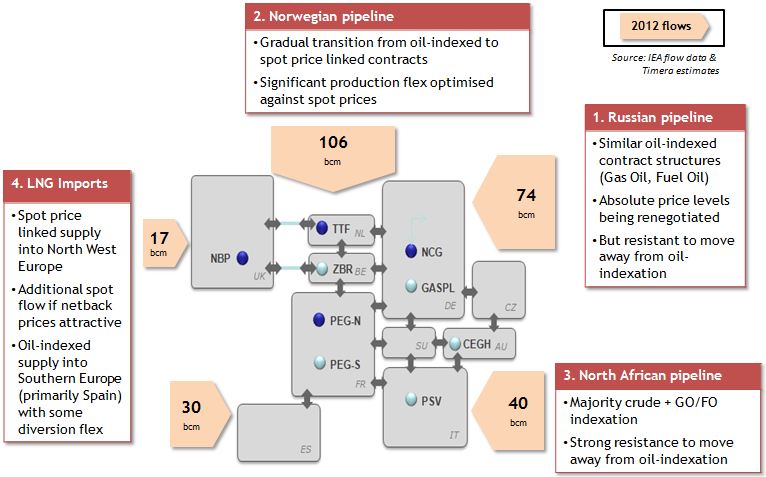
To understand hub pricing dynamics it helps to start by drawing a ring around the European countries that have direct access to hub liquidity. The boundaries of this ring are somewhat arbitrary depending on focus, but broadly include North West, Central and Southern Europe. Within this boundary, European gas supply can be grouped into several key sources by geography as illustrated in Diagram 1. The diagram illustrates volumes by supply source based on 2012 gas flows.

Diagram 1: Sources of European gas imports

2012 Gas Flows

Note: Diagram and gas flows based on a European hub zone boundary that covers UK, BE, NL, FR, DE, CZ, AU, CH, IT & ES.

The following is a brief summary of each source of supply:

  1. Russian supply – imported under long term supply contracts of a relatively consistent structure, incorporating (i) indexation to oil products (ii) with some volume flexibility but (iii) a take or pay constraint.
  2. Norwegian supply – which can be split into two components:
    • Long term oil-indexed supply contracts (on a similar basis to Russian supply).
    • Supply that flows based on spot price signals, incorporating (i) hub indexed supply contracts and (ii) uncontracted Norwegian production.
  3. North African supply – primarily import contracts into Italy and Spain on a similar pricing and flexibility basis to Russian gas (although with a greater influence of crude indexation and generally higher contract prices).
  4. LNG supply – which can be split into two components:
    • Long term oil-indexed supply contracts (primarily into Southern Europe).
    • Supply that flows based on spot price signals, incorporating (i) hub indexed supply contracts into North West Europe and (ii) global LNG spot market supply (i.e. cargoes that flow into Europe based on spot price signals).
  5. Domestic production – dominated by declining field production in the UK and Netherlands.

The other key supply dynamic that is not captured in these five categories is gas storage capacity. This is not to say storage should be ignored – it can in fact be a very important driver of hub pricing dynamics. But it makes more sense to think of storage capacity as enabling the movement of gas between time periods, rather than as an outright source of supply. Seasonal storage acts to move gas from lower priced summer periods to higher priced winter periods. Fast cycle storage acts in a similar fashion but over a short time horizon.

The geographical groupings of supply sources set out above are defined primarily on contractual rather than physical characteristics (although uncontracted sources are also captured). This enables a focus on the commercial decisions that drive the pricing and flow of gas, rather than trying to capture the detailed complexity of physical assets and infrastructure. The logic of these groupings will become clearer as we explore how flexibility drives pricing.

Types of supply: flexible vs inflexible

Gas supply volumes are either flexible or inflexible. Flexible supply can respond to changes in hub pricing, with flows based on the relationship between hub prices and contract prices (or an opportunity cost alternative in the case of storage). But the majority of European gas supply is inflexible, i.e. supply volumes are insensitive to changes in hub prices. This characteristic is key because it greatly simplifies the task of understanding hub price drivers.

Inflexible supply falls broadly into three categories that make up around 75% of European supply:

  1. Pipeline contract take or pay volumes – Virtually all long term pipeline supply contracts into Europe contain provisions where buyers must pay for gas volumes (typically 80 – 90% of annual contract quantity) regardless of whether gas is taken.
  2. Destination inflexible LNG contracts – Supply contracts into Southern Europe have traditionally had fixed destination clauses that prohibit the diversion of gas (although a number are being renegotiated).
  3. Domestic production – With the exception of a small number of fields, production within Europe is largely insensitive to price.

It is important to account for these inflexible volumes in developing an overall view of the supply & demand balance across Europe. These volumes will essentially flow regardless of the absolute hub price level (although several tranches are profiled within year and have an influence on seasonal price spreads). But in terms of understanding the drivers of hub pricing dynamics, inflexible volumes sit a long way down the list of priorities.

Much more important are the volumes of flexible supply that are responsive to price. These are summarised in the following table:

Flexible tranche

Impact on hub pricing

Pipeline contract swing volumes

  • Contract owners optimise swing volume flexibility in pipeline contacts as a function of contract prices and hub prices.
  • Broadly, contract lift is minimised to take or pay levels if contract owners can source their incremental gas requirements for less at the hub (contract price > hub price) and contract lift is maximised if it is cheaper to do so (contract price < hub price).
Uncontracted pipeline import flexibility
  • Focused on Russian and Norwegian production given North African supply constraints:
  • Norway typically flows gas to spot price signals within a target production range.
  • Russia is likely to require hub prices at or above existing oil indexed contract levels before flowing additional uncontracted gas.
Spot and divertible LNG supply
  • Divertible LNG supply contracts typically flow based on the opportunity cost of LNG in the global spot market (i.e. hub prices need to be above global spot prices adjusted for shipping, risk premiums and transaction costs), although portfolio dynamics may also influence diversion economics.
  • Spot LNG cargoes flow into Europe if hub prices are greater than prevailing netback global LNG spot prices (as was the case in 2009-10).
  • One notable exception is Qatar which currently manages a ‘strategic’ flow of spot LNG cargoes into North West Europe, in order to avoid putting excessive downward pressure on the Asian spot price (a threat to its long term contracting goals).
Gas storage
  • Storage capacity provides the flexibility to move gas between different time periods (e.g. summer to winter).
  • The exercise of this flexibility is driven by the opportunity cost of flowing gas in different periods, which is in turn a function of the other flexible supply sources set out in this table.
  • So storage acts to smooth seasonal shape and volatility in hub prices, but it is not a primary driver of hub price level.


Hub prices move based on the changing intersection between demand and supply. Given demand is relatively insensitive to price, it is supply flexibility that plays the central role in determining how prices evolve at the margin. So a solid grasp of hub price dynamics can be built around an understanding how the different sources of flexible supply interact to drive marginal pricing.

In order to do this a view of the pricing of each flexible supply source is required. Although there are many individual supply contracts that determine this, the fact that each flexible supply source uses a similar pricing structure makes life easier. Price proxies can be developed relatively easily, for example for Russian, Norwegian and North African oil-indexed supply (see here for an explanation of how). Alternatively if you prefer to steer clear of spreadsheets, you can gain a reasonable understanding from forward market prices and published contract benchmarks, for example for the German border price of oil-indexed contract imports.

Pulling everything together

So far we have talked about (i) geographical groupings of supply and (ii) different types of flexible supply. The picture comes into focus when we combine these two views to define the main individual tranches of flexible gas supply. It is the commercial dynamics of these tranches that are the primary driver of hub pricing dynamics.

Of the flexible sources of supply, pipeline contract swing is of principle importance. Russian and Norwegian oil-indexed contracts are particularly important as a provider of swing flex into Germany. Utilisation of this swing flexibility tends to anchor European hub prices within a band around oil-indexed contract price levels.

This price band is somewhat flexible, but it is also resistant. It can be stretched by prevailing supply and demand dynamics, but the further prices deviate from oil-indexed benchmarks (e.g. the German border price), the stronger is the force acting to pull prices back. As hub prices fall below oil-indexed contract prices, contract owners utilise swing to pull back on contract volumes which supports hub prices. As hub prices rise above oil-indexed levels, swing gas flows increase acting as price resistance.

Norwegian uncontracted production flexibility also plays an important role. Norwegian flows are a key source of seasonal flexibility as well as an equalising force across hubs (given multiple delivery points across North West Europe). Norway also holds an important strategic card in being able to pull back on production to support hub prices in periods of oversupply.

Flexible and spot LNG supply is currently of less importance to European hub pricing. The prevailing structural Asian spot price premium means diversion flexibility is being fully utilised to send cargoes east. But with volatile spot prices, this situation can change at short notice e.g. the temporary LNG flows back into Europe in summer 2012.

Next week we apply the framework

The logic set out above describes the basic elements of a framework to understand European hub pricing. This is built around the interaction between the flexible tranches of supply that drive marginal pricing. At a summary level these are factors that you can grapple with in your head. If you want to dig deeper, a more dynamic representation of the framework can be developed in a spreadsheet relatively easily. We have taken it a step further again and developed a more detailed framework model, but this is no prerequisite.

Next week we focus on the more practical application of this framework, using examples to illustrate how tranches of flexible supply move hub prices. Importantly we also look at the strategic considerations of the key players with significant market power, the Russians, Norwegians and Qataris. To do this we develop a simple ‘supply stack’ view of European flexibility. We then use the framework and supply stack view to illustrate the commercial dynamics driving hub price evolution.

Strategic negotiation with portfolio assets in play

This is the third and final in a series of articles on commercial negotiation of long term energy contracts, written by Nick Perry.

In the first two parts of this series we looked at how out-of-the-money long term energy contracts (LTCs) give rise to commercial tensions.  We considered how these can either degenerate into wasteful commercial conflict or, more constructively, act as a catalyst for win-win renegotiations.  We also considered the scope for creativity in recasting the contract across several of its many dimensions, allowing the distressed party to trade for some relief against its main source of financial pain, and enabling both sides to avoid the uncertain outcome of arbitration or the courts.

In this final article of the series, we extend this lateral thinking even more widely, to look at opportunities for commercial tradeoffs at a portfolio level.

Broadening the scope

We have already observed that by their very nature, LTCs are complex and multi-dimensional.  This provides fertile ground for creative commercial thinking and, in particular, for win-win opportunities to be found.  These often arise as a result of asymmetries in the positions of the two parties: their respective costs of capital; their assessments of extrinsic value; their tax positions; their varying abilities to manage risks; their trading capabilities etc.

In the same vein, it is usually the case that the parties to large energy LTCs are companies with extensive portfolios.  These often range widely across regional energy sectors (utilities with generating fleets, gas assets and infrastructure investments) or international markets (oil and gas players with widespread interests), or indeed both.

Leveraging the portfolio

Large companies rarely see themselves as static: they generally have strategic goals that include transition over time away from, say, one traditional class of assets or geographical location towards another.  Their counterparty in an LTC may very probably have assets that could be of interest to them in their longer-term objectives: and in the 21st century most assets ‘have their price’.

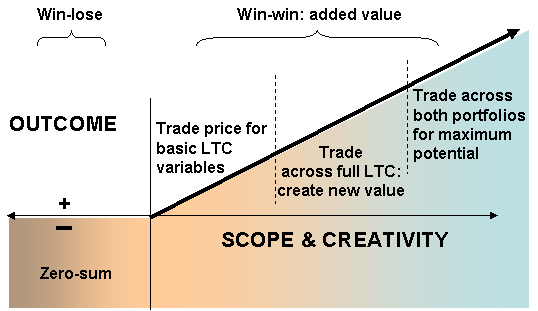
Open-minded consideration of the two portfolios across the negotiating table may reveal useful differences in valuation – be that cash or strategic value – that can be traded on, in exactly the same way as terms within the LTC but on an even larger and more fruitful scale as illustrated in Diagram 1.

Diagram 1: Creating value by expanding negotiation creativity and scope

Timera graphic2

The key requirements to turn this from a theoretical prescription into a practical source of significant value are several:

  • Creative and experienced negotiators, deal structurers and advisers
  • A comprehensive and flexible analytical capability to identify and value opportunities
  • Open-minded corporate management, willing to consider creative solutions

Companies should resource negotiations appropriately to the amount of value at stake.  These can be among the largest sums that will ever be contested across their negotiating tables.

Companies that know the score

The energy companies that are probably most familiar with this approach are E&P players in the oil and gas sector.  They often have very different legacy portfolios specialities.  For example, one may have an exploration bias, a US market orientation, and strongly prefer gas assets over oil; another may have offshore specialities, its own refineries, and favour already-producing oil plays in developing markets.

Their risk management precepts also place value on portfolio diversification; and they are well-versed in joint ventures, ‘farming-in’ and ‘farming out’ assets.  Asset swaps are a familiar feature of their commercial repertoire.  For such companies, their non-core assets are always potentially ‘in play’, and can serve to add a depth of possibilities to a commercial forum that was initiated by the need to renegotiate an LTC.

Examples of the portfolio approach

Companies from other traditions do well to emulate this open-minded commercial approach, and some have done this successfully. Good examples include:

  • E.ON, which has exchanged European downstream positions and midstream assets with Gazprom in exchange for upstream assets in Russia
  • BASF, which has packaged gas LTCs with assets and marketing ventures in deals also with Gazprom

Perhaps the most comprehensive example of a successful portfolio approach to solving distressed LTCs is that of the former British Gas Corporation (BGC), and its offshoot Centrica in its first years of existence after de-merger from BGC in the mid 1990s. At that time BGC was in a classic LTC squeeze, having over-bought gas in a series of GSAs at prices that were many billions of pounds out-of-the-money after the UK gas price collapse of 1994-5.

In order to give its corporate restructuring the best chance of success, BGC and later Centrica entered a series of difficult renegotiations with the key gas producing companies that were the counterparties to their GSAs. They were prepared to consider any contractual structure, and indeed settled on a wide range of different solutions. Some deals were bought out for cash; some with changes to the detailed terms of the GSAs; and others involved assets from BGCs own portfolio of UKCS assets.

In less than 2 years they negotiated out the most economically damaging prices in their portfolio under more than a dozen LTCs – a very commendable timetable, given how long some LTC counterparties take to renegotiate a single GSA. (For completeness it should be noted that the UK government made clear to all the parties concerned that they were expected to make constructive progress in these sessions, and itself contributed expeditious treatment of the several complex tax issues involved.)


Negotiating with perspective

Out-of-the-money LTCs can be a source of substantial damage to energy companies, with severely out of the money contracts sometimes proving fatal.  Attempts to re-negotiate contracts can be extremely fraught.  Too often a one-dimensional, zero-sum, win-lose approach is taken to contract negotiation.  But a creative commercial approach that is allowed to range over as wide an area as possible – within the LTC itself and sometimes even more widely across the portfolio – can identify win-win opportunities that facilitate better outcomes for both parties.

Gas plant & renewable penetration: a UK case study

The increase in renewable capacity is eroding gas plant generation margins across Europe.  At the same time there is an increasing system requirement for gas plant flexibility to support renewable intermittency.  This paradox is challenging the orderly operation of wholesale power markets in Europe.  But it remains unclear how intermittent renewable and gas-fired plant will happily coexist.

In this article we focus on the interaction between renewable and gas capacity by exploring their impact on supply curve dynamics.  The issues are similar across most European power markets, but we have chosen the UK as a case study given its tight capacity margin and security of supply issues.  The UK response to gas plant remuneration may well form the blueprint for other European markets to follow.

Supply curve transformation

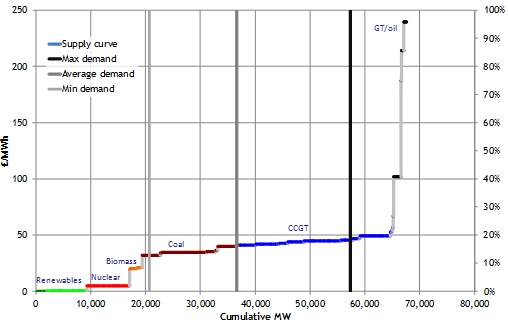
Commodity prices and government policy are conspiring against gas plant across Europe.  The precipitous fall in coal prices over the last two years has resulted in coal plant sitting clearly ahead of gas plant in the generation merit order.  At the same time, government support for low variable cost renewable capacity is eroding gas plant generation margins.  These factors are best understood by considering their impact on the generation supply curve.  While the effects are similar across most of Europe, we focus on the UK market as an illustration.

Chart 1 shows the UK generation supply curve.  UK plant are ranked by short run marginal cost based on forward fuel and carbon prices for the 2013-14 gas year (Oct 13 – Sep 14). The volume of intermittent renewable capacity is de-rated for average plant load factors (e.g. average wind conditions).  So the chart shows a snapshot of supply given average conditions across the year.

Chart 1: UK supply stack (2013-14)

stack chart1

Source: Timera Energy.  Note: Supply stack reflects average plant & interconnector availability.  Actual plant & interconnector operation will differ at any specific point in time depending on availability, system requirements & market conditions.

Government support is expanding the low cost tranches of renewable capacity (wind, solar, biomass) at the left of the supply curve.  This pushes the market price setting tranches of gas and coal capacity to the right, reducing thermal plant load factors.  As a result, demand (illustrated via max, average and min annual levels) is met by cheaper plant, dragging down wholesale power prices.  Lower load factors and lower power prices are eroding gas plant margins and value.

Looking at the problem through a different lens

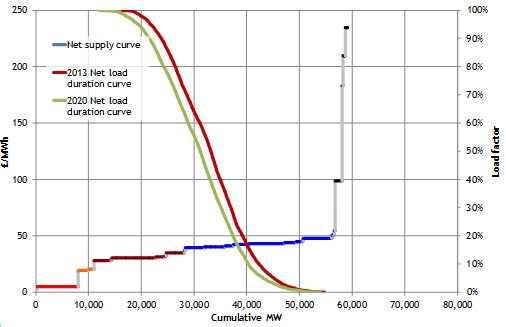
It is difficult to get a clear picture of the impact of renewable intermittency by looking at the supply curve snapshot in Chart 1 which only shows annual average load factors.  A different approach is required in order to appreciate the impact of swings in the output of intermittent capacity.  It is more helpful creating a supply curve net of uncontrollable generation (e.g. wind, solar and interconnectors).  Uncontrollable generation can then be netted of system demand to generate a net load-duration curve as illustrated in Chart 2.

The left hand vertical axis in Chart 2 again shows the marginal cost of plant as for Chart 1.  But the load duration curve which is overlaid, is measured against the right hand axis and shows the range of system demand (net of uncontrollable generation) from the lowest hour in the year (top left = 100%, ~56GW), to the highest hour of the year (bottom right = 0%, ~17GW).  The red net load duration gives an indication of current conditions based on actual 2012 demand, wind and interconnector flows.

Chart 2: UK supply stack net of uncontrollable generation (2013-14)

stack chart2

Source: Timera Energy.  Note: 2012 relationship between demand, wind, hydro and interconnectors has been used to project net load duration curve.  Load factors are indicative only.

The advantage of this adjusted view of the supply stack is that it gives a much clearer indication of how thermal plant are required to meet net system demand.  An indication of annual load factors for different plant can be measured against the net load duration curve.  For example it can be seen that:

  • Only the most efficient coal plant are required to operate baseload
  • Newer CCGT plant are currently only running mid-merit (~50% annual average load factor)
  • About a third of UK CCGT capacity is currently running at very low or zero load factor (i.e. only really operating for balancing and reserve purposes)

The impact of adding another 10 GW of intermittent renewable capacity to the UK stack this decade is illustrated with the green net load duration curve.  Compared to the red curve, the green net load duration curve stretches to the left as average renewable output increases, but peak net system demand (bottom right = 0%) is largely unaffected.

Adding wind and solar capacity reduces average net system demand across the year.   But there are still hours in the year when the wind doesn’t blow and the sun doesn’t shine.  New renewable capacity has little impact on the volume of backup gas plant capacity required to maintain security of supply.  It also increases transmissions stress and system balancing issues.  So in order to maintain security of supply, gas plant needs to be adequately remunerated for providing flexibility support.

The gas plant owner’s dilemma

Saying that the market needs to remunerate gas plant may sound like cold comfort to asset owners currently being battered by depressed plant margins.  After all there is a long history of markets making a fool of economic theory.  But as renewable capacity continues to expand across Europe, there appear to be 3 potential outcomes for gas plant remuneration:

  1. Market remuneration: Gas plant returns increase in the fewer hours of the year that plants operate i.e. there is an increase in market and balancing mechanism volatility and ‘super peak’ pricing.  While the market may deliver this outcome if left alone, regulatory authorities may not tolerate the associated price volatility.
  2. Capacity/reserve payments:  Regulatory authorities step in to provide support for gas plant via new revenue streams outside the wholesale energy market e.g. via capacity market and/or supplementary reserve payments.  This looks to be the route the UK will pursue.
  3. Under remuneration: There is inadequate remuneration for flexible gas plant, causing plant closures and a tightening capacity margin. This describes the current conditions across much of North West Europe given surplus capacity, although as thermal capacity closes 1. or 2. will eventually need to happen if security of supply is to be maintained.

Support for renewable capacity is set to continue to erode gas plant load factors. But the key question for gas plant owners is how incremental flexible capacity will be remunerated going forward.  Via wholesale market spreads and volatility, via a capacity market or via balancing and reserve payments.  The UK, given its relatively tight capacity situation, is the ‘canary in the coal mine’ for European power markets.  In an article to follow, we will consider how the uncertain evolution of plant remuneration impacts gas plant valuation.

US exports are a big deal for global gas pricing

US LNG exports are firmly on the gas industry radar.  But the primary focus to date has been on whether US LNG is cheap vs alternative sources of supply such as Australia and East Africa.  While this focus is understandable from a competitive perspective, US exports are more than just another source of global supply.

The structure of US supply contracts is fundamentally different to that of conventional LNG supply.  Importantly, US LNG supply is hub indexed and inherently flexible.  As a result, the ramping up of US exports mid-decade is set to significantly impact global LNG pricing dynamics.

US export contracts vs conventional LNG supply

US supply contracts are structured as a liquefaction capacity option rather than a firm commitment to take a volume of cargoes.  This capacity option is exposed to the spread between Henry Hub prices and the shipping cost adjusted netback spot prices that can be achieved selling gas into the global market.

Fixed cost:  The fixed fee (or option premium) component of cost is a capacity fee.  This is designed to cover the costs of liquefaction terminal development.  The 2.25 $/mmbtu fixed fee in the first export contract from Sabine Pass between BG and Cheniere, gives a reasonable indication of the cost of brownfield liquefaction development at an existing US regas terminal.  Fixed fees in export contracts signed since this have been closer to 3 $/mmbtu, although it will be interesting to see if these levels can be maintained as export project competition hots up.

Variable cost:  The fixed fee is important from a total supply cost perspective.  But once an export contract is signed, this cost is sunk and therefore becomes largely irrelevant in influencing commercial decisions around the flow of gas.   The variable cost of exports at Sabine Pass is structured as a percentage premium on top of the Henry Hub price.  So the short run marginal cost (SRMC) of exported gas is 115% times the Henry Hub price (about half of this premium covers the actual cost of gas used in the liquefaction process).

Importantly there is an inherently high level of flexibility in export contracts.  Flexibility to hedge price levels at Henry Hub.  But also flexibility to deliver exported gas to whatever location offers the highest netback spot price.   This is a very different structure to traditional fixed destination clause oil-indexed LNG supply contracts.

US export contract flow decisions

The flow decision for US export contracts will be driven primarily by two factors:

  1. The variable cost (or SRMC) of US export contracts i.e. Henry Hub plus the costs to get LNG onto a vessel (primarily liquefaction).
  2. The netback global spot price signals that represent the market value for exported gas, adjusted for appropriate shipping costs.

As long market conditions are such that 2. exceeds 1. then US gas will flow into the global market, constrained by the volume of US export capacity.

On a variable cost basis, US exports are relatively cheap.  Based on current Henry Hub forward prices, US export SRMC will be around 5 $/mmbtu mid decade, rising to around 7 $/mmbtu by the end of the decade (given forward curve contango).  Add $1.00-1.50 for shipping to Europe and $2.50-3.00 for shipping to Asia and these contracts are well in the money on an SRMC basis vs European (9-10 $/mmbtu) and Asian ($15/mmbtu) price benchmarks.

So barring the return of another major global gas glut (not out of the question, particularly later this decade), US export contracts should flow baseload.  But given the inherent delivery flexibility in the export contracts, LNG will tend to flow to spot price signals, unlike most of the existing DES long term contracts into Asia.

That does not mean that flexible LNG contracts will always be physically diverted to the highest priced market.  There are important liquidity, transactions cost and portfolio effects that will impact the actual flow of gas.  But LNG spot price signals will represent an increasingly transparent opportunity cost for the contract owner, of the decision to flow gas to a particular destination.  Whether that opportunity cost drives the actual diversion of gas, sale to a third party or internal portfolio re-optimisation will depend on the specific circumstances involved. 

Watch out for the spot market impact

The volume of the first tier US export projects looks to be in the order of 45 to 60 mtpa (of a total ‘proposed’ volume in excess of 200mtpa).  In a global market context (~240 mtpa) this is not an overwhelming volume when anticipated incremental demand growth is considered.  However the volume of first tier US projects is large in the context of spot market pricing dynamics, given only around 20% of global LNG supply is currently flexible.

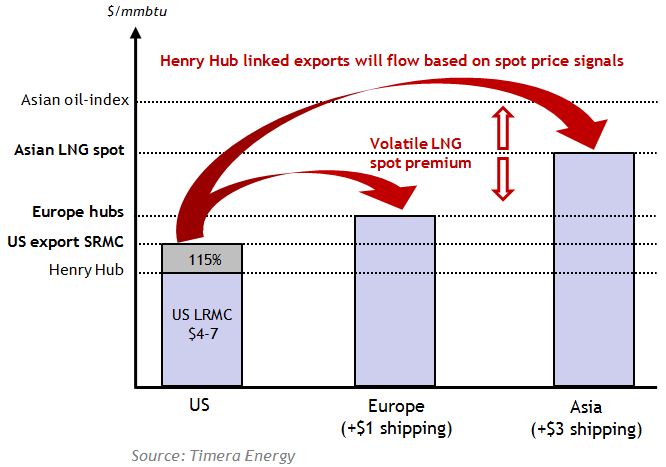
This significant increase in LNG volumes that flow to spot price signals is set to have two key impacts on global pricing as illustrated in Chart 1.

Chart 1: The impact of US exports on global spot price dynamics

US Exports

US exports will act to:

  1. Reduce global spot price differentials – given delivery flexibility, US LNG will tend to flow to the highest price market on a netback basis.
  2. Reduce spot price volatility – US exports will increase the volume of flexible gas to respond to fluctuations in global spot prices, dampening volatility.

As long as US export capacity remains constrained, this will limit the extent to which Henry Hub becomes a key driver of long term contract pricing.  However on a shorter term basis the influence of Henry Hub price signals on LNG spot pricing dynamics is likely to increase, even if US export capacity remains constrained.

Implications for LNG supply contracting

Commercial and investment decisions in the LNG market are currently being strongly influenced by prevailing market conditions.  That is understandable in a post-Fukushima world of tight supply, large regional price differentials and constrained supply flexibility, factors likely to remain until at least the middle of this decade.

However many market players are looking to invest in or acquire LNG supply flexibility over a much longer time horizon.  And given current market conditions, supply flexibility is expensive.  In this context, understanding the impact of US exports on pricing dynamics and the value of flexibility is an important consideration.  LNG exports are ultimately a factor working against the value of LNG supply flexibility.


Getting creative with long term contract renegotiation

This is the second in a series of articles on commercial negotiation of long term energy contracts, written by Nick Perry.

European gas contract re-opener negotiations are re-shaping the pricing and flexibility of gas flows into Europe.  Re-opener discounted tranches of Russian gas are having a growing influence in setting marginal hub prices.  Greater portfolio supply flexibility is being facilitated by the negotiation of spot indexation, take or pay volume reductions and LNG delivery flexibility.  Most of these renegotiations are being triggered by concerns around contract price level.  But as parties come to the negotiating table there is a lot more in play.

In the first article of this series we noted that long-term energy transactions, like other forward contracts, generally have a very small mark-to-market (MTM) value for both parties when the deal is first done.  However, over time the contract can increase in MTM value very significantly for one side – and decline in value correspondingly for the other.   We now consider how this potentially damaging commercial tension can be harnessed constructively to benefit both parties.

Getting to the re-negotiation table

Genuine commercially-motivated re-negotiations will typically occur when both the buyer and seller agree that ‘something has to change’.  This may be even though the parties have very different views as to what this change should be before they get to the table.  Clearly, for at least one party an extreme adverse MTM value-shift can be one such reason for seeking changes.

European energy contract re-negotiations are usually initiated via one of two routes, depending on the legal jurisdiction under which the contract was signed:

  1. Contracts entered into under a Civil Code approach (found in most European, South American and non-English-speaking Asian countries), typically contain re-opener clauses that specify the conditions under which contract counterparties should come together to resolve a dispute.
  2. Contracts entered into in a Common Law context (as found in most of the English-speaking world), typically do not have a formal contractual trigger for renegotiation, meaning that it is usually commercial incentives that bring parties to the table.

For those interested, a further analysis of Common Law and Civil Code context is provided in the breakout section below.  Otherwise, we move straight on to the commercial considerations in contract negotiation.

Further analysis: A Layman’s Guide to Common Law vs Civil Code context

In a Civil Code context, conditions of extreme market movements or any other cause of material change in contract MTM value make it almost inevitable that re-negotiation will occur.  By contrast, the Common Law legal tradition is for contracting parties to make changes to contracts only through bilateral (re-)negotiation, coming together for this purpose on a voluntary, ‘willing buyer, willing seller’ basis.

[Read more]

Under the Civil Code approach (found in most European, South American and non-English-speaking Asian countries) there can be circumstances in which a commercial court could intervene to impose a change in price and other contract terms: and one or other contract party could unilaterally approach the court for such a ruling – usually when they were in financial distress arising from the terms of the contract. In advance of such a situation (i.e. when the contract is first being negotiated) parties are naturally reluctant to leave their future commercial fate for a general commercial court to decide, and would prefer expert arbitration.

To avoid the courtroom, LTCs subject to Civil Code jurisdiction therefore generally contain ‘re-opener’ clauses which dictate conditions under which one or other party can demand that the contract be submitted for expert determination, which both parties agree in advance they will accept. These clauses will typically state a time-interval (e.g. 3 years) and a ‘threshold of pain’ (e.g. extent of change in market conditions) which must be met in order for one party to be able to call for arbitration unilaterally. It is usual for re-opener clauses also to require negotiations to be conducted in good faith prior to the suffering party invoking arbitration.

Common Law parties sometimes agree that foreseeable contractual disputes on minor matters are to be settled by arbitration; but it is very rare that they would allow arbitration to change something as fundamental as contract price, however extreme the market circumstances.

Likewise, under Common Law, the courts are generally unwilling to impose a change in contract price or other significant terms, even if the contract has become materially out-of-the-money for one party. So any re-negotiation will take place only because both parties feel they have something to gain.


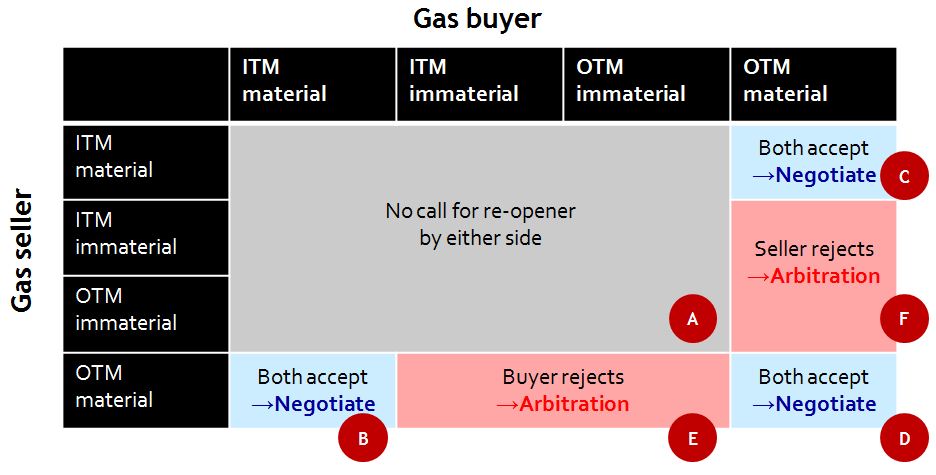
Negotiation – Civil Code context:  contract renegotiations follow a formal re-opener process.  The potential paths through the re-negotiation of a long term gas supply contract are illustrated in Diagram 1.

Diagram 1: European long term gas contract re-negotiation map
Negotiation Matrix

In the diagram we take the extent to which the contract has become out-of-the-money (OTM), either ‘material’ or ‘immaterial’, as a proxy for the degree of pain being suffered by a contract party.  Material represents MTM stress above the contractually defined ‘pain threshold’ to trigger a re-opener.  If the buyer assesses the contract is OTM for itself we assume it will assess it as being correspondingly in-the-money (ITM) for the seller.  It is worth noting however, that it will not always be that the buyer and seller agree in their assessments either of their own position or their counterparty’s.

There are broadly 3 potential situations that can arise:

1.  No re-opener

If both the buyer and seller independently assess that the contract is (i) ITM for themselves, or (ii) OTM but only to an immaterial extent (i.e. below the ‘pain threshold’)Then they will not convene to re-negotiate (the grey area marked A in the diagram).

2.  Negotiation

If the buyer and seller both agree that one of their positions is OTM to a material extent, then they will meet to renegotiate (areas B and C).  This has been illustrated by the more proactive approach Statoil and Gas Terra have taken to renegotiating some of their ITM contracts with European suppliers (area C).

Interestingly, if both parties simultaneously consider the contract is OTM for themselves (and they might both be right!), they will also meet to renegotiate (area D) even though they may be seeing things differently.  This can be the most fruitful circumstances for a win-win outcome!

An example of this is an oil-indexed European LNG supply contract with a fixed destination clause, which is OTM vs European hub prices for the buyer and OTM vs Asian LNG prices for the seller.  Both parties win from cancelling the contract, or negotiating diversion rights such that upside is shared between the buyer and seller.

Of course, nothing guarantees that re-negotiations will succeed, and ultimately the case may go to arbitration (or the courts).

3.  Arbitration

Arbitration tends to result when the buyer and seller disagree on the size/impact of the change in contract value. For example, if the seller is of the view that the contract is OTM for itself and the buyer rejects this assessment, the seller will invoke arbitration (area E): or vice versa for the buyer (area F).  A prominent example of this is the recent arbitration cases between Gazprom and large European gas suppliers, where there has been a fundamental disagreement over the role European hub prices play in determining the long term value of gas.

Negotiation – Common Law context, there are typically no formal contractual drivers for the re-negotiation process, or recourse to arbitration or the commercial courts.  What happens commercially will then be a function of the attitudes of the parties.  If the ITM party is reluctant to engage, without a back-stop of arbitration sometimes the only ‘threat’ available is for the OTM party to hint at inability to perform the contract.  In extreme circumstances some distressed parties have been known to default deliberately in order to trigger negotiations. There were several cases of this happening in the period 1995-98 in the UK, when the gas price collapsed and many contracts became significantly OTM. Needless to say, this often degenerates into litigation, and represents a failure of sound commercial practice.

It must always be a principle of good business that parties should at least meet to explore each others’ positions.  Regrettably, in both Civil Code and Common Law contexts the ITM party often enters discussions with the time-worm attitude: what’s mine is mine, and what’s yours is open for discussion.

Identifying  opportunities for win-win

When an OTM party comes to the table it will generally be self-evident as to what changes ideally they would like: at its most basic, a distressed seller will ask for a higher price and a buyer will want a lower.  As we noted in Part 1, the counterparty must certainly have uppermost in mind a clear perception of what is at stake, not least when the LTC represents a hedge.

In consequence it can be all too easy to see the matter as a straight win-lose, zero-sum game: the buyer wants a lower price – how can that be other than at the direct expense of the seller?  Unless there is a genuine prospect of the buyer’s bankruptcy (which would completely nullify the seller’s hedge), can the buyer’s appeal for a lower price be other than a charitable request (perhaps based on the business relationship)?

Nine times out of ten, for the seller to approach the situation from this limited perspective is culpably to ignore the scope for creative outcomes.

One of the most striking aspects of energy LTCs is how complex they are – inevitably so, as they must cover the wide range of contingencies which energy companies face.  To contract administrators, complexity can be a nightmare!  To the creative negotiator, however, complexity is a rich source of commercial possibilities.

At very least, LTCs will frequently contain terms such as price-indexation formulae and flexibility provisions (swing, take-or-pay, carry-forward etc).  These represent multiple dimensions, all of which can be analysed for the value that lies in them.  And whereas the buyer and seller will typically have the same view of the value of one unit of price, they may have quite different assessments of the value of, say, an incremental 10% of swing, or a switch from oil indexation to spot-gas indexation in the pricing formula.  This has been illustrated in the recent renegotiated outcomes of many of Gazprom, Statoil and Gas Terra’s contracts with suppliers.

Thus, price may to some degree readily be traded for movement in one of the other basic dimensions of value, for example the price decrease may be bought with an increase in flexibility.  Here it is very usual – and commercially helpful – for valuation of flexibility / optionality to vary widely between different players in the same market.  This is often the source of great opportunity for a win-win negotiated outcome.

Getting creative

But this is only the start of the creative thought-process.  At its most general we can assert that over time, even an LTC that seemed perfect to both counterparties when first negotiated will start to become less satisfactory in many details.  Given the complexity and sheer length of tenor of energy LTCs, and the significant changes that take place in energy markets, this is inevitable.  The buyer will have his list of various changes he would ideally like to make, ranging across the whole contract, and the seller will have his own – likely to be different in many respects, which is exactly what gives rise to potential for fruitful trade-offs.

Therefore, both parties, including the ITM party, should be approaching the table with a prioritised – and carefully evaluated – wish-list.  The list of possibilities is endless, including entirely new contract terms, and the number of dimensions in play goes far beyond price and flexibility.  Everything has a price, and constructive win-win trades should be possible between open-minded and commercially-creative counterparties. There should always be a commercial pretext for constructive re-negotiation.

Viewed in this way, when an LTC becomes materially OTM it is seen as a catalyst for all-round win-win contractual enhancement, in which the suffering counterparty can trade for some degree of relief against its main source of pain. This is the correct mind-set for companies approaching a re-negotiation.

But this is not the end of the story, and in the final article of this series we consider an even more wide-ranging perspective on energy contract re-negotiation.

Getting comfortable with CCGT extrinsic value

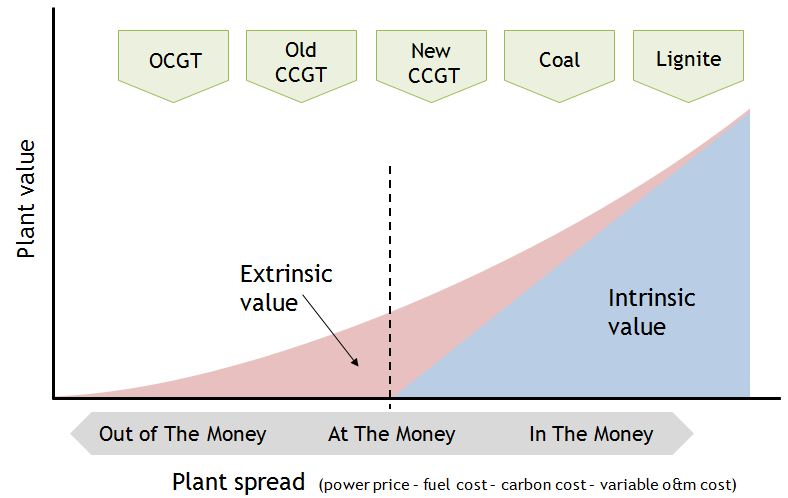
CCGT power plant valuation has traditionally focused on intrinsic value, the value of dispatching the plant against prices observed in the forward market.  Any mention of the extrinsic (or flexibility) value of CCGT assets, resulted in nervous glances around the table.  Extrinsic value was considered to be icing on the cake.  Nice if you could get some, but unreliable and unbankable.

With the rapid decline in CCGT generation margins since 2010, Europe is now a different place.  Support for intermittent renewable capacity has driven down power prices and cheap coal has displaced gas plant from the merit order.  CCGT asset values have been written down as a result.   But the value of CCGT assets has evolved not disappeared.

Intermittency is causing a structural increase in the requirement for system flexibility, in the form of responsive but lower load factor generation.  CCGT assets are well placed to service this requirement.  But the extrinsic value from plant flexibility now plays a central role in defining CCGT asset value.  The owner of a newer CCGT may still have the ability to hedge some intrinsic value over peak periods, but an increasing portion of asset value is now extrinsic.  For older CCGTs, 100% of value is extrinsic.

Deconstructing CCGT asset value

CCGT value is driven by the clean (or carbon adjusted) spark spread achieved by the plant.  This spread is simply the difference between the market power price and the variable cost of operating the plant, calculated in any given period as:

clean spark spread = power price[€/MWh] – gas price[€/MWh] / plant efficiency[%] – carbon price[€/t] × plant carbon intensity[t/MWh]

Note: the formula above is for a European gas plant.  Conversions (energy and currency) and the consideration of the Carbon Price Floor are required when calculating the clean spark spread for a gas plant in the UK. 

A CCGT asset is essentially a strip of options on the spark spread.  These options can be exercised on a very granular basis over a short time horizon ahead of plant dispatch, e.g. against hourly or half hourly price granularity in the spot market or even finer granularity in balancing markets.  But monetising plant value based on short term optimisation alone, usually results in unpalatably high earnings volatility.

So where possible, asset owners will typically hedge plant exposures in the forward market.  Exposures can be hedged on a forward basis by grouping the strips of plant options into a granularity that matches available forward contracts in the power, gas and carbon market.  These forward hedge positions can then be adjusted in response to changes in market prices.

Extrinsic value of European power plant

The intrinsic value of a CCGT can be monetised with low risk, by hedging generation margin in the forward market and then dispatching the asset to fulfil the hedge.  So hedging intrinsic value sets a floor for plant returns (ignoring plant outage risk for the moment).  But the plant can also be ramped up to respond to periods where spark spreads move higher and ramped down during periods of zero or negative spreads.  Extrinsic value is generated from the flexibility of the power plant to respond to changes in market prices.

European CCGTs currently have relatively little intrinsic value at current forward market prices.  Sparkspreads range from slightly positive values in the UK, to pronounced negative values in markets like Germany and the Netherlands that are currently suffering from significant overcapacity.  In other words the strip of CCGT plant spark spread options is only slightly ‘in the money’ in the UK and well ‘out of the money’ across much of Continental Europe as illustrated in Chart 1.

Chart 1: Intrinsic/extrinsic value split for European generation assets

CCGT extrinsic

Source: Timera Energy

Note: Chart 1 illustrates baseload ‘in the moneyness’ of different assets.  Assets can also be hedged on a peakload basis, giving a slightly different picture, although the principles are the same.

A lignite plant which is deep ‘in the money’ at current market prices, has relatively low extrinsic value.  Lignite plant flexibility is of little value, given healthy generation margins mean the plant is likely to be running anyway.  But weak forward generation margins for CCGT assets mean that extrinsic value is very important.

Extrinsic value for a plant is highest when it is ‘at the money’ or when the plant spark spread is zero.  At this point only small changes in spread are required for the asset to ramp up if the spread goes positive, or ramp down if the spread turns negative.  Similarly, small movements in forward prices may open up a spread margin that can be hedged.

The key driver of extrinsic value is market volatility.  The more volatile prices and spark spreads are, the higher the value of plant flexibility in being able to respond.  It is this exposure to spark spread volatility rather than to the absolute level of spark spreads that has historically made CCGT investors nervous about extrinsic value.

Monetising extrinsic value

In order to appreciate how CCGT extrinsic value can be monetised, it is useful to build up a view of how asset returns can be monetised in the market.  A more conservative CCGT monetisation strategy can be thought of in three tranches:

  1. In periods when either baseload or peakload forward spark spreads are positive, intrinsic value can be hedged to protect the asset owner from downside risk.
  2. As forward prices move, the owner can adjust and improve on existing forward hedge positions to increase asset returns.  This can be achieved via a rolling intrinsic or delta hedging strategy that monetises forward market volatility.
  3. In the prompt horizon approaching real time delivery, the owner can hedge price shape and capture additional value using the flexibility of the asset to respond to volatility in within-day and balancing markets.

The extrinsic value of a CCGT is not as easily observable on a forward basis as intrinsic value.  There are also a number of practical challenges in monetising extrinsic value which need to be taken into account when quantifying plant value, e.g. market liquidity, risk capital and transactions costs.  But monetising the flexibility value of a CCGT does not need to involve speculation or excessive risk taking.