
A spring slump in spot gas prices

It is ironic that the growing threat of Russian supply cuts has conincided with a sharp decline in European gas hub prices.  Prompt UK NBP prices have fallen more than 20 p/th since the start of the year.  TTF & NCG prices by more than 8 €/MWh.

This price slump is more than a seasonal decline as winter turns to spring.  It reflects a North West European gas market that is substantially oversupplied into the summer.  But what are the drivers behind price falls and are they structural or temporary?

Oversupply in Europe

It has been a mild winter followed by a mild spring across Europe, with gas demand well below average.  As a result storage levels have remained relatively high coming out of winter.  UK storage for example is currently around 65% full vs around 20% this time last year.  Despite lower demand levels, pipeline flows into Europe have held up well, e.g. robust flows from Norwegian fields.  On top of this, significant volumes of Qatari LNG have started to flow back into Europe over the spring.

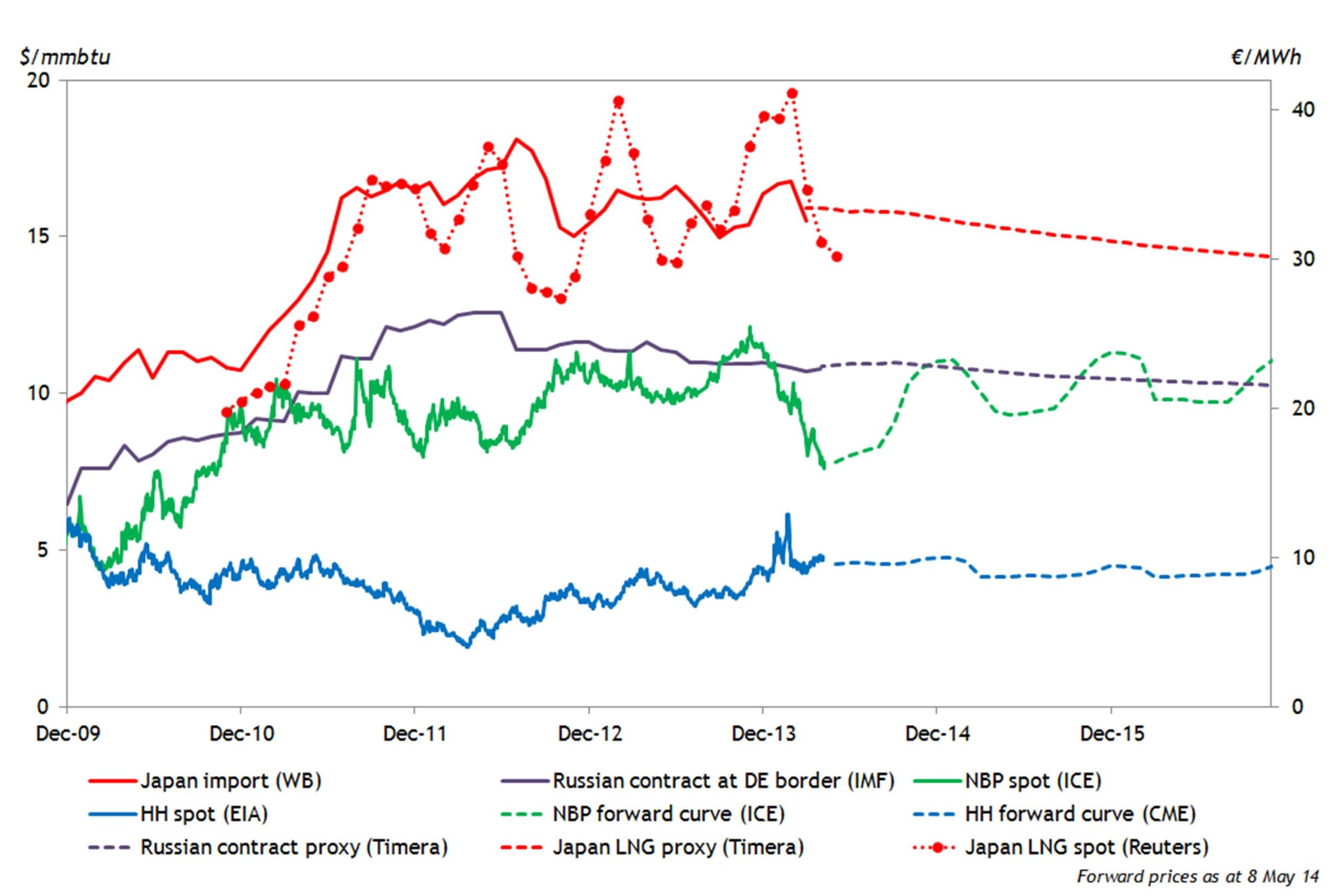
The resulting decline in gas prices is illustrated in Chart 1 by the green line (spot NBP prices).  It can be seen that as spring has progressed, hub prices have diverged from oil-indexed contract prices (the dark blue line) and moved sharply lower.  It is no coincidence that on the other side of the world Asian spot LNG prices have also plummeted (the red dotted line).  But we come back to that relationship shortly.

Chart 1: Global gas price benchmarks
gas price chart

Source: Timera Energy

Last year we set out a framework for understanding European gas hub pricing dynamics.  This focuses on understanding the behaviour of the key tranches of flexible (price responsive) supply into European hubs.  Applying the framework to the current market conditions provides a good insight into the behaviour of hub prices.

In describing the framework we set out why hub prices typically trade within a loose band around oil-indexed contract price levels:

Of the flexible sources of supply, pipeline contract swing is of principle importance. Russian and Norwegian oil-indexed contracts are particularly important as a provider of swing flex into Germany. Utilisation of this swing flexibility tends to anchor European hub prices within a band around oil-indexed contract price levels. 

This price band is somewhat flexible, but it is also resistant. It can be stretched by prevailing supply and demand dynamics, but the further prices deviate from oil-indexed benchmarks (e.g. the German border price), the stronger is the force acting to pull prices back. As hub prices fall below oil-indexed contract prices, contract owners utilise swing to pull back on contract volumes which supports hub prices. As hub prices rise above oil-indexed levels, swing gas flows increase acting as price resistance.  A similar logic applies to gas storage.

As prices fall, reduction of swing contract volume take and buying of gas to inject into storage facilities, act to support hub prices.  But this impact has limitations, e.g. storage injection will start to dry up as facilities fill by June/July.  The current disconnect between hub and oil-indexed prices indicates that stronger forces are at work driving prices below the oil-indexed price band.  This is where global LNG dynamics are playing a key role.

Europe as LNG balancing market:

Since Fukushima, flexible LNG volumes (e.g. uncontracted production & divertible supply contracts) have mostly flowed to premium markets in Asia and South America.  European hub prices are a less attractive alternative for LNG that can be sold at higher prices elsewhere.  But the LNG spot market is relatively illiquid and when prices are soft, Europe plays an important balancing role in soaking up excess supply.  This is particularly the case in spring periods given seasonal weakness in Asian LNG demand.

Qatar as the world’s largest exporter of LNG plays a key role in determining flows to Europe.  The Qataris have significant volumes of relatively inflexible uncontracted production that needs to find a market.  Most of this LNG flows to Asia.  But when Asian spot prices are weak and liquidity is poor, additional volumes can act to drive prices even lower.  It is not in the Qatari’s strategic interest to drive a slump in spot prices in their primary market.  So surplus LNG is typically sold into Europe, hence the volume pickup in gas imports to the South Hook terminal in the UK over the last couple of months.

European hub prices (particularly NBP) offer a relatively liquid option for selling surplus cargoes and there is easy access to regas capacity.  So the current weakness in Asian spot prices is compounding weakness in European hub prices.  While most of the LNG is being imported into the UK, the impact is quickly transmitted to the Continental hubs (e.g. TTF, NCG).  The IUK interconnector has been flowing strongly to Belgium (with NBP at discount to TTF) and Norwegian flows also act to balance hub differentials.  But perhaps the most important question is what happens next?

Some factors to watch

This year’s spring decline in spot LNG prices is not unusual.  A similar decline was seen in 2012 and 2013 (see Chart 1).  Asian demand has historically recovered to support prices over the summer period (e.g. to hedge air-conditioning load and the start of preparations for winter).  That will be a key factor to watch this year.

The much anticipated Russian supply cuts for gas via Ukraine are also likely to have an effect from June.  We come back to the impact of these in an article to follow shortly.  But Russian cuts should provide price support also (albeit well priced into the forward market).

But a couple of factors that normally provide support at low price levels, are unlikely to help this year.  High storage levels will reduce injection demand this summer (caveat the impact of Russian cuts).  And gas-fired power plants, which typically increase output as gas prices fall, are currently so far out of merit (vs coal plant) that power sector gas demand will provide little support.

As a result, the timing and volume of spot LNG flows into Europe may be very important in determining the extent and duration of the European hub price slump.  The structural Asian price premium over Europe is likely to return into next winter.  But in the meantime the hub price slump may have further to run.  These dynamics are an interesting preview of what will be a much more dynamic global gas market once flexible US LNG exports start to flow later this decade.
Considering an alternative view on global LNG pricing

A market consensus view has developed that the global LNG market will remain tight for the rest of this decade.  The thesis runs that LNG buyers are nervous about being caught short supply as gas import demand from developing economies surges.  The post-Fukushima squeeze is fresh in mind.  Producers are also projecting a tight market to support their investment cases, given the tens of billions of dollars flowing into new liquefaction capacity.  While this consensus is currently supported by a range of buyers and producers, it is increasingly coming under challenge.

The tight market consensus has developed with some justification. Since the Fukushima disaster and the end of the most recent liquefaction growth ramp in 2011, new supply has struggled to keep up with demand growth. This has driven a structural premium of Asian spot LNG prices over European prices as shown in Chart 1.

Chart 1: Global gas price evolution gas price chart

Source: Timera Energy

It is not difficult to build a compelling case for market tightness to continue as new production is absorbed by aggressive demand growth across Asia, the Middle East and South America.  However a number of key factors driving the global LNG supply and demand balance remain uncertain. In our view that uncertainty warrants the consideration of alternative outcomes.

An uncertain future

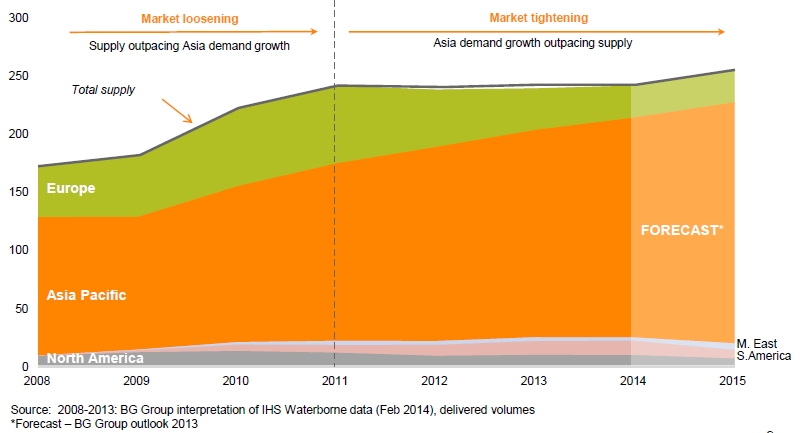
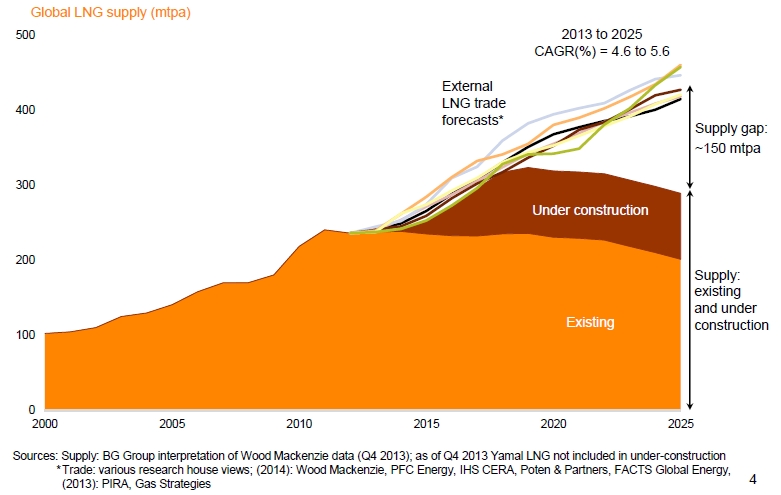
Complexity and uncertainty around the global supply and demand balance increases significantly from 2015. Most forecasts of the LNG market balance show a steady growth in demand met by an equally steady increase in supply (see Chart 2 below where BG has overlaid a number of consultant demand forecasts on its estimates of supply growth).  But the actual outcome, whatever form it takes, may not follow such a smooth path.

Chart 2: Demand and supply growth projections

LNG demand forecast BG

Source: BG

On the supply side, large and lumpy volumes of new liquefaction capacity are being developed.  As these projects approach FID, much of the gas will have been signed under long term contract.  But many of these supply contracts are with portfolio players rather than the gas being assigned to dedicated demand sources.

In simplistic terms the development of new liquefaction capacity can be viewed as a response to recent ‘price signals’ from the Asian markets.  But it can also be seen as a consequence of:

  • the monetisation of Australian projects – both under construction and planned
  • the recent ‘surprise’ discovery of a new large gas basin offshore East Africa looking for market
  • a push by Russian players to access the Asian LNG market
  • the much publicised prospective wave of US LNG projects
  • Western Canadian projects also seeking to enter the LNG supply business.

History illustrates the timing risks associated with large new liquefaction projects.  New capacity has consistently faced delays given the cost and complexity of project execution.  This is rightly presented as an argument in support of tighter market conditions.  But it can also result in large volumes of gas coming to market at a similar time (i.e. divergence of actual vs forecast delivery profile).  These volumes can place downward pressure on spot prices even if only on a temporary basis.

There is also the potential for a major new ‘wave’ of supply in the 2018 to 2023 time window (encouraged by the current tight market price levels).  There is clearly significant uncertainty around the magnitude and timing of this new supply.  But once projects are committed, it can be difficult for the industry to respond to developments in market dynamics, given the lengthy (~4 year) liquefaction construction period.

On the demand side, Japan has recently announced its decision to re-start its fleet of nuclear power plant, although the extent and timing of the resulting LNG demand displacement is unclear.  But the elephant in the room is non-Japanese Asian demand.  The strong LNG demand growth projections (shown in Chart 2) are heavily dependent on growth in Chinese and Indian demand.

However uncertainty over the size and impact of a more sustained slowdown in Asian economic growth remains.  China epitomises this problem.  Between recent IEA and Chinese forecasts the uncertainty for 2020 gas demand ranges from 330 to 400 bcma.  The domestic supply situation is unclear and partially driven by views of future shale gas success. The possible use of upside to 65 bcma  in Turkmenistan and Central Asian pipeline imports is perhaps eclipsed in uncertainty level by the ‘Schrödinger’s Cat’ of the deal for Eastern Siberian gas, reported as a 38 bcma deal but with the potential for higher volumes over time .  If China’s LNG imports are the ‘residual’ balancing item in the global market then they reflect a highly uncertain future.

The tight market view

There can be no doubt that the LNG market is currently tight.  There has been little in the way of new liquefaction capacity since 2011 and there have been significant feedgas issues into some existing terminals (e.g. Algeria, Eygpt and others).  This has contributed to the spot price volatility that can be seen since 2011 in Chart 1, although it should be recognised that this volatility is in part driven by the relatively small number of price-disclosed spot sales.  Over the same period Asian demand growth has remained robust (albeit with seasonal variations) and incremental demand has largely been satisfied via the diversion and reloading of European cargoes.  These dynamics are illustrated in Chart 3.

Chart 3: Recent evolution of global LNG market balance

tight mid decade

Source: BG

If Asian LNG demand growth continues to outstrip its dedicated supply for the rest of the decade, European LNG supply will likely retain its current global balancing role.  In other words significant spot price premiums over European hub prices will attract cargoes away from Europe, to be replaced as necessary by ‘back-filling’ Russian pipeline supplies.  Spot price volatility will likely remain, as the marginal drivers of LNG arbitrage dynamics change over time e.g. due to seasonal factors and timing of new supply.  So there may be temporary increases in cargo flows to Europe as the global balancing market in times of lower Asian spot prices (with Russian pipeline supplies to Europe providing the buffering mechanism).

Under these conditions of market tightness, oil-indexed contract pricing is more likely to remain dominant, albeit accepted with extreme reluctance by Asian buyers.  The LRMC of new projects in Australia, Canada and East Africa will be an important benchmark when long term contracts are signed.  In other words it is likely to be a seller’s market where Australian and North American export volumes are absorbed without a structural impact on market and contract pricing.

In this world the majority of US exports will flow to Asia.  However the more flexible structure of US export contracts will likely increase the influence of Henry Hub on LNG spot market price dynamics.  US export projects represent the reconnection of the US to the rest of the global gas market and a Henry Hub/NBP driven ‘Atlantic Basin’ price signal is likely to increase over time.

However, underpinning this view of a long-term tight LNG market is the premise that ‘Economics 101 has failed’ in that suppliers, although each hopeful of supplying what they see as a premium market, collectively fail to execute projects to schedule and so in aggregate constrain supply.

A transition to oversupply

There are a number of factors that could derail the consensus view.  But perhaps the most obvious one is a failure of developing economy demand to materialise to the extent that has been forecast.  This could be for example due to an Asian economic downturn (major setbacks in emerging economies are common even if only temporary). Or it could be due to a combination of Japanese nuclear restarts and the displacement of large volumes of Chinese LNG demand by Russian pipeline imports or other supplies from the back end of this decade.  Howard Rogers explored some of the drivers of an Asian LNG demand induced oversupply situation in a previous article.

Whatever the potential causes, the result of an oversupply situation is likely to be the flow of surplus gas into the LNG spot market.  This will place pressure on global LNG prices to re-converge as they did in 2009-10. It would also tend to dampen LNG spot price volatility and could significantly reduce the value of LNG portfolio flexibility (which is currently at a premium).

LNG volumes ‘in excess’ of Asian requirement would find a home in Europe (as they did in 2010 and 2011) placing pressure on Russia to either reduce pipeline supplies to maintain hub prices at ‘target’ levels or alternatively engage in a price war to reduce US LNG exports.  Such dynamics, in addition to seasonal weather effects could increase price volatility albeit around lower LNG price levels.  This is unlikely to be a good outcome for LNG producers and large portfolio players and unsurprisingly some larger players are starting to downplay the risks around an oversupply scenario (perhaps a barometer for concern).

Such an oversupply scenario may be relatively short lived (e.g. the period over 2009-10) as a result of a temporary mismatch in new demand and supply.  But this could be enough to disrupt long term contract pricing dynamics and to shift the balance in favour of LNG buyers.  The 2009-10 period was an important driver of the development of hub prices in Europe.  A similar oversupply situation later this decade could be the catalyst for an increase in influence of hub pricing on Asian LNG supply.  It is interesting to note that anecdotal references to ‘hybrid pricing’ i.e. the inclusion of hub price as well as oil indexation, are starting to circulate in Asian LNG circles.

Commercial implications of the two alternative outcomes

In this article we have set out two views of LNG market evolution.  The current consensus view that market tightness continues until the end of this decade, and an alternative view that there is another period of global oversupply (either on a temporary or more structural basis).  The actual outcome may indeed differ from both of these.  But in our view the level of uncertainty around some of the key drivers of supply and demand warrants the consideration of a range of outcomes.

The value of considering alternative outcomes comes from a realisation that LNG asset and portfolio values may differ substantially depending on the evolution of the global market balance into the end of this decade.  Spot price dynamics, gas flows, the structure of supply contract pricing and the value of portfolio flexibility will all be strongly influenced by market outcome.  We take a more structured look at the commercial implications of a tight vs oversupplied market in an article to follow shortly.

This week’s article was co-authored by Howard Rogers, a Senior Advisor with Timera Energy and Director of Natural Gas Research at the Oxford Institute for Energy Studies.

Risk management of optionality in energy portfolios

This is the third in a series of articles on the principles of energy risk management, written by Nick Perry.

Energy portfolios are rich with physical optionality.  For example, options to take different volumes of delivery (e.g. supply contracts), options to convert one type of energy into another (e.g. gas into power) and options to store energy for later use (e.g. gas or hydro storage).  The market exposures and values of these options are typically complex.  But they are an inherent part of most energy portfolios.

Earlier in this series we have several times mentioned options in the context of energy risk.  In particular, we suggested that many aspects of risk management in energy are quite challenging enough even before confronting the additional complexities posed by options. But given their prevalence in most energy portfolios, the treatment of options is an important risk management issue.

The inevitability of options

As discussed last time, uncertainties abound in energy markets.  Price risk (exposure to variable prices), volumetric risk (exposure to uncertainty of the amounts of supply or demand to be managed) and basis risk (vulnerability to breakdown in correlations) are all abnormally pronounced, especially in gas and power.

At the same time, reliable physical performance of delivery obligations is commercially and societally critical: we do not tolerate the lights going out.  Energy portfolios must accordingly be designed to be resilient, and in general terms this means building in a great deal of flexibility, in order to be able to respond to a range of contingencies.

Under traditional monopoly models, when ‘risk management’ was not really a term of art, flexibility was conceived of largely in terms of substantial over-capacity in physical systems.  If one power plant trips, we have others in reserve at our command.  But when open markets become the norm, and companies no longer have the luxury of a captive customer base on which to foist the cost of large-scale redundancy, they must expand their understanding of flexibility to embrace commercial and financial tools.  In the language of traded markets, they need to incorporate options in the portfolio.

Of course, various forms of contractual optionality have long existed in energy portfolios alongside physical over-capacity: for example, ‘swing’ contracts for gas purchases and interruptible sales contracts all featured in monopoly suppliers’ repertoires.  Over time they learn to identify these as optionality, albeit as options ‘embedded’ in ‘physically settled’ contracts.  They further observe that in their supply portfolios they have sold a great deal of flexibility to end-users, which again translates into optionality – this time, a short option position, which is generally considered a higher risk exposure.  And they see a need to analyse these various “real options” as one would a purely ‘paper’ option contract.

Physical flexibility as an option

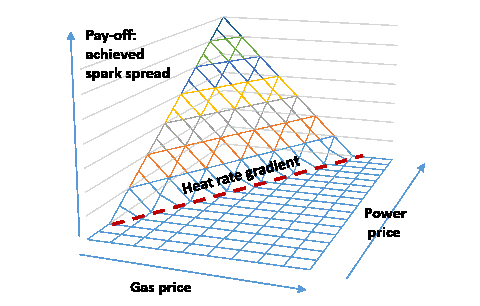
But this new way of describing and analysing old tools does not stop at contracts.  Through this lens, a flexible gas-fired power plant looks like a way of capturing a positive price-differential between gas and power at the relevant heat-rate (the spark spread), while retaining the ability to turn the plant down when the spark spread is negative.

Thus, capacity in a CCGT can be seen as a strip of call-options on the spark spread, yielding positive pay-offs when they are available, and (ideally) never incurring a negative marginal outcome.  The pay-off diagram (shown in Chart 1 below) has an additional dimension to that of the classic call-option on an equity: but it is clearly an option nonetheless.

Chart 1: Representing a gas plant as a spark spread option

Spark Spread Pay-off

The same reasoning can be applied to a very significant set of classic steel-and-concrete energy assets.  Oil refineries, transmission systems and storage facilities are all good examples.  ‘Call-options on spreads’ may not be how they were conceived of by the engineers who built them; but that is how risk managers and portfolio managers need to analyse them.

Complexities galore

One great advantage of this way of looking at energy portfolios is that the financial theorists have equipped us with ways of valuing options as assets, assessing the risks of holding them unhedged in the portfolio, and devising hedging strategies to protect their value.

That’s the good news.  The bad news is that many of these ‘real options’ are particularly difficult to model.

This is intrinsically bound up with the challenge of exercising these particular options optimally.  Option theory tends to start from a simple call option on an equity that can be exercised once only, at a particular point in time, in a market of complete transparency and liquidity.  Optimal exercise of the option is so straightforward, your broker will do it for you.

But consider the case of a coal-fired power plant that is ‘opted out’ under the European Large Combustion Plants Directive.  The owner would like to operate it as a call-option on the ‘clean dark spread’ and generate when and only when there is a positive spread.  This implies on-off actions at the start and end of periods in the day when a positive prevails.  But the output of a coal plant is constrained to ramp up and down relatively slowly, so that some periods of sub-optimal ‘exercise’ of the option are inevitable.

Complicating matters still further, the opted-out plant has only a finite number of running hours permitted.  The dark spread may be high right now: but perhaps it will be even higher in the months to come, and we may regret using finite running hours now rather than generating more profitably later.  Then again, running the plant more aggressively now may advance and/or lengthen the timing of a maintenance outage, when we would lose potentially more profitable generating opportunities.

Addressing the challenge

These problems are multi-dimensional and make our valuations, risk assessments and hedging strategies very challenging indeed.  Financial theory may give us a head-start, providing a framework for the analyses we would like to conduct, and a template for the strategies we would like to deploy.  But at the trickier end of the spectrum we will rapidly encounter severe difficulties, from the complexity of modelling the option to the illiquidity of the market in which hedges must sourced.

Yet the portfolio manager and the risk manager cannot avoid them.  The time-honoured principle – “if we can’t analyse it, we won’t do it” – might deter, say, a hedge fund from buying a power plant.  But is not of much help to a utility whose core business is owning and operating these assets, which represent substantial amounts of their capital at risk.  If the optionality in the take-or-pay structure of a long term gas supply agreement defies analysis, that is a good reason for not signing the contract.  But if it is already a substantial component of the legacy portfolio, avoidance is no longer an alternative.

As in so many real-life situations, the solution will lie in a blend of strong theory and robust pragmatism.  Without the theory, we don’t even know the direction we’d ideally like to take, and cannot begin to optimise our position.  Without the ability to make intelligent compromises in the face of reality, we may find ourselves frustrated to the point of inertia.

Where water-tight text-book risk management solutions are not available, we will still be better placed by bringing to bear the best analyses possible, in combination with experience and judgment.  An 80% solution is a big improvement on none.  And this is nowhere more applicable than in risk-managing real options in energy portfolios.

Nick Perry is a Senior Advisor with Timera Energy.  He has extensive energy industry expertise specialising in portfolio & transaction structuring, risk management, market dynamics and regulatory issues. He has spent over 20 years working in the gas and power industries for Exxon, Amoco and Enron, where he was a Board Director of Enron Europe.


Timera Energy provides tailored in-house corporate training services covering, amongst other areas, energy risk and portfolio management. If you are interested in finding out more please contact us.


UK shale and security of supply

Vladimir Putin’s political brinkmanship has brought security of gas supply firmly back into focus across Europe.  The importance of gas sales to the Russian economy means that disruptions to gas supply are likely to be temporary rather than structural.  But Russia’s use of energy supply as a means of political leverage presents an uncomfortable situation for European governments.

The UK government has displayed a clear concern, given domestic reserves of conventional gas are in rapid decline.  The UK also sits at the outer edge of European gas transport infrastructure network.  Growth in LNG regas capacity over the last decade has increased the UK’s insurance policy against pipeline supply cuts.  But with the cost of LNG supply currently driven by Asian spot prices, this is an expensive insurance policy to fall back on.  As a result, security of supply is a key factor supporting the long term case for investment in UK shale gas.

Government backing

We wrote previously on the gap between rhetoric and reality in the UK government’s case for shale gas support.  Government arguments in support of shale have been refocused in the last six months.  The government appears to have understood that shale gas is very unlikely to have a significant impact on marginal wholesale price setting.  Instead support for shale gas has been re-focused around a more realistic package of security of supply, balance of payments and jobs.   The government has also announced a number of practical policy support measures.

Shale developers will have access to generous tax breaks.  For example they will be granted tax allowances for developing gas fields, where exploration expenditure can be offset against tax for a decade.

The government has also announced incentives to encourage local support, given local planning permission is one of the biggest hurdles to shale gas development.  These are focused on channelling financial benefits from shale gas back into the local communities, for example:

  • Local councils are able to retain 100% of business rates raised from fracking sites.
  • A lump sum of £100,000 plus 1% of revenues may be available for distribution to local communities  when test wells are fracked.
  • Direct cash payments may also be made to property owners living near fracking sites.

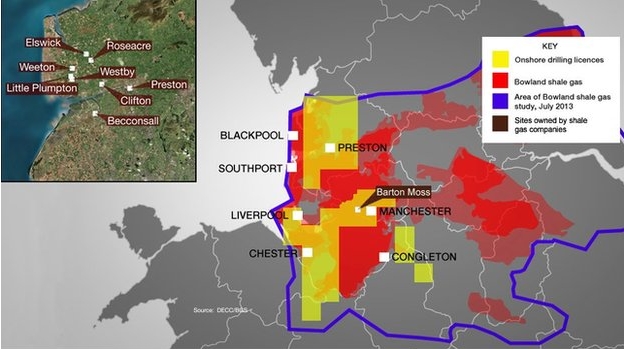
As well as direct financial incentives, the other carrot for local communities is jobs.  Diagram 1 illustrates how UK shale gas development potential is focused around a belt across Northern England.  This is an area that continues to suffer from the fallout of the financial crisis and if shale gas development took off it could provide a valuable boost to the local economy.  But in order for that benefit to transpire, shale gas production economics remains the biggest of all hurdles.

Diagram1: Key UK shale gas formations, licenses and sites.

shale diag

Source: BBC

Resource potential vs economic extraction

The British Geological Survey (BGS) published a report with DECC in July 2013 that suggested there could be about 1,300 tcf (36.8 TCM) of shale gas in the Bowland basin in North West England.  Although only a small portion (e.g. 10%) of that is likely to be recoverable.

Recent exploration progress by Cuadrilla has shown some positive signs.  The company has said there is 330 tcf (9.3 TCM) of gas within its licence area, 50% more than previous estimates.  A recent progress report from the Imperial College London was also promising, with analysis indicating that the UK’s onshore shales are rich enough in organic material and have the right petrology for hydraulic fracturing.

But ultimately it will be the drilling of test wells that reveals the economic viability of UK shale.  UK shale formations are more complex than US shale which is likely to significantly increase production cost.  The planning permitting process is also expensive, with 8 or 9 permits required for each test well.  As a result the chairman of Cuadrilla (Lord Browne ) has indicated it will take 5 years and the drilling of 20 to 40 test wells to judge whether the UK has a viable shale gas industry.

Industry money is flowing

Even though the gas is yet to flow, the last 12 months has seen a step up in capital flow into UK shale gas exploration.  The prospects of the Riverstone backed Cuadrilla improved significantly last year when Centrica purchased a 25% stake in the Bowland exploration licence for £40m.  Centrica will also pay an additional £60m in exploration and appraisal costs and £60m if it participates in any development.  Total has also announced in January that is will invest $50m in UK shale gas and has acquired stakes in shale gas exploration licences in the Midlands operated by the US company Ecorp.

These investments represent low cost options for the companies involved.  However the fact that oil majors and utilities are stepping in to invest directly in UK shale licenses is a sign of transition from the speculative exploration stage.  Test wells and time will tell whether shale gas production will have a major impact on UK gas supply.  But across US shale and Australian coal seam methane plays, recent history illustrates that there is at least the potential for main stream investment in unconventional gas reserves to be followed by transformational changes in a country’s gas balance.

New UK capacity market information & its impact

The UK government has released further details of its intended approach for the 1st capacity auction, now scheduled for December 2014.  These provide information on factors such as bidding rules, auction process and the publishing of information to the market.

DECC has also confirmed that 15 year capacity agreements are available for new build plant (rather than the initially proposed 10 years).  This should materially reduce the cost structure of new build plant.  Importantly it is also likely to provide a bigger relative benefit to OCGT versus CCGT plant.  Most UK asset developers are focused on CCGT development.  But in our view the Capacity Market brings the OCGT investment option back on to the table.

What’s new from DECC?

DECC’s Capacity Market policy team released a ‘working synthesis’ specification paper in early April.  The paper emphasises the ‘work in progress’ nature of some of the information announced.  But this paper has clearly been released to provide a guidance update on DECC’s intentions given the rapidly approaching 1st auction.

Key details in the paper include:

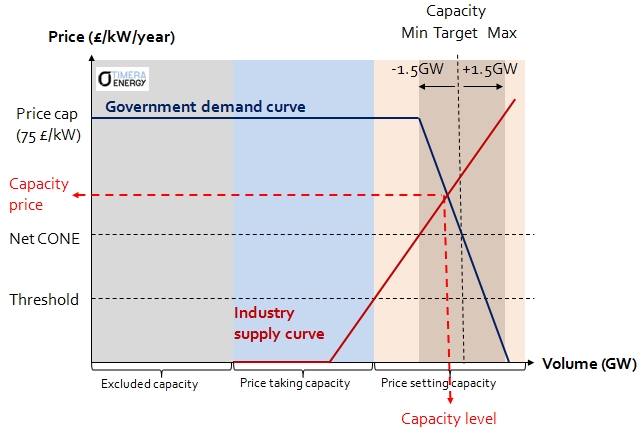
  • 75 £/kW auction price cap in 2012 terms – escalated at CPI to delivery year.
  • Price taker/setter threshold to be published at a later stage (based on net CONE).
  • 15 year capacity agreements are now available for new build plant, but DECC refurbishment agreements remain limited to a maximum of 3 years.
  • Refurbishment and new build capacity thresholds confirmed as in Oct 2013 (i.e. 125 and 250 £/kW), note that this is on de-rated not nameplate capacity.
  • Non-performance penalties are to be capped at 200% of monthly capacity payment revenues, with an overarching annual cap of 100% of capacity revenue.
  • DECC’s aim is to include interconnectors in the 2015 auction.

There are no standout surprises here, but these details provide some further clarity to feed into pre-qualification submissions and bidding strategy development.  The diagram below that we published previously, is a reminder of the key elements of the capacity market structure.

cap mkt

Auction process and DECC published information

Auction format

DECC has also provided some more clarity on how the auction rounds may evolve.  There will be up to 4 auction rounds per day for up to 4 days.  DECC suggests it intends to step price down in small decrements.  An example of 5 £/kW is given, which is consistent with the 75 £/kW cap and maximum of 16 auction rounds.  A full price schedule will be published as part of the auction guidelines.

DECC published information

DECC has indicated it intends to provide some useful details on capacity supply following the pre-qualification stage.  This includes:

  • Which CMUs qualified for the auction and at what de-rating, and whether as existing, new or refurbishing plant – but not whether they qualified as price maker or taker
  • Which CMUs have opted out and how much capacity will be deducted from the demand curve
  • Which CMUs said they will be retiring / unavailable (and so not had their capacity deducted from the demand curve).

However during the auction information release will be limited to how much spare capacity there is at the conclusion of each auction round.  This again raises a key question as to how much information players will actually gain from one auction round to the next (e.g. on implied energy market expectations).  And whether there will actually be much market participant adjustment of capacity bids through the auction rounds.

Auction cancellation

The government also retains a key ‘get out of jail’ card.  DECC intends to require all pre-qualified participants to confirm auction participation 10 business days prior to the 1st auction.  This includes whether they are price takers or setters and their intended length of contract.  Two business days later a list will be sent to the Secretary of State who has the ability to cancel the auction if it is not deemed to be sufficiently liquid/competitive.   Given the market design complexity, remaining uncertainty and tight timelines, it would seem a prudent strategy for market participants to have an auction delay contingency plan close to hand.

New CCGT vs OCGT

UK generation asset developers have historically focused on CCGT plant.  From a total asset margin perspective this makes complete sense.  CCGT have a clear efficiency advantage over OCGT and with 30GW of existing CCGT capacity merit order competition is fierce.  As a result it is hard to build an OCGT investment case based on significant energy margin returns.

However the availability of 15 year fixed price capacity agreements may change the UK power market investment landscape.   With a capacity price cap of 75 £/kW/year, new build CCGT plant will still need to bank on recovering a healthy energy margin (given capital costs in excess of 100 £/kW/year).  But energy margin expectations may be heavily discounted by players given the potential for capacity overbuild and general market uncertainty.  CCGT plant may still be the best solution on a total margin basis, but the capacity market design is swinging the balance back towards OCGT assets.

An OCGT investment case will revolve principally around capacity margin.  So CCGT investment concerns over energy margin expectations and tolling agreements disappear.  OCGT capital costs are also significantly lower than for CCGT.  And if plant margin is covered under a 15 year capacity agreement, there are some attractive leveraging options.  There do not appear to be many ‘auction ready’ OCGT projects out there.  Yet a credible OCGT development option may undercut new build CCGT as well as being a valuable diversification opportunity for generation portfolio players.

We offer bespoke workshops on the commercial implications of the Capacity Market. These can be tailored to address issues such as business impact, asset strategy and market pricing dynamics. If you are interested please contact us.

Unique energy risk management characteristics

This is the second in a series of articles on the principles of energy risk management, written by Nick Perry.

In the previous article we considered a range of common misconceptions about risk management in energy companies, not least of which is the notion that hedging is trivial for portfolios not containing options, i.e. for exposures with linear ‘delta’.  (Did you solve the two-minute challenge?)

In this second article we are again putting options aside for now, to focus on ways in which even basic risk management for energy is more demanding than for other commodities.  In most cases the reasons stem from fundamental characteristics that will not change or improve over time.  We take a look at some of the important risk management implications of these characteristics in the form of volatility, volumetric risk and basis risk.

Volatility

When natural gas became a traded commodity for the first time, levels of volatility were encountered that re-wrote the game-book on what constituted high volatility.  For example it is not unusual for spot gas volatility to rise to levels above 100% on an annualised basis, around 10 times greater than spot foreign exchange volatility.  When power started to be traded some years later, the books were revised again: electricity is the most volatile commodity ever traded. Spot power volatility can rise to levels above 1000% (annualised).

The reasons are clear, and will not change any time soon.  These commodities are extremely ‘granular’: gas portfolios must be balanced daily and power in real-time; and storage of both is difficult – in the case of electricity, quite exceptionally difficult.  These factors will drive considerable volatility in spot markets for as long as they persist which, being based on the laws of physics, will be for the foreseeable future.  And almost every aspect of risk management is made more problematic by high volatility.

Volatility is a key driver of the value of asset & contract flexibility.  As a result there is an important relationship between volatility and energy portfolio risk, given the inherent flexibility of most energy portfolios.  Flexibility can be considered in two categories: owned flexibility (e.g. upstream production flex, gas storage capacity, power plant) and sold flexibility (e.g. gas swing contracts, retail power contracts).  Effectively managing sold flexibility exposures against underlying asset positions in energy portfolios, is one of the key challenges of energy risk management (given high price volatility) and one we return to in more detail later in this series.

Volumetric Risk

In most commodities, the volumetric aspects of a deal are unremarkable.  I buy 10,000 tonnes of steel, and that’s what is delivered.  But when I enter a contract for gas and power, as an end-user I will very rarely be able to specify the amount I will buy.  On the coldest day in winter, will I turn on every heating appliance in the house – or will I go on a skiing vacation and use nothing?  Or cancel my contract and switch suppliers?

It is not just retail portfolios that suffer from volumetric uncertainty.  Demand for gas and power are remarkably sensitive to ambient temperature; and power plants can trip at any time: just two of the many vicissitudes of the sector.  In systems that must balance in real-time, such uncertainties – often termed Volumetric Risk – present very complex challenges (and, incidentally, contribute significantly to the volatility mentioned above).  Once again, this problem is far more acute in energy than in any other commodity.

Take the prompt exposures of a vertically integrated power portfolio as an example.  The portfolio needs to be broadly balanced in real-time to avoid exposures to very volatile prompt and balancing prices.  Volumetric risk in the portfolio stems from the flexibility sold to customers via retail contracts.  Customer load may swing substantially over short periods (e.g. given changes in weather conditions).  Given short term market liquidity constraints, this exposure is often managed via ownership of flexible power plants (e.g. gas peaking assets).  However forced outages on generation assets can add to the complexity of volumetric risk, given that these may leave wholesale contract and retail positions exposed to volatile prompt prices.

Basis Risk

Basis risk – where the variability of the value of an underlying exposure is not perfectly inversely correlated with that of its hedge – can be an issue in any portfolio.  But in energy there are more twists than usual.  In particular:

Delivery point:   the complexities of transportation for gas and power, and sometimes also coal and even oil, mean that end-users and smaller wholesale players are often uncomfortable with taking settlement at one of the handful of delivery-points at which hedges are most readily found, which may be a long way from their ‘natural basis point’.  Thus, locational basis is a very common issue in energy markets.

For example, liquidity in European coal is focused around API2, a specified set of conditions for delivery of coal to Amsterdam- Rotterdam-Antwerp (ARA).  Yet many owners of European coal-fired plant use API2 contracts to hedge coal delivery to locations which are separated both geographically and logistically from the ARA area.

Quality / specification:  there are very many grades of oil and coal, but hedges only exist for a handful of grades.  The well-traded hedging grades will for the most part be highly correlated with other grades, but not perfectly so: and small differences multiplied by large volumes over long periods of time can add up – particularly for the many energy players operating a margin business model, such as refiners, thermal generators and retailers.

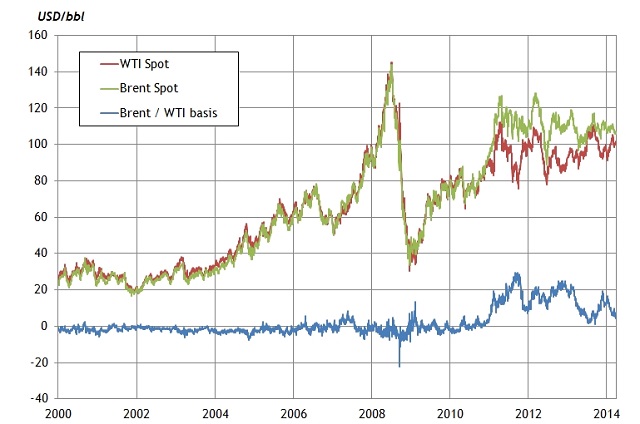
Chart 1: Brent vs WTI crude oil spot price basis

Noname

Worse still, even high correlations can break down over time.  Chart 1 illustrates perhaps the most famous recent example of WTI and Brent, the two most commonly-traded crude-oil blends which are of slightly different quality, with delivery-points in the USA and Europe respectively.  From being very well correlated for many years, starting in 2011 the price of WTI relative to Brent collapsed (as a result of a flood of new unconventional domestic oil production in the US and constrained local infrastructure).  It is a fact that, based on the years of good correlation, some US oil-market participants hedged their European oil exposures using WTI, an instrument they were very familiar with. The correlation breakdown uncovered an unwelcome basis risk exposure behind their apparently hedged positions.

Although electricity and natural gas do not have ‘grades’ in quite the same way as oil, power is commonly traded as ‘baseload’ and ‘peak’ despite more granular underlying exposure shape;  in Northern Europe there is a low-calorific ‘grade’ of gas alongside the usually-traded hi-cal commodity; and in both markets, weekend prices are not identical to weekday prices.   Here again, basis risk can complicate a hedging strategy.

Conclusions

In any commodity, deployment of risk management tools for even ‘simple’, linear exposures hinges materially on market liquidity – the ready availability of spot and forward deals that enable portfolio imbalances and exposures to be managed.  But because of the unique difficulties associated with gas and power discussed above, and exacerbated by global financial conditions, gas and power market liquidity is frequently unsatisfactory.  This leads some players to assert that vertical integration is a necessary base for risk management in large energy companies – an uncomfortable conclusion for regulators and other energy-market stakeholders who consider that open, competitive and liquid markets are critical to ensuring secure and economically efficient supplies.

Whatever stance is taken on the issue of vertical integration, the compounding difficulties of market fundamentals and liquidity result in considerable premium being placed on pragmatism and experience in energy risk management, in parallel with excellent technical skills.

They also dictate an emphasis on flexibility within the portfolio itself.   And since flexibility translates into optionality, we quickly find ourselves needing to wrestle with the complexities of risk-managing options!  It is to this that we turn in the next part of the series.

Nick Perry is a Senior Advisor with Timera Energy.  He has extensive energy industry expertise specialising in portfolio & transaction structuring, risk management, market dynamics and regulatory issues. He has spent over 20 years working in the gas and power industries for Exxon, Amoco and Enron, where he was a Board Director of Enron Europe.

Timera Energy provides tailored in-house corporate training services covering, amongst other areas, energy risk and portfolio management. If you are interested in finding out more please contact us.

Germany vs UK generation margin comparison

Comparisons between Germany and the UK are always an interesting exercise.  Germany is impressive in its efficiency, structured approach and longer term thinking.  The UK prides itself on flexibility, independence and innovation.  Interesting contrasts between Germany and the UK can be extended across business, culture and food.  For example, a shared passion for beer and sausages (but of very different styles) is worthy of an article in itself.  But this article focuses on a comparison of generation margins in the German and UK power markets.

Germany is a key driver of wholesale price and margin dynamics across NW Europe.  This is a result of market scale, high levels of interconnection and the export implications of aggresive renewable build.  The UK on the other hand is still a relatively isolated power market.   But it is a key test case for the future of conventional generation margins in Europe, given that the UK is leading the European push to implement capacity markets.  A comparison between Germany and the UK sheds light on many of the challenges gas and coal plant owners face across Europe.

Germany is about coal

An historical chart of German power prices resembles a descent down a steep mountain.  A rapid increase in renewable capacity, combined with falling coal prices and relatively weak  post financial crisis demand, have resulted in relentless downward pressure on wholesale prices.

Gas and coal generators face three important implications from the rise in low variable cost renewable capacity:

  • The average variable cost of plant on the margin is falling, reducing power prices.  Gas plant is now largely out of merit, with coal and increasingly lignite dominating marginal price setting.
  • The load factors of gas and coal plant are declining as renewable output increases
  • Wind and particularly solar output are acting to flatten within-day price shape, which tends to negatively impact gas and coal plant margins.

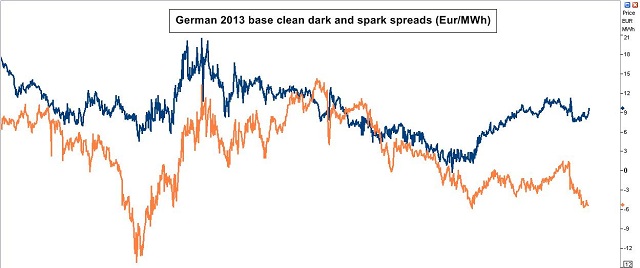
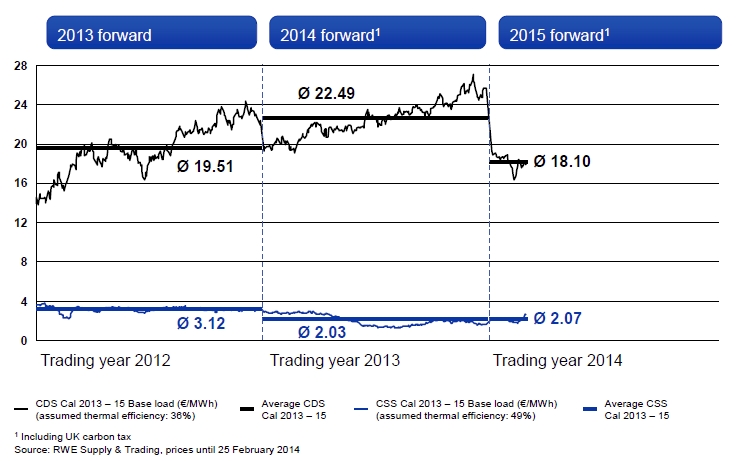
These factors are common across European power markets as renewable capacity expands.  But they are particularly pronounced in Germany given the scale of renewable roll out.  And Germany is exporting these effects across NW Europe (e.g. to the Netherlands where gas plant load factors have plummeted).  The impact on German coal plant (clean dark spread) and gas plant (clean spark spread) generation margins is shown in Chart 1.

Chart 1: Evolution of German CDS and CSS

DE spreads

Coal plant margins are currently weak compared to historical levels.  But they have held up relatively well given the decline in German power prices.  Falling coal plant revenue has been offset by falling fuel costs (as coal prices have declined), and with coal plant predominantly setting marginal prices, margins have been relatively stable.

Coal margins are facing renewed pressure from around 10GW of new coal & lignite capacity coming online between 2011-14.  But importantly going forward, coal plant are somewhat  insulated from rises in carbon prices, given that these tend to feed through into higher power prices with coal on the margin.

The story for German gas plant is not a happy one.  Given gas plant is out of merit, falling coal and power prices have caused sharp declines in spark spreads.  As spreads head deep into negative territory, gas plant are suffering negative cashflow as they absorb fixed costs.  Revenue opportunities are focused on reserve payments and increasing volumes of capacity is being closed, mothballed or signed over to TSOs to provide system support.  Gas plant margin recovery hopes are firmly focused on implementation of a capacity market (being discussed for later this decade).

The UK is about gas

Renewable build in the UK is having a similar impact to Germany, but on a smaller scale (and with less solar capacity).  The key difference between the two markets is the large volume (~30GW) of CCGT capacity that dominates marginal price setting in the UK.  This results in a very different generation margin environment, shown in Chart 2.

Chart 2: Evolution of UK CDS and CSS

UK spreads

Spark spreads in the UK are weak.  About a third of UK gas capacity runs at zero or very low load factor.  But they have been relatively stable, avoiding the dive into negative territory seen in Germany.

It is difficult to envisage a scenario in the next decade where UK gas plants are driven off the margin as has happened in Germany.  But at current spark spreads, CCGTs are struggling to recover fixed & capital costs.  And the UK market hangs precariously in the balance awaiting a tightening capacity margin and implementation of the capacity market.

The story for UK coal plant margins has been a more positive one.   Generators are earning relatively strong margins given rents from higher cost gas plant setting marginal prices.  But UK coal plant are more exposed to increases in carbon cost given gas plants are on the margin, as can be seen more recently in Chart 2.

Coal generators are facing the combined impact of carbon backloading (although this appears to be fading) and the rising UK carbon price floor.  The government’s freezing of UK carbon price support announced this month has improved the margin outlook for coal plant later this decade.  But UK generators are facing some key investment decisions around capex spend to ensure IED (EU emissions law) compliance if they want to run beyond 2023.
A comparison of Germany and the UK illustrates the difference between markets where coal vs gas plant set marginal prices.  German market dynamics are increasingly driving generation margin behaviour in neighbouring markets.  The UK in contrast remains relatively insulated from these effects given limited interconnection and large volumes of gas capacity.  But a common theme across both markets is the battle that policy makers face trying to decarbonise their power sectors in a world awash with cheap coal.

US wild winter volatility a reminder for Europe

It has been a very mild winter in Europe and gas demand has been soft. As a result weakness in winter/summer hub price spreads has continued and price volatility remains in the doldrums.  Even the threat of Russia flexing its muscles and restricting supply via Ukraine has so far had a limited impact on hub pricing.

But for a real case study in depressed seasonal price spreads and volatility look no further than the US.  The last 5 years have seen the US gas market transition to conditions of pronounced structural oversupply.  The factors driving this are relatively simple and well understood.  Domestic unconventional gas production has surged, with surplus gas production trapped in the US given limited export infrastructure.  As a result seasonal spreads and volatility have been crushed.  At least until this winter…

What is going on in the US?

Given structural conditions of oversupply, it is easy to become complacent about the short term inelasticity of gas supply and demand.  While supply and demand for gas are responsive to price over a multi-year horizon, they can be very unresponsive to price over a shorter horizon.

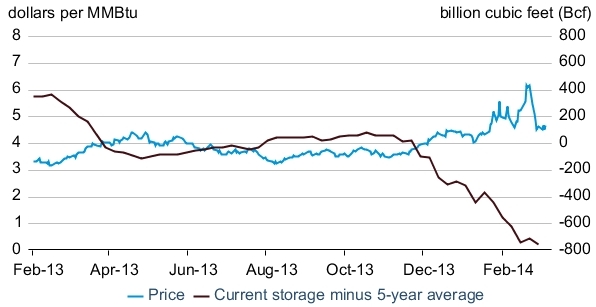
The US gas market has experienced this with a bang this winter.  Henry Hub spot prices surged to over 8 $/mmbtu, levels not seen since the second half of 2008.  Front month prices peaked at over 6 $/mmbtu, up more than 50% in 2014, before slumping more than 10% in a day in late Feb.  While these price movements reflect a market that has been caught off guard, the cause of the jump in prices is relatively simple.

A prolonged cold winter in the US has seen gas demand up around 10% compared to last year and this has sharply eroded gas storage levels.  Chart 1 illustrates the relationship between the front month Henry Hub futures contract and the decline in storage levels.

Chart 1: Henry hub prices spike as storage inventories decline

price & storage

Source: EIA

Prices have risen at Henry Hub to incentivise further storage withdrawals and other system deliverability.  This is a similar to the dynamic that was witnessed in March 2013 when European storage responsed to sharp UK price signals.  But unlike the UK example, prices at Henry Hub remained below levels required to attract significant LNG incremental imports (the ultimate backstop for a short US market).

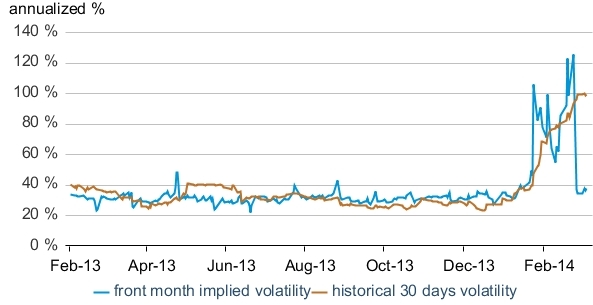
In response to the price squeeze at Henry Hub, month-ahead volatility has also surged above 100% from levels below 40% at the start of winter, as shown in Chart 2.  However, March implied volatility has declined sharply as the cold snap has eased, suggesting the market is pricing this as a temporary event.

Chart 2: Henry Hub front month historic and implied volatility explodes into life

HH vol

Source: EIA

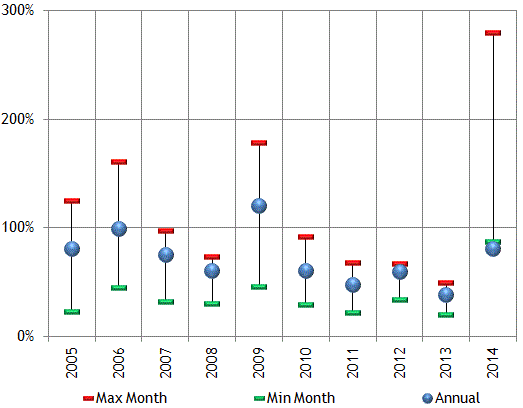
The impact on spot volatility (a key factor driving storage optimisation) is even more pronounced. Chart 3 illustrates this winter’s surge in Henry Hub historic spot volatility, relative to monthly ranges back over the last decade.

Chart 3: Historic Henry Hub spot volatility ranges (annualised)

Henry Hub Spot Volatility

Source: Timera Energy

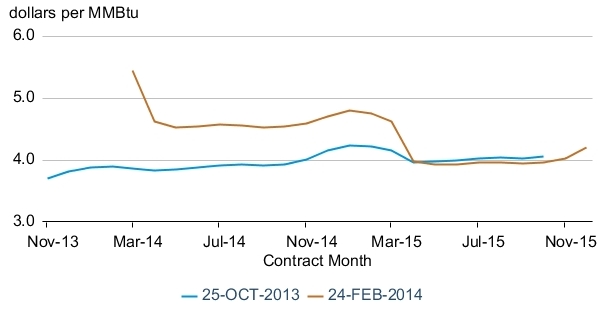
The HH futures curve also points towards the winter price jump being a one season event, with virtually no forward price impact once storage levels have been replenished (i.e. from 2015 and beyond), as illustrated in Chart 4.

Chart 4: Recent Henry Hub forward curves – The spot is not wagging the curve

HH curves

Source: EIA

The fact that prices for specific forward delivery periods can move in relative independence is a sign of market maturity.  It suggests that forward prices reflect the expected market conditions in the forward delivery periods rather than taking the price signal from, and broadly moving in parallel to, prompt prices.

Could this happen in Europe?

There is currently a structural oversupply of gas flexibility in Europe, causing downward pressure on seasonal spreads and volatility.  But in many ways Europe is more vulnerable than the US to a similar bout of hub price volatility.

Unlike the US, domestic gas production in Europe is in decline, leaving Europe more vulnerable to import constraints.  The European cold snap in March 2013 was far less harsh and shorter than the ‘polar vortex’ that has gripped the North American market this winter.  The fact that European hub prices spiked to levels required to attract flexible LNG cargoes, whilst HH prices did not, illustrates this higher vunerability. It is a while since there has been a prolonged cold winter across Europe, as opposed to more isolated cold snaps.  And the pricing of tail risk appears to indicate a degree of complacency has crept into the market as a result.

Russia temporarily curtailing supplies via Ukraine no longer represents the threat that it used to, given alternative supply routes.  But a cold winter combined with key infrastructure outages is another story. These events tend to be positively correlated given system stress and could well cause a surge in hub prices and volatility, and a re-pricing of tail risk and the insurance value of portfolio flexibility.

There is more to energy risk management than option theory

This is the first in a series of articles on the principles of energy risk management, written by Nick Perry.

The business of energy companies increasingly revolves around the management of portfolio risk.  Risk associated with customer contracts, supply agreements, upstream assets and hedge books. But the term ‘risk management’ is often narrowly applied to refer to the trading risk control function.  While risk control is one aspect, risk management is a much broader and more powerful discipline, one that should enhance a company’s commercial advantage, rather than hinder it.  In this, the first in a series of articles on risk management principles, we set out some of the common misunderstandings about energy risk management.

What is risk management about?

Several popular misconceptions about financial Risk Management are to be found in energy companies:

  • It is an arcane discipline, the preserve of a handful of specialists in a best-avoided corner of the building
  • It is well-enough understood by those who need to know, and irrelevant to those who don’t
  • Its role is essentially negative, applying the brakes to over-exuberant traders and overly-creative deal-makers
  • It’s all about options and Black-Scholes
  • It may be relevant in highly liquid markets, but gas and power rarely fit this description
  • Companies that are vertically integrated are ‘naturally hedged’, and don’t need risk management much at all

Years of acquaintance with energy players whose origins lie in the physically-oriented realms of utilities, upstream producers and large end-users make it easy to see how these ideas take root.  And any notion that in 2014 they are a thing of the past is disabused in the first morning of any risk management training session.

All about options?

Let’s start with the point about options.  If anyone new to risk were diligently to search out one of the several excellent books on energy risk management they would probably find that Chapter 1 lists some of the well-known energy trading scandals and is easy enough to read.  Then comes Chapter 2 – on Options; Chapter 3 is on More Options; and Chapter 4 is on Exotic Options … and for those whose advanced maths is some years behind them, enthusiasm soon wanes.

The reason for this bias towards options is easy enough to deduce. The ‘textbook’ authors typically come from a background of strong academic credentials. They tend to give a cursory treatment to the basics of hedging positions with linear exposures (or constant delta), in order to focus on the more academically challenging problems presented by non-linear exposures.

However a great number of the practical risk management problems that arise in energy companies have nothing to do with options.  Firstly, even basic hedging in energy markets is rarely as simple to execute as for less ‘granular’ commodities in more liquid markets.  Secondly, many foundation-level aspects of financial risk management are deeply non-intuitive, or even counter-intuitive to those coming to the issues for the first time.

Take this two minute challenge

Take this simple challenge: a significantly simplified version of the most basic type of contract in the industry – a gas purchase with price indexed to oil.

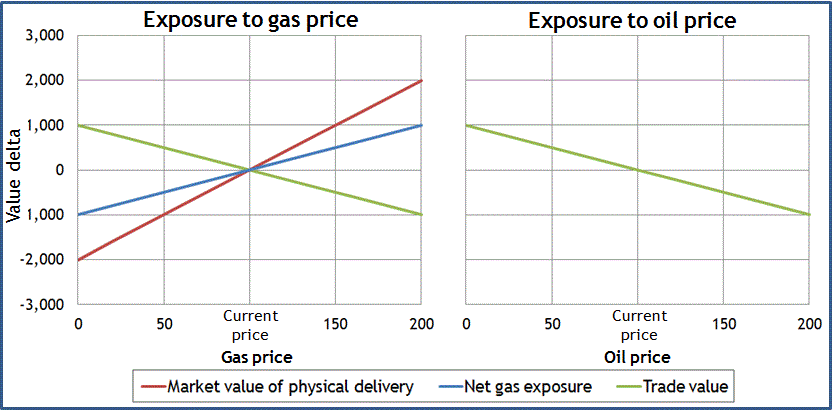
A gas buyer purchases 20 volumetric units of physical gas under a contract in which the price is indexed 50:50 to the spot prices of oil and of gas itself.  Delivery is taken at a location where there are liquid markets for both gas and oil.  For simplicity the contract price = 0.5 x spot oil price + 0.5 x spot gas price, both in the same currency, price and volume units.  What, measured in volumetric units, are the exposures (if any) to the oil price and gas price for the buyer?

Hint: price exposure is generated from both the pricing terms of the deal and the underlying physical delivery of gas. The latter is often overlooked by those new to the concepts.  This is illustrated in the following chart.

Chart 1: linear exposures of a simple indexed gas physical deal

Simple indexed exposures

I reckon there are 25 possible answers that might be under consideration.  Given the various dimensions and numbers in play (oil, gas, 20, 50%), then you might be thinking the exposures (deltas) must be one of +20, +10, 0, -10 or -20, for each of oil and gas.   When I set this puzzle in training workshops, I regularly get as many answers as there are people in the room – sometimes without hearing the correct one!  And yet, as everyone quickly grasps, this is about as simple a real-life energy risk problem as could be posed – with not an option in sight.

The arithmetic is not the issue here – indeed most delegates to energy risk training come from highly numerate disciplines such as engineering and accounting.  It is rather the ability to internalise new, rigorous ways of analysing apparently straightforward business scenarios that are not widely taught beyond the trading floor.


Fixed price, floating price

Another common misconception is that exposure to ever-changing spot prices is the fundamental source of financial risk.  Indeed, when told that it is in fact fixed-price positions (in liquid, variable-price markets) that are the root cause of price risk, and that floating-price positions are risk-neutral, some delegates in risk training sessions actually resist this basic assertion.

If there is an explanation for the misconception, it probably lies in the fact that for many companies, before energy is procured (or sold) there has already been some prior commitment made within the corporate portfolio that equates analytically to an implicit short (or long) fixed-price energy position.  For example, an automobile manufacturer may have committed to a price list that must be maintained for 12 months, and in consequence may be implicitly short energy (and steel and other raw materials).  Staff from such a background may subliminally be recognising the need for a hedge, and therefore conceive of floating energy prices as a source of risk – instead of identifying the initial commitment to the price list as the primary source.

This floating price risk focus is more common among demand-side players for whom energy is only a part of their business.  However it can also be found within utilities.  The shift in utility business models towards portfolio management via centralised trading functions has significantly improved the level of understanding of risk exposures.  But people within utilities have often come from a background where ‘marking to portfolio’ is more readily adopted than marking to market.  Given this background, several aspects of risk management can be non-intuitive, and several ‘Chapter One’ issues can represent new perspectives requiring new analytic disciplines.

There are excellent reasons why these perspectives and disciplines need to be more widely shared across the company – going well beyond the requirements of staffing the middle office.  All commercial staff, and many managers at all levels, will conduct much better business with a good grasp of the principles involved.

Options again

When we get deeper into the subject, it turns out to be quite appropriate to develop a fixation on options in energy.  Energy portfolios are rich with optionality and non-linear exposures.  This can be envisaged quite readily for example by recognising that a good way of analysing capacity in an oil refinery, is as ‘a call-option on the crack spread’ or capacity in a CCGT as ‘a strip of call-options on the spark spread’.  But that is a relatively sophisticated thought process, and certainly not material for Chapter One.  We shall, however, consider it later in this series of articles – after looking next at some of the almost unique risk characteristics of the energy sector, and how techniques from the trading floor need to be adapted and enhanced to cater for them.

Nick Perry is a Senior Advisor with Timera Energy.  He has extensive energy industry expertise specialising in portfolio & transaction structuring, risk management, market dynamics and regulatory issues. He has spent over 20 years working in the gas and power industries for Exxon, Amoco and Enron, where he was a Board Director of Enron Europe.

Timera Energy provides tailored in-house corporate training services covering, amongst other areas, energy risk and portfolio management.  If you are interested in finding out more please contact us.

Commercial implications of the UK capacity market

The countdown has commenced to the implementation of the UK Capacity Market.  Between now and November, the UK power market will be focused on the volume and pricing of capacity delivered in the first auction.  And the rest of Europe will be watching, given capacity markets are the subject of whiteboard sketches across the offices of the EU’s energy regulators.

For all that has been said and written about the UK Capacity Market, industry views range widely as to its commercial impact.  What will the outcome of the 1st auction be?  How will the capacity price interact with the wholesale power price?  What are the implications for generation asset returns?  We consider these questions in this, the final article, in our three part series on the Capacity Market.

The 1st auction outcome

Understanding the capacity price & volume outcome in the first auction means taking a view on two key factors:

  1. The volume of incremental capacity that the system will require to meet the government’s 3 hour LOLE security standard (estimated by National Grid to be equivalent to a de-rated capacity margin of 3.8%)
  2. The source and cost of the marginal provider of this incremental capacity.

The government will provide a clearer view on the incremental capacity volume requirement (1.) when it publishes its capacity demand curve (scheduled for June).  In our view, there is a risk that political influence leans towards a more ambitious capacity target for the first auction given concerns over security of supply.  After all, the costs of providing capacity via the Capacity Market are less transparent than via the wholesale power market, and are smeared over a multiple forward year horizon.

Once there is more clarity around capacity demand, the key determinant of capacity price will be the cost of the marginal source of supply (2.).  In our view the capacity price in the first auction is more likely to be set by existing gas and coal assets rather than new build CCGT/OCGT.  This may either be via refurbishment of existing capacity to enhance/extend assets lives, or via existing assets recovering the ‘going forward’ costs required to remain open (as we set out here).  However it cannot be ruled out that the government really leans on the capacity lever, pulling the capacity price up to levels that support new build.

There are also still a number of unresolved issues around market design which could impact the auction outcome.  For example, the length and legal basis of capacity contracts, qualification for price setting ability and the amount and nature of capacity costs that can be bid in.

Impact on wholesale power price levels

In the current world with no Capacity Market, the absolute level of power prices is driven by the fuel & carbon costs of marginal generators (primarily CCGT).  This will not change with the Capacity Market, regardless of capacity pricing outcomes.

However the Capacity Market is set to have a pronounced negative impact on power price levels, relative to the current energy only market.  Adding an additional capacity revenue stream for generators has two important effects:

  1. It is likely to support higher levels of system capacity than in an energy only world
  2. It reduces the requirement for generators to recover fixed costs via wholesale power prices.

Both these factors are likely to put downward pressure on power prices.  In order to better understand the dynamics of capacity and energy market interaction, it is useful to use a supply curve framework as shown in Chart 1.

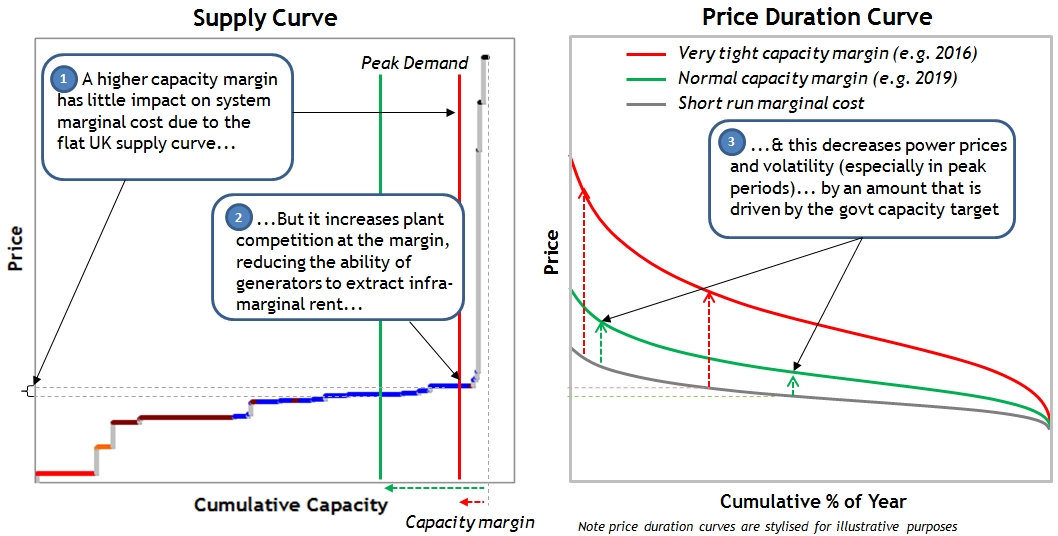
Chart 1: The UK supply stack, power prices and generator rents

PDC Supply Curve

Source: Timera Energy

The left hand diagram shows a short run marginal cost (SRMC) view of the UK supply stack (net of intermittent generation).  The CCGT portion of the supply curve (blue line) which typically sets marginal power prices is very flat, given there is around 30GW of CCGT competing to supply power at similar marginal cost levels.  That translates into a flat SRMC duration curve in the right hand chart (the grey line).

In a market which has a very tight capacity margin (e.g. the UK in 2016), wholesale power prices rise significantly above SRMC.  This yields a steeper price duration curve (the red line in the left hand chart), with generators earning rents above SRMC, particularly in periods of peak net system demand.   The principle mechanism that drives these higher rents is reduced competition between marginal generators in setting market price (given capacity tightness).  This means marginal generators have a greater ability to price power above marginal cost.

However in a market with a more comfortable capacity margin (e.g. the UK in 2019), wholesale power prices are likely to more closely reflect SRMC.  Rents are reduced given an increased level of competition between marginal generators at higher capacity levels.  In other words, the ability of marginal generators to price power above marginal cost is reduced and the price duration curve flattens accordingly (the green line in the right hand chart).

So implementation of the Capacity Market, combined with delivery of new renewable generation, will mean higher system capacity levels.  These factors act to stretch the supply curve, shifting the intersection of supply and demand to the left.  This in turn reduces rents in the wholesale market and places downward pressure on power prices.

Impact on power price volatility & market liquidity

The effect of renewable intermittency in increasing prompt power price volatility is a well understood concept.  Fluctuations in wind and solar output stretch and contract the supply stack, causing changes in marginal price setting generation units and hence price volatility.  This effect is set to increase between 2014 and 2018, as the system capacity margin tightens and wind & solar volumes increase.

But implementation of the Capacity Market may act as a volatility dampener from 2018/19.  The factors behind this are the same ones that place downward pressure on power prices.  Higher levels of system capacity reduce the system tightness that drives price volatility.  And as the focus of fixed cost recovery for peaking assets shifts to the Capacity Market, a reduction in the extraction of peak period rents should dampen wholesale price fluctuations.

The Capacity Market will also do little to help wholesale market liquidity.  The government’s other EMR reforms have eroded the requirement for low carbon generators to hedge output in the power market.  The Capacity Market is likely to have a similar effect on gas and coal generators.  As the margin focus of these asset shifts to annual capacity payments, it reduces their wholesale market hedging requirements (particularly for peaking assets).

Implications for gas plant owners

The Capacity Market will have profound structural implications for the margins and risk/return profiles of gas assets.   Most importantly it should boost and de-risk plant margins.  Capacity prices will fluctuate from one year to the next, but more stable fixed annual capacity payments will reduce asset dependence on volatile wholesale market revenue.  While this is good news for asset owners, it introduces a new set of challenges in understanding and managing the interaction between capacity and energy margins.

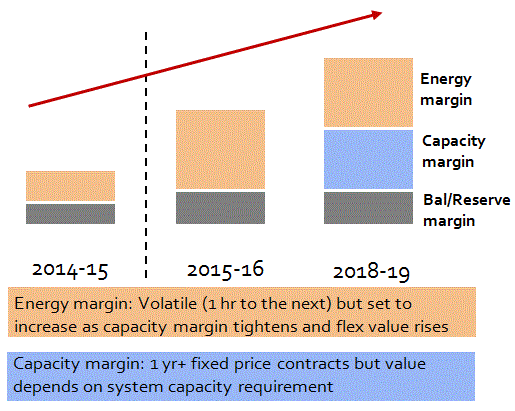
Chart 2 provides a simple illustration of the margin recovery path for gas plant between now and the end of this decade.

Chart 2: CCGT margin recovery path

CCGT Margin Recovery

Source: Timera Energy

Healthy system capacity margins and steadily increasing renewable volumes are currently depressing CCGT margins in the wholesale power market.   As scheduled regulatory retirements occur mid-decade, the capacity margin is set to tighten which should in turn increase gas plant energy market rents (as described above).  Then a new capacity margin stream is available from 2018/19, but one that will have an important interaction with the existing energy margin stream.

As long as there is a system requirement for the Capacity Market to deliver incremental capacity, capacity prices are likely to cover the fixed cost base of CCGT assets (otherwise older CCGT plant will close).  This, combined with a 4 year forward visibility on capacity revenues, will help support and de-risk the value of CCGT assets.  In addition CCGTs will be able to recover capacity margins significantly above fixed costs in periods when the capacity price rises to incentivise capacity delivery.

For older CCGT assets, currently out of merit and suffering low or negative cashflows, the Capacity Market is a potential game changer (as long as plants meet the required flexibility standards).  The key challenge for asset owners is how to manage margin in the period between now and 2018/19 and how to bid assets into the capacity auctions.

Newer CCGT assets running at higher load factor will also benefit from capacity margin, but will retain a significant exposure to the wholesale power market for recovering capital costs.  The key challenge here is for asset owners to understand the interaction between capacity and power pricing and to manage, hedge and bid their assets accordingly.

As the November auction approaches, asset owners are confronted with a set of decisions on how to manage asset value across the energy and capacity markets.  The cost structure and expected energy market returns of individual plant are key factors in defining a capacity bidding strategy. But there are also important considerations around anticipating actions of other generators, pricing capacity based on alternative bids and bidding with a generation portfolio perspective.  Most importantly, the Capacity Market has a key bearing on lifetime investment decisions on asset retirement, mothballing, capex spend and refurbishment.

We offer bespoke workshops on the commercial implications of the Capacity Market. These can be tailored to address issues such as business impact, asset strategy and market pricing dynamics. If you are interested please contact us.