Tighter UK market, higher spreads & volatility

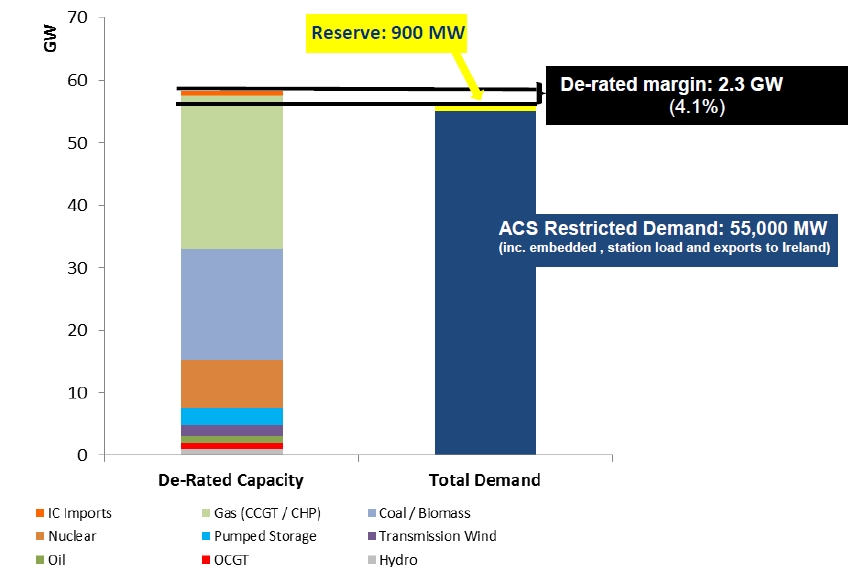
National Grid has now published its view on the UK power market supply & demand balance going into the current winter.  The situation looks very tight.  Grid’s numbers show a de-rated system capacity margin of just 4.1%.  In volume terms that is only 2.3 GW.  That is less than the capacity of one of the UK’s larger power stations (e.g. Drax, Longanett).

This does not mean a significant threat of a lights out scenario.  There are several units currently on outage that are expected to return early in the winter.  Grid also has some additional contracted reserve capacity behind this 2.3 GW margin.  It can use this to respond in an emergency situation (e.g. to prevent brownouts or blackouts).   But because the majority of this reserve capacity is effectively removed from the wholesale energy market, it won’t act to dampen rises in power prices, generation margins and price volatility if the UK experiences a cold winter.

Winter 2014/15 balance

Grid has published two important pieces of information in the last two weeks which add clarity on how tight the current winter looks:

  1. Grid’s 2014/15 Winter Outlook shows detailed projections of UK market supply/demand balance.
  2. Grid has also released details of the volume of Supplemental Balancing Reserve (SBR) capacity recently contracted for the coming winter, showing SBR contracts totalling 1.1 GW of de-rated capacity (covering 2 older CCGTs, an oil plant and some demand side response).

The winter supply & demand balance and 4.1% capacity margin is illustrated in Chart 1.

Chart 1:  UK winter 2014/15 supply vs demand balance

system margin

Source: National Grid

Forecasting system capacity margins is not a precise science.  Uncertain factors such as weather, outages and interconnector flows mean that Grid needs to make a range of assumptions in order to forecast system margins.  For example, plant capacities are de-rated to reflect average planned & unplanned outages.  Wind levels and temperatures are projected based on historical conditions.

If these uncertain factors combine to produce a more benign outcome as they did last winter (which was both wet and windy), then winter may pass by uneventfully, even with a tight system capacity margin.  However if these uncertain factors land the other way, then it may be a very tight winter indeed as we have set out previously.

While at a headline level it may appear that a 4% capacity margin means the market will rely on the operation of a single large station, things are likely to be different in practice.  In any given hour, uncertain factors may combine to provide a higher effective level of capacity than Grid assumes, e.g. higher than average plant outputs and higher import levels through the UK’s interconnectors with France, the Netherlands and Ireland.  But factors may also conspire to reduce capacity, e.g. multiple forced outages across gas/coal/nuclear plants or conditions of little or no wind (Grid assumes quite an optimistic average 20% output from wind).

What is clear on an historical basis is that tighter system capacity margins coincide with periods of higher prices, higher spreads and higher volatility.

Impact on prices and spreads

The inverse relationship between system capacity margins and prices/spreads/volatility is more than a theoretical linkage.  There is a practical mechanism that drives it.  A tight system capacity margin acts to increase prices because there are less plants competing to provide the marginal MW required to balance the market.  This increases the scarcity rents (the difference between market price and the highest short run marginal cost of the plant at the margin) that accrue to generators.

Historically these scarcity rents have acted as a price signal to encourage new build.   But the mechanism for providing a price signal for capacity in the UK market is changing.  The signal to retain an adequate system capacity level going forward will primarily come from:

  • Pre 2018: Grid’s tendering of SBR capacity, which acts to support older existing gas/coal/oil plants that would otherwise close.
  • Post 2018: The Capacity Market, which is likely to favour development of low capex but high variable cost peaking plant.

Neither of these mechanisms are likely to encourage significant volumes of efficient new CCGT plant to increase energy market competition at the margin.  SBR contracted plants are removed from the energy market and used only as emergency backup.  In other words SBR plants are shifted away from the margin to the very top of the merit order.

Rather than supporting efficient new CCGT build, the first capacity auction is likely to crystallise the weaker economics of a number of older existing coal and CCGT plants.  Capacity already existing or under construction (55.8 GW) exceeds the max demand level (50.1 GW at 0 £/kW capacity price) by 5.7 GW. That means at least 5.7 GW of existing plant are likely to be unsuccessful in the first auction (more likely 7+ GW).  This volume may be higher if low capex new peaking plant proves to be competitive (although this new capacity will also sit at the back of the merit order).  It is reasonable to assume that a significant portion of existing plants will close without capacity price support.  That will also act to reduce competition at the margin in the energy market.

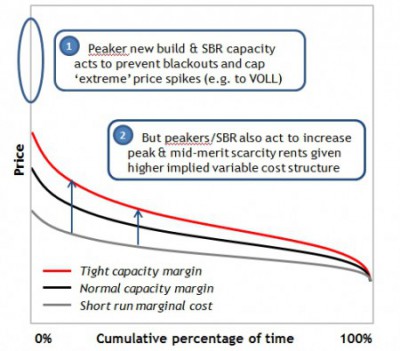
Chart 2 shows a simple stylised illustration of the likely impact of this reduced competition on energy market pricing.

Chart 2: Stylised price duration curve view of reduced competition at the margin

PDC

Source: Timera Energy

The chart shows a simplified view of price duration curve, the shape of which is distorted in order to illustrate a point.  The effects we are talking about are harder to visualise using real market data.  The grey line represents short run marginal cost for the system across a given year.  It increases to the left to reflect higher marginal cost plants setting system prices in times of peak net system demand. It is also in those periods that scarcity rents are highest given reduced competition at the margin.

The shift from the black line (normal PDC) to the red line (tight PDC) illustrates the impact of reduced competition at the margin.  Reducing the number of plants competing at the margin (via SBR and plant closures) acts to increase mid-merit and peak rents.  In practice this is achieved by higher and more volatile power prices.

Changes in the UK market design have implemented mechanisms (SBR and the Capacity Market) that allow the government and system operator to more closely control the level of backup capacity.   SBR in particular may become a key tool to ensure the lights remain on over the next three years.  However these mechanisms are unlikely to stop a pronounced rise in spark spreads, dark spreads and volatility over periods of market tightness.

Full commercial analysis of the 1st auction: For a comprehensive analysis of the 1st auction and its commercial implications you can purchase Timera Energy’s First Auction in Focus briefing report.
The report provides a more detailed analysis of competition between plant types and the marginal pricing outcome in the first auction. Analysis covers the impact of energy market expectations, going forward costs, price maker/taker status, refurb option dynamics and new build competitiveness. The report also explores the key interaction between capacity and wholesale energy market pricing dynamics and the relationship between 1st and subsequent auction outcomes (e.g. T-1 and 2nd T-4).  It concludes with a set of key commercial considerations on market dynamics going into the first auction.
For a report prospectus and more details please contact david.stokes@timera-dev.positive-dedicated.net.


A quick check on gas hub liquidity

Trading liquidity is the oxygen that is supporting the evolution of Europe’s gas hubs. Liquidity growth has been self reinforcing.  With higher transaction volumes, price transparency increases and transaction costs decrease.  This increases the attractiveness and reliability of hubs as a means to manage gas portfolio hedging and optimisation.

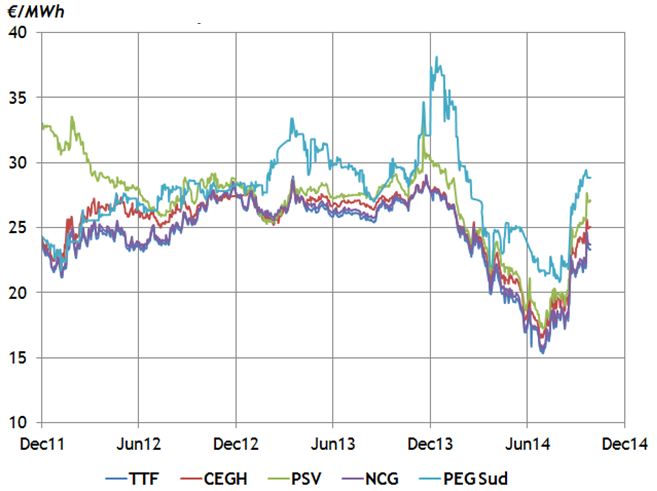
Some strong trends have emerged as hub liquidity has grown over the last decade. European gas trading has evolved around the UK NBP and Dutch TTF virtual trading points. While prompt liquidity has emerged at a number of other locations (e.g. Zeebrugge, NCG, Gaspool, PEG, PSV), forward liquidity remains focused on NBP and TTF. This is a function of the strength of price convergence across European hubs (illustrated in Chart 1).

Chart 1: Month-Ahead price evolution at major European gas hubs

Hub Prices

Source: Timera Energy (LEBA prices)

Prices between the different Continental hubs can diverge over the shorter term (e.g. within-month) as a result of locational supply and demand factors (e.g. weather, LNG flow). But structural divergences in prices beyond the prompt horizon are rare (with the notable exception of the French PEG Sud and Spanish AOC hubs). There has been a particularly strong correlation between TTF and the important German NCG hub.

This has reinforced the focus on TTF as the hub of choice for forward trading. TTF liquidity has also been helped by relatively low trading costs (e.g. narrow bid/offer spreads and exchange trading fees) and a greater range of tradable products that help the portfolio exposure management and asset monetisation. Forward portfolio exposures are mainly hedged against TTF with locational basis risk managed via prompt trading at other hubs.

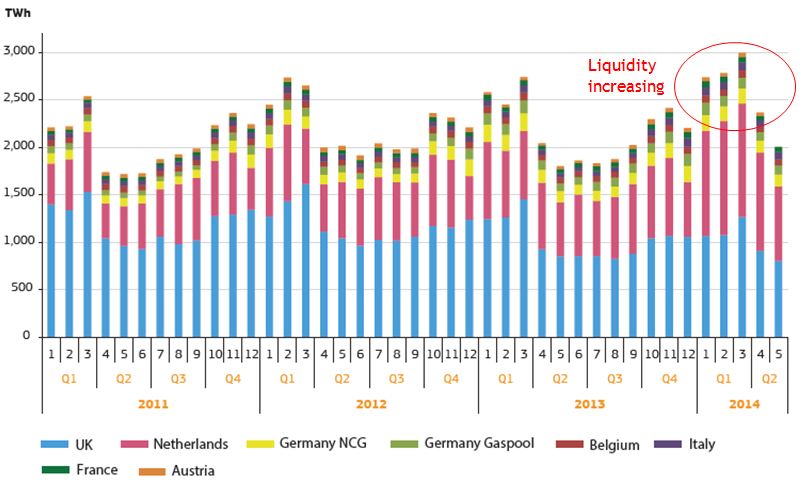
The dominance of TTF as the most liquid Continental hub is illustrated clearly in Chart 2 which shows the evolution of traded volumes over recent history.  While volumes at other Continental hubs have expanded, they are small relative to TTF given the focus of trading on prompt portfolio optimisation.

Chart 2: Liquidity evolution at major European hubs

Hub Liquidity 2014

Source: Quarterly Report on European Gas Markets (Vol 7) – European Commission

Since the onset of the financial crisis in 2008, European hub liquidity has almost doubled. Liquidity evolution was given a big boost by the 2009-10 global gas glut period of oversupply.  This was the result of two main factors:

  1. As hub prices fell below oil-indexed contract levels, suppliers were strongly incentivised to use cheaper hub gas in their portfolios wherever possible.
  2. Surplus LNG supply flowed into Europe as a market that offered a relatively robust price signal and forward liquidity to support cargo sales.

These factors are again at work as the global gas market balance has shifted back towards oversupply in 2014.

A pronounced increase in traded volumes can be seen in Q1 and Q2 2014 in Chart 2. This period coincides with an increase in the flow of spot LNG cargoes to Europe as Asian spot prices have declined.  It is also a period over which European hub prices have fallen sharply below oil-indexed contract strike prices.  If the gas market is transitioning towards a period of oversupply, these factors are likely to support further growth in hub liquidity.


First UK capacity auction in focus

Note: Several hours after this article was published DECC announced that they had revised the 1st auction capacity target down.  The article has now been updated to reflect this new information.

It is now 7 weeks and counting until the first UK Capacity Market auction.  The introduction of a Capacity Market represents the largest structural change to UK power market design since the NETA market replaced the pool in 2001.  Large sums of money are involved.  Capacity payments to generators are expected to be in the order of £1.5-2.5 billion in the first auction alone.  And the outcome of the auction will almost certainly result in the development of new power plants and the closure of existing assets.  It will also reshape pricing dynamics in the wholesale energy market.  So what can we expect?

One of the challenges in analysing the Capacity Market (CM) has been the level of uncertainty behind a number of key market drivers.  It doesn’t matter how good your telescope is if it’s misty.  However the situation improved substantially about a week ago when the final list of pre-qualified plants for the 1st auction was published.   This provided a clear read on participating plants & players, de-rated capacity volumes and plant status (e.g. existing, refurb or new build), as well as a view on which plants have chosen to opt out of the market.

There is still considerable uncertainty around several CM drivers, the most important of which is individual player expectations of the evolution of future plant energy margins.  But the information available now is about as good as it is going to get before the auction.  And there is plenty to work with in order to draw some powerful commercial conclusions.

Pre-qualification – what have we learned?

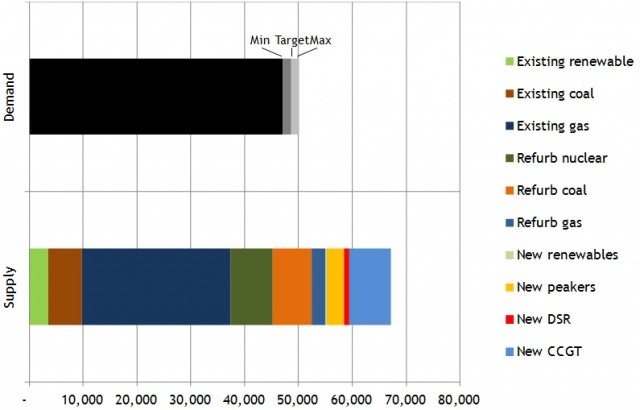
Publication of pre-qualification data has laid bare details of the 80 or so market participants and their assets which will compete to provide the government’s target level of 48.6GW of de-rated capacity for delivery in 2018/19.  A summary of prequalified capacity supply versus demand curve ranges is shown in Chart 1.

Chart 1: Final pre-qualified capacity for 1st auction (MW)
PQ chart2

Source: Timera Energy

Some of the more important facts on pre-qualification are as follows:

  • Just over 67GW of de-rated capacity prequalified, leading to the obvious initial conclusion that upwards of 15GW of capacity is likely to miss out in the 1st auction.
  • Scotland’s largest power station, the Longannet coal plant (~2GW), has opted out of the CM leaving the option open for Scottish Power to close the plant prior to 2019.  Plant economics are being eroded by increasingly unfavourable transmission charges given its northerly location.
  • A number of other existing coal plants (Cottam, West Burton, Eggborough and Ratcliffe) have prequalified on the basis of 3 year refurbishment options, to cover plant efficiency upgrades and ensure IED emissions compliance.
  • EDF Energy has chosen to submit all its existing nuclear assets for refurbishment, although it is not exactly clear how this refurbishment will enhance the UK’s capacity position.  This has been somewhat of a surprise and has the potential to become quite politically sensitive (given existing concerns around support for EDF via the Hinkley Point CfD and the Carbon Price Floor).
  • A wide range of smaller scale peaker plants (e.g. diesel gen sets, reciprocating engines, small scale gas turbines) have prequalified on 15 year terms.  Although this provides an interesting dynamic, the overall volume is still small relative to conventional thermal power assets.  Only slightly over 3GW of new build peakers are participating.  There is also slightly less than 1GW of Demand Side Response (DSR), presumably mostly in the form of new back up peaking generators.
  • 7.8GW of new CCGT has also pre-qualified on 15 year terms across 9 participants (SSE, ESB, Centrica, Scottish Power, Intergen and several other specialist developers).  It however remains to be seen how much of this will be competitive enough on a cost basis to displace other capacity.

It is also important to note that the government revised down its 1st auction capacity target level to 48.6GW (initially set at 50.8GW) on 27th October, to account for opt out decisions (e.g. Longannet).

Analysing the auction outcome

Analysis of CM dynamics has been a key area of focus for Timera Energy across 2014.  As a result we have developed a strong capability to model pricing interaction between the UK capacity and energy markets.  To keep this article focused we do not provide a detailed description of our modelling methodology.  However there are two principles behind our analytical approach that is important to set out upfront.

The first principle is that what looks like a complex mess of different plants, players, costs and expectations can be substantially simplified by focusing on the plants and cost structures that are likely to drive marginal pricing.  In other words by working out which subset of plants are likely to drive the intersection between supply and demand.

The second important principle behind our modelling is having a healthy respect for uncertainty.  There are a couple of important and interrelated CM drivers that will influence the auction outcome, yet remain uncertain up until the auction day:

  1. Energy margin expectations:  The margin required to support existing and new power plants can be broken into three categories: (i) capacity (ii) energy and (iii) reserve margin.  Plant bidding levels (determining capacity margin) in the auction are directly influenced by player expectations on the evolution of energy and reserve margin over the period to 2018/19 and beyond.  With poor forward market liquidity past 2016, there is there is scant quantified market price signal on forward energy margin, and expectations on this for the future may differ significantly.  Uncertainty around these expectations is a reality that has to be recognised and confronted when analysing CM auction dynamics.
  2. Going forward losses:  Some existing plants (e.g. older coal and CCGT assets) will suffer losses from weak generation margins in advance of delivering capacity in 2018/19.  Players can recover for these losses by applying for price maker status (shortly prior to the auction).  This allows them to bid above the price taker threshold for existing assets (25 £/kW), in order to attempt to recover for losses incurred by remaining open.  Loss levels in turn come back to energy margin expectations.  We can do some sensible analysis of the impact of losses on capacity bidding, but ultimately a significant degree of expectation based uncertainty remains.

In our view, trying to forecast these factors at an individual plant/player level tends to give credence to a spurious level of detail in CM analysis.  We prefer to recognise the uncertainty involved around these factors and try and analyse how it may impact the auction outcome.

1st auction supply stack

In order to analyse CM dynamics it is necessary to construct a representation of the supply stack.  The supply stack is driven by the costs of providing capacity in 2018/19, with the CM being designed such that players have quite strong incentives to bid plants at true cost.

The task of developing the supply curve is helped by the fact that good cost benchmarks are available by plant type.  The important benchmarks are the fixed costs of existing plants, the upgrade capex required for refurbishment plants and the capex costs for new build.  The more difficult task is netting off energy margin expectations to derive capacity bids (as described above).  As a result, energy margin expectations become a key focus variable for running scenarios.

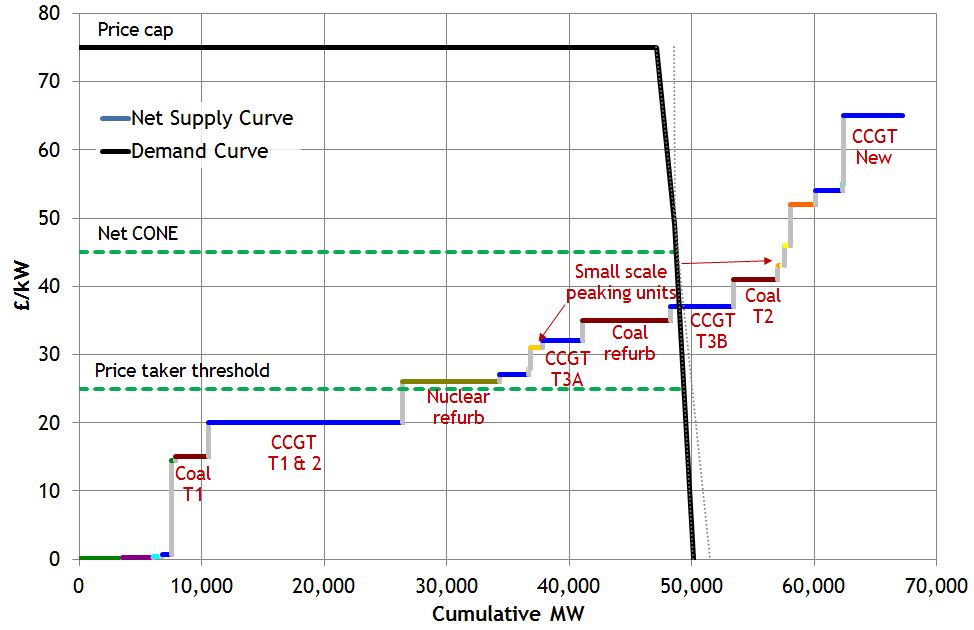
Chart 2 shows a stylised scenario view of the 1st auction capacity supply stack with the demand curve overlaid.  We have constructed this chart to provide a simplified representation of some of the CM pricing dynamics (described below).  As such it is illustrative and should not be interpreted as a forecast of the auction outcome.

Chart 2: Stylised scenario view of 1st auction supply stack
CM stack revised

Source: Timera Energy

For the purposes of this chart, we have set up our CM model in ‘aggregated’ plant mode showing the supply curve grouped into tranches of capacity types based on cost of provision.  Several of the key capacity categories around the margin are labelled.  In practice we undertake detailed analysis at a more granular level, but it is easier to visualise the CM and draw high level conclusions at an aggregated level.

Some background in order to understand what the chart is showing:

  • The demand curve (black line) reflects the new 48.6GW auction target level. It is downward sloping from a min volume of 47.1GW (at the 75 £/kW price cap) to a max volume of 50.1GW (at zero capacity price).
  • The inflection point of the demand curve is at the government’s 49 £/kW estimate of net new entry cost (net CONE).
  • The chart also shows the price taker threshold at 25 £/kW which caps the level at which existing plants can bid in the absence of going through the process of applying for price maker status (to recover going forward losses).
  • With our supply stack model set in ‘aggregated’ mode, plants are grouped into 25 basic categories for which bids are defined based on cost and energy market expectations.  These categories are shown for the illustrative scenario by different coloured sections of the supply stack.
  • Some capacity types are made up of multiple tranches, e.g. existing CCGTs are split into 3 tranches (T 1-3) as we have explained previously here, with the oldest assets (T3) split into two subcategories to differentiate between the impact of going forward losses on capacity bids.

Marginal pricing setting

As we described above, analysing the CM becomes easier if you focus in on the range of the supply stack where the marginal price is likely to be set.  A good case can be made for a lower price bound around the fixed costs of older CCGT plants (~20 £/kW).  There is 6-8GW of CCGT built in the early/mid 1990’s that is currently making close to zero margins in the wholesale energy market.  This capacity (and several GW of older coal capacity) will be very likely to close at a capacity price below that level.  There also looks to be a reasonable supply of new build gas and peaking plants above 50 £/kW that is likely to act as an upper bound in the first auction.  It is the range in between these two bounds where the 1st auction is likely to be fought out.

The supply stack representation in Chart 2 illustrates three key categories of plants that are likely to be competing to drive marginal pricing within this range:

  1. Older coal plants:  7GW of less efficient existing coal plant are bidding for 3 year refurb contracts to comply with IED requirements.  In addition there are several more GW of other older existing coal stations that will likely apply for price maker status to recover going forward losses (with a view to closing by 2023 given IED constraints).
  2. Older CCGTs:  Many of the 6-8 GW of older, less efficient CCGT that are currently making very little energy margin are also likely to apply for price maker status to recover going forward costs.  The interaction between the bidding of these CCGTs and existing coal plant is likely to be a key factor driving the auction outcome.
  3. New small scale peakers: Low capex small scale peaking plants under advantageous 15 year capacity agreements (supporting attractive leverage structures) are likely to be the most competitive form of new build.  Given the number of different players and technologies, some of these plants should feature around the margin.  But relatively low volumes mean that they are less important than the two categories above.

Our conclusions from previous articles we have published on the CM were that (i) refurb and going forward costs will be key drivers of the 1st auction outcome and (ii) low capex small scale peakers will be competitive given leverage opportunities under 15 year agreements.  Our analysis since release of the prequalification data only reinforces these initial conclusions.

A noteable exclusion from the list of key marginal price setting plants is the 7.8 GW of new CCGT capacity that is participating in the 1st auction.  We assume ESB’s Carrington CCGT will be built regardless given it is already under construction.  But the developers of other new CCGT projects face a key challenge in putting a price on energy margin from which to imply a CM bid.  The source of this energy margin pricing falls into two main categories. Projects will either need to sign a third party market tolling agreement (e.g. IPP developers) or internalise the energy margin risk in their portfolio (e.g. utility developers).  Both categories are likely to face the issue of heavily discounted energy margin as a result of the pain being caused by current weakness in sparkspreads.  As a result it will take a very cost competitive new CCGT project to compete with existing assets and smaller peakers. 

The first vs subsequent auctions

After focusing in on marginal price drivers, it is useful to take a step back and consider the 1st auction from a more strategic perspective.  There are strong market design incentives to bid plant in a cost reflective manner.   But first auction bidding behaviour will also be influenced by expectations of future auction outcomes.

If a plant bidding for a 3 year refurb or 15 year new build contract is unsuccessful, it has the option to try again next year.  But the 1st auction looks attractive given greater competition next year (e.g. from interconnectors) and expectations that the government may introduce less favourable rules around longer term capacity agreements (e.g. via a price duration curve mechanism).  This is likely to incentivise a more aggressive bidding stance in the first auction, particularly for new build plant chasing favourable 15 year terms.

For a number of existing gas and coal plants this year’s auction is likely to pose an existential challenge.  Plant losses mean that assets need to bid as price makers to recover going forward costs.  Yet owners run the risk of missing out in the auction if bids are high, necessitating plant closure.  Ultimately first auction bidding strategy is linked to the complex assessment of plant abandonment economics.  This may skew plant owners to take a more aggressive stance on assumptions such as energy margin recovery expectations (e.g. 2015-18 as the market tightens) to support lower bid levels.  This effect and the new build one described above may result in downward pressure on the 1st auction capacity price.

Market pricing dynamics

Ultimately it is existing power plants that are going to be the main drivers of the first auction outcome.  This is the logical result of an auction target level that does not require the delivery of incremental capacity volumes.  The government’s target level relies heavily on DECC/Grid’s assumptions of peak demand reduction between now and 2018. If these turn out to be optimistic then it will mean substantial ‘top up’ buying of capacity or DSR in the year ahead auction.  This is likely to favour developers of small scale peaking assets (with low capex and short lead times).  It may also support contracting of supplementary reserve in the meantime.

There are 10-12GW of existing older coal and gas plants that currently have weak economics given low spark and dark spreads.  Some of these plants will miss out in the 1st auction and subsequently close.  This will have an important knock-on impact for pricing and volatility in a tightening energy market over the next three years.

This is particularly the case if low capex but high variable cost small scale peakers are successful in displacing significant volumes of existing gas/coal plant.  That would act to support power price and volatility levels (and hence plant energy margins).  Small scale peakers may be cheap on a capex basis but they are very expensive on a variable cost basis and hence will have a limited impact in dampening power prices relative to larger conventional plants.

It is this interaction between capacity and wholesale energy pricing dynamics that is going to be critical going forward.  The capacity market will determine the level and type of system capacity.  This will then drive price shape, scarcity rents and volatility in the energy market.  As a result, the first capacity auction marks the start of a transformational change in the UK power market and the dynamics of generation investment returns.

Full commercial analysis of the 1st auction: For a more comprehensive analysis of the 1st auction and its commercial implications you can purchase Timera Energy’s First Auction in Focus briefing report.
The report provides a more detailed analysis of competition between plant types and the marginal pricing outcome in the first auction. Analysis covers the impact of energy market expectations, going forward losses, price maker/taker status, refurb option dynamics and new build competitiveness. The report also explores the key interaction between capacity and wholesale energy market pricing dynamics. It concludes with a set of key commercial considerations on market dynamics going into the first auction.

For a report prospectus and more details please contact david.stokes@timera-dev.positive-dedicated.net.


German recession, power prices & generation margins

After being the poster child of post crisis European recovery, Germany is suddenly facing the combined threat of deflation and recession. German GDP contracted in Q2 and industrial production has slumped across the summer. German exports have also sharply declined in August despite a weakening Euro. This is not a positive backdrop for German power demand. But there are factors ahead that may prevent a weakening German economy from translating into further declines in power prices and generation margins.

German power prices: a conspiracy of events

German wholesale power prices have fallen more than 60% since they peaked in Q3 2008. The three main factors behind this decline are:

New build: In the last 5 years approximately 10GW of wind, 30GW of solar and 10GW of new thermal (hard coal, lignite and gas) capacity has been commissioned.   This can be compared to a little over 10GW of retirements (the majority of which are nuclear closures). There is also another 6.5GW of capacity (mostly hard coal) still under construction which will be commissioned over the next 2 years. The pace of new build has led to a substantial capacity overhang which has helped to drive higher variable cost thermal plant out of merit.   In addition, the increase in solar and wind output has acted to flatten intra-day price shape pulling down peak prices.

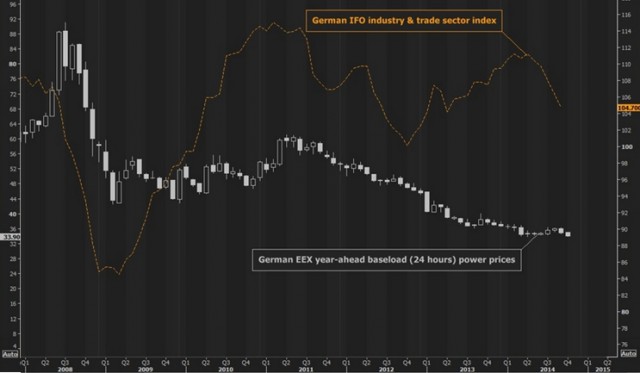
Coal price slump: Gas-fired generators have suffered the double edged sword of a surge in low cost new capacity and an erosion of competitiveness as a result of falling coal prices. With gas-fired plant removed from the margin, wholesale power prices are now predominantly set by coal fired plant. As a result the post financial crisis decline in coal and carbon prices has fed through into a steady decline in wholesale German power prices as shown in Chart 1.

Weak demand: After a snap back recovery from the aftermath of the post-Lehman shock in 2008-09, power demand in Germany has also steadily declined. This is due to a combination of increasing embedded generation, energy efficiency measures and weaker post crisis industrial demand.  Chart 1 shows the recent downturn in the IFO German business confidence index which is pointing to further declines in industrial demand.

Chart 1: 5 years of German power price declines (source Reuters)

DE power & IFO2

German generation margins looking forward

After 5 years of events that have consistently reinforced the downward trend in German power prices, it is easy to extrapolate a pessimistic view into the future.   This is particularly true if you subscribe to the theory that Germany and its neighbours are falling back into recession. But there are several factors that are working against a further substantial decline in power prices and generation margins.

Lignite on the margin: While hard coal plants dominate German marginal price setting, the factors described above are increasing the number of hours where lignite comes on to the margin (e.g. in periods of high renewable output and low demand).   The variable cost of coal plant is driven predominantly by the cost of imported coal (a global traded commodity). However the variable cost of lignite plants is determined by local extraction costs at strip mines. It is harder to define the true variable cost of lignite plant than it is for coal plant, but it is in the order of 25-30 €/MWh. This is not far below the current level of year-ahead power prices (see Chart 1) and it represents an important support level going forward.

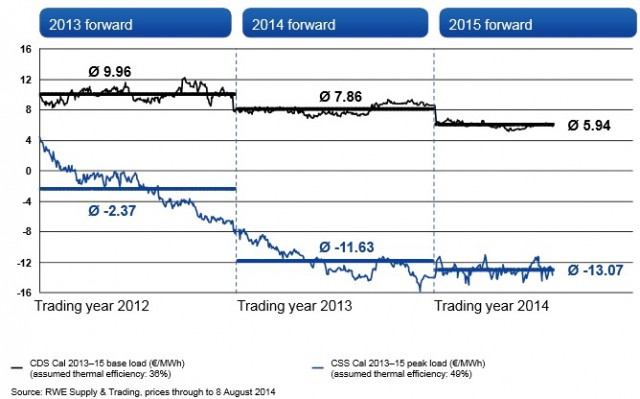
Coal prices: For the moment, API2 coal prices remain the most important factor driving German power prices. We wrote last week about how global coal prices had fallen below the long run marginal cost of new production and how export supply was being curtailed as a result. In the medium term these factors are likely to stem the fall in coal prices (although further price declines are certainly a possibility in the near term). But exchange rate movements are diluting the effect of falling global coal prices for German importers. The Euro has fallen almost 10% over the last six months, substantially offsetting the API 2 coal price decline across this period. If the US dollar continues to rise against the euro, this will act to support German power prices. A stabilisation in forward German gas and coal fired generation margins this year is evident in Chart 2.

Chart 2: German forward dark and spread margins

DE spreads

Plant closures: Under recently instated rules, plant owners planning to retire assets must submit an application to be approved by the German Federal Network Agency (BNetzA). Around 7GW of capacity has already applied for permanent closure, with BNetzA anticipating a total of more than 11GW of retirements by 2018. The volume of mothballing and retirements may increase significantly over the next few years given the inability of generators to cover costs at current dark and spark spread levels (shown in Chart 2). The large utility players in Germany continue to rationalise their generation portfolios as they face balance sheet constraints. Germany’s third largest generator Vattenfall may well sell its power portfolio and exit the German market all together.

Capacity mechanism support: Unlike the UK, Germany is in no rush to implement a new capacity market. Ample interconnection and the current capacity overhang are supporting security of supply, even if there are some increasingly acute localised transmission stress issues. The Ministry of Economic Affairs and Energy has commissioned three studies that investigate German power market design. The Ministry is expected to release a green paper setting out its thoughts on market design next month. This will then go to public consultation with a white paper expected in Sep 2015. There is pressure on Germany to implement a capacity mechanism as part of a broader European solution, despite the UK and France already having acted unilaterally to support capacity returns. While the nature of the solution is as yet unclear, it is a reasonable assumption that a capacity mechanism will be in place later this decade in order to support thermal generator fixed costs.

Power asset investment?

Both utilities and funds are treating the German power market with extreme caution. This is understandable when you look at the current market landscape. The important question is to what extent this is reflected in market expectations, investment decisions and asset prices. Sentiment on thermal generation assets in Germany is now very negative. Coal plant margins have been eroded with stiff competition from both renewable and thermal generation new build. Gas plants have been pushed out of merit, now representing ‘out of the money’ options that incur a substantial cost of carry (in the form of plant fixed costs).

But we have described a set of factors above that may act to support energy margins. In addition generators may benefit going forward from the implementation of a capacity mechanism and increasing reserve margin (as transmission stress rises). The key challenge investors  face in valuing thermal generation assets is understanding how these factors drive asset margin  risk/return distributions.

The German power market is also a key driver of pricing and generation margins in neighbouring markets such as France, Netherlands and Belgium. So the logic in this article extends across North West Europe, although the capacity situation varies by country. It appears to us that there may be some interesting generation investment opportunities in Continental Europe over the next two to three years. The challenge will be to find the right assets in the right locations at the right price.

Oil and coal pricing back in focus

This blog is focused on gas and power markets.  But every few months we take a step back and look at the impact of the broader commodity market environment.  With front month Brent crude oil plunging more than 20% over the last few weeks and a broader sell off across commodity markets, it seems like an opportune time to revisit this theme.

There are two main factors behind the recent commodity price falls.  Firstly, there are increasing concerns about weakening global economic growth and hence commodity demand.   The IMF last week fired a warning shot on global growth, raising particular concern about Europe slipping into another recession.  Despite massive monetary stimulus, the Japanese economy is also treading water.  And importantly for commodity demand, the Chinese economy still appears to be going through a period of consolidation at lower levels of growth.

The second factor is a surge in the US dollar across the last three months.  This reflects a shift in the balance of monetary expansion away from the US and towards Europe and Asia.  Over the next year or two it looks like both the Eurozone and Japan will rely on more aggressive monetary easing to respond to the dual threats of deflation and weakening economic growth.  The US currently has the healthiest growth & employment scorecard and may start to raise interest rates again next year.  This shift in relative monetary policy stances is driving the movement of capital from other currencies into the US dollar.  This is important for global commodities (which are traded in USD terms) because there has historically been a significant negative correlation between commodity prices and the dollar.

With these two factors as context we now take a look at the recent evolution of oil and coal prices.

Oil takes a dive

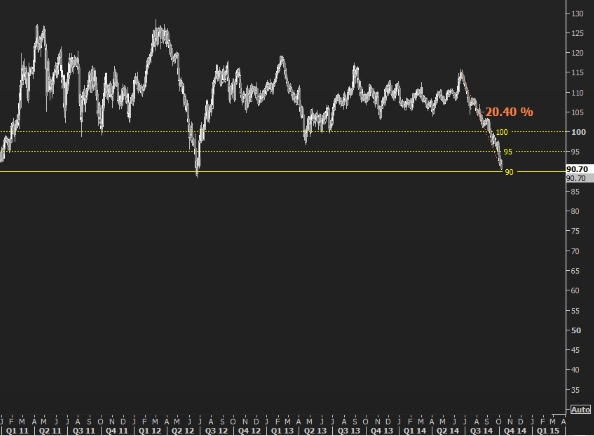
The front of the Brent crude oil curve has been trading in a range between 90 and 125 $/bbl since the start of 2011.  The last few weeks have seen a sharp 20% decline in the front month contract to break support at the bottom of this range, a move which has got a lot of press.  As well as the two factors described above there are a couple of other factors of specific relevance to the decline in oil prices:

  • US unconventional oil production keeps expanding to new record levels, which is contributing to the weight of global supply in a weaker demand environment.
  • OPEC does not appear to be presenting a convincing near term response to counter the recent price fall.  In fact Saudi Arabia appears to be comfortable with the current price fall according to Reuters.

As much as the recent move in the front of the oil curve has generated excitement, there has not been much follow through when you look several years forward.  The recent move down in near term contracts has resulted in a very flat curve.  But this is still anchored above 90 $/bbl in 2020.  The current oil price decline will become a much bigger story if the fall below 90 $/bbl in the front of the curve, starts to materially pull down longer term prices in the tail.

Chart 1: Evolution of Brent crude front month contract since 2011 ($/bbl)

Brent chart

Source: Reuters

Coal continues to slide

The coal market has been a story of steady price decline for the last three years, as shown in Chart 2.  It is well known that China sits at the centre of the global coal market as the world’s biggest consumer.  What is less well known is that China is also the world’s biggest producer of coal.  Although a number of Chinese mines look to be uneconomic at current price levels, China’s production has continued to expand, reducing import demand.  China has also recently slapped tariffs on imported coal in a worried attempt to protect struggling domestic miners.  The situation in China is weighing on an already oversupplied seaborne coal market.  This is not helped by weakening US gas prices which continue to favour gas-fired generation over coal.

Chart 2: Evolution of coal API#2 ($/tonne)

API2 chart

Source: Reuters

Global coal price weakness is however starting to induce curtailment of supply in large exporting countries.  Australia in particular has had several mine closures and cutbacks as a result of weak export prices and a relatively high production cost base.  More closures of export mines are going to be required to stabilise coal prices.  But prices have been at or below the long run marginal cost of new production for some time now.  So the coal market has progressed to a more advanced stage of reacting to price weakness.  The oil and gas markets on the other hand are only just starting to confront the prospect of a period of oversupply.

LNG vessel charter rates heading south

The upheaval in the global gas market this year is also being felt in the LNG shipping market. LNG charter rates have sunk in 2014 alongside gas prices.   Healthy LNG vessel order books in anticipation of new liquefaction capacity are resulting in a wave of new deliveries from shipyards.  At the same time the fall in demand for gas in Asia is reducing vessel journey times.   The fall in LNG charter rates is having an important knock on impact on LNG shipping costs which are becoming an increasingly important driver of global gas price differentials.

The weight of supply

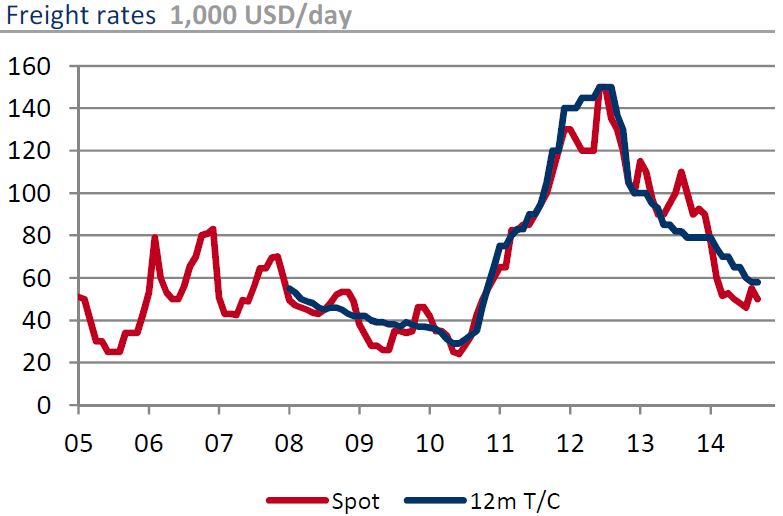
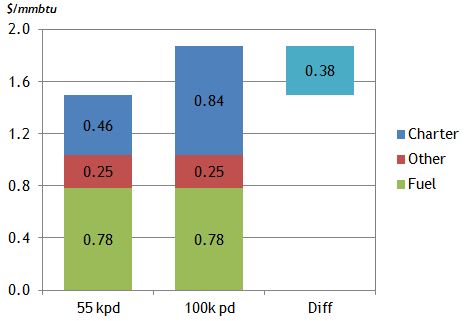
We published an article at the start of January on ‘Steam coming out of the LNG shipping market’.  Our conclusion was that given the weight of a substantial order book for LNG vessels “2014 may mark the start of the next glut in LNG shipping capacity”.  Spot charter rates have fallen from levels around 90,000 – 100,000 $/day in 2013 to around 50,000 $/day last month.  12 month term charter rates have also fallen to around 58,000 $/day in sympathy as shown in Chart 1.

Chart 1: LNG spot and 12 month term charter rates

LNG Charter Rates Sept14

Source: RS Platou Monthly (Sept ’14)

These rates are now back below those required to support new build of LNG vessels. It also appears that the post-Fukushima boom in shipping charter rates is giving way to a period of oversupply, similar to that seen from 2008 to 2010.

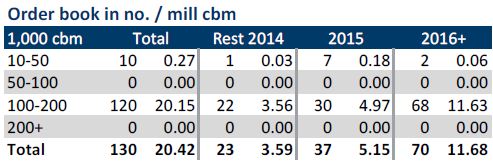
New orders for LNG vessels are drying up. But there is a lot of inertia in the existing order book given the time lag between order and delivery.  Existing orders have been driven by higher LNG prices and charter rates post-Fukushima and a wave of enthusiasm around new liquefaction capacity coming to market in the second half of this decade.  Chart 2 gives an indication of the number of vessels to delivered over the next 3 years.  While many of these vessels are under long term contract in relation to new liquefaction capacity, there are also a number that are not under contract.  These may further weigh on shorter term charter rates.

Chart 2: Global LNG vessels order book

LNG Vessel Order Book Sept14

Source: RS Platou Monthly (Sept ’14)

Changing LNG shipping costs and flow dynamics

As well as a healthy order pipeline, the other factor weighing on LNG charter rates in 2014 is changing patterns of vessel utilisation.   The sharp fall in Asian spot LNG prices over the summer has seen a reduction in the diversion and reloading of European LNG supply to Asia.  This in turn reduces average journey time and unballasted voyages, factors which have supported shipping demand and charter rates over the post-Fukushima period.

Weak spot gas prices and falling charter costs have also reportedly led to a number of vessels being used for storage plays for up to 6 months, i.e. gas can be stored in the summer and re-sold as prices recover into winter.

Vessel charter rates are the largest component of LNG shipping costs. So the fact that charter rates have more than halved since 2012 has significantly reduced the cost of moving LNG.  Chart 3 shows the impact of the recent fall in charter rates in reducing shipping costs for cargo diversions from Spain (Huelva) to Japan (Sakai).

 Chart 3: Illustration of reduced LNG cargo diversion costs from Europe to Asia

LNG Shipping Cost Example Sept14

Main assumptions:

  • Laden leg only, 147k MT vessel, 600 MT fuel oil price
  • 10,014 NM journey via Suez canal, 19 knots average speed,(~22 day voyage) 
  • USD 400k canal transit charge (one way), other costs including port fees, brokerage and insurance.

Source: Timera Energy

The primary driver of LNG flows is locational price differentials.  It appears that we are entering a new phase of global gas pricing where these price differentials may be narrowing (as we set out here).  A reduction in LNG charter rates will likely act to reinforce global price divergence by reducing the cost of moving LNG between locations.  As global LNG market tightness subsides, shipping costs are likely to become increasingly important in driving global pricing.  We look at some of the implications of shipping costs on LNG pricing dynamics in an article to follow shortly.

Tighter UK market, higher gas plant margins?

The last 3 years have been tough for UK gas-fired plant owners. A slump in coal prices has given coal plant a clear competitive advantage over gas plant in the merit order.   On top of this a steady increase in renewable output is eroding CCGT generation margins and load factors.  Yet looking forward over the next 3 years the UK is heading into a period of very tight system capacity margins.  But is the market anticipating a recovery in gas plant generation margins as a result?

Several important things have happened since we last looked at UK gas plant margins. The UK power market has now been given a rulebook for the new Capacity Market, which is likely to have broad reaching implications for capacity decisions and power price dynamics as the decade progresses.  In the more immediate future there are a number of unexpected plant outages into the approaching winter as we set out here.  That has in turn led the system operator National Grid to run an additional tendering process for emergency generating reserve (BSR) into this winter.

A recap on UK gas-fired plant

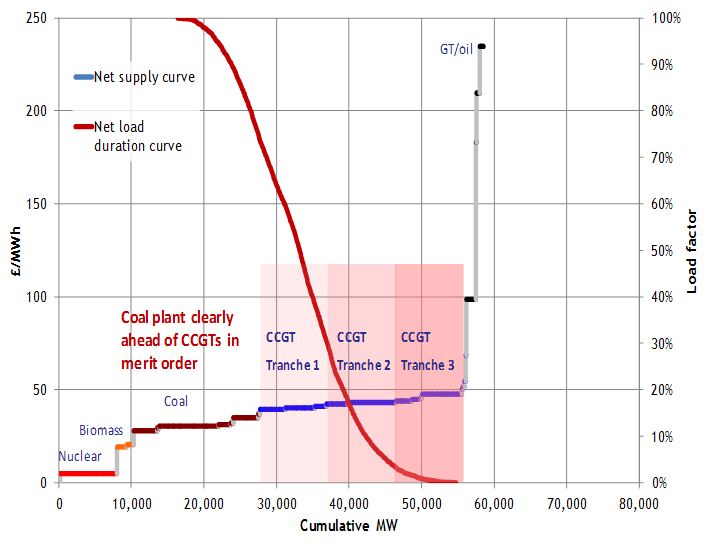
There is about 30GW of CCGT capacity in the UK market which plays a dominant price setting role. CCGTs can be thought of in 3 tranches (of approximately 10GW each):

  1. Tranche 1: Very efficient and flexible CCGT built in the last few years, currently running mostly as mid-merit plants (e.g. ~50% load factor)
  2. Tranche 2: Plant of average efficiency and flexibility built around the turn of the century, currently running mostly as peaking plants
  3. Tranche 3: Older, less efficient and less flexible plant built in the early to mid 90s, currently running at very low or zero load factors

These 3 Tranches are shown in the UK stack diagram in Chart 1 below (for an illustrative set of forward prices).

Chart 1: UK generation supply stack (with non-controllable generation netted off demand)

UK stack

Source: Timera Energy

Market pricing for plant gas margins

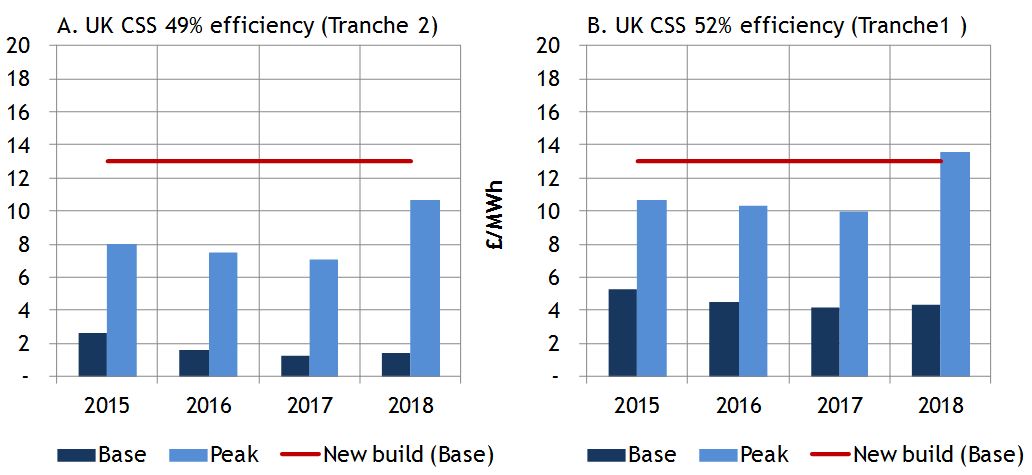
Chart 1 shows the dominance of CCGT in the UK supply stack. That results in a strong relationship between power and gas prices.  This relationship drives gas plant generation margins (sparkspreads).  Market convention is to track sparkspreads based on a defined plant efficiency (49%) and cost structure system, broadly representative of system average parameters.  However actual margins earned by individual CCGT vary significantly based on the efficiencies and cost structures of individual assets.  Two set of clean spark spreads are illustrated for a generic Tranche 1 (52% efficient) and Tranche 2 (49% efficient) asset at current forward market prices in Chart 2.

Chart 2: UK Forward Clean Spark Spreads (CSS)

UK CSS Sept14

Source: Timera Energy (prices from ICE, Sep 2014)

Market liquidity is very limited beyond 2016, which means that 2017/18 pricing is little more than indicative. But there are a few important observations that can be made:

  • Intrinsic value: Plant value that is hedgeable in the forward market is focused in peak periods, particularly for Tranche 2 assets.  This means a significant portion of realised asset value depends on capturing price shape and volatility close to plant dispatch.
  • Margin recovery: Despite sharply declining system capacity margins over the 2015-17 period (due to scheduled closures), the market is not pricing in any recovery in spark spreads (although note the point below on curve rerating).
  • New build: Current forward market pricing is a long way short of what is required to support new build of CCGT (around 13 £/MWh on a baseload equivalent CSS basis), unless a very strong capacity price signal emerges in the new Capacity Market (e.g. 70+ £/kW).

Looking forward

While the current UK market environment is not friendly for CCGT margins, the composition of the supply stack provides a key downside support for CCGT generation margins. Because CCGT plants make up such a large portion of the stack, negative spark spreads are not the problem they are in Continental European power markets.  Even at low levels of demand (& high levels of wind output) gas-fired plants are still typically fulfil the role of marginal price setting capacity.  A buffer against negative spreads may be cold comfort for UK gas plant owners but it does prevent CCGT plant from being driven completely out of merit as has happened in Continental markets (e.g. Germany, Netherlands).

The really important question is when forward sparkspreads may recover. History has shown that structural shifts in forward market conditions are often precipitated by a shock in the prompt market, for example due to a cold winter or major asset outages.  Shocks to the front of the forward curve can result in a rapid re-rating of margins along the curve.  And the UK market is certainly vulnerable to such a shock as the system capacity margin tightens across the next 3 years (as we set out here).  We suspect market pricing reflects a degree of complacency as to the risks over this period.

Looking beyond the UK market tightening over the next 3 years, the evolution of gas plant margins will depend heavily on the Capacity Market.  Capacity payments represent a structural change to gas plant margins, likely to at least cover CCGT fixed costs (as we set out here).  However the Capacity Market is also likely to support higher system capacity levels, a factor that weighs on wholesale prices and volatility.  As important will be the type of incremental capacity delivered (e.g. OCGT, vs CCGT vs interconnectors) as this will impact price shape and volatility.  All these factors point to the result from the 1st capacity auction in December providing some key insights into the long term evolution of gas plant generation margins.

The next phase of global gas pricing

Commodity markets are known for their rapid shifts in supply/demand balance and pricing dynamics. The global gas market is a great case study.  In the space of a decade we have seen a commodity ‘supercycle’ boom, a global gas glut and a post-Fukushima squeeze.  And now price evolution in 2014 points to the start of something new.

Europe is playing a central role in shaping the evolution of the global gas market, as a gas importer and as a provider of LNG diversion flexibility. In turn, global LNG pricing and flows are becoming increasingly important drivers of the European gas market.  LNG import volumes are still low relative to pipeline imports, but they have a disproportionate influence on marginal pricing at European gas hubs.

The return of significant volumes of LNG to Europe in 2014 has been an important factor behind the hub price slump into the summer. Looking forward into the next phase of global pricing, global price differentials are set to play a key role in driving the evolution of the European gas market.

Global gas pricing phases

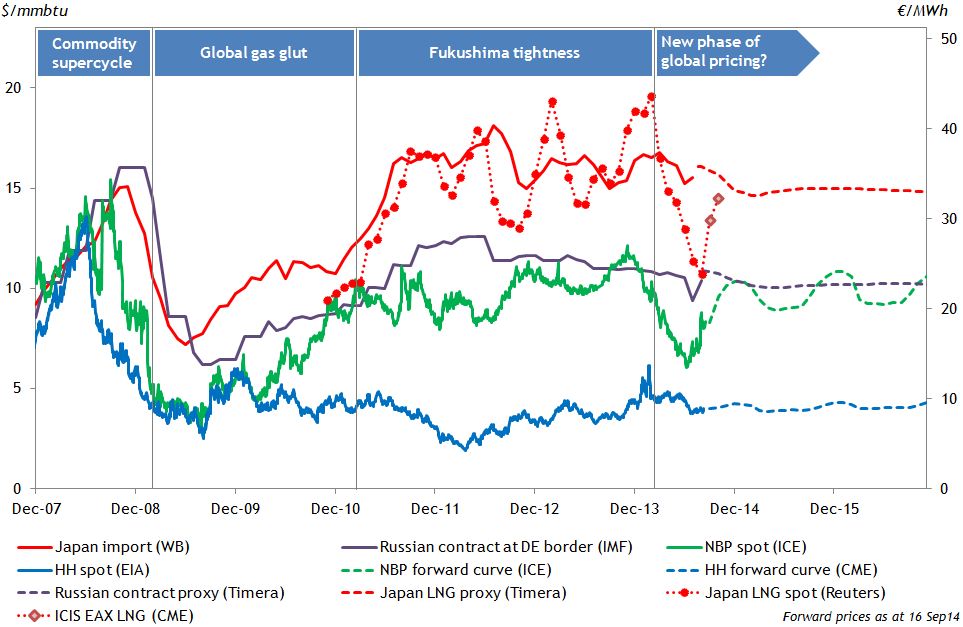
There have been several quite pronounced phases of global gas pricing over the last decade as described below and illustrated in Chart 1:

  1. 2006-2008 Commodity super cycle: The gas market was dragged along in a highly correlated boom/bust cycle in global commodity markets. However regional price convergence remained relatively strong as did the linkage between spot and oil-indexed contract prices.
  2. 2009-10 Gas supply glut: A surge in US shale production, new LNG liquefaction capacity and a global financial crisis, combined to rapidly shift the global gas market into a phase of oversupply. Importantly in Europe, hub prices went through a significant de-linkage from oil-indexed contract prices, fuelling substantial losses in supplier portfolios and a round of contract price reopener negotiations.
  3. 2011-13 Fukushima tightness: A more than 20% y-o-y increase in Japanese LNG demand precipitated a phase of tight and volatile spot LNG markets, inducing substantial volumes of European supply to be diverted to higher priced markets. This in turn supported a reconnection of European hub prices with oil-indexed contract prices.

Chart 1: Global gas price phases

Global Gas Prices Sept14

Source: Timera Energy

Gateway to a new phase

From the chart it can be seen that a pronounced shift in pricing dynamics is occurring in 2014. As we set out recently, this is no ordinary fall in global gas prices.  Asian spot LNG prices almost halved in H1 2014, from around 20 $/mmbtu to just above 10 $/mmbtu.  European hub prices have slumped in sympathy, to a large extent driven by surplus LNG flowing back into Europe but also by the loss of 57 bcma of demand over the October 2013-April 2014 period  on a year-on-year basis due to a mild winter.  Yet both spot LNG and European hub prices are showing signs of a recovery into the coming winter.

Substantial volumes of new Australian and US LNG exports are looming on the horizon which threaten to tip the global gas market into a period of oversupply (as we set out here). Although new supply starts to come online later this year, volumes do not ramp up in earnest until 2016/17.  That appears to leave the window open for two potential scenarios for the next phase of global pricing:

  1. Transitory volatility:  Emerging market LNG demand growth still looks to be relatively strong.  The 2014 price slump has definitely changed perceptions of the level of market tightness post Fukushima.  But it is possible we are entering a transitory period of uncertainty and volatile spot prices.  Gas prices may exhibit a more pronounced seasonal shape, with global price divergence in periods of tightness (e.g. cold winters).  But after the events of this year, a return to the consistent price divergence of the post-Fukushima phase looks to be much less likely.

This means that the flow of LNG into Europe is also likely to become more volatile with a knock on effect for European hub prices. The length of such a transitory phase is likely to be determined by the extent to which emerging demand growth can soak up the substantial volumes of new supply under development.

  1. Renewed supply glut: A scenario which was widely considered implausible at the start of this year is that the global market is already entering a period of oversupply. For this scenario to become a reality, the ramp up of new liquefaction capacity over the next three years would need to outpace demand growth.  Factors such as Japanese nuclear restarts and Asian economic growth will play an important role in determining this.  For Europe, such a scenario would mean a substantial increase in LNG flow back into Europe.  This would in turn be likely to place pressure on hub prices and lead to periods of disconnection from oil-indexed contract prices as was seen across 2009-10.

In both these scenarios, spot LNG prices will play an increasingly important role in determining the behaviour of European hub prices.

Watch for winter

The coming winter will be an important test case to understand which of these scenarios is more likely. The approach of winter is helping to stabilise Asian spot LNG prices which are now back above 14 $/mmbtu for November delivery.  This is below long term Asian contract levels (15-16 $/mmbtu at $100/bbl crude) and well short of spot price levels at the start of this year.  However it is enough to incentivise the diversion of cargoes from Europe back to Asia.

The diversion of LNG supply back to Asia and the end of a mild summer in Europe should relieve some of the recent downward pressure on European hub prices.   Certainly the forward curve assumes a sharp price recovery in spot NBP prices as is evident in Chart 1.  And the steep NBP (and TTF) curve contango into winter, points to unease at the ongoing threat of Russian supply cuts.

But perhaps the most important uncertainty for European energy companies is the relationship between hub prices and long term oil-indexed contract prices.  The gap between contract and hub prices which caused European suppliers so much pain in 2009-10 has re-opened again this year.  The evolution of this differential will be a key risk factor in the European gas market going forward.  Will the assessment of Russian ‘oil indexed with concessions’ contract price for Russian pipeline gas into Europe remain the important benchmark for European market players?  Or has the rather opaque process of rebates granted by Russia to many of its European long term contract buyers undermined this as a natural gravitational price benchmark?  We will return to revisit the implications of hub vs oil-index divergence in an article shortly.

UK power crunch risk remains

The threat of a mid-decade capacity crunch in the UK power market made national headlines in 2013. Concern around this threat has diminished noticeably over the last 12 months.  This change in mood is down to several factors.  Conditions last winter were benign, a new Capacity Market is on the way, and the system operator has new powers to tender for reserve capacity.  The calmer tone in the regulator’s 2014 Capacity Assessment reflects these factors.

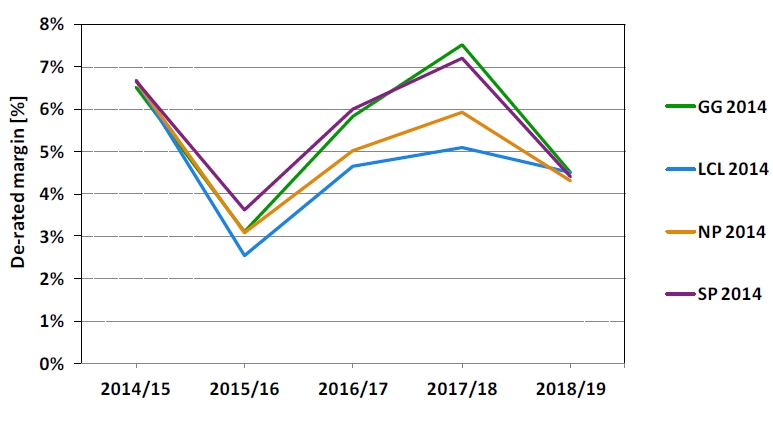
Plant availability was relatively good last winter with a system capacity margin around 10%. However a number of scheduled asset closures are approaching and the UK is heading towards several years of historically low system capacity margins.  System margins are projected to fall below 5% by 2015 as shown in Chart 1.  With the capacity buffer this low, the risk of disorderly market behaviour and periods of system stress materially increases.  A cold winter, further asset closures or major plant outages across this period may cause a sharp rise in power prices and volatility.

Chart 1: Ofgem 2014 Capacity Assessment system capacity margin scenarios

derated CM chart

Source: Ofgem

After raising the alert in its 2013 Capacity Assessment, Ofgem set a calmer tone in its latest Assessment (published in June). This largely comes down to three factors:

  1. An historical downtrend in peak power demand (reinforced by a significant fall last winter)
  2. Steps taken by the government to implement a Capacity Market from 2018/19
  3. The introduction of Supplementary Balancing Reserve (SBR) contracts, which enable the system operator (National Grid) to tender for additional reserve capacity prior to 2018

In this article we take a look at some of the factors that will drive the system capacity balance over the next three years and their potential impact on market price dynamics.

Peak demand uncertainty

The decline in peak UK power demand over the last few years has been quite pronounced (as shown in Chart 2). The drop from 60GW to 58GW in 2008-09 reflected the impact of the financial crisis. There have also been some structural factors reducing peak demand, e.g. an increase in embedded renewable generation (which nets off demand).  But unusual weather was a key driver of the fall in demand in Winter 2013/14 (from around 56 to 54 GW).  Last winter was one of the warmest and windiest in recent history.

Chart 2: UK peak demand evolution and Ofgem projections

PK demand chart

Source: Ofgem

There is a combination of temporary and more structural effects driving the recent historical decline in peak demand.   This makes projecting the evolution of peak demand quite difficult.  All of Ofgem’s projected scenarios in Chart 2 show a continuing decline in peak demand as the decade progresses.  Ofgem also consider high demand sensitivities, although none of these exceed 55.5 GW, i.e. the sensitivities are lower than actual peak demand in Winter 12/13 (56GW).

A cold winter across the next 3 years with a recovery in peak demand back to 56GW (or higher) could lead to a very tight system capacity balance.  This is hardly an extreme scenario on the distribution of possible demand outcomes. 

Generator availability uncertainty

The other important part of the capacity balance equation is generator availability. Uncertainty around available capacity can be split into two categories:

  1. Unplanned generator outages
  2. Retirement or mothballing of capacity for economic reasons (or removal of capacity from the energy market to provide reserve services)

There is significant uncertainty associated with both of these categories, which erodes the effectiveness of scenario based forecasts of future outcomes. It is also an unfortunate characteristic of power markets that events which contribute to system stress tend to be positively correlated.

A number of unplanned outages are impacting the UK market coming into this winter (which are not reflected in the system margins shown in Chart 1). Two of EDF’s nuclear plant at Heysham and Hartlepool (around 2.4 GW) may remain offline until the end of the year given unexpected boiler safety issues.  Units 3 and 4 (1 GW combined) at SSE’s Ferrybridge plant are also out after a serious fire, with Unit 4 likely to remain on outage for the full winter.  There is also an overhang of availability risk associated with switching on older gas-fired plants which are currently sitting cold for long periods.

There is around 10 GW of older and less flexible CCGT capacity that has been running at low or zero load factor over the last two years. Most of this capacity is currently suffering substantial losses given ongoing fixed costs.  Plant owners are hanging on for a sparkspread recovery, favourable reserve contracts or capacity payments from 2018, but their patience to absorb further losses is being tested.  The 1 GW Barking power station recently announced it would close.  In our view it is quite possible that several more GWs of old gas capacity could either close, or be removed from the energy market under reserve contracts with the system operator.

Contracting of additional reserve capacity

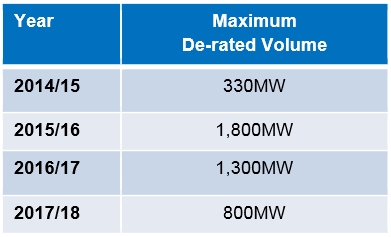
In June this year, National Grid announced its intention to contract Supplementary Balancing Reserve (SBR) services as an additional precaution across the period prior to Capacity Market implementation in 2018. Grid also announced the volume of SBR it intended to contract (see table below) and indicated that it would only tender for demand side reserve (DSBR) for the coming winter.

Table 1: Intended SBR volumes announced by Grid in June

Grid SBR

At the beginning of this month, National Grid announced its intention to run an additional tender for SBR this winter. The volume of generation capacity to be contracted is yet to be announced, but the tender is an indication of Grid’s nervousness around unplanned outages and plant closures.

What is important to note about capacity contracted under SBR services is that while it is available to the system operator in emergencies, it is effectively removed from participating in the energy market and balancing mechanism. National Grid’s mandate is to use SBR capacity only as a last resort (i.e. just prior to issuing Emergency Instructions for involuntary demand reductions).  So by contracting SBR capacity, Grid reduces the probability of brown or blackouts.  But the window remains open for a substantial increase in power prices and volatility if the market tightens over the next three years.

Price dynamics in the wholesale energy and balancing markets are driven by the level of competition between generators to provide the marginal MW of capacity required.   Plant closures, outages and SBR contracting all act to reduce competition at the margin.  This in turn acts to increase scarcity rents earned by remaining generators and hence to increase power prices, sparkspreads and price volatility.

After several years of healthy system capacity margins and subdued prices it is easy to assume current market conditions will continue.  But as the system capacity margin falls over the next three years, the probability of a sharp increase in power prices, spark spreads and price volatility increases.  This would provide a welcome relief for the owners of existing flexible gas plants, which will be key to maintaining system security of supply as the capacity margin tightens.

Why the UK will need fast cycle storage

The UK gas market is undergoing two major long term structural shifts. UK import dependency is increasing as domestic gas production declines.  At the same time, short term fluctuations in UK power sector gas demand are increasing as intermittent renewable generation capacity rises.  Both of these factors are driving an increasing requirement for system flexibility.   This will in turn drive the need for investment in new gas storage facilities.

The UK’s gas storage requirements are however commonly misunderstood. As well as specific storage sites, the UK is very well interconnected with other large sources of longer range gas flexibility.  For example pipeline imports from Norway, Belgium, Netherlands and a high level of LNG regas capacity.  As a result, there is ample existing import infrastructure capacity which can be used for seasonal balancing.

However imports can be susceptible to supply disruptions or time lags in response to market price signals. Fast cycle gas storage plays a key shorter term ‘bridging’ role in providing deliverability to insure against issues with imported supply.  It also provides important short term flexibility to enable gas fired power plant to support renewable intermittency.

Structural market changes

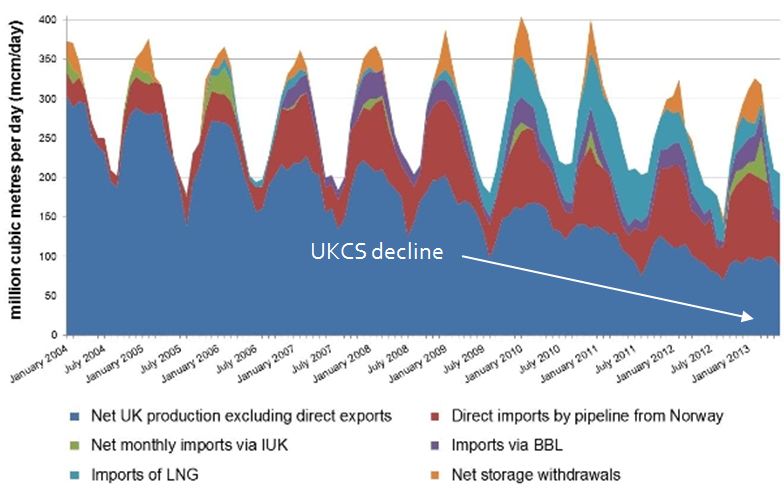
The increase in UK import dependency is a function of declining UK Continental Shelf production as shown in Chart 1. The UK is becoming more dependent on several larger supply sources (e.g. Norwegian pipelines, interconnectors and LNG imports) as opposed to a diversified mix of UKCS fields, pipelines & processing plants.  This is resulting in a greater UK exposure to external supply shocks and an increase in dependency on key import infrastructure.

Chart 1: Evolution of UK gas supply mix (2004-2013)

UKCS Decline C1

Source: DECC Energy Trends 2013

The UK’s aggressive targets for renewable generation also have significant implications for the gas market. The UK has around 30 GW of CCGT capacity that is the marginal provider of flexibility in the power market.  As intermittent output from wind and solar capacity rises, so to do the short term fluctuations in gas demand from CCGTs as they respond.  This will over time act to increase UK gas system stress and price volatility.

Increases in import dependency and renewable intermittency both drive a requirement for an increase in shorter term gas deliverability (as opposed to longer term seasonal flexibility).

Why deliverability is key

The UK has ample import capacity across the Norwegian pipelines, interconnectors and LNG terminals. In a medium to longer term horizon (e.g. greater than a 1-2 month horizon), a strong price signal can respond to pull more gas into the UK.   DECC to their credit understand this logic and used it to support their decision not to intervene in the gas storage market last year (a position we supported).

The vulnerability of the UK gas market is to short term swings in demand, infrastructure outages & supply chain response delays. In periods of system pressure what is most important is the bridging role played by short term deliverability, not higher volumes of gas in store.  This importance will increase with intermittency.

Evidence of this short term requirement for deliverability and the longer term effectiveness of the NBP price signal in attracting imports can clearly be seen across the last three winters. For example, the price spikes of Mar 2013 reflected a period of deliverability scarcity over 4 to 6 weeks, until higher prices attracted additional LNG imports (as described here).

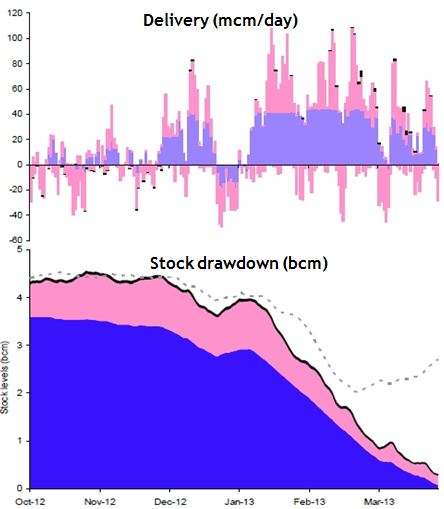
It is in these periods of system stress that fast cycle storage facilities play a critical role. There is just under 5bcm of operational storage capacity in the UK.  The large seasonal Rough storage facility represents about 75% of this on a working capacity basis.  While salt cavern facilities such as Holford and Aldbrough are small relative to Rough on a capacity basis, their flexibility to cycle working capacity multiple times a year means they punch well above their weight.

This is illustrated in Chart 2 where Rough is represented by the blue areas and faster cycle facilities by the pink areas. Rough tends to withdraw gas in a reasonably steady pattern across the winter.  The faster cycle facilities on the other hand are constantly cycling and adjusting patterns of injection and withdrawal in response to market conditions.

Chart 2: UK storage delivery and stock drawdown (Winter 12/13)

Storage Util C3

Source: National Grid 2013-14 Winter Consultation

As well as providing deliverability in periods of supply disruption or system stress, fast cycle storage also provides ideal support for increasing intermittency. Fast cycle storage can be thought of as a rapid charge and release ‘gas battery’.  Gas can be withdrawn in periods of low renewable output when CCGT gas demand is high and re-injected in higher output periods when gas demand (and prices) fall.

This cycling flexibility of fast cycle storage acts to reduce market price volatility. It also acts to increase prompt market liquidity (e.g. within day & day-ahead), as storage capacity owners manage their injection and withdrawal exposures in the market.  Both of these factors ultimately contribute to reducing the cost of supplying gas to customers. 

Investment in new storage capacity

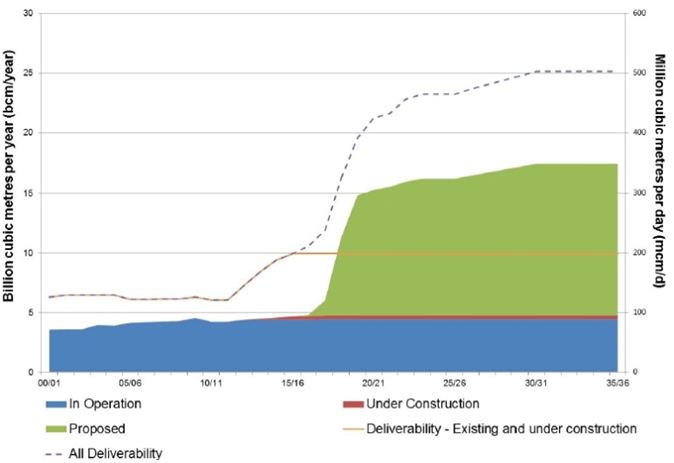
Both the government and the system operator (National Grid) recognise the requirement for further investment in storage deliverability. DECC & Ofgem point to a large volume of consented projects in their Oct 2013 Security of Supply Report, included in the green area in Chart 3.

Chart 3: Operational vs proposed UK storage capacity volume Deliverability C2

Source: DECC/Ofgem Statutory Security of Supply Report (Oct 2013)

But a significant volume of this consented capacity is lower cycling seasonal storage that is unlikely to ever be developed, given structural weakness in seasonal price spreads. There is a much smaller volume of consented fast cycle salt cavern capacity.  The development & incremental investment economics of this fast cycle capacity is favourable given a value skew towards volatility (as opposed to seasonal spreads).

The UK market has been delivering fast cycle capacity over the last 5 years (e.g. Aldborough, Holford & Stublach) which reflects this characteristic. However investment approval on this capacity was achieved under more favourable market conditions several years ago.  The current environment remains tough for developers with a strong market price signal yet to emerge to support further investment.

Chris Lefevre provides a telling statistic on proposed vs developed storage capacity in his 2013 OIES report on UK gas storage. In 2005, DECC listed 5 bcm of additional capacity (10 new projects) to come online by 2010.  In reality only 0.35 bcm was actually delivered.  If the current market environment leads to a hiatus in storage investment over the next few years, the UK’s deliverability issues may become much more pronounced next decade as import dependency and intermittency increases.

The timing of a market price signal to support storage may be uncertain. But the structural drivers behind a requirement for additional deliverability in the UK gas market are real.  Fast cycle salt cavern storage facilities represent a relatively cheap and flexible source of incremental deliverability as well as having low incremental expansion costs.  As a result these facilities are going to play a key role in supporting the evolution of the UK gas market.