Market benchmark for gas flexibility value

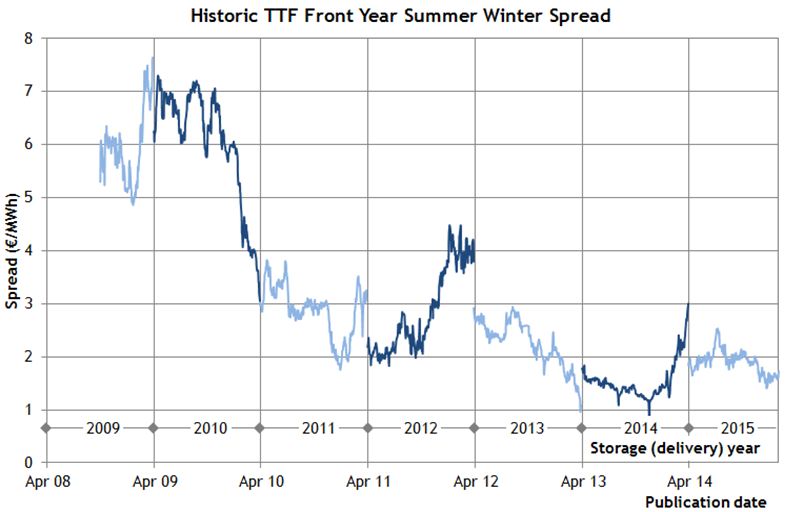
After a recovery in the first half of 2014, seasonal price spreads at European hubs have again fallen back towards historically low levels (currently around 1.70 €/MWh).  Given summer/winter spreads are the key market price signal for seasonal flexibility, there has been an associated decline in the market value for storage capacity.

GasTerra has been auctioning storage capacity for 4 years now.  The standard bundled unit (SBU) has become a transparent and objective benchmark for the value of flexibility in the NW European gas market.  It also provides a useful benchmark for the level of extrinsic value which capacity buyers are prepared to pay for, over and above the intrinsic spread value that can be hedged against forward prices.

The latest auction for GasTerra capacity was held last week.  In this article we show some simple analysis of the results and consider implications for flex value.

Seasonal spread evolution

Chart 1 shows the evolution of seasonal spreads at the Dutch TTF hub since 2008.  It clearly illustrates how the development of an oversupply of seasonal flexibility has driven down summer/winter spreads.   Spreads have fallen from above 6 €/MWh in 2008-09 to below 2 €/MWh in 2013-14.

Chart 1: Evolution of Front Year TTF summer winter spreads

TTF spreads

Source: Timera Energy

There have been isolated years where spreads have made a brief within year recovery.  For example high volumes of storage withdrawals in Q1 2014 after a mild winter, saw a sharp drop in summer prices which temporarily fed through into a higher summer/winter spread.  But as yet there is no evidence of any structural recovery in seasonal spreads that can be observed in forward market pricing.

Feb 15 GasTerra auction result

Hub price signals are now the primary driver of the value of European gas flex (e.g. storage, swing).  Seasonal hub price spreads drive the return on seasonal response.  Prompt volatility drives the return on rapid flexibility response.

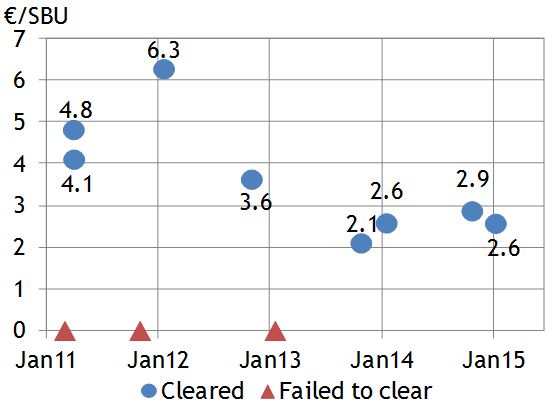
The auction clearing prices for GasTerra SBU capacity (shown in Chart 2) illustrate the strong relationship between seasonal storage capacity value and TTF summer/winter price spreads.

Chart 2: Evolution of GasTerra SBU auction clearing prices

GT Results

Source: ICE/GasTerra

Over the last 4 auctions (Q4 2013 to Q1 2015) prices for GasTerra capacity have stabilised in a 2-3 €/MWh range.  The different results across these auctions can be explained by marginal differences in forward spreads, absolute gas price levels and extrinsic (volatility) value capture dynamics.

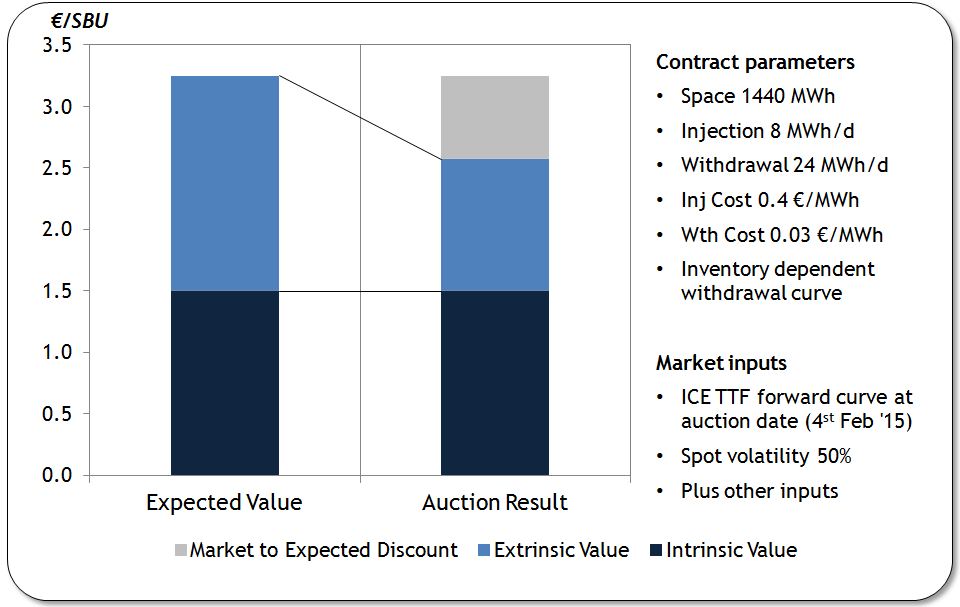
We have undertaken a simple analysis of the outcome of the February 2015 auction in Chart 3.  In order to do this we have calculated our view of the expected value of the GasTerra SBU using the Timera Energy storage modelling suite (shown on the left).  This is then compared to the actual auction results (on the right).

There is a relatively high proportion of extrinsic value given that seasonal spread levels are so low (i.e. storage optionality is close to ‘at the money’).  Our analysis indicates that the market is paying for just over 60% of extrinsic value.  This is consistent with the logic that capacity buyers need to allow for a margin to cover trading costs (e.g. risk capital and transactions costs).

Chart 3: Feb 2015 GasTerra auction result analysis

GT Auction Analysis updated

Source: Timera Energy

Some practical implications for storage capacity

There is a soft lower bound on seasonal spreads at around the 1 €/MWh level reflecting the transactions costs involved in cycling storage capacity to move gas from summer to winter.  Market pricing is pretty close to that level with current spread levels around 1.70 €/MWh.  That means that there is asymmetric upside from spread recovery.

However asymmetric upside does not in its self mean that spreads will necessarily recover anytime soon.  But it does impact the management of exposures by capacity owners and buyers.  For example it is being reflected in the behaviour of storage operators (e.g. GasTerra, TAQA Bergermeer) who are selling capacity on an indexed basis (i.e. retaining spread exposure when they sell capacity).

There are going to be several important factors to watch moving into 2015 that could impact the evolution of European seasonal hub price spreads:

  • The seasonal volume profile of LNG flows into Europe (e.g. high volumes in summer given weaker global demand, lower volumes in winter given stronger global demand)
  • The gas vs coal plant competitive balance and its impact on power sector gas burn (particularly in the UK with the carbon price floor)
  • The impact of weakening economic growth projections in Europe and associated impact on gas demand

We will keep a close eye on these factors as the year evolves.

Brent curve collapse in animation

The Brent crude forward curve had a wild ride across 2008 and 2009.  The commodity supercycle peak dragged spot crude towards 150 $/bbl, with forward prices following almost in parallel.  Then the financial crisis saw spot prices crash and a deep contango open up along the curve.  But since 2010, crude prices have moved in a tighter range accompanied by a relatively flat and stable forward curve.  That is until Q4 2014.

The wild ride is back again.  As the crude market has taken on board the reality of shorter term oversupply, spot prices have slumped in a similar fashion to 2008.  A steep contango has again opened up along the curve reflecting a pronounced near term supply glut.

Last week we set out two important benchmarks that are influencing crude price behaviour via the marginal cost dynamics of US shale oil production:

  • Spot prices may need to breach the SRMC of US shale (~40 $/bbl) to curtail production and stabilise the market.
  • The curve may need to sit below the LRMC of US shale (70-80 $/bbl) to curtail investment in new US shale wells.

In today’s article we use an animation of the evolution of the Brent forward curve to illustrate how these benchmarks relate to spot vs curve behaviour.  We also look at a third important benchmark driving oil curve dynamics: the contango driven physical storage arbitrage.

Brent in animation

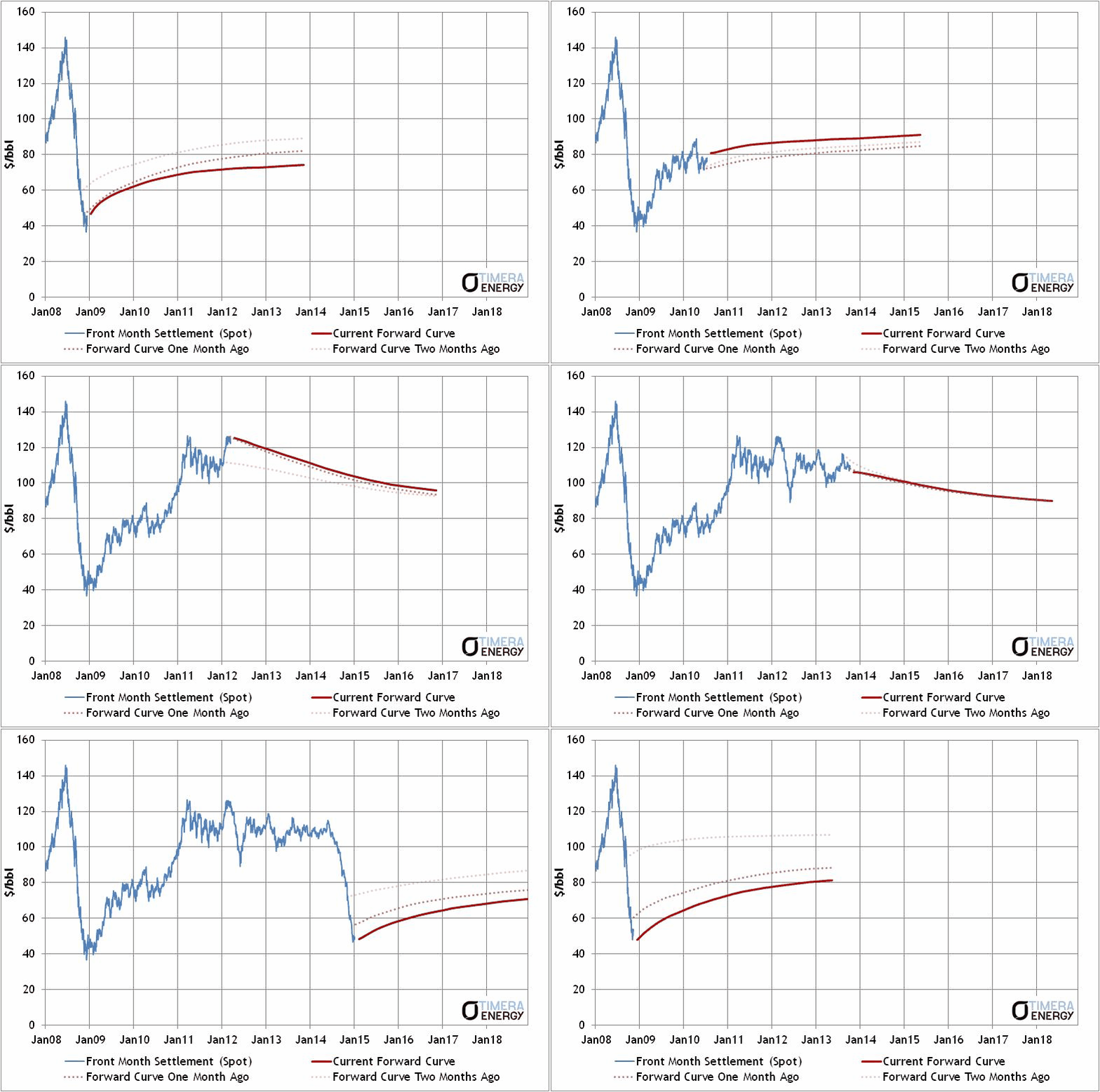
Chart 1 shows a monthly time step animation of the evolution of the front 5 years of the Brent curve since 2008 (note the animation may not work in some older web browsers).  This follows on from a similar animated analysis we did previously of UK NBP gas curve evolution.

Chart 1: Evolution of Brent crude spot and forward prices

oil animated v3

Source: Timera Energy (based on ICE Brent Futures settlement prices)

The chart illustrates some interesting characteristics of crude curve behaviour:

  • 2008-09: A period of major market transition with the commodity supercycle peak followed by the financial crisis crash and then a relatively sharp recovery. There was a strong parallel curve shift during the move up towards 150 $/bbl.  This then gave way to a spot price slump to 40 $/bbl.  However the tail of the curve held up at around 70 $/bbl (similar to the current Brent curve).
  • 2010-14: Both spot prices and the curve recovered into 2010 as the demand shock from the financial crisis eased.  Across this period crude moved in a tighter $90-120 range.  The tail of the curve was anchored between $90-100 (which led to curve backwardation in periods of tighter spot prices).  A market consensus developed across this period that there was an $80-90 floor in crude prices driven by LRMC of unconventional oil production.
  • Q4 2014+: A strong market consensus rarely bodes well for price stability.  The spot and curve price decline since Q4 2014 has so far followed a similar path to the 2008 slump.  However the sharp recovery bounce seen in 2008 is unlikely to be repeated this time given the time required for supply side response to impact prices, as we described last week.  As in 2008, a pronounced curve contango has again opened up.

Contago is back

Physical storage arbitrage is an important driver of crude curve dynamics.  Curve contango means that oil can be bought at today’s spot price, stored in tanks or on anchored vessels and sold forward at higher prices.  The contango price spread is locked in subject to delivery of the stored oil.  A recent pickup in interest for US storage capacity and the chartering of tankers for floating storage plays illustrates the market reaction to the widening crude curve contango.

It is interesting to contrast physical arbitrage in the crude market with the LNG market.  While there are genuine arbitrage opportunities available to the owners of seasonal gas storage capacity, the LNG market is more complicated.  Much pain has been suffered over the last year on attempted intertemporal LNG price spread plays.  A number of portfolio players purchased what appeared to be cheap LNG cargoes last summer (around 10-11 $/mmbtu) with a view to selling them into higher Asian winter prices.  But the buyers retained seasonal price spread risk, given an inability to sell the cargoes forward (because of liquidity constraints).  This has left buyers exposed as LNG spot prices have now plunged well below the price levels from last summer (currently trading around 7 $/mmbtu).

During the 2008 crude price slump, the 12 month contango opened up to 20 $/bbl and storage arbitrage provided a key source of spot price support.  The current Brent and WTI curve 12 month contangos are ranging around the 10 $/bbl mark.  Not yet as pronounced as 2008, but still presenting an attractive arbitrage opportunity subject to storage capacity access.  As the fallout from the current decline in oil prices continues, storage arbitrage will act as an important force supporting spot prices and pulling down forward prices.

Crude impact on gas pricing

This article concludes our three part series on crude pricing dynamics. While we have explored forward curve dynamics in today’s article it is spot oil prices that have the most important impact on gas and LNG prices.  European long term gas contract prices are predominantly linked to oil product spot prices (which trade at a basis to spot crude), typically with a six month time lag. Asian LNG contracts are indexed to crude, often with a shorter time lag.

So it is possible to predict today within a reasonable margin of error the level of European and Asian gas contract prices coming out of spring and into summer. And those levels are substantially below current contract price levels.  As a result there is going to be heavy downward pressure on European hub prices from cheaper pipeline contract gas and an increased flow of cheap flexible LNG back into Europe.  Add the potential for rapid withdrawal from well stocked gas storage facilities and there may be a wild ride to follow in the European gas market in 2015, a theme we will return to in subsequent articles over the next few months.


Supply side response to lower crude

This is the second article in a three part series on falling crude prices.  In the first two of these articles we look at the two key factors behind the current price decline:

  1. A weakening global demand outlook, with global economic growth expectations weakening. Specifically in some of the larger oil importing countries (e.g. Japan, China and India)
  2. A surge in production, driven predominantly by the expansion of US shale oil production but also by robust production from some of the larger conventional producers (e.g. Libya and Iraq)

Last week we focused on weakening demand.  But the demand side provides limited insight into the shorter term drives of crude market price dynamics.  Demand for oil is not particularly timely in its price responsiveness.  So it is likely to be supply side response that determines when and at what price level the crude market stabilises.  That is the focus of today’s article.  Some of the material in this article draws on useful recent analysis on production dynamics by Goldman Sachs.

Producer strategy

Analysis of the oil market has historically been clouded by the cartel behaviour of OPEC producers.   But the relevance of OPEC’s price/volume strategies has been eroded by the surge in US shale production.  Growth in US shale output has been a big factor behind the current oversupply.  But the economics of shale production are also likely to drive the marginal pricing dynamics that stabilise the crude market.

Several conspiracy theories have been floated on collusive behaviour that has contributed to the decline.  For example OPEC is happy to see US and producers suffer at lower prices or Saudi Arabia and the US are acting to hurt Russian interests.

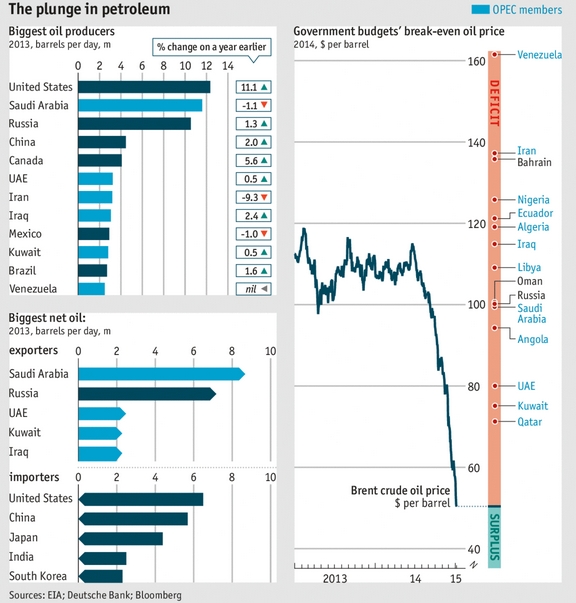
But the reality is that OPEC (and Saudi Arabia) has limited power to act to stem the current price rout.  All producers are suffering together from lower oil prices.  Not a single OPEC member can balance their budget at current oil price levels as shown in Chart 1 via an interesting graphic published in the Economist.

Chart 1: Budget impact of the crude price slump

economist chart

Source: The Economist

The traditional assumption has been that OPEC producers will respond to price declines by cutting production volumes.  But the reality in the current world of falling prices is that producers are incentivised to increase production because they need the revenue.  They are not incentivised to cut production to boost prices.  This removes the focus on OPEC production volume dynamics and shifts it to the economics of US shale oil producers who dominate the marginal section of the crude supply curve.

How will supply respond?

In order to address the current oversupply in the crude market, prices need to fall to a level that curtails production.  There are two important benchmarks here:

  1. Short run marginal cost (SRMC): Producers will scale back production if they cannot cover their operating cash costs at current price levels (subject to the influence of protection from existing hedge positions).
  2. Long run marginal cost (LRMC): New production will not be commissioned if prices do not cover life cycle investment costs (note: this is driven more by prices over an investment horizon than the current spot price, albeit it with an obvious linkage).

In conditions of plentiful supply, spot price movements in commodity markets tend to be focused more on SRMC than LRMC dynamics.  There is usually a rapid supply curtailment response if producers cannot cover variable costs.  With cash operating costs of around 40 $/bbl, the more marginal US shale plays may act as important price support in the short term (caveat the risk of prices overshooting to the downside before there is an adequate production response).

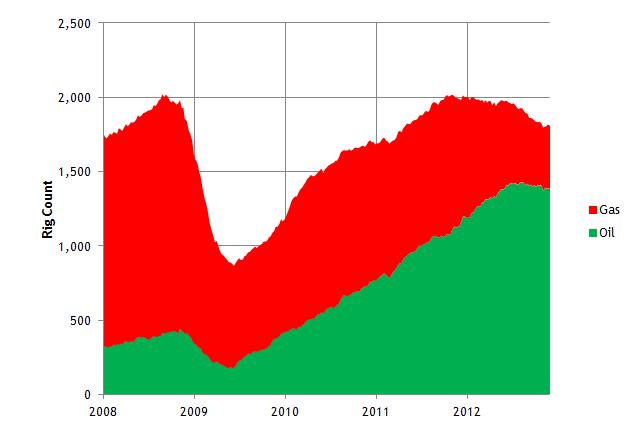
However Goldmans’ argument is that the LRMC dynamics of US shale will also be a key driver of short to medium term production response.  This is a function of the scalability of shale production and short production lead times.  A high decline rate on new wells means that there is a relatively fast investment replacement cycle.  In other words the life cycle costs of shale wells (at 75-80 $/bbl) play a much more important role in influencing prices than the LRMC of other production plays with longer investment cycles (e.g. deep water or tar sands).  Chart 2 illustrates the fall in US rig count as a result of the recent decline.  While this shows producers have started to respond by cutting back on production there may be a long way to go to stabilise the market (the 2008-09 drop was over 1000 rigs).

Chart 2: US oil and gas rig count

US rig count

Source: Business Insider, Baker Hughes

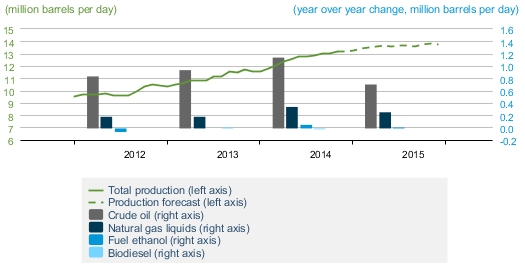
Chart 3 illustrates the surge in US shale production over the last three years.  Production has increased by an average of more than 1 million bpd each year over this period.  In doing so, US production has completely dominated the global growth in crude output (against the relatively stable or declining production of other major producers).

For the crude market to stabilise, prices need to remain at a level that substantially reduces the growth rate of US shale production until surplus supply is absorbed.  That means the life cycle costs of US shale production may act as an important resistance level for crude prices in the interim period.

Chart 3: US oil production 2012-2014

US production

Source: EIA 

Where to next?

The SRMC vs LRMC dynamics of the oil market are reflected in the current steep contago of the Brent & WTI forward curves.  The Brent spot contract is currently trading below 50 $/bbl, whereas the contracts three years out along the curve are trading closer to 70 $/bbl.

Spot prices may need to fall further in the short term (e.g. below 40 $/bbl) for production to respond to immediate oversupply issues.  But prices along the curve may need to remain below the LRMC of US shale for a longer period of time in order to drive a more structural curtailment in US production.  These dynamics mean that we may be entering a period where crude prices move in the 30–70 $/bbl price range rather than returning to the 100+ $/bbl prices of the last few years.  If that is the case it will flow through into much lower long term contract prices for European pipeline gas and LNG, putting considerable downward pressure on European gas hub prices.

In the final installment of our three article series on crude, we come back next week and look at the behaviour of Brent spot prices in relation to the forward curve, using an animation of price movements since 2008 (as we did with NBP gas prices previously).

Crude is not alone as it plunges into 2015

The plunging price of crude oil is the big story of the energy industry in 2015 so far.  The impact of this seismic shift in the pricing of hydrocarbons reaches well beyond the oil market. The fall in crude is in turn acting to drag down global gas prices, changing LNG flows and threatening the economics of large volumes of new production.  Shifts in the relative pricing of hydrocarbons are also set to shake up the competitive balance across gas, coal and renewable power generation assets.

Looking back through history, similar oil price moves of this magnitude suggest prices are unlikely to make a meaningful recovery anytime soon.  Weak crude is not just going to be January’s story.  It will likely be the defining energy market event of 2015.  So we are going to start the year with a series of three articles focused on crude pricing:

  1. This week we focus on the demand side and look at the crude price fall against a backdrop of a broader sell off in commodity prices and weakening global economic outlook.
  2. Next week we look at the specific factors driving the current oversupply in the crude market, as well as how supply side response may act to stabilise the oil market.
  3. Finally in the third article we will show an animated view of the evolution of spot Brent vs the forward curve (as we previously did with NBP gas prices), to illustrate the structural shifts that are taking place across the curves in a historical context.

Then in series of subsequent articles across the first half of this year we will drill down into some of the more detailed implications of the structural shift in crude pricing for LNG, European gas and power markets.

Oil is in good company

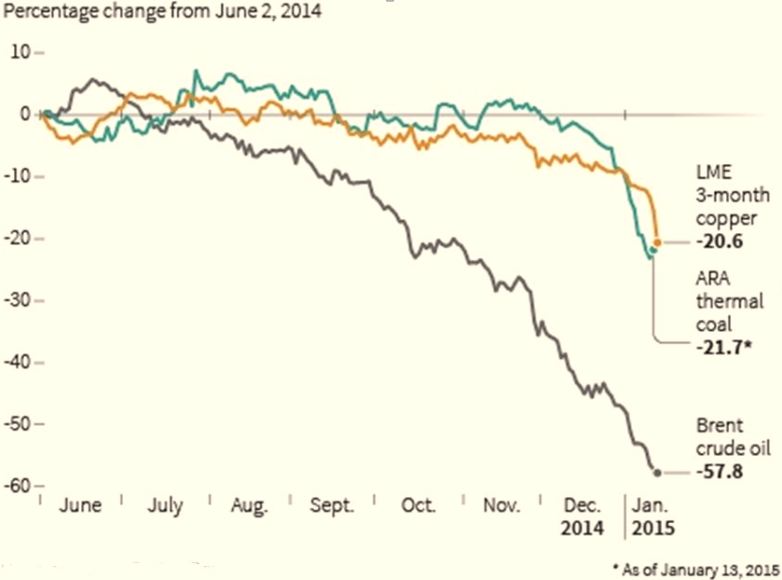
As the decline in oil prices gained pace towards the end of 2014, the prices of other key industrial and energy commodities have also accelerated lower. This reflects a broader weakening in commodity demand tied to a softening global economic growth outlook.  Chart 1 plots the crude price decline against two other important commodities:

  • Copper: A key industrial commodity (and useful benchmark for the strength of global commodity markets as we set out previously)
  • Coal: The other key global energy commodity, which has fallen sharply since the start of 2015 (with ARA coal prices now under 60 $/t)

So while there is a specific oversupply story playing out in the crude market, the rapid decline in the prices of other commodities into 2015 suggests a broader weakening in global commodity demand.

Chart 1: Key commodity price changes (from June 14)

 Commodity sell off

Source: Thomson Reuters

Is the global economy stagnating?

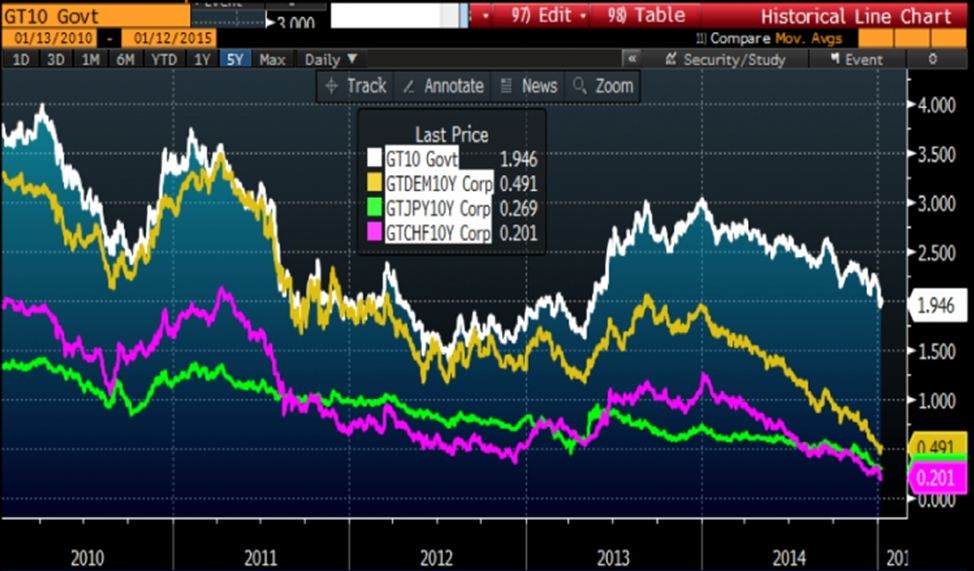
Looking beyond commodity markets for a minute, it is not hard to find evidence of increasing concerns around global economic weakness. Interest rate markets are a good place to start.  Long term (10 year) government bond yields have also fallen sharply across the last 6-12 months as illustrated in Chart 2, with bond yields of 4 major developed countries shown as follows:

  • Japanese yields in purple
  • German and Swiss yields in yellow and green respectively
  • US yields in white

Chart 2: Long term government bond yields

Bloomberg Govt Bonds

Source: Bloomberg

Yield curves across the world have been flattening (longer term yields falling relative to short ones), a dynamic typically associated with expectations of weakening economic conditions.  It is important to also take into account the effects of central bank bond purchases on bond yields (Quantitative Easing or QE).  But in a sense these bond purchase programs only reinforce the message of underlying economic weakness.

The pronounced decline in German yields across 2014 symptomises concerns about Europe joining Japan in a state of prolonged deflationary stagnation.  The European Central Bank is expected to respond this week by announcing aggressive new QE measures of its own.  But while the world’s major central banks have inflated share and property markets with QE, their success in fostering real economic growth in a debt laden global economy has been limited.

The US yield gap over Europe and Japan reflects a healthier US economy in relative terms but one whose fortunes are clearly linked to the rest of the world.  But importantly, higher US yields have driven a pronounced rally in the US dollar over the last year.  This has also contributed to global commodity price weakness given commodities are traded in USD terms.

The linkage back to energy markets

Why does all this matter for European gas and power markets?  There are the more obvious direct implications of weakening economic growth on demand for power and gas across Europe.  But there are a number of more indirect consequences of a structural shift lower in global commodity prices caused by weakening demand.  For example:

  • Falling crude is pulling down oil-indexed Asian LNG prices, a factor that combined with weak spot prices is likely to see a substantial increase in LNG flows into Europe in 2015, particularly into the summer.
  • European oil-indexed gas contract prices are also set to decline as 2015 progresses (once the impact of contract price lags feeds through), putting downward pressure on gas forward curves and hub prices as well as having important implications for the value of gas flexibility.
  • The relative pricing of coal and gas (influenced by oil) will alter generation dynamics in European power markets as well as bringing down absolute power prices.

We will follow through on each of these themes in a number of subsequent articles across the first half of 2015.  But next week we continue our focus on crude with a more specific look at supply side drivers.

Timera take on the 1st UK capacity auction

The first UK capacity auction was concluded just in time for Christmas, with 49.3 GW of capacity procured at a clearing price of 19.40 £/kW.  The auction results gave little in the way of Christmas cheer for most UK generators, with the clearing price close to half that of market consensus expectations.  However the first UK auction marks the start of an important transition of Europe’s larger power markets towards market based mechanisms to remunerate flexible capacity.

First auction headlines

The conditions that set up the downward price pressure in the auction stemmed from a relatively low government capacity target that saw an ‘oversupply’ of existing capacity.  Existing capacity volume (54.9 GW) exceeded the procured volume in the auction (49.3 GW) by 5.6 GW.  2.8 GW of new capacity was successful in obtaining capacity agreements despite the low auction clearing price.  But this meant 8.4 GW of older existing coal and CCGT plants failed to secure a capacity agreement, leaving plant owners in a precarious position.

The auction outcome is being heralded as a success by the government (‘capacity procured cheaply for the consumer’).  But it is unclear whether the first auction has done anything to improve UK security of supply over the critical period of market tightness from 2015-18.  In fact the outcome may have exposed one of the key weaknesses in the capacity market design, where capacity is procured on the basis of uncertain forecasts of conditions four years in advance.  This leaves little ability for the capacity market to respond to market tightness over the next 3 years.

National Grid has published plenty of data on the 1st auction outcome.  Rather than duplicating any of this analysis, our intention in this article is to focus on the key lessons learned from the auction and the implications for evolution of the UK power market.

How did the auction results match our expectations?

Prior to the 1st auction we published a ‘First Auction in Focus’ report.  The following are excerpts from the summary section of this report which give a quick overview of our analysis ahead of the auction:

  • Marginal plant: 3 key plant types are likely to drive the 1st auction outcome (older coal, older CCGT, low capex peakers).
  • Pricing: Our analysis indicates a 1st auction capacity price around 30 £/kW if participants bid rationally to recover costs. But the 1st auction outcome will come down to EM (&CM) expectations (diverse range likely across players).
  • Downside risk: The low 1st auction target and ‘Fear of Missing Out’ dynamics may lead to a lower clearing price than expected. These factors could easily combine to reduce the 1st auction clearing price by 5-10 £/kW.
  • Older plant: 6-8 GW of older CCGT/coal to be unsuccessful in 1st auction → most of this uneconomic without capacity returns.
  • Energy market impact: It’s likely a significant volume of older capacity is closed/mothballed as a result, supporting wholesale energy market generation margin recovery.

The auction outcome was broadly consistent with these expectations.  However the downward price pressure dynamics were somewhat stronger than we had expected, resulting in a lower clearing price (19.40 £/kW) and higher level of unsuccessful older plant (8.4GW).

We also expected a higher volume of coal capacity to be successful in securing 3 year refurbishment agreements with a view to covering the costs of IED capex.  The fact that a number of existing coal plants missed out on refurbishment agreements raises a query as to the economics of IED cost recovery if these plants are going to remain open in the 2020’s.

There was around 1 GW of new build peaking & unproven DSR capacity which was in line with our expectations.  But we were surprised by two factors relating to new build CCGT:

  1. The Carrington CCGT project did not secure a capacity agreement despite already being under construction. Sunk cost dynamics were perhaps trumped by expectations of higher capacity returns in the future.
  2. One of the other new CCGT projects, Carlton Power’s Trafford plant (next door to the Carrington plant), was successful in the auction. This suggests that there may be some unique benefits to this project (e.g. low capex, synergies with the Carrington project construction) as well as one of the parties to the project taking a very optimistic view of the evolution of the wholesale energy market.

The success of the Trafford CCGT project raises an important question going forward.  Was this an anomaly, or can we expect significant volumes of new build CCGTs at lower capacity prices (e.g. < 40 £/kW).  We suspect the former.  We also note that it is one thing to secure a capacity agreement, but this does not guarantee an ability to raise the capital, secure offtake contracts and construct and commission the plant.

Lessons from the auction results

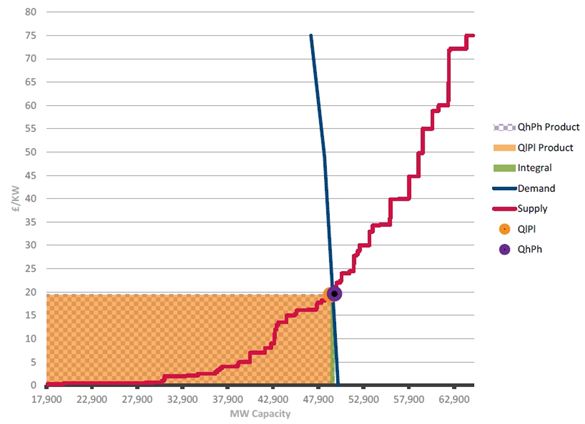
While the specific bids of each plant have not been released, Grid has published a representation of the supply stack shown in Chart 1.

Chart 1: 1st auction supply stack

CM outturn supply curve

Source: National Grid

Some useful conclusions can be drawn from this supply stack, particularly by focusing in on the margin (where supply and demand intersect):

  • As expected, around 30 GW of existing capacity did not require capacity support and was bid into the auction at zero price.
  • The supply curve looks to be quite steep above the marginal clearing price. For example if another 4 GW of capacity had been procured, the clearing price would have risen towards 35 £/kW.
  • There looks to be a reasonable level of price support (5-6 GW of capacity) below the clearing price around the 15-20 £/kW level. This is likely to represent owner bidding to reflect the direct fixed cost recovery requirements of thermal plant.
  • The ‘blockiness’ of the supply curve above 35 £/kW suggests the more expensive tail of the stack was dominated by a number of larger thermal units (both existing and new build).
  • The finer granularity definition of capacity volumes in the 20-35 £/kW bid range suggests that there may have been a reasonable supply of smaller scale peaking assets sitting above the clearing price, but below many of the larger thermal unit bids.

From a capacity perspective the auction result headlines are that:

  1. 8.4 GW of existing plants failed to secure agreements: comprised of
    1. 3.9 GW of older CCGTs (Barry, Brigg, Killingholme A&B, Peterborough, Corby, Deeside & Peterhead)
    2. 4.5 GW of older coal plants (Rugeley, Eggborough, Ferrybridge and 1 unit of Fiddlers Ferry & West Burton)
  2. 2.6 GW of new plants secured agreements:
    1. The 1.8 GW Trafford CCGT project
    2. 0.9 GW of smaller scale peaking plants (e.g. diesel gen sets, reciprocating engines)
    3. 0.2 GW of unproven DSR capacity

The subsequent actions of plants that failed to secure a capacity agreement are likely to be as important as the auction outcome itself. 

Implications for UK power market evolution

Without any capacity price support, the economics of many of the older coal and CCGT plants that failed to secure an agreement do not look healthy.  This is particularly true of the 3.9 GW of older CCGTs which have been suffering cash losses for several years now.  Owners have been holding on for capacity payments.  So it is likely that a weak auction clearing price will crystallise plant economics.  Expect plant closures and mothballing over the next two years.

Somewhat ironically, if a substantial volume of plant that was unsuccessful in the auction closes (e.g. 4-5 GW), the auction may have actually worked to undermine security of supply over the next three years rather than improve it.  In this scenario it is likely Grid will take action to secure additional reserve capacity.  This brings the new Supplemental Balancing Reserve (SBR) contracts into focus.  While Grid can use SBR as an emergency capacity back stop, SBR contracted assets are removed from competing in the wholesale energy market supply stack.  This means plant closures are likely to drive higher rents and generation margins in the energy market despite SBR contracting (as we set out here).

In a sense SBR may become a temporary capacity market over the 2015-18 period, albeit one that lacks transparency and a clear set of rules.  As we have said many times previously, once the government starts overlaying complicated market interventions, the unintended distortions that result tend to generate the requirement for further intervention.

Welcome back

Happy New Year and welcome back. The festive season is often a quieter time for energy markets. This has certainly not been the case over the last month. Brent crude oil has continued its precipitous decline, falling another 15 $/bbl since early December to under 53 $/bbl, almost halving in value over the last three months. The shockwaves of this move are still feeding through into the global LNG and European gas markets. But there can be no doubt now that we are moving into a more structural period of hydrocarbon oversupply. This will have far reaching implications for LNG spot pricing & supply growth, oil-indexed gas contract prices, hub price dynamics and gas vs coal plant competitive balance. The commercial and market implications of this shift will be a key theme for this blog in 2015.

The other major event in European power markets over the last few weeks was the inaugural UK capacity market auction. There are some interesting lessons to be learned from the auction results, given a policy shift across Europe towards market based mechanisms to remunerate capacity. We will publish our first feature article on Monday 12th January which will explore the auction outcome and implications for wholesale energy market evolution.

In the meantime we wish our readers all the best for a prosperous 2015.

2014 themes and the way forward into 2015

With Christmas approaching this is our last article of 2014.  We will be back with more in early January.  To finish the year, it has become a bit of a tradition for us to look back at the key market and commercial themes of the past year.  Then to draw on these themes to look forward into the next year.

2013 looking forward

In Dec 2013, we published our end of year article with Brent crude around 110 $/bbl and Asian LNG spot prices above 18 $/mmbtu.  At the time there was a strong consensus view that the gas and oil markets were tight and projected to remain so well through this decade.  We finished 2013 with a list of potential energy market ‘shocks’ to consider coming into 2014:

  • A period of surplus in the spot LNG market causing Asian spot prices to fall to a level where flexible supply flows back into European hubs.
  • Another period of significant disconnect between European gas hub prices and oil-indexed contract prices (similar to 2009-10).
  • A major slowdown in Chinese economic and industrial growth, e.g. reducing gas import demand and inhibiting a policy shift from coal to gas-fired generation.
  • A significant fall in gas prices relative to coal, shifting the competitive balance back towards gas-fired generation.
  • A prolonged period where oil prices fall back below 80 $/bbl.
  • A pronounced policy shift away from support for low carbon generation capacity.

This was not a list of forecasts but a set of scenarios that we thought warranted prudent consideration.  Most of these shocks have either transpired or sound a lot more plausible now than they did at the end of last year.  In fact weakening oil and LNG prices have become a reality in 2014 with a profound impact on energy portfolio exposures.  The knock-on effects are being felt across European gas and power markets and will likely determine the way forward into 2015.

2014 looking back

LNG market:

Both the short term and the longer term balance in the LNG market have shifted towards oversupply in 2014.

The LNG spot market is an increasingly good barometer of shorter term global gas market balance. A 50% decline in spot prices since January provides a good indication of the profound shift that has taken place across this year.  The big move lower came in Q2 with prices falling towards 10 $/mmbtu. Cargoes flowed back into Europe as the Asian diversion arbitrage dried up and as LNG was sold into European hubs as a market of last resort.  Any theories that this was a seasonal phenomenon have been dashed by renewed spot price weakness in Q4.

Perhaps more importantly the longer term balance also appears to be shifting towards oversupply.  The LNG market has now weathered the ‘drought’ of new supply across the 2011-14 period.  From 2015 new liquefaction projects, particularly in Australia and the US, start to ramp up.  Not all of these projects are fully contracted suggesting more pressure to come on spot prices.

Towards the back end of the decade Russian pipeline gas poses an increasing threat.  Russia signed framework agreements for a massive 68bcm of gas exports to eastern and western China in two separate deals this year.  That is likely to put a substantial dent in China’s LNG import growth appetite from later this decade. It also puts Russia in the box seat to undercut LNG producers in making incremental sales to China going forward.

These factors are shifting the LNG market balance back towards buyers.  A Japanese buyer (Chubu Electric) recently signed a 20 cargo deal with a partially spot indexed structure.  Look out for an evolution in LNG contract structures and pricing terms if market oversupply continues.

European gas markets:

Events at European gas hubs in 2014 have been strongly connected to the LNG spot market.  In a year where demand has remained relatively weak and pipeline supplies robust, an increase in LNG imports has weighed on prices.

The fall in hub prices over the summer of 2014 was on a similar scale to the slump in spot LNG prices.  European hubs acted as key price support for the global gas market across the summer.  But hub prices fell well below long term oil-indexed contract prices.  This oil vs hub price divergence has eased into the winter, but it foreshadows problems that may lie ahead for suppliers who remember the pain of 2009 & 2010.

Chart 1 provides an illustration of historical TTF price evolution through the post-Fukushima phase of market tightness (2011-13) and the transition towards oversupply in 2014.  It also indicates the current state of play in the forward market, with TTF pricing up towards oil-indexed contract levels in the winter periods.

Chart 1: TTF historical and forward price benchmarks
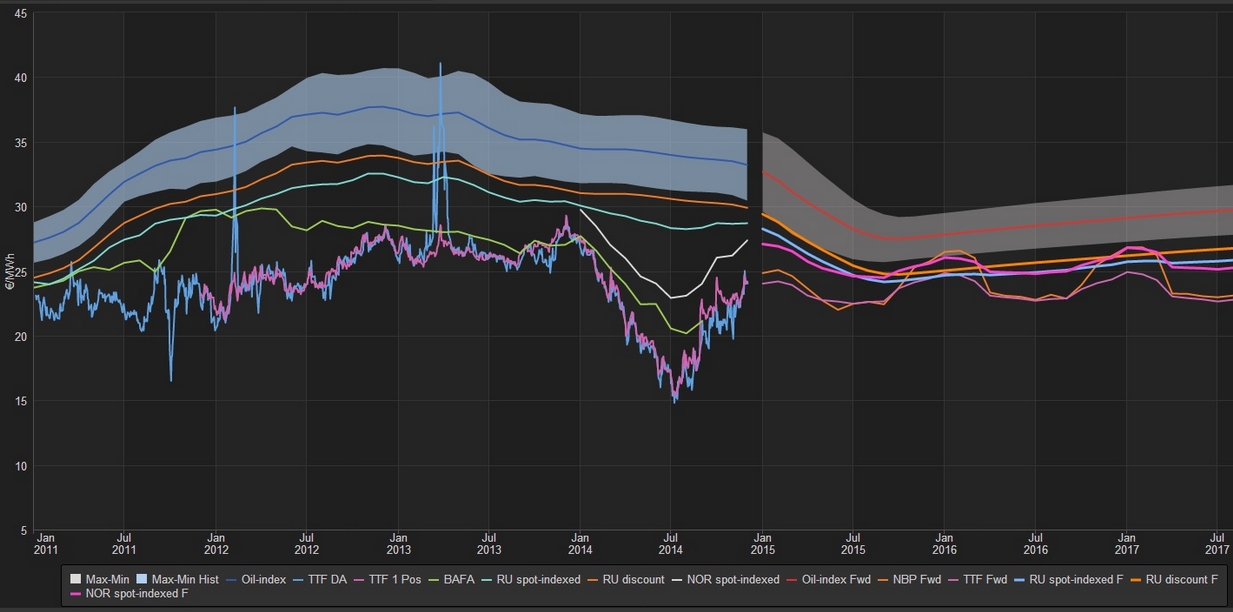
TTF benchs

Source: Reuters

The events of 2014 have also seen the start of a recovery in seasonal price spreads and volatility.  Interestingly this has occurred against the backdrop of falling hub prices, illustrating that oversupply does not necessarily reduce gas flexibility value.  In the past wider spreads and higher volatility have tended to coincide with periods of higher hub prices.  The pickup in spreads and volatility has also seen a renewed interest in gas flexibility products such as storage capacity.

As the year draws to a close, the European market remains focused on the threat of Russian supply cuts.  But with robust gas storage levels across Europe and pronounced weakness in spot LNG import prices, this threat looks much more manageable than it appeared to be earlier in the year.

European power markets:

One of our themes in 2014 has been on the implementation of capacity markets across Europe.  It is becoming clear that capacity markets will be the mechanism of choice to support thermal capacity in a world of low carbon support.

The UK is the first large European power market to lead the way with an auction this month.  France is next and Germany looks to be following later in the decade.  Market designs are likely to differ significantly and these differences may have profound impacts on generation margins and wholesale power price dynamics.  The interaction between capacity and energy market pricing is a big story for power station owners and investors going forward.

We have also focused this year on the evolution of thermal power station value in Europe.  The world of guaranteed baseload running has gone.  As renewable output increases, gas and coal plants are increasingly playing a mid-merit and peaking role.  These assets are essentially strips of options on the clean spark or dark spread.  Asset ownership will likely evolve over time towards players who are able to understand and monetise the risk associated with this optionality.

Power asset transactions have started to pick up in 2014.  Change in ownership patterns are suggesting a shift from utilities towards independent generators and investment funds.  This is partly driven by balance sheet constraints and partly by a continuing negative outlook on generation margin returns.  There have been some big portfolios on the block e.g. Vattenfall’s German assets and E.ON Spanish assets (recently purchased by Macquarie).  E.ON’s announcement last week that it will spin off a separate listed entity containing its generation assets and trading business is another indication of utility appetite to shed generation asset exposures.  We expect more to follow in 2015.

Looking forward into 2015

We ended last year with a list of potential shocks that could threaten market consensus.  A number of these shocks have been delivered in 2014 (driven by falling oil, LNG and gas hub prices).  We suspect that the market transitions taking place in 2014 will continue to shape events through 2015.

OPECs battle for market share against a backdrop of weak demand suggests there may be a sustained period of lower crude prices.  Crude price recovery may require significant volumes of marginal supply to be driven out of the market as a result of lower prices (e.g. US shale oil).

For the LNG and European gas markets, lower crude prices are already a ticking fuse given lagged long term contract oil-indexation.  This may be compounded by a spot market oversupply of gas, particularly coming into next spring.  There is currently a lot of gas stored in anticipation of spot market tightness over the winter.  If that fails to transpire, stored gas and increasing LNG flows may send spot prices spiraling lower in Q1.

As new LNG production ramps up in 2015 there looks to be a key risk that the trends of 2014 continue, potentially leading to a gas glut similar to that of the 2009-10 period.  Important for European suppliers will be to what extent gas hub prices disconnect from oil-indexed contract prices again.

For European power markets, the factors above may lead to some rebalancing in gas vs coal plant competitiveness.  Across the 2012-14 period coal prices have slumped to levels below the long run marginal cost of production.  This has moved coal plants up the merit order to have a clear variable cost advantage over CCGTs.  But if gas prices decline relative to coal prices in 2015, this may support an increase in gas plant load factors and margins, particularly in markets with a higher proportion of gas-fired capacity (e.g. the UK).

All of the above is hypothesis based on the impact of a continuation in the trends set in place in 2014.  But the future is no more certain now than it was at the end of last year.  We finished 2013 by emphasising the importance of stress testing asset & portfolio returns to understand the potential impact across a plausible range of market outcomes.  That logic applies just as much now as it did then.

Happy Christmas

2014 has seen our readership approximately double, with our base of regular readers rising towards 10,000.  We have again been widely published in industry journals and the press as well as speaking at a several conferences.  We appreciate your support and look forward to bringing you more in 2015.  In the meantime we wish you all the best for a relaxing break over the Christmas period.

Market interconnectivity and the next 6 months

The term ‘big price move’ is used too liberally in relation to energy markets which have a relatively high level of ambient volatility.  But last week’s decline in the Brent crude curve was a big move by any standards. This decline in Brent will have profound repercussions for an already weakening LNG market.  And these will feed through into European gas and power markets in 2015.

OPEC’s Saudi led Middle Eastern producer block has thrown down the gauntlet to non-cartel producers.  By maintaining production targets and implicitly accepting associated price declines they have initiated a battle for market share with both the US and Russia.  As a result the front month Brent contract crashed through 70 $/bbl on Friday.  And more importantly, the front 3 years of the Brent curve has re-rated towards $80/bbl.

The move lower in Brent will act to drag down long term LNG & European gas contract prices with several months lag.  This increases the chances of a substantial decline in European gas hub prices in 2015. It also opens up the potential for a return to supply glut conditions (similar to 2009-10).

In this environment of ‘tectonic’ movements in energy prices, market interconnectivity plays an increasingly important role.  European gas hubs may play an important role in stemming the declines in spot LNG prices.  In turn European power markets may act to provide key support for European gas hub prices. 

An update on the LNG spot price fall

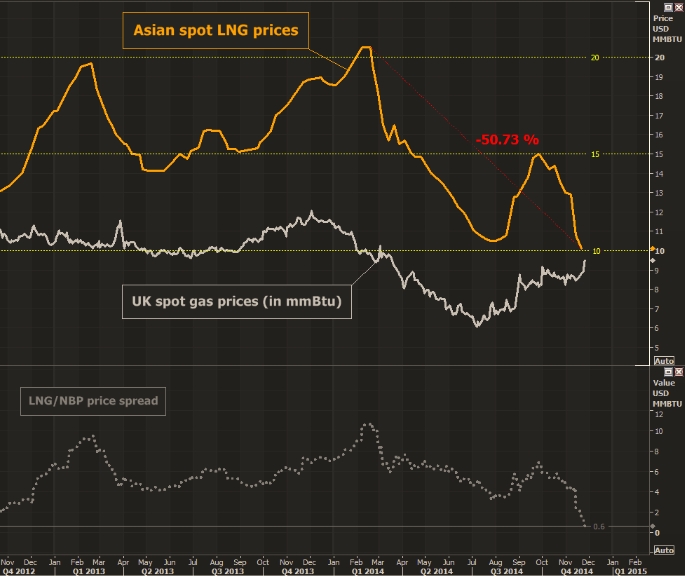
Last week we looked at some of the drivers of this renewed slump in LNG spot prices. The lead up to the last few Christmas periods has become associated with robust demand and rising prices.  But this year Asian buyers have ample supply, storages are full and portfolio players are long LNG.  As a result spot prices have crashed back to pre-Fukushima levels.

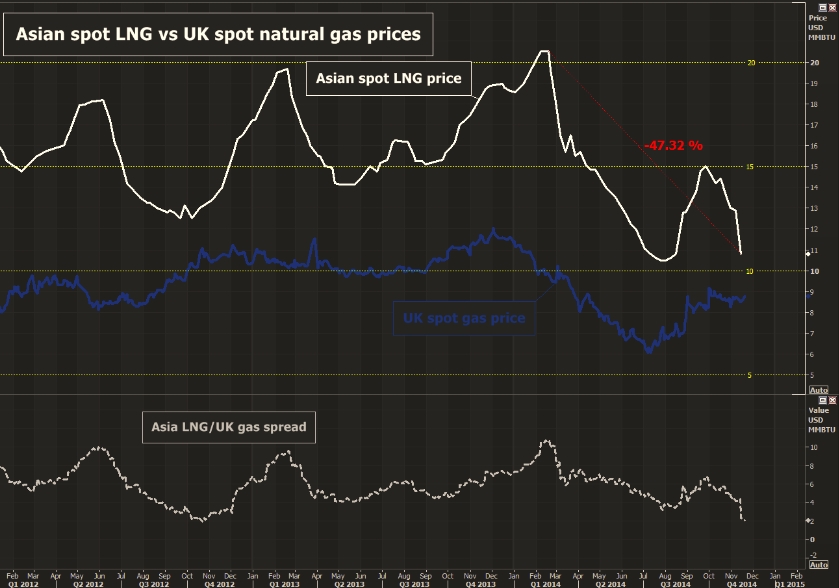
Chart 1 is an update of Reuter’s Asian LNG spot vs UK NBP price chart that we showed last week.  The differential between these two prices is falling towards zero.  That means Europe is becoming a much more attractive place to ship LNG, despite it being winter.  This is going to be a key chart to watch over the winter as an indicator of:

  1. The volume of LNG import flow into Europe (both spot cargoes and contracted European supply which cannot be economically diverted).
  2. The price of incremental LNG import volumes if there are supply issues in Europe over the winter (e.g. Russian interruptions or major infrastructure outages).

But it also may have important implications for European power markets.

Chart 1: Asian spot LNG vs UK NBP prices

Asian spot vs NBP

Source: Reuters

The fall in the differential between spot LNG and European hub prices shown in Chart 1 suggests European LNG import volumes may pick up substantially across this winter.  In the absence of:

  1. a recovery in LNG spot prices and/or
  2. a major European shock this winter (e.g. Russian interruption, infrastructure outage, prolonged cold spell)

An increased flow of LNG imports will put downwards pressure on hub European hub prices.  As Q1 develops, storage withdrawals are likely to add to that price pressure.  This could precipitate a Q1 slump in European gas hub prices.

Power market support for gas prices

As Asian spot prices declined into summer 2014 reducing the premium over NBP, LNG imports into Europe increased, acting to drive down hub prices.  A pickup in power sector demand (given weaker hub prices) provided some important support for NBP gas prices across this period.

Gas hub prices fell to a level where CCGTs started to displace coal-fired generation capacity in the merit order.  The UK is Europe’s canary in the coal mine here, given the dominance of gas-fired capacity in the supply stack.  But this effect may become wider spread across European power markets in 2015 if gas hub prices are really under pressure from oversupply.

If a similar or more significant hub price decline plays out in 2015, hub prices may again need to fall to a level where CCGTs are displacing coal in European merit orders.  So the variable cost competitiveness of newer CCGTs vs older coal stations may become a very important dynamic to watch in 2015. The UK is a key market to watch but this is relevant for gas fired generation in Continental markets as well (e.g. Netherlands, France, Spain).

Gas price declines may be good news for beleaguered CCGT owners, through acting to increase plant load factors and generation margins, particularly in the UK where the carbon price floor increases gas plant competitiveness.  We will come back and have a look at this dynamic in early 2015 when we have a clearer view of the winter supply/demand balance.  In the meantime it may be worth keeping an eye on the LNG spot vs NBP price differential as a useful indicator of things to come.

A shift in LNG market balance

Since the Fukushima disaster, LNG has been a seller’s market.  But the LNG market balance has undergone a sharp transformation in 2014.  The summer slump in LNG spot prices sent shock waves through the global gas market.  All eyes have been on the approaching winter as a barometer of the LNG supply/demand balance.   But after a Q3 recovery, spot prices have slumped again over the last few weeks, falling below 10 $/mmbtu.  This is suggesting a structural rather than a seasonal oversupply of gas is looming.

Renewed LNG spot slump into winter

Chart 1 courtesy of the team at Reuters, shows Asian spot LNG vs UK NBP prices.  There was a sharp Q3 Asian LNG spot price recovery from summer lows of around 10 $/mmbtu. But the recovery into winter has proved short lived.  Over the last six weeks spot prices have plunged from above 14 $/mmbtu to break through the summer lows to levels below 10 $/mmbtu towards the end of last week.

Chart 1: Evolution of Asian spot LNG prices

Asia spot vs NBP

Source: Reuters

The Asian market looks to be well supplied into the coming winter.  Temperatures have been mild to date and there has been a notable absence of the strong incremental hedging volumes that have been common in Q4 over recent years.  In fact there has been very little interest from large Japanese and Korean buyers as prices have slumped, given they are already well supplied via long term contract volumes.

In addition the LNG spot market faces an overhang of ‘floating storage’ volumes.  Portfolio players bought spot cargoes during the summer price slump with a view to selling into higher winter prices.  This has proved to be a painful strategy and the overhang is contributing to downward price pressure.

LNG market players are also aware of the impact that the recent spot crude price slump will soon have in pulling down long term LNG contract prices. The majority of Asian LNG contract volumes are indexed to the JCC Japanese crude marker, typically with a several month time lag.  This will mean a strong downward pressure on long term contract prices into the spring of 2015.  And it will likely cap any recovery of LNG spot prices even if demand picks up over winter, as buyers have the ability to call on contract flex in preference to entering the spot market.

The impact on Europe

The Asian spot price slump reduces the risk around a tight winter in Europe. Concerns have been that a prolonged cold spell and Russian interruptions could cause very high and volatile hub prices across winter.

The threat of large scale Russian interruptions to European supply this winter is unlikely anyway in our view.  But if this did occur, or if there were more major infrastructure issues (a higher probability in our view), the UK is particularly vulnerable to a sharp increase in marginal import prices over a cold winter. The price spikes of Mar 2013 are an illustration of what happens when the UK NBP hub needs to price up to attract spot LNG cargoes.

But weaker Asian spot LNG prices reduces this threat in two ways. Firstly, weak Asian prices will cut-off cargo diversion arbitrage plays from European supply contracts, meaning a higher flow of LNG into the NBP and TTF hubs, as well as the potential for higher volumes of Qatari LNG diverted to the UK.  Secondly, if Europe (particularly the UK) does need to price up to attract additional LNG imports it is likely to be at much lower price levels than the last three winters.

We wrote previously that we would be watching this winter closely as a barometer of transition in the global supply/demand balanceThe renewed slump in spot LNG prices suggests the balance in the global gas market is shifting back towards the buyers.

Spot vs forward price dynamics: UK gas case study

Commodity markets are plagued by confusion as to the relationship between spot and forward prices.  There are good reasons.  The relationship is not determined by a clean mathematical formula, as it is for example in interest rate markets. In fact it is hard to cleanly define a theoretical relationship between the physical delivery of a commodity and the trading of forward contracts in advance of delivery.  This is particularly the case for gas and power markets given challenges with storing these commodities.  Instead it is more useful to make observations about the spot vs forward relationship as it is observed in practice.

UK NBP gas spot vs curve animation

The energy industry is typically more focused on analysis of spot prices than forward prices.  This is understandable in as much as spot prices drive physical portfolio dispatch and optimisation decisions.  But forward price curves are much more relevant from a value monetisation and risk management perspective.  It is these prices against which the majority of portfolio exposures are hedged.

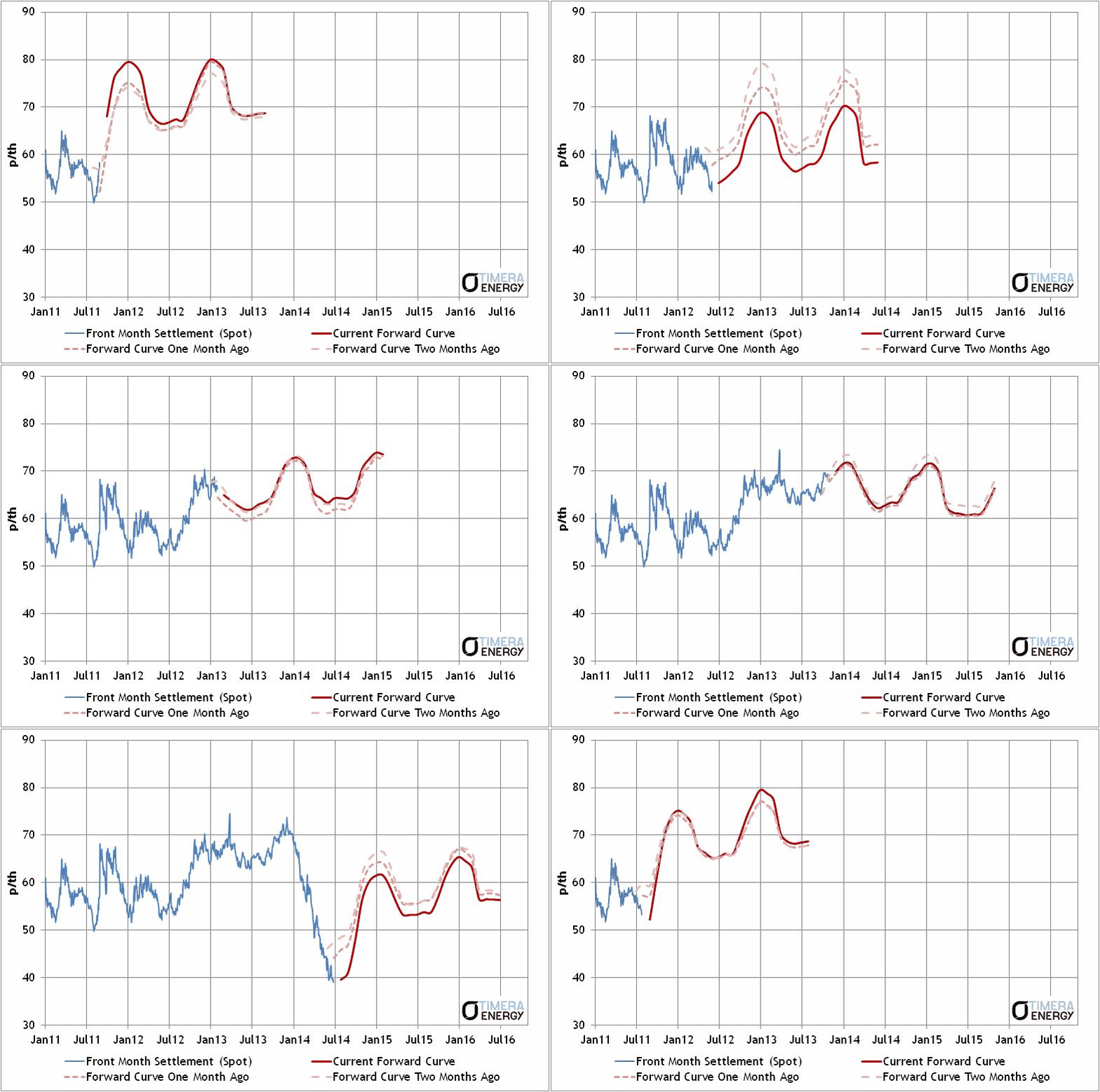
One of the problems with analysing forward curves is that a single static curve on its own can be quite a bland snapshot of market conditions.  A simple animation provides a more insightful view.  Chart 1 shows an animation of the evolution of the relationship between spot and forward curve prices in the UK NBP gas market since Jan 2011.  We have illustrated spot prices in the chart with the month-ahead rather than day-ahead contract to remove some of the noise.

Chart 1: UK gas spot price and forward curve evolution 

Fwd Curve Animation

Source: Timera Energy (based on ICE NBP gas futures EoD Settlements).  Note, the animation may not work in all browsers (particularly older ones).

As well as being somewhat mesmerising (take care after a long Christmas lunch), the animation illustrates some important curve dynamics.  Take two examples:

  1. Spot wags the curve: A characteristic that is particularly common in gas and power markets is the influence of spot price movements in driving ‘parallel’ shifts along the forward curve.  Look how prices evolved across 2012 as an example. There are practical physical forces that act to connect the two, e.g. time spread arbitrage via physical storage.  But these are not formulaic and interact with a number of other drivers.
  2. Spot price shocks: This year’s summer gas hub price shock provides a good case study of a more extreme disconnect between spot and forward prices. As spot prices began to fall in Q1 2014 the forward curve was dragged down.  But as the spot continued to slump into Q2 the forward curve held up (albeit at a lower level to the start of the year).  In other words a pronounced curve contango opened up representing a substantial shorter term physical oversupply of gas into NW European hubs (driven by surplus LNG, robust pipeline flows and storage injection limitations).  However beyond the current year the back end of the forward curve retained a linkage to oil-indexed contract prices.

These simple case studies illustrate perhaps the two most commonly observed features of spot vs curve behaviour in gas and power markets.  But they are by no means the basis for trying to develop an academic theory that comprehensively captures this relationship.

Curve behaviour and market maturity

Prompt vs forward curve behaviour is closely linked to market maturity and the level of commercially optimised intertemporal flexibility (e.g. storage, swing, production flex).  Some factors that act as a useful barometer for the maturity of a forward curve include:

  • Forward horizon – how far ahead of delivery can I trade contracts
  • Liquidity & transaction costs – what is my access to contract liquidity and my cost of moving in and out of positions (measured by narrowness of bid/offer spreads and market depth)
  • Contract types & granularity – what types of products are available for me to trade e.g. to manage price shape & non-linear exposures, particularly important for markets with inherent shape and/or flexibility of underlying exposures
  • Dynamics of forward curve movements – to what extent do different portions of the forward curve move independently from each other
  • Availability of derivatives – that can be used to manage price risk along the curve with-out having to manage the complexity of physical delivery

As an illustration of different stages of forward curve maturity it is useful to step away from the NBP gas market example and compare:

  1. The Brent crude curve – liquid several years ahead of delivery, tight bid/offer spreads, a range of time spread and options contracts traded and pronounced independent movement along different sections of the curve driven by arbitrage constraints
  2. The UK power curve – limited liquidity out to 3 seasons ahead of delivery, relatively high bid/offer spreads, a limited range of standard contracts and a strong parallel shift relationship between spot and curve movements

As well as the UK power curve being less mature than Brent, these dynamics also reflect a greater difficulty in access to physical arbitrage opportunities for power, given limited storage ability.

Some practical observations on curve behaviour

One myth worth dispelling is that forward prices represent a market prediction of future spot prices.  Forward contract prices represent the value today at which paper contracts change hands for delivery of gas over a defined period in the future.  The market for forward contracts has its own supply and demand dynamics, driven primarily by the hedging of forward portfolio exposures, but also by other factors such as speculative trading flows.

Spot price events clearly influence the trading of forward contracts as can be seen in the parallel shift case study.  This is both via:

  1. Physical arbitrage between spot and forward prices (e.g. “the more cheap spot gas I have to buy and inject into storage now, the more I can sell forward against a future higher price”)
  2. Precipitating rebalancing of supply and demand for forward delivery (e.g. “the price at which I can buy gas today impacts my pricing of gas for delivery in the future”).

Physical arbitrage is the strongest practical linkage between spot and forward prices and an important driver of curve backwardation and contango. Portfolio flexibility options such as swing contract take, storage inventories and production flexibility are all increasingly being managed against forward curve price shape. In more technical jargon, intertemporal flexibility is being optimised against forward time spreads. It is the constraints around optimisation of this flexibility that most closely determines the evolution of forward curve shape. While this is a relationship that can be analysed empirically it is not one that lends itself to a theoretical formula.