Winter LNG spot price volatility

Global LNG spot prices have been relatively subdued over the past two winters.  Increases in global liquefaction capacity and weaker demand have kept regional LNG prices within a relatively tight range of European hub price support.

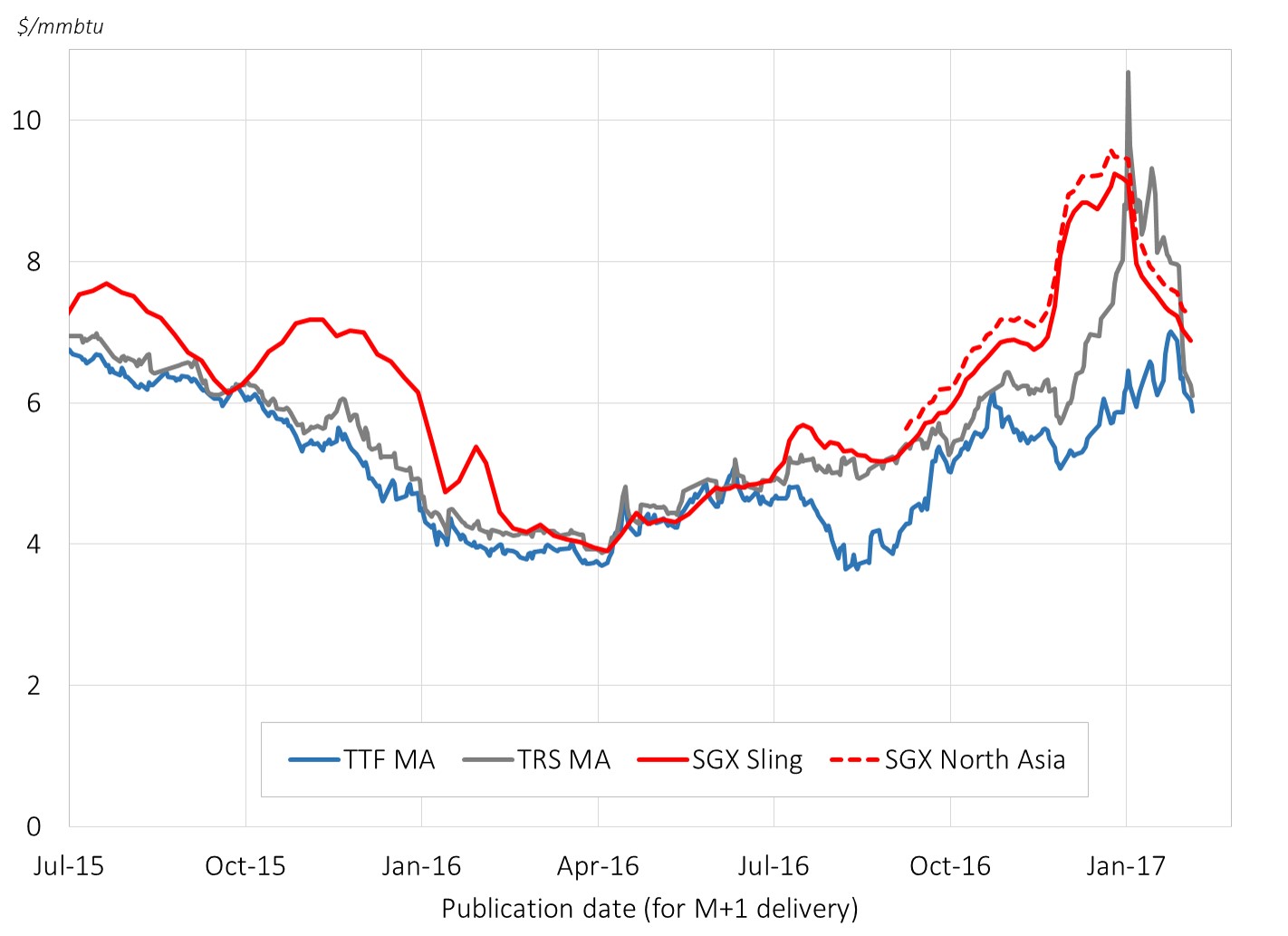
But LNG spot price volatility is back this winter.  Asian spot prices surged from just above 7 $/mmbtu at the start of December towards 10 $/mmbtu in early January.  This opened up a significant premium over North-West European hub prices, signalling Asia’s requirement for incremental cargoes.

Early January then saw Southern European spot prices trumping Asia as a cold snap hit the Mediterranean. Pipeline bottlenecks within France caused a sharp price separation between Northern European hubs and their LNG dependent Southern neighbours.

The events of Winter 2016-17 make an interesting case study of how spot price volatility can temporarily disrupt structural global price convergence, despite prevailing supply glut conditions.

Asian LNG premium makes a comeback

European hub prices have been the primary driver of spot LNG prices since the global supply glut took hold in Summer 2014.  This is because North-West European hubs represent a liquid backstop in an oversupplied LNG market.  If regional spot prices start to diverge from European hub prices, flexible LNG is diverted away from Europe to higher priced markets, checking the extent of regional price separation.

However the ‘gravitational’ effect of European hubs can break down over a shorter term horizon.  This is because volumes of flexible LNG still make up a relatively small portion of the total market.  LNG supply chain lead times also create practical constraints in moving gas between regions.

As a result of these factors, short term supply can be relatively unresponsive to spot prices (i.e. inelastic).  The events of the current winter illustrate this dynamic.

Asian spot prices entered this winter at a relatively narrow premium to North-West European hub prices (~ 1 $/mmbtu).  Over the first two weeks of December, a surge in Asian spot prices saw this premium quickly rise towards 4 $/mmbtu.

Chart 1 shows the evolution of prices in Asia versus European hubs in Q4 2016, relative to recent history.  We have used Singapore Exchange (SGX) spot price data to show Asian spot LNG benchmarks (the Singapore and North Asia indices).

Chart 1: Asian spot vs European hub prices
Source: Timera Energy (data from LEBA/SGX)

Several factors contributed to the sudden tightening in Asia in Q4.  On the supply side, the large Western Australian Gorgon project announced an outage at the end of November, compounding supply reductions from outages at an APLNG train in Queensland and the terminal in Angola.

At the same time, Asian demand for spot cargoes increased.  South Korea faced several nuclear outages requiring LNG backup and Chinese demand was strong as the winter took hold.  This surge in demand was suddenly pushing up a steep and contracting supply curve.

Southern Europe prices up to Asia

Gas flows within France are constrained by a North-South pipeline bottleneck as we have described previously.  This can leave the TRS hub (an amalgamation of the former PEG Sud & TIGF hubs) in Southern France dependent on LNG imports to the Fos terminals on the Mediterranean coast in periods of higher winter demand.

Just as Asia sent a strong spot price signal to Europe to divert flexible LNG cargoes, Southern Europe had its own supply crunch.  A cold snap hit Mediterranean Europe in early January with gas demand surging.  This led to a shortage of cargoes available for Mediterranean delivery, exacerbated by an Algerian liquefaction terminal maintenance outage.

Relatively small price increases are typically required for Southern France to attract cargoes from other Mediterranean terminals e.g. in Spain. But a more widespread LNG shortfall in January saw Southern European spot price benchmarks surge through 10 $/mmbtu to open up a premium to Asia as can be seen in Chart 1.

Price separation of this magnitude between Northern and Southern Europe is typically a short lived phenomena.  TRS prices can be seen re-converging with by late January as LNG imports returned. The key North-South pipeline bottleneck is also in the process of being alleviated with new pipeline capacity due to come online for winter 2018-19.

How is this volatility possible with a supply glut?

Price spikes and Asian spot premiums appear to be strange conditions for a structurally oversupplied global market.  Are they evidence of a premature end to the global supply glut? And is global price convergence an over-hyped phenomena?  Not in our view.

Spot prices re-converged with European hub prices in late January just as fast as they rose in early December.  As a result, the premium of Asian spot prices over North-West Europe has fallen back to less than 1 $/mmbtu, signalling a return of surplus cargoes into Europe.  The primary drivers of this ‘return to normal’ are:

  1. Winter demand surges reverting to normal
  2. Liquefaction capacity returning from outages
  3. LNG supply chain response to spot price signals

In other words the spot price volatility observed over December and January is a function of short term dislocations in supply and demand, and the supply chain response time required to rectify these.

Volatility events such as those observed over the current winter become less common in an oversupplied global gas market.  But this sort of shorter term price volatility is inherent to the LNG market.  The appearance of shorter term bouts of regional price volatility does not challenge the prevailing conditions of structural oversupply and price convergence between Asia and Europe.

We return next week to take a closer look at European gas market dynamics, Russian market share and gas coal switching.

Article written by Olly Spinks & David Stokes

UK power: will next winter be a repeat of this one?

The UK power market entered this winter with the tightest system reserve margin since market liberalisation in the 1990s. The reserve margin has fallen sharply over the last five years as older gas and coal plants have retired.  The closure of three large coal plants in the first half of 2016 set up particularly tight conditions for the current winter.

Symptoms of market tightness over the last three winters have been disguised by relatively mild & windy weather. High volumes of lower cost imports from the Continent have also helped to dampen volatility.  But Q4 2016 saw UK power prices and generation margins explode higher as system stress set in.

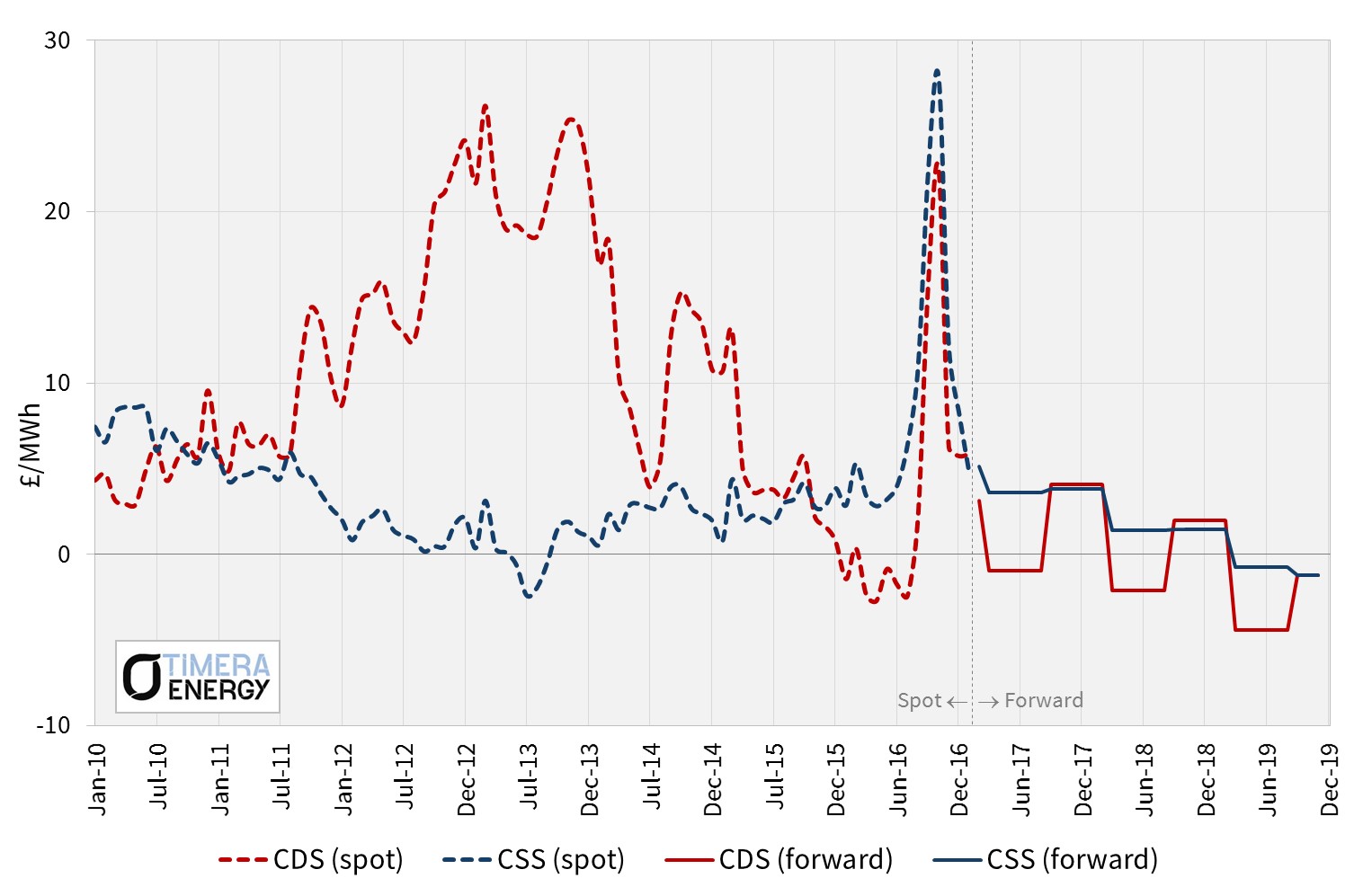
After spending most of the last five years in a relatively tight 0 to 5 £/MWh range, gas plant generation margins spiked towards 30 £/MWh in Q4 2016.  Chart 1 shows the scale of the Q4 jump in Clean Spark Spreads (CSS) relative to the rest of this decade.

Chart 1: UK Baseload Clean Spark Spreads (CSS) and Clean Dark Spreads (CDS)

Source: Timera Energy

The French nuclear outages we looked at last week were a big factor behind the UK’s Q4 price spike, as the two markets fought for available electricity across the interconnector.  But more normal conditions have returned in Q1 2017 as French nukes have come back online.

Generation margins in the forward market for Winter 2017-18 have also returned to more subdued levels, as shown in Chart 1.  This relates in part to the calming influence of the extra auction (EA) for capacity in 2017-18 that cleared on February 3rd.  In today’s article we look at the results of this EA auction and consider how UK price dynamics next winter may compare to the conditions experienced this winter.

As we have pointed out a number of times before, forward curves are not forecasts of spot price evolution.  The downward slope of forward CSS prices is primarly driven by contango in the gas curve.  There is also very limited liquidity beyond the front three seasons in the UK power market, meaning published forward prices have little relevance beyond 2018.  To better understand how spot price evolution may diverge from forward pricing, it is important to dig into supply, demand and marginal price setting dynamics in the UK power market.

EA auction

The extra 2017-18 capacity auction was implemented by the UK government in 2016 in response to widespread criticism of the Supplemental Balancing Response (SBR) mechanism, used to procure emergency reserve capacity over the last three winters.  The EA auction allowed the government to directly influence the system capacity level from Oct 2017, helping to alleviate concerns around security of supply.

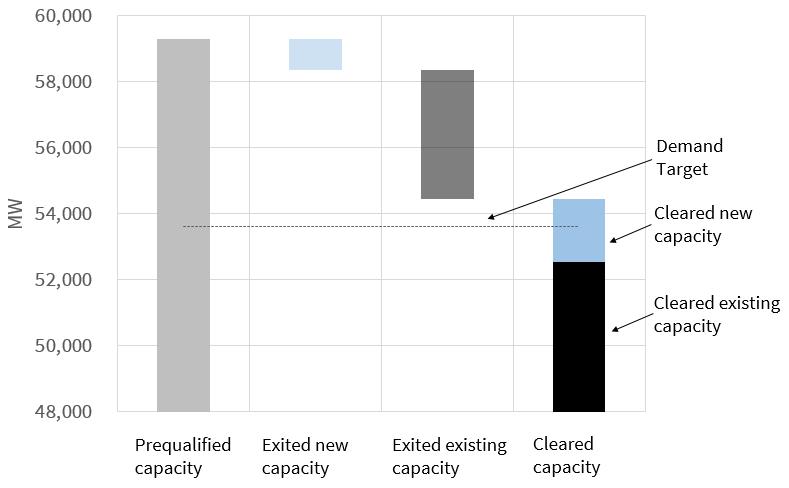
The lower EA auction clearing price (6.95 £/kW) was primarily a function of a surplus of 3.6GW of existing capacity over the government’s demand target.  57.2 GW of existing capacity prequalified for the auction (including the already commissioned Carrington CCGT which is categorised as new capacity) versus the 53.6 GW target.

You could be forgiven for thinking it sounds strange that a market as tight as the UK can have such a surplus of existing capacity.  Chart 2 sheds some light on how this is possible, at least in a capacity accounting sense.

Chart 2: Summary of EA auction volumes

Source: Timera Energy, Grid provisional auction results

The key numbers from the auction results that are shown in Chart 2 are as follows:

  • Cleared capacity: Of the 59.3 GW of prequalified capacity, 54.4 GW of capacity cleared the auction (above the government’s 53.6 GW demand target, given a downward sloping demand curve and lower clearing price).
  • Cleared new capacity: 1 GW of new capacity was successful (0.9 GW of new generation, 0.2 GW of new DSR), effectively adding to the surplus of existing capacity. This capacity predominantly came from the accelerated delivery of small scale peaker projects successful in previous T-4 auctions. Note the 0.8GW Carrington CCGT is also technically classified as new capacity, but we have excluded this given it is already operational.
  • Exited existing capacity: 9 GW of existing capacity did not clear the auction. The key thermal units that failed to clear were Barking (already mothballed), Deeside CCGT, 1 unit of Fiddlers Ferry coal station, Peterhead CCGT, 2 units of Ratcliffe coal station and the remaining units of Uskmouth coal station.

The two main surprises from the auction were:

  • The Eggborough coal plant (1.8GW derated) cleared the auction, helping to push down the auction price.
  • Ratcliffe Units 1 & 3 (448 MW each) exited the auction despite these units having T-4 agreements for 2018-21.

It is reasonable to assume that up to 2.4GW of existing capacity that was unsuccessful in the auction will close or be unavailable to provide capacity next winter. This excludes the two Ratcliffe units, given the status of these next winter is not yet clear.

Market dynamics in Winter 2016 vs Winter 2017

The tight UK capacity balance this winter has clearly resulted in higher power prices and generation margins (as shown in Chart 1).  So let’s consider how this capacity balance is likely to change by next winter:

The following is an estimated breakdown of the main incremental changes that may occur:

  • SBR: 3.5 GW (derated) of ‘emergency response’ SBR capacity comes back into normal supply stack as the SBR mechanism is discontinued.
    Withdrawals: An estimated 2.4 GW (derated) capacity closes during 2017 or is unavailable to provide capacity next winter (after exiting the EA auction).  This could be less if some of these units remain online despite not receiving capacity payments.
  • New build: 1.1 GW (derated) of new, predominantly peaking, capacity is built by Oct 17.
  • Renewables: ~1.5 GW (nameplate) of new renewables capacity comes online, predominantly intermittent wind.

In a capacity accounting sense those changes result in a system reserve margin that National Grid estimates is consistent with the UK government’s security of supply standard (3 hour LOLE).  But underneath the headline capacity level, there are some important changes in supply stack dynamics.

In isolation, the return of 3.5GW of SBR capacity back into the supply stack should definitely have a price and volatility dampening effect.  This is because this capacity will return to operating on a short run marginal cost basis.  The effective variable cost of dispatching SBR capacity across Winter 2016-17 has been very high given the ‘emergency response’ guidelines.

The ‘SBR return’ benefit may be significantly offset by the removal of up to 2.4GW of capacity from the supply stack.  Replacement capacity comes mainly in the form of new peakers and wind capacity.  But the peakers have high effective variable dispatch costs (e.g. 150-250 £/MWh) compared to the larger coal and CCGT units that are closing.  And new wind capacity is intermittent versus the flexible capacity it is replacing.

There is also a thorny question as to whether the government’s assumed capacity contribution from interconnectors is still appropriate after issues with flows from France over the current winter (see our article last week).

So in summary, the system reserve buffer may have improved versus last winter in a capacity accounting sense. But the UK market will be more dependent on intermittent renewable capacity and higher variable cost peakers by next winter.  These factors are likely to continue to support CCGT generation margins and power price volatility until new CCGT capacity is built next decade.

Article written by David Stokes & Olly Spinks

Interconnector value & the cross-channel tug of war

It has been an explosive winter in North West European power markets.  Elevated prices, spikes and volatility have suddenly returned, in stark contrast to the relatively stable conditions that have become the norm over most of this decade.

System stress has been highest in the French and UK power markets. Extended outages at nuclear plants in France decimated the system reserve margin, leaving the French market dependent on imports in periods of high demand.  Across the English Channel, the UK power market is also confronting its tightest winter in history.

These conditions mean the IFA interconnector between the UK and France (2GW) has become a battle ground for available electricity.  This has been reflected in a surge in volatility of the spread between UK and French power prices.  The strong structural flow pattern from France to the UK has been temporarily replaced with a complex pattern of fluctuating flows and intra-day reversals.  Today we look at the implications for interconnector capacity value.

How to think about interconnector capacity value

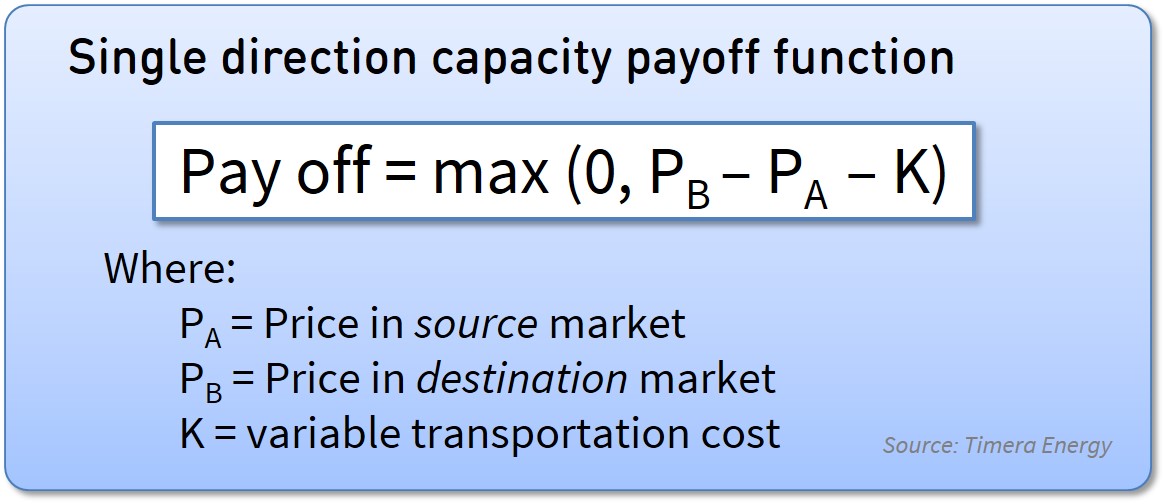
Cross border transmission capacity deconstructs into a locational spread option.  In other words it provides the capacity holder with the right but not obligation to flow power between two countries.

Power is flowed to realise a positive margin, if the price in Market A exceeds the price in Market B, allowing for any variable costs of flow (and vice versa).  A simple payoff function is summarised in Diagram 1 below.

Diagram 1: Interconnector capacity payoff function

Capacity pay-off

There are two key drivers of capacity value:

  1. The level of the price spread between the two markets, which drives the intrinsic value of capacity.
  2. The behaviour of price spread movement over time characterised by the volatility and correlation of power prices, key drivers of extrinsic value that can be realised from adjusting flows in response to fluctuations in the price spread.

These drivers have undergone a transformational change coming into the current winter.

 UK vs French spread and flow dynamics

The last five years have seen relatively stable price spread conditions, with UK prices at a structural premium to France.  There have been two primary drivers of this structural spread:

  1. Power prices in France (and across NW Europe) have been predominantly influenced by coal unit variable costs, which have been structurally cheaper than CCGT variable costs which set UK power prices.
  2. The UK carbon price floor (18 £/t above the EU ETS price) reinforces the generation cost premium of the UK over France.

These factors continue to support a strong structural premium of UK over French power prices in the forward market.  The Calendar 2018 UK power price is currently trading at around a 15 €/MWh premium to France, similar to its pre-winter level.  But this structural forward spread dynamics has been disrupted in the spot market across the current winter as illustrated in Chart 1.

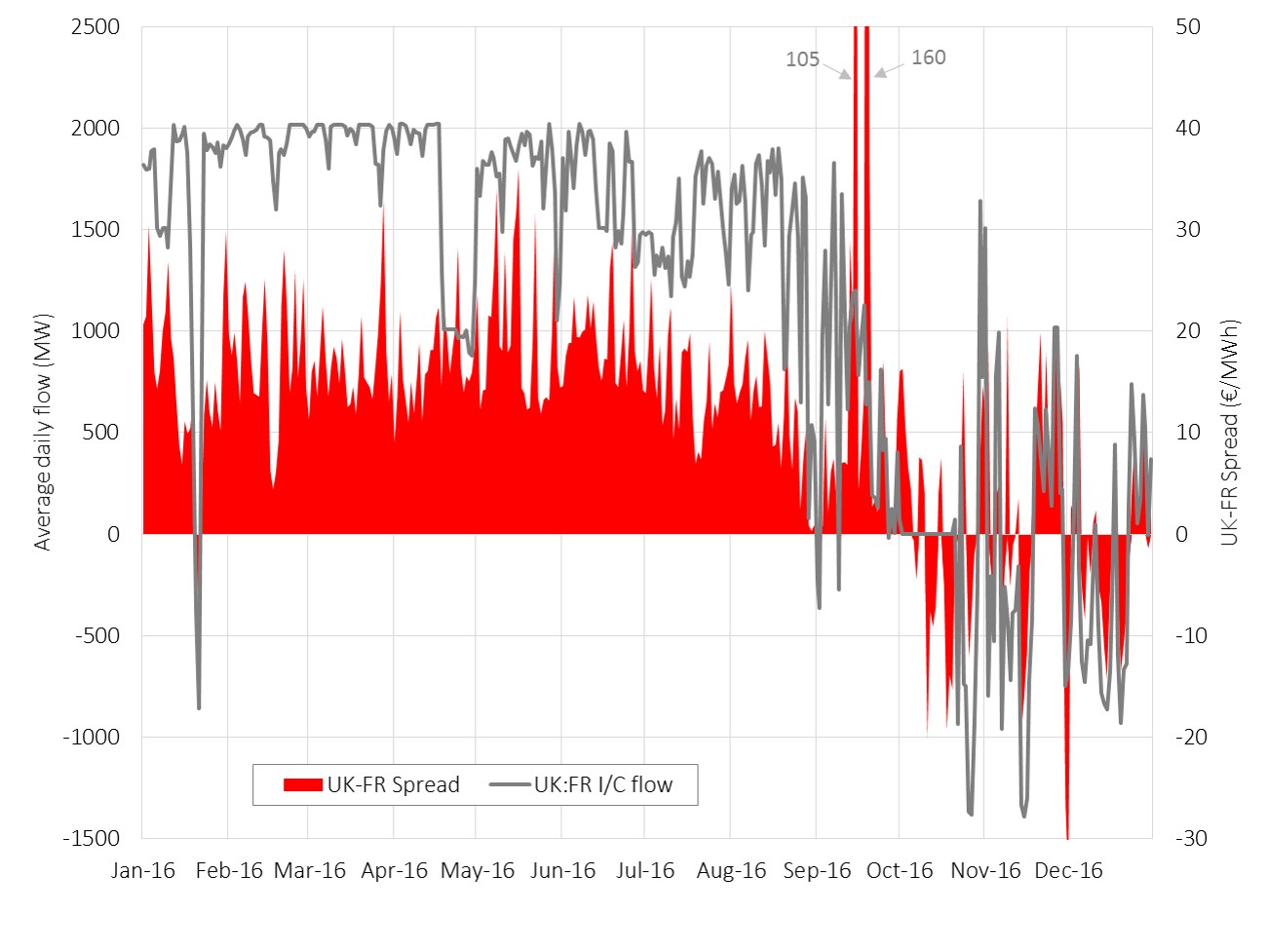
Chart 1: Average daily FR/UK spread and I/C flows (2016)

FR UK IC daily

Source: Timera Energy

Chart 1 shows UK imports as positive flows (the grey line above the horizontal axis).  The red line shows the UK vs FR power price spread, which is positive when UK prices are at a premium to France (and vice versa).

Several observations on the Chart:

  1. The strong structural UK vs FR price spread and associated flow pattern is evident from Jan until Aug
  2. A rapid transformation in spread and flows took place from September as the impact of French nuclear outages started to drive a substantial scarcity premium into French power prices (eroding the spread)
  3. The volatility of the price spread and fluctuations of flows has surged since the start of winter, reflecting a cross channel ‘tug o war’ as both the French and UK systems fight for available electricity

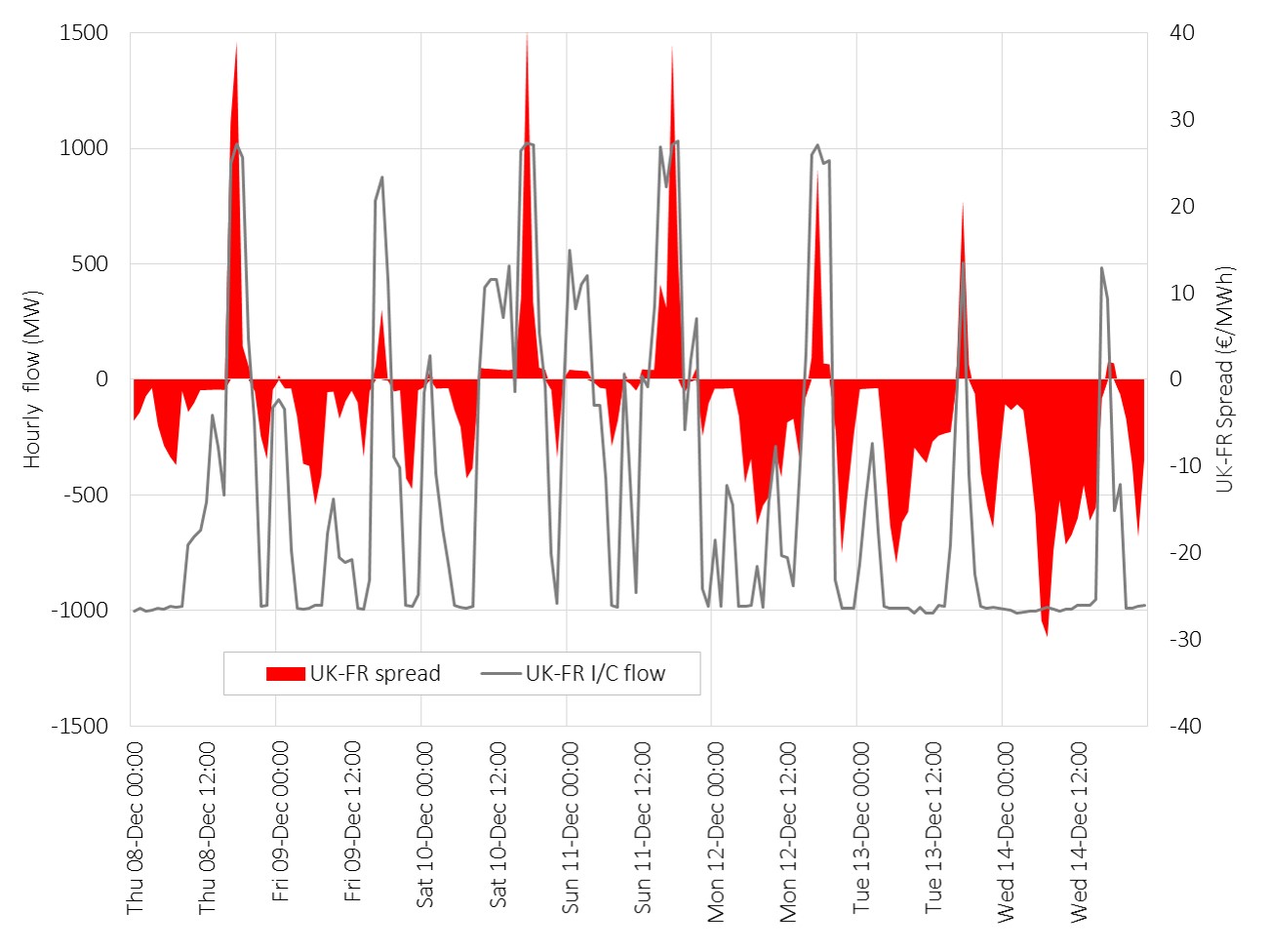
The dynamic behaviour of cross-channel spreads and flows is even clearer when viewed at an hourly level in Chart 2.

Chart 2: Hourly UK vs FR price spread and IFA flows (7 days from 8th Dec 16)

FR UK IC hourly

Source: Timera Energy

Chart 2 shows how cleanly participants can dispatch interconnector capacity against spot price signals using harmonised day-ahead auctions.  This can be seen via the very strong relationship between the direction of price spreads and flows.  This shows that capacity utilisation and dispatch is operating efficiently, as are the workings of the UK and French power markets in providing liquidity on each side of the interconnector.

Implications for asset owners and investors

Asset owners and investors love intrinsic value driven by structural price spreads. A high proportion of intrinsic value can be realised when selling capacity to market counterparties.  This is because capacity buyers can hedge intrinsic value with relatively low cost & risk, and easily mark it to market.

But extrinsic value dynamics also play a key role in driving interconnector capacity value.  This is particularly the case during periods of lower price spreads or higher spread volatility.  Chart 2 illustrates how liquid hourly spot markets facilitate capacity buyers to precisely nominate flows to capture margin from cross border price spread volatility.

There are several important characteristics of intrinsic and extrinsic value that impact the risk and return on interconnector capacity:

  1. Structural spreads: Intrinsic value dominates interconnector margin during times of strong structural price spreads. Intrinsic margin is important in supporting the sale of capacity contracts, particularly long term contracts to facilitate debt financing.
  2. Bi-directional flows: The bi-directional nature of interconnector flows means that value loss in one direction is typically replaced by value gain in the other. In other words it is the absolute level of the price spread that drives intrinsic value, rather than whether the spread is positive or negative.
  3. Extrinsic value offset: During periods where price spreads decline (i.e. when the spread option moves ‘close to the money’), extrinsic value increases significantly (e.g. across the current winter). Increasing extrinsic value partially offsets the decline in intrinsic value.  This inverse relationship provides important downside margin protection.
  4. Extrinsic value capture: There is a higher cost and risk in monetising the extrinsic value of capacity (relative to intrinsic value), given it requires a more complex and higher volume prompt trading strategy. This is reflected in deeper price haircuts when selling capacity contracts.

Robust valuation of interconnector assets can be challenging.  Spread optionality is complex and there are practical challenges in monetising capacity, whether via selling long term contracts or via shorter term capacity sales. But accurately capturing the dynamics of intrinsic and extrinsic value set out above is a good starting point for developing an accurate quantification of asset risk/return.

Article written by Olly Spinks & David Stokes
5 surprises for 2017

Our list of surprises for 2016 focused on changing energy market price dynamics. In Q1 2016, cyclically depressed conditions in a number of markets suggested the risk of major changes in energy pricing trends as the year progressed. We focused on oil, German power, European spark spreads and trans-Atlantic LNG price spreads (see here for an end of year status update on these surprises).

Cyclical extremes and pricing inflection points are particularly interesting because they often coincide with extremes in the mispricing of asset values and asset risks. Many energy markets look to have formed multi-year cyclical lows in Q1/Q2 2016. But prices recovered sharply in the second half of the year, returning markets to a more balanced state.

So this year we cast the net a little wider. Coming into 2017, surprise risk looks to be skewed more towards political and policy shifts.

The 2017 landscape

An important transition appears to be underway globally. Austerity and monetary easing have been two of the dominant economic policy response mechanisms since the financial crisis. But support for these mechanisms appears to be weakening, particularly given a rise in populist politics.

There appears to be a policy shift underway towards national self-interest and higher fiscal spending to reflate economic growth. This is most obvious in the US under Trump, but is becoming a more prominent trend in European countries also. The success, or otherwise, of this policy transition will have an important impact on economic growth, inflation, interest rates, exchange rates and commodity prices, all of which are important macro drivers of energy markets.

Against this backdrop we set out 5 potential surprises to consider below. The first surprise considers some larger ‘macro’ risks that could have an important knock-on impact on energy markets. Then the next four are specific surprises that relate to European power and gas markets.

1. Macro shock(s)

There were a number of big political shocks in 2016: Brexit, Trump’s election victory and the Italian referendum and resignation of Renzi. All of these represented a rapidly rising discomfort with incumbent political leadership and a shift towards new populist candidates. The impact of these shocks has only just started to play out.

Political uncertainty remains unusually high in 2017 with key elections in France, Germany, Netherlands and Italy. A populist shift in any of these countries has the potential to reshape the European political landscape. This could also result in a sharp weakening in the Euro.

The other important transition that appears to be taking place in a number of key economies, is a return to a rising inflation and rising interest rate environment for the first time since 2008. Inflation in several European countries has picked up over the last few months, albeit from very low levels. German inflation may breach the 2% ECB target range this month, driven by rising energy prices. UK inflation is also rising towards 2%, helped by a weaker pound. 2017 could see an upside surprise for both inflation and interest rates, both of which may be commencing a long term recovery from historically low levels.

2. LNG Asian demand pickup

Annual Asian LNG demand fell in 2015 for the first time ever, despite rapidly declining LNG prices. This sent shockwaves through the LNG industry which was banking on robust Asian demand growth to absorb the output from huge investments in new liquefaction capacity.

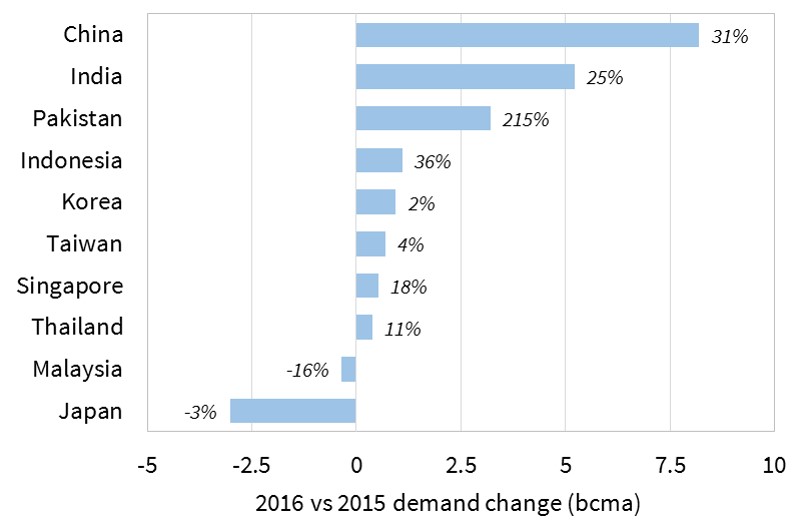
2016 saw a significant recovery in annual Asian LNG demand as shown in Chart 1. Increasing demand was driven by China, India and Pakistan, offsetting a further decline in Japanese demand. However, even at the end of 2016, total Asian LNG demand remains below the 2014 level.

Chart 1: Annual Asian LNG demand (2016 vs 2015)

Asian LNG demand change

Source: Timera Energy

As 2016 progressed, the price of alternative fuels (e.g. coal and oil) increased relative to LNG. This may provide momentum in 2017 for both:

  1. an increase in opportunistic purchasing of spot cargoes
  2. signing of new contract volumes on a medium to longer term basis (supported by more attractive deal terms)

These factors could mean Asian LNG demand growth in 2017 surprises to the upside. But even aggressive Asian demand growth recovery is unlikely to reverse the looming supply glut, given the scale of new supply coming online by 2020. It may however mean that Asia plays a more important role in absorbing that glut.

3. European power & gas M&A growth

Conditions that support growth in mergers & acquisition (M&A) in European power and gas markets have been building for several years. On the sell side, utilities and producers have written down more than €100 bn in asset values since 2010. Tens of billions of euros of European power and gas assets have been earmarked for sale to shore up balance sheets.

Infrastructure and private equity funds dominate the buy side, alongside interest from some large Asian investors. Power and gas infrastructure is an increasingly attractive acquisition target for these investors. Cash balances are relatively high and financing flexibility has improved. European currency depreciation against the dollar is also helping, particularly a more than 20% post-Brexit fall in GBP (vs the USD). After much anticipation over the last two to three years, 2017 may be the year that transaction volumes really jump, causing some major restructuring of European asset ownership.

4. Capacity support becomes a reality on the Continent

The UK government has been focused on power market security of supply for the last five years. But direct action on security of supply has been a lower priority in Continental power markets. Different capacity support mechanisms are being designed and discussed, but aside from France who introduced a new capacity market in 2016, implementation has been slow given a perceived structural oversupply of capacity.

Capacity tightness has come racing back into focus across the current winter. Capacity shortfalls in France relating to nuclear outages have sent power prices into triple figures (> 100 €/MWh). Increasing interconnection and renewables penetration are supporting a knock on effect in neighbouring markets. Periods of high net system demand have seen markets such as France, the UK and Belgium fighting for access to flexible generation output.

The events of this winter are likely to drive an increased policy focus on support measures for flexible generation capacity. 2017 may be the year that planning and talking about capacity support are replaced by a leap toward implementation.

5. Jump in value of European gas supply flexibility

A recovery in supply flexibility value is partly a cyclical story. Price signals have been weak for 6 or 7 years, choking off investment in new flexible supply infrastructure and causing the closure of some existing assets.

Spot gas price volatility levels above 150% were commonplace last decade. But spot volatility at European gas hubs has hovered around 50% for most of this decade. Volatility started to recover in 2016 and could accelerate further in 2017.

There are several specific issues that could bite this year. As European LNG imports increase this year with global supply volumes, hub prices may be buffeted by the ebb and flow of chunky cargo volumes, increasing the requirement for supply flexibility.

A cloud also remains over two of Europe’s key flexible supply assets. Further reductions in flexibility from the UK’s Rough storage facility or the Dutch Groningen field may help support the value of supply flexibility.

Scenario application

The scenarios above draw on a number of themes that we have written about previously:

  • The key role of Asian LNG demand in a world of oversupply
  • Growing momentum behind European gas and power asset transactions
  • The widespread role out of capacity payments for flexible power assets
  • Depressed values of flexible European gas supply infrastructure
  • The potential for external macro shocks to impact energy markets

The aim of these surprises is not to deliver specific trade or investment ideas, although they hopefully provide some food for thought. Instead the surprises are intended to provide a reasonable challenge to prevailing industry consensus views. They are areas to consider when formulating commercial and risk management strategies in 2017.

We will return again at the end of the year for a status check.

Article written by David Stokes & Olly Spinks

The impact of LNG imports on hub price volatility

After 5 tough years, a glimmer of hope emerged for gas storage operators in 2016. Spot price volatility at European hubs started to show signs of a more enduring recovery. This has been supported by a resurgence in power sector gas demand. Reductions in existing gas supply flexibility have also helped, for example constraints around the UK’s Rough storage facility.

However gas storage facilities face a potential threat in the form of rising LNG imports. There is little doubt that LNG import volumes into Europe will increase significantly over the next decade, as the LNG supply glut intensifies and European import dependency increases. But there is less clarity as to exactly how rising LNG imports will impact hub price volatility.

The simple argument that is often presented is that LNG regas terminals and on-site tank storage compete with conventional gas storage facilities to dampen volatility. But this argument ignores some important practical constraints that limit LNG import flexibility. 

Deconstructing LNG import terminal flexibility

LNG import flexibility can be broadly split into two categories, the first associated with the LNG supply chain and the second with regas terminal storage tanks:

  1. ‘Type A’ flexibility – LNG cargo diversion: Cargoes not initially intended for European delivery are sent to Europe as a result of (i) cargo diversion or (ii) purchase of spot cargoes. Or alternatively cargoes that were intended for Europe are diverted away.
  2. ‘Type B’ flexibility – use of LNG terminal storage: On-site tank storage can be used to profile gas send out in response to hub price volatility (i.e. increased/decreased withdrawal as prices rise/fall). Tank storage can also facilitate “Type A flex” via enabling the reload and diversion of cargoes that are bound by destination specific contract clauses.

Let’s consider how each of these sources of flexibility impacts hub price volatility.

Type A flexibility constraints: diversion flexibility

The LNG supply chain can certainly provide seasonal flexibility to the European gas market, if there is an adequate hub price signal to incentivise a seasonal flow profile. However there are practical constraints around the ability of LNG imports to respond to spot price volatility.

Spot price volatility is by nature a short term phenomenon, often shorter than the time horizon required for LNG supply chain response (e.g. 1 to 3 weeks). Response time depends on the availability of divertible LNG cargoes which can be constrained by price, location and contractual factors.

Ability to divert a cargo in response to higher hub prices may depend on the availability of short term shipping and regas capacity. Diversion or reloading LNG in response to lower hub prices often relies on complex diversion economics and logistics and access to regas terminals.

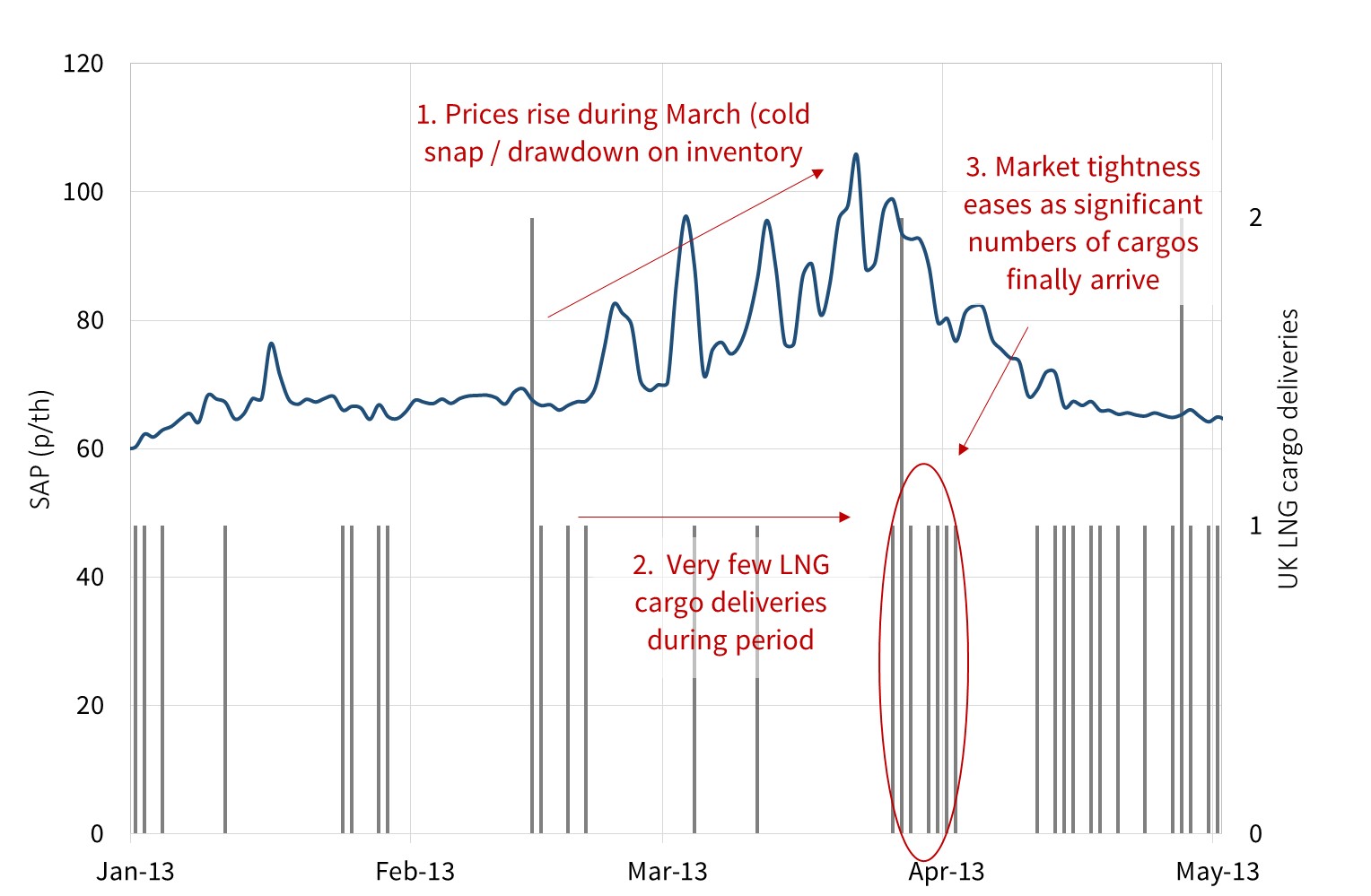
Chart 1 shows a case study focused on the response of LNG imports to the UK NBP price spikes in Mar-Apr 2013.

Chart 1: UK LNG deliveries vs spot prices (Jan – Jul 2013)

2013 case study v2

Source: Timera Energy (data from National Grid)

Hub price volatility across this period was caused by a combination of major infrastructure outages that curtailed Norwegian imports, cold weather and issues with the IUK interconnector. Spot prices began to signal system stress in late Feb and remained at elevated levels throughout Mar (spiking to above 100 p/th). But it was not until Apr that the LNG supply chain was able to deliver a significant increase in import volumes to help rebalance the system.

Type B flexibility constraints: regas tank flexibility

At first glance, LNG tank storage may appear to have similar characteristics to fast cycle gas storage facilities. But while tanks can be used to profile gas send out, there are fundamental differences that limit regas terminal flexibility. These include:

  • LNG storage can only inject into the network, not withdraw from it
  • During periods of high terminal utilisation, storage tank optimisation is restricted by a requirement to send out gas to facilitate the unloading of cargoes
  • Minimum inventory requirements to keep the tanks cool can constrain send-out during periods with few deliveries
  • The use of terminal storage can often be limited by contractual terms
  • In tank boil off rates contribute to the cost of holding inventory, although rates are relatively low (0.02-0.1% per day)

Under the right conditions, regas terminal send-out can be profiled into periods of higher prices to dampen volatility.   But the factors listed above combine to substantially reduce the flexibility associated with terminal tank storage.

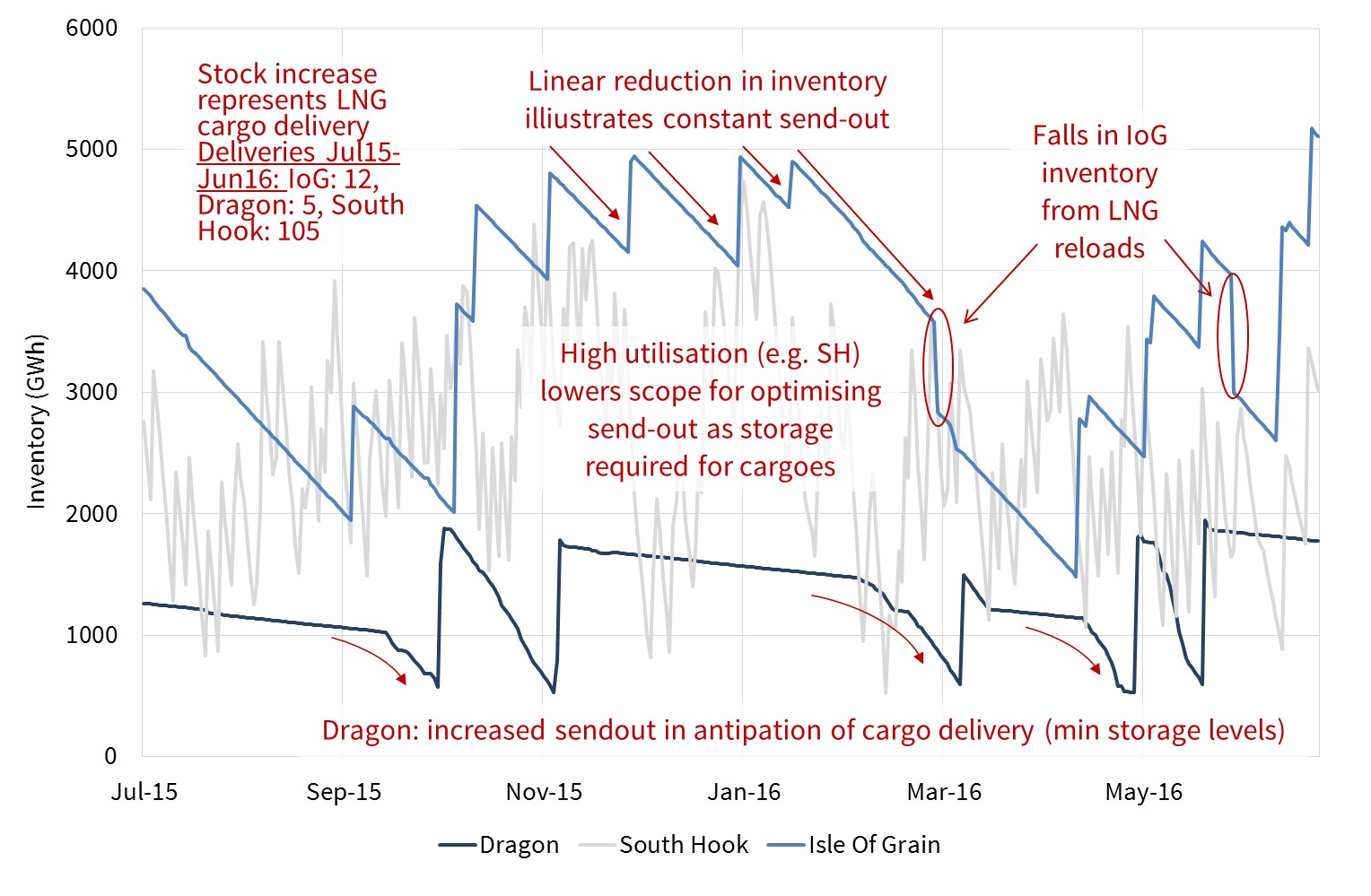
Chart 2 shows a case study of UK terminal send out over a recent 12 month period to illustrate the fact that physical terminal constraints and cargo logistics are key drivers of terminal send-out, as opposed to optimisation against NBP spot prices.

Chart 2: UK regas terminal send-out (Jul 2015 – Jun 2016)

2016 UK terminal sendout v2

Source: Timera Energy (send-out data from National Grid)

The chart shows how tank inventory was typically sent out in a linear (steady) profile, as opposed to being optimised against spot price volatility. It also illustrates how terminals need to use high send out rates during periods of higher utilisation (e.g. for South Hook receiving regular cargoes). Terminals with lower utilisation such as Dragon need to  retain a minimum inventory to keep the tanks cool and then typically send out gas in anticipation of a new delivery.

LNG imports as a source of higher volatility?

There is inherent flexibility within the LNG supply chain to divert cargoes to higher priced markets. Regas terminal storage tanks also provide flexibility to profile send out of inventory. But the combination of these two factors alone does not necessarily mean that rising LNG imports will act to dampen European hub price volatility.

There are circumstances under which rising European dependence on LNG imports may act to increase spot price volatility. This is particularly the case because of the growing role of European hubs as the global LNG swing market (or ‘market of last resort’). Consider the following two cases:

    1. Surplus: During periods of surplus LNG cargoes, Europe can see a substantial ramp up in imports. Periods of high terminal utilisation can act to temporarily depress hub prices. This dynamic is exacerbated by the fact that LNG cargo volumes are bulky in nature relative to other supply sources delivering to hubs (e.g. fields, pipelines, storage).
    2. Shortage: Relatively large volumes of LNG supply can also be diverted away from Europe during periods of tightness in other regional markets (e.g. Asia or South America). This can drive up European hub prices, particularly if hubs need to ‘price up’ to compete for available cargoes.

Swings from surplus to shortage can occur over a relatively short time span, given the immaturity of the LNG spot market (e.g. compared to the crude market). So cycles of surplus and shortage can act to drive higher European spot price volatility.

The logic that rising LNG imports always acts to reduce spot price volatility oversimplifies the problem. The reality is more complex and depends on market conditions. If conditions are right, terminal send out can be profiled to dampen hub price volatility. But this effect is likely to be overshadowed by a structural increase in volatility as Europe evolves into the role of ‘shock absorber’ for the LNG market.

Article written by Olly Spinks and David Stokes


Progressing up the mountain of LNG

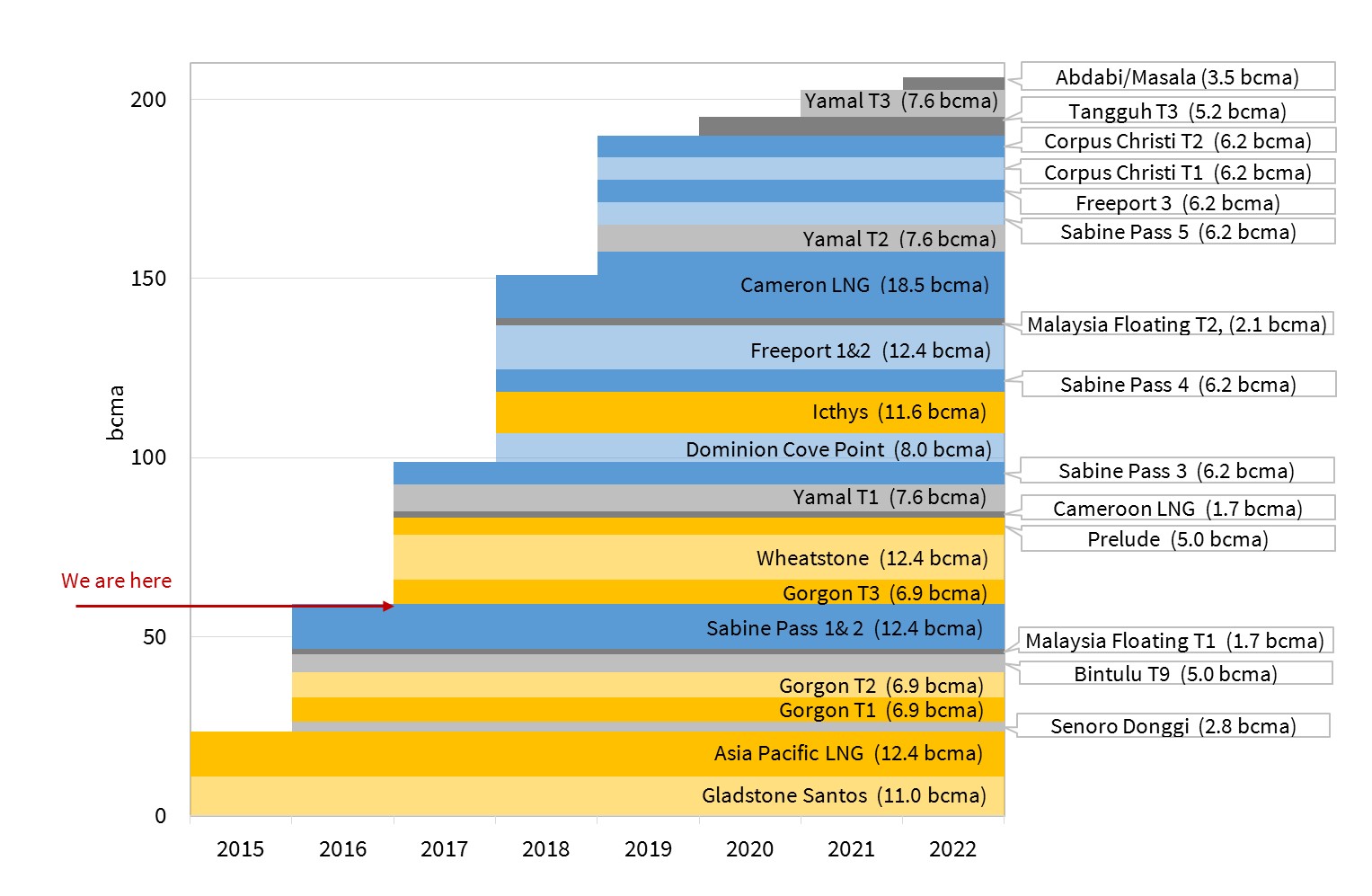
The LNG market is in the earlier stages of an unprecedented ramp up in supply. Global liquefaction capacity is set to rise by more than 50% by 2022. 205 bcma (149 mtpa) of new liquefaction capacity is past the Financial Investment Division (FID) and is under construction or has come onstream since 2015.

We published an article in early 2016 setting out the characteristics of this mountain of new LNG supply. As we enter 2017, we are only approximately 30% up the mountain. There remains over 145 bcma (101 mtpa) of capacity still to be commissioned across 2017-22. 130 bcma (96 mpta), almost 90% of the remaining volumes, will come online over the next three years alone.  In today’s article we return for a status check.

Mountain characteristics

New LNG supply is dominated by two sources:

  1. Australian LNG liquefaction capacity which reached FID between 2009-12 and is due to come online between 2015-17.
  2. US LNG export capacity which reached FID between 2012-15 and is due online 2017-20 (in addition to Sabine Pass trains 1 & 2 which were commissioned in 2016).

Chart 1 shows an updated view of the mountain of supply volume breakdown we showed last year.

Chart 1: 2015-22 Mountain of new LNG supply updated

LNG Supply Jan17

Source: Timera Energy

The 60 bcma (44 mtpa) of capacity delivered to date across 2015-16 has included:

  • The three Queensland projects backed by coal bed methane (Curtis Island, Gladstone)
  • Sabine Pass Trains 1 & 2
  • Indonesia’s Donggi-Senoro plant
  • Trains 1 & 2 of the giant West Australian Gorgon project

The capacity volumes shown in Chart 1 are based on target dates for first cargoes. However the full impact of new supply from the projects commissioned to date has been diluted by project ramp up times and delays.

The calm before the storm

As observed in the last LNG supply growth surge in the late 2000s, there is a lag between anticipation and reality. New LNG trains typically have a commissioning ramp up time of 6 to 9 months from first cargo to full capacity. On top of this there have been a number of delays and disruptions to the ramp up of new LNG trains.

Chevron’s Gorgon terminal has suffered perhaps the most prominent issues, with a series of unscheduled stoppages for maintenance disrupting supply from both Train 1 and 2. These issues, in addition to cold weather in China and nuclear maintenance in South Korea contributed to firming Asian spot LNG prices in Q4 2016. It should be noted however that despite these setbacks, Australian LNG exports for November 2016 were up 44% YoY.

The remainder of the climb

The impact of new supply is set to become more pronounced as 2017 progresses. Ramp up and teething issues for existing terminals are likely to recede. In addition the next wave of new projects are due to come online including the Wheatstone, Itchys and Prelude projects in Australia, the 1st train of the Russian Yamal terminal and Sabine Pass Train 3.

The issue confronting the LNG market from 2017 is that the pace of growth in supply in the next three years is likely to significantly outstrip demand growth. There are likely to be two important implications of this:

  1. Increasing European imports: LNG cargoes that are surplus to Asian (& emerging market) requirements are likely to end up in Europe, given liquid hubs, flexible contractual structures and an ability for the power sector to absorb gas.
  2. Further price convergence: Surplus LNG is likely to put downwards pressure on spot price differentials between Asia, Europe and the US. This could see the trans-Atlantic spread between NBP/TTF and Henry Hub compressing to non-sunk variable costs below 1 $/mmbtu.

Beyond 2017 all eyes shift to the US. There is a committed delivery pipeline of more than 80 bcma of US export capacity, most of which is due to come online in 2018-19. The US is also the most likely next source of new liquefaction FIDs to supply the LNG market in the 2020s. In addition to possible FID’s for Sabine Pass Train 6 and Corpus Christi Train 3, the Golden Pass project, awaiting non-FTA approval could add a further 20 bcma of export capacity if it proceeds.

Perhaps most importantly, the growing supply glut is set to see a substantial increase in the role of Henry Hub in driving the level of global gas prices as LNG trading arbitrage narrows spreads between key regional price benchmarks.

Article written by David Stokes, Olly Spinks & Howard Rogers.

UK capacity market surprises again

The UK capacity market continues to deliver surprises.  Large scale CCGT plants were expected to provide most of the new capacity in the third T-4 auction held in December.  But small scale peaking generators again dominated the auction, driving down the clearing price to 22.50 £/kW, well below consensus expectations.

The evolution of the UK capacity market is being closely followed across Europe.  France and Italy are in the process of implementing similar market wide capacity mechanisms.  Other markets such as Germany and Belgium are exploring strategic reserve mechanisms to ensure support for flexible capacity.

Regardless of the capacity support mechanism, the UK experience is providing important information on capacity costs and the competitiveness of new technology types versus existing plants.  The UK capacity market is also helping to crystallise the commercial and financing models of new flexible generation projects and driving down costs. So what are the lessons from the UK auction to carry into 2017?

3rd auction highlights

Given quite a bit of detailed analysis on the auction has already been published, we keep this article focused on a few important headline facts.

Clearing price:

There was a broad range of published views on clearing price levels going into the auction.  Most of these were in the 35-45 £/kW range, based on estimates of the cost to deliver new CCGT capacity.  Instead, substantial volumes of smaller scale distribution connected capacity pushed prices below 25 £/kW.  The auction supply stack is shown in Chart 1.

Chart 1: 2016 T-4 auction supply stack

2018-t-4-auction-stack

Source: EMR delivery body

Unsuccessful capacity:

The volume of existing capacity that was unsuccessful in the auction was dominated by older coal units (Cottam, Fiddlers Ferry and 1 unit of West Burton A) and Peterhead, the Scottish CCGT disadvantaged by locational TNUoS charges.  No big surprises here.

The other key category of exiting capacity was the 8.5 GW of unsuccessful new build CCGT projects.   The developers backing these projects included ESB, Carlton Power, Calon (Macquarie), Scottish Power, SSE and Intergen.

Existing coal assets and new CCGTs likely dominated the large volumes of capacity that exited the auction between 30-35 £/kW and between 22.50-25 £/kW.

New build:

Small scale peakers once again dominated successful derated new build capacity which was split across:

  • 0.33 GW Centrica’s Kings Lynn CCGT
  • 0.30 GW Intergen’s Spalding expansion OCGT
  • 1.5 GW of small scale peakers (mostly gas or diesel reciprocating engines)
  • 1.4 GW unproven DSR (the majority of which is likely to be small scale engines behind the meter)
  • 0.5 GW of battery storage (including some volumes also successful in Grid’s Enhanced Frequency Response tender in Aug 2016)

You could easily conclude from these results that small scale peakers will continue to dominate capacity delivery going forward.  But in our view the result of 2016 T-4 auction may with hindsight be viewed as a bit of an anomaly.

Peakers and embedded benefits

The economics of small scale distribution-connected peakers have been attractive to date.  Reciprocating engines have ‘all in’ capex costs as low as 150-200 £/kW (vs 500+ £/kW for new CCGTs).  Peakers have also had access to revenue uplift from a range of other embedded generation benefits that we have described previously.

These factors have helped to drive down capacity bids to around the 20 £/kW level or even below.  But peaker developers are facing dark clouds building on the horizon.  There is a concerted government effort underway to ‘level the playing field’ between CCGTs and small peakers.  Action already underway includes:

  1. Ofgem review of embedded generation benefits, with specific focus on the most lucrative triad benefit (from helping suppliers reduce transmission charge burdens)
  2. UK government (BEIS) consultation on removing the ‘double counting’ of Capacity Market Supplier Charge avoidance revenue
  3. DEFRA consultation on imposing emissions limits that require diesel engines to fit emissions abatement equipment

In advance of the Dec 2016 auction, there was a lack of clarity on what changes will ultimately be made, and when. But Ofgem published a letter that provided strong guidance that it is minded to substantially reduce the triad benefit going forward (citing a 1-6 £/kW range versus the current 45 £/kW).

The ‘11th hour’ nature of Ofgem’s letter (only 4 days before the auction started) likely diluted its impact on auction bidding.  Capacity market bids tend to be signed off at board & investment committee level well in advance of the auction.  And it appears optimism prevailed in the way peaker developers bid capacity into the December auction.

Bidding optimism may have been driven by a belief that the government will grandfather existing projects, despite Ofgem providing guidance that this may cause problems.  But in the absence of grandfathering, the economics of small peakers is under threat, at least at 20 £/kW capacity bids.

New build CCGTs

All the excitement surrounding the success of peakers masked another important development from the 2016 auction process.  The bids from CCGT new build projects were significantly more competitive than in previous auctions.  We identify three important factors behind this:

  1. Turnkey contract terms: There have been genuine reductions in turbine capex costs and improvements in unit efficiencies and flexibility.
  2. Financing terms: Investor willingness to take on merchant risk has reduced project dependence on tolling contracts with steep price haircuts.
  3. Spark spreads: The 2016 recovery in spark spreads and CCGT load factors (at the expense of coal units) is increasing energy margin expectations

So while peakers won round three of the battle for 15 year new build agreements, CCGTs closed the competitive gap.  This is likely to be important going forward as peaker economics are eroded by the reduction and removal of embedded benefit revenue streams.

Implications for the future

Rightly or wrongly the government remains supportive of larger scale grid connected generation capacity, particularly new CCGTs, as the primary way to resolve the UK’s current security of supply issues. So ironically, a good result for small peakers in 2016 may undermine their prospects going forward.

The results of the 2016 auction will likely only encourage the UK government to take more aggressive action to curb embedded benefits going forward.  A set of scheduled policy announcements in 2017 will mean a clearer rule book going into next year’s T-4 auction.  And it is our view that the ‘levelled playing field’ will likely favour CCGT developers as the primary source of new capacity going forward.

Article written by Olly Spinks & David Stokes
Revisiting our 5 surprises for 2016

‘We are fairly confident of one thing.  2016 will not be a dull year.’

This was our concluding statement from an article published on the February 1st this year, setting out 5 potential market surprises for 2016.

It was hardly a prophetic statement.  Crude oil prices had already fallen 20% by the beginning of February to around 30 $/bbl.  European coal prices had slumped to 44 $/t.  German Calendar 2017 power prices were trading near 22 €/MWh.  Even after only a month, it was clear that 2016 was going to be an unusually volatile year in energy markets.

This is our last article for this year.  As 2016 draws to a close, we revisit the 5 surprises for a year end status check.

What do we mean by surprises?

Before we examine the 5 surprises, here is a little context on their genesis (taken from our 1st Feb article):

Over the last two years, we have published a number of bearish articles on commodity prices… Being bearish was a lonely argument in early 2014.  But now in 2016 we are hard pressed to find anyone with a positive outlook.

Such a strong market consensus for further commodity price weakness suggests to us it is time to take a more creative approach to considering what could happen next.  Markets are after all a discounting mechanism.  The near term fundamental drivers of the power, gas, oil and coal markets all point towards ongoing oversupply.  But the strength of market consensus suggests this is starting to be well reflected in market prices.

Periods of such strong consensus have historically tended to mark price inflection points.  So it strikes us in 2016 that it is time to look beyond a ‘bearish everything’ view, for some more interesting structural changes in market dynamics.

In today’s article we consider 5 potential surprises for 2016.  These are not forecasts or predictions; we have no better chance than anyone else of divining the future.  But they strike us as being plausible scenarios, not currently reflected in market pricing, but worthy of consideration when planning for 2016 and beyond.

With that context on board, let’s assess each of the surprises.

1. Oil prices form a multi-decade bottom:  Status: Surprise is now likely a reality.

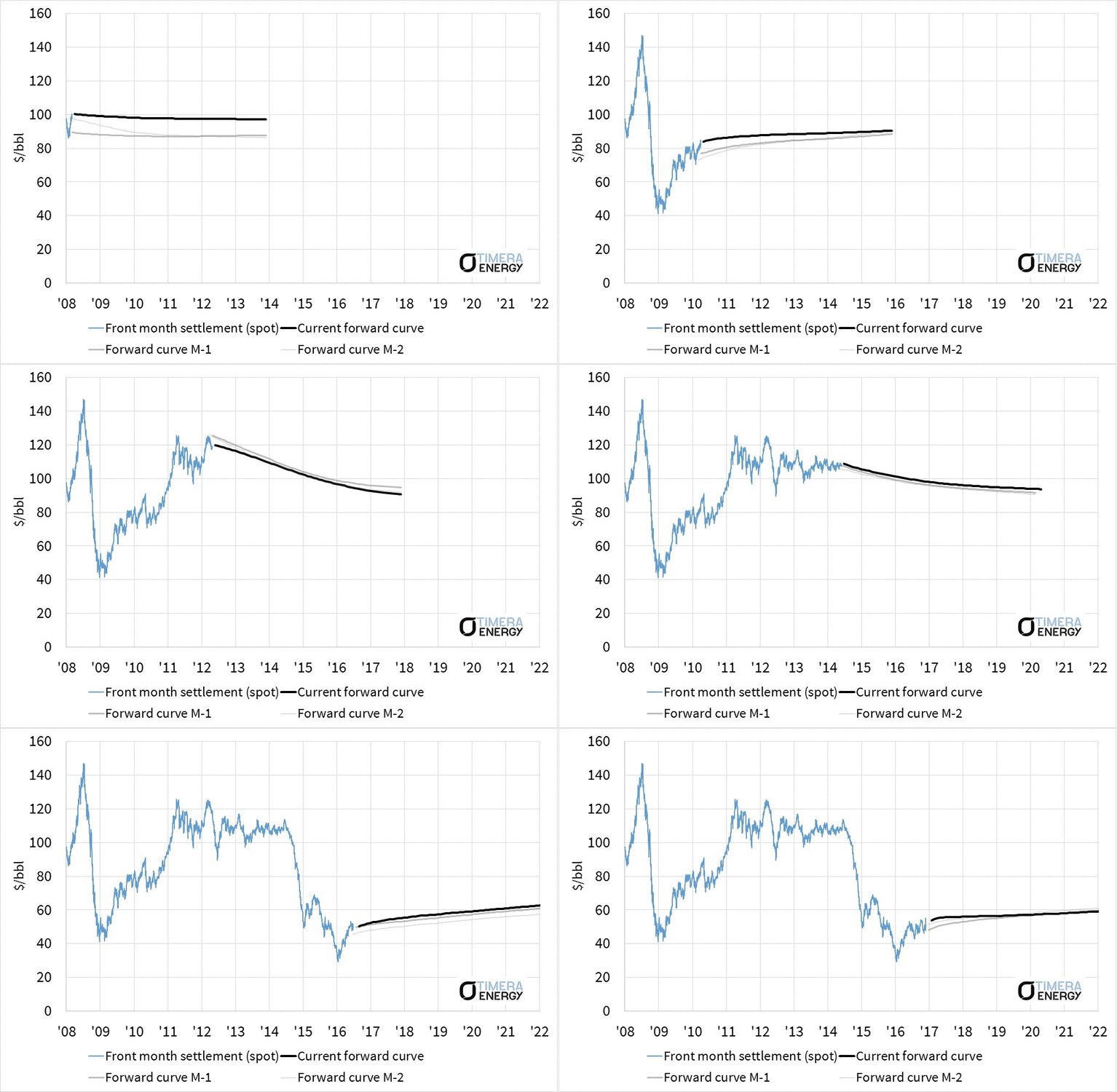
Brent has roughly doubled in price since hitting 27 $/bbl in late Jan, its lowest level of the year.  This can be seen via the animation in Chart 1. Current market pricing for ‘out of the money’ put options suggests the crude market is placing a very low probability of Brent prices returning to those levels.  In other words it is likely that the Q1 low in oil prices was the bottom of this cycle.

That said, crude may run into some headwinds in 2017. The OPEC ‘freeze’ looks shaky at best. And continuing price rises will start to support renewed hedging and investment from US shale producers.  The evolution of global oil demand should also play a key role in determining how oil prices behave next year.

Chart 1: Animation of Brent crude spot price and forward curve

brent-animationdec16

2. European gas market converges with Henry Hub  Status: No surprise in 2016, but risk remains for 2017.

We published an updated analysis of trans-Atlantic spreads two weeks ago.  The price differential between Henry Hub and NBP/TTF has remained in a fairly tight range this year (around the 2 $/mmbtu level), relative to the scale of the absolute price swings at these hubs.

In our view the trans-Atlantic spread can fall significantly further, for example to a 0.5-1.0 $/mmbtu range reflecting the non-sunk variable costs of moving gas from the US to Europe.  The rise in European LNG imports has been relatively modest in 2017.  But pressure is set to build on the trans-Atlantic price spreads as new liquefaction capacity continues to come online in 2017.

3. Major commodity market credit event Status: No surprise in 2016; looks less likely into 2017.

This surprise focused on a commodity price slump-induced credit event.  Back in Q1 this certainly looked plausible.  The market was pricing in substantial premiums to hedge the credit exposure to major commodity traders such as Glencore and Noble.

But as commodity prices have recovered, default risk has diminished.  As long as there is not a renewed plunge in commodity prices in 2017, the probability of a more systemic credit event appears to have receded.  What 2016 has shown though is that the balance sheets of large commodity traders are materially exposed to underlying commodity prices, despite the ‘structural hedge’ logic promoted by their PR departments.

4. Jump in European gas plant competitiveness Status: Surprise is now a reality.

Falling hub prices had already started to support UK gas plant load factors in January.  But a more structural shift in the competitiveness of CCGTs vs coal plants has taken place as the year has developed.  This has been driven by a sharp recovery in coal prices, while gas prices remain weighed down by strong supply.

The gas dominated UK and Italian power markets have led the recovery in load factors.  UK power sector gas burn has increased approximately 50% relative to 2015 levels.  But the recovery has extended across France, Spain, Belgium and the Netherlands.  Even Germany had positive baseload CCGT generation margins over the summer.  As long as coal prices remain elevated, this structural shift looks set to continue into 2017.

5. Continental power prices form a bottom Status: Surprise is now a reality.

The 2016 coal price rally has also played a key role in driving a recovery in Continental power markets. Baseload calendar 2017 German power prices fell to 21 €/MWh in Q1.  At these price levels it was doubtful whether any thermal plants in the German market were profitable.  But as coal prices recovered, German power prices surged 50% by October (although they have since given up some ground as coal prices have softened).

German power prices have a key influence across Continental European power markets, given high levels of interconnection.  Price rises in 2016 in France have been exacerbated by ongoing nuclear outage issues.  The price recovery may pause in 2017 if coal prices continue to retreat and French nuclear plants come back online.  But it is unlikely we see 21 €/MWh again.

What’s in store for 2017?

We leave you with two observations at the end of 2016:

  1. Cyclical bottom: It looks like energy prices have bottomed in 2016, marking the start of a cyclical recovery.
  2. Volatility: The events of 2016 suggest that after several years of more subdued conditions, energy market volatility is back.

Given the popularity of this year’s ‘5 surprises’, we have decided to make it a regular feature of the blog.  So what surprises lie ahead for 2017?  That was a topic of debate over an ale or two at the Timera Christmas party last week.  We’ll be back in early 2017 with further details.  In the meantime, all the best for the festive season.

Article written by David Stokes & Olly Spinks

Volatility has a gas price anchor

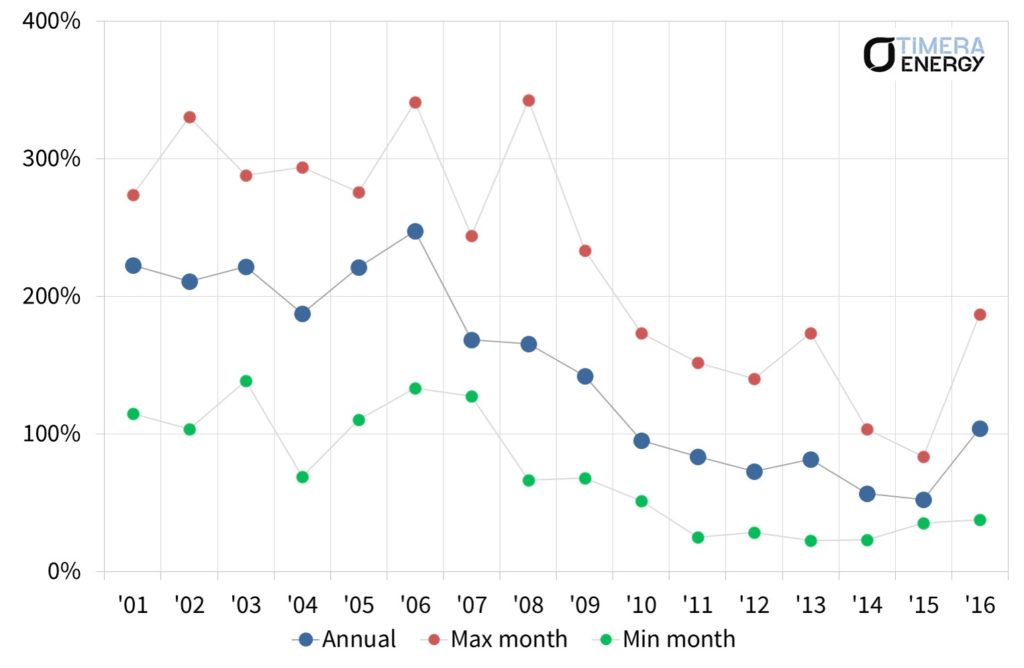
European spot gas price volatility has been in structural decline since the middle of last decade.   Volatility levels above 200% in the UK gas market were common across the first half of the 2000s. But by 2014 volatility levels had sunk to under 50%.  Only in 2016 have the first signs of a more sustained recovery in volatility started to emerge.

Chart 1 shows the evolution of historical UK spot gas price volatility since 2000.  Falling gas price volatility has been caused by the commissioning of new flexible infrastructure, improved interconnection and declining European gas demand, particularly swing demand from the power sector.

Chart 1: NBP Spot Volatility

nbp-vol-chart

Source: Timera Energy

Note: Spot volatility calculation is based on System Average Price (SAP) and excludes extreme price jumps (>3 standard deviations)

But is a 200% volatility level at a 15 p/th NBP price in 2000 directly comparable to 50% volatility at a 60 p/th price in 2014? The answer is not really.  The absolute level of gas prices matters as well as the percentage level of volatility.

In today’s article we explore this rather under-appreciated phenomenon.  We do this using an NBP case study because it provides the longest historical dataset (back to 2000).

Price times volatility

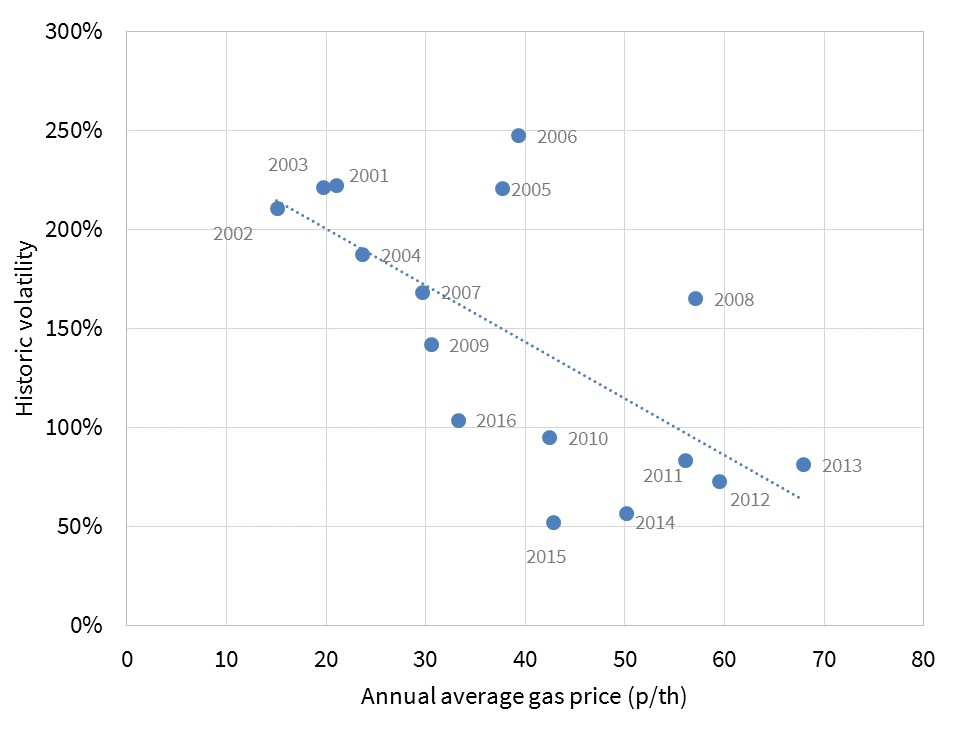
Volatility is a measure of relative price movements.  But it is absolute price movements that actually drive asset returns.  For example with a storage asset it is the absolute difference between injection and withdrawal price that drive cycling margins. Chart 2 shows different combinations of annual average NBP prices and historical volatility levels. The chart illustrates how periods of higher NBP volatility have historically been associated with periods of lower gas prices.

NBP gas prices were relatively low from 2000-05, with relatively high levels of spot volatility.  Conversely, NBP prices have been relatively high across the 2010-15 period, coinciding with lower volatility levels. This is logical given an absolute move in price represents a larger percentage change of a lower gas price than of a higher price.  This means that focusing on a decline in percentage volatility alone, tends to overstate the impact on decline in the value of assets such as gas storage.

Chart 2: NBP gas spot price vs volatility

price-change-vs-vol-scatter

Source: Timera Energy

Normalising for price

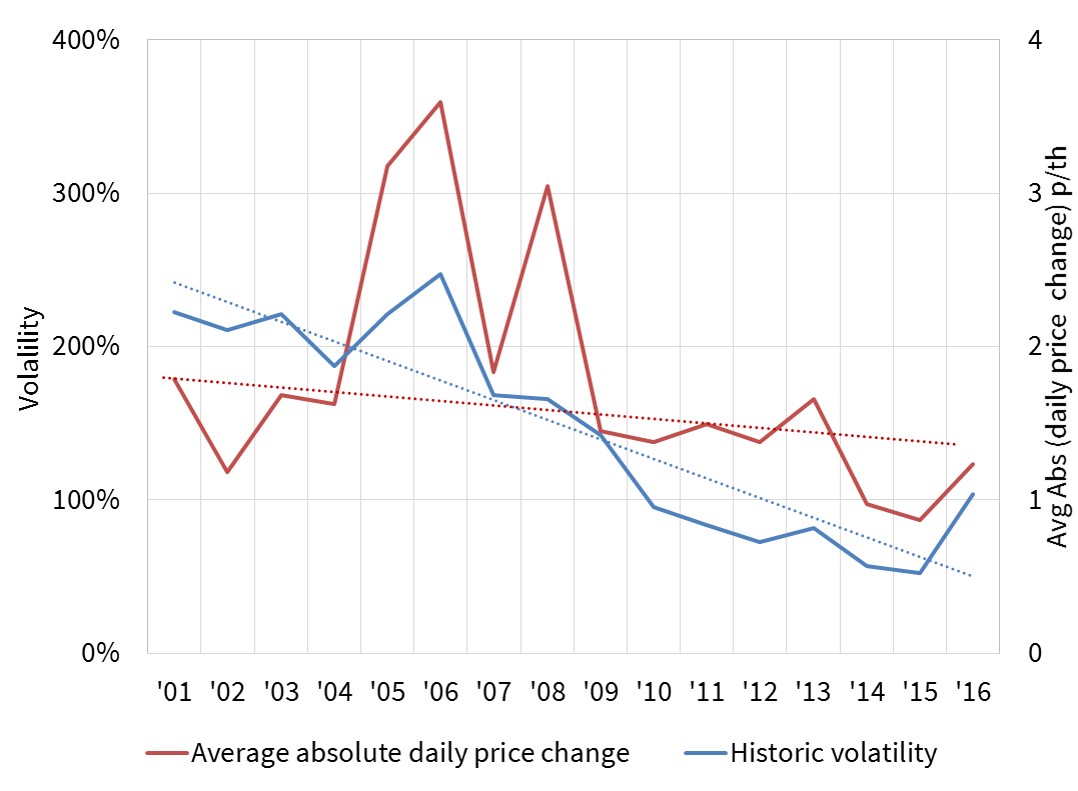
‘Average absolute daily gas price change’, a mouthful of a name, is a metric that can be used to normalise the impact of absolute gas prices.  This is useful because it is reflects the movements in price that actually drive flexible asset value.  Chart 3 shows the relationship between 1. the absolute daily price change metric and 2. the more commonly used percentage volatility metric.  The chart shows that while 1. has declined steadily between 2005-15, the reduction has been less extreme than 2.

Chart 3: NBP price volatility vs absolute price changes

price-change-vs-vol-v2

Source: Timera Energy

So whilst the margins accruing to flexible asset owners has been in decline over the last 12 months.  Looking at it through a pure volatility lens somewhat overstates the decline.

2016 volatility recovery

Both measures of volatility show a clear recovery in 2016.  There is still room for a further rise if December proves to be a cold month.  However the December risks have fallen somewhat this week with Centrica Storage announcing that the UK’s large Rough storage facility would be back on line for withdrawals of existing inventory by Dec 9th at the latest.

As we move into 2017, several key issues remain looming over the North-West European market for gas supply flexibility:

  • What happens to Rough after it limps through the current winter?
  • To what extent will the CCGT load factor recovery remain/continue (supporting gas swing demand)?
  • How will loss of Groningen supply flexibility impact hub prices?
  • How many more existing storage facilities may be mothballed or closed given an inability to cover fixed costs?

These issues are set to play a big role in determining whether the 2016 recovery in volatility is temporary or structural.

Article written by Olly Spinks and David Stokes

Global gas price convergence: state of play

A cold start to the northern winter is breathing some life back into global gas prices. There has been some excitement this month as Asian spot LNG prices have rallied back to around 7.10 $/mmbtu. While this is a steep discount to winter prices over the 2011-14 period, it still represents a sharp rise from prices around 4 $/mmbtu in Q2 this year. But what has this rally meant for the spreads between regional gas prices?

Convergence is alive and well

Some of the Q2 vs Q4 price rise is seasonal in nature (summer vs winter). But the Asian gas price recovery also mirrors a broader underlying recovery in both European and US gas prices. The UK NBP has rallied from below 4 $/mmbtu in Q2 to around 6 $/mmbtu currently. US spot gas prices have doubled from around 1.50 $/mmbtu to 3 $/mmbtu.

Throughout these significant move higher in regional prices, strong global price convergence forces remain. The spread of Asian over European spot prices remains constrained by variable transport cost differentials (at ~1.00-1.50 $/mmbtu level). This is illustrated by the Q4 recovery in Asian spot prices having been capped by the diversion of flexible LNG supply away from Europe.

The spread between the US and European prices is less strongly influenced by the forces of physical cargo arbitrage. Sabine Pass is so far the only active US exporter of LNG, with the majority of first wave export capacity due online in 2018-19. Yet the price spread between the US Henry Hub and UK NBP remains similar to levels of Q2 (albeit at significantly higher absolute price levels). Let’s take a more careful look at this relationship.

Trans-Atlantic price spreads

In Chart 1 we show an updated view of the relationship between European and US gas prices that we published back in April.

Chart 1: Trans-Atlantic price spread benchmarks

atlantic-basin-arbitrage

Source: Timera Energy

The Trans-Atlantic front month spread currently sits over 3 $/mmbtu. This can be contrasted with an average forward spread closer to 2.50 $/mmbtu  along the Henry Hub vs NBP forward curves.

The wider current spot price differential partly relates to more pronounced seasonal price spreads in Europe compared to the US. Seasonal spreads are close to historically low levels in Europe, but the spreads in the US are even lower given an oversupply of seasonal flexibility.

European hub prices have also been supported this year by the sharp rally in coal prices.  This increases the gas price levels at which gas for coal plant switching takes place in the power sector, creating additional gas demand.

Further along the curve, forward hedging of US export contract volumes is helping keep any European vs US price divergence in check. But in our view European hubs are not yet converged with Henry Hub on a variable cost basis as we set out in April. In other words current forward curves still reflect positive arbitrage value above the true non-sunk variable costs of moving LNG between the Gulf Coast and North West Europe.

Lessons learned from 2016 price dynamics

We finish this week with three factors that have been illustrated by the events of 2016:

  1. Price vs spread level: The global price rally since Q2 2016 demonstrates how the current LNG glut is driving lower regional price spreads (i.e. global price convergence), rather than lower absolute price levels. Underneath the rally this year has been a fundamentally driven recovery in Atlantic Basin hub prices that has helped support a move higher in global prices.
  2. European anchor: The influence of Europe as a market of last resort is not dependent on a surge in LNG import flows. LNG import growth this year has been somewhat below expectations, given robust pipeline flows from Russia, North Africa and Norway. But European hubs remain the key price setting influence for Asia (& other importing countries), given the diversion flexibility of European LNG supply.
  3. Henry Hub influence: Growth in the influence of Henry Hub on global prices does not depend on high volumes of physical arbitrage. Relatively few Sabine Pass cargoes have landed in Europe. But despite this European hub prices remain the key spot price benchmark for US export flows. And the hedging of forward US export capacity is strengthening the Henry Hub vs NBP forward curve relationship.

Approximately 30% of the committed volume of new LNG liquefaction capacity to be delivered between 2015-20 will have been commissioned by the end of 2016. The influence of the three factors above should continue to strengthen as the LNG market absorbs the remainder of this new supply.

Article written by Olly Spinks and David Stokes