Impact of the approaching LNG supply wave

Supply growth from new LNG projects has to date been on something of a ‘rolling delay’. Project execution slippage and start-up/commissioning problems have delayed the attainment of designed capacity output levels, particularly in the case of the Australian Gorgon project.

This delay phenomenon was also observed in the last supply wave of the mid to late 2000s. Liquefaction projects represent complex investments with capital costs in the tens of billions of dollars. Oncehttps://timera-dev.positive-dedicated.net/asian-demand-response-to-lower-lng-prices/ started they proceed to completion, so achieving the ramp up of new supply is a matter of time not probability.

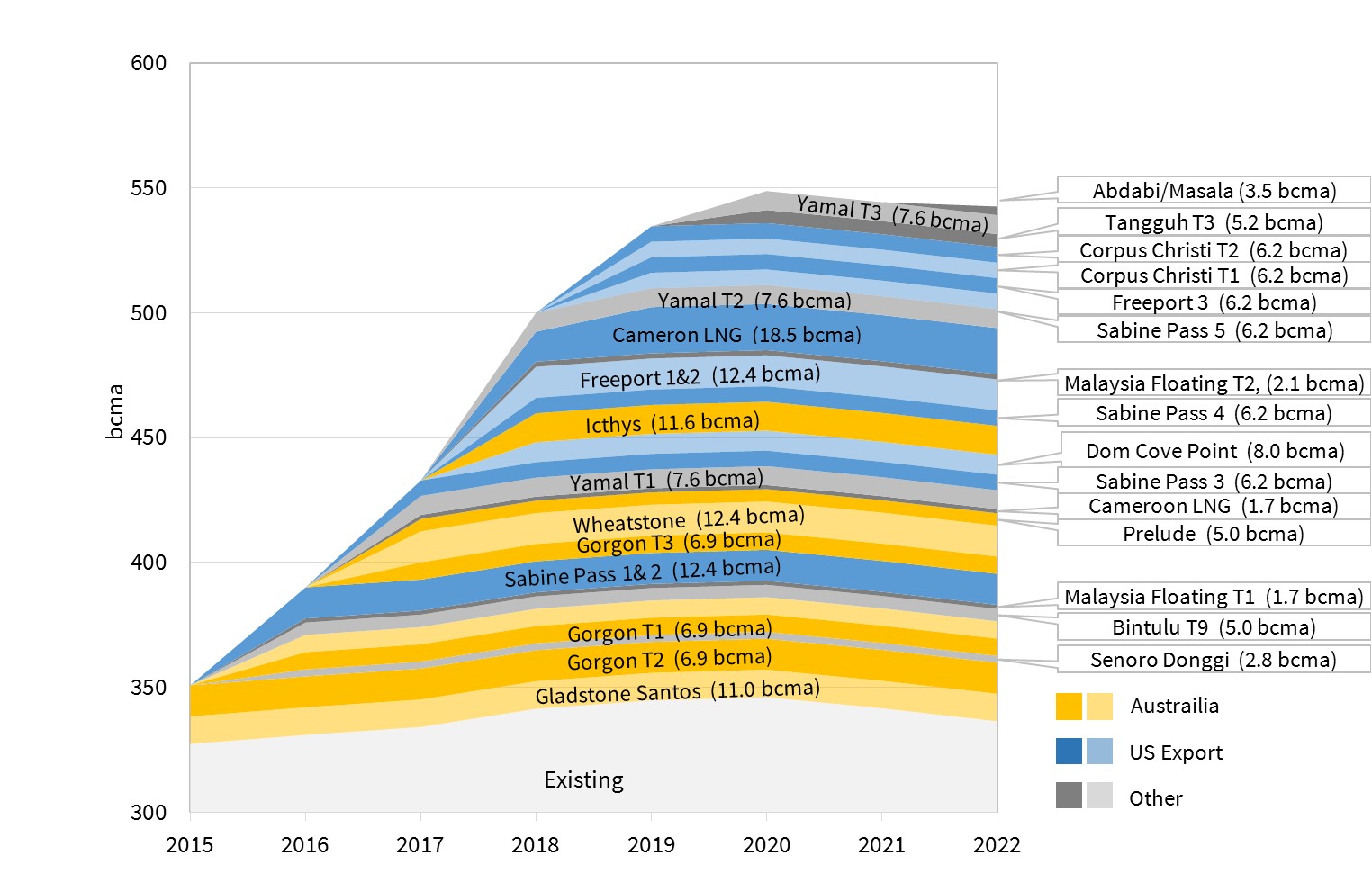
Despite delays there was a 6% increase in global LNG supply in 2016. This was consumed by markets in Asia (up 17 bcma) and the Middle East (up 10 bcma), with South American demand down 5 bcma. This left only 50 bcma of LNG available for Europe in 2016, little changed on 2015 LNG import levels. Chart 1 shows our current estimate of global LNG supply to 2021.

Chart 1 Annual global LNG supply outlook to 2021 (projects post FID)
Source: Timera Energy

The impact this supply surge will have on regional markets will be primarily determined by how much LNG Asia is able to absorb.

All eyes on Asian demand growth

The key uncertainties driving future Asian LNG demand growth include the:

  1. pace and extent of Japan’s nuclear re-start programme
  2. scale of coal to gas switching in China achieved in line with policy
  3. affordability of LNG in India (subsidy regime and infrastructure build being key factors)
  4. aggregate scale of imports in markets such as Pakistan, Bangladesh, Thailand and others where domestic gas production is in decline.

Analysis and judgment can be used to define High and Low future Asian LNG demand scenarios. But it may take a year or two of further evidence before the range of uncertainty can be narrowed. One factor which clouds the picture is the degree of seasonality in Asian LNG demand, in large part driven by the lack of significant gas storage capacity in these markets.

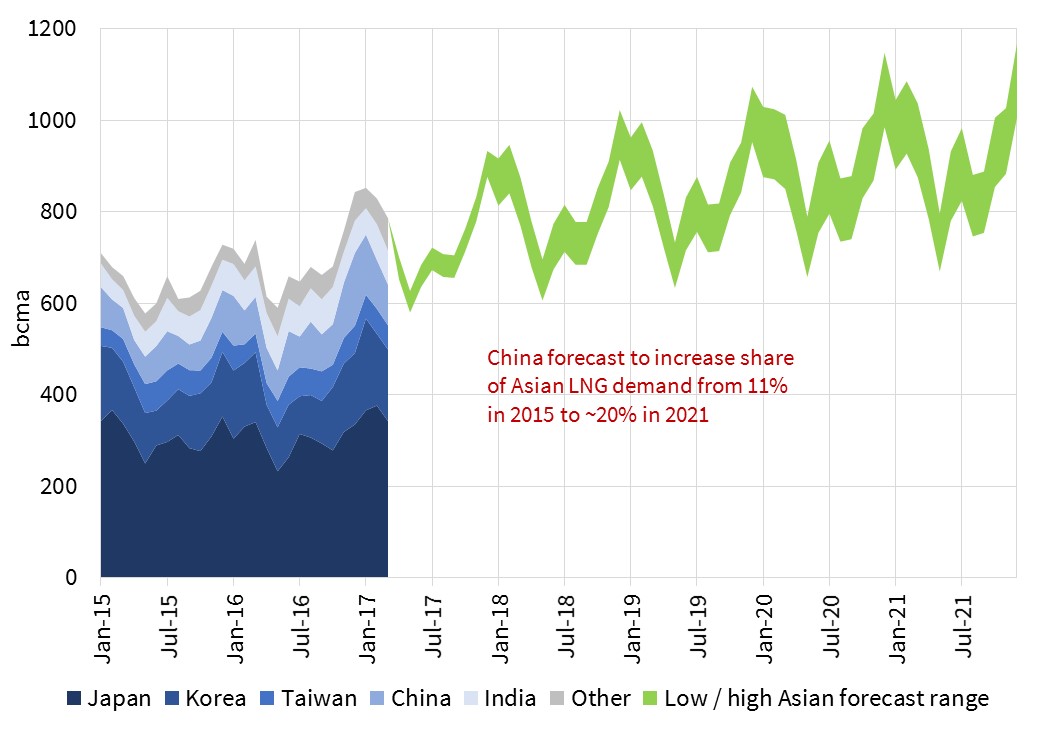
Chart 2 shows monthly Asian LNG import historical data and future trends for both the High and Low scenarios we have defined. Winter 2016/17 saw the impact of an (anticipated) cold Chinese winter and the impact of nuclear capacity offline.

Chart 2 Asian LNG demand (2015 – 2021)
Source: Timera Energy

This resulted in a spike in Asian LNG prices which subsided and re-converged on European hub prices by Spring 2017. Late 2017 Asian import levels should provide a better guide to annual trends (particularly if winter 2017/18 has ‘average’ seasonal temperatures).

Scenario analysis of LNG market balance

Asian demand growth is the most important variable determining the global market gas balance.   So we now look at the implications for the wider market of LNG supply growth under the two Asian LNG demand scenarios shown in Chart 2.

Low Demand scenario

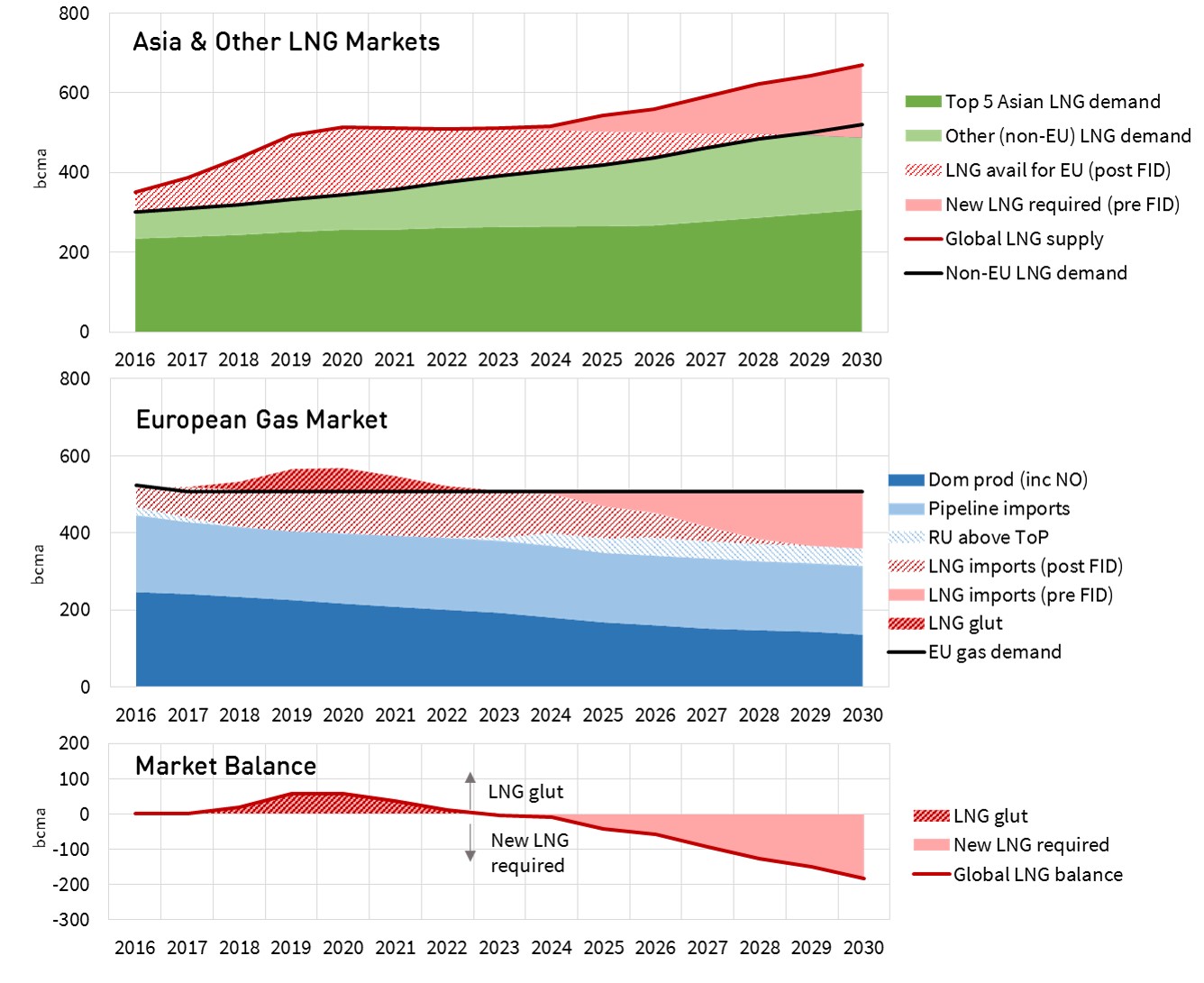
Chart 3 shows, for the Low Asian Demand case, global LNG supply compared with non-European LNG demand. In the upper panel, total non-European LNG demand rises to some 520 bcma by 2030. LNG from post FID projects above this demand line is available for Europe. The graph also shows a notional volume of ‘New LNG’ from future (pre-FID) projects from 2025 onwards.

The middle pane shows the European gas market balance, assuming a flat demand level of some 510 bcma. This is met by:

  1. a) Domestic gas production (including Norway)
  2. b) pipeline imports comprising North Africa, Azerbaijan and Russia (at take or pay levels)
  3. c) Russian pipeline gas volumes above take or pay levels (dashed blue)
  4. d) LNG imports from post-FID projects and
  5. e) LNG imports from future (pre-FID) projects (assumed to be notionally 180 bcma).

The bulge above the demand line is the ‘LNG glut’ in this scenario. This represents surplus LNG that in not absorbed by ‘business as usual’ demand in Europe. The surplus in this scenario reaches levels of around 60 bcma in 2019 and 2020.

Chart 3 – Low Asia Demand Case LNG Balances
Source: Timera Energy

The lower pane of Chart 3 isolates the glut and the new LNG required from new pre-FID projects. Three points arise from this analysis:

  • Although represented as a ‘glut’ – the apparent oversupply of LNG would be cleared by the market through one or more of the following mechanisms: (i) coal to gas switching in the European power sector, (ii) induced additional demand due to lower spot LNG prices in Asia, (iii) potentially a reduction of LNG send-out for coal seam gas – supplied Australian LNG projects and (iv) the curtailment of some US LNG export volumes as the compressed spread between Henry Hub and European hubs (and Asian spot prices) becomes less than the variable costs of the most expensive off-takers.
  • As the glut recedes, Europe requires higher volumes of pipeline gas from Russia, who (in this period) are providing the marginal supply tranche into the system and are therefore in a position of ‘pricing power’.
  • In anticipation of this re-balancing and consequent higher pricing, new LNG projects gain FID around the turn of the decade and begin producing from 2025 onwards. In Chart 3, the (assumed) mid 2020s wave of new supply is such that it still requires Russian volumes above take or pay levels out to 2030. Consequently Russia retains significant pricing power over European hubs, and through LNG arbitrage, Asian LNG spot prices. It is possible that optimism over future LNG demand trends could lead the industry to ‘overinvest’ in the mid-2020s LNG supply wave, in which case we may see a repeat of the ‘glut’ phenomenon ten years from now.

High Demand scenario

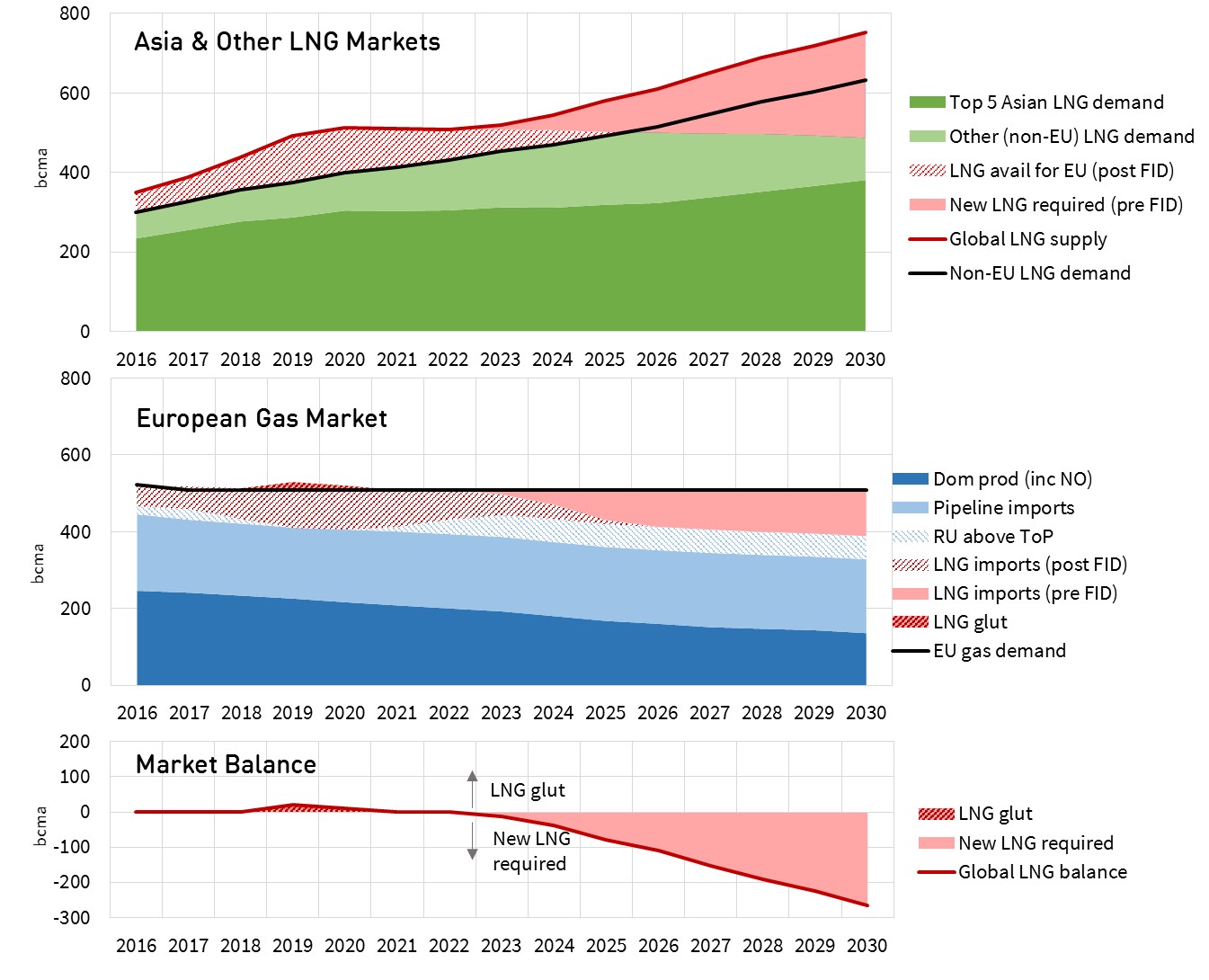
Chart 4 shows the same representations of the global LNG supply and European balance for the High Asian Demand case. In the upper panel, total non-European LNG demand rises to some 635 bcma by 2030. LNG from post FID projects above this demand line is available for Europe. The graph also shows a notional volume of LNG from future (pre-FID) projects from 2024 onwards.

Chart 4 – High Asia Demand Case LNG Balances
Source: Timera Energy

The middle panel shows the European gas market balance, again assuming a flat demand level of some 510 bcma. As the market in this scenario rebalances earlier and more rapidly, the build-up of Russian volumes above take-or-pay is more emphatic. The ‘LNG glut’ in this scenario is muted: 20 bcma in 2019 and 10 bcma in 2020. The assumed mid 2020’s wave of new LNG supply in this scenario is more significant (270 bcma by 2030), while still leaving Russia with a total of some 210 bcma of pipeline exports to the European regional market.

Implications of scenario analysis

This scenario based analysis of the LNG market balance, forcing attention on the global implication of the LNG cycle, throws up some interesting insights.

Currently industry attention is rightly focused on the period of potential ‘glut’ between 2018 and 2021. But the growth of Asian LNG demand, even in the Low Case, requires near term upstream investment in new LNG project FIDs, by the end of this decade at the latest.

The pace and scale of the next LNG supply wave of the mid 2020s could be comparable to that of the 2010s and even exceed it in the High Case. This again underlines the importance of understanding Asian LNG demand trajectories going forward.

The rise of Russian pricing power in the 2020s is also a feature of both scenarios. This may either be directly or implicitly via an oil-products price linkage. Or it may be via a more strategic targeting of hub pricing through physical volume management.

Time is well invested in better understanding Asian demand growth and Russian price/volume strategy as two critical drivers of LNG market evolution into next decade.

Authors: Howard Rogers, David Stokes & Olly Spinks

Further detail on the themes in article can be found in Howard Rogers’ article: The Forthcoming LNG Supply Wave: A Case of ‘Crying Wolf?’.

A wild winter in European power markets

The Winter of 2016/17 will be etched in the annals of European power market history. A string of safety related outages highlighted Europe’s dependence on the 63GW fleet of French nuclear plants as a cornerstone of its capacity mix. The resulting generation shortfall drove extreme price volatility in France and sent shockwaves through interconnected neighbouring markets.

We have already written about the price shocks over the current winter in the UK power market. Today we look at last winter’s events as an interesting case study in the differences between pricing dynamics in the French and German power markets.

Winter dynamics in France

French power prices are structurally higher than in Germany, with a baseload price premium of around 6 €/MWh in 2018. This premium is driven by winter peak prices where France utilises gas-fired generation, both from within its borders and imported from neighbouring markets, to satisfy demand. In contrast summer prices are typically set at the German border, with the variable costs of coal and lignite plants being the predominant driver.

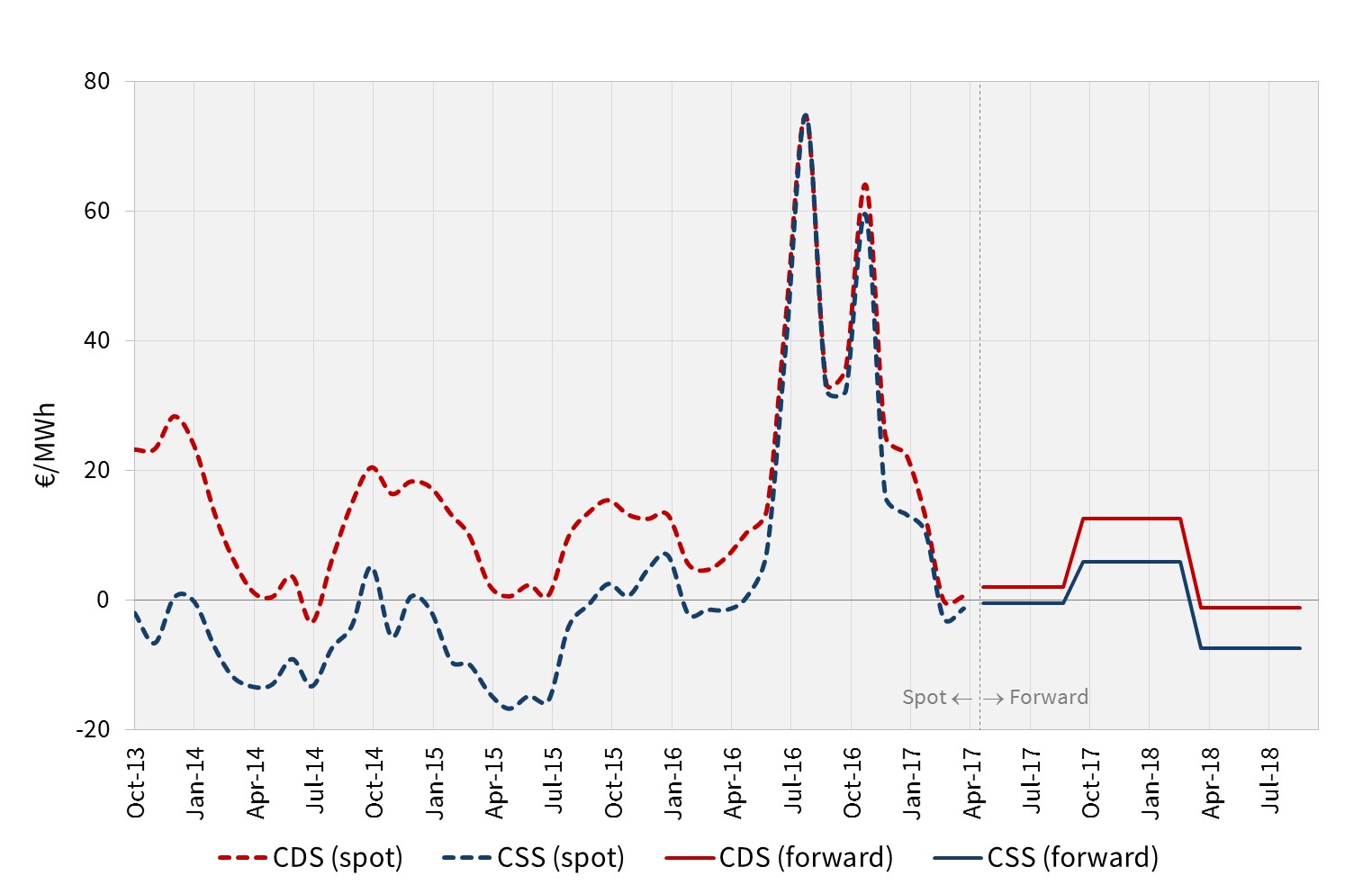
Chart 1 shows the evolution of generation margins for coal and CCGT plants in France since 2013. This puts the price shock of the current winter in perspective.

Chart 1: Evolution of French clean dark and spark spreads

Source: Timera Energy

As the scale of the nuclear outage issue became apparent in Sep 2016, French spot power prices spiked higher. The concept of power prices rising above variable fuel and carbon costs is often referred to as a ‘scarcity premium’. This is a rather loosely used term that often reflects theory more than reality.

Let’s take a look at Q4 power prices in France as an illustration of the actual drivers of elevated prices. The price premiums that can be seen in Q4 reflect the marginal price signal required to:

  1. Incentivise dispatch of more expensive peaking generation within France
  2. Attract sufficient imports (or reduce exports) from neighbouring markets, particularly the UK market which was also very tight

In addition in some periods of more severe tightness, individual generators (or interconnectors) actually gain pricing power. This is a function of a reduced level of competition to provide the marginal MW, amongst the available sources of capacity.

These situations can lead to quite extreme price spikes with the market pricing up towards expensive balancing alternatives or ultimately towards the value of lost load. Periods of significant pricing power tend to be short lived until more normal levels of supply competition are restored.

As a result of surging Q4 power prices in France, both clean spark and clean dark spreads jumped and remained at elevated levels across Q4. But as 2016 drew to a close and nuclear capacity returned, spot prices & spreads reverted to more normal conditions. French power prices have continued to weaken this year, helped by unusually warm spring weather, with France experiencing the warmest March weather for more than one hundred years.

Forward French spark and dark spreads are hovering around zero across the summer. But baseload prices for next winter currently sit at around a 9 €/MWh premium over Summer 17. Behind this premium is the requirement for gas-fired plants to run across the winter peaks, reflected in forward peakload spark spreads which are currently around 17 €/MWh.

Winter dynamics in Germany

Price setting in the German power market is dominated by coal-fired generation capacity. Over the last 3 years German power prices have declined, helped by robust growth in low variable cost wind and solar output. Over the same period gas prices have declined relative to coal prices.

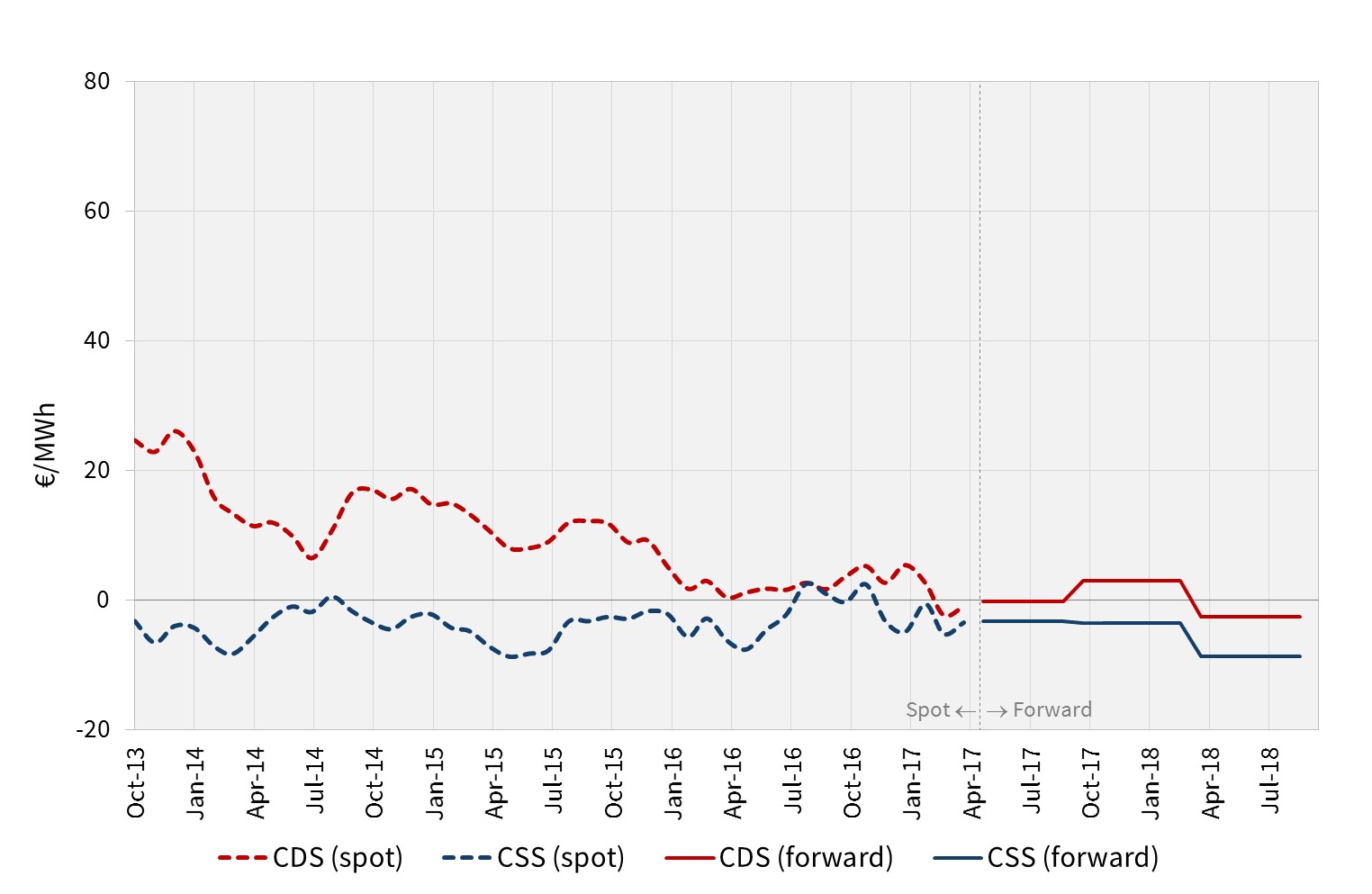
These factors have combined to drive a convergence in the generation margins of coal and gas fired plants in Germany. This can be seen in Chart 2.

Chart 2: Evolution of German clean dark and spark spreads

Source: Timera Energy

German CCGT margins have been in negative territory for most of the last 5 years as generation output is dominated by lower variable cost coal capacity. But as the French market tightened in Sep 2016, German CCGTs were required to help make up shortfall. Chart 2 shows German spot spark spreads temporarily recovering into positive territory in 2016.

However the price impact of French nuclear outages was much more subdued in Germany. German power prices rose as the French market imported more German power. But at the point that available interconnector capacity became constrained, pricing across the two markets separated, with German prices and generation margins remaining at a substantial discount to France.

Forward spark and dark spreads remain very lean. This is a function of the continuing role out of low variable cost renewables and a current overhang of thermal capacity. Higher spot price returns are likely to precede a structural recovery in forward spreads.

What does Winter 16/17 tell us about the future

Last winter’s events illustrate the dependence of European power markets on the French nuclear fleet. If nuclear safety issues resurface, higher prices and volatility will return. The winter price shock also seems to undermine current French election pledges for a major reduction in nuclear output by 2025. Political debate has conveniently sidestepped the resulting impact of higher prices on French industry and consumers.

The events of winter 2016 were also an indication of how conditions in North West European power markets may change into the 2020s as capacity retires. Germany alone is set to lose a huge volume of capacity by the early 2020s given regulatory and economic retirements. The German Association of Energy and Water Industries (BDEW) estimates 26GW of nuclear and thermal plant closures by 2022.

This highlights the challenge North West European power markets face over the next five years. The rollout of renewables continues at an impressive pace, but this intermittent capacity requires flexible backup. Market price signals currently do not support existing flexible capacity, let alone development of new capacity. This suggests higher prices and volatility are going to become a more regular feature of European power markets.

Article written by David Stokes & Olly Spinks


The UK gas market without Rough

Centrica Storage Limited announced on the 12th April that there will be no injections at the Rough storage facility until May 2018 at the earliest. This leaves Rough effectively crippled for at least a year.

Rough could return to operation in some constrained form in 2018, but there appears to be a growing threat of permanent closure. There are substantial technical challenges facing the ageing facility relating to well integrity. Even if these can be partially overcome, it is unlikely that current seasonal price spread levels would justify the capex investment required. Closure also allows Centrica to monetise the substantial volume of cushion gas in the reservoirs by flowing this into the grid .

In an article last year we looked at the threat of reduced flexibility from Rough. In today’s article we consider the impact on the UK gas market of the closure of Rough.

Space vs deliverability

The UK market is less dependent on Rough flexibility than it was a decade ago. This is because of major investments in connectivity with the Norwegian Continental Shelf (Langeled, Vesterled), interconnection with the Continent (BBL) and incremental regas capacity (at Dragon, South Hook & Grain).

This new supply infrastructure means that the UK has ample import capacity to meet annual demand and to support seasonal flexibility. The gas market’s vulnerability is to shorter term constraints in supply deliverability to meet gas demand on any given day.

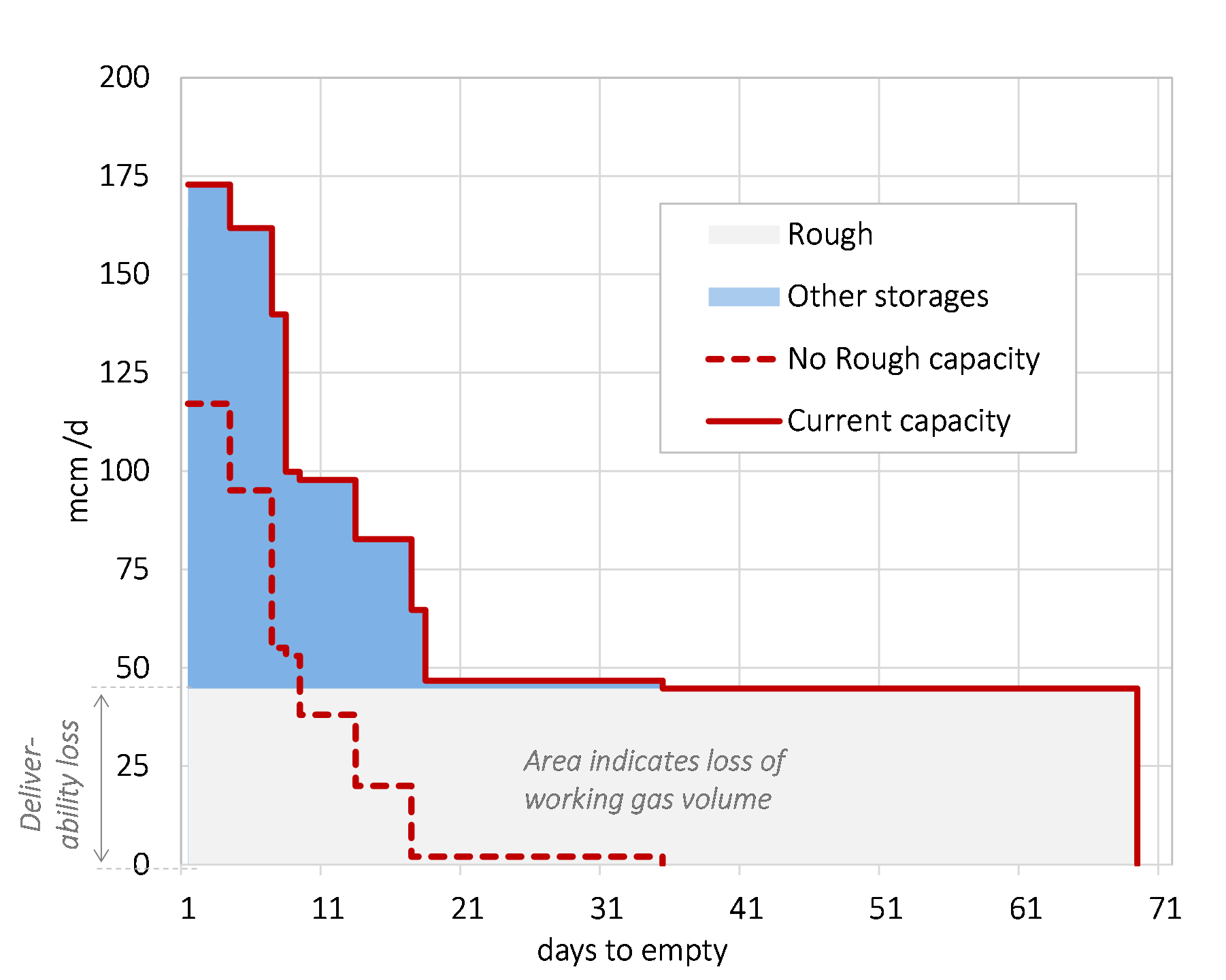
Rough makes up an impressive 70% of the UK’s storage working gas volume. This can be contrasted with Rough’s contribution to the UK’s daily deliverability, at around 25%. And it is the deliverability that the UK market will miss most. The impact of Rough closure on deliverability is illustrated in Chart 1.

Chart 1: UK gas storage deliverability profile (assuming all capacity starts full)

Source: Timera Energy

The solid red line in the daily deliverability profile of aggregate UK storage capacity including Rough, assuming continuous withdrawal from full inventory. Deliverability quickly falls past the first 1-2 weeks as fast cycle facilities exhaust their working gas volume, with Rough providing the only significant delivery capability beyond a two week horizon. The impact of losing Rough is illustrated by the dotted red line.

Impact on pricing

The chart illustrates the two main impacts of Rough closure:

  1. A 25% fall in deliverability reduces the ability of the UK market to respond to short term swings in the supply/demand balance (e.g. import infrastructure outages, cold snaps), over a 1 -2 week horizon.
  2. A 70% reduction in working gas volume reduces the ability of the UK to cope with a more prolonged supply shock over the 2-6 week horizon period it can take for the LNG supply chain to respond a, e.g. as the UK faced in Mar/Apr 2013.

The loss of deliverability should boost spot price volatility as it reduces the buffer of supply flexibility available to respond to swings in daily demand. There is already evidence of volatility recovery in 2016, supported by the partial Rough outage. The loss of working gas volume is likely to mean that supply shocks (e.g. major infrastructure outages) have a sharper and more prolonged price impact.

The other interesting pricing dynamic is the spread between UK and Continental hub prices. The Rough injection season has historically acted to soak up UKCS summer production, supporting NBP prices. The loss of Rough may see a reduction in NBP prices relative to TTF in summer months and a fall in net UK to Continental export flows. This logic applies in reverse in winter when the UK will need to attract more gas from the Continent (or Norway) to replace Rough withdrawals.

Impact on asset values

The loss of Rough should increase the role that imports play in servicing daily demand swings. This is good news for the value of interconnector and regas terminal capacity. Value is likely to be impacted in two ways:

  1. Greater capacity utilisation as flows increase in the absence of the ability to store gas within the UK market
  2. A higher ‘insurance value’ associated with import capacity, given the reduction in deliverability means imports will play a more important role in servicing daily demand swings or providing supply shock response.

Rough closure is undoubtedly good news for UK storage assets, particularly fast cycle assets which are focused on providing deliverability. It means a lower volume of flexibility to respond to short term price volatility, as remaining slower cycling storage assets become more focused in backfilling the loss of Rough seasonal flexibility.

There is already a knock on impact being seen with pricing and demand for storage & transport capacity prices. This reflects anticipation of increasing returns on flexible capacity as a result of the Rough issues, as well as greater competition to acquire flexible capacity from other sources.

We recently set out evidence of a 2016 rise in spot gas price volatility after many years of decline. This is consistent with increasing UK import dependency, ageing flexible supply infrastructure and increasing gas swing demand from the power sector. The loss of Rough next winter, and probably permanently, is a big factor pointing towards a continuation of the volatility recovery.

Article written by David Stokes & Olly Spinks


Market access contracts: 5 success factors

Owners of gas and power assets in Europe are increasingly contracting 3rd parties to provide market access services. This is a function of changing asset ownership structures. Utilities and producers are selling assets to investment funds which lack the in-house trading & commercial capabilities required to hedge and optimise assets.

Last month we wrote an article on the types of market access services being provided by 3rd parties. In today’s article we set out 5 key success factors in structuring and negotiating market access contracts, based on our experience from working with asset owners. We focus on ‘incentivised exposure management’ contracts, the most common and most complex deals to get right.

As covered in our previous article, incentivised exposure management contracts involve the transfer of asset exposures from owner to 3rd party provider, along with incentives to monetise asset value within a defined set of constraints. If a contract is structured well, it allows the asset owner to retain a degree of control over managing asset risk/return. But it also allows for the 3rd party provider to add value through its trading expertise.

In order to illustrate the practical challenges and pitfalls for each of the 5 success factors, we use a case study. This involves a CCGT owner with no in-house trading capability but that wants to be actively involved in determining the forward hedging profile of the asset. This means negotiating a services contract with a 3rd party trading desk that covers market access, plant nomination & dispatch and hedging & optimisation over the prompt horizon (e.g. from the day-ahead stage to delivery).

Table 1 summarises the 5 success factors that we explore in more detail below. These are not in any specific order of priority.

Success factor Summary description Pitfalls
1. Governance Defining and enforcing guidelines for the management of asset value and risk. Asset risk profile not aligned to owner risk appetite. Excessive rigidity constraining trader value creation.
2. Fee structure Fair capture of a fixed fee covering overheads and variable fees covering trade execution costs. Excess charging for incremental overheads. Excess variable fees incurred due to ‘volume churn’.
3. Incentivisation Defining a clean mechanism and value baseline from which trading desk ‘value added’ can be rewarded. Alignment of party interests across value, risk & asset performance. Transparency & oversight where this isn’t possible.
4. Exposure transfer Clean definition of which party has responsibility for managing asset exposures at any point in time. Prompt exposure handover. Information asymmetry in defining value base line. Transfer of ‘monkey value’.
5. Asset representation Capturing actual physical asset characteristics in a way that can practically be written in the contract. ‘Grey areas’ of exposure and value responsibility for each party from over-simplified asset representation.

Source: Timera Energy 

1. Governance:

The ability to define an appropriate risk/return boundary is a primary concern for asset owners, underpinned by the owner’s risk appetite, equity return targets and debt service cashflow requirements. This is achieved via ensuring an appropriate governance structure for a 3rd party agreement.

Defining a robust governance structure is about imposing an appropriate set of guidelines, within which the 3rd party can maximise asset value creation. This is typically implemented in the market access contract via a defined set of controls that provide the owner with appropriate transparency and oversight as to how asset value is being managed by the 3rd party. For example hedging profile guidelines, asset risk metrics and an associated reporting framework.

Challenges & pitfalls

Let’s consider challenges in the context of our CCGT case study. Governance of power plant risk/return is typically based around forward hedging profile guidelines (e.g. min/max levels of hedge cover by time horizon). Associated risk metrics can be used to manage the exposure of unhedged volumes. This structure can be reflected in the market access agreement, along with a means of regular engagement between the 3rd party and owner to determine hedging decisions within the defined guidelines (e.g. via a regular hedging meeting).

A good 3rd party trading desk will create value within the defined CCGT hedging guidelines, e.g. via timing of trading decisions and hedging of spark spread optionality. But providing the trading desk with too much freedom around hedging decisions may encourage excessive risk taking, compromising the owner’s risk appetite. Alternatively, constraints that are too rigid may inhibit the ability of the 3rd party to create value (e.g. specific hedge execution orders vs target hedge ranges).

2. Fee structure

Market access contracts typically consist of a fee structure with fixed and variable components. The fixed fee element aims to reflect the overheads of the 3rd party in providing the contracted services (e.g. trading systems, analytics). The variable fees are intended to reflect the ‘per transaction’ costs of executing trades in the market (e.g. bid/offer spread, credit).

Benchmarking these fixed and variable fee elements is an important part of market access contract due diligence. Fixed fees should reflect the incremental costs of supporting the services provided (reflecting the economies of scale of an established trading desk). Variable costs should be comparable to market bid/offer spreads and credit costs.

Challenges & pitfalls

Ensuring a fair level of fixed and variable fees is becoming easier as competition to provide market access services increases fee transparency. It is easy to focus on the headline fee numbers, but there are other more subtle challenges.

For example the volume of trades undertaken by the 3rd party can have a big impact on asset value accruing to the owner. Higher trading volumes can be associated with greater value creation e.g. from re-optimising forward hedges. But a ‘per transaction’ fee structure can also incentivise the 3rd party to ‘churn’ trades in order to generate variable fee income. This needs to be appropriately captured via incentivisation mechanisms (e.g. netting variable costs) and transparency/guidelines on trading value capture (e.g. ensuring minimum value capture when re-optimising hedges).

3. Incentivisation:

A fundamental challenge of market access agreements is that the interests of the owner and 3rd party provider are not always aligned. The owner is focused on maintaining asset performance and meeting asset risk/return targets, the 3rd party on maximising value generated from the market access agreement (and potentially the value of other assets in its own portfolio). It is important to confront and address this tension when structuring the contract, rather than glossing over it.

Incentivisation structures are a key mechanism that asset owners can use to better align the interests of the contract parties. This is usually focused on defining a clean benchmark for value added by the 3rd party, which is then shared between the two parties. We focus specifically in success factor 4. below on issues in defining this value benchmark.

Challenges & pitfalls

Our CCGT case study can be used to illustrate examples of incentive alignment issues:

  1. Asset performance: The 3rd party trading desk may increase value capture via more aggressive utilisation of CCGT flexibility. But the owner bears an associated cost in the form of higher outage rates and maintenance charges.
  2. Risk/return profile: Downside risk for the 3rd party is typically limited by a fixed contract fee, whereas upside from value incentivisation is often uncapped (e.g. via profit sharing). This typically means the 3rd party is incentivised to take greater risk than the owner who bears the true risk/return profile of the underlying asset.
  3. Value incentivisation: The ability of the 3rd party to add value via trading, hedging and optimisation decisions differs over different time horizons. This can be reflected via a ‘tiered’ incentivisation structure that e.g. reflects a greater potential for the 3rd party to add value in the within-day period close to delivery. But a tiered incentivisation structure can cause further issues if it allows the 3rd party to push asset value into time buckets where it receives a higher profit share.

It is also important to consider how incentivisation mechanisms may change with market conditions (e.g. an increasing portion of plant value being achieved in the within-day market). Careful structuring of market access contracts can either better align party incentives, or ensure appropriate transparency and oversight where this is not possible.

4. Exposure transfer & valuation

Market access contracts by nature mean that two parties have responsibility for the management of asset value. This creates a structural challenge: there must be a clean definition as to who has responsibility for asset exposures at any point in time. The contract should set this out in black and white. It is not an area that benefits from grey.

This challenge typically focuses on the handover of asset exposures from the plant owner to the trading desk in the prompt horizon ahead of delivery. The handover of an owner mandated forward hedging profile can be achieved relatively easily e.g. using traded contract buckets. But the owner typically hands over asset exposures in their entirety close to delivery to allow the 3rd party to fully optimise flexibility in the traded markets (e.g. at the day-ahead stage).

A clean mechanism for transfer of asset exposures between the parties also typically underpins the contract incentivisation structure. This is because the transferred exposures are ‘marked to market’ at the point of handover to form a value baseline against which 3rd party ‘value added’ performance is measured. This baseline is sometimes referred to as ‘monkey value’, the value a monkey or robot could generate before any trader value added.

Challenges & pitfalls

Two key areas often undermine the exposure transfer structure in market access contracts. Failure to ensure:

  1. Transfer and valuation of exposures against clean executable market price benchmarks
  2. Fair representation and valuation of asset flexibility (or extrinsic value).

With a CCGT this means choosing a point in time ahead of delivery (e.g. at the day-ahead stage) when there is a clean price benchmark against which plant optionality can be optimised and transferred. From this point the 3rd party then assumes full control for creating further value in the within-day, balancing and ancillary services markets.

It is also common for the incentivisation link to result in ‘value bleed’ from the asset owner to the 3rd party, due to the exposures being undervalued at point of transfer between parties. The CCGT owner is confronted here by an important information asymmetry. The 3rd party will typically have a strong commercial and analytical capability to allow it to fully value plant flexibility. Whereas the owner may fall back on a simpler valuation mechanism to determine the value baseline for incentivisation in the contract. Confronting this issue to define a fair value benchmark is key to avoiding structural value bleed via giving away ‘monkey value’.

5. Asset representation

The final success factor we cover is how to represent a complex physical asset in a contract. This means striking the right balance between accuracy and practicality.

Getting asset representation right is important because it forms the foundation from which each of the two parties responsibilities are defined. It also underpins the management and transfer of asset exposures and the incentivisation of 3rd party performance.

In the interests of contract simplicity it is tempting to represent the asset in the market access contract at a simplified level. But this can result in ‘grey areas’ of contract interpretation which typically favour the 3rd party by opening opportunities to optimise value in its favour.

Challenges & pitfalls

The CCGT case study provides examples of some factors to consider:

  • Considering the plant at an aggregate level rather than breaking it down into individual units (or even sub-units e.g. to cover excess output from duct-firing)
  • Fully representing market granularity as opposed to aggregating exposures into non-traded buckets
  • Adequate capture of plant physical characteristics (e.g. ramp rates, start cost structure)
  • Robust treatment of outage risk, defining owner responsibility for asset performance but 3rd party responsibility for unwind of hedges (within realistic liquidity costs)

A key principle that helps with the clean structuring of market access contracts is ensuring that asset representation allows exposures to be allocated and priced by the party best placed to manage them This can be assisted by a review clause in the contract, to recalibrate the asset representation periodically.

Getting contracts right

Traders are experts at optimising within a given set of constraints to create value. This expertise can be harnessed via a well-structured market access contract to significantly increase an asset owner’s returns. In areas where trading expertise can really add value it can often make sense to strongly incentivise this (e.g. 25-50% profit share).

But it is a double edged sword. Trading desks will also optimise any loopholes in market access contracts, usually to the detriment of the asset owner who is at a clear disadvantage in identifying issues. In many cases loopholes are the result of weaknesses in the way the contract is structured before it is signed. In other words the loopholes are baked into the contractual relationship, often with the explicit knowledge and intent of the trading desk.

In some areas there is nothing an owner can do. There is a balance between structural complexity and practicality. But recognising potential loopholes and structuring incentivisation mechanisms accordingly is an important way of preventing value bleed.

As market access contracts continue to evolve, standardisation of terms should work in an asset owner’s favour. But that may take several years. In the meantime considering the 5 success factors above should help with a number of potential challenges and pitfalls.

Article written by David Stokes, Olly Spinks and Nick Perry

How higher coal prices support gas hub prices

European gas demand fell by approximately 20% over the first five years of this decade.  But 2016 marked a turning point, with demand (including Turkey) rising by 27 bcma (or 5.4%).  Of this increase approximately 75% (or 20 bcma) was driven by higher power sector demand.

The switching of coal plants for CCGTs was the key driver behind the demand increase. More than 40% of incremental gas demand in 2016 came from the UK (where the gap between coal and gas marginal costs is narrower than the continent due to the carbon price floor).

What is perhaps surprising is that this increase in power sector gas demand was not the result of falling gas prices.  Spot prices at European hubs rose significantly across the second half of 2016. So how is this consistent with a shift to gas-fired power plants?

Linkage between coal and gas prices

It is the relative level of gas vs coal prices rather than absolute gas price levels that drives gas for coal switching in the power sector. Gas prices rose as 2016 progressed, but the proportional rise in coal prices was greater.

Chart 1 shows power sector demand curves for two different levels of coal price:

  1. 45 $/tonne: the Calendar 2016 forward price at the end of 2015
  2. 60 $/tonne: the approximate average outturn spot price across 2016

Chart 1 2016 European power sector gas demand curves

Source: Timera Energy

The two blue lines in the chart can be thought of as an aggregate gas demand curves for the European power sector.  In other words the lines show aggregate gas burn (bcma) as a function of gas price, for a given coal price level (45 and 60 $/t). We generate these demand curves by running multiple combinations of gas and coal prices through the pan-European power market model.

The chart shows a move to the right in the European aggregate demand curve as a result of the 2016 rise in coal prices.  As a result of this demand curve shift:

  1. Outturn gas hub prices in 2016 rose approximately 0.25 $/mmbtu relative to the Calendar 2016 forward price level at the end of 2015
  2. Power sector gas demand increased by 20 bcma from 2015 levels

The chart also provides an indication of what would have happened if coal prices had remained at 45 $/tonne in 2016.  Under this weaker coal price scenario, European gas hub prices would have had to have fallen by over 1.0 $/mmbtu to have allowed the European power sector to generate an equivalent 20 bcma increase in demand.  In other words the fact that coal prices roughly doubled between Q1 and Q4 2016 was a big factor supporting hub prices.

As the LNG glut grows, power sector switching will be a key mechanism allowing surplus LNG volumes to be absorbed by European hubs.   It is worth watching coal prices and power sector demand closely in 2017 as a driver of both European hub prices and spot LNG prices.

Article written by David Stokes & Olly Spinks

Evolving trends in LNG contracting

Several structural trends are combining to change the way that LNG is being contracted.  The traditional LNG contracting model was built on long term, destination specific, oil-indexed contracts between producers and suppliers.  But a surplus of gas from the current supply glut is boosting the negotiation power of LNG buyers, who are seeking greater volume and pricing flexibility.

The LNG contracting market is maturing with a growing role of intermediary players and emerging market buyers.  In parallel, there is a growing importance of hub market price signals as a benchmark from which to contract LNG.  These trends point towards the evolution of a new contracting model to support the next wave of global LNG supply.

In this week’s article we look at 4 key trends that are driving an evolution of LNG contracting behaviour.

1. Reduction in average contract length

The financing of new LNG supply projects has traditionally been underpinned by long term, oil-indexed contracts (the most recent exampe of which is the Australian export contracts signed in the first half of this decade).

But this model is becoming increasingly challenging for LNG buyers who are confronted by a growing penetration of hub pricing.  This is the same issue facing buyers of long term pipeline contracts. Mismatches between long term contract prices and hub prices are increasingly difficult to pass through to customers or to absorb into supplier portfolios.

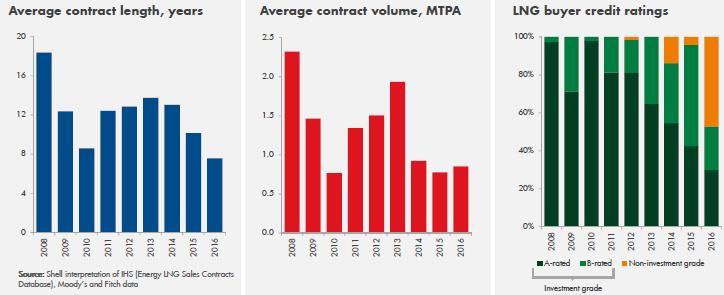
The supply glut has taken the pressure off LNG buyers to secure new supply via traditional long term contracts.  Buyers in Asia, Europe and Latin America are instead pushing for shorter and more flexible gas linked contracts.  This has driven a reduction in average contract length since the glut took hold in 2014.  This can be seen in the left hand panel of Chart 1, taken from Shell’s 2017 LNG Outlook.

Chart 1: Empirical evidence of LNG contracting trends

Source: Shell

While the shift in contract negotiation power towards LNG buyers is an important factor behind reduced contract length, this trend is also supported by the other trends we set out below.

 2. Growing importance of portfolio players

The role of LNG ‘intermediaries’ has grown rapidly over the last five years. These are primarily commodity trading companies (e.g. Vitol, Gunvor, Trafigura) who are focused on LNG midstream flexibility, with portfolios built around shorter term contract positions and access to shipping, regas and storage capacity. The growing role of these intermediaries is driving an important erosion of the direct contracting of LNG between producers and end suppliers.

Supply glut conditions are helping intermediaries gain traction in the LNG contracting market. Oversupply increases the availability of cargoes to trade, as well as strengthening the role of hub price signals against which portfolios can be managed. Access to flexibility is key to the business and contracting models of intermediary players.  And that flexibility is being priced, hedged and optimised based on liquid hub price signals.

An example of the growing role of intermediaries was the large Egyptian tender in Nov 2016 (96 cargoes).  The tender was dominated by intermediary players, with Glencore winning the largest volume, Trafigura also securing cargoes and Vitol and Gunvor providing competition.

3. Declining buyer credit quality

The right hand panel of Chart 1 shows a pronounced decline in the credit ratings of LNG buyers.  This is a function of the evolving nature of LNG buyers.  Traditional A-rated buyers (e.g. Japan, Korea) are currently relatively well contracted from long term deals signed pre-glut. In contrast, stronger demand growth from emerging buyers (e.g. India, Egypt, Pakistan) is acting to reduce credit quality.

Higher buyer credit risk is also a factor contributing to shorter contract lengths.  Credit quality precludes a number of emerging buyers from contracting on a longer term basis.  This has for example been an issue that has led Argentina to buy LNG via shorter term tenders.

Credit risk is further supporting the role of intermediaries in the LNG market.  Commodity trading companies can often price & manage credit risk on a more competitive basis than producers, increasing their competitiveness in supplying LNG buyers.  Some intermediaries also provide a ‘sleeving’ service for sale of individual cargoes, to insulate producers from the credit risk of emerging buyers.

4. Increasing penetration of hub prices

Hub prices drive pricing of end user gas sales in Europe and North America.  As a result, there is a strong buyer preference for hub indexed LNG contracts.

So far there is an absence of liquid regional hubs as a reference in Asia and Latin America, although Singapore is making progress.  But in a world of converged global gas prices, there is growing confidence in Atlantic basin spot price signals (NBP, TTF, Henry Hub) as a global benchmark for LNG contracting.

Even when LNG is contracted on an oil-indexed basis, the contract pricing terms are being set off liquid hub price benchmarks.  Recent Middle Eastern tenders (e.g. Eygpt, Jordan) have been conducted on a Brent indexed basis, but with the level of oil-indexation effectively set off NBP & TTF spot price levels, given it is these hub prices driving the value of incremental LNG supply.

The importance of spot prices in the LNG market is penetrating much deeper than the exchange of contracts.  Volumes of LNG cargoes transacted on a spot basis are still relatively low.  But spot price signals are the key driver of LNG flow and optimisation decisions for large portfolio players, e.g. internal portfolio decisions such as cargo diversions and cargo swaps.

These portfolio optimisation activities impact a much larger volume of LNG than the external trading of cargoes.  The importance of spot price signals is set to grow further as 89 bcma [65 mtpa] of highly flexible new US export supply is due online by 2021, most in 2018/19.

LNG buyers gaining influence over contract terms

In the tight post Fukushima LNG market, large buyers were pursuing individual strategies in competing to contract available incremental supply from producers in the US and Australia.  But the supply glut has led to a more considered and collabrative approach.

Korean Kogas, Japanese JERA and China National Offshore Oil Corp (CNOOC) signed a memorandum of understanding this month to cooperate in the joint procurement of LNG.  While this collaboration is no doubt aimed at sourcing lower priced LNG, Asian buyers are also pushing for greater flexibility in contract pricing and volume terms.

Market conditions favour the buyers.  Our analysis shows the LNG market balance swinging relatively quickly from glut conditions to a tight market in the first half of next decade.  This leaves producers in a challenging position, given 5 year lead times on new liquefaction projects.

The supply glut means that current market price signals are being driven by SRMC dynamics. So it is unlikely that LNG buyers will sign up to long term oil-indexed supply contracts at prices that support liquefaction project LRMC.

The negotiating power of LNG buyers will likely force greater market risk and contracting concessions onto producers (and the equity capital supporting new liquefaction projects).  As the market tightens bargaining power will shift back towards producers.  But by this stage, the traditional long term oil-indexed contracting model for new supply may be in terminal decline.

Article written by Olly Spinks & David Stokes

Power sector switching, gas hub prices & volatility

In early 2016, the idea of a significant recovery in CCGT load factors at the expense of coal plants was treated with a degree of scepticism. CCGT load factors had been in decline for 5 years, driven by a combination of weak coal prices and increasing renewable output. Market consensus was firmly of the view that these trends would continue.

We started writing about the potential for significant volumes of gas for coal switching early last year. We then followed in Q2 2016 with a numerical analysis of potential switching volumes based on changes in gas and coal prices. By the end of 2016 the empirical evidence for switching was clear.

European gas fired generation output increased by more than 100TWh in 2016, relative to the previous year. This drove a 20 bcma increase in power sector gas demand. Higher gas plant load factors came largely at the expense of coal plant generation as the relative gas vs coal price balance shifted.

In today’s article we look at where switching took place in 2016. We also look at the impact of switching in:

  1. Driving the 2016 recovery in European gas demand
  2. Supporting gas hub prices and price volatility across 2016


Switching becomes a reality in 2016

Shifting relative fuel prices were the primary driving force behind power sector switching in 2016. European gas hub prices fell in Q1 and remained relatively weak through until Q4. Coal prices on the other hand commenced a sharp rally in Q1, roughly doubling by Q4.

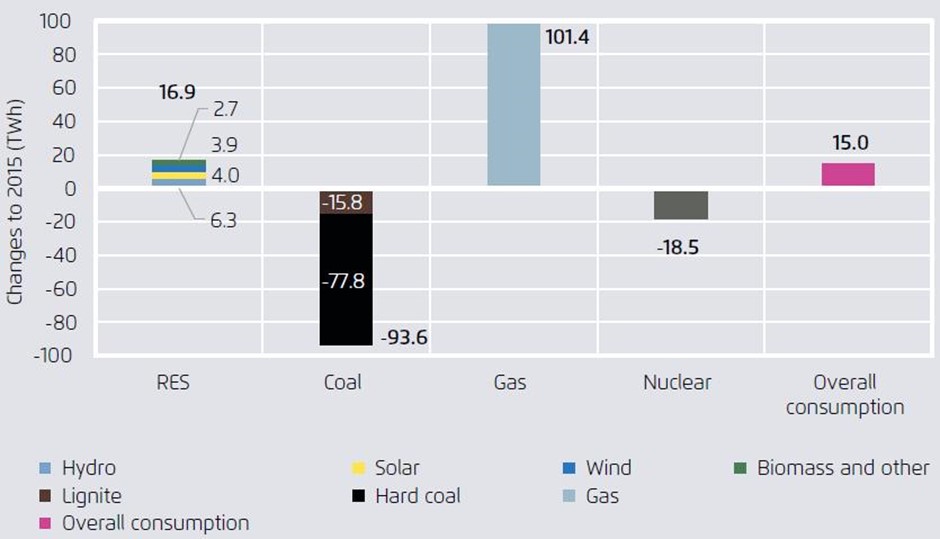
Chart 1 gives a sense of the aggregate pan-European switching of gas for coal plant across 2016.

Chart 1: Aggregate change in European generation by fuel type (2016 v 2015)

Source: Sandbag/Agoda Energiewende

Chart 1 has been produced using data from a study conducted by Sandbag and Agora Energiewende. The data set covers estimated annual changes in generation output by fuel type and country in 2016 relative to 2015.

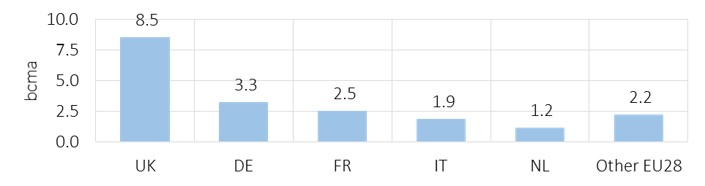
In Chart 2 we have used this data to generate a breakdown of estimated volumes of additional power sector gas burn.

Chart 2: Top 5 power markets driving 2016 gas demand recovery

Source: Timera Energy, Sandbag/Agoda Energiewende

The UK accounted for an estimated 43% of the 20 bcma of power sector demand recovery in 2016. This is principally a result of the UK carbon price floor (lifting generator carbon costs 18 £/t above the EU ETS price). The 2016 decline in gas prices relative to coal prices, in combination with the carbon price floor, crushed UK coal plant generation margins. Coal plants were driven out of merit and relegated to providing peaking backup, with CCGTs stepping in to fill the gap.

Germany was the second largest contributor. This was driven by the size of the German power market and the scale of switching potential given the dominance of thermal capacity. German spark spreads swung into positive territory over the summer as gas prices fell. They then remained supported over the second half of the year by surging coal prices.

The increase in power sector gas demand in France was more to do with the Q4 2016 nuclear outages than switching. Relatively low installed coal capacity in France limits switching potential. But CCGTs ran at relatively high load factors over the second half of the year to make up capacity shortfalls.

The Italian and Dutch markets were in fourth and fifth place, no surprise given the importance of CCGTs in the supply stack. Greece, Ireland and Portugal were the biggest contributors in the ‘Other EU 28’ category in the chart.

Switching is also supporting hub prices & volatility

European gas demand (including Turkey) recovered to 523 bcma in 2016. This is a 27 bcma (or 5.4%) increase from the 2015 level.

The power sector accounted for an estimated 20 bcma (74%) of that recovery, putting the importance of gas for coal switching in context. The French nuclear outages and cold weather in Q4 were the main drivers of the remainder of the recovery.

Switching was the transmission mechanism that allowed the 2016 coal price rally to feed through into gas prices. As coal prices rose, coal plant were displaced from power market merit orders to the benefit of CCGTs. The additional gas demand ensured gas hub prices ended 2016 substantially higher than they would have done if it had not been for the doubling of coal prices.

Another more subtle impact of the 2016 recovery in CCGT load factors is the associated support for spot gas price volatility. CCGTs are the transmission mechanism for the impact of intermittency from the power sector into gas market volatility. In other words, swings in generation output from intermittent renewable generation, translate into swings in CCGT load factors and hence fluctuations in power sector gas demand.

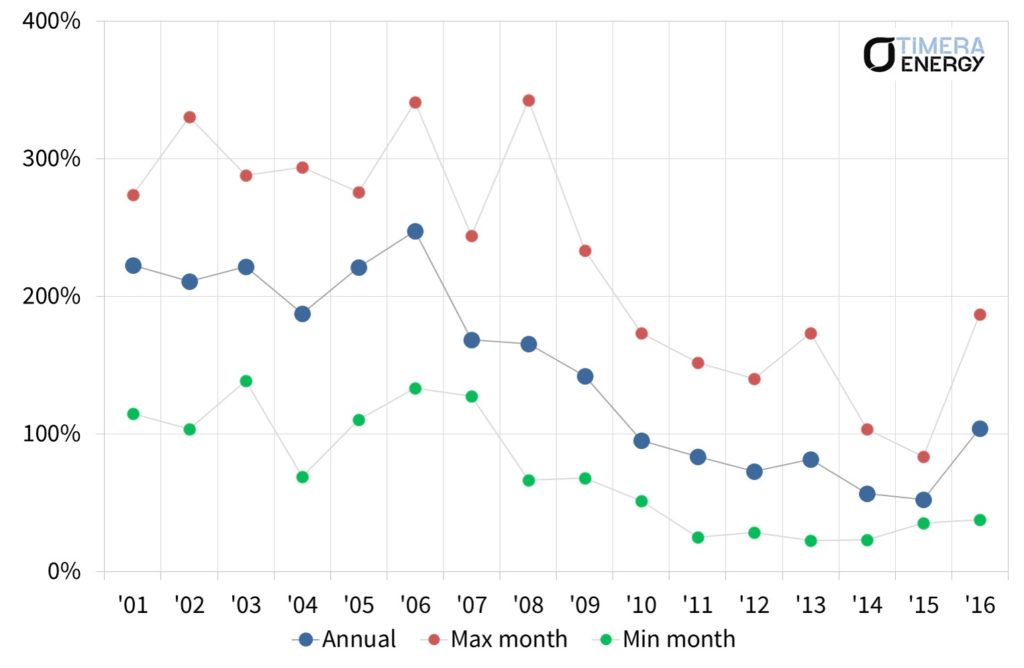
Chart 2 shows a pronounced recovery in UK spot gas price volatility in 2016. A similar trend can be observed across Europe’s other key hubs (e.g. TTF, NCG). Last year’s volatility recovery was helped by higher CCGT load factors causing higher gas demand and greater swing demand.

Chart 3: Evolution of UK spot price volatility (based on System Average Prices)

Source: Timera Energy

Switching sceptics may suggest that 2016 was an outlier year, a one off phenomena. We are not so sure. European coal prices remain elevated in Q1 2017. Gas hub prices recovered in Q4 2016 but downward pressure has returned in 2017 as the winter subsides, with Asian spot LNG prices re-converging with European hubs.

CCGTs have retained their advantage over coal in 2017 in the UK. The extent to which CCGTs displace coal plants on the Continent this year will come down to relative gas vs coal pricing, the barometer for European power sector switching.

Article written by David Stokes & Olly Spinks

US export flows, the supply glut and Europe

The Sabine Pass terminal exported its first cargo in Feb 2016.  This marked the start of a new era of US gas exports, an almost unthinkable development from a decade earlier when the US gas market was fighting to ramp up its imports of LNG.

While the commissioning of Sabine Pass was of symbolic importance, export volumes in 2016 were relatively small. Only 4.2 bcm [3 mt] of US LNG was exported last year, with capacity limited to Sabine Pass Trains 1 & 2.  Train 3 is currently being commissioned, with its first cargo dispatched recently.

A total of 89 bcm [65 mt] of committed new US export supply is due online by 2021, with the greatest volumes scheduled for 2018-19.  As US export volumes gain momentum they are set to transform LNG market flow patterns and pricing dynamics.

Where is US LNG flowing?

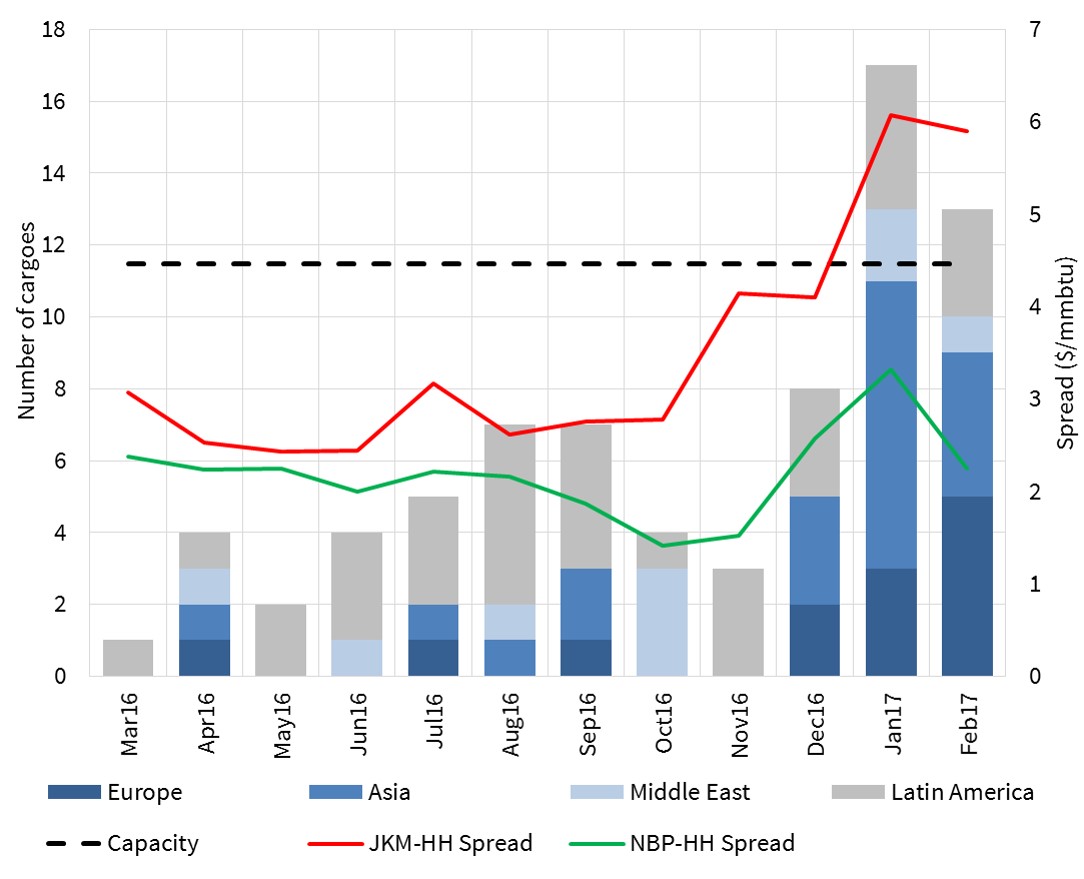
75 cargoes have been exported from Sabine Pass (up until the end of Feb 17).  Chart 1 shows a monthly breakdown of US originated cargoes by destination region.

Chart 1: US export flows by destination (vs regional price spreads)

Source: Timera Energy

Flow decisions for US export contracts are driven by netback global spot price signals.  These represent the market value for exported gas, adjusted for appropriate shipping and regas costs from the US.  To provide some guidance on regional price dynamics, we have overlaid the US vs Asian and US vs European spot price spreads on the chart.

A few observations on flows to date:

  • Cargo volumes by destination region were split as follows:
    • Latin America: 44%
    • Asia: 27%
    • Europe: 17%
    • Middle East: 12%
  • Latin America is a natural ‘first destination’ for US cargoes, as short shipping distances reduce netback costs. But Latin American demand is relatively low in a global context, so as US exports increase the Latin American share of cargoes will fall in proportion to other destinations (e.g. Europe).
  • The sharp jump in Asian spot prices in Dec saw an associated jump in US export volumes to Asia. Historically, Asia has pulled flexible cargoes from Europe in times of market tightness. Now the US is also contributing as a source of flexible supply.
  • Significant outages at Sabine Pass contributed to the dip in export volume in Oct-Nov 16.

While these observations provide an interesting first insight into US LNG flows, we suggest caution in extrapolating these conditions going forward.  As US export volumes grow over the next 2 to 3 years, destination and flow dynamics will likely alter significantly.

US exports and the European gas market

A relatively low volume of US exports have landed in Europe to date (17%).  But this belies the ‘behind the scenes’ role that Europe is playing in supporting the LNG market. US export volumes are being priced, optimised and hedged based on European hub price signals.

US cargo flow decisions are strongly influenced by NBP and TTF as liquid pricing benchmarks against which LNG portfolios are optimised, even though only a portion of cargoes actually land in Europe.  This dynamic is magnified by the fact that significant volumes of US export capacity are held by LNG aggregators who have flexible portfolios and a strong focus on portfolio optimisation.

Liquid North-West European gas hubs have been the key driver of regional LNG spot price signals since the gas glut started in earnest back in the summer of 2014.  There have been brief periods of regional price divergence from Europe (e.g. Dec 16 – Jan 17).  But the role of Europe as the market of last resort provides the benchmark from which regional spot prices are determined (e.g. in Asia and Latin America).

As well as playing an important pricing role, Europe is set to attract higher US cargo volumes as more export trains come online. After Latin America, Europe is the next cheapest destination for US exports from a shipping cost perspective.  As US export volumes grow, significant volumes are likely to land in Europe, or to displace cargoes that flow to Europe from elsewhere.  An increase in European cargo volumes can already be seen across the last 3 months in Chart 1.

Gas glut and the importance of Henry Hub

One of the most important implications of US export growth is the rising influence of the US Henry Hub price signal on global gas prices.  Henry Hub prices drive the variable cost base of existing US terminals.  They also determine the long run marginal cost (LRMC) competitiveness of new US export supply.

As new US export projects are commissioned and the LNG glut intensifies, European hub prices are likely to further converge with Henry Hub.  This should increase the importance of a converged trans-Atlantic hub price signal in setting regional LNG prices, with the US gas market providing global price support through the glut.

Some producers and analysts have recently suggested that the LNG supply glut may be ending. In our view, the numbers tell a different story, as we set out in our latest update pack on the LNG glut and asset value implications.

We are sticking to the thesis we set out last year: the LNG glut will remain the dominant driver of gas market dynamics for the next 3 – 5 years.  But market tightness may return with a vengeance next decade unless Financial Investment Decisions (FIDs) on new LNG supply are taken soon.

Article written by David Stokes and Olly Spinks

Contracting for market access via a 3rd party

A major transition is taking place with European energy asset ownership structures. Thermal power and midstream gas assets have traditionally been owned by utilities and producers. But asset write-downs, balance sheet pressure and changes in strategic focus are paving the way for large scale asset divestment.

Power plants, interconnectors, pipelines, gas storage facilities and midstream LNG assets are increasingly being sold to infrastructure and private equity investors, who are also funding the development of new flexible infrastructure projects. Most of the assets involved have significant associated market risk exposures which need to be optimised, dispatched and hedged in traded energy markets.

Some assets are being purchased with commercial functions already in place to manage market risk exposure. But in many cases, the trading & commercial capability and associated support functions remains with the utility or producer selling the asset. This is creating a growing requirement for investors to outsource commercial, trading and risk management services to 3rd party providers.

In today’s article we look at how investors are managing to access ‘route to market’ services via contracting with third parties.

Overview of market access structures

There is a spectrum of 3rd party market access structures. At one end are simple execution based agreements where the asset owner retains full commercial control of the asset, using a 3rd party trading desk as a market execution service. At the other end of the spectrum are complex contracts that effectively transfer the commercial management of an asset to a 3rd party in exchange for a fee. Most contracts currently being struck sit somewhere in the middle ground.

Two important factors determining the approach an asset buyer takes to negotiating a market access contract structure are:

  1. Risk/return profile: The extent to which the owner wants to be actively involved in management of asset risk & return.
  2. Commercial capability: The existing level of in-house commercial capability, or strategic ambition to develop this.

The common feature of all market access agreements is that the asset owner is contracting with a party that is active in the traded markets required to monetise the value of asset flexibility. This includes commercial & risk management expertise, counterparty and exchange agreements, analytics, systems and processes.

In order to understand how market access agreements are being structured, we have grouped contract structures into three approaches that sit at different points on the spectrum described above. These three groups are summarised in Table 1 and described below.

Table 1: Summary of types of market access agreement

Agreement Type Summary Pitfalls
Deal execution 3rd party provider transacts in market under direct instruction from owner
  • Structure of transaction fees
  • Credit risk & cost
Incentivised exposure transfer 3rd party provider incentivised to create value via actively managing asset exposures on behalf of owner, within defined constraints
  • Defining a clean asset exposure transfer mechanism
  • Alignment of incentives
  • Robust performance benchmark for trader value added
Value transfer 3rd party provider pays fee to asset owner in exchange for full control of margin & flexibility
  • Defining a fair benchmark for transfer of asset value (particularly extrinsic value)
  • Defining a clean separation of market exposures from other asset exposures (e.g. outage risk)

Source: Timera Energy

1. Deal execution

The simplest form of market access agreement is a deal execution service. The asset owner retains and manages all market risk exposure and control of hedging and optimisation of asset(s). The asset owner effectively pays the 3rd party trading desk to transact in the market on their behalf, rather than transacting directly in the external market.

The reason for contracting a deal execution service is that it means asset owners can avoid the overheads of establishing multiple counterparty trading relationships e.g. the setup costs of master agreements, credit lines, complex trading & risk management systems and 24/7 commercial operations. 3rd party deal execution can also mean access to better market prices i.e. lower bid/offer spreads.

The asset owner typically pays a fee, usually in the form of a variable charge for each transaction. This covers external market costs (e.g. bid / offer spreads) and risks (mainly a credit risk charge). An allocation for trading overheads may be covered via a fixed fee (e.g. monthly) or via a surcharge on the variable fees.

Deal execution agreements are typically signed by asset owners with a strong in-house commercial capability, but who lack an established presence and access to information in specific traded markets, or lack the required physical capabilities and licences. For example a US or Asian fund may have strong commercial capabilities in their domestic markets but not in Europe. Or alternatively a generator may have a short term asset dispatch capability but lack access to forward markets.

From an asset owner’s perspective the key areas to watch out for with deal execution agreements are:

  • The level and mechanism of transaction fees, which can result in ‘death by a thousand cuts’ via transaction fees eroding value if they are not properly structured.
  • The extent of the 3rd party contractor’s access to counterparties and market liquidity, as well as an assessment of their overall market & commercial expertise. This includes how the costs and risks associated with periods of market illiquidity are dealt with.
  • The credit risk of the 3rd party.

The good news is there is growing competition to provide deal execution services in Europe amongst banks, commodity traders and larger utility/producer energy trading desks. This is helped by the fact that traders typically like providing execution services (for the right fee), because they generate a regular deal flow (i.e. provide liquidity).

2. Incentivised exposure management

The most common form of market access contracts currently being negotiated by asset investors, involves the transfer of asset exposures from owner to 3rd party provider, along with incentives to monetise asset value. If a contract is structured well, it allows the asset owner to retain a degree of control over managing asset risk/return. But it also allows for the 3rd party provider to add value through its trading expertise.

CCGT ‘exposure transfer’ case study

Consider a simple case study involving a CCGT power asset. The asset owner may want to retain control over hedging of asset margins in the forward market. For example the timing and volume decisions on hedging of forward spark spreads may be made by the owner, even if individual trades are executed via the 3rd party provider.

But the owner may want to transfer plant exposures to the 3rd party provider prior to the day-ahead stage. This allows the owner to avoid the overheads and complexities required to deal with factors such as hourly auctions, nominations, plant dispatch and balancing.

Exposure transfer is typically achieved by agreeing a benchmark for optimised asset value at the point of handover (e.g. day-ahead). Once asset exposures have been transferred, incentivisation mechanisms can be used to align the interests of owner and 3rd party trader in managing asset risk/return into delivery.

In the situation described above, the value added by the 3rd party is focused on managing power plant exposures in the prompt forward and real time markets. Significant incremental value can be generated over this shorter term horizon, given ability to optimise CCGT flexibility against price shape and volatility.


This type of market access agreement is a structure that allows the 3rd party provider to maximise the value of asset exposures within the incentives and constraints imposed by the agreement. In return the provider receives compensation for this service based on a portion of the value delivered.

The key to structuring a successful agreement of this type is defining:

  1. A fair & transparent benchmark for incremental value added by the trading desk (vs the inherent value of asset flexibility which should accrue to the owner)
  2. An appropriate incentivisation mechanism that aligns party interests and allows a fair sharing of realised value

The asset owner may also choose to handover a greater degree of control for asset margin management to the 3rd party provider. This is typically achieved via adopting more of an ‘open book’ approach to asset value management as set out in the case study below.

Gas pipeline ‘open book’ case study

Consider another simple example involving a European gas pipeline asset, where margin is managed via a combination of long term and shorter term contract sales.

In this situation the asset owner may want to retain control over the sale of long term contracts (typically large and infrequent). But the owner may have an agreement with a 3rd party service provider to manage the day to day sale of shorter term firm and interruptible capacity products.

Under this type of structure, the 3rd party has a greater degree of responsibility for monetising asset value, given a broader commercial freedom to market capacity not already sold via long term contract.   But value management is done within a governance framework controlled by the asset owner. This allows the owner to have a relatively small commercial team to support the asset (e.g. 2 or 3 people), something which is often an advantage for a fund with multiple investments.

The asset owner is typically looking for commercial creativity and an ability to access sources of value are difficult for the owner to achieve (e.g. given a lack of critical mass). But the asset owner can be faced with the issue of conflict of interests, if the 3rd party has a portfolio of its own assets in the same class, as is often the case.

This type of agreement is typically structured around an ‘open book’ approach, where both parties have full transparency of deals being made.   However for this structure to work, a clear set of constraints (e.g. risk/return boundaries), incentives (e.g. aligned value sharing) and performance benchmarks are critical.   It can also create a significant overhead for reporting & auditing of P&L and commercial decisions for both parties.


3. Value transfer

The third grouping of market access agreements involves a more structural transfer of asset value management to a 3rd party provider. This is typically done via some form of exposure transfer pricing structure. The 3rd party provider pays the asset owner for what is usually full control of asset margin and flexibility. In exchange for this payment, the 3rd party has access to 100% of asset value generated. In other words its profit and loss is the difference between realised asset margin and the transfer pricing payment.

The most common type of deal here is a tolling contract. The asset owner receives a capacity fee, for transferring asset management and margin via contract to a 3rd party. Examples include the tolling of thermal power plant capacity, oil refinery capacity and the sale of US LNG export capacity. The tolling fee is typically fixed but can also be indexed to market price benchmarks or even volatility.

But more flexible structures are also used. Utilities and producers commonly use a ‘rolling transfer’ mechanism to pass asset exposures from the ‘asset owner’ business unit to the ‘trading’ business unit. Exposures are typically transferred over a rolling forward curve horizon, based on prevailing market conditions at the time. For example, transfer of asset exposures from a CCGT priced at prevailing spark spread.

The toughest challenge in structuring deals in this group is typically associated with defining a fair value for transferring asset exposures. The intrinsic or hedgeable component of value can be benchmarked against forward market prices. But defining a robust mechanism for pricing and transferring the extrinsic (or flexibility) value of an asset is complex.

There is often an asymmetry of information here. The 3rd party trader typically has strong commercial expertise and market knowledge that supports definition of asset value. The asset owner on the other hand is often a step removed from this detailed expertise.

Structuring market access contracts

The growth in 3rd party market access services in Europe is being driven by an increasing business model separation of asset ownership from trading expertise. As a results, market access services and contract structures have matured significantly over the last two or three years.

However the degree to which market access contracts are standardised will always be limited by the unique characteristics of individual assets and owner requirements. The approach taken on fee structures, pricing mechanisms, exposure transfer, incentivisation and performance benchmarking, define the difference between a deal that adds or erodes asset value.

We return shortly with a follow up article to set out our experience of the 5 key success factors underpinning a robust market access deal.

Article written by Olly Spinks, David Stokes and Nick Perry

Relative pricing dynamics driving European gas hubs

A number of interesting dynamics have emerged in the European gas market over the last twelve months.

On the supply side, relatively low LNG import volumes have been offset by higher Russian flow volumes. This has been pitched as round one in a multi-year Russian vs LNG import battle for European market share.

On the demand side, European gas consumption recovered in 2016, driven by a sharp increase in power sector gas demand and the onset of a cold winter.

It may be tempting to try understand the drivers of each of these developments in relative isolation. But the events of the last year can to a large extent be explained by the evolution of market pricing dynamics.

Last week we explored the relationship between European hub and spot LNG prices. In today’s article we look at the key relationships between:

  1. European gas and oil prices, driving long term gas contract flow volumes
  2. European gas and coal prices, impacting power sector gas demand

These three relationships are key indicators on our European gas market ‘dashboard’. They provide an insight into both the historical evolution of market conditions as well as guidance on the future direction of flows and pricing.

Revisiting the key price benchmarks that drive European hubs

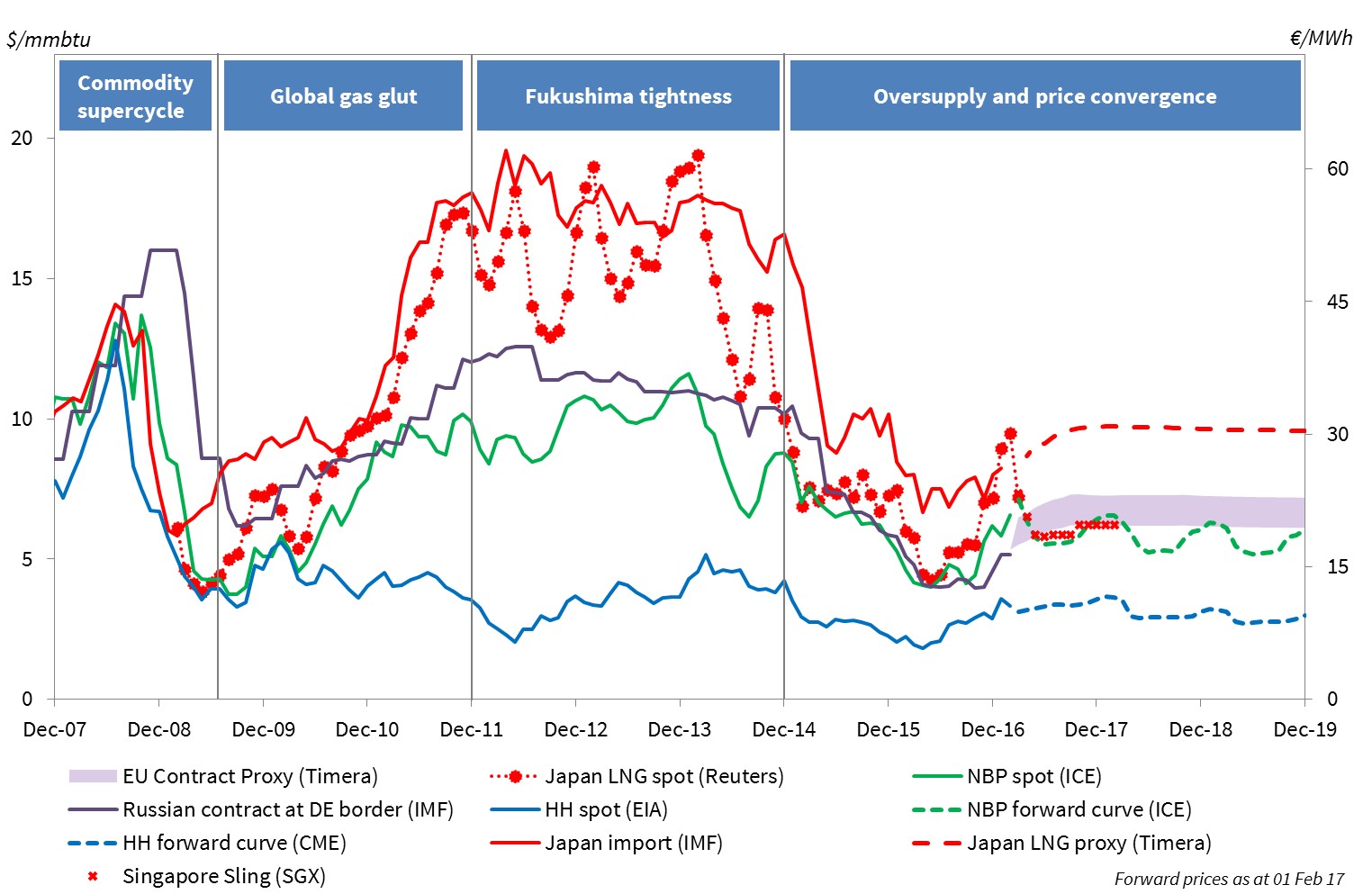
Chart 1 summarises the evolution of hub prices in the context of the last 10 years of history, as well as providing a current snapshot of forward market pricing.

Chart 1: Evolution of key gas price benchmarks

Source: Timera Energy

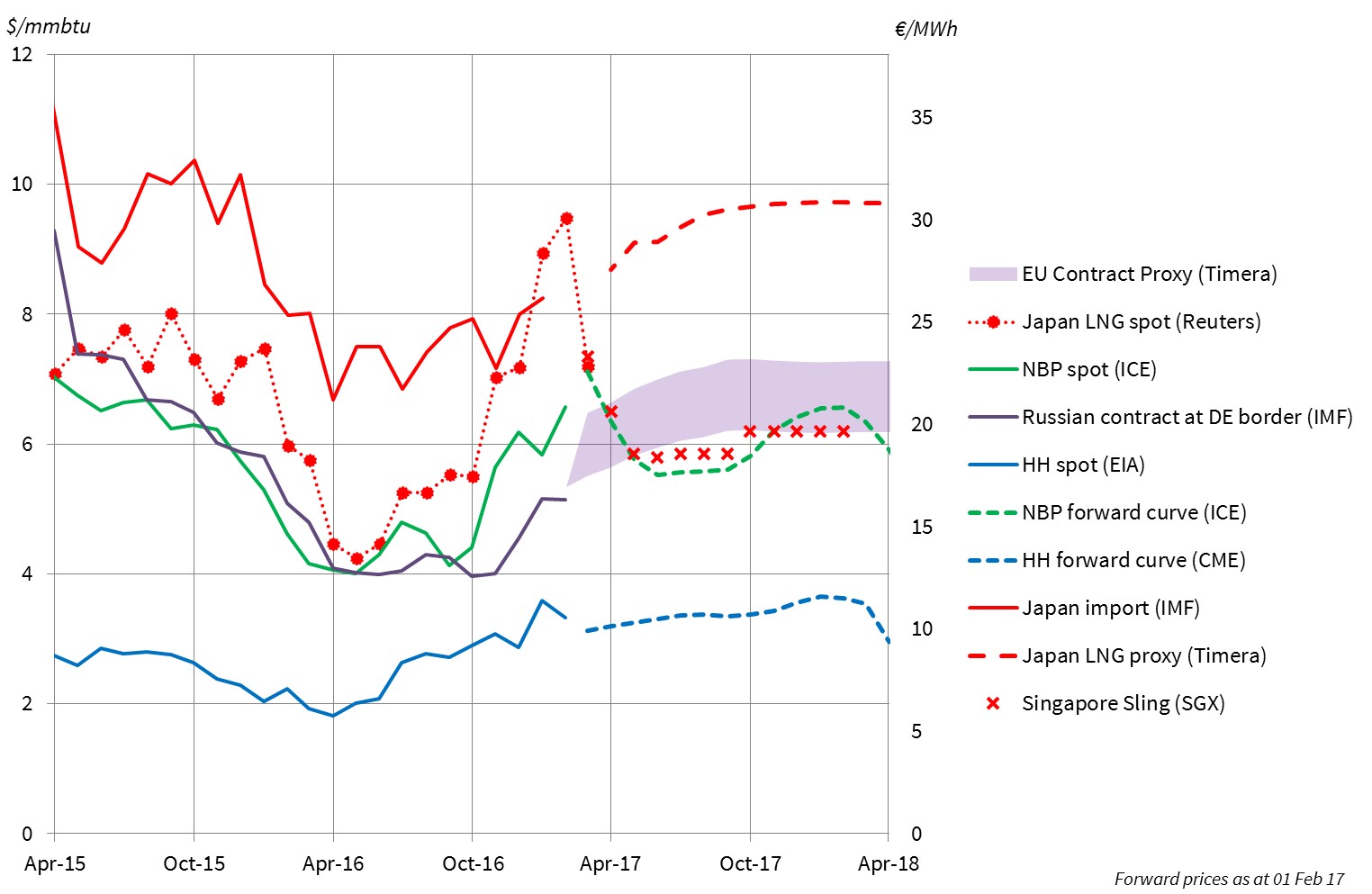
Chart 2 then shows a blown up view of recent history and forward market benchmarks over the next 12 months.

Chart 2: Blown up view of gas price benchmarks

Source: Timera Energy

Some important observations from Chart 2:

  • Q1 slump: European hub prices, Asian spot LNG and Russian oil-index contract prices all fell sharply in Q1 2016 towards 4 $/mmbtu. This happened in parallel to a global commodity price slump.
  • Oil & coal recovery: Oil and coal prices commenced a pronounced recovery in Q2 that carried through to Q4, with the prices of both commodities roughly doubling from their lowest levels. Coal prices played a key role in influencing European hub prices in late 2016 as we discuss below.
  • LT contract prices: The prices of long term oil-indexed supply contracts remained relatively weak across 2016, driven by the 6-9 month time lag in indexation to crude prices.
  • Q4 rally: Hub prices rallied sharply in Q4 back to 6 $/mmbtu, alongside rising Asian spot LNG prices as the winter set in. This opened up a significant premium of hub prices over oil-indexed contract prices.

We now map these pricing dynamics on to some of the key supply and demand events on 2016.

Is Russia making a grab for market share?

European import volumes from Russia were strong in 2016, at 179 bcm (an approximately 34% market share). This can be compared to a recent historical average closer to 150 bcma.

LNG imports on the other hand were lower than expected, despite the commissioning of significant volumes of new global liquefaction capacity. In January we summarised the outage issues and liquefaction ramping delays that have somewhat curtailed volumes of new LNG supply.

As a result of robust export volumes, Gazprom has been quick to claim round one in its fight for market share against LNG. But the reality is a more complex function of exercise decisions on long term contract volumes.

The flow decisions on the large majority of Russian gas imports, sits with suppliers via long term contract exercise rights. The big boost in Russian import volumes in 2016 came in Q4. Chart 2 illustrates why suppliers nominated high volumes in Q4, given the substantial discount of oil-indexed contract prices relative to hub price alternatives. At the same time, stronger Asian demand was causing LNG cargoes to be diverted away from Europe.

Gazprom may be becoming more assertive in its attempts to grow European market share. But its ability to do this in 2016 had a lot to do with the evolution of hub prices relative to oil and Asian LNG prices. Those tailwinds look to be weakening in 2017.

Gas vs coal switching becomes a reality

A cold start to the current winter helped to support gas demand in Q4 2016. But the primary driver of a recovery in European gas demand relative to 2015 was a sharp increase in power sector gas demand.

Gas demand from European power plants rose by approximately 20 bcm relative to 2015, as CCGTs ran at higher load factors. The key driver of higher gas plant burn was a shift in relative gas vs coal prices.

As 2016 progressed, coal prices surged relative to European gas prices. This meant that CCGTs were more competitive on a variable cost basis, supporting run hours. The coal price surge played an important and underappreciated role in supporting European hub prices in 2016.

Coal prices roughly doubled between Q1 and Q4 2016. This significantly lifted the switching boundaries at which CCGTs displaced coal plants, particularly in UK power market with its carbon price floor. In other words the rise in coal plant variable costs meant that price support from the power sector materialised at higher gas price levels.

Power sector gas demand was particularly strong in Q4 2016, as coal prices surged towards 100 $/t and French nuclear outages were backfilled by CCGTs. This also contributed to the Q4 rally in hub prices that can been seen in Chart 1.

 Looking forward into 2017

European hub prices have remained supported into Q1 2017 by ongoing cold weather and relatively low storage inventories. But prices have started to decline in February as regional LNG spot prices have re-converged with North-West European hubs. There looks to be an associated increase in LNG cargoes heading for Europe.

The big rally in oil prices in the second half of 2016 is starting to feed through long term contract price index lags. The effect of this can be seen in Chart 2, with the Russian oil-indexed contract price benchmark rising sharply in Q1 2017.

However current forward market prices suggests that hub gas will once again become cheaper than oil-indexed contracts in Q2. So Russian import volumes are likely to be robust in Q1 2017, but relative pricing dynamics may shift against Russian gas flows as the year progresses. The spread of Asian spot LNG prices over European hubs will also be an important factor to watch as an indication of LNG market tightness.

The key gas demand question for 2017 is to what extent power sector consumption continues to recover. The barometer for further gas for coal switching in 2017 is the relative levels of gas versus coal prices. European coal prices have fallen back from their peak in Q4 2016, but remain elevated (API2 currently around 77 $/t). The extent to which gas hub prices fall into the summer will be an important driver of the relative competitiveness of CCGTs.

We will keep an eye on the key relative price relationships covered in this article as the year progresses.

Article written by David Stokes, Olly Spinks & Howard Rogers