Where will the next wave of LNG supply come from?

The 2015-2020 wave of new LNG supply has been built on Australian and US export projects. Australian liquefaction projects were underwritten by long term oil-indexed contracts with Asian buyers. In contrast, US terminals were financed off the back of long term Henry Hub indexed tolling contracts that pushed US gas price risk onto LNG buyers.

Both these models now appear to be ‘broken’. In the current market environment there is little interest from Asian buyers or LNG portfolio players to sign new long term contracts on either basis.

Many Asian LNG importers are already over-contracted, particularly in Japan, China, India and South Korea. Projecting future LNG requirements is also challenging given uncertain energy demand and policy-induced changes to the energy mix.

Liquefaction project developers are also confronted by a gap between LNG spot price expectations and prices required to support the cost of investment in new supply.

Yet the LNG market needs investment commitments for new liquefaction projects to be made before the end of this decade to avoid a supply squeeze in the early to mid-2020s. This sets up an interesting dynamic around the ‘next wave’ of new LNG supply projects.

Next wave characteristics

A successful investment & business model for ‘next wave’ LNG projects is yet to be defined. But it is likely to reflect the following characteristics:

  • Market risk: New supply will be dominated by projects whose investors do not require long term contracts i.e. equity investors will need to bear market risk.
  • Cost of capital: Cost of capital will be key to keeping project costs down. This is likely to drive a focus on robust balance sheets and low debt costs rather than project finance.
  • Reserve access: Investors looking to monetise existing upstream reserves, with infrastructure access to terminals are likely to dominate.
  • Market access: An absence of long term contracts means a greater importance of LNG supply chain presence and capability to monetise cargoes directly in the market.

These factors point towards oil & gas majors and large LNG portfolio players dominating the next wave of supply .

Competition for marginal supply

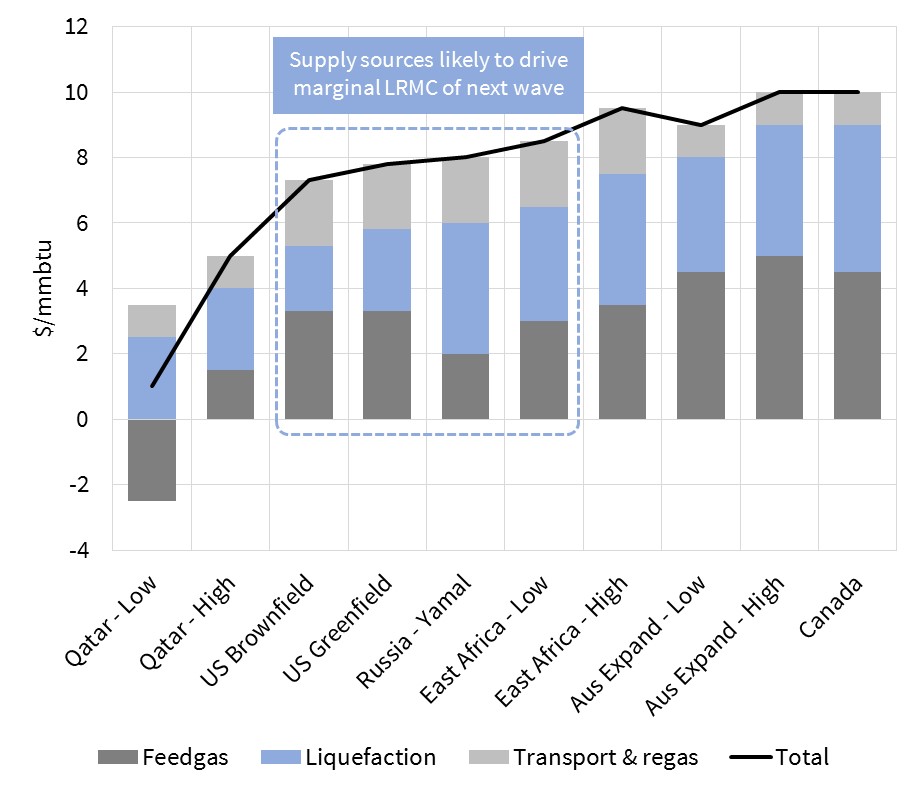
Chart 1 shows our estimates for the long run marginal cost (LRMC) of key generic sources of potential new LNG supply.

Chart 1: Next wave LRMC by supply source
Source: Timera Energy

Qatar

Qatari expansion options are at the head of the cost curve. Qatar has announced its intention to lift the 2005 moratorium on LNG export expansion and develop 23 mtpa of new supply over the next 5-7 years. Based on reported condensate yields, we estimate delivered LRMC of 5 $/mmbtu for this LNG, assuming 1 $/mmbtu for shipping and regas costs into Europe or Asia.

However it is our understanding condensate & LPG yields could be significantly higher (e.g. based on data provided by the Qataris in the late 2000s), in which case LRMC could be lower. Qatar may also be able to increase exports via relatively low cost debottlenecking of supply into its existing trains.

There is no doubt that Qatar is the cheapest source of new global supply. But expansion volumes are not enough to meet global demand growth. That means Qatari supply sits below the expansion options likely to drive the marginal cost of new supply.

US LNG

There is a growing consensus that US unconventional gas production can meet US consumption as well as LNG export volume requirements at Henry Hub prices of around 3.00-3.50 $/mmbtu. We have assumed a 3.00 $/mmbtu cost base for Chart 1.

US export contracts signed to date have included a 15% variable liquefaction fee. But this has included some margin for terminal owners. The true variable costs of liquefaction (e.g. costs of gas consumed) are closer to 10% (i.e. $0.30 at $3.00 Henry Hub).

The liquefaction tolling fee in existing contracts was $2.50 in early contracts, rising to $3.50/mmbtu in later contracts. But there is mounting anecdotal evidence that fixed and capital costs for the next wave of terminals may come in under even  the lower end of this range. Costs can be driven down by standardising terminal design rather than pursuing the specific site designs deployed to date. We assume 2.00 $/mmbtu for brownfield sites and $2.50 for greenfield sites.

We then assumed long run marginal shipping and regas costs of 2.00 $/mmbtu to deliver gas to Asia. That gives all in LRMC estimates (delivered into Asia) of:

  1. Brownfield: 7.30 $/mmbtu
  2. Greenfield: 7.80 $/mmbtu

Second wave US export projects look to be an increasingly competitive source of new supply. But ownership structures and business models may need to evolve to support new FIDs.

Russia

New Russian LNG supply also looks relatively cost competitive. But supply is likely to be limited to two projects.

Yamal LNG benefits from large onshore arctic fields (Russia’s core expertise). Yamal LNG comprises three trains each of 5.5 mtpa, the first of which comes onstream late 2017/early 2018. Arctic LNG (also known as Artic LNG II) may reportedly be able to supply up to 18 mtpa.

Russian state infrastructure funding and good project executions would support a delivered breakeven cost or around 8.0 $/mmbtu.

East Africa

There have been huge (dry gas) discoveries in East Africa. But progress to achieve development frameworks for investment have been hampered by government capability and opposition opportunism. The offshore Coral LNG project (Eni, Anadarko) is moving towards construction. However the likelihood and timing of other land based liquefaction projects are less certain.

Our estimates of delivered cost into Asia for an efficiently executed project is $8.5/mmbtu. This may increase to $9.5/mmbtu if additional infrastructure spend is required (or cost overruns).

Australia Brownfield

With cost reductions by competitors, new Australian supply projects are looking increasingly compromised. Further east coast export options are constrained by a shortage of feedgas. West coast and northern options suffer from expensive labour costs and/or incremental infrastructure requirements.

We estimate generic feedgas costs at 4.5 – 5.0 $/mmbtu, with a further $3.4 – 4.0 of liquefaction costs. Add on transport to Asia and project breakevens look to be in the 9-10 $/mmbtu range.

Canada

The economics of Canadian LNG projects are eroded by the relative distance of gas supply from export terminal access. Costs are also impacted by the complication of gaining ‘First Nation’ and environmental approval for pipeline corridors and navigation of an overlapping approval, regulatory and fiscal system. In addition the availability of sufficient skilled labour for liquefaction project construction is questionable which adds to the risk of cost escalation.

We estimate feedgas costs including transportation to the terminal at 4.5 $/mmbtu and greenfield liquefaction costs of another 4.5 $/mmbtu. That means a delivered cost into Asia of 10 $/mmbtu.

Summary of new supply options

The analysis above relates to breakeven costs for generic projects by location. There are also a number of specific projects likely to benefit from unique characteristics that give them a cost advantage.

For example:

  1. Offshore FLNG projects, if they are able to realise cost and schedule advantages, such as the Coral (Mozambique) and Fortuna (Equatorial Guinea) currently in the process of FID.
  2. Exxon’s PNG expansion option benefitting from existing infrastructure and an impressive implementation track record.
  3. Other projects with LPG and Condensate co-production which can significantly improve economics from those in Chart 1.

However we have focused on large generic sources of new supply as the key driver of the marginal cost of new LNG going forward. The cost structure of these supply sources will have an important influence on LNG pricing dynamics next decade.

In summary, Qatari volumes are cheap but limited. Incremental supply from the US (high volumes) and Russia (more restricted volumes) look most competitive. Advantaged East African projects look to be the ‘best of the rest’ of the major sources of new supply.
An under-estimated driver of gas storage value

Gas storage value is underpinned by an ability to shift gas from lower to higher priced periods. Differences in the value of gas across time periods are commonly referred to as time spreads.

Capacity owners focus on two key market price signals for time spread behaviour:

  1. Summer/winter price spreads drive the value from seasonal profiling of inventory.
  2. Spot price volatility drives the value of shorter term injection and withdrawal decisions.

But there is a third value driver, forward price correlation, which gets less attention than it deserves.

The correlation of forward gas price movements determines the value that can be created from hedging storage capacity.  If forward prices move up and down in unison, forward hedging opportunities are limited.  But as price correlations break down, the value that can be generated from hedging storage in the forward market rises.

The two primary storage hedging strategies

Storage traders use two basic strategies to monetise capacity value:

  1. Spot based strategies: The focus here is on a single decision: to injection, withdraw or do nothing (if variable costs cannot be covered). This decision is based on how the current spot price compares to the assumed behaviour of future spot prices. As such, it is an approach that relies on probabilistic modelling of spot price behaviour.
  2. Spread strategies: The focus here is on hedging observable time spreads (or price differences) across forward market contracts. Adjustments can then be made as time spreads evolve and new contracts become available (e.g. via a rolling intrinsic strategy). At any point in time the intended injection and withdrawal profile are covered by hedges.

Traders like spread based strategies because they provide access to extrinsic value, while significantly reducing risk (because they are essentially arbitrage trades). At any point in time storage inventory is not exposed to sharp changes in absolute gas price.

Traders also like the possibility of trading profitable spreads in volumes equivalent to the full capacity of the facility over the tenor of the forward contracts involved (e.g. one month), as compared with spot trades that are often only for a single day’s injection / withdrawal amount.

In practice, most storage traders will operate a hybrid strategy (a combination of spot + spread) overlaying market views and personal judgement.

Why price correlation matters

The behaviour of forward market time spreads is the key driver of spread based strategies. Traders generate margin via the placement and adjustment of forward hedges.  The amount of margin achieved is a function of both price volatility and the correlation between contract prices. For example if two contracts are very volatile but perfectly correlated, there will be no change in the underlying spread.

In less mature forward markets, price correlations across different contracts tend to be very highly correlated.  This is because forward curve movements are heavily influenced by movements in the spot price (‘prompt wagging the curve’).

In more mature markets (such as NBP and TTF), correlations can break down as different contract periods are influenced by unique supply and demand dynamics. For example, a forecast for a blast of cold weather over the next three days has little impact on the price of gas for next month.  Similarly announcement of dates for a maintenance outage on a key import pipeline will typically impact forward prices around those dates, but have little impact on other forward prices.

UK price correlation is declining

In order to illustrate the importance of price correlation we look at a UK gas market case study. The logic is also directly applicable to Continental hubs (e.g. TTF & NCG).

In table 1 we show an analysis of the correlation of prompt NBP contacts.  These are particularly important as a driver of fast cycle storage capacity value.

Table 1: UK prompt contract correlations (of price returns) (2009-2017)

Source: Timera Energy

Price correlation between contracts can be seen to decline the larger the time gap between periods.  For example, Within Day contract prices are highly correlated to Day Ahead (0.85), given similar supply & demand drivers.  But the Day Ahead contract correlation with the Month Ahead is only 0.38.

In Chart 1 we show how the price correlation between different price pairs has evolved since 2009.

Chart 1: Evolution of correlation of across key UK gas prompt contracts

Source: Timera Energy

Correlations generally strengthened from 2009 to 2014.  This significantly reduced the value that could have been extracted from storage capacity by spread based trading strategies.  The overhang of gas supply flexibility and increased competition across storage assets over the first half of this decade was a key factor behind this decline in correlations.

Interestingly, evidence is emerging that NBP prompt price correlations have started to break down again from 2015-17.  This coincides with a recovery in NBP spot price volatility over the same period.  Rough coming offline is an important driver. And these factors are coinciding with a pronounced pick up in market interest in purchasing storage capacity.

Energy from waste investment in the UK

Energy from waste (EfW) is a relatively small but rapidly evolving sector in North West European power markets. EfW investment is being driven by technology improvements, cost reductions and stringent EU guidelines on landfill waste.

The UK is Europe’s second largest market for EfW with 12 mtpa of waste consumed in 2016. Other dominant markets include Germany (24 mtpa), Netherlands (8 mtpa) and Scandinavia (12 mtpa combined).

The UK EfW sector is focused on power production (6 TWh in 2016), complemented with additional revenue streams e.g. from steam and metals recovery. CHP and steam outputs play a much bigger role on the Continent e.g. via district heating plants.  In the UK, only 8 of a total of 40 EfW plants export heat.

UK EfW projects have historically focused on conventional incineration technologies (e.g. grate based systems).  But the government has now limited renewable CfD access to emerging EfW technologies.

The lure of government CfDs has supported renewed interest in Advanced Conversion Technologies (ACT) which involve waste gasification and Anaerobic Digestion (AD) to generate biogas.  64MW of small scale ACT projects were successful in the second UK CfD round announced last month.

In today’s article we look at investment value drivers and challenges for UK EfW assets.

EfW investment considerations

There have historically been a range of smaller EfW project developers in the UK.  But asset ownership is starting to consolidate as EfW technology matures, capacity volumes increase and a proven track record of financing is established.

There is also a substantial EfW project development pipeline in the UK, which is increasingly focusing on larger scale conventional grate technologies.

EfW assets however have a unique set of exposures that mean they sit on the fringe of the conventional infrastructure investment space.  Key asset value drivers and associated challenges are summarised in Table 1.

Table 1: 5 key drivers of EfW asset value

Value drivers Key valuation challenges
Power price exposure Power revenue can account for upwards of half of total revenue. This creates a strong implicit exposure to UK gas prices (which dominate marginal power price setting). Projecting UK power prices for 20+ years. UK supply stack evolution & extent of gas price recovery in 2020s are key drivers of EfW asset value upside.
Waste input revenue Revenue from long term contracts for waste disposal underpins asset revenues (e.g. 60-70 £/t). Waste prices have been increasing, with some assets retaining uncontracted exposures. Waste supply versus EfW capacity volume growth (in the context of other sources of UK capacity) are key drivers of waste price evolution.
Capacity payments CfD availability limited. But capacity payments provide an alternative revenue stream which is relatively stable (e.g. 20-30 £/kW/year). Evolution of UK capacity mix important. Focus on competition across peakers, CCGTs & batteries driving marginal capacity pricing.
Embedded benefits & other revenue Triad benefit to fall to 3-10 £/kW by 2020. But significant BSuoS benefit remains (e.g. 12-15 £/kW), given high EfW load factors. CHP benefits also possible. Understanding value revenue upside from avoided rising system balancing costs (BSUoS).  Capturing any CHP revenue dynamics.
Growth strategy Aggregation opportunities across 40 existing assets in the UK.  Significant development pipeline of EfW projects. Also expansion potential into NW Europe. Quantifying economies of scale from aggregating assets and defining a realistic EfW growth volume potential.

Source: Timera Energy

Conventional thermal power assets are primarily exposed to the correlated spread between fuel and power prices.  EfW however has an outright power price exposure.  While this can be relatively easily hedged in the forward market over a 18-24 month horizon, it still means equity bears significant market risk exposure.  But with that risk comes the potential for substantial value upside from gas price driven UK power price recovery in the 2020s.

The challenges associated with market risk are helped by EfW asset revenues typically being underpinned by long term waste contracts (at increasingly healthy prices). Waste revenues combined with capacity payments and embedded benefit streams are helping to support project financing.

The other important challenge investors face is defining a scalable business model.  There can be significant efficiencies and overhead reductions from developing a portfolio of EfW assets.  These include a central commercial function to market power, capacity and embedded benefits, as well as well as sharing operational capabilities across plants.  It is these factors that are likely to drive an ongoing consolidation across EfW assets, similar to that currently underway in the UK peaker sector.

European gas demand recovery: the comeback story

European gas demand fell 20% across the first half of this decade. Declining CCGT load factors in the power sector were the main driver of this decline, as coal & carbon prices fell and renewable output increased.

The fall in gas demand contributed to the emergence of a significant surplus of European gas supply flexibility. Flex oversupply was compounded by new storage and pipeline infrastructure coming online, based on investment decisions made in tighter conditions towards the end of last decade. These factors combined to drive down market price signals for flexibility, with substantial declines in summer/winter price spreads and spot gas price volatility.

But European gas demand hit an inflection point in 2014. Demand across Europe recovered 52 bcma (11%) between 2014 and 2016. That recovery is continuing into 2017, with evidence of ongoing power sector switching of gas for coal plant, as well as the impact of a broader recovery in economic growth.

We take a look today at the key markets driving demand recovery.

Shining a light on the recovery drivers

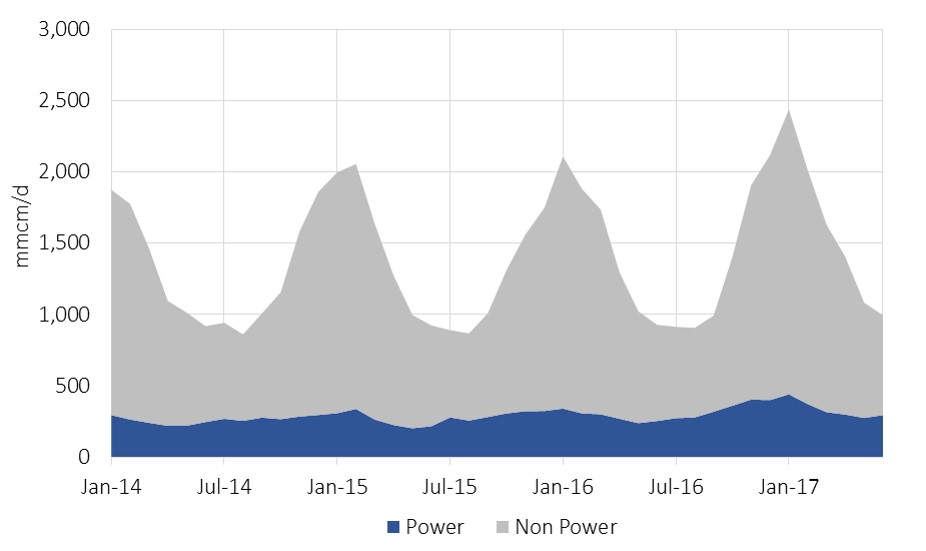
Chart 1 shows the evolution of European gas demand across the ‘EU 29’ countries (including Norway, Switzerland & Turkey). 2014 marked the trough of this decade’s decline in gas demand. This was helped by weaker demand in 2014 given a relatively mild year of weather. The demand recovery since 2014 can be seen in Chart 1, with the power sector playing an important role, particularly across the last 12 months.

Chart 1: Evolution of pan-European gas demand (H1 2014 -H1 2017)

Source: Timera Energy

In order to better understand the drivers of demand recovery it is useful to focus in on Europe’s key gas markets, shown in Chart 2.

Chart 2: Market view of demand recovery (H1 2014 vs H1 2017)

Source: Timera Energy

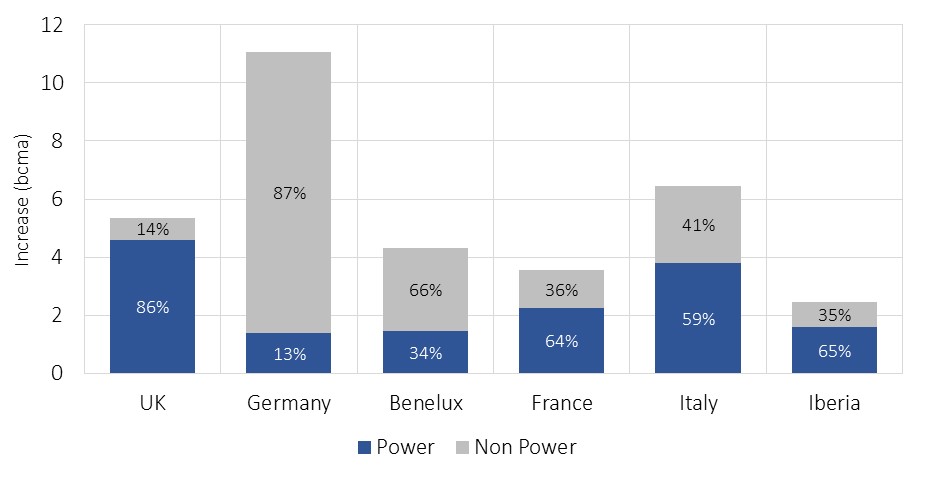
Chart 2 shows the key role of the power sector in driving demand recovery. The power sector accounts for just over 20% of total European gas demand. But it has accounted for a much higher percentage of the demand recovery since 2014, particularly in the key Western European gas markets shown in Chart 2.

The power sector switching impact in boosting gas demand has been greatest in the UK and Italy, accounting for 86% and 59% of respective gas demand growth across this period. Switching is most pronounced in the UK given the carbon price floor (18 £/t premium).

The power sector has also played an important role in demand recovery in France, Iberia (Spain + Portugal) and the Benelux region. Increases in power sector demand have been particularly pronounced over the last 12-18 months. The rise in coal prices relative to gas prices across this period has supported switching across all markets. But there have also been specific issues in play e.g. the French nuclear outages of last winter and recent low hydro balances on the Iberian peninsula.

An 11bcm increase in German gas demand (H1 2014-17) has been a major factor behind the overall recovery in European demand. Chart 1 is misleading here in suggesting that the power sector has not been doing the heavy lifting in Germany (a function of the data series). When gas burn for both generation and heat is accounted for, the grid connected power sector accounts for around 5 bcm of the 11bcm increase. This is even higher if distribution connected gas assets are included (although data here is more difficult).  The commercial & residential sector account for most of the remaining increase (which is partly weather related with cooler temperatures in H1 17 vs 14).

A more positive economic backdrop is a factor that is helping with a broader demand uplift across most European gas markets.

Further demand recovery

Market consensus for European gas demand at the start of this decade was for slow but steady growth. Expectations had turned decidedly bearish by 2014-15, ranging from broadly flat to a steady decline. A power sector driven recovery in demand of more than 10% across the last two years has surprised almost everyone.

Two key factors are likely to determine what happens with gas demand going forward:

  1. Further switching: UK power sector switching has largely happened, but there is significant potential for further Continental European switching (e.g. across Germany, Benelux and Iberia), depending on the relative path of coal vs gas prices.
  2. Economic growth: Whatever your views on the longer term risks of the European Central Bank’s €60 billion a month of QE bond purchase programme, it has coincided with a recovery in European growth since 2015. Further growth is likely to be important in underpinning a continuing recovery in gas demand.

The recovery in European gas demand since 2015 has been an important factor allowing the orderly absorption of higher import volumes of Russian gas and LNG. Gazprom appears to be shifting towards defending a higher market share target than it has historically (closer to 170 bcma vs 150 bcma pre 2015).

There have also been early signs of a recovery in price signals for gas supply flexibility in the UK, with a significant pickup in NBP spot price volatility over the last 18 months. This is yet to be mirrored at the Dutch TTF. But a recovery in gas demand across Europe is an important factor in eroding the overhang of gas supply flexibility that has prevailed since the start of this decade.

Flexibility investment: New UK CCGTs

New CCGTs have not fared well so far in the UK capacity market. Centrica’s repowering of the Kings Lynn plant (0.4GW) has been the only successful project to date. The gravestone raised over the 2.0 GW Trafford project stands as a warning to overly enthusiastic CCGT developers, after it failed to raise capital and reneged on its 2014 capacity agreement.

But it is too early to write off new CCGTs just yet given a policy landscape shifting in their favour. Ofgem has levelled the capacity market playing field by revoking the lucrative triad benefit that has underpinned distribution connected peaker economics to date. CCGT developers are also experiencing tailwinds from improving capital access, capex costs and unit efficiencies.  The recovery in forward sparkspreads over the last 12 months helps too.

There is a substantial pipeline of new CCGT project options waiting for the right capacity price. These sit across a range of developers, for example:

  • Utilities (e.g. Scottish Power’s Damhead Creek 2)
  • IPP generators (e.g. Drax & Eggborough coal to CCGT repowering options)
  • Fund backed (Macquarie backed Calon Energy’s Willington project)

But getting the numbers to line up is not easy. Today we take a look at drivers of the investment case for new CCGTs to illustrate the challenges involved.

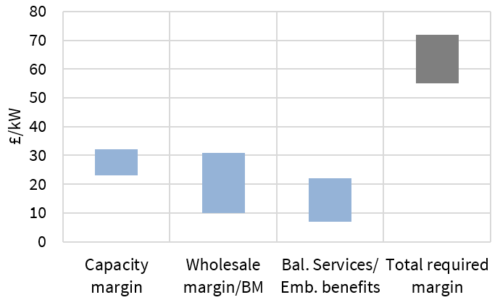
Margin breakdown of new CCGTs

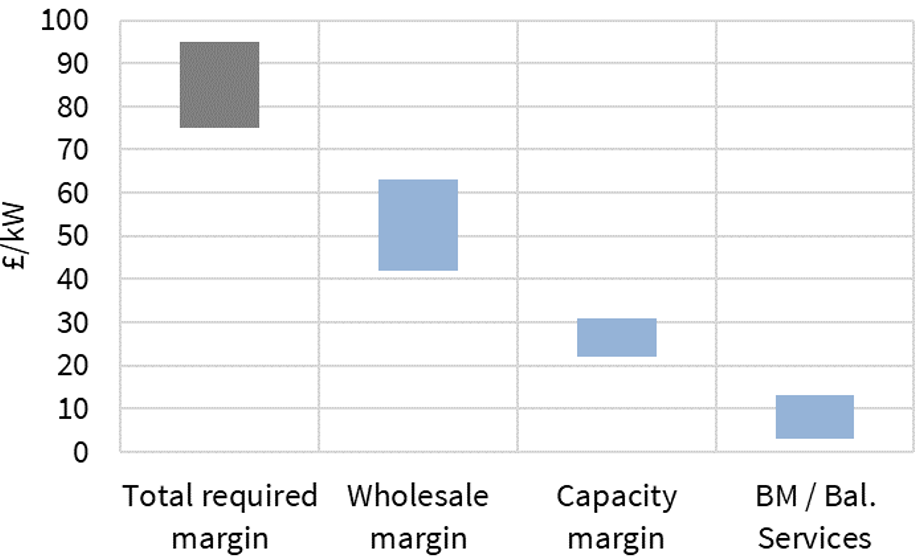
Chart 1 illustrates margin ranges for a generic new UK CCGT. The left hand column represents total asset margin required to earn a reasonable return on capital (i.e. a higher single digit unlevered IRR).

In the other chart columns we have broken margin components into three key buckets:

  1. Wholesale energy margin: Driven by margin capture in the wholesale energy market, a function of the evolution of clean spark spreads.
  2. Capacity margin: Driven by the evolution of pricing in the UK capacity market, adjusted for CCGT derating factors.
  3. BM & balancing services: Additional margin from bidding units into the Balancing Mechanism (BM) and providing other balancing/ancillary services.

Chart 1: Generic UK CCGT (@56% HHV) margin ranges

Source: Timera Energy

Wholesale margins

CCGT economics are underpinned by wholesale market margins. High unit efficiencies mean new CCGTs have a significant merit order dispatch advantage over existing coal & CCGT units, as well as gas peakers. This translates into higher load factors and the ability to earn margin rents when higher variable cost thermal units are setting wholesale market prices. This is weighed against a capex cost tradeoff, with new CCGT capex costs in the order of 550 £/kW (vs gas peaker capex of 350-400 £/kW).

The latest CCGTs (H-frame technology) are around 56% efficient (HHV). These units have a 3-10% efficiency advantage over existing CCGTs. Compare for example a 56% efficient new plant with a 52% efficient CCGT from the last wave of build in the late 2000s. The 4% efficiency advantage translates into an approximately 3 £/MWh increase in baseload clean spark spread.

The efficiency advantage of new CCGTs over OCGTs and reciprocating engines widens to 15%+. This translates into a ~15 £/MWh lower variable dispatch cost versus gas peakers.

The challenge in projecting CCGT wholesale market returns is understanding how margin and load factors erode over time. In other words, how a new CCGT asset transitions from relatively high load factors in the early 2020s to an increasing dependency on price shape and volatility by the 2030s.

The pace and scale of this transition depends strongly on evolution of the UK capacity mix and associated implications for pricing dynamics. A robust logic around capital cost recovery in the first 10 years of asset life is critical.

Capacity margin

Capacity margin is key from a financing perspective. A 15 year capacity agreement with a fixed price (indexed to inflation) acts to reduce margin risk. This is important downside protection for project equity. And it also impacts the ability of developers to raise debt financing (typically tested via a debt service coverage ratio against a downside scenario).

A significant part of the reason new CCGTs have not featured in the UK capacity market to date is capacity prices near 20 £/kW (around the level of CCGT fixed costs). Prices of 30 £/kW or higher are likely to be required to support significant volumes of new CCGT capacity development.

BM & balancing services

Margin from balancing and ancillary revenues can be a key component of peaking asset economics. But they are more like ‘icing on the cake’ for new CCGTs, at least in the first years of asset life. This is because relatively high load factor operation in the wholesale market typically constrains other revenue opportunities.

Despite the improved flexibility of new CCGTs, BM margins are typically limited to more opportunistic bidding by wholesale market operations e.g. bidding to ramp down volumes in the BM or pricing up smaller incremental volumes of additional output. Ancillary services can provide useful margin uplift, but tend to be strongly locationally dependent (e.g. higher in South West vs Northern UK).

Understanding competition, decarbonisation and downside risks

One of the biggest challenges facing a new CCGT developer is quantifying the risk/return impact of a range of credible threats. This is particularly key given the risks associated with a 20 year asset lifetime (+ 3-4 year development lead time) in a decarbonising world that is seeing rapid technology & cost innovation.

Some examples of important threats:

  • Cheaper capacity from alternative sources (e.g. peakers, batteries, life extensions of existing CCGTs)
  • Rapid deployment of offshore wind capacity, displacing thermal plants
  • Substantial build of other new CCGTs, eroding load factors & margins
  • Disruptive technology developments e.g. wide scale deployment of load-shifting batteries or technology induced changes in consumer behaviour.

Some CCGT value drivers can be complex and counterintuitive. For example:

  • The ramp up of electric vehicles may erode peak price shape, but also result in significantly higher system electricity demand, providing some support for load factors of more efficient CCGTs.
  • High volumes of gas peaker and short duration battery deployment may reduce the number of new CCGTs built, but at the same time increase wholesale margin rents in peak periods for those CCGTs that are developed.

Capital structure and route to market

One of the key factors bringing down the cost of new CCGT projects is the evolution of project capital structure. The traditional tolling contract model (tried by Trafford) is broken. But new sources of equity willing to bear market risk are emerging to underpin asset financing structures. This process is being helped by a strong willingness from turbine manufacturers to try and kick start a new generation of European CCGTs.

Route to market has also historically been a major hurdle for non-utility developers. Monetisation of CCGT value depends on access to sophisticated trading and optimisation expertise at a reasonable cost. The expense of developing this capability in-house has seen a growing ‘route to market’ service offering from established trading desks (e.g. Macquarie, Centrica, Gazprom Marketing & Trading). As services become more standardised, costs are also declining.

Ultimately a successful CCGT investment case is likely to be built around:

  1. A creative capital structure & competitive cost of capital
  2. An ability to quantify a robust breakdown of asset margin, recognising credible threats
  3. A capability to monetise that margin in the wholesale market and BM
  4. One or more specific value enhancing characteristics of the project

Specific project value sources are likely to be the difference between project FID and shelving. Capacity prices are unlikely to support substantial volumes of ‘generic’ CCGT projects. Instead successful projects need some competitive edge e.g. locational benefits, existing infrastructure, CHP revenue streams or short haul gas tariff benefits.

The UK government has tried to distance itself from picking winners. But it has created a policy and competitive landscape that has moved in favour of new CCGTs, despite the questionable logic of this given its emissions reduction goals. This may see several GW of new capacity developed by the mid 2020s. But the CCGT investment window is likely to be limited given the combined forces of decarbonisation and flexible technology innovation.


Barometers for LNG market tightness

There seems to be an increasingly polarised debate about the state of LNG market balance.  This debate turns around use of the term ‘glut’.

In the red corner are the ‘supply glut’ crowd. Their view is that committed supply will outstrip demand for at least the next 5 years and that there is plenty of cheap gas beyond (e.g. from the US, Qatar & Russia) that should keep global gas prices subdued well into the 2020s.

In the blue corner are the ‘no glut’ crowd.  Their view is that robust Asian demand growth will absorb new supply, with gas prices set to rise imminently, in response to a requirement for new liquefaction in the next 3 or 4 years.

With any observed decline in spot LNG prices, plenty of noise can be heard from the red corner about the building glut.  On the other hand, any recovery in spot prices is a catalyst for the blue corner to embark on a bout of glut scepticism. It seems to us that there is a more constructive framework via which to track the evolution of the LNG supply & demand balance.

Regardless of market balance demand always equals supply.  What is important about current LNG market dynamics is that two key price responsive mechanisms are facilitating market balancing:

  1. Asian demand response – lower LNG spot prices triggering a pick-up in demand
  2. European power sector switching – gas hub price signals inducing higher CCGT load factors

It is these mechanisms that are worth focusing on rather than glut semantics.  In this context we set out two useful barometers for tracking LNG market balance.

Barometer 1: Asian vs European spot price spread

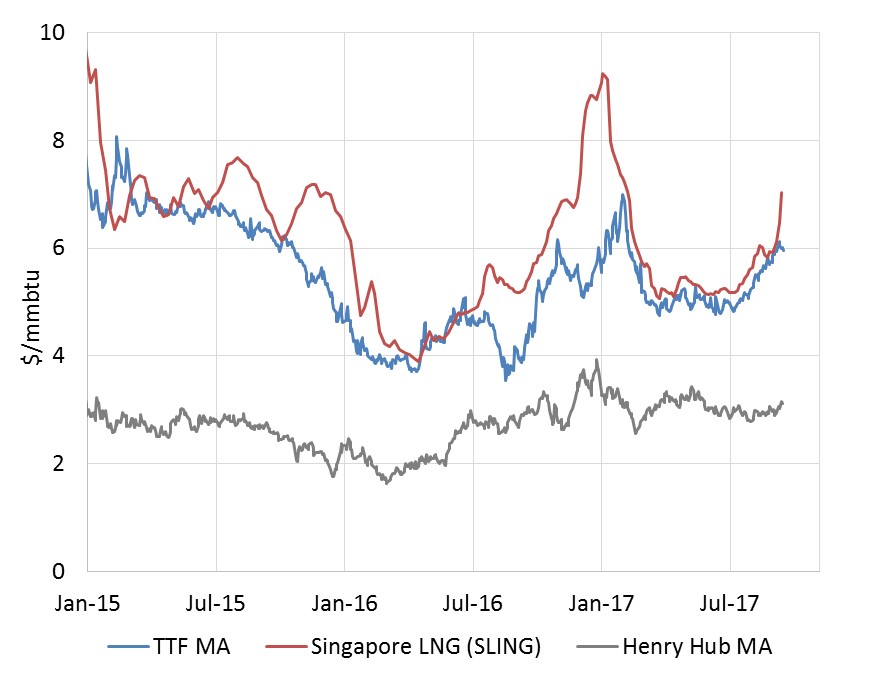
The first thing we watch for guidance on market tightness is the spread between Asian and European spot prices, illustrated in Chart 1.  This spread is a price signal for flexible LNG cargo flow to Asia vs Europe.

Chart 1: Spread between TTF and Singapore spot LNG marker

Source: Timera Energy (SGX for SLING data, ICE for TTF data)

This spread has been structurally converged since new supply started to outpace ‘business as usual’ demand growth back in summer 2014.  Since this time European hubs have been driving global LNG spot pricing given the role of the European gas market as swing provider. The resulting Asian vs European spread convergence sits within a range of tolerance, typically capped around the 1.50 $/mmbtu transport differential required to pull significant volumes of additional LNG supply from Europe to Asia.

Structural convergence does not preclude periods of temporary price divergence and volatility. The best example of this was the supply outage and cold weather driven events of Dec 16 – Jan 17 we described previously. This month Asian spot prices have again perked up, helped by pre-winter buying and hurricane damage at Sabine Pass, with the JKM spot marker now above 7.50 $/mmbtu in Nov/Dec.

The Asia vs European spot price spread is a better indicator of LNG market balance than absolute gas price levels.  This is because absolute gas price levels are strongly influenced by other commodity prices such as coal and oil.  For example a 20% rally in coal prices since June has been a key factor lifting the gas vs coal switching point in European power markets, in turn pulling up gas hub prices (as we set out in our Angle column last week).

Barometer 2: European LNG import volumes

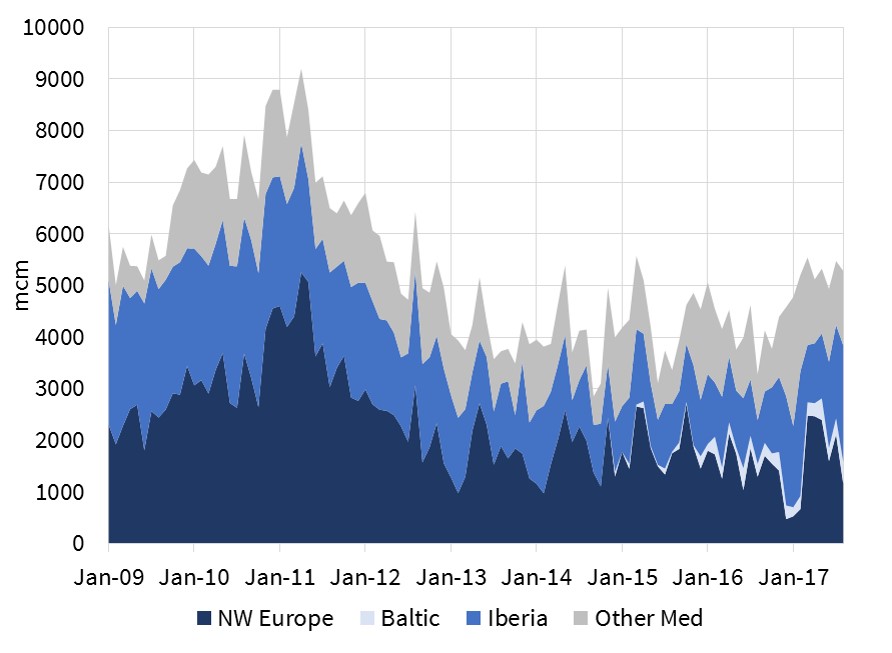
The second indicator we are watching closely is the volume of LNG imports into Europe as shown in Chart 2.

Chart 2: European LNG import volumes by region

Source: Timera Energy

LNG cargoes that are surplus to Asian requirements typically flow to Europe. As a result, European import volumes are a useful indicator of how Asian demand growth is keeping pace with new supply.

European import volumes have been relatively strong over the last 12 months, particularly given robust Russian flows into Europe.  Power sector switching has enabled the European market to absorb this supply, helped by higher coal prices.

But LNG import volumes are yet to define a convincing trend back up toward pre-Fukushima levels.  Two factors have prevented a stronger growth in imports:

  1. Ramp up delays and outage issues with new production capacity (e.g. Gorgon, Sabine Pass)
  2. Robust Asian spot demand at lower prices, particularly from China this year

The LNG market has absorbed approximately 70 bcma (51 mtpa) of the current wave of new supply.  What remains uncertain going forward is whether Asian demand response & delays of new supply will continue to enable Asia to absorb the remaining 130 bcma (96 mtpa) of liquefaction capacity coming to market over the next 3 years.

To the extent that this is not the case then watch for European LNG import levels to rise.  If LNG flows to Europe do start to trend higher then the Asian vs European spot price spread will likely converge in a narrower range.  At that point convergence of the trans-Atlantic spread between NBP/TTF and Henry Hub also comes into focus as an important third barometer.


Power price analysis: focus on what matters

We apply three simple rules when we analyse power prices:

  1. Confront the reality that the price forecast is going to be wrong
  2. Define the key market drivers likely to cause deviations from forecast
  3. Focus analysis on these drivers, rather than trying to capture spurious detail

This logic quickly points to the conclusion that fuel price assumptions are the primary driver of power price evolution. Taking the logic a step further, it makes sense to focus on the fuel price of the generation technology that dominates marginal price setting.

In the UK and Italy that is gas. In Germany it is coal. In markets such as France and Belgium it is a combination of the two.

There are of course other important drivers of power prices e.g. demand, capacity mix and cross border flows. But the impact of inputs such as half hourly wind profiles in 2032 are dwarfed by a 10% change in gas price assumption.

A UK power market case study

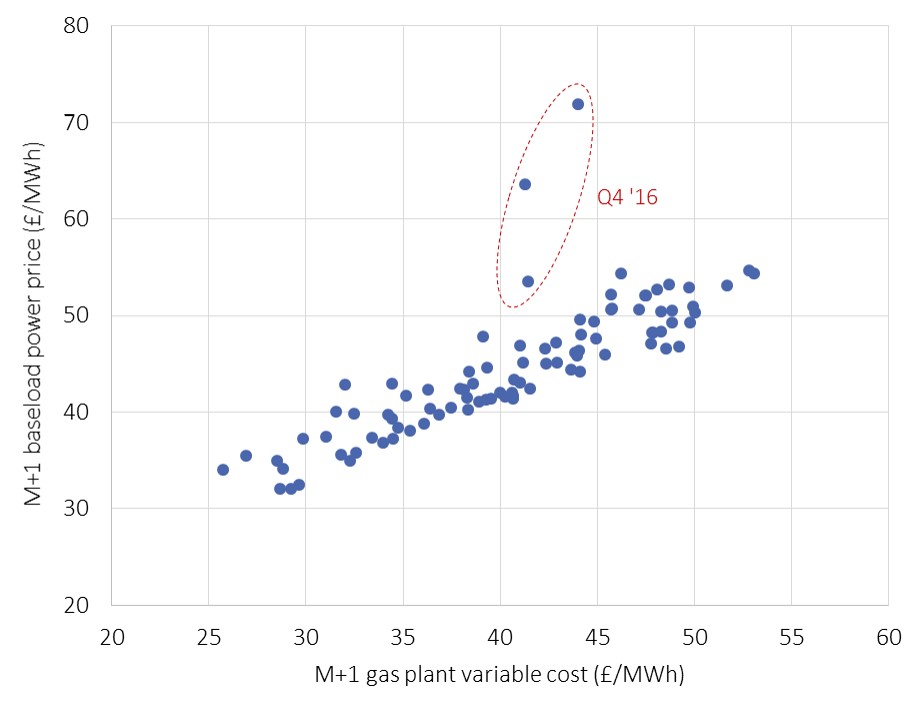
Let’s illustrate the importance of fuel prices using a practical case study from the UK power market. Chart 1 shows the monthly relationship between 2010 and 2017 of:

  1. UK month-ahead baselaod power prices (vertical axis)
  2. The fuel & carbon related variable costs of a CCGT asset @49% HHV efficiency (horizontal axis)

Chart 1: UK gas vs power price relationship

Source: Timera Energy

The strength of this relationship is pretty clear evidence of the fact that gas prices drive UK power prices. The carbon price is a second order driver, given it is a significantly smaller component of variable cost and carbon prices are currently relatively stable.

The deviations of power prices away from CCGT variable cost are predominantly explained by:

  1. Periods of CCGT margin rents (e.g. influence of coal units and start cost recovery in peak periods)
  2. System variable costs (e.g. Balancing Services Use of System (BSUoS) and flow based gas commodity costs)

It is only during periods of extreme market shocks that power prices materially diverge from CCGT variable costs e.g. during the French nuclear capacity closures in Q4 2016.Looking forward, the increasing penetration of renewables acts to erode the spark spread margin between CCGT variable cost and power prices. But gas prices are likely to remain a dominant driver of power prices well into the 2030s, given the influence of existing gas-fired capacity.

Fuel prices should be part of the analysis

We continue to be surprised how many power price forecasters avoid any detailed analysis of underlying fuel markets. Instead it is common to assume fuel curves are an exogenous input. In other words fuel prices only receive cursory consideration as assumptions, before the focus of modelling shifts to details of the supply stack.

What are your assumptions on Henry Hub gas price level, trans-Atlantic spread, Russian gas market share, Asian LNG demand and the cost structure of new LNG supply?  Different combinations of these gas market drivers determine whether European hub prices will be at 4 or 9 $/mmbtu (both numbers are quite plausible over a 10 year horizon).  In UK power market terms these gas price levels are broadly equivalent to power prices at 35 £/MWh or 65 £/MWh (an 85% range).

Fuel curves should be endogenous. In other words fuel price analysis should be just as much part of power market analysis as detailed stack modelling.

An even more dubious practice which is also common place is ‘borrowing’ public forecasts for commodity prices (e.g. from the IEA, EIA or other analysts). Or alternatively taking an average of multiple public sources to create a scenario soup.

Borrowing fuel prices may be convenient, but it ignores the fact that the assumptions behind these borrowed forecasts are almost certainly inconsistent with assumptions used for the rest of the power market scenario.

A robust understanding of power price evolution is built on an analysis of the fuel of the marginal price setting generators. Avoiding fuel market analysis is ignoring the crux of the problem. Outsourcing fuel curve assumptions is only a step away from outsourcing the power price forecast.

How Russia can balance the global gas market

After the wild ride of 2014-16, a consensus is re-emerging as to the way forward for the LNG market. Across industry conferences, capital market presentations, analyst reports and bar stool discussions, you are likely to have heard a version of the following logic:

  1. Oversupply: There is a temporary oversupply due to committed global LNG liquefaction capacity, with 145 mtpa (200 bcma) coming online between 2015-2021.
  2. Demand growth: That oversupply will be eroded by LNG demand growth, particularly from emerging Asian buyers (e.g. China & India).
  3. Re-balance: Demand growth is likely absorb oversupply at some stage over the next 3-5 years, depending on the rate of Asian growth.
  4. New supply: At this stage, in the early to mid 2020s, new LNG liquefaction capacity will be required onstream to prevent a shortfall in the global gas market.

We agree with steps 1 to 3. But step 4 oversimplifies the dynamics around a requirement for new LNG supply. Why? In a word, Russia.

Russia can delay new LNG supply

By 2021 the global gas market will have 67 mtpa (90 bcma) of destination flexible, spot price responsive US LNG export capacity. This comes on top of substantial existing diversion flexibility in European LNG supply contracts (e.g. as was exercised to balance the global market across the 2011-13 post Fukushima period).

In this environment, it is difficult to define a credible scenario where Asian and European spot LNG prices diverge on a structural basis. There will be periods of short term price volatility, given delays in supply chain response time to spot price signals (e.g. 2 to 6 weeks). But any structural price divergence can be arbitraged by flexible supply.

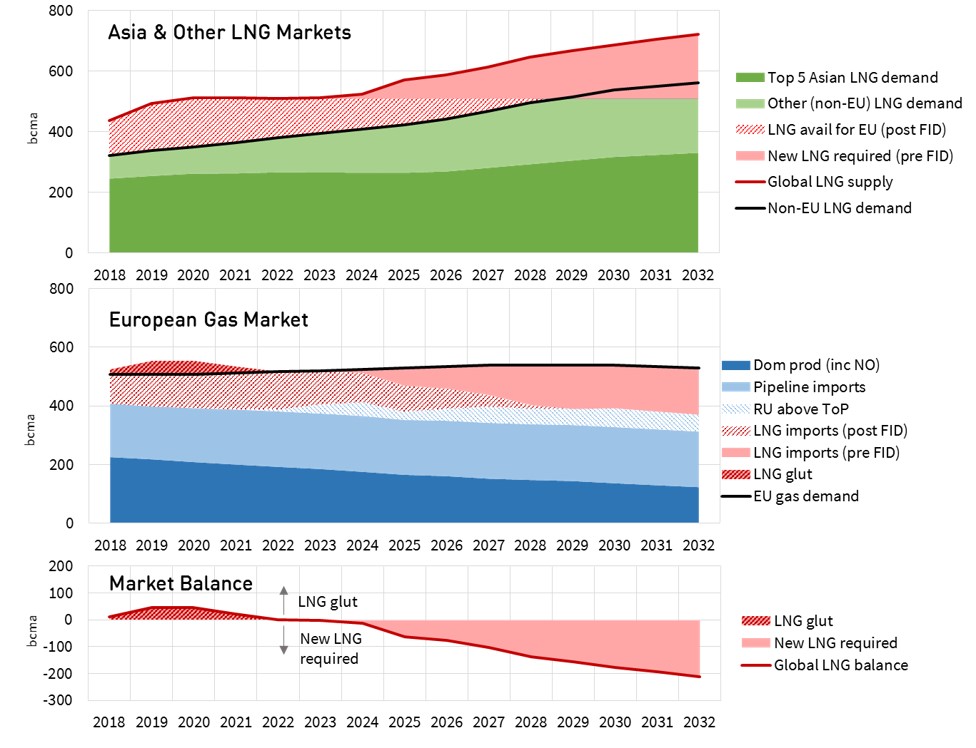
In this new world, Russia can balance the Asian LNG market by increasing exports of pipeline gas to Europe and displacing flexible LNG supply. This puts Russia in a powerful position as the global market rebalances. We illustrate global rebalancing dynamics with a scenario of global supply and demand balance evolution in Chart 1.

Chart 1: Illustrative scenario of LNG and European gas market evolution to 2030

Source: Timera Energy

The chart shows liquid European hubs playing a key role in absorbing the temporary oversupply of LNG (primarily via gas for coal switching in the power sector). The bottom panel illustrates the global LNG market balance. Under the scenario shown (which assumes a lower Asian demand growth trajectory), oversupply is absorbed by 2022. But significant new volumes of LNG liquefaction capacity are not required until 2024.

The reason for this hiatus is Russia’s ability to flow up to 100+ bcma of existing ‘shut in’ gas production capacity (73+ mtpa equivalent).

Dynamics around shut in Russian gas

This shut in production capacity is located in West Siberian gas fields developed by Gazprom late last decade in anticipation of higher European demand growth. Loss of Russian domestic market share from Gazprom to other Russian ‘independents’ (mainly Rosneft, Lukoil and Novatek) has also contributed to the volume of shut in gas.

Gazprom has historically chosen not to flow this gas at price levels below existing long term oil-indexed contract prices. To do so would have acted as a catalyst for hub versus contract price divergence and development of hub liquidity, both of which Gazprom has considered to be against its strategic interests.

However over the last 12-18 months Russia has made a notable shift towards pursuing market share and adopting a more flexible stance on spot price indexation (e.g. via allowing TTF price corridor structures in a number of its long term supply contracts).

This may mean Gazprom defends a higher European market share (e.g. 160-170 bcma) than it has historically targeted (~150 bcma). But it still appears to be against Gazprom’s interests to push large volumes of new gas into Europe prior to global re-balancing. This would only induce a ‘bloody’ short run marginal cost driven price war e.g. by attempting to shut in US export capacity at sub 4.00 $/mmbtu European hub prices.

Instead, this surplus of ‘shut in’ gas puts Russia in a strong pricing position once the current LNG oversupply is absorbed. As long as Gazprom sells this gas into Europe at a sufficient discount to new gas supply project LRMC, it can delay marginal new LNG supply (e.g. in the form of ‘second wave’ US export projects).

Russian disruption is important but only temporary

This ability to delay new liquefaction projects is only a temporary situation. The extent to which Russia can exercise its power depends on the rate of global demand growth. It also depends on the volume of new LNG liquefaction capacity that is committed (i.e. progresses past FID) over the next 5 years. Once new liquefaction capacity is committed, Russia needs to compete with it on an SRMC rather than an LRMC basis (given sunk costs).

For these reasons it is unlikely that Gazprom manages to export the full 100 bcma of incremental production capacity to Europe. Russian influence is likely to be limited to a 3 or 4 year period. This may only be 1 or 2 years if you assume robust global demand growth and early FIDs of new liquefaction capacity.

But a production volume this large definitely has the potential to disrupt a smooth transition from oversupply to deficit in the LNG market (implied in step 4. of the logic in the first paragraph). And the threat of this disruption impacts FID decisions on new LNG projects today.

Beyond this temporary influence of Russia, the LRMC of new LNG supply is set to reassert its influence on global gas pricing.  But the capital structure and business model for delivering the next wave of new liquefaction capacity is likely to look very different to the current wave of supply. We will come back to explore this dynamic in more detail shortly.

Investment in flexibility: gas peakers

A major transformation is underway in European power markets. Ageing coal, gas and nuclear plants are retiring and being replaced to a significant extent by renewable capacity. Loss of existing flexible plants and the inherent intermittency of wind and solar output is driving a requirement for substantial investment in new flexibility.

Interconnector investment and transmission upgrades can play a role in facilitating the more efficient integration of existing system flexibility. Batteries are emerging as a key provider of balancing services, although not yet load-shifting (as we set out last week). There is also a technology driven push towards more demand side flexibility. But there remains a key system requirement for flexible thermal generation capacity.

Investment in flexible thermal capacity over the last 3 decades has been dominated by large grid connected CCGTs. But investment in distribution connected peakers has surged over the last 3 years, particularly as a source of new capacity in the UK power market (with 3.5GW successful in UK capacity auctions to date).

Peaker investment is now focused on gas-fired technologies, particularly distribution connected reciprocating engines. These units represent a relatively cheap source of low load factor flexibility. However there are a number of different types of technology in play and an important trade-off between cost & efficiency.

Gas engines have a capital cost advantage over CCGTs (400-450 $/kW vs 650-700 $/kW). Fixed costs of CCGTs (around 25 $/kW) can be more than 50% higher than those of gas engines. Engines are significantly more flexible than CCGTs and have lower start costs. Peaker economic lives are also shorter than for CCGTs (e.g. 15 vs 25 years) which reduces the risk of assets becoming uneconomic or stranded in later life.

In today’s article we look at investment in UK gas engines as a case study of project economics and challenges.

Margin breakdown

There are two main reasons why the UK has so far led European peaker investment. Firstly the UK faces a serious deficit of flexible capacity as older coal and gas plants retire. And secondly the policy environment is relatively favourable in defining clear sources of ‘stackable’ peaker margin.

Margin can be broken down into 4 streams:

  1. Capacity margin: Driven by the evolution of pricing in the UK capacity market.
  2. Energy margin: Driven by margin capture in the wholesale energy market & balancing mechanism (BM), a function of the evolution of spark spreads, peak pricing dynamics, volatility & imbalance volumes.
  3. Balancing services: Focused on revenue from the Short Term Operating Reserve (STOR) market, with peaker revenue potential from other ancillary services limited by alternative sources of rapid flex (e.g. batteries & pump hydro dominating frequency response services).
  4. Embedded benefits: Available to distribution connected peakers, with revenue predominantly driven by helping suppliers avoid demand charges (e.g. triad benefits), but taking a bit hit from the recent Ofgem decision to scale back embedded benefits.

The challenge in quantifying risk & return across these margin streams is that they are neither mutually exclusive or independent. Margin can be ‘stacked’ across streams, but there is a strong co-dependence of returns. For example a peaker cannot provide committed STOR services at the same time it is operating in the wholesale market.

This means that the returns across margin streams depend strongly on the monetisation strategy of the peaker operator. Chart 1 gives some guidance on approximate ranges of:

  1. Margin by stream (note margin potential depends on monetisation strategy and margin streams are not simply additive given codependence).
  2. Total margin required to earn a low to mid double digit IRR (note this in part depends on capex variance across different gas engine technologies).

Chart 1: UK gas reciprocating engine margin ranges

Source: Timera Energy

Capacity margin is the foundation of peaker investment. Uncertainty around this margin stream is reduced by 15 year capacity agreements with a fixed price (indexed to inflation). Peaker developers require the capacity price to clear above a certain level to support the project (e.g. in the 25-35 £/kW range). But once this is achieved this margin stream is relatively secure and can be used to support debt financing.

The interaction between wholesale margin/BM and STOR/embedded benefits margin streams is much more challenging. Realistic quantification of margin capture in the wholesale market is the critical component of peaker economics. This requires robust probabilistic analysis of asset value capture from power price shape and volatility.

In quantifying these margin streams, an optimisation approach must be adopted that is consistent with the way a trading desk actually manages peaking units in practice.  Analysis of wholesale margin also depends on realistic assumptions about how peaking units can be optimised across codependent margin streams e.g. STOR, triads, wholesale energy & BM.

Revenue stacking is not magic.  In a post triad world it is tough to build a realistic margin case for gas engines that yields healthy double digit returns. The definition of realistic margin numbers has to be founded on a pragmatic analysis of how wholesale and BM margin can be captured in practice as the UK market evolves.

Business model & route to market

In building a viable investment case, there are a number of challenges a peaker developer faces. Securing advantaged sites. Sourcing competitively priced units. Access to financing. Site management. Unit operation and maintenance. Regulatory risk around revenue streams. But the toughest challenge is margin stream optimisation and market access.

Margin streams for flexible generation units have traditionally been optimised by the established trading desks of large utilities. Here, the significant overheads of operating a sophisticated trading desk and risk management function are spread across a large generation fleet.

Peaker developers can choose to outsource margin optimisation to an established trading desk. But this typically involves taking a significant margin haircut as well as giving away margin upside (via profit sharing). This can result in a major hit to project economics.

This has driven the more established peaker developers to develop in-house commercial capabilities to optimise margin across co-dependent streams. While an in-house capability sounds sensible in principle, it is challenging for a relatively small peaker developer to match the scale and sophistication of a large trading desk.

Good traders need practical experience and this means attracting them away from well paid jobs on established trading desks. Robust trading and risk management systems are expensive and typically require portfolio scale to support implementation. There are also a number of commercial and risk governance issues that require experienced headcount and processes. These functions are not the traditional domain of smaller scale asset developers.

Competition & scalability

Beyond the economics of an individual project, peaker developers face an important question of scalability. The UK market needs investment in new flexible capacity, particularly as coal and nuclear plants retire over the next decade. But peakers face competition from:

  1. New CCGTs: relative project economics have improved significantly over the last 12-18 months, as has access to capital. Watch out for new CCGTs if capacity prices start clearing above 30 £/kW.
  2. Existing CCGTs: The capacity market is also supporting life extensions of existing CCGTs e.g. via bypassing steam turbines and running GTs (as a number of owners have already done).
  3. Interconnectors: More than 4GW is already under construction with a pipeline of 8GW+ behind.
  4. Batteries: Currently have specific frequency response applications but may be deployed more broadly from the later 2020s (see last week’s article).
  5. DSR: Over time, technology driven innovation is set to increasingly boost demand side flexibility.

The growth potential of peaking units is a function of how these sources will compete in combination with renewable rollout, to drive the evolution of the UK capacity mix. Peakers are set to play an important role, but not necessarily a dominant role.


Investment in flexibility: battery storage

Electricity flexibility investment

We are starting the second half of 2017 with a mini-series on investment in electricity system flexibility.  Today’s article looks at investment in grid scale battery storage.  We then return next week to contrast this with the investment economics of gas-fired peaking generators.  We will come back to investment in alternative sources of flexibility (e.g. CCGTs, interconnectors and DSR/distributed flex) as the year progresses.

Flexibility remains a central challenge in a decarbonising and decentralising energy system. Substantial cost reductions in wind and solar capacity are underpinning a robust pipeline of renewable capacity development across Europe. But this requires major investment in flexibility to facilitate swings from intermittent output.

Until recently, consensus was that this flexibility was going to be dominated by gas-fired generators and improvements in interconnection.  But rapid costs declines and deployment of battery storage is challenging this view.

The UK power market is leading European investment in the deployment of both battery storage and gas peaking assets. This is being driven by a tight UK reserve margin and a relatively supportive regulatory framework for investment in new flexible capacity.  So as we look at investment in batteries vs peakers, we use the UK market as a case study to illustrate the practical challenges facing asset investors.

Batteries: state of play

There is a dazzling array of potential battery storage applications.  But to date, the practical focus for commercial deployment has been investment in lithium-ion batteries to provide system services.

Growth in lithium-ion battery deployment is being driven by very rapid cost reductions. Only 2-3 years ago battery costs were in excess of 1000 $/kWh.  Tesla made headlines this year with a 250 $/kWh ‘pack level’ cost for 129 MWh battery system it is deploying in South Australia (the world’s largest to date).  This headline grabbing price tag excludes some important cost components.  But even accounting for these, grid scale battery costs may decline to under 200 $/kWh by the early 2020s.

The batteries currently being rolled out can provide very fast (sub-second) output response, but only over a short duration (e.g. 1 hour).  This means that they are well suited to servicing an increasing intermittency driven requirement for rapid frequency response services. Batteries can also be used to defer the costs of investment in grid upgrades. But short duration batteries are not designed to provide wholesale market arbitrage or ‘load shifting’ services.

That doesn’t mean that ‘load shifting’ batteries for wholesale market application should be written off.  There are already 4-6 hour duration batteries at the development stage. But the cost structure and cycling limitations of long duration batteries means that load shifting is not yet commercial.

The question looks to be when, rather than if, technology will progress to support broader commercial deployment of load shifting batteries (mid/late 2020s?).  But for now we focus on investment in short duration batteries.

UK focus for battery investment

Back in 2014 a 6MW, 10 MWh battery was developed at Leighton Buzzard in the UK. At the time it was the largest battery storage development in Europe.  Development relied heavily on support from the UK Low Carbon Networks Fund.

It was almost inconceivable that two years later, 500MW of batteries would be successful in the Dec 2016 UK capacity auction. A combination of technology cost declines and a constructive regulatory framework has catapulted the UK into global pole position for grid scale battery investment.

The rapid growth potential for batteries in the UK is illustrated by the system operator (National Grid’s) latest Future Energy Scenarios projections.  Grid projects more than 2GW of growth in UK electricity storage capacity over the next 5 years, in all four of its scenarios for capacity mix evolution.  The driving forces: declining battery costs and an increase in system requirement for rapid frequency response services as wind deployment grows.

UK battery investment case study

Commercial deployment of batteries in the UK is attracting a lot of investor attention. In a world of depressed infrastructure yields, battery developers are targeting double digit project returns.  There is also a compelling story around scalability, both within the UK market and in Continental Europe.

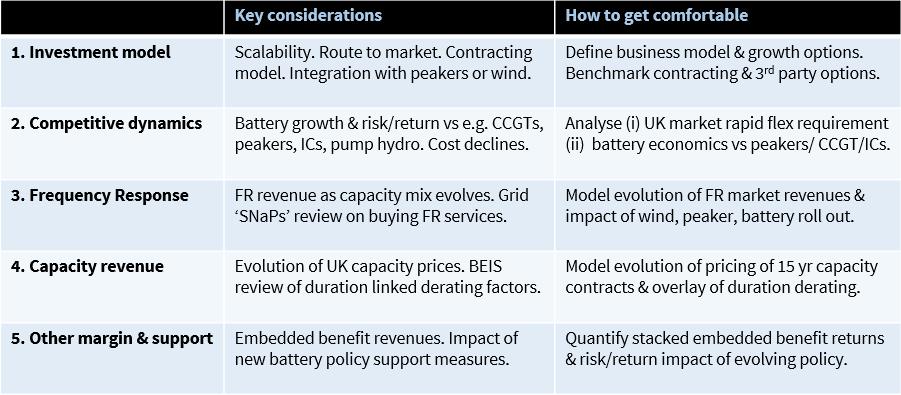
But project yields reflect risks. Battery investment is by no means a one-way bet.  In Table 1 we set out 5 key challenges facing battery investors.

Table 1: Challenges with UK battery investment

Consideration Getting comfortable
1. Investment model Scalability. Route to market. Contracting model. Integration with peakers or wind. Define business model & growth options. Benchmark contracting & 3rd party options.
2. Competitive dynamics Battery growth & risk/return vs e.g. CCGTs, peakers, ICs, pump hydro. Cost declines. Analyse (i) UK market rapid flex requirement (ii)  battery economics vs peakers/ CCGT/ICs.
3. Frequency Response FR revenue as capacity mix evolves. Grid ‘SNaPs’ review on buying FR services. Model evolution of FR market revenues & impact of wind, peaker, battery roll out.
4. Capacity Revenue Evolution of UK capacity prices. BEIS review of duration linked derating factors. Model evolution of pricing of 15 yr capacity contracts & overlay of duration derating.
5. Other margin & support Embedded benefit revenues. Impact of new battery policy support measures. Quantify stacked embedded benefit returns & risk/return impact of evolving policy.

Source: Timera Energy

The first challenge for investors is defining a viable business model to support asset risk/return and growth targets.  Most investors are currently looking at batteries as an integrated play with other assets.  There are revenue management and risk diversification synergies from building a portfolio of batteries and peakers (e.g. gas engines).  There are also potential co-locational benefits of integrating batteries with renewables. In all cases the battery business model relies on a route to market, to manage the interaction between stacked revenues (e.g. across balancing services, embedded benefits, wholesale market).

The policy framework to support batteries is more advanced in the UK than most other power markets.  This is underpinned by relatively well defined revenue streams for frequency response, capacity payments and demand charge avoidance.  But UK electricity storage policy is still evolving rapidly, causing inherent investment risks, for example:

  1. Frequency Response: Grid launched a comprehensive System Needs and Product Strategy (SNaPS) review of the way it procures balancing services in Jun 2016. This will likely result substantial changes to frequency response service procurement (e.g. replacement/aggregation of Firm Frequency Response and Enhanced Frequency Response services).
  2. Capacity Market: BEIS (UK Department for Business, Energy and Industrial Strategy) launched a consultation in Jul 2017, indicating its intention to scale battery capacity payments based on discharge duration. This may significantly reduce revenues under 15 year capacity agreements, particularly for the more cost effective short duration batteries.
  3. Broader policy support: BEIS also provided broad guidance in Jul 2017 of its intention to improve policy measures to support investment in battery technology. This includes cutting ‘double charging’ for system usage, facilitating colocation with renewables and smoothing the connections process, the investment impact of which depends on details yet to be announced.

Ultimately battery investment comes down to numbers.  Quantifying battery project risk/return involves a ‘revenue stacking’ problem.  In other words revenue is aggregated across co-dependent revenue streams.  In the UK there are three key components that make up battery returns (listed in order of importance):

  1. Frequency Response: The UK rapid FR market has historically been dominated by the 2GW First Hydro pump storage assets. This market currently presents a lucrative source of returns for batteries which can provide even faster response than pump hydro.  But the supply & demand dynamics in the FR market are complex and depend on the pace of roll out of batteries vs wind.  Returns are likely to be volatile and there is a risk that battery rollout outpaces system requirements, driving down FR returns.  The policy implications of the SNaPS review are also key.
  2. Capacity Payments: 15 year fixed price capacity agreements were very attractive in the 2016 capacity auction given battery storage derating factors of 96%. However the majority of successful batteries fall into the 0.5-1.5 hour duration categories that are most at risk from BEIS policy changes.  This impact may be partly offset however by rising capacity prices given negative policy impacts on peaker economics (e.g. reduction of the triad benefit).
  3. Other margin: Batteries can access a range of embedded benefits, focused on avoidance of demand side charges. But revenues depend on location and the key triad benefit is set to decline steeply by 2020. Batteries can also have specific opportunities from operation in the wholesale market, although this depends on duration and cycling costs.

Investors are running the numbers as developers raise capital for both existing and planned battery projects. The next UK capacity auction in Feb 2018 will be a key test for batteries under a rapidly evolving policy landscape. And while the UK may have a head start on battery deployment in Europe, other markets are rapidly catching up, particularly Germany.